Breaking Bipartite and Time Reversal Symmetries by Fusing Porphine Unit in-between two Zigzag-edge Graphene Nanoribbons
Pith reviewed 2026-06-29 06:55 UTC · model grok-4.3
The pith
Fusing a porphine ring between two zigzag graphene nanoribbons breaks bipartite symmetry and produces nearly degenerate antiferromagnetic semiconducting and ferromagnetic conducting states.
A machine-rendered reading of the paper's core claim, the machinery that carries it, and where it could break.
Core claim
The hybrid structure of two zigzag-edge graphene nanoribbons with a fused porphine ring in between results in two distinct nearly degenerate ground states: a semiconducting antiferromagnetic state and a conducting ferromagnetic state with unequal and opposite Fermi velocities of majority and minority spins, the former having slightly higher stability. Such ground states result from the broken bipartite symmetry induced by the porphine ring. The incorporation of different transition metal atoms in the porphine cavity reduces their energy difference but keeps their electronic properties mostly unchanged. The splitting of the d-orbitals in the distorted square-planar ligand field of porphine pr
What carries the argument
The fused porphine ring placed between two zigzag-edge graphene nanoribbons, which induces the breaking of bipartite symmetry in the nanoribbon lattice.
If this is right
- The antiferromagnetic state remains semiconducting while the ferromagnetic state remains conducting.
- The ferromagnetic state supports spin-dependent transport due to opposite Fermi velocities for the two spin species.
- Transition-metal substitution in the porphine reduces the energy difference between the two states without altering the overall electronic character.
- The majority-spin channel in the ferromagnetic state shows reduced sensitivity to edge disorder.
- The structures are positioned as candidates for dual spin-filtering applications.
Where Pith is reading between the lines
- Analogous fusions of other macrocyclic units into nanoribbon lattices could produce comparable symmetry-breaking effects in related one-dimensional systems.
- Edge-disorder robustness of the majority channel suggests that device performance may remain stable under realistic fabrication imperfections.
- The combination of broken time-reversal symmetry and opposite velocities opens the possibility of intrinsic spin-polarized currents without applied magnetic fields.
- Scanning-probe measurements of local density of states could directly map the spatial separation of the two nearly degenerate states along the hybrid chain.
Load-bearing premise
The porphine ring breaks the bipartite symmetry of the zigzag-edge graphene nanoribbons in a manner that produces the described antiferromagnetic and ferromagnetic ground states as the dominant outcomes of the electronic structure calculation.
What would settle it
An electronic structure calculation or transport measurement that finds the two states are not nearly degenerate, or that the Fermi velocities of the two spin channels are not opposite and unequal, would falsify the central claim.
Figures
read the original abstract
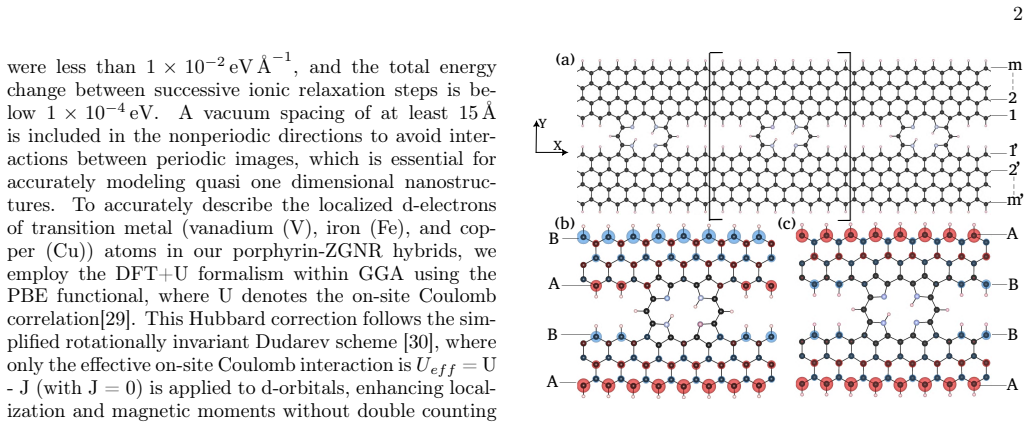
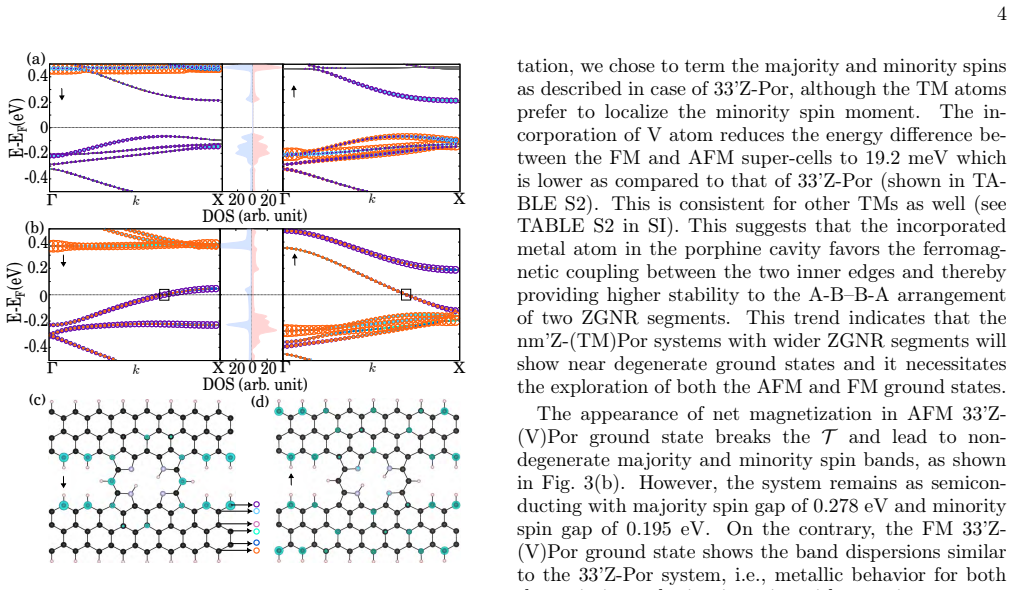
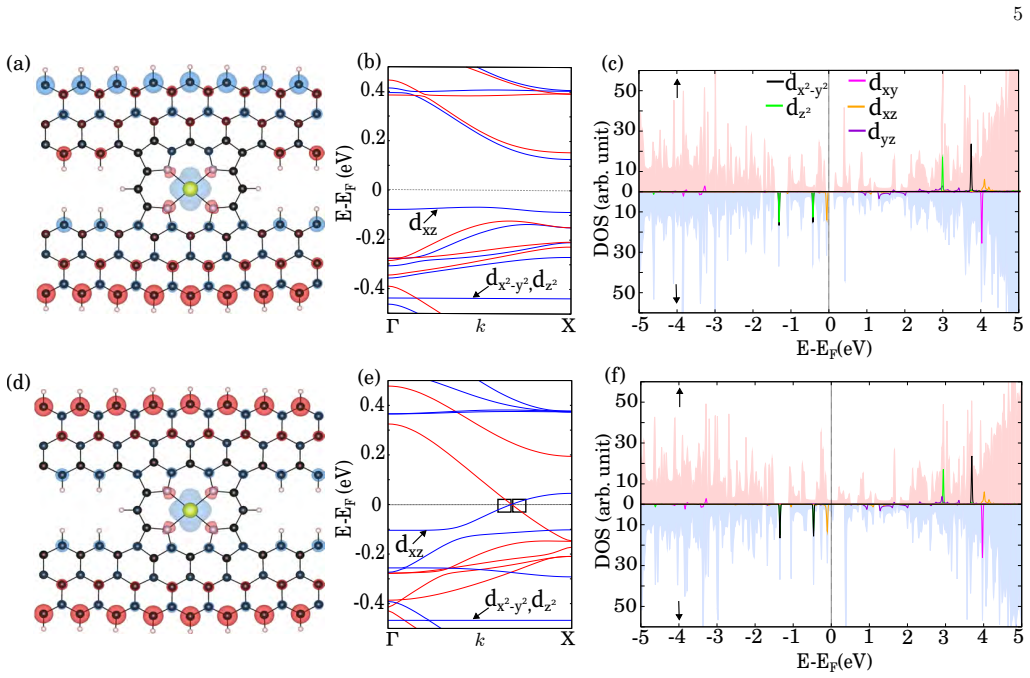
Hybrid structure of two zigzag-edge graphene nanoribbons with a fused porphine ring in between, results in two distinct nearly degenerate ground states: a semiconducting antiferromagnetic state and a conducting ferromagnetic state with unequal and opposite Fermi velocities of majority and minority spins, the former having slightly higher stability. Such ground states result from the broken bipartite symmetry induced by the porphine ring. The incorporation of different transition metal atoms in the porphine cavity reduces their energy difference but keeps their electronic properties mostly unchanged. The splitting of the $d$-orbitals in the distorted square-planar ligand field of porphine produces a high spin ground state that breaks the global time reversal symmetry ($\mathcal{T}$). The opposite Fermi velocities of the majority and minority spins in the ferromagnetic ground state and lower sensitivity of the conducting majority spin channel to the edge disorder, make this class of quasi-one-dimensional hybrid structures promising for dual spin-filtering device applications.
Editorial analysis
A structured set of objections, weighed in public.
Referee Report
Summary. The manuscript examines a hybrid quasi-1D structure in which a porphine ring is fused between two zigzag-edge graphene nanoribbons. It reports that the fusion breaks bipartite (A/B sublattice) symmetry and produces two nearly degenerate ground states: a semiconducting antiferromagnetic state that is slightly lower in energy and a conducting ferromagnetic state whose majority- and minority-spin bands exhibit unequal and opposite Fermi velocities. Insertion of transition-metal atoms into the porphine cavity is stated to reduce the energy difference while leaving the electronic character largely unchanged; d-orbital splitting in the distorted ligand field is said to break global time-reversal symmetry. The opposite Fermi velocities and relative robustness of the majority-spin channel to edge disorder are highlighted as enabling dual spin-filtering applications.
Significance. If the reported electronic-structure results prove robust, the work would identify a concrete route to engineer nearly degenerate magnetic states with spin-dependent transport asymmetries in a single molecular-scale junction. The combination of broken bipartite and time-reversal symmetries together with the claimed disorder tolerance of one spin channel would be of direct interest to the design of spintronic elements.
major comments (2)
- [Abstract] Abstract (and presumably the opening of §2 or §3): the central claim that the porphine fusion produces a semiconducting AF ground state only slightly lower in energy than a metallic FM state with unequal, opposite Fermi velocities is presented without any description of the Hamiltonian (DFT functional, Hubbard U, or tight-binding parameters), basis-set or k-point convergence, or the numerical value of the energy difference. Because these quantities are load-bearing for the symmetry-breaking argument, their absence prevents verification that the reported states follow from the geometry rather than from an unstated model choice.
- [Abstract] Abstract: the statement that the porphine ring breaks bipartite symmetry is asserted without a quantitative measure (e.g., sublattice population imbalance or explicit A/B site counting) or a comparison to the pristine ZGNR reference. Without this metric it is impossible to judge whether the claimed AF/FM degeneracy is a direct, parameter-free consequence of the fusion or an outcome of the particular computational setup.
Simulated Author's Rebuttal
We thank the referee for the careful review and constructive comments. We address the major comments point by point below.
read point-by-point responses
-
Referee: [Abstract] Abstract (and presumably the opening of §2 or §3): the central claim that the porphine fusion produces a semiconducting AF ground state only slightly lower in energy than a metallic FM state with unequal, opposite Fermi velocities is presented without any description of the Hamiltonian (DFT functional, Hubbard U, or tight-binding parameters), basis-set or k-point convergence, or the numerical value of the energy difference. Because these quantities are load-bearing for the symmetry-breaking argument, their absence prevents verification that the reported states follow from the geometry rather than from an unstated model choice.
Authors: We agree that the abstract should be self-contained with these details. In the revised manuscript we will add a concise description of the DFT functional, any Hubbard U correction, basis set, k-point sampling, and the numerical energy difference between the AF and FM states. revision: yes
-
Referee: [Abstract] Abstract: the statement that the porphine ring breaks bipartite symmetry is asserted without a quantitative measure (e.g., sublattice population imbalance or explicit A/B site counting) or a comparison to the pristine ZGNR reference. Without this metric it is impossible to judge whether the claimed AF/FM degeneracy is a direct, parameter-free consequence of the fusion or an outcome of the particular computational setup.
Authors: We acknowledge the value of a quantitative metric. In the revision we will add an explicit measure of sublattice population imbalance together with a direct comparison to the pristine ZGNR to demonstrate that the symmetry breaking is induced by the porphine fusion. revision: yes
Circularity Check
No significant circularity detected
full rationale
The provided abstract and description present results from electronic-structure modeling of a hybrid nanoribbon-porphine system, attributing observed AF and FM states to structural symmetry breaking. No equations, self-citations, or parameter-fitting steps are quoted that would reduce any claimed prediction to an input by construction. The central claims rest on computational outputs rather than tautological redefinitions or load-bearing self-references, making this a standard non-circular reporting of simulation results.
Axiom & Free-Parameter Ledger
axioms (1)
- domain assumption The porphine ring breaks the bipartite symmetry of the zigzag-edge graphene nanoribbons, producing the described antiferromagnetic and ferromagnetic states.
Reference graph
Works this paper leans on
-
[1]
Enoki and K
T. Enoki and K. Takai, Solid State Commun.149, 1144 (2009)
2009
-
[2]
Enoki, Y
T. Enoki, Y. Kobayashi, and K.-I. Fukui, International Reviews in Physical Chemistry26, 609 (2007)
2007
-
[3]
V. L. J. Joly, M. Kiguchi, S.-J. Hao, K. Takai, T. Enoki, R. Sumii, K. Amemiya, H. Muramatsu, T. Hayashi, Y. A. Kim, M. Endo, J. Campos-Delgado, F. López- Urías, A. Botello-Méndez, H. Terrones, M. Terrones, and M. S. Dresselhaus, Phys. Rev. B81, 245428 (2010)
2010
-
[4]
N. A. Poklonski, E. F. Kislyakov, S. A. Vyrko, O. N. Bubel, and S. V. Ratkevich, J. Nanophotonics6, 061712 (2012)
2012
-
[5]
Asano and J
T. Asano and J. Nakamura, ACS Omega4, 22035 (2019)
2019
-
[6]
Hsieh, V
K. Hsieh, V. Kochat, T. Biswas, C. S. Tiwary, A. Mishra, G. Ramalingam, A. Jayaraman, K. Chattopadhyay, S. Raghavan, M. Jain, and A. Ghosh, Phys. Rev. Lett. 126, 206803 (2021)
2021
-
[7]
Moles, H
P. Moles, H. Santos, F. Domínguez-Adame, and L. Chico, Phys. Rev. Res.7, 033255 (2025)
2025
-
[8]
Jiang, X
P. Jiang, X. Tao, H. Hao, Y. Liu, X. Zheng, and Z. Zeng, npj Quantum Inf.7, 21 (2021)
2021
-
[9]
O. V. Yazyev and M. I. Katsnelson, Phys. Rev. Lett.100, 047209 (2008)
2008
-
[10]
Kumar, V
V. Kumar, V. Kolli, S. Shukla, and S. Saxena, Diamond Relat. Mater.102, 107662 (2020)
2020
-
[11]
Milivojević, J
M. Milivojević, J. Mnich, P. Jureczko, M. Kurpas, and M. Gmitra, Mater. Futures5, 015201 (2026)
2026
-
[12]
Kohda, T
M. Kohda, T. Okayasu, and J. Nitta, Sci. Rep.9, 1909 (2019)
1909
-
[13]
Ozaki, K
T. Ozaki, K. Nishio, H. Weng, and H. Kino, Phys. Rev. B81, 075422 (2010)
2010
-
[14]
Dutta, A
S. Dutta, A. K. Manna, and S. K. Pati, Phys. Rev. Lett. , 096601 (2009)
2009
-
[15]
Dutta and S
S. Dutta and S. K. Pati, J. Phys. Chem. B112, 1333 (2008)
2008
-
[16]
S.DuttaandS.K.Pati,J.Mater.Chem.20,8207(2010)
2010
-
[17]
Kratzer, S
P. Kratzer, S. A. Tawfik, X. Y. Cui, and C. Stampfl, RSC Adv.7, 29112 (2017)
2017
-
[18]
F. Gao, R. E. Menchón, A. Garcia-Lekue, and M. Brand- byge, Commun. Phys.6, 115 (2023)
2023
-
[19]
Y. He, M. Garnica, F. Bischoff, J. Ducke, M.-L. Bocquet, M. Batzill, W. Auwärter, and J. V. Barth, Nat. Chem. 9, 33 (2017)
2017
-
[20]
Deyerling, M
J. Deyerling, M. Pörtner, L. Ðorđević, A. Riss, D. Boni- fazi, and W. Auwärter, J. Phys. Chem. C126, 8467 (2022)
2022
-
[21]
Q. Chen, A. Lodi, H. Zhang, A. Gee, H. I. Wang, F. Kong, M. Clarke, M. Edmondson, J. Hart, J. N. O’Shea, W. Stawski, J. Baugh, A. Narita, A. Saywell, M. Bonn, K. Müllen, L. Bogani, and H. L. Anderson, Nat. Chem.16, 1133 (2024)
2024
-
[22]
L. M. Mateo, Q. Sun, K. Eimre, C. A. Pignedoli, T. Tor- res, R. Fasel, and G. Bottari, Chem. Sci.12, 247 (2021)
2021
-
[23]
Xiang, Y
F. Xiang, Y. Gu, A. Kinikar, N. Bassi, A. Ortega- Guerrero, Z. Qiu, O. Gröning, P. Ruffieux, C. A. Pignedoli, K. Müllen, and R. Fasel, Nat. Chem.17, 1356 (2025). 7
2025
-
[25]
Kresse and D
G. Kresse and D. Joubert, Phys. Rev. B59, 1758 (1999)
1999
-
[26]
J. P. Perdew, K. Burke, and M. Ernzerhof, Phys. Rev. Lett.77, 3865 (1996)
1996
-
[27]
Kresse and J
G. Kresse and J. Furthmüller, Phys. Rev. B54, 11169 (1996)
1996
-
[28]
H. J. Monkhorst and J. D. Pack, Phys. Rev. B13, 5188 (1976)
1976
-
[29]
J.Hubbard,Proc.R.Soc.LondonSer.A276,238(1963)
1963
-
[30]
S. L. Dudarev, G. A. Botton, S. Y. Savrasov, C. J. Humphreys, and A. P. Sutton, Phys. Rev. B57, 1505 (1998)
1998
-
[31]
Lu and J
H. Lu and J. Robertson, Phys. Status Solidi B256, 1900210 (2019)
2019
-
[32]
Liu and C
H. Liu and C. Di Valentin, J. Phys. Chem. C121, 25736 (2017)
2017
-
[33]
Szabová, T
L. Szabová, T. Skála, I. Matolínová, S. Fabris, M. Far- nesi Camellone, and V. Matolín, Appl. Surf. Sci.267, 12 (2013)
2013
-
[34]
V. Wang, N. Xu, J.-C. Liu, G. Tang, and W.-T. Geng, Comput. Phys. Commun.267, 108033 (2021)
2021
-
[35]
Wakabayashi, K
K. Wakabayashi, K. ichi Sasaki, T. Nakanishi, and T. Enoki, Sci. Technol. Adv. Mater.11, 054504 (2010)
2010
-
[36]
Luo, Phys
M. Luo, Phys. Rev. B102, 075421 (2020)
2020
-
[37]
Fujita, K
M. Fujita, K. Wakabayashi, K. Nakada, and K. Kusak- abe, Journal of the Physical Society of Japan65, 1920 (1996)
1920
-
[38]
Wakabayashi and S
K. Wakabayashi and S. Dutta, Solid State Communica- tions152, 1420 (2012)
2012
-
[39]
E. H. Lieb, Phys. Rev. Lett.62, 1201 (1989)
1989
-
[40]
Wierzbowska and A
M. Wierzbowska and A. L. Sobolewski, J. Magn. Magn. Mater.401, 304 (2016)
2016
-
[41]
Prigodin, N
V. Prigodin, N. Raju, K. Pokhodnya, J. Miller, and A. Epstein, Adv. Mater.14, 1230 (2002)
2002
-
[42]
T. A. Oliveira, P. V. Silva, F. M. de Vasconcelos, V. Me- unier, and E. C. Girão, Phys. Chem. Chem. Phys.26, 26943 (2024)
2024
-
[43]
H. K. Singh, P. Kumar, and U. V. Waghmare, J. Phys. Chem. C119, 25657 (2015)
2015
-
[44]
Castillo, F
E. Castillo, F. Cargnoni, R. Soave, and M. Trioni, Mag- netochemistry6, 27 (2020)
2020
-
[45]
Liao and S
M.-S. Liao and S. Scheiner, J. Chem. Phys.117, 205 (2002)
2002
-
[46]
Leeet al., J
J.-I. Leeet al., J. Korean Phys. Soc. , 3662 (2008). Supplementary Information Breaking Bipartite and Time Reversal Symmetries by Fusing Porphine Unit in-between two Zigzag-edge Graphene Nanoribbons R. K. Rohit 1, Jisvin Sam 2 and Sudipta Dutta 2 1Department of Physics, Sardar Vallabhbhai National Institute of Technology (SVNIT), Surat-395007, Gujarat, In...
2008
discussion (0)
Sign in with ORCID, Apple, or X to comment. Anyone can read and Pith papers without signing in.