Macroscopic evidence of spatial modulation of conductivity in a microtextured ferromagnetic film
Pith reviewed 2026-06-29 05:41 UTC · model grok-4.3
The pith
In a Fe0.5Pt0.5 film with striped domains, domain walls produce an additional resistivity that can exceed the anisotropic term at low temperatures.
A machine-rendered reading of the paper's core claim, the machinery that carries it, and where it could break.
Core claim
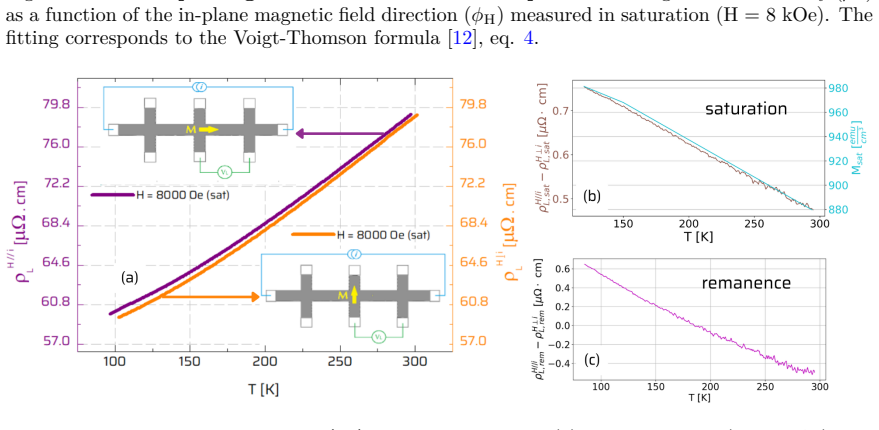
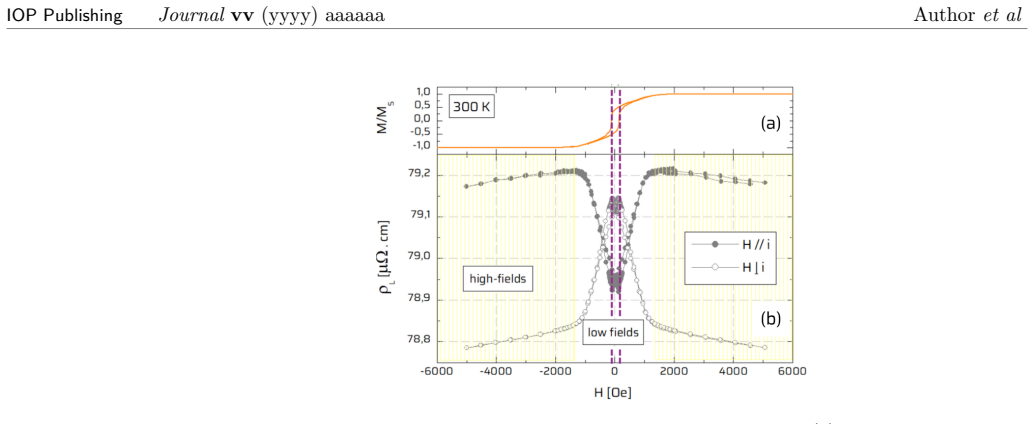
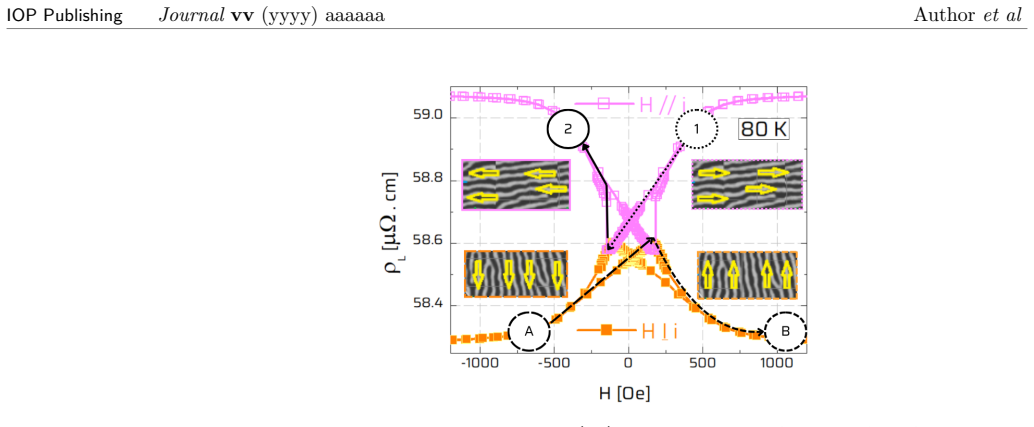
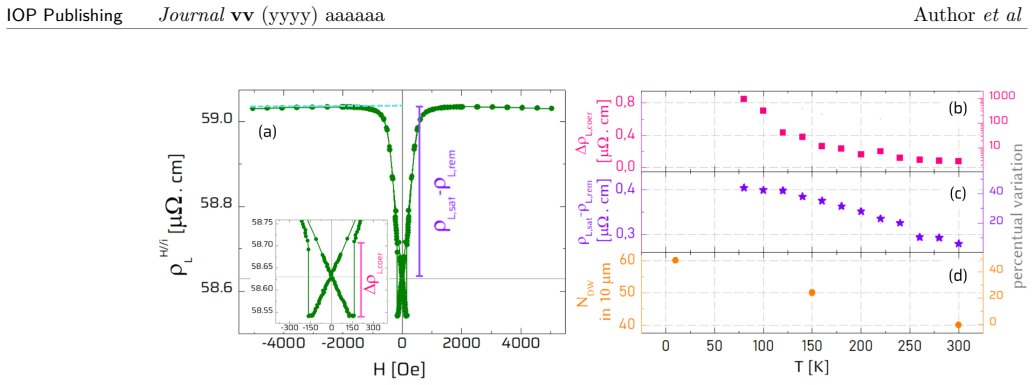
High-field magnetotransport follows the expected competition between metallic conduction and electron-magnon scattering. At low fields the macroscopic response deviates in a manner that the authors attribute to the microtextured domain structure. By defining a new quantity from the generalized Ohm's law they extract the texture contribution, which low-field data link to resistivity inhomogeneities caused by the spatial distribution of domains and domain walls. Near the coercive field this extra term is assigned to the domain walls themselves and is shown to surpass the anisotropic term at low temperatures.
What carries the argument
A newly introduced quantity that sizes the magnetic-texture contribution to macroscopic magnetotransport, obtained by applying the generalized Ohm's law to separate the domain-wall term from other resistivity channels.
If this is right
- Domain-wall resistivity can dominate over anisotropic magnetoresistance in this film once temperature is reduced.
- Spatial conductivity modulation produced by the magnetic texture is detectable in ordinary macroscopic transport data.
- The generalized Ohm's law plus the new quantity cleanly separates the texture term from high-field metallic and magnon contributions.
- Low-field magnetoresistance curves exhibit inhomogeneities whose magnitude tracks the expected domain-wall density.
Where Pith is reading between the lines
- The same separation technique could be tested on other striped-domain films to check whether domain-wall resistivity grows with decreasing temperature in a material-independent way.
- Device models for magnetic sensors or memory elements operating at cryogenic temperatures may need to include an explicit domain-wall resistivity channel.
- Mapping the new quantity against independent domain-wall density measurements would provide a direct test of the attribution.
Load-bearing premise
The observed low-field resistivity inhomogeneities and the extra term near the coercive field arise principally from the spatial distribution of domains and domain walls rather than from other scattering channels or experimental geometry effects.
What would settle it
Simultaneous domain imaging and local four-probe resistivity measurements that show the extra resistance scales directly with domain-wall density while remaining independent of temperature-independent scattering strength.
Figures
read the original abstract
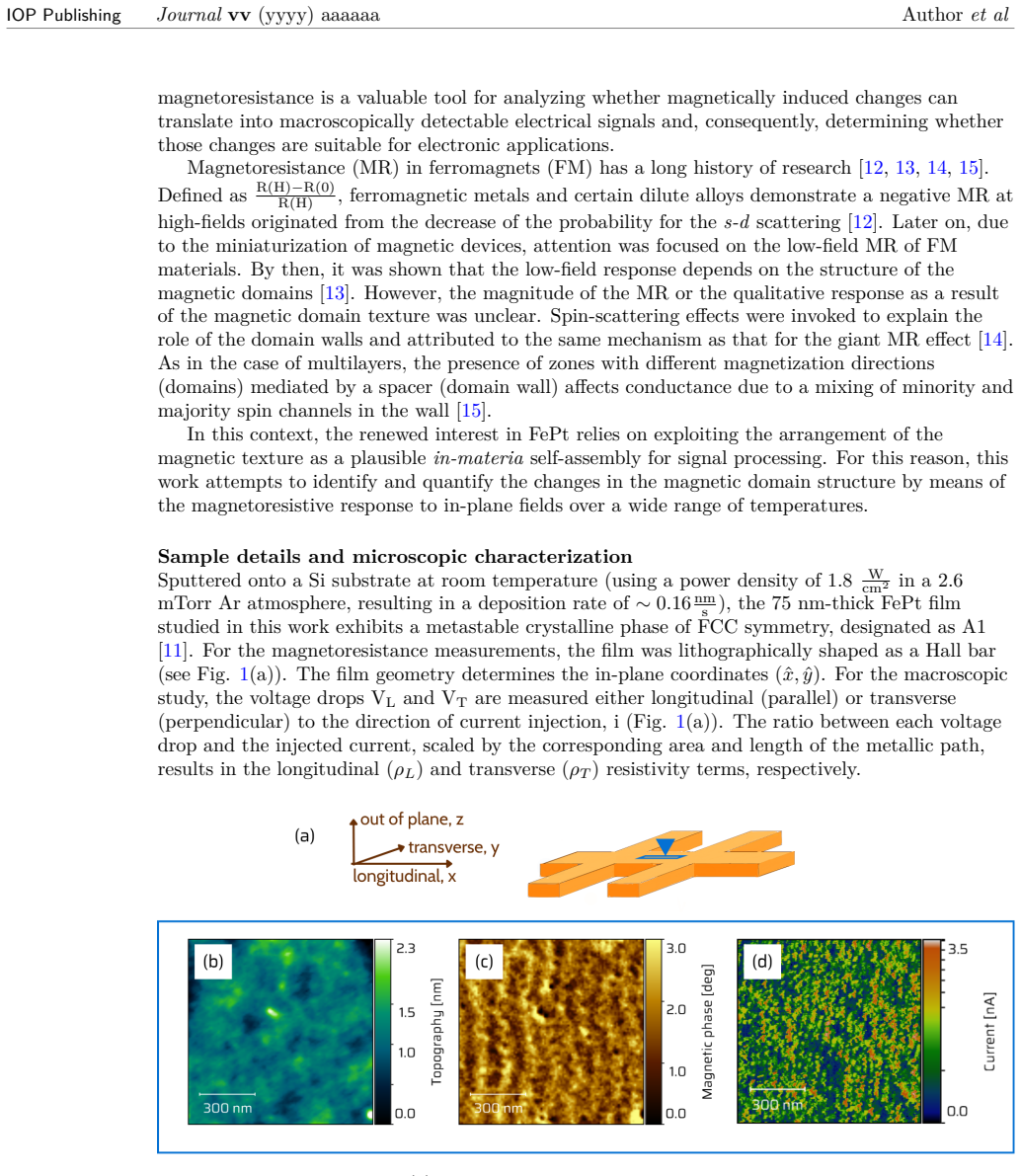
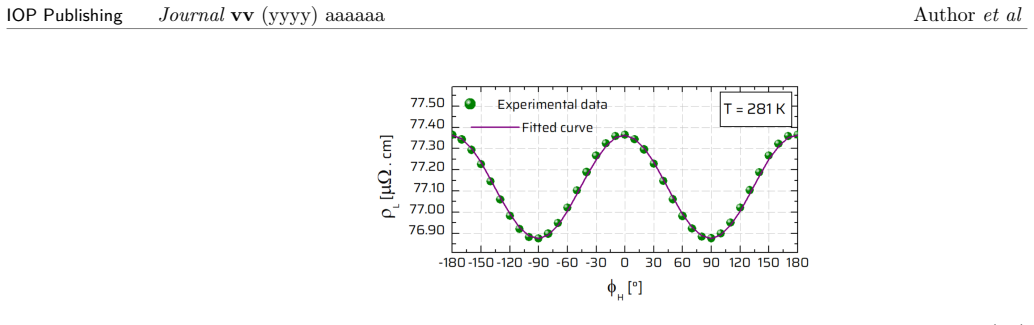
A 75 nm-thick Fe0.5Pt0.5 film is a ferromagnetic metal showing striped magnetic domains in remanence at room temperature. The magnetoresistance is characterized by varying the external temperature and the in-plane magnetic field intensity, thereby affecting its magnetic structure. Qualitatively, the resistivity is well described by using the generalized Ohm's law. High-field magnetotransport properties are successfully explained by considering the competition between the expected metallic behavior and the electron-magnon interaction. In the low-field condition, we size the contribution of the magnetic texture to the macroscopic magnetotransport response by introducing a new quantity. Consistent with the microscopic modulation of the lateral conduction, low-field measurements reveal inhomogeneities attributed to the spatial distribution of ferromagnetic domains and domain walls. By carefully analyzing the macroscopic response near the coercive field, the additional contribution to the resistivity is attributed to the domain walls themselves. In fact, this term could surpass the anisotropic term at low temperatures. In summary, this study demonstrates that spatial magnetic inhomogeneities are not only macroscopically measurable but also comparable in magnitude to other regularly considered terms, mainly at low temperatures.
Editorial analysis
A structured set of objections, weighed in public.
Referee Report
Summary. The manuscript reports magnetotransport measurements on a 75 nm Fe0.5Pt0.5 film with striped magnetic domains at room temperature. It claims that resistivity is qualitatively described by the generalized Ohm's law, that high-field data are explained by competition between metallic conduction and electron-magnon scattering, and that a newly introduced quantity sizes the magnetic-texture contribution at low fields. Near the coercive field this extra term is attributed to domain walls themselves and is stated to be capable of exceeding the anisotropic magnetoresistance at low temperature, thereby furnishing macroscopic evidence of spatial conductivity modulation due to the domain structure.
Significance. If the new quantity is shown to be independent of geometry-induced current crowding and residual scattering channels, the result would establish that domain-wall resistivity can be macroscopically isolated and can dominate conventional AMR terms at low T; such a demonstration would be of interest for inhomogeneous magnetotransport in microtextured ferromagnets.
major comments (2)
- [low-field analysis and new quantity (abstract and corresponding results section)] The definition and derivation of the new quantity used to size the magnetic-texture contribution (introduced in the low-field analysis) are not shown to be orthogonal to current-crowding or demagnetizing-field effects inherent to the striped-domain geometry; without an explicit test that the quantity remains independent when the domain pattern changes near coercivity, the central attribution of the extra resistivity term to domain walls rests on an unverified assumption.
- [near-coercive-field analysis] The claim that the additional low-field resistivity term near the coercive field arises principally from domain walls (rather than residual temperature- or field-dependent scattering not captured by the high-field magnon model) lacks quantitative error bars, control measurements, or falsification tests against alternative explanations; this attribution is load-bearing for the statement that the term can surpass the anisotropic contribution at low T.
minor comments (1)
- [Abstract] The abstract repeatedly uses the qualifier 'qualitatively' for agreement with the generalized Ohm's law yet supplies no numerical metrics, R² values, or figure references that would allow the reader to assess the quality of the fit.
Simulated Author's Rebuttal
We thank the referee for the careful reading of our manuscript and the constructive comments. We respond point by point to the major concerns, indicating where revisions will be made to strengthen the presentation.
read point-by-point responses
-
Referee: [low-field analysis and new quantity (abstract and corresponding results section)] The definition and derivation of the new quantity used to size the magnetic-texture contribution (introduced in the low-field analysis) are not shown to be orthogonal to current-crowding or demagnetizing-field effects inherent to the striped-domain geometry; without an explicit test that the quantity remains independent when the domain pattern changes near coercivity, the central attribution of the extra resistivity term to domain walls rests on an unverified assumption.
Authors: The new quantity is obtained by subtracting the high-field resistivity (extrapolated from the metallic plus magnon-scattering model) from the measured low-field values, after the generalized Ohm's law has already been used to describe the average conductivity of the striped pattern. This construction is intended to isolate the additional contribution arising when the domain texture is present. We agree that an explicit demonstration of independence from geometry-induced current crowding would remove any ambiguity. In the revised manuscript we will add a supplementary calculation that recomputes the quantity under small perturbations of the domain period and wall density (consistent with the observed MFM images) to show that the extracted term remains stable. revision: yes
-
Referee: [near-coercive-field analysis] The claim that the additional low-field resistivity term near the coercive field arises principally from domain walls (rather than residual temperature- or field-dependent scattering not captured by the high-field magnon model) lacks quantitative error bars, control measurements, or falsification tests against alternative explanations; this attribution is load-bearing for the statement that the term can surpass the anisotropic contribution at low T.
Authors: The attribution rests on the fact that the extra term appears only in the low-field regime, reaches its maximum precisely at the coercive field (where domain-wall density is highest), and exhibits a distinct temperature dependence from the high-field magnon channel. We acknowledge that the original manuscript does not display error bars on this subtracted term and does not explicitly rule out every conceivable residual scattering channel. In the revision we will (i) include propagated uncertainties on the low-field excess resistivity and (ii) add a short discussion comparing the observed field and temperature scaling against plausible alternative mechanisms (e.g., enhanced magnon scattering or weak localization). Full control experiments with deliberately altered domain geometries are outside the scope of the present data set, but the correlation with the independently measured coercive field and domain structure provides the primary supporting evidence. revision: partial
Circularity Check
No circularity: new quantity is phenomenological attribution, not self-defined or fitted by construction
full rationale
The abstract separates high-field magnetotransport (explained via metallic behavior competing with electron-magnon scattering) from low-field behavior, where a new quantity is introduced to size the magnetic-texture contribution. No equations or definitions are provided that reduce the new quantity to the resistivity data it is meant to explain, nor is there a self-citation chain or ansatz smuggling that forces the central claim. The attribution to domain walls follows from analyzing the response near coercivity and consistency with microscopic domain patterns; this is an interpretive step resting on the generalized Ohm's law and experimental separation of field regimes rather than a definitional loop. The derivation remains self-contained against external benchmarks such as independent domain imaging or alternative scattering models.
Axiom & Free-Parameter Ledger
free parameters (1)
- new quantity sizing magnetic texture contribution
axioms (1)
- domain assumption Generalized Ohm's law qualitatively describes the resistivity under varying temperature and field
Reference graph
Works this paper leans on
-
[1]
Ferroelastic Domain Walls in BiFeO 3 as Memristive Networks
J. L. Rieck et al. “Ferroelastic Domain Walls in BiFeO 3 as Memristive Networks”. In: Advanced Intelligent Systems 5.1 (2023), p. 2200292.issn: 2640-4567.doi: 10.1002/aisy.202200292.url: https://onlinelibrary.wiley.com/doi/abs/10.1002/aisy.202200292(visited on 11/14/2022)
-
[2]
C. P. Quinteros et al. “Thermal evolution of low-temperature magnetic texture modulation in FePt thin films by direct visualization”. In: J. Phys. D: Appl. Phys. 57.18 (Feb. 2024), p. 185001.issn: 0022-3727.doi:10.1088/1361-6463/ad2567.url: https://dx.doi.org/10.1088/1361-6463/ad2567(visited on 05/06/2025)
-
[3]
G. Milano et al. “In materia reservoir computing with a fully memristive architecture based on self-organizing nanowire networks”. In: Nature Materials 21.2 (Feb. 2022), pp. 195–202. doi:10.1038/s41563-021-01099-9. (Visited on 04/26/2023)
-
[4]
Toward a formal theory for computing machines made out of whatever physics offers
H. Jaeger, B. Noheda, and W. G. van der Wiel. “Toward a formal theory for computing machines made out of whatever physics offers”. In: Nature Communications 14.1 (Aug. 2023), p. 4911.issn: 2041-1723.doi:10.1038/s41467-023-40533-1.url: https://www.nature.com/articles/s41467-023-40533-1(visited on 05/15/2025). 9 IOP PublishingJournalvv(yyyy) aaaaaa Authoret al
-
[5]
Ferromagnetic Resonance of Disordered FePt Thin Films
M. Vasquez Mansilla, J. Gomez, and A. Butera. “Ferromagnetic Resonance of Disordered FePt Thin Films”. In: IEEE Transactions on Magnetics 44.11 (2008), pp. 2883–2886.doi: 10.1109/TMAG.2008.2001518
-
[6]
Thickness and temperature dependence of the dynamic magnetic behavior in disordered FePt films
M. V´ asquez Mansilla et al. “Thickness and temperature dependence of the dynamic magnetic behavior in disordered FePt films”. In: Journal of Magnetism and Magnetic Materials 321.18 (2009), pp. 2941–2945.issn: 0304-8853.doi: https://doi.org/10.1016/j.jmmm.2009.04.045.url: https://www.sciencedirect.com/science/article/pii/S0304885309004600
-
[7]
Magnetic domain crossover in FePt thin films
E. Sallica Leva et al. “Magnetic domain crossover in FePt thin films”. In: Phys. Rev. B 82.14 (Oct. 2010), p. 144410.doi:10.1103/PhysRevB.82.144410. (Visited on 01/13/2022)
-
[8]
Relaxation dynamics of ferromagnetic FePt thin films in a broad frequency range
N. ´Alvarez et al. “Relaxation dynamics of ferromagnetic FePt thin films in a broad frequency range”. In: Journal of Physics D: Applied Physics 46.50 (Nov. 2013), p. 505001.issn: 0022-3727.doi:10.1088/0022-3727/46/50/505001.url: https://doi.org/10.1088/0022-3727/46/50/505001(visited on 04/05/2021)
-
[9]
Correlation between magnetic interactions and domain structure in A1 FePt ferromagnetic thin films
N. ´Alvarez et al. “Correlation between magnetic interactions and domain structure in A1 FePt ferromagnetic thin films”. In: Journal of Applied Physics 115.8 (Feb. 2014), p. 083907. issn: 0021-8979.doi:10.1063/1.4866685.url: https://aip.scitation.org/doi/abs/10.1063/1.4866685(visited on 04/05/2021)
-
[10]
Tunable stress induced magnetic domain configuration in FePt thin films
N. R. ´Alvarez et al. “Tunable stress induced magnetic domain configuration in FePt thin films”. In: Journal of Physics D: Applied Physics 48.40 (Sept. 2015), p. 405003.doi: 10.1088/0022-3727/48/40/405003. (Visited on 04/05/2021)
-
[11]
Dominios magn´ eticos y respuesta din´ amica en aleaciones ferromagn´ eticas de FePt
N. ´Alvarez. “Dominios magn´ eticos y respuesta din´ amica en aleaciones ferromagn´ eticas de FePt”. PhD thesis. Universidad Nacional de Cuyo, Mar. 2016.url: http://ricabib.cab.cnea.gov.ar/564/(visited on 01/14/2021)
2016
-
[12]
Galvanomagnetic and Thermomagnetic Effects in Metals*
J. -P. Jan. “Galvanomagnetic and Thermomagnetic Effects in Metals*”. In: Solid State Physics. Ed. by FREDERICK Seitz and DAVID Turnbull. Vol. 5. Academic Press, Jan. 1957, pp. 1–96.doi:10.1016/S0081-1947(08)60101-0.url: https://www.sciencedirect.com/science/article/pii/S0081194708601010(visited on 05/06/2025)
-
[13]
Magnetoresistance due to domain walls in micron scale Fe wires with stripe domains
A. D. Kent et al. “Magnetoresistance due to domain walls in micron scale Fe wires with stripe domains”. In: IEEE Transactions on Magnetics 34.4 (July 1998), pp. 900–902.issn: 1941-0069.doi:10.1109/20.706305.url: https://ieeexplore.ieee.org/document/706305(visited on 05/06/2025)
-
[14]
Spin scattering in ferromagnetic thin films
M. Viret et al. “Spin scattering in ferromagnetic thin films”. In: Phys. Rev. B 53.13 (Apr. 1996), pp. 8464–8468.doi:10.1103/PhysRevB.53.8464.url: https://link.aps.org/doi/10.1103/PhysRevB.53.8464(visited on 05/06/2025)
-
[15]
Giant Magnetoresistive Effects in a Single Element Magnetic Thin Film
J. F. Gregg et al. “Giant Magnetoresistive Effects in a Single Element Magnetic Thin Film”. In: Phys. Rev. Lett. 77.8 (Aug. 1996), pp. 1580–1583.doi:10.1103/PhysRevLett.77.1580. url:https://link.aps.org/doi/10.1103/PhysRevLett.77.1580(visited on 05/06/2025)
-
[16]
Electrical detection of magnetization dynamics via spin rectification effects
M. Harder, Y. Gui, and C.-M. Hu. “Electrical detection of magnetization dynamics via spin rectification effects”. In: Physics Reports. Electrical detection of magnetization dynamics via spin rectification effects 661 (Nov. 2016), pp. 1–59.issn: 0370-1573.doi: 10.1016/j.physrep.2016.10.002.url: https://www.sciencedirect.com/science/article/pii/S03701573163...
-
[17]
Resistivity of Iron as a Function of Temperature and Magnetization
G. R. Taylor, A. Isin, and R. V. Coleman. “Resistivity of Iron as a Function of Temperature and Magnetization”. In: Physical Review 165.2 (Jan. 1968), pp. 621–631.doi: 10.1103/PhysRev.165.621.url:https://link.aps.org/doi/10.1103/PhysRev.165.621 (visited on 05/12/2025)
work page doi:10.1103/physrev.165.621.url:https://link.aps.org/doi/10.1103/physrev.165.621 1968
-
[18]
A. Guan et al. “An experimental apparatus for simultaneously measuring Seebeck coefficient and electrical resistivity from 100 K to 600 K”. In: Review of Scientific Instruments 84.4 (Apr. 2013), p. 043903.issn: 0034-6748.doi:10.1063/1.4798647.url: https://doi.org/10.1063/1.4798647(visited on 05/12/2025)
-
[19]
Electron-magnon scattering and magnetic resistivity in 3d ferromagnets
B. Raquet et al. “Electron-magnon scattering and magnetic resistivity in 3d ferromagnets”. In: Physical Review B 66.2 (July 2002), p. 024433.doi:10.1103/PhysRevB.66.024433.url: https://link.aps.org/doi/10.1103/PhysRevB.66.024433(visited on 05/12/2025). 10 IOP PublishingJournalvv(yyyy) aaaaaa Authoret al
-
[20]
Resistivity due to Domain Wall Scattering
P. M. Levy and S. Zhang. “Resistivity due to Domain Wall Scattering”. In: Phys. Rev. Lett. 79.25 (Dec. 1997), pp. 5110–5113.doi:10.1103/PhysRevLett.79.5110.url: https://link.aps.org/doi/10.1103/PhysRevLett.79.5110(visited on 05/06/2025)
-
[21]
Magnetotransport properties of Fe 0.8Ga0.2 films with stripe domains
M. Granada et al. “Magnetotransport properties of Fe 0.8Ga0.2 films with stripe domains”. In: Phys. Rev. B 94.18 (Nov. 2016), p. 184435.doi:10.1103/PhysRevB.94.184435. (Visited on 11/28/2021)
-
[22]
B. Pianciola et al. “Magnetoresistance in Fe 0.8Ga0.2 thin films with magnetic stripes: The role of the three-dimensional magnetic structure”. In: Phys. Rev. B 102.5 (Aug. 2020), p. 054438.doi:10.1103/PhysRevB.102.054438. (Visited on 01/04/2023)
-
[23]
Negative Domain Wall Contribution to the Resistivity of Microfabricated Fe Wires
U. Ruediger et al. “Negative Domain Wall Contribution to the Resistivity of Microfabricated Fe Wires”. In: Phys. Rev. Lett. 80.25 (June 1998), pp. 5639–5642.doi: 10.1103/PhysRevLett.80.5639.url: https://link.aps.org/doi/10.1103/PhysRevLett.80.5639(visited on 11/17/2025). Supplementary data Mathematical expressions for the resistivity terms General formula...
discussion (0)
Sign in with ORCID, Apple, or X to comment. Anyone can read and Pith papers without signing in.