Reducing Experimental Testing in Space Propulsion Film Cooling Analyses by Pixelwise Generative Image Interpolation
Pith reviewed 2026-06-29 08:46 UTC · model grok-4.3
The pith
A lightweight neural network generates accurate film cooling images from 30% fewer experimental measurements.
A machine-rendered reading of the paper's core claim, the machinery that carries it, and where it could break.
Core claim
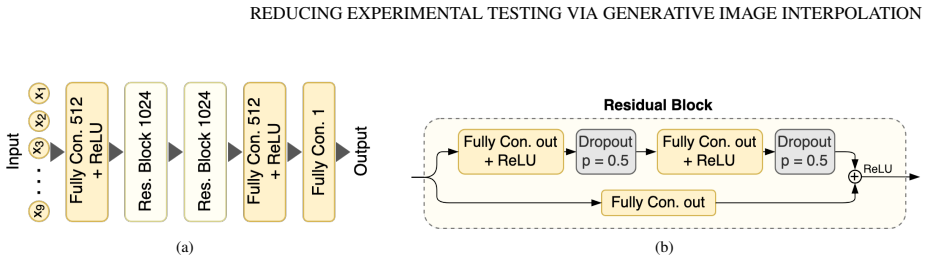
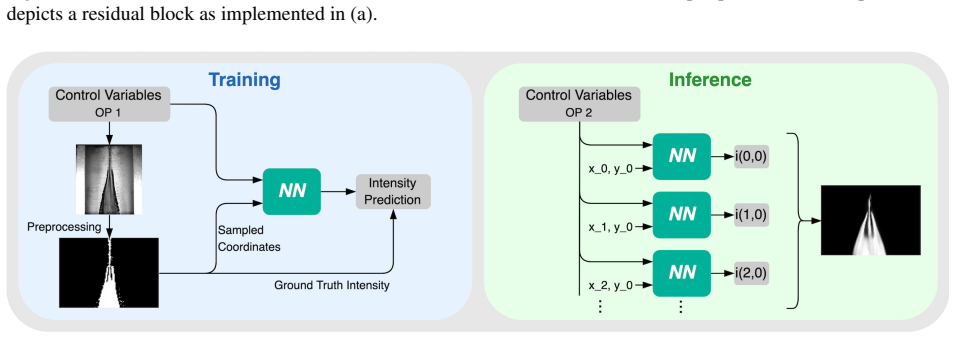
A lightweight feed-forward neural network with positional encoding generates pixelwise images from sparse experimental measurements in film cooling analyses, conditioned by input parameters, achieving high similarity to ground truth while enabling a 30% reduction in the number of required tests.
What carries the argument
Lightweight feed-forward neural network with positional encoding for conditioned image generation from sparse data.
Load-bearing premise
The neural network trained on sparse measurements will generalize to new injector configurations and flow conditions without missing key physical effects in the film cooling process.
What would settle it
A new set of experiments on an unseen injector configuration where the generated images deviate substantially from measured data in terms of cooling effectiveness or temperature distribution.
Figures

read the original abstract
We propose a machine learning approach for image regression from sparse experimental measurements. We show the application of the proposed method on film cooling studies in propulsion system development, aiming to reduce the need for extensive physical testing. Our method employs a lightweight feed-forward neural network with positional encoding to generate images conditioned by input parameters. Validated on real and synthetic data, it achieves high image similarity (RMSE < 8 %, SSIM > 93 %) while maintaining accuracy with a 30 \% reduction of measurements. We further propose a knowledge-informed extension for local adaptability of the generated images. This approach significantly reduces required tests while preserving high-quality data, enabling efficient optimization of coolant injector configurations with applications beyond aerospace.
Editorial analysis
A structured set of objections, weighed in public.
Referee Report
Summary. The paper proposes a lightweight feed-forward neural network with positional encoding for pixelwise image regression from sparse experimental measurements in film cooling analyses for space propulsion systems. Conditioned on input parameters, the model generates full images; a knowledge-informed extension is also introduced for local adaptability. Validated on real and synthetic data, it reports RMSE < 8 % and SSIM > 93 % while claiming a 30 % reduction in required physical measurements, with the goal of enabling efficient optimization of new coolant injector configurations.
Significance. If the reported accuracy holds under proper out-of-distribution testing, the approach could meaningfully lower the experimental burden in propulsion development by substituting interpolation for additional physical tests. The method is lightweight and directly targets a practical bottleneck in aerospace testing.
major comments (1)
- [Abstract] Abstract: the central claim that the method enables a 30 % reduction in measurements for previously unseen injector configurations and flow conditions requires demonstration that held-out test cases are out-of-distribution with respect to the training parameter space. The reported RMSE and SSIM figures on 'real and synthetic data' do not establish this, as no information is given on data partitioning, parameter ranges in the test set, or whether new geometries were included.
minor comments (1)
- [Abstract] The abstract supplies performance numbers but omits any description of training procedures, data partitioning strategy, error analysis, or the precise experimental design that produced the 30 % reduction figure.
Simulated Author's Rebuttal
We thank the referee for the careful review and for emphasizing the importance of clarifying whether the held-out cases support claims of applicability to previously unseen injector configurations. We address the single major comment below and will revise the manuscript to supply the requested details on data partitioning.
read point-by-point responses
-
Referee: [Abstract] Abstract: the central claim that the method enables a 30 % reduction in measurements for previously unseen injector configurations and flow conditions requires demonstration that held-out test cases are out-of-distribution with respect to the training parameter space. The reported RMSE and SSIM figures on 'real and synthetic data' do not establish this, as no information is given on data partitioning, parameter ranges in the test set, or whether new geometries were included.
Authors: We agree that the manuscript does not currently supply the information needed to evaluate whether the reported 30 % reduction applies to out-of-distribution cases. In the revised version we will add a dedicated paragraph in the 'Dataset and Experimental Setup' section that (i) describes the exact splitting procedure, (ii) lists the numerical ranges of all conditioning parameters (mass-flow ratio, blowing ratio, etc.) used for training versus testing, and (iii) states whether any test images correspond to injector geometries absent from the training set. If the test cases prove to lie inside the convex hull of the training distribution, we will also revise the abstract and conclusion to qualify the claim as a reduction achieved via interpolation within the sampled parameter space, while noting the potential for further OOD validation. revision: yes
Circularity Check
No significant circularity; supervised regression validated on held-out data
full rationale
The paper describes a standard supervised image regression task: a feed-forward NN with positional encoding is trained on sparse experimental measurements (real and synthetic) to generate full images conditioned on input parameters. Performance is reported via RMSE and SSIM against held-out test cases, with no equations or claims that reduce a prediction to a fitted parameter by construction. No self-citations are load-bearing for the core method, no uniqueness theorems are invoked, and no ansatz is smuggled via prior work. The derivation chain is self-contained against external benchmarks.
Axiom & Free-Parameter Ledger
Reference graph
Works this paper leans on
-
[1]
Review on film cooling of liquid rocket engines,
S. R. Shine and S. S. Nidhi, “Review on film cooling of liquid rocket engines,”Propulsion and Power Research, vol. 7, no. 1, pp. 1–18, Mar. 2018. doi: 10.1016/j.jppr.2018.01.004
-
[2]
Optimal Liquid Engine Architecture by Performance- Cooling TradeoffAnalysis,
S. Tauchi, C. Inoue, Z. Wang, Y . Daimon, and G. Fujii, “Optimal Liquid Engine Architecture by Performance- Cooling TradeoffAnalysis,”Journal of Propulsion and Power, vol. 40, no. 4, pp. 631–641, 2024. doi: 10.2514/1.B39409
-
[3]
Data-Driven Aerospace Engineering: Reframing the Industry with Machine Learning,
S. L. Brunton, J. N. Kutz, K. Manohar, A. Y . Aravkin, K. Morgansen, J. Klemisch, N. Goebel, J. Buttrick, J. Poskin, A. W. Blom-Schieber, T. Hogan, and D. McDonald, “Data-Driven Aerospace Engineering: Reframing the Industry with Machine Learning,”AIAA Journal, vol. 59, no. 8, pp. 2820–2847, 2021. doi: 10.2514/1.J060131
-
[4]
C. U. Kirchberger, T. Hörger, J. Scholl, F. Merz, P. Teuffel, M. Kurilov, F. Lauck, L. Werling, R. Scholl, S. Ricker, and D. Freudenmann, “Green Propellants for Satellite Propulsion: Status of Research and Developments at DLR Lampoldshausen,” inAIAA SCITECH 2024 F orum, American Institute of Aeronautics and Astronautics. doi: 10.2514/6.2024-1789
-
[5]
Test results of a film cooled 200 N hypergolic green propellant thruster using hydrogen peroxide as coolant,
P. Teuffel, F. Lauck, F. Merz, D. Turner, L. Werling, and C. Kirchberger, “Test results of a film cooled 200 N hypergolic green propellant thruster using hydrogen peroxide as coolant,”Space Propulsion Conference, 2024
2024
-
[6]
R. R. Selvaraju, M. Cogswell, A. Das, R. Vedantam, D. Parikh, and D. Batra, “Grad-CAM: Visual Explanations from Deep Networks via Gradient-Based Localization,” in2017 IEEE International Conference on Computer Vision (ICCV), Oct. 2017, pp. 618–626. doi: 10.1109/ICCV .2017.74
-
[7]
Thermal performance of MMH/NTO rocket thrust chamber based on pintle injector by using liquid film cooling,
G. Zhang, G. Li, L. Li, and G. Tang, “Thermal performance of MMH/NTO rocket thrust chamber based on pintle injector by using liquid film cooling,”Appl. Therm. Eng., vol. 223, p. 120035, Mar. 2023. 13 REDUCING EXPERIMENTAL TESTING VIA GENERATIVE IMAGE INTERPOLATION
2023
-
[8]
Evaporation of Three-Dimensional Wavy Liquid Film Entrained by Turbulent Gas Flow,
T. Inoue, C. Inoue, G. Fujii, and Y . Daimon, “Evaporation of Three-Dimensional Wavy Liquid Film Entrained by Turbulent Gas Flow,”AIAA J., vol. 60, no. 6, pp. 3805–3812, Jun. 2022
2022
-
[9]
Experimental analysis of hydrogen peroxide film-cooling method for nontoxic hypergolic thruster,
H. Kang, H. Kim, S. Heo, S. Jung, and S. Kwon, “Experimental analysis of hydrogen peroxide film-cooling method for nontoxic hypergolic thruster,”Aerospace Sci. Technol., vol. 71, pp. 751–762, Dec. 2017
2017
-
[10]
M. W. L. Chee, P. Chauhan, J. Georgiou, and D. I. Wilson, “Flow distribution in the liquid film created by a coherent circular water jet impinging obliquely on a plane wall,”Experimental Thermal and Fluid Science, vol. 140, p. 110748, Jan. 2023. doi: 10.1016/j.expthermflusci.2022.110748
-
[11]
Data Driven Models for the De- sign of Rocket Injector Elements,
J. F. Zapata Usandivaras, A. Urbano, M. Bauerheim, and B. Cuenot, “Data Driven Models for the De- sign of Rocket Injector Elements,”Aerospace, vol. 9, no. 10, p. 594, Oct. 2022. [Online]. Available: https://www.mdpi.com/2226-4310/9/10/594
2022
-
[12]
Surrogate Neural Network for Rapid Flight Performance Evaluation of Hybrid Rocket Engines,
A. Zavoli, P. M. Zolla, L. Federici, M. T. Migliorino, and D. Bianchi, “Surrogate Neural Network for Rapid Flight Performance Evaluation of Hybrid Rocket Engines,”J. Spacecr . Rockets, vol. 59, no. 6, pp. 2003–2016, 2022. [Online]. Available: https://doi.org/10.2514/1.A35369
-
[13]
Experimental and Simulative Evaluation of a Reinforcement Learning Based Cold Gas Thrust Chamber Pressure Controller,
T. Hörger, L. Werling, K. Dresia, G. Waxenegger-Wilfing, and S. Schlechtriem, “Experimental and Simulative Evaluation of a Reinforcement Learning Based Cold Gas Thrust Chamber Pressure Controller,”Acta Astronau- tica, vol. 219, pp. 128–137, Jun. 2024
2024
-
[14]
G. Waxenegger-Wilfing, K. Dresia, J. Deeken, and M. Oschwald, “Machine Learning Methods for the Design and Operation of Liquid Rocket Engines – Research Activities at the DLR Institute of Space Propulsion,”arXiv, no. arXiv:2102.07109, Feb. 2021. [Online]. Available: http://arxiv.org/abs/2102.07109
-
[15]
Conditional image synthe- sis with diffusion models: A survey.arXiv preprint arXiv:2409.19365,
Z. Zhan, D. Chen, J.-P. Mei, Z. Zhao, J. Chen, C. Chen, S. Lyu, and C. Wang, “Conditional Image Syn- thesis with Diffusion Models: A Survey,”arXiv preprint arXiv:2409.19365, Jun. 2025. [Online]. Available: http://arxiv.org/abs/2409.19365
-
[16]
Pixel Recurrent Neural Networks,
A. van den Oord, N. Kalchbrenner, and K. Kavukcuoglu, “Pixel Recurrent Neural Networks,” inProc. 33rd Int. Conf. Mach. Learn. (ICML), 2016, pp. 1747–1756. [Online]. Available: https://proceedings.mlr.press/v48/oord16.html
2016
-
[17]
FILM: Frame Interpolation for Large Motion,
F. Reda, J. Kontkanen, E. Tabellion, D. Sun, C. Pantofaru, and B. Curless, “FILM: Frame Interpolation for Large Motion,” inComputer Vision - ECCV 2022, Cham: Springer Nature Switzerland, 2022, pp. 250-266. doi: 10.1007/978-3-031-20071-7_15
-
[18]
Machine-learning enabled prediction of 3D spray under engine combustion network spray G conditions,
J. Hwang, P. Lee, S. Mun, I. K. Karathanassis, P. Koukouvinis, L. M. Pickett, and M. Gavaises, “Machine-learning enabled prediction of 3D spray under engine combustion network spray G conditions,”Fuel, vol. 293, p. 120444, Jun. 2021. doi: 10.1016/j.fuel.2021.120444
-
[19]
Video Frame Interpolation: A Comprehensive Survey,
J. Dong, K. Ota, and M. Dong, “Video Frame Interpolation: A Comprehensive Survey,”ACM Trans. Multimedia Comput. Commun. Appl., vol. 19, no. 2, pp. 78:1–78:31, 2023. doi: 10.1145/3556544
-
[20]
DiffMorpher: Unleashing the Capability of Diffusion Models for Image Morphing,
K. Zhang, Y . Zhou, X. Xu, B. Dai, and X. Pan, “DiffMorpher: Unleashing the Capability of Diffusion Models for Image Morphing,” inProc. IEEE/CVF Conf. Comput. Vis. Pattern Recognit. (CVPR), 2024, pp. 7912–7921
2024
-
[21]
Conditional Image Generation with PixelCNN Decoders,
A. van den Oord, N. Kalchbrenner, L. Espeholt, K. Kavukcuoglu, O. Vinyals, and A. Graves, “Conditional Image Generation with PixelCNN Decoders,” inAdvances in Neural In- formation Processing Systems, vol. 29, Curran Associates, Inc., 2016. [Online]. Available: https://proceedings.neurips.cc/paper/2016/hash/b1301141feffabac455e1f90a7de2054-Abstract.html
2016
-
[22]
Gonzalez and R
R. Gonzalez and R. Woods,Digital Image Processing. Pearson Deutschland, 2017, pp. 699–810. ISBN: 9781292223070
2017
-
[23]
PyTorch: An Imperative Style, High-Performance Deep Learning Library
A. Paszke, S. Gross, F. Massa, A. Lerer, J. Bradbury, G. Chanan, T. Killeen, Z. Lin, N. Gimelshein, L. Antiga, A. Desmaison, A. Köpf, E. Yang, Z. DeVito, M. Raison, A. Tejani, S. Chilamkurthy, B. Steiner, L. Fang, J. Bai, and S. Chintala, “PyTorch: An Imperative Style, High-Performance Deep Learning Library,” arXiv preprint arXiv:1912.01703, Dec. 2019. do...
work page internal anchor Pith review Pith/arXiv arXiv doi:10.48550/arxiv.1912.01703 1912
-
[24]
M. K. Phibbs and P. A. Giguère, “Hydrogen peroxide and its analogues: I. Density, refractive index, viscosity, and surface tension of deuterium peroxide - deuterium oxide solutions,”Canadian Journal of Chemistry, vol. 29, no. 2, pp. 173–181, Feb. 1951. doi: 10.1139/v51-022. 14 REDUCING EXPERIMENTAL TESTING VIA GENERATIVE IMAGE INTERPOLATION
-
[25]
unwrap_labels,
A. Zankevich, “unwrap_labels,” GitHub repository, https://github.com/Nepherhotep/unwrap_labels, Accessed: Jun. 5, 2025
2025
-
[26]
The OpenCV Library,
G. Bradski, “The OpenCV Library,”Dr . Dobb’s Journal of Software Tools, 2000
2000
-
[27]
Image quality metrics: PSNR vs. SSIM,
A. Horé and D. Ziou, “Image quality metrics: PSNR vs. SSIM,” inProc. 2010 20th Int. Conf. on Pattern Recog- nition (ICPR), Aug. 2010, pp. 2366–2369. doi: 10.1109/ICPR.2010.579
-
[28]
Image quality assessment through FSIM, SSIM, MSE and PSNR– A comparative study,
U. Sara, M. Akter, and M. S. Uddin, “Image quality assessment through FSIM, SSIM, MSE and PSNR– A comparative study,”Journal of Computer and Communications, vol. 7, no. 3, pp. 8–18, Mar. 2019. doi: 10.4236/jcc.2019.73002
-
[29]
Video quality assessment through PSNR estimation for different compression standards,
R. G. Deshpande, L. L. Ragha, and S. K. Sharma, “Video quality assessment through PSNR estimation for different compression standards,”Indonesian Journal of Electrical Engineering and Computer Science, vol. 11, no. 3, 2018
2018
-
[30]
Cosine similarity to determine similarity measure: Study case in online essay assessment,
A. R. Lahitani, A. E. Permanasari, and N. A. Setiawan, “Cosine similarity to determine similarity measure: Study case in online essay assessment,” inProc. 2016 4th Int. Conf. on Cyber and IT Service Management (CITSM), Apr. 2016, pp. 1–6. doi: 10.1109/CITSM.2016.7577578
-
[31]
An overview of perceptual hashing,
H. Farid, “An overview of perceptual hashing,”Journal of Online Trust and Safety, vol. 1, no. 1, Oct. 2021. doi: 10.54501/jots.v1i1.24
-
[32]
scikit-image: Image processing in Python,
S. van der Walt, J. L. Schönberger, J. Nunez-Iglesias, F. Boulogne, J. D. Warner, N. Yager, E. Gouillart, T. Yu, and the scikit-image contributors, “scikit-image: Image processing in Python,”PeerJ, vol. 2, p. e453, Jun. 2014. doi: 10.7717/peerj.453
-
[33]
O. Okonji, “cosine_similarity.py,” GitHub Gist, https://gist.github.com/onyekaokonji/7224787b3f127003b14f6ab 36570622c #file-cosine _similarity-py, Accessed: Jun. 5, 2025
-
[34]
ImageHash,
J. Buchner, “ImageHash,” GitHub repository, https://github.com/JohannesBuchner/imagehash, Accessed: Jun. 5, 2025. 15
2025
discussion (0)
Sign in with ORCID, Apple, or X to comment. Anyone can read and Pith papers without signing in.