Entropy of Liquids and Glasses from Recurring Structural Patterns
Pith reviewed 2026-06-29 00:36 UTC · model grok-4.3
The pith
Configurational entropy equals the decay rate of recurrent structural patterns with increasing patch size.
A machine-rendered reading of the paper's core claim, the machinery that carries it, and where it could break.
Core claim
Entropy is obtained as the decay rate of recurrent structural patterns with increasing patch size in a higher-dimensional Grassberger-Procaccia construction; this rate yields configurational entropy values that agree quantitatively with conventional definitions, and the entropies measured in aging states equal their equilibrium counterparts at the same inherent-structure energy.
What carries the argument
Higher-dimensional Grassberger-Procaccia algorithm that extracts the decay rate of recurrent structural patterns from particle positions alone.
If this is right
- Entropy calculation becomes possible from positions without knowledge of the interaction potential or particle sizes.
- The method applies equally to equilibrium liquids and to nonequilibrium aging glasses.
- Higher-order Rényi complexities extracted the same way also match conventional values.
- Entropy reduction is tied directly to the growing persistence of amorphous order with patch size.
- Aging and equilibrium states can be compared on equal footing by matching inherent-structure energies.
Where Pith is reading between the lines
- The approach could be applied to experimental images of colloidal glasses where forces are not known a priori.
- If the same decay-rate construction works in three dimensions, it would offer a route to entropy estimates in bulk materials without simulation of the full phase space.
- The coincidence of aging and equilibrium entropies at fixed inherent-structure energy suggests that the pattern-persistence measure is insensitive to the particular relaxation pathway taken.
Load-bearing premise
The decay rate of recurrent patterns with patch size directly measures configurational entropy independently of dynamics and theoretical framework.
What would settle it
A side-by-side numerical test on the same configurations where the pattern-decay entropy deviates from the value obtained by thermodynamic integration or by counting inherent structures.
Figures






read the original abstract
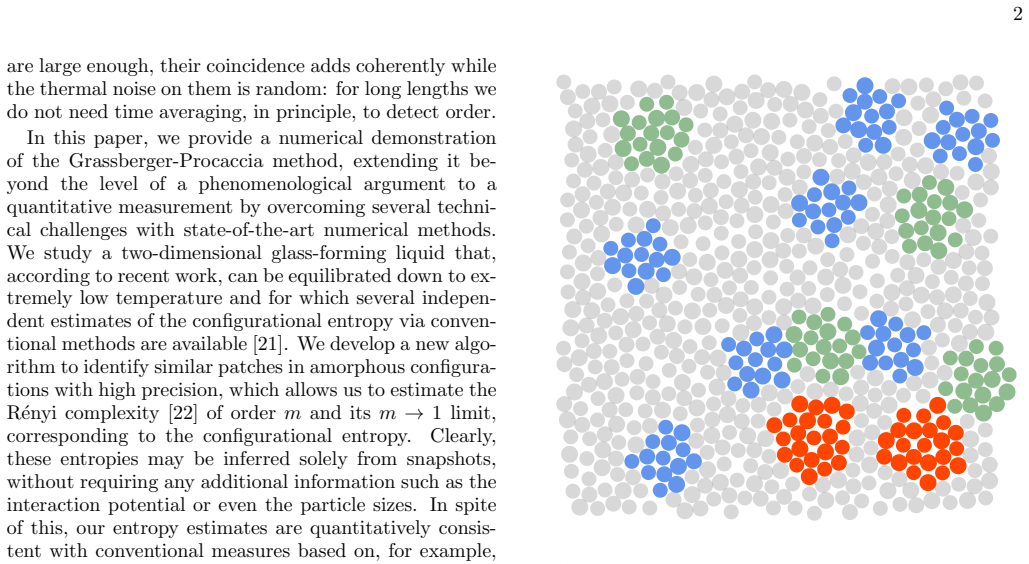
We compute the low-temperature configurational entropy of a two-dimensional supercooled liquid. Our method, based on a higher-dimensional version of the Grassberger--Procaccia algorithm, can be implemented in a manner that is entirely agnostic with respect to both the dynamics and the theoretical framework, as any genuine notion of order should be. In this construction, entropy is obtained as the decay rate of recurrent structural patterns with increasing patch size, directly linking entropy reduction to the growing persistence of amorphous order. Because the method requires only particle positions, without any knowledge of the interaction potential or even of the particle sizes, it can be applied directly to both equilibrium and nonequilibrium aging configurations. The resulting configurational entropy, together with the higher-order R\'enyi complexities, agree quantitatively with values obtained from conventional definitions. Remarkably, the entropies measured during aging coincide with their equilibrium counterparts when compared at the same inherent-structure energy.
Editorial analysis
A structured set of objections, weighed in public.
Referee Report
Summary. The manuscript presents a method to compute the low-temperature configurational entropy of a 2D supercooled liquid using a higher-dimensional Grassberger-Procaccia algorithm applied to patches of particle positions. Entropy is extracted as the decay rate of recurrent structural patterns with increasing patch size. The approach is described as agnostic to dynamics and interaction potential. The resulting configurational entropies and higher-order Rényi complexities are reported to agree quantitatively with conventional definitions, and entropies measured in aging states coincide with equilibrium values when compared at the same inherent-structure energy.
Significance. If the central mapping holds, the work offers a configuration-only route to configurational entropy that does not require the potential or a specific dynamical model, which would be useful for both simulations and experiments on glasses. The reported coincidence of aging and equilibrium entropies at fixed inherent-structure energy would provide direct support for the inherent-structure picture of glass thermodynamics. No machine-checked proofs or open code are mentioned, but the position-only requirement is a clear practical strength.
major comments (2)
- [Abstract] Abstract and method section: the central claim that the higher-dimensional Grassberger-Procaccia recurrence decay rate on position patches equals the thermodynamic configurational entropy (total entropy minus vibrational contribution, or equivalent to inherent-structure enumeration) is asserted without an explicit derivation. The abstract states that entropy is 'obtained as the decay rate ... directly linking entropy reduction to the growing persistence of amorphous order,' yet the conversion from correlation-integral scaling in embedding space to log(number of distinct amorphous configurations) independent of vibrations or dynamics is not shown; this equivalence is load-bearing for all quantitative-agreement statements.
- [Abstract] Results section (comparison with conventional definitions): the manuscript claims quantitative agreement for both equilibrium and aging states, but the abstract supplies no error bars, implementation details of the pattern-detection threshold, or verification steps against known benchmarks (e.g., thermodynamic integration or enumeration). Without these, the strength of the agreement cannot be assessed and may depend on unstated choices in patch construction or embedding dimension.
Simulated Author's Rebuttal
We thank the referee for their careful reading and constructive comments. We address the two major comments point by point below.
read point-by-point responses
-
Referee: [Abstract] Abstract and method section: the central claim that the higher-dimensional Grassberger-Procaccia recurrence decay rate on position patches equals the thermodynamic configurational entropy (total entropy minus vibrational contribution, or equivalent to inherent-structure enumeration) is asserted without an explicit derivation. The abstract states that entropy is 'obtained as the decay rate ... directly linking entropy reduction to the growing persistence of amorphous order,' yet the conversion from correlation-integral scaling in embedding space to log(number of distinct amorphous configurations) independent of vibrations or dynamics is not shown; this equivalence is load-bearing for all quantitative-agreement statements.
Authors: We appreciate the referee drawing attention to the need for an explicit derivation. The manuscript grounds the approach in the information-theoretic properties of the Grassberger-Procaccia correlation integral applied to position patches, where the scaling exponent directly yields the entropy rate of recurrent patterns. To address the concern, the revised manuscript will include a dedicated derivation subsection in the Methods that rigorously connects the correlation-integral scaling to the logarithm of the number of distinct amorphous configurations, showing independence from vibrations and dynamics via the inherent-structure framework. revision: yes
-
Referee: [Abstract] Results section (comparison with conventional definitions): the manuscript claims quantitative agreement for both equilibrium and aging states, but the abstract supplies no error bars, implementation details of the pattern-detection threshold, or verification steps against known benchmarks (e.g., thermodynamic integration or enumeration). Without these, the strength of the agreement cannot be assessed and may depend on unstated choices in patch construction or embedding dimension.
Authors: We agree that additional implementation details and error estimates would strengthen the presentation of the quantitative agreement. The full manuscript contains these elements (including thresholds, embedding dimensions, and benchmark comparisons), but they are not summarized in the abstract. In the revision we will add error bars to all reported values, explicitly state the pattern-detection thresholds and patch-construction choices, and include a verification subsection comparing against thermodynamic integration and enumeration results. revision: yes
Circularity Check
No circularity: method applies established GP algorithm to positions and validates externally
full rationale
The derivation defines configurational entropy via the decay rate of recurrent patterns under a higher-dimensional Grassberger-Procaccia procedure applied directly to particle coordinates. This is presented as an independent, framework-agnostic construction that is then shown to match conventional thermodynamic values. No equation reduces the output to a fitted parameter by construction, no self-citation supplies the central equivalence, and the validation step is external (quantitative agreement with independent definitions). The paper therefore remains self-contained against external benchmarks.
Axiom & Free-Parameter Ledger
Reference graph
Works this paper leans on
-
[1]
Berthier and G
L. Berthier and G. Biroli, Theoretical perspective on the glass transition and amorphous materials, Rev. Mod. Phys.83, 587 (2011)
2011
-
[2]
Binder and W
K. Binder and W. Kob,Glassy materials and disor- dered solids: An introduction to their statistical mechan- ics(World scientific, 2011)
2011
-
[3]
M. D. Ediger, C. A. Angell, and S. R. Nagel, Supercooled liquids and glasses, The journal of physical chemistry 100, 13200 (1996)
1996
-
[4]
Tanaka, T
H. Tanaka, T. Kawasaki, H. Shintani, and K. Watanabe, Critical-like behaviour of glass-forming liquids, Nature materials9, 324 (2010)
2010
-
[5]
Tanaka, H
H. Tanaka, H. Tong, R. Shi, and J. Russo, Revealing key structural features hidden in liquids and glasses, Nature Reviews Physics1, 333 (2019)
2019
-
[6]
I. Tah, S. Sengupta, S. Sastry, C. Dasgupta, and S. Karmakar, Glass transition in supercooled liquids with medium range crystalline order, arXiv preprint arXiv:1705.09532 (2017)
work page internal anchor Pith review Pith/arXiv arXiv 2017
-
[7]
Kumawat, M
S. Kumawat, M. Sharma, U. K. Nandi, I. Tah, and S. Maitra Bhattacharyya, Growth of structural length- scale in kob–andersen binary mixtures: Role of medium range order, The Journal of Chemical Physics163 (2025)
2025
-
[8]
Singh, Z
N. Singh, Z. Zhang, A. Sood, W. Kob, and R. Ganapa- thy, Intermediate-range order governs dynamics in dense colloidal liquids, Proceedings of the National Academy of Sciences120, e2300923120 (2023)
2023
-
[9]
Tarjus, S
G. Tarjus, S. A. Kivelson, Z. Nussinov, and P. Viot, The frustration-based approach of supercooled liquids and the glass transition: a review and critical assessment, Journal of Physics: Condensed Matter17, R1143 (2005)
2005
-
[10]
Coslovich and G
D. Coslovich and G. Pastore, Understanding fragility in supercooled lennard-jones mixtures. i. locally preferred structures, The Journal of chemical physics127(2007)
2007
-
[11]
C. P. Royall and S. R. Williams, The role of local struc- ture in dynamical arrest, Physics Reports560, 1 (2015)
2015
-
[12]
Biroli, J.-P
G. Biroli, J.-P. Bouchaud, A. Cavagna, T. S. Grigera, and P. Verrocchio, Thermodynamic signature of growing amorphous order in glass-forming liquids, Nature Physics 4, 771 (2008)
2008
-
[13]
Yaida, L
S. Yaida, L. Berthier, P. Charbonneau, and G. Tar- jus, Point-to-set lengths, local structure, and glassiness, Physical Review E94, 032605 (2016)
2016
-
[14]
Cammarota and G
C. Cammarota and G. Biroli, Patch-repetition correla- tion length in glassy systems, Europhysics Letters98, 36005 (2012)
2012
-
[15]
Kurchan and D
J. Kurchan and D. Levine, Order in glassy systems, J. Phys. A: Math. Theor.44, 035001 (2010)
2010
-
[16]
I. Fraenkel, J. Kurchan, and D. Levine, Information and configurational entropy in glassy systems, arXiv preprint arXiv:2402.05081 (2024)
-
[17]
Kurchan, Comptes rendus physique, Comptes Rendus
J. Kurchan, Comptes rendus physique, Comptes Rendus. Physique26, 271 (2025)
2025
-
[18]
A. N. Kolmogorov, A new metric invariant of transi- tive dynamical systems and endomorphisms of lebesgue spaces, Doklady Akademii Nauk SSSR119, 861 (1958)
1958
-
[19]
Y. G. Sinai, On the concept of entropy of a dynamical system, Doklady Akademii Nauk SSSR124, 768 (1959)
1959
-
[20]
Grassberger and I
P. Grassberger and I. Procaccia, Estimation of the Kol- mogorov entropy from a chaotic signal, Phys. Rev. A28, 2591 (1983)
1983
- [21]
-
[22]
Javerzat, E
N. Javerzat, E. Bertin, and M. Ozawa, R´ enyi complexity in mean-field disordered systems, SciPost Physics18, 124 (2025)
2025
-
[23]
Franz and G
S. Franz and G. Parisi, Effective potential in glassy sys- tems: theory and simulations, Physica A261, 317 (1998)
1998
-
[24]
Berthier and D
L. Berthier and D. Coslovich, Novel approach to numer- ical measurements of the configurational entropy in su- percooled liquids, Proc. Natl. Acad. Sci. USA111, 11668 (2014)
2014
-
[25]
Berthier, P
L. Berthier, P. Charbonneau, D. Coslovich, A. Ninarello, M. Ozawa, and S. Yaida, Configurational entropy mea- surements in extremely supercooled liquids that break the glass ceiling, Proc. Natl. Acad. Sci. USA114, 11356 (2017)
2017
-
[26]
Vink and G
R. Vink and G. Barkema, Configurational entropy of network-forming materials, Physical review letters89, 076405 (2002)
2002
-
[27]
Bruji´ c, C
J. Bruji´ c, C. Song, P. Wang, C. Briscoe, G. Marty, and H. A. Makse, Measuring the coordination number and entropy of a 3d jammed emulsion packing¡? format?¿ by confocal microscopy, Physical review letters98, 248001 (2007)
2007
-
[28]
Zhao, B.-B
J. Zhao, B.-B. Chen, Y.-C. Wang, Z. Yan, M. Cheng, and Z. Y. Meng, Measuring R´ enyi entanglement entropy with high efficiency and precision in quantum Monte Carlo simulations, npj Quantum Mater.7, 69 (2022)
2022
-
[29]
Avinery, M
R. Avinery, M. Kornreich, and R. Beck, Universal and accessible entropy estimation using a compression algo- rithm, Physical review letters123, 178102 (2019)
2019
-
[30]
Martiniani, P
S. Martiniani, P. M. Chaikin, and D. Levine, Quantifying hidden order out of equilibrium, Physical Review X9, 011031 (2019)
2019
-
[31]
M. Zu, A. Bupathy, D. Frenkel, and S. Sastry, Informa- tion density, structure and entropy in equilibrium and non-equilibrium systems, Journal of Statistical Mechan- ics: Theory and Experiment2020, 023204 (2020)
2020
-
[32]
I. M. Douglass, J. C. Dyre, and L. Costigliola, Complex- ity scaling of liquid dynamics, Physical Review Letters 133, 068001 (2024)
2024
-
[33]
A. Nir, E. Sela, R. Beck, and Y. Bar-Sinai, Machine- learning iterative calculation of entropy for physical sys- tems, Proceedings of the National Academy of Sciences 117, 30234 (2020)
2020
-
[34]
Gu and K
J. Gu and K. Zhang, Thermodynamics of the ising model encoded in restricted boltzmann machines, Entropy24, 1701 (2022)
2022
-
[35]
Hukushima and K
K. Hukushima and K. Nemoto, Exchange monte carlo method and application to spin glass simulations, Journal of the Physical Society of Japan65, 1604 (1996)
1996
-
[37]
Hukushima and Y
K. Hukushima and Y. Iba, Population annealing and its application to a spin glass, inAIP Conference Proceed- ings, Vol. 690 (American Institute of Physics, 2003) pp. 200–206. 7
2003
-
[38]
Charbonneau, E
P. Charbonneau, E. Marinari, G. Parisi, F. Ricci- tersenghi, G. Sicuro, F. Zamponi, and M. Mezard,Spin Glass Theory and Far Beyond: Replica Symmetry Break- ing after 40 Years(World Scientific, 2023)
2023
-
[39]
A. R´ enyi, On measures of entropy and information, in Proceedings of the Fourth Berkeley Symposium on Math- ematical Statistics and Probability, Volume 1: Contribu- tions to the Theory of Statistics, Vol. 4 (University of California Press, 1961) pp. 547–562
1961
-
[40]
Calabrese and J
P. Calabrese and J. Cardy, Entanglement entropy and conformal field theory, Journal of physics a: mathemati- cal and theoretical42, 504005 (2009)
2009
-
[41]
A. M. Kaufman, M. E. Tai, A. Lukin, M. Rispoli, R. Schittko, P. M. Preiss, and M. Greiner, Quantum ther- malization through entanglement in an isolated many- body system, Science353, 794 (2016)
2016
-
[42]
Ozawa and N
M. Ozawa and N. Javerzat, Perspective on physical in- terpretations of R´ enyi entropy in statistical mechanics, Europhys. Lett.147, 11001 (2024)
2024
-
[43]
Berthier and M
L. Berthier and M. D. Ediger, Facets of glass physics, Physics today69, 40 (2016)
2016
-
[44]
Guiselin, L
B. Guiselin, L. Berthier, and G. Tarjus, Statistical me- chanics of coupled supercooled liquids in finite dimen- sions, SciPost Physics12, 091 (2022)
2022
-
[45]
Sciortino, W
F. Sciortino, W. Kob, and P. Tartaglia, Inherent struc- ture entropy of supercooled liquids, Phys. Rev. Lett.83, 3214 (1999)
1999
-
[46]
Karmakar, C
S. Karmakar, C. Dasgupta, and S. Sastry, Growing length and time scales in glass-forming liquids, Proceedings of the National Academy of Sciences106, 3675 (2009)
2009
-
[47]
Sausset and D
F. Sausset and D. Levine, Characterizing order in amor- phous systems, Phys. Rev. Lett.107, 045501 (2011)
2011
-
[48]
J. E. Hallett, F. Turci, and C. P. Royall, Local structure in deeply supercooled liquids exhibits growing length- scales and dynamical correlations, Nat. Commun.9, 1 (2018)
2018
-
[49]
Gunde, N
M. Gunde, N. Salles, A. H´ emeryck, and L. Martin-Samos, Ira: A shape matching approach for recognition and com- parison of generic atomic patterns, Journal of Chemical Information and Modeling61, 5446 (2021)
2021
-
[50]
M. Gunde,Development of IRA : a shape matching al- gorithm, its implementation, and utility in a general off- lattice kMC kernel, Theses, UPS Toulouse - Universit´ e Toulouse 3 Paul Sabatier (2021)
2021
-
[51]
Kantz and T
H. Kantz and T. Schreiber,Nonlinear time series analysis (Cambridge university press, 2003)
2003
-
[52]
A. D. Parmar and A. Heuer, Depleting states dictate the ideal glass and physics of glass transition, arXiv preprint arXiv:2307.10143 (2023)
work page internal anchor Pith review Pith/arXiv arXiv 2023
-
[53]
Cohen and I
A. Cohen and I. Procaccia, Computing the kolmogorov entropy from time signals of dissipative and conservative dynamical systems, Physical review A31, 1872 (1985)
1985
-
[54]
Grassberger and I
P. Grassberger and I. Procaccia, Characterization of strange attractors, Phys. Rev. Lett.50, 346 (1983)
1983
-
[55]
Camastra and A
F. Camastra and A. Staiano, Intrinsic dimension estima- tion: Advances and open problems, Information Sciences 328, 26 (2016)
2016
-
[56]
Parisi and F
G. Parisi and F. Zamponi, Mean-field theory of hard sphere glasses and jamming, Reviews of Modern Physics 82, 789 (2010)
2010
-
[57]
Krzaka la, A
F. Krzaka la, A. Montanari, F. Ricci-Tersenghi, G. Semer- jian, and L. Zdeborov´ a, Gibbs states and the set of solu- tions of random constraint satisfaction problems, Proc. Natl. Acad. Sci. USA104, 10318 (2007)
2007
-
[58]
L. F. Cugliandolo, J. Kurchan, and L. Peliti, Energy flow, partial equilibration, and effective temperatures in sys- tems with slow dynamics, Physical Review E55, 3898 (1997)
1997
-
[59]
T. S. Grigera and N. Israeloff, Observation of fluctuation- dissipation-theorem violations in a structural glass, Phys- ical Review Letters83, 5038 (1999)
1999
-
[60]
Crisanti and F
A. Crisanti and F. Ritort, Activated processes and inher- ent structure dynamics of finite-size mean-field models for glasses, EPL (Europhysics Letters)52, 640 (2000)
2000
-
[61]
Dirindin and D
M. Dirindin and D. Coslovich, Glassy dynamics and lo- cal crystalline order in two-dimensional amorphous silica, The Journal of Physical Chemistry B129, 1095 (2025)
2025
-
[62]
Kapteijns, W
G. Kapteijns, W. Ji, C. Brito, M. Wyart, and E. Lerner, Fast generation of ultrastable computer glasses by mini- mization of an augmented potential energy, Physical Re- view E99, 012106 (2019)
2019
-
[63]
Leoni, J
F. Leoni, J. Russo, F. Sciortino, and T. Yanagishima, Generating ultrastable glasses by homogenizing the local virial stress, Physical Review Letters134, 128201 (2025)
2025
-
[64]
X. Fan, D. Xu, J. Zhang, H. Hu, P. Tan, N. Xu, H. Tanaka, and H. Tong, Ideal non-crystals as a distinct form of ordered states without symmetry breaking, Na- ture Materials , 1 (2026)
2026
-
[65]
V. M. Bolton-Lum, R. C. Dennis, P. K. Morse, and E. I. Corwin, Ideal glass and ideal disk packing in two dimen- sions, Physical Review Letters136, 058201 (2026)
2026
-
[66]
Computational Methods towards Ultrastable Glasses
F. Leoni, M. Ozawa, J. Russo, T. Yanagishima, and A. Ninarello, Computational methods towards ultra- stable glasses, arXiv preprint arXiv:2605.02679 (2026)
work page internal anchor Pith review Pith/arXiv arXiv 2026
-
[67]
Swartzentruber, Direct measurement of surface diffu- sion using atom-tracking scanning tunneling microscopy, Physical review letters76, 459 (1996)
B. Swartzentruber, Direct measurement of surface diffu- sion using atom-tracking scanning tunneling microscopy, Physical review letters76, 459 (1996)
1996
-
[68]
Adam and J
G. Adam and J. H. Gibbs, On the temperature de- pendence of cooperative relaxation properties in glass- forming liquids, J. Chem. Phys.43, 139 (1965)
1965
-
[69]
Javerzat, Patchcomplexity (2025), simulation code
N. Javerzat, Patchcomplexity (2025), simulation code
2025
-
[70]
G. Jung, G. Biroli, and L. Berthier, Predicting dynamic heterogeneity in glass-forming liquids by physics-inspired machine learning, Phys. Rev. Lett.130, 238202 (2023)
2023
-
[71]
A. D. Parmar, M. Ozawa, and L. Berthier, Ultrastable metallic glasses in silico, Physical Review Letters125, 085505 (2020)
2020
-
[72]
Ninarello, L
A. Ninarello, L. Berthier, and D. Coslovich, Models and algorithms for the next generation of glass transition studies, Phys. Rev. X7, 021039 (2017)
2017
-
[73]
Berthier, E
L. Berthier, E. Flenner, C. J. Fullerton, C. Scalliet, and M. Singh, Efficient swap algorithms for molecular dynam- ics simulations of equilibrium supercooled liquids, Jour- nal of Statistical Mechanics: Theory and Experiment 2019, 064004 (2019)
2019
-
[74]
Berthier, M
L. Berthier, M. Ozawa, and C. Scalliet, Configurational entropy of glass-forming liquids, J. Chem. Phys.150, 160902 (2019)
2019
-
[75]
Kabsch, A solution for the best rotation to relate two sets of vectors, Acta Crystallographica Section A32, 922 (1976)
W. Kabsch, A solution for the best rotation to relate two sets of vectors, Acta Crystallographica Section A32, 922 (1976)
1976
-
[76]
M. G. et al, Iterative rotations and assignments (2025)
2025
-
[77]
Widmer-Cooper and P
A. Widmer-Cooper and P. Harrowell, Predicting the long-time dynamic heterogeneity in a supercooled liquid on the basis of short-time heterogeneities, Physical re- view letters96, 185701 (2006)
2006
-
[78]
Shiba, Y
H. Shiba, Y. Yamada, T. Kawasaki, and K. Kim, Unveil- ing dimensionality dependence of glassy dynamics: 2d in- 8 finite fluctuation eclipses inherent structural relaxation, Physical review letters117, 245701 (2016). 9 Appendix A: Glass model, equilibration and configurational entropy In this Appendix, we describe the simulation model and the methodology u...
2016
-
[79]
Simulation model The atomistic glass-forming model studied in this work is closely based on the system introduced in Ref. [70]. It consists of a modified two-dimensional ternary Kob– Andersen mixture (KA2D), in which particles interact through a Lennard–Jones potential given by Vαβ(rij) = 4ϵαβ σαβ rij 12 − σαβ rij 6 +C 0 +C2 rij σαβ 2 +C 4 r...
-
[80]
The full procedure is described in detail in Ref
Equilibration, inherent structures, and thermally-averaged configurations The equilibration procedure combines SWAP Monte Carlo (SMC) [72, 73] with parallel tempering (PT) [35] and population annealing (PA) [37]. The full procedure is described in detail in Ref. [21], and we adopt here the same protocol and parameters as in that work. Im- portantly, we co...
-
[81]
using conven- tional methods, i.e., without relying on the Grassberger- Procaccia construction
Configurational Entropy and R´ enyi Complexity from Standard Methods We compute the configurational entropys conf and the R´ enyi complexitysR´ enyi m form= 2,3, . . .using conven- tional methods, i.e., without relying on the Grassberger- Procaccia construction. a. Inherent structures By grouping configurations according to their inherent- structure energ...
discussion (0)
Sign in with ORCID, Apple, or X to comment. Anyone can read and Pith papers without signing in.