Light rings and optical appearances of naked singularities, solitons, and black holes in beyond Horndeski gravity
Pith reviewed 2026-06-29 06:43 UTC · model grok-4.3
The pith
In beyond Horndeski gravity, the number of horizons does not determine the optical image of compact objects.
A machine-rendered reading of the paper's core claim, the machinery that carries it, and where it could break.
Core claim
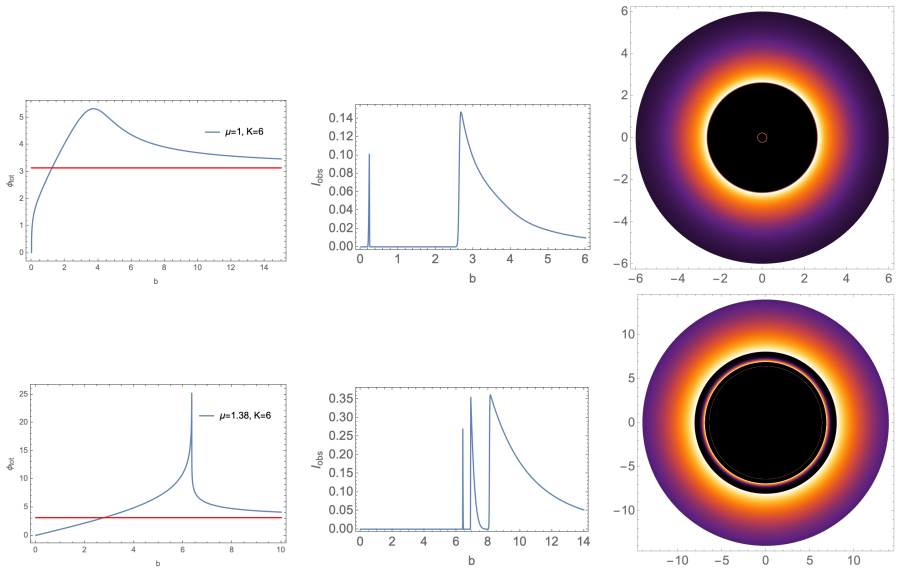
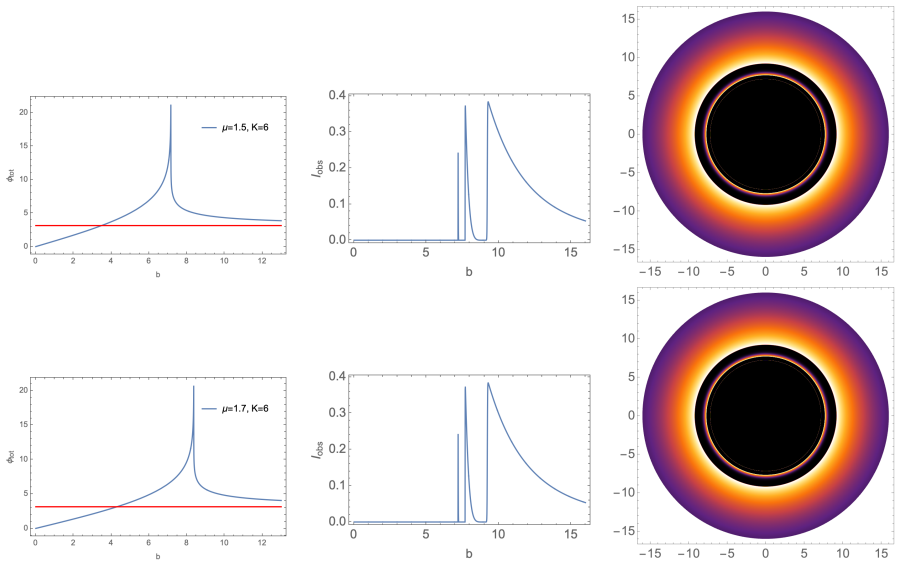
For fixed theory parameter, varying the mass parameter produces a sequence of spacetimes from timelike naked singularities through regular solitons and black holes with one or more horizons to Schwarzschild-like black holes. Null geodesics reveal light rings whose critical impact parameters control the apparent size of central depressions. Thin-disk ray-tracing shows that horizonless objects can exhibit shadow-like features while multi-horizon black holes can closely match single-horizon images when exterior light-ring and disk structures are similar. The optical appearance is therefore governed mainly by the photon potential and disk inner edge, with deeper horizon structure leaving only an
What carries the argument
The photon potential together with thin-disk ray-tracing applied to the analytic family of metrics parameterized by theory and mass parameters.
If this is right
- Images depend primarily on the critical impact parameter fixed by the outermost light ring.
- Rescaled radial brightness profiles become similar across different horizon structures.
- The morphological degeneracy holds when exterior light-ring and disk-edge properties coincide.
- Deeper horizon features affect only higher-order image details.
Where Pith is reading between the lines
- Shadow observations may fail to rule out horizonless objects in this class of theories.
- Similar image degeneracies could appear in other scalar-tensor models with primary hair.
- Thick-disk or polarized-light observations could break the degeneracy by probing closer to the would-be horizon.
Load-bearing premise
The given analytic solution accurately describes the spacetime metric of the theory and the thin-disk approximation captures the dominant light paths.
What would settle it
A ray-traced image of a horizonless object whose central depression size and brightness profile match those of a known single-horizon black hole only when their light-ring radii differ.
Figures
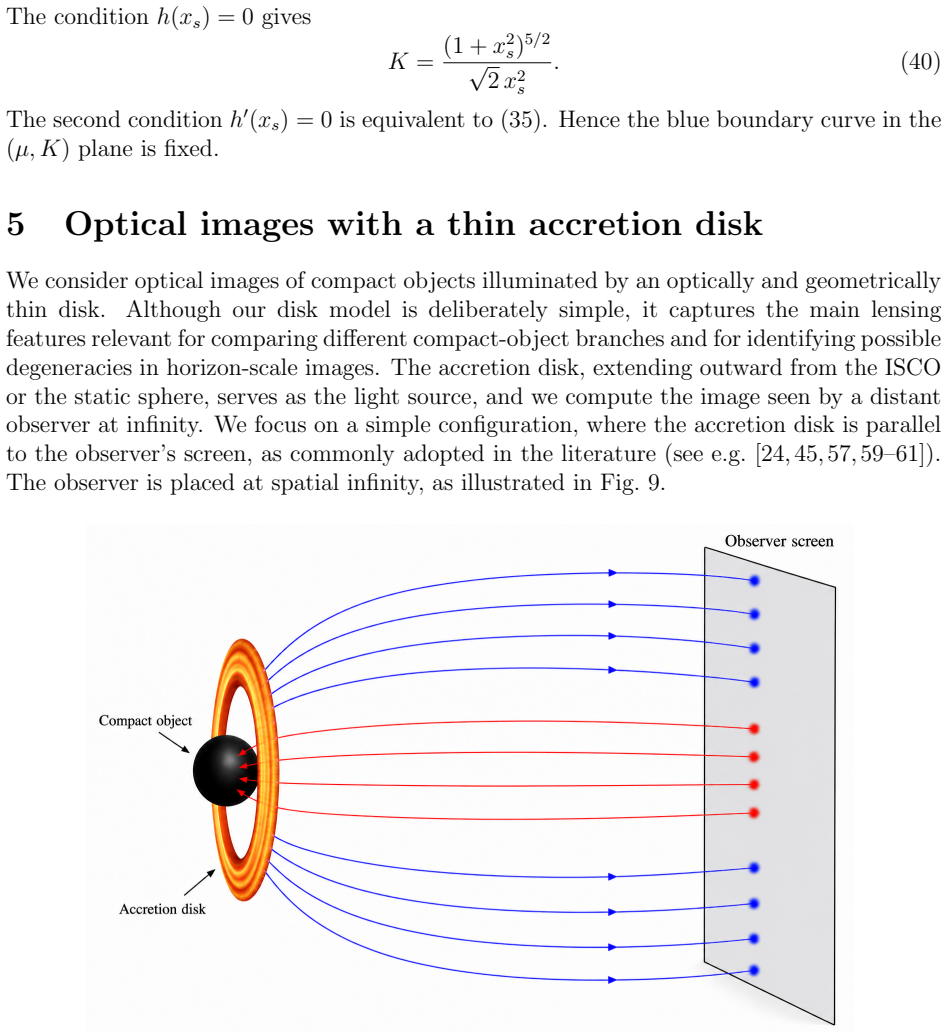
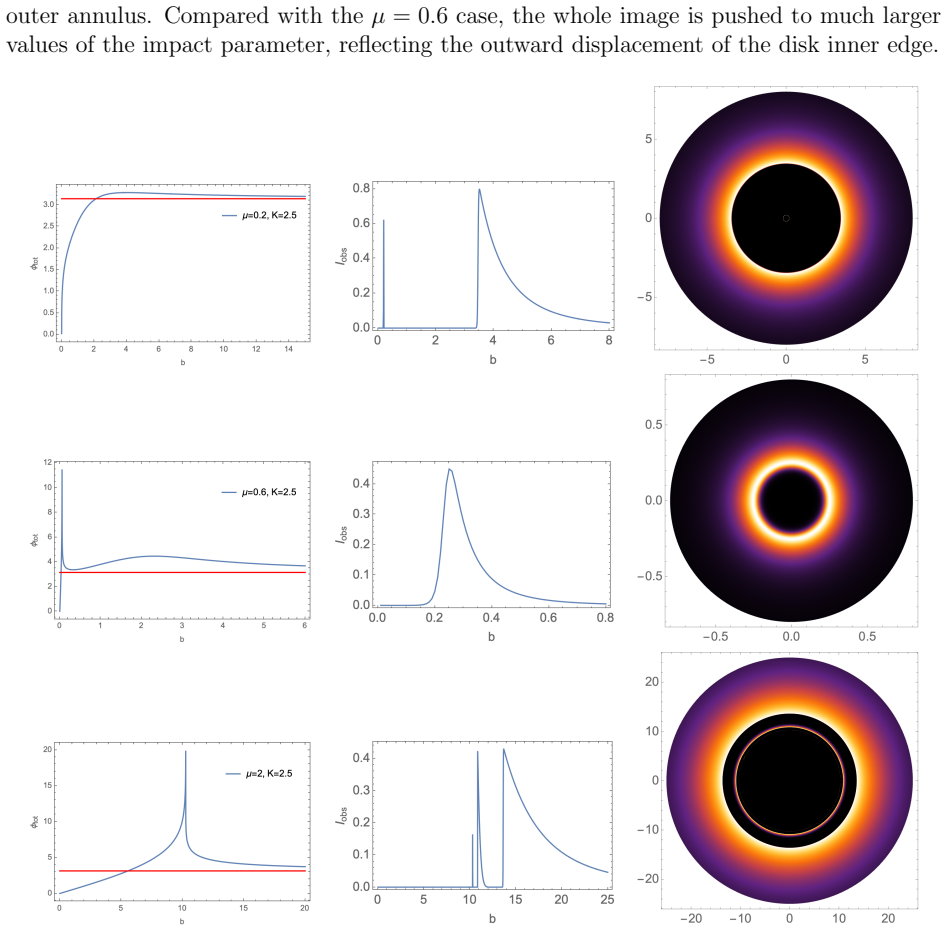
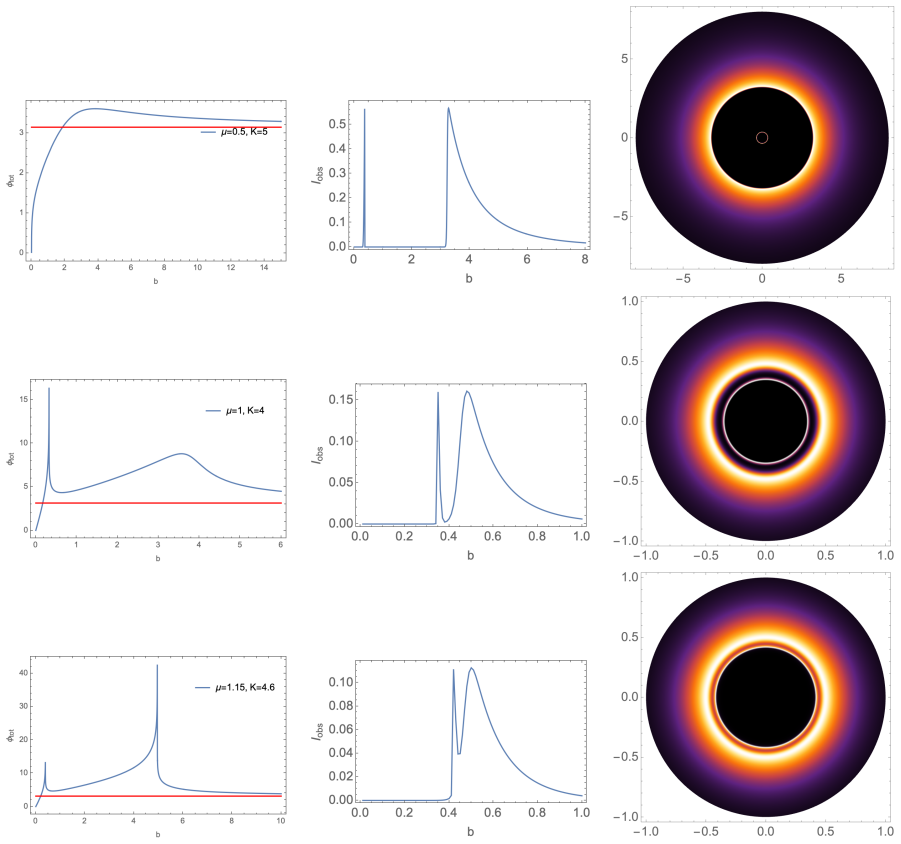
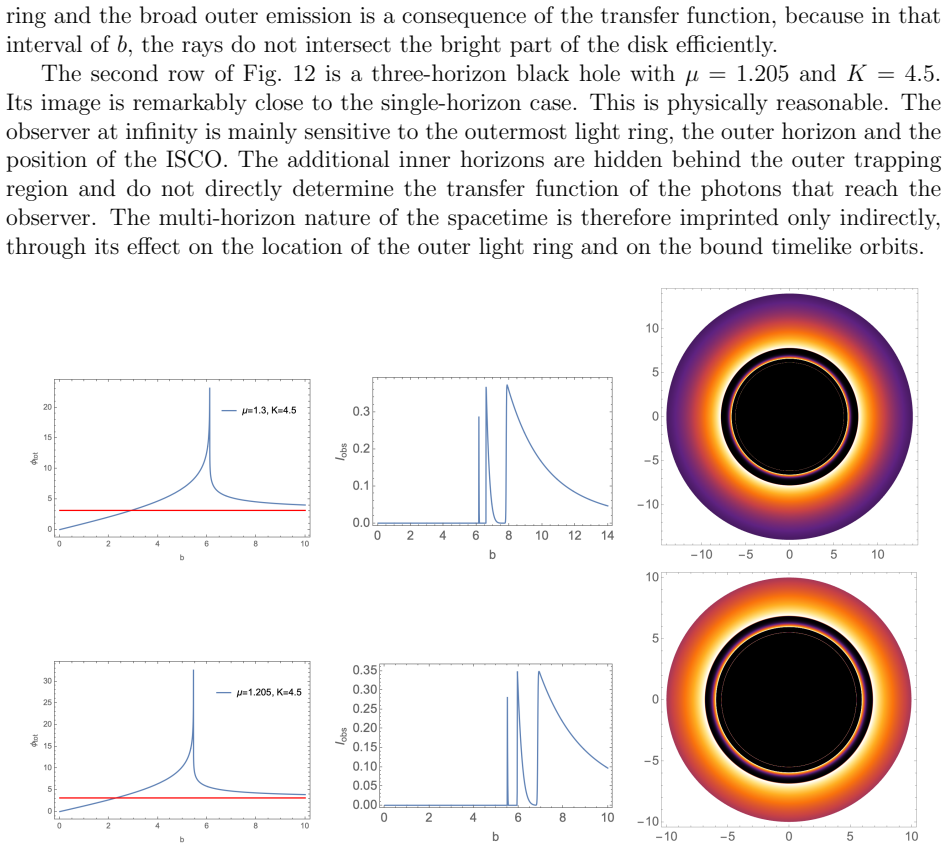
read the original abstract
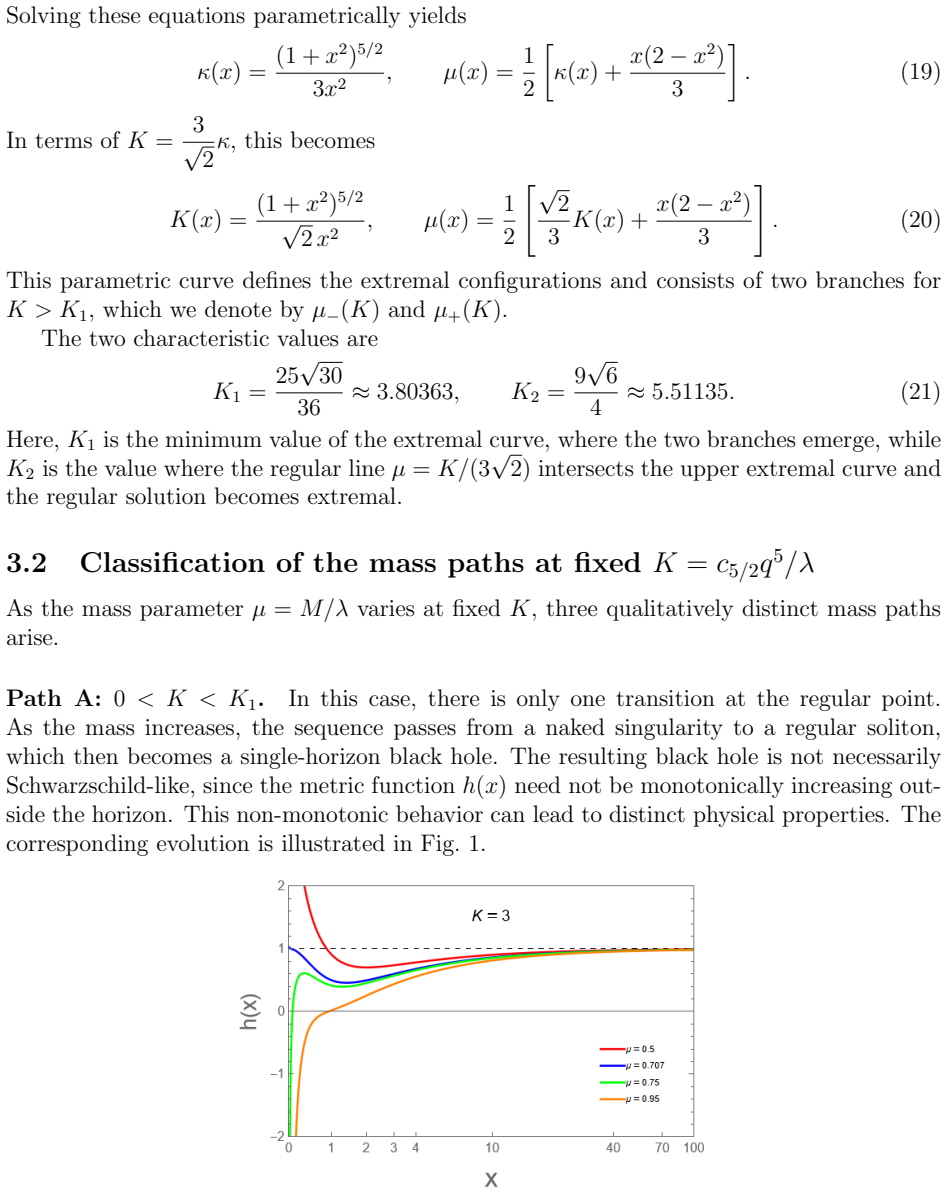
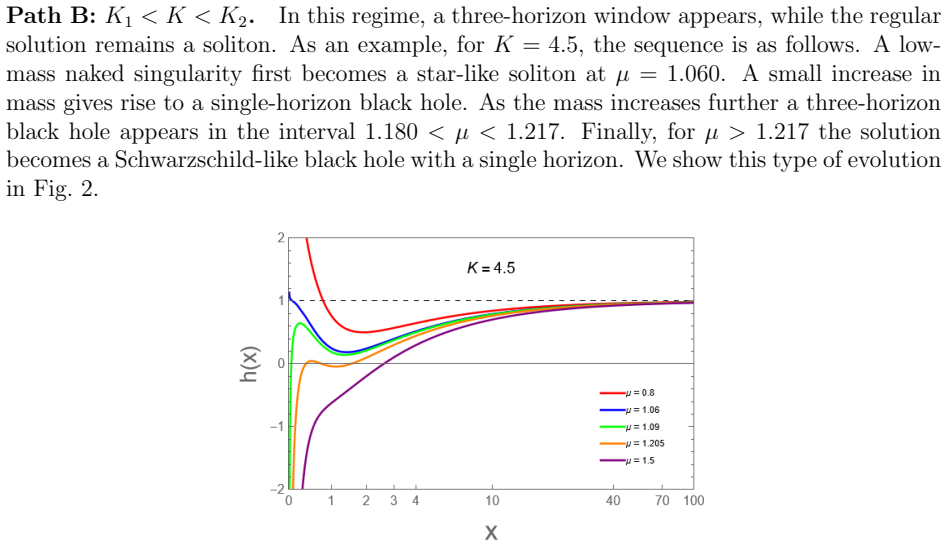
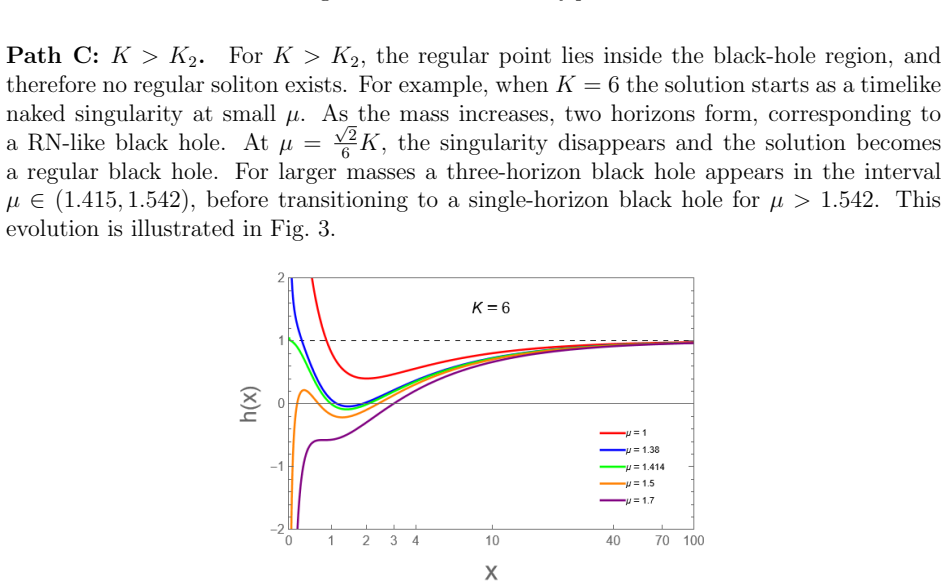
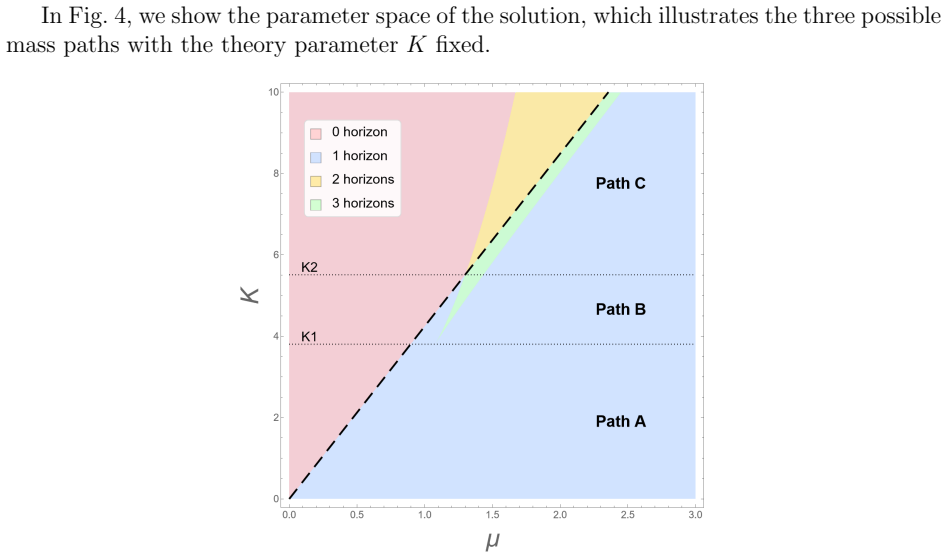
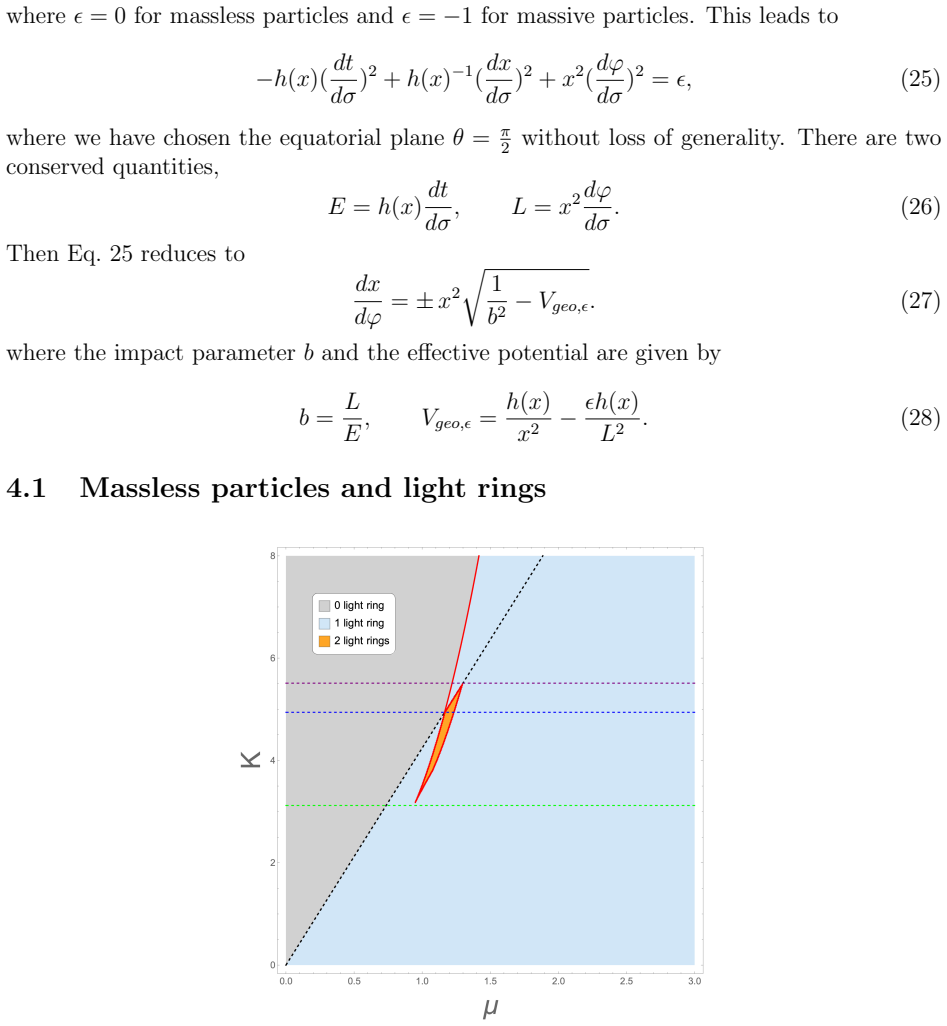
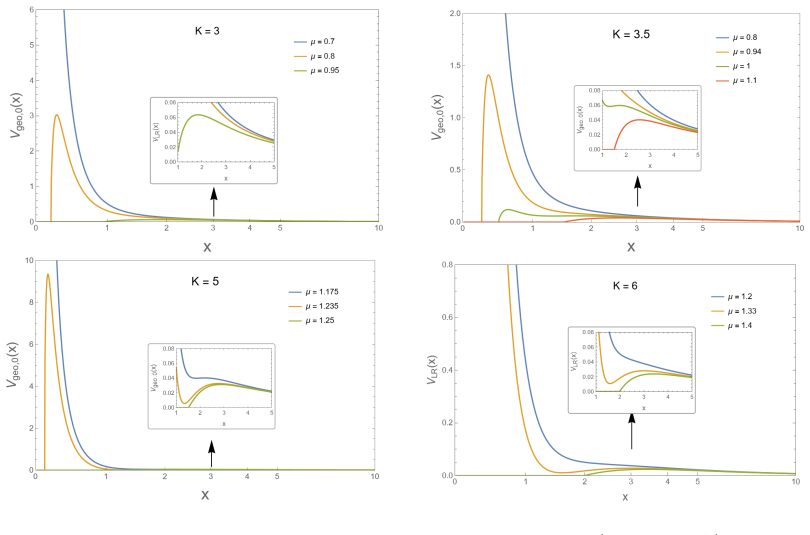
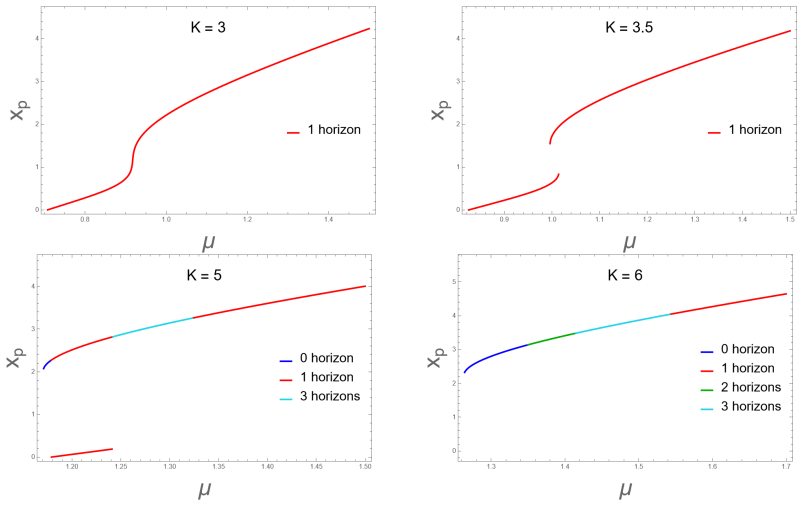
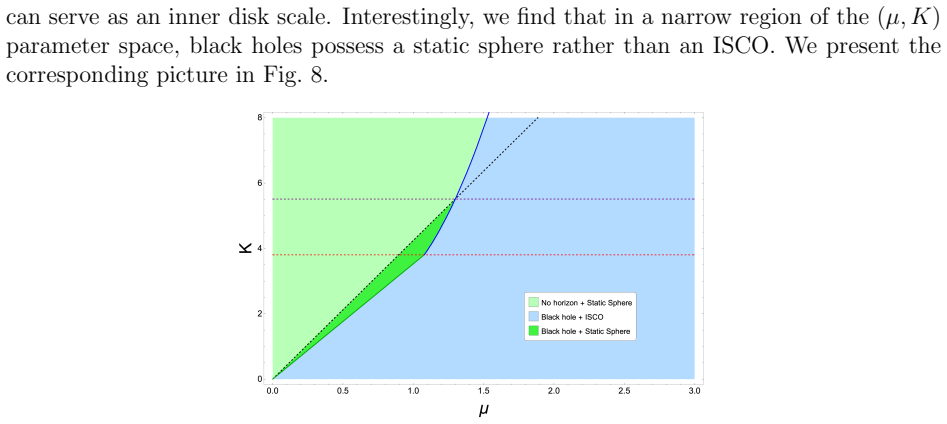
We investigate the geodesic structure and optical appearance of compact objects with primary scalar hair in shift- and parity-symmetric beyond Horndeski gravity. The analytic solution considered here depends on a theory parameter and a dimensionless mass parameter \cite{Bakopoulos:2023sdm}. For a fixed theory parameter, varying the mass traces a family of static spacetimes that can interpolate between timelike naked singularities, regular solitons, regular black holes, Reissner-Nordstr\"om-like black holes, multi-horizon black holes, and Schwarzschild-like black holes. We classify these branches by their horizon structure and analyze null and timelike geodesics, focusing on light rings, innermost stable circular orbits, and static spheres. We then compute thin-disk optical images by ray tracing. We find that the number of horizons is not directly encoded in the image: horizonless objects can show shadow-like central depressions, while multi-horizon black holes can closely resemble single-horizon black holes when their exterior light ring and disk structures are similar. Thus, the optical appearance is governed mainly by the photon potential and the disk inner edge, with the deeper horizon structure leaving only an indirect imprint. Quantitative radial-profile diagnostics confirm that the degeneracy is mainly morphological: the profiles differ at fixed impact parameter, but become much closer after rescaling by the critical impact parameter. These results provide a concrete example of how distinct compact object branches in beyond Horndeski gravity can share similar observational signatures.
Editorial analysis
A structured set of objections, weighed in public.
Referee Report
Summary. The manuscript examines the geodesic structure and thin-disk optical appearances of a one-parameter family of static spacetimes in shift- and parity-symmetric beyond Horndeski gravity. For fixed theory parameter, varying the dimensionless mass traces branches from timelike naked singularities through regular solitons to single- and multi-horizon black holes. After classifying horizons and locating light rings, ISCOs and static spheres, the authors ray-trace thin accretion disks and conclude that horizon number is not directly encoded in the image; optical morphology is controlled by the photon potential and disk inner edge, producing degeneracies in which horizonless objects exhibit shadow-like depressions and multi-horizon black holes resemble single-horizon ones. Radial-profile comparisons before and after rescaling by critical impact parameter quantify the mainly morphological character of the degeneracy.
Significance. If the reported degeneracies survive more complete radiative-transfer calculations, the work supplies a concrete, analytic example in modified gravity of how distinct horizon structures can share similar strong-field signatures. The explicit branch classification, location of light rings and ISCOs, and quantitative before/after-rescaling profile diagnostics are clear strengths that advance the literature on observational degeneracies beyond GR.
minor comments (3)
- [optical-appearance section] The thin-disk ray-tracing approximation is standard but central to the degeneracy claim; a brief discussion of its domain of validity (e.g., possible impact of non-geodesic effects or thick-disk emission on the central depression) would strengthen the manuscript without altering the reported results.
- Figure captions and axis labels should explicitly identify the theory-parameter value and the branch (naked singularity, soliton, RN-like, multi-horizon, Schwarzschild-like) for each curve.
- [introduction or metric section] The abstract states that the solution depends on a theory parameter and a dimensionless mass parameter; the main text should give the explicit ranges explored for both parameters.
Simulated Author's Rebuttal
We thank the referee for the positive summary, significance assessment, and recommendation of minor revision. The report accurately captures the manuscript's focus on geodesic structure, light rings, ISCOs, and thin-disk images across the family of solutions in shift- and parity-symmetric beyond Horndeski gravity, as well as the conclusion that optical morphology is controlled primarily by the photon potential and disk inner edge rather than horizon number.
Circularity Check
No circularity; results from explicit geodesic and ray-tracing computation on given metric family
full rationale
The paper obtains its central claims about horizon-independent optical appearances by classifying the analytic metric branches (from the cited solution), integrating the null geodesic equations to locate light rings, and performing thin-disk ray tracing to generate images and radial profiles. These steps are direct numerical/analytic evaluations of the geodesic structure and do not reduce to any fitted parameter, self-definition, or self-citation chain; the morphological degeneracy is an output of the integration, not an input. The cited metric source supplies the spacetime but carries no load-bearing uniqueness theorem or ansatz that the present work merely renames. No self-citation is invoked to justify the main result.
Axiom & Free-Parameter Ledger
free parameters (2)
- theory parameter
- dimensionless mass parameter
axioms (2)
- domain assumption The analytic solution from Bakopoulos:2023sdm correctly describes the metric in shift- and parity-symmetric beyond Horndeski gravity.
- domain assumption Standard null-geodesic equations and thin-disk ray tracing apply without additional radiative-transfer corrections.
Reference graph
Works this paper leans on
-
[1]
Compact objects with primary hair in shift and parity symmetric beyond Horndeski gravities,
A. Bakopoulos, N. Chatzifotis and T. Nakas, “Compact objects with primary hair in shift and parity symmetric beyond Horndeski gravities,” Phys. Rev. D110, 024044 (2024)
2024
-
[2]
Theory and Experiment in Gravitational Physics,
C. M. Will, “Theory and Experiment in Gravitational Physics,” Cambridge University Press (2018)
2018
-
[3]
Beyond Einstein Gravity: A Survey of Gravitational Theories for Cosmology and Astrophysics,
V. Faraoni and S. Capozziello, “Beyond Einstein Gravity: A Survey of Gravitational Theories for Cosmology and Astrophysics,” Springer (2011)
2011
-
[4]
Testing General Relativity with Present and Future Astrophysical Observations,
E. Bertiet al., “Testing General Relativity with Present and Future Astrophysical Observations,” Class. Quant. Grav.32, 243001 (2015)
2015
-
[5]
Modified Gravity and Cosmology: An Update by the CANTATA Network,
E. N. Saridakiset al.[CANTATA], “Modified Gravity and Cosmology: An Update by the CANTATA Network,” Springer (2021)
2021
-
[6]
Observation of Gravitational Waves from a Binary Black Hole Merger,
B. P. Abbottet al.[LIGO Scientific and Virgo], “Observation of Gravitational Waves from a Binary Black Hole Merger,” Phys. Rev. Lett.116, 061102 (2016)
2016
-
[7]
GW151226: Observation of Gravita- tional Waves from a 22-Solar-Mass Binary Black Hole Coalescence,
B. P. Abbottet al.[LIGO Scientific and Virgo], “GW151226: Observation of Gravita- tional Waves from a 22-Solar-Mass Binary Black Hole Coalescence,” Phys. Rev. Lett. 116, 241103 (2016)
2016
-
[8]
GWTC-1: A Gravitational-Wave Transient Catalog of Compact Binary Mergers Observed by LIGO and Virgo during the First and Second Observing Runs,
B. P. Abbottet al.[LIGO Scientific and Virgo], “GWTC-1: A Gravitational-Wave Transient Catalog of Compact Binary Mergers Observed by LIGO and Virgo during the First and Second Observing Runs,” Phys. Rev. X9, 031040 (2019)
2019
-
[9]
GWTC-2: Compact Binary Coalescences Observed by LIGO and Virgo During the First Half of the Third Observing Run,
R. Abbottet al.[LIGO Scientific and Virgo], “GWTC-2: Compact Binary Coalescences Observed by LIGO and Virgo During the First Half of the Third Observing Run,” Phys. Rev. X11, 021053 (2021)
2021
-
[10]
First M87 Event Horizon Telescope Results. I. The Shadow of the Supermassive Black Hole,
K. Akiyamaet al.[Event Horizon Telescope], “First M87 Event Horizon Telescope Results. I. The Shadow of the Supermassive Black Hole,” Astrophys. J. Lett.875, L1 (2019) 32
2019
-
[11]
First M87 Event Horizon Telescope Results. VI. The Shadow and Mass of the Central Black Hole,
K. Akiyamaet al.[Event Horizon Telescope], “First M87 Event Horizon Telescope Results. VI. The Shadow and Mass of the Central Black Hole,” Astrophys. J. Lett. 875, L6 (2019)
2019
-
[12]
First Sagittarius A* Event Horizon Tele- scope Results. I. The Shadow of the Supermassive Black Hole in the Center of the Milky Way,
K. Akiyamaet al.[Event Horizon Telescope], “First Sagittarius A* Event Horizon Tele- scope Results. I. The Shadow of the Supermassive Black Hole in the Center of the Milky Way,” Astrophys. J. Lett.930, L12 (2022)
2022
-
[13]
First Sagittarius A* Event Horizon Tele- scope Results. IV. Variability, Morphology, and Black Hole Mass,
K. Akiyamaet al.[Event Horizon Telescope], “First Sagittarius A* Event Horizon Tele- scope Results. IV. Variability, Morphology, and Black Hole Mass,” Astrophys. J. Lett. 930, L15 (2022)
2022
-
[14]
Healthy theories beyond Horndeski,
J. Gleyzes, D. Langlois, F. Piazza and F. Vernizzi, “Healthy theories beyond Horndeski,” Phys. Rev. Lett.114, 211101 (2015)
2015
-
[15]
Exploring gravitational theories beyond Horndeski,
J. Gleyzes, D. Langlois, F. Piazza and F. Vernizzi, “Exploring gravitational theories beyond Horndeski,” JCAP02, 018 (2015)
2015
-
[16]
Horndeski theory and beyond: a review,
T. Kobayashi, “Horndeski theory and beyond: a review,” Rept. Prog. Phys.82, 086901 (2019)
2019
-
[17]
Second-order scalar-tensor field equations in a four-dimensional space,
G. W. Horndeski, “Second-order scalar-tensor field equations in a four-dimensional space,” Int. J. Theor. Phys.10, 363 (1974)
1974
-
[18]
Degenerate higher derivative theories beyond Horndeski: evading the Ostrogradski instability,
D. Langlois and K. Noui, “Degenerate higher derivative theories beyond Horndeski: evading the Ostrogradski instability,” JCAP02, 034 (2016)
2016
-
[19]
Degenerate higher order scalar-tensor theories beyond Horndeski up to cubic order,
J. Ben Achour, M. Crisostomi, K. Koyama, D. Langlois, K. Noui and G. Tasinato, “Degenerate higher order scalar-tensor theories beyond Horndeski up to cubic order,” JHEP12, 100 (2016)
2016
-
[20]
Degenerate Higher-Order Scalar-Tensor (DHOST) theories
D. Langlois, “Degenerate Higher-Order Scalar-Tensor (DHOST) theories,” [arXiv:1707.03625 [gr-qc]]
work page internal anchor Pith review Pith/arXiv arXiv
-
[21]
Black holes with primary scalar hair,
A. Bakopoulos, C. Charmousis, P. Kanti, N. Lecoeur and T. Nakas, “Black holes with primary scalar hair,” Phys. Rev. D109, 024032 (2024)
2024
-
[22]
Thermodynamic and observational constraints on black holes with primary hair in Beyond Horndeski gravity: Stability and shadows,
C. Erices and M. Fathi, “Thermodynamic and observational constraints on black holes with primary hair in Beyond Horndeski gravity: Stability and shadows,” JCAP01, 016 (2025)
2025
-
[23]
Shadows and strong gravitational lensing: a brief review,
P. V. P. Cunha and C. A. R. Herdeiro, “Shadows and strong gravitational lensing: a brief review,” Gen. Rel. Grav.50, 42 (2018)
2018
-
[24]
Black Hole Shadows, Photon Rings, and Lensing Rings,
S. E. Gralla, D. E. Holz and R. M. Wald, “Black Hole Shadows, Photon Rings, and Lensing Rings,” Phys. Rev. D100, 024018 (2019) 33
2019
-
[25]
Does the black hole shadow probe the event horizon geometry?,
P. Cunha, V.P., C. A. R. Herdeiro and M. J. Rodriguez, “Does the black hole shadow probe the event horizon geometry?,” Phys. Rev. D97, 084020 (2018)
2018
-
[26]
Exotic Compact Objects and the Fate of the Light-Ring Instability,
P. V. P. Cunha, C. Herdeiro, E. Radu and N. Sanchis-Gual, “Exotic Compact Objects and the Fate of the Light-Ring Instability,” Phys. Rev. Lett.130, 061401 (2023)
2023
-
[27]
Influence of quantum correction on black hole shadows, photon rings, and lensing rings,
J. Peng, M. Guo and X. H. Feng, “Influence of quantum correction on black hole shadows, photon rings, and lensing rings,” Chin. Phys. C45, 085103 (2021)
2021
-
[28]
Static spheres around spherically symmetric black hole spacetime,
S. W. Wei, Y. P. Zhang, Y. X. Liu and R. B. Mann, “Static spheres around spherically symmetric black hole spacetime,” Phys. Rev. Res.5, 043050 (2023)
2023
-
[29]
Shadows and photon rings of a quantum black hole,
J. P. Ye, Z. Q. He, A. X. Zhou, Z. Y. Huang and J. H. Huang, “Shadows and photon rings of a quantum black hole,” Phys. Lett. B851, 138566 (2024)
2024
-
[30]
Lensing and light rings of parity-odd rotating boson stars,
Y. Huang, D. J. Liu and H. Zhang, “Lensing and light rings of parity-odd rotating boson stars,” Sci. China Phys. Mech. Astron.68, 280411 (2025)
2025
-
[31]
Dynamics of photons and shadows for black holes haired with parity-odd fields,
Y. Huang, D. J. Liu and H. Zhang, “Dynamics of photons and shadows for black holes haired with parity-odd fields,” JHEP11, 027 (2025)
2025
-
[32]
Light rings and shadows of static black holes in effective quantum gravity II: A new solution without Cauchy horizons,
W. Liu, D. Wu and J. Wang, “Light rings and shadows of static black holes in effective quantum gravity II: A new solution without Cauchy horizons,” Phys. Lett. B868, 139742 (2025)
2025
-
[33]
The optical appearance of a star orbiting an extreme Kerr black hole,
C. T. Cunningham and J. M. Bardeen, “The optical appearance of a star orbiting an extreme Kerr black hole,” Ap. J.183, 237 (1973)
1973
-
[34]
Image of a spherical black hole with thin accretion disk,
J. P. Luminet, “Image of a spherical black hole with thin accretion disk,” Astron. Astrophys.75, 228 (1979)
1979
-
[35]
Color Photographs of an Accretion Disk around a Black Hole,
J. Fukue and T. Yokoyama, “Color Photographs of an Accretion Disk around a Black Hole,” Publ. Astron. Soc. Japan40, 15 (1988)
1988
-
[36]
Image generation in Kerr geometry. I. Analytical investigations on the stationary emitter-observer problem,
S. U. Viergutz, “Image generation in Kerr geometry. I. Analytical investigations on the stationary emitter-observer problem,” Astron. Astrophys.272, 355 (1993)
1993
-
[37]
The photon transfer function for accretion disks around a Kerr black hole,
R. Speith, H. Riffert, H. Ruder, “The photon transfer function for accretion disks around a Kerr black hole,” Computer Physics Communications88, 109 (1995)
1995
-
[38]
Detecting Accretion Disks in Active Galactic Nuclei,
C. Fanton, M. Calvani, F. de Felice and A. ˇCadeˇ z, “Detecting Accretion Disks in Active Galactic Nuclei,” Publ. Astron. Soc. Japan49, 159 (1997)
1997
-
[39]
Viewing the shadow of the black hole at the galactic center,
H. Falcke, F. Melia and E. Agol, “Viewing the shadow of the black hole at the galactic center,” Astrophys. J. Lett.528, L13 (2000)
2000
-
[40]
The brightest point in accretion disk and black hole spin: implication to the image of black hole M87*,
V. I. Dokuchaev and N. O. Nazarova, “The brightest point in accretion disk and black hole spin: implication to the image of black hole M87*,” Universe5, 183 (2019) 34
2019
-
[41]
Image of the Janis-Newman- Winicour naked singularity with a thin accretion disk,
G. Gyulchev, P. Nedkova, T. Vetsov and S. Yazadjiev, “Image of the Janis-Newman- Winicour naked singularity with a thin accretion disk,” Phys. Rev. D100, 024055 (2019)
2019
-
[42]
Observational signa- tures of strongly naked singularities: image of the thin accretion disk,
G. Gyulchev, J. Kunz, P. Nedkova, T. Vetsov and S. Yazadjiev, “Observational signa- tures of strongly naked singularities: image of the thin accretion disk,” Eur. Phys. J. C 80, 1017 (2020)
2020
-
[43]
Image of the thin accretion disk around compact objects in the Einstein–Gauss–Bonnet gravity,
G. Gyulchev, P. Nedkova, T. Vetsov and S. Yazadjiev, “Image of the thin accretion disk around compact objects in the Einstein–Gauss–Bonnet gravity,” Eur. Phys. J. C81, 885 (2021)
2021
-
[44]
Light ring behind wormhole throat: Geodesics, images, and shadows,
H. Huang, J. Kunz, J. Yang and C. Zhang, “Light ring behind wormhole throat: Geodesics, images, and shadows,” Phys. Rev. D107, 104060 (2023)
2023
-
[45]
Shadow images of compact objects in beyond Horn- deski theory,
H. Huang, J. Kunz and D. Mitra, “Shadow images of compact objects in beyond Horn- deski theory,” JCAP05, 007 (2024)
2024
-
[46]
Observing naked singularities with the present and next-generation Event Horizon Telescope,
V. Deliyski, G. Gyulchev, P. Nedkova and S. Yazadjiev, “Observing naked singularities with the present and next-generation Event Horizon Telescope,” Phys. Rev. D111, 064068 (2025)
2025
-
[47]
V. O. Deliyski, G. N. Gyulchev, D. D. Doneva, P. G. Nedkova and S. S. Yazadjiev, “Polarized Equatorial Emission around Kerr Black Holes with Synchronized Scalar Hair. I. Direct images,” [arXiv:2605.03006 [gr-qc]]
work page internal anchor Pith review Pith/arXiv arXiv
-
[48]
Optical images of Kerr-Sen black hole illuminated by thick accretion disks
Y. K. Wang, C. Y. Yang and X. X. Zeng, “Optical images of Kerr-Sen black hole illuminated by thick accretion disks,” [arXiv:2604.08439 [astro-ph.HE]]
work page internal anchor Pith review Pith/arXiv arXiv
-
[49]
Gravitational Field of a Global Monopole,
M. Barriola and A. Vilenkin, “Gravitational Field of a Global Monopole,” Phys. Rev. Lett.63, 341 (1989)
1989
-
[50]
Global monopoles in the extended Gauss-Bonnet gravity,
N. Chatzifotis, N. E. Mavromatos and D. P. Theodosopoulos, “Global monopoles in the extended Gauss-Bonnet gravity,” Phys. Rev. D107, 085014 (2023)
2023
-
[51]
Light rings as observational evidence for event horizons: long-lived modes, ergoregions and nonlinear instabilities of ultracompact objects,
V. Cardoso, L. C. B. Crispino, C. F. B. Macedo, H. Okawa and P. Pani, “Light rings as observational evidence for event horizons: long-lived modes, ergoregions and nonlinear instabilities of ultracompact objects,” Phys. Rev. D90, 044069 (2014)
2014
-
[52]
Light-Ring Stability for Ultracompact Objects,
P. V. P. Cunha, E. Berti and C. A. R. Herdeiro, “Light-Ring Stability for Ultracompact Objects,” Phys. Rev. Lett.119, 251102 (2017)
2017
-
[53]
On the number of light rings in curved spacetimes of ultra-compact objects,
S. Hod, “On the number of light rings in curved spacetimes of ultra-compact objects,” Phys. Lett. B776, 1 (2018)
2018
-
[54]
Stationary black holes and light rings,
P. V. P. Cunha and C. A. R. Herdeiro, “Stationary black holes and light rings,” Phys. Rev. Lett.124, 181101 (2020) 35
2020
-
[55]
Investigating shadow images and rings of the charged Horndeski black hole illuminated by various thin accretions,
X. J. Gao, T. T. Sui, X. X. Zeng, Y. S. An and Y. P. Hu, “Investigating shadow images and rings of the charged Horndeski black hole illuminated by various thin accretions,” Eur. Phys. J. C83, 1052 (2023)
2023
-
[56]
Observational appearances of an inner extremal regular black hole illuminated by various accretion flows,
D. Zhang, G. Fu, X. J. Wang, Q. Pan, X. M. Kuang and J. P. Wu, “Observational appearances of an inner extremal regular black hole illuminated by various accretion flows,” Eur. Phys. J. C85, 1051 (2025)
2025
-
[57]
A code to compute the emission of thin accretion disks in non-Kerr space- times and test the nature of black hole candidates,
C. Bambi, “A code to compute the emission of thin accretion disks in non-Kerr space- times and test the nature of black hole candidates,” Astrophys. J.761, 174 (2012)
2012
-
[58]
Observational features of thin accretion disk around rotating regular black hole,
Z. Li, “Observational features of thin accretion disk around rotating regular black hole,” Eur. Phys. J. C85, 514 (2025)
2025
-
[59]
Shadows and photon spheres with spherical accretions in the four-dimensional Gauss–Bonnet black hole,
X. X. Zeng, H. Q. Zhang and H. Zhang, “Shadows and photon spheres with spherical accretions in the four-dimensional Gauss–Bonnet black hole,” Eur. Phys. J. C80, 872 (2020)
2020
-
[60]
Black hole image encoding quantum gravity informa- tion,
C. Zhang, Y. Ma and J. Yang, “Black hole image encoding quantum gravity informa- tion,” Phys. Rev. D108, 104004 (2023)
2023
-
[61]
Shadow of the scalar hairy black hole with inverted Higgs potential,
K. G. Lim and X. Y. Chew, “Shadow of the scalar hairy black hole with inverted Higgs potential,” Phys. Rev. D111, 084085 (2025)
2025
-
[62]
Shadows and rings of the Kehagias-Sfetsos black hole surrounded by thin disk accretion,
G. P. Li and K. J. He, “Shadows and rings of the Kehagias-Sfetsos black hole surrounded by thin disk accretion,” JCAP06, 037 (2021)
2021
-
[63]
Shadows and optical appearance of black bounces illuminated by a thin accretion disk,
M. Guerrero, G. J. Olmo, D. Rubiera-Garcia and D. S. C. G´ omez, “Shadows and optical appearance of black bounces illuminated by a thin accretion disk,” JCAP08, 036 (2021)
2021
-
[64]
Thin accretion disk in the Simpson- Visser black-bounce and wormhole spacetimes,
P. Bambhaniya, S. K, K. Jusufi and P. S. Joshi, “Thin accretion disk in the Simpson- Visser black-bounce and wormhole spacetimes,” Phys. Rev. D105, 023021 (2022)
2022
-
[65]
Shadows of boson and Proca stars with thin accre- tion disks,
J. L. Rosa and D. Rubiera-Garcia, “Shadows of boson and Proca stars with thin accre- tion disks,” Phys. Rev. D106, 084004 (2022)
2022
-
[66]
Light ring images of double photon spheres in black hole and wormhole spacetimes,
M. Guerrero, G. J. Olmo, D. Rubiera-Garcia and D. G´ omez S´ aez-Chill´ on, “Light ring images of double photon spheres in black hole and wormhole spacetimes,” Phys. Rev. D105, 084057 (2022)
2022
-
[67]
Multiring images of thin accretion disk of a regular naked compact object,
M. Guerrero, G. J. Olmo, D. Rubiera-Garcia and D. S´ aez-Chill´ on G´ omez, “Multiring images of thin accretion disk of a regular naked compact object,” Phys. Rev. D106, 044070 (2022)
2022
-
[68]
The Current Ability to Test Theories of Gravity with Black Hole Shadows,
Y. Mizuno, Z. Younsi, C. M. Fromm, O. Porth, M. De Laurentis, H. Olivares, H. Falcke, M. Kramer and L. Rezzolla, “The Current Ability to Test Theories of Gravity with Black Hole Shadows,” Nature Astron.2, 585 (2018) 36
2018
-
[69]
Universal interferometric signatures of a black hole’s photon ring,
M. D. Johnson, A. Lupsasca, A. Strominger, G. N. Wong, S. Hadar, D. Kapec, R. Narayan, A. Chael, C. F. Gammie and P. Galison,et al.“Universal interferometric signatures of a black hole’s photon ring,” Sci. Adv.6, eaaz1310 (2020)
2020
-
[70]
Geometric modeling of M87* as a Kerr black hole or a non-Kerr compact object,
F. H. Vincent, M. Wielgus, M. A. Abramowicz, E. Gourgoulhon, J. P. Lasota, T. Pau- mard and G. Perrin, “Geometric modeling of M87* as a Kerr black hole or a non-Kerr compact object,” Astron. Astrophys.646, A37 (2021)
2021
-
[71]
The shape of the black hole photon ring: A precise test of strong-field general relativity,
S. E. Gralla, A. Lupsasca and D. P. Marrone, “The shape of the black hole photon ring: A precise test of strong-field general relativity,” Phys. Rev. D102, 124004 (2020)
2020
-
[72]
Black Hole Images as Tests of General Relativity: Effects of Spacetime Geometry,
Z. Younsi, D. Psaltis and F. ¨Ozel, “Black Hole Images as Tests of General Relativity: Effects of Spacetime Geometry,” Astrophys. J.942, 47 (2023)
2023
-
[73]
The Photon Ring in M87*,
A. E. Broderick, D. W. Pesce, P. Tiede, H. Y. Pu, R. Gold, R. Anantua, S. Britzen, C. Ceccobello, K. Chatterjee and Y. Chen,et al.“The Photon Ring in M87*,” Astro- phys. J.935, 61 (2022)
2022
-
[74]
Interferometric Imaging Directly with Closure Phases and Closure Am- plitudes,
A. A. Chael, M. D. Johnson, K. L. Bouman, L. L. Blackburn, K. Akiyama and R. Narayan, “Interferometric Imaging Directly with Closure Phases and Closure Am- plitudes,” Astrophys. J.857, 23 (2018)
2018
-
[75]
Tracing Hot Spot Motion in Sagit- tarius A* Using the Next-Generation Event Horizon Telescope (ngEHT),
R. Emami, P. Tiede, S. S. Doeleman, F. Roelofs, M. Wielgus, L. Blackburn, M. Liska, K. Chatterjee, B. Ripperda and A. Fuentes,et al.“Tracing Hot Spot Motion in Sagit- tarius A* Using the Next-Generation Event Horizon Telescope (ngEHT),” Galaxies11, 23 (2023)
2023
-
[76]
Can we distinguish black holes from naked singularities by the images of their accretion disks?,
R. Shaikh and P. S. Joshi, “Can we distinguish black holes from naked singularities by the images of their accretion disks?,” JCAP10, 064 (2019)
2019
-
[77]
Shadow of a Naked Singularity without Photon Sphere,
A. B. Joshi, D. Dey, P. S. Joshi and P. Bambhaniya, “Shadow of a Naked Singularity without Photon Sphere,” Phys. Rev. D102, 024022 (2020)
2020
-
[78]
Shadow of nulllike and timelike naked singularities without photon spheres,
D. Dey, R. Shaikh and P. S. Joshi, “Shadow of nulllike and timelike naked singularities without photon spheres,” Phys. Rev. D103, 024015 (2021) 37
2021
discussion (0)
Sign in with ORCID, Apple, or X to comment. Anyone can read and Pith papers without signing in.