Stability Analysis of Superconductivity in textit{P6/mmm}-LaSc₂H₂₄ and its Experimental Reproducibility from La-Sc Alloys
Pith reviewed 2026-06-29 00:26 UTC · model grok-4.3
The pith
Tetrahedral electron-phonon integration yields Tc above 300 K for LaSc2H24 at 300 GPa while the phase sits at the stability edge.
A machine-rendered reading of the paper's core claim, the machinery that carries it, and where it could break.
Core claim
The tetrahedral method for the electron-phonon interaction, unlike σ-broadening of the double delta function, produces a stable Tc > 300 K at 300 GPa for LaSc2H24. This compound exists at the edge of stability (ξ = 0.54) in the 250-300 GPa range. Experimental synthesis from the (La, Sc2) alloy at 250-280 GPa produces no superconducting La-Sc-H phases.
What carries the argument
The tetrahedral method for evaluating the electron-phonon coupling matrix elements on the Fermi surface.
Load-bearing premise
Unsuccessful attempts to synthesize LaSc2H24 from the (La,Sc2) alloy indicate that the compound does not form at all, rather than that the chosen pressure, temperature, or precursor method was insufficient.
What would settle it
Detection of superconductivity above 245 K or formation of the P6/mmm-LaSc2H24 phase in samples prepared by simultaneous deposition of lanthanum and scandium metals at 250-280 GPa.
Figures
read the original abstract
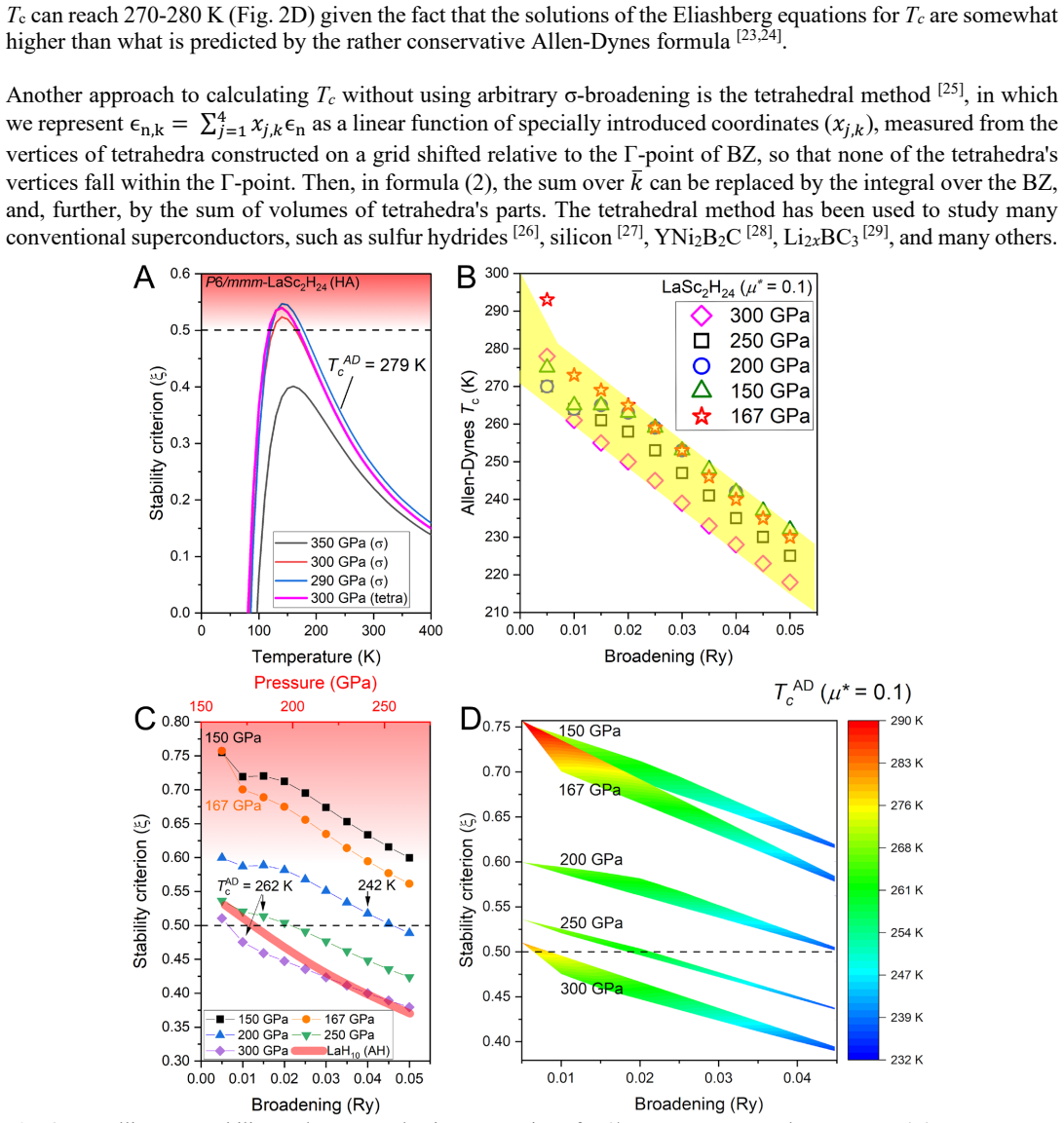
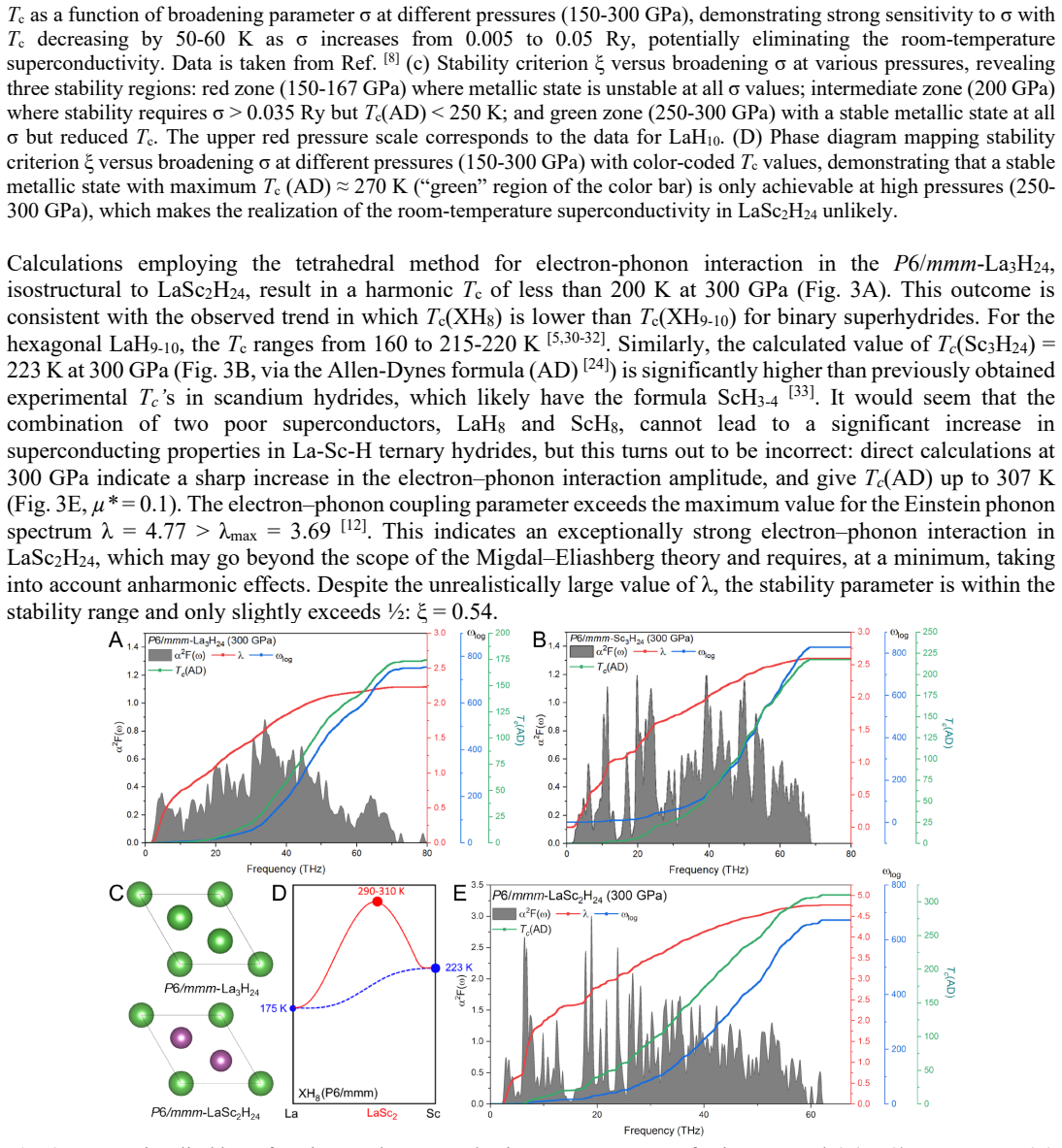
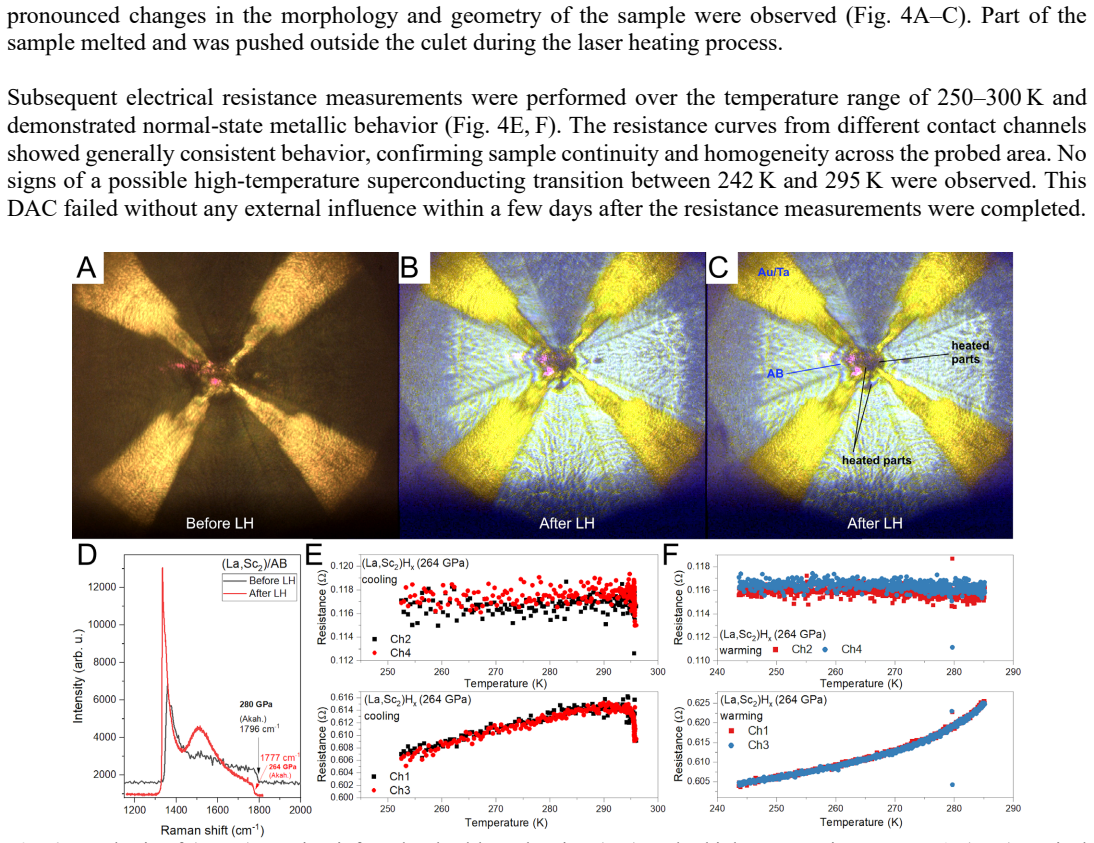
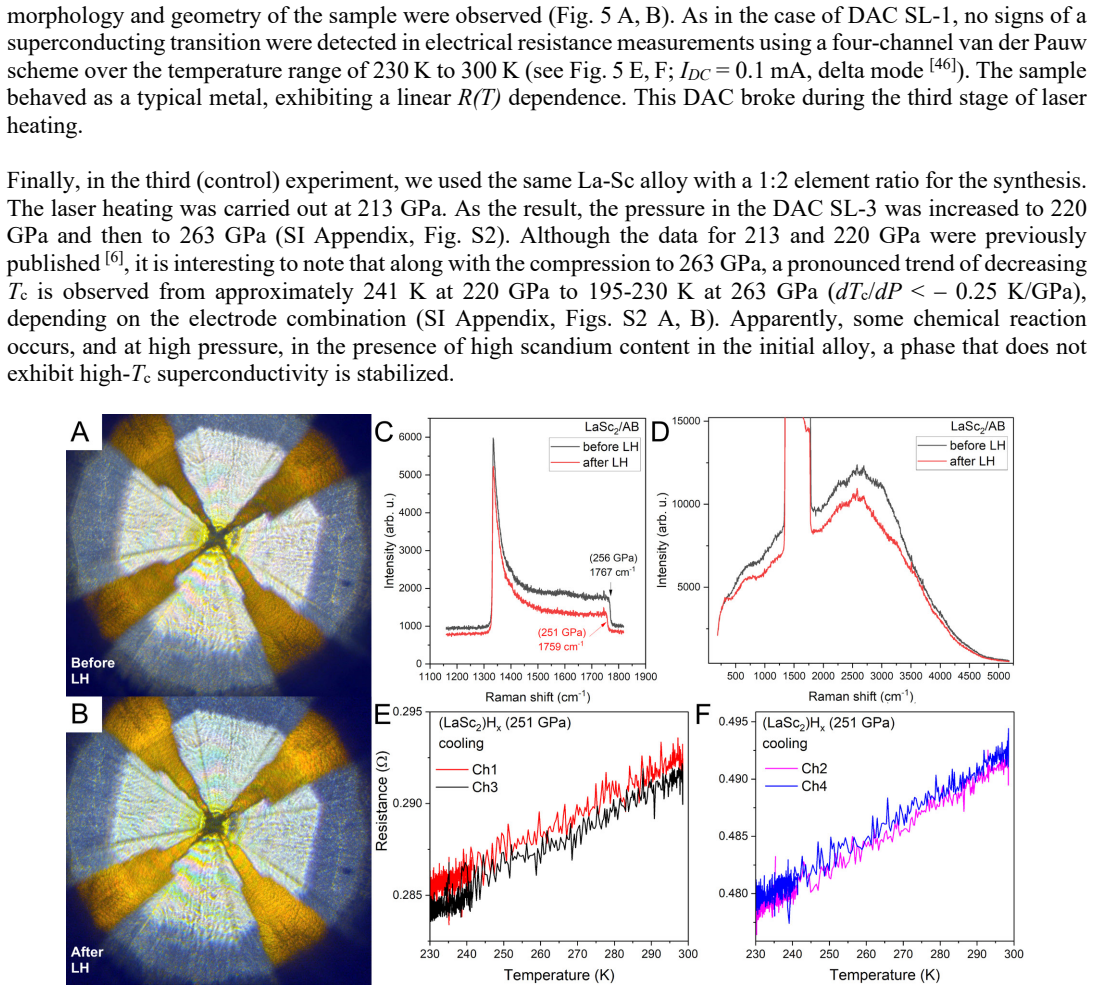
In this work, we analyze the feasibility of room-temperature superconductivity in the lanthanum-scandium hydride $\textit{P6/mmm}$-LaSc$_2$H$_{24}$. We demonstrate that the electron-phonon coupling calculations performed using the ${\sigma}$-broadening of the double ${\delta}$-function at the Fermi surface lead to a very strong dependence of $\textit{T$_c$}({\sigma})$ on the arbitrary ${\sigma}$, whereas the tetrahedral method for the electron-phonon interaction is free from this drawback and leads to $\textit{T$_c$}$ > 300 K at 300 GPa in agreement with previous predictions. By analyzing the stability of the metallic state of LaSc$_2$H$_{24}$ at 250-300 GPa, we show that this compound is at the edge of the stability region (${\xi}$ = 0.54), similar to $\textit{fcc}$ LaH$_{10}$ at 140-150 GPa. Experimental attempts to synthesize LaSc$_2$H$_{24}$ at 250-280 GPa starting from the (La,Sc$_2$) alloy are unsuccessful and indicate the absence of even traces of superconductivity at 245-300 K in all the resulting La-Sc-H hydrides. The method for preparing the precursor by simultaneous deposition of La and Sc metals may be a key factor for the successful synthesis of LaSc$_2$H$_{24}$.
Editorial analysis
A structured set of objections, weighed in public.
Referee Report
Summary. The manuscript analyzes the feasibility of room-temperature superconductivity in P6/mmm-LaSc₂H₂₄. It demonstrates that σ-broadening of the double δ-function at the Fermi surface produces strong, arbitrary dependence of Tc(σ), whereas the tetrahedral method for electron-phonon coupling yields Tc > 300 K at 300 GPa. Stability analysis places the compound at the edge of the metallic state (ξ = 0.54) at 250-300 GPa, analogous to fcc-LaH₁₀. Experimental attempts to form the phase from (La,Sc₂) alloy at 250-280 GPa are reported as unsuccessful, with no superconductivity observed at 245-300 K, and simultaneous La/Sc deposition is suggested as potentially key.
Significance. If the tetrahedral-method results and stability assessment are robust, the work would supply a concrete methodological caution against σ-broadening in hydride calculations and illustrate the experimental difficulties for phases near stability boundaries. The failed synthesis attempts supply independent evidence separate from the theoretical Tc values.
major comments (2)
- [Abstract] Abstract (experimental paragraph): the claim that unsuccessful synthesis from the (La,Sc₂) alloy indicates absence of LaSc₂H₂₄ formation is load-bearing for the reproducibility conclusion, yet the text itself states that simultaneous deposition 'may be a key factor,' leaving open the possibility that the alloy-precursor route fails even if the phase is stable under improved conditions; no controls with known analogs or direct phase identification are described to close this gap.
- [Stability analysis] Stability analysis (ξ = 0.54): the quantitative definition of the stability parameter ξ, the pressure range over which it is evaluated, and the explicit numerical comparison to the corresponding value for LaH₁₀ at 140-150 GPa are not provided in sufficient detail to confirm that the compound sits at a comparable stability edge; this underpins the central claim linking marginal stability to synthesis difficulty.
minor comments (2)
- The abstract refers to 'all the resulting La-Sc-H hydrides' without specifying the characterization techniques, pressure calibration, or temperature range of the resistivity or magnetic measurements.
- Notation for the stability parameter ξ should be introduced with its explicit formula or reference in the main text.
Simulated Author's Rebuttal
We thank the referee for the careful reading and constructive comments on our manuscript. We address each major comment point by point below, indicating where revisions will be made to improve clarity and precision.
read point-by-point responses
-
Referee: [Abstract] Abstract (experimental paragraph): the claim that unsuccessful synthesis from the (La,Sc₂) alloy indicates absence of LaSc₂H₂₄ formation is load-bearing for the reproducibility conclusion, yet the text itself states that simultaneous deposition 'may be a key factor,' leaving open the possibility that the alloy-precursor route fails even if the phase is stable under improved conditions; no controls with known analogs or direct phase identification are described to close this gap.
Authors: We agree that the abstract wording merits refinement to ensure the experimental conclusion is not overstated. The manuscript already qualifies the result by noting that simultaneous La/Sc deposition may be a key factor, which acknowledges the limitations of the alloy route. In revision we will rephrase the abstract to state that the (La,Sc₂) alloy precursor route did not produce detectable LaSc₂H₂₄ or superconductivity, while explicitly preserving the caveat about alternative synthesis conditions. We will also add a brief clarification that direct phase identification was not performed in these runs. This addresses the concern on the basis of the existing data without altering the reported observations. revision: partial
-
Referee: [Stability analysis] Stability analysis (ξ = 0.54): the quantitative definition of the stability parameter ξ, the pressure range over which it is evaluated, and the explicit numerical comparison to the corresponding value for LaH₁₀ at 140-150 GPa are not provided in sufficient detail to confirm that the compound sits at a comparable stability edge; this underpins the central claim linking marginal stability to synthesis difficulty.
Authors: We accept that additional explicit detail on the stability parameter would strengthen the presentation. In the revised manuscript we will supply the quantitative definition of ξ, confirm that the value ξ = 0.54 is evaluated at 250–300 GPa, and include the corresponding numerical value obtained for fcc-LaH₁₀ at 140–150 GPa to enable direct comparison. These additions will make the analogy to marginal stability fully transparent while leaving the underlying analysis unchanged. revision: yes
Circularity Check
No significant circularity detected
full rationale
The paper derives Tc > 300 K at 300 GPa via the tetrahedral electron-phonon method (contrasted explicitly with sigma-broadening dependence) and obtains ξ = 0.54 from direct stability analysis of the metallic state at 250-300 GPa. These steps are presented as independent computations. The unsuccessful synthesis from (La,Sc2) alloy is reported as a separate experimental observation, not used to derive the theoretical stability or Tc values. No quoted equations or steps reduce by construction to inputs, fitted parameters renamed as predictions, or load-bearing self-citations. The derivation chain remains self-contained.
Axiom & Free-Parameter Ledger
free parameters (1)
- σ
axioms (2)
- domain assumption The tetrahedral integration method for electron-phonon coupling is free of arbitrary parameters and accurate for this system.
- standard math Standard assumptions of density functional perturbation theory apply to high-pressure La-Sc hydrides.
Reference graph
Works this paper leans on
-
[1]
Somayazulu, M
M. Somayazulu, M. Ahart, A. K. Mishra, Z. M. Geballe, M. Baldini, Y. Meng, V. V. Struzhkin,R. J. Hemley, Phys. Rev. Lett. 2019, 122, 027001
2019
-
[2]
A. P. Drozdov, P. P. Kong, V. S. Minkov, S. P. Besedin, M. A. Kuzovnikov, S. Mozaffari, L. Balicas, F. F. Balakirev, D. E. Graf, V. B. Prakapenka, E. Greenberg, D. A. Knyazev, M. Tkacz,M. I. Eremets, Nature 2019, 569, 528-531
2019
-
[3]
Struzhkin, B
V. Struzhkin, B. Li, C. Ji, X.-J. Chen, V. Prakapenka, E. Greenberg, I. Troyan, A. Gavriliuk,H.-k. Mao, Matter Radiat. Extremes 2020, 5, 028201
2020
-
[4]
Y. L. Wu, X. H. Yu, J. Z. L. Hasaien, F. Hong, P. F. Shan, Z. Y. Tian, Y. N. Zhai, J. P. Hu, J. G. Cheng,J. Zhao, Nat. Commun. 2024, 15, 9683
2024
-
[5]
A. V. Sadakov, V. A. Vlasenko, I. A. Troyan, O. A. Sobolevskiy, D. V. Semenok, D. Zhou,V. M. Pudalov, J. Phys. Chem. Lett. 2023, 14, 6666-6671
2023
-
[6]
D. V. Semenok, I. A. Troyan, D. Zhou, A. V. Sadakov, K. S. Pervakov, O. A. Sobolevskiy, A. G. Ivanova, M. Galasso, F. G. Alabarse, W. Chen, C. Xi, T. Helm, S. Luther, V. M. Pudalov,V. V. Struzhkin, Adv. Funct. Mater. 2025, 35, 2504748
2025
-
[7]
D. V. Semenok, D. Zhou, J. Zhang, T. Helm, Y. Ding, H.-k. Mao,V. V. Struzhkin. (2025)
2025
-
[8]
X. He, W. Zhao, Y. Xie, A. Hermann, R. J. Hemley, H. Liu,Y. Ma, Proc. Natl. Acad. Sci. 2024, 121, e2401840121
2024
-
[9]
D. V. Semenok, F. Bärtl, D. Zhou, T. Helm, S. Luther, J. Wosnitza, I. A. Troyan, V. V. Struzhkin,H. Kühne, Adv. Sci. 2026, 13, e20701. 12
2026
-
[10]
Y. Song, presented at 29th International Conference on High Pressure Science and Technology (AIRAPT- 29), Room-Temperature Superconductivity at 298 K in Ternary La-Sc-H System at High-pressure Conditions, Matsuyama, Japan (Year)
-
[11]
Y. Song, C. Ma, H. Wang, M. Zhou, Y. Qi, W. Cao, S. Li, H. Liu, G. Liu,Y. Ma, arXiv:2510.01273 2025
arXiv 2025
-
[12]
D. V. Semenok, B. L. Altshuler,E. A. Yuzbashyan, Adv. Mater. 2025, 37, 2507013
2025
-
[13]
E. A. Yuzbashyan, B. L. Altshuler, Phys. Rev. B 2022, 106, 054518
2022
-
[14]
E. A. Yuzbashyan, B. L. Altshuler,A. Patra, Physical review letters 2025, 135, 026503
2025
-
[15]
Errea, F
I. Errea, F. Belli, L. Monacelli, A. Sanna, T. Koretsune, T. Tadano, R. Bianco, M. Calandra, R. Arita, F. Mauri,J. A. Flores-Livas, Nature 2020, 578, 66-69
2020
-
[16]
D. Sun, V. S. Minkov, S. Mozaffari, Y. Sun, Y. Ma, S. Chariton, V. B. Prakapenka, M. I. Eremets, L. Balicas,F. F. Balakirev, Nat. Commun. 2021, 12, 6863
2021
-
[17]
Jiang, D
Q. Jiang, D. Duan, H. Song, Z. Zhang, Z. Huo, S. Jiang, T. Cui,Y. Yao, Adv. Sci. 2024, 11, 2405561
2024
-
[18]
Osmond, L
I. Osmond, L. J. Conway, M. A. Kuzovnikov, C. Stevens, T. Marqueño, H. A. Shuttleworth, A. Huxley, C. J. Pickard, G. J. Ackland, R. T. Howie,M. Peña-Alvarez, Phys. Rev. Lett. 2026, 136, 086102
2026
-
[19]
J. Guo, G. Shutov, S. Chen, Y. Wang, D. Zhou, T. Cui, X. Huang,D. Semenok, Natl. Sci. Rev. 2024, nwae149
2024
-
[20]
Cross, J
S. Cross, J. Buhot, A. Brooks, W. Thomas, A. Kleppe, O. Lord,S. Friedemann, Phys. Rev. B 2024, 109, L020503
2024
-
[21]
Giannozzi, S
P. Giannozzi, S. Baroni, N. Bonini, M. Calandra, R. Car, C. Cavazzoni, D. Ceresoli, G. L. Chiarotti, M. Cococcioni, I. Dabo, A. D. Corso, S. d. Gironcoli, S. Fabris, G. Fratesi, R. Gebauer, U. Gerstmann, C. Gougoussis, A. Kokalj, M. Lazzeri, L. Martin-Samos, N. Marzari, F. Mauri, R. Mazzarello, S. Paolini, A. Pasquarello, L. Paulatto, C. Sbraccia, S. Scan...
2009
-
[22]
A. M. Shipley, M. J. Hutcheon, M. S. Johnson,R. J. Needs, Phys. Rev. B 2020, 101, 224511
2020
-
[23]
Pellegrini, A
C. Pellegrini, A. Sanna, Nat. Rev. Phys. 2024, 6, 509-523
2024
-
[24]
P. B. Allen, R. C. Dynes, Phys. Rev. B 1975, 12, 905-922
1975
-
[25]
Jepson, O
O. Jepson, O. K. Anderson, Solid State Commun. 1971, 9, 1763-1767
1971
-
[26]
Akashi, M
R. Akashi, M. Kawamura, S. Tsuneyuki, Y. Nomura,R. Arita, Phys. Rev. B 2015, 91, 224513
2015
-
[27]
Bourgeois, X
E. Bourgeois, X. Blase, Applied Physics Letters 2007, 90
2007
-
[28]
Kawamura, R
M. Kawamura, R. Akashi,S. Tsuneyuki, Physical Review B 2017, 95, 054506
2017
-
[29]
Y. Quan, W. E. Pickett, Physical Review B 2020, 102, 144504
2020
-
[30]
A. P. Drozdov, V. S. Minkov, S. P. Besedin, P. P. Kong, M. A. Kuzovnikov, D. A. Knyazev,M. I. Eremets, arXiv:1808.07039 2018
Pith/arXiv arXiv 2018
-
[31]
Y. Chen, J. Wen, Z.-X. He, J.-W. Fan, X.-Y. Pan, C. Ji, H. Gou, X. Yu, L. Chen,G.-Q. Liu, arXiv:2510.21877 2025
arXiv 2025
-
[32]
P. Dalladay-Simpson, G. Marchese, Z.-Y. Cao, P. Barone, L. Benfatto, G. Garbarino, F. Mauri,F. A. Gorelli, arXiv:2511.10784 2025
arXiv 2025
-
[33]
M. Shao, S. Chen, W. Chen, K. Zhang, X. Huang,T. Cui, Inorg. Chem. 2021, 60, 15330-15335
2021
-
[34]
GitGreg228/a2f, <https://github.com/GitGreg228/a2f> 2022
Author. GitGreg228/a2f, <https://github.com/GitGreg228/a2f> 2022
2022
-
[35]
W. Chen, D. V. Semenok, X. Huang, H. Shu, X. Li, D. Duan, T. Cui,A. R. Oganov, Phys. Rev. Lett. 2021, 127, 117001
2021
-
[36]
D. V. Semenok, A. G. Kvashnin, A. G. Ivanova, V. Svitlyk, V. Y. Fominski, A. V. Sadakov, O. A. Sobolevskiy, V. M. Pudalov, I. A. Troyan,A. R. Oganov, Mater. Today 2020, 33, 36-44
2020
-
[37]
I. A. Kruglov, D. V. Semenok, H. Song, R. Szczęśniak, I. A. Wrona, R. Akashi, M. M. Davari Esfahani, D. Duan, T. Cui, A. G. Kvashnin,A. R. Oganov, Phys. Rev. B 2020, 101, 024508. 13
2020
-
[38]
M. Shao, W. Chen, K. Zhang, X. Huang,T. Cui, Phys. Rev. B 2021, 104, 174509
2021
-
[39]
I. A. Troyan, D. V. Semenok, A. G. Kvashnin, A. V. Sadakov, O. A. Sobolevskiy, V. M. Pudalov, A. G. Ivanova, V. B. Prakapenka, E. Greenberg, A. G. Gavriliuk, I. S. Lyubutin, V. V. Struzhkin, A. Bergara, I. Errea, R. Bianco, M. Calandra, F. Mauri, L. Monacelli, R. Akashi,A. R. Oganov, Adv. Mater. 2021, 33, 2006832
2021
-
[40]
P. Kong, V. S. Minkov, M. A. Kuzovnikov, A. P. Drozdov, S. P. Besedin, S. Mozaffari, L. Balicas, F. F. Balakirev, V. B. Prakapenka, S. Chariton, D. A. Knyazev, E. Greenberg,M. I. Eremets, Nat. Commun. 2021, 12, 5075
2021
-
[41]
L. Ma, K. Wang, Y. Xie, X. Yang, Y. Wang, M. Zhou, H. Liu, X. Yu, Y. Zhao, H. Wang, G. Liu,Y. Ma, Phys. Rev. Lett. 2022, 128, 167001
2022
-
[42]
Z. Li, X. He, C. Zhang, X. Wang, S. Zhang, Y. Jia, S. Feng, K. Lu, J. Zhao, J. Zhang, B. Min, Y. Long, R. Yu, L. Wang, M. Ye, Z. Zhang, V. Prakapenka, S. Chariton, P. A. Ginsberg, J. Bass, S. Yuan, H. Liu,C. Jin, Nat. Commun. 2022, 13, 2863
2022
-
[43]
Chen, (Jilin University) (Private Communication)
W. Chen, (Jilin University) (Private Communication)
-
[44]
D. V. Semenok, D. Zhou, W. Chen, A. G. Kvashnin, A. V. Sadakov, T. Helm, P. N. Ferreira, C. Heil, V. M. Pudalov, I. A. Troyan,V. V. Struzhkin, Annalen der Physik 2026, 538, e00467
2026
-
[45]
Akahama, H
Y. Akahama, H. Kawamura, J. Appl. Phys. 2006, 100, 043516
2006
-
[46]
S1 Supporting Information Stability Analysis of Superconductivity in P6/mmm-LaSc2H24 and its Experimental Reproducibility from La-Sc Alloys Fig
Low Resistance Measurement with a SourceMeter: Do I use Current Reversal, Offset Compensation or Delta Mode measurement methods? , <https://www.tek.com/en/blog/low-resistance-measurement- sourcemeter-do-i-use-current-reversal-offset-compensation-or-delta-m> 2016. S1 Supporting Information Stability Analysis of Superconductivity in P6/mmm-LaSc2H24 and its ...
2016
discussion (0)
Sign in with ORCID, Apple, or X to comment. Anyone can read and Pith papers without signing in.