REVIEW 1 major objections 1 minor 53 references
Lindblad and Bloch-Redfield master equations produce quantitatively different decay rates for undriven qubit-resonator systems and qualitatively different driven behaviors.
Reviewed by Pith at T0; open to challenge. T0 means a machine referee read the full paper against a public rubric. the ladder, T0–T4 →
T0 review · grok-4.3
2026-06-29 06:38 UTC pith:ACYDRR6Z
load-bearing objection The paper shows Lindblad and Bloch-Redfield can differ quantitatively without drive and qualitatively under drive, but treats the perturbative Redfield as reference without checking it against exact dynamics. the 1 major comments →
A comparison of different master equations for driven-dissipative dynamics in composite quantum systems: Dispersive readout in structured electromagnetic environments
The pith
A machine-rendered reading of the paper's core claim, the machinery that carries it, and where it could break.
Core claim
Lindblad and Bloch-Redfield decay rates can be quantitatively different without driving; in the driven case the time-independent Redfield dissipator and its time-dependent generalization show qualitatively different behaviors as a function of driving strength; the Bloch-Redfield approach recovers suppression of measurement-induced relaxation with a Purcell filter.
What carries the argument
Microscopic Bloch-Redfield dissipator constructed in the eigenbasis of the coupled qubit-resonator Hamiltonian using a complete frequency-dependent open-system description of the transmission line.
Load-bearing premise
The Bloch-Redfield construction in the eigenbasis with the full frequency-dependent environment gives the correct reference dynamics for judging Lindblad models.
What would settle it
Experimental measurement of relaxation rates in a driven qubit-resonator circuit whose transmission-line spectral density is independently characterized, compared against predictions from both Lindblad and Bloch-Redfield equations at the same drive strengths.
If this is right
- Lindblad models built from subsystem-local operators can give decay rates that differ numerically from the microscopic treatment even without driving.
- Time-independent and time-dependent Redfield dissipators can produce qualitatively different dependence on drive strength in the driven regime.
- Bloch-Redfield recovers the suppression of measurement-induced relaxation when a Purcell filter structures the spectral density.
- Dispersive readout modeling in structured electromagnetic environments requires care in choosing the master-equation form when the qubit and resonator are hybridized.
Where Pith is reading between the lines
- Results suggest that time-dependent Redfield treatments may be needed for quantitative accuracy when modeling strongly driven composite systems.
- The same comparison framework could be applied to other hybridized superconducting circuits to test whether Lindblad approximations remain adequate under driving.
Editorial analysis
A structured set of objections, weighed in public.
Referee Report
Summary. The manuscript compares Lindblad master equations (with subsystem-local jump operators) to microscopic Bloch-Redfield constructions (both time-independent and time-dependent) for driven-dissipative dynamics of hybridized qubit-resonator systems coupled to a structured transmission-line environment. It reports that Lindblad and Bloch-Redfield decay rates differ quantitatively without driving; that the time-independent Redfield dissipator and its time-dependent generalization exhibit qualitatively different behaviors versus driving strength; and that the Bloch-Redfield approach recovers suppression of measurement-induced relaxation when a Purcell filter is included in the spectral density.
Significance. If the Bloch-Redfield reference is accurate, the results demonstrate concrete limitations of common Lindblad approximations in the hybridized regime relevant to dispersive readout, with direct implications for predicting measurement back-action and filter design in circuit QED.
major comments (1)
- [Abstract; § on driven case and Purcell filter] The central claims rest on the microscopic Bloch-Redfield (time-dependent and time-independent) providing the correct reference dynamics. However, the manuscript contains no comparison of Redfield rates or steady-state populations to a non-perturbative solver (HEOM, tensor-network methods, or exact diagonalization on a discretized bath) that would confirm the weak-coupling plus Markov/secular approximations remain valid for the driven, hybridized qubit-resonator system with frequency-dependent transmission-line spectral density.
minor comments (1)
- Notation for the time-dependent versus time-independent Redfield dissipators could be introduced more explicitly when first defined to aid readability of the qualitative-difference claim.
Simulated Author's Rebuttal
We thank the referee for their careful reading and constructive feedback. We address the major comment below.
read point-by-point responses
-
Referee: [Abstract; § on driven case and Purcell filter] The central claims rest on the microscopic Bloch-Redfield (time-dependent and time-independent) providing the correct reference dynamics. However, the manuscript contains no comparison of Redfield rates or steady-state populations to a non-perturbative solver (HEOM, tensor-network methods, or exact diagonalization on a discretized bath) that would confirm the weak-coupling plus Markov/secular approximations remain valid for the driven, hybridized qubit-resonator system with frequency-dependent transmission-line spectral density.
Authors: We appreciate the referee highlighting this point. Our manuscript's primary objective is to quantify differences between the standard Lindblad treatment (with local jump operators) and a microscopically derived Bloch-Redfield treatment for the same system-bath Hamiltonian, rather than to benchmark Bloch-Redfield against exact solvers. The Bloch-Redfield construction follows the usual weak-coupling, Born-Markov, and secular approximations applied in the joint eigenbasis, which are the same assumptions used in the majority of open-system analyses of circuit-QED readout. For the parameter regime explored (qubit-resonator hybridization with system-bath coupling small compared to relevant frequencies and decay rates), these approximations are expected to remain valid. We agree that an explicit comparison to HEOM or tensor-network methods would provide further reassurance. In the revised manuscript we will add a dedicated paragraph discussing the expected range of validity, supported by order-of-magnitude estimates of the neglected terms, together with references to existing benchmarks of Redfield versus exact methods in related driven-dissipative settings. Full non-perturbative simulations for the driven, structured-bath case lie outside the present scope. revision: partial
Circularity Check
No significant circularity; derivation remains self-contained
full rationale
The paper constructs the Bloch-Redfield dissipator microscopically in the eigenbasis of the coupled qubit-resonator Hamiltonian using a frequency-dependent transmission-line spectral density, then compares its predictions (quantitative rate differences without drive; qualitative driven behaviors; Purcell-filter suppression) against subsystem-local Lindblad models. No equation reduces a reported difference or rate to a fitted parameter renamed as a prediction, no self-citation supplies a load-bearing uniqueness theorem, and no ansatz is imported by reference. The reference status of Bloch-Redfield rests on its perturbative derivation rather than on any result internal to the present comparison, satisfying the criteria for an independent derivation chain.
Axiom & Free-Parameter Ledger
read the original abstract
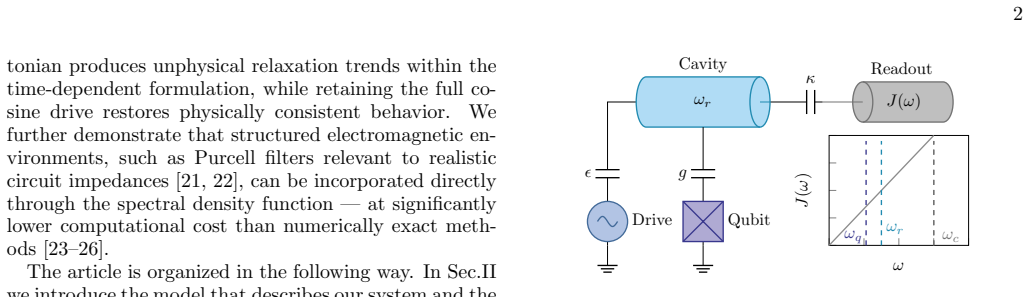
Driven-dissipative qubit-resonator dynamics, which are the basis of most dispersive superconducting qubit measurement schemes, are often modeled with Lindblad master equations built from subsystem local jump operators, even when the qubit and resonator are appreciably hybridized. In this work we revisit this setting using a microscopic Bloch-Redfield approach, where dissipation is constructed in the eigenbasis of the coupled qubit-resonator Hamiltonian with a complete, frequency dependent, open system description of the transmission line environment. Here, we show that the Lindblad and Bloch-Redfield decay rates can be quantitatively different in the absence of driving, while in the driven case we demonstrate that the time-independent Redfield dissipator and its time-dependent generalization can show qualitatively different behaviors as a function of driving strength. Finally, we investigate the effects of driving in structured spectral densities, recovering the suppression of measurement-induced relaxation in the presence of a so called Purcell filter.
Figures


Reference graph
Works this paper leans on
-
[1]
Static Redfield tensor We start from the microscopic picture with the von Neumann equation in the interaction picture with an in- teraction of the type ˆHI = ˆA⊗ ˆBwhere ˆAand ˆBare oper- ators that act on the system and the environment Hilbert space respectively. Following the procedures mentioned in [31], in the Redfield equation we perform the Born- Ma...
-
[2]
Time-dependent Redfield tensor In the time-dependent version which we call as the time-dependent Bloch-Redfield (TDBR), we write the time evolution of the density matrix as ˙ρmn(t) =−iω mn(t)ρmn(t) + X m′,n′ Rmnm′n′(t)ρm′u′(t) (11) where{|m(t)⟩}is the instantaneous eigenbasis of the driven Hamiltonian ˆHS(t) at timeti.e., ˆHS(t)|m(t)⟩= εm(t)|m(t)⟩whereε m...
-
[3]
Secular approximation In equation (9) instead of summing over all possible terms, we can impose a cutoffω f such that only terms that satisfy the relation|ω µν −ω µ′ν′|< ω f are used to construct the dissipator. This is essentially built from the fact that we want to select a time scaleτ ∗ such that |ωµν −ω µ′ν′|−1 ≪τ ∗ ≪τ R,(12) so that while integrating...
2000
-
[4]
Aspelmeyer, T
M. Aspelmeyer, T. J. Kippenberg, and F. Marquardt, Rev. Mod. Phys.86, 1391 (2014)
2014
-
[5]
C. W. Gardiner and M. J. Collett, Phys. Rev. A31, 3761 (1985)
1985
-
[6]
Ritsch, P
H. Ritsch, P. Domokos, F. Brennecke, and T. Esslinger, Rev. Mod. Phys.85, 553 (2013)
2013
-
[7]
Carusotto and C
I. Carusotto and C. Ciuti, Rev. Mod. Phys.85, 299 (2013)
2013
-
[8]
Bianchetti, S
R. Bianchetti, S. Filipp, M. Baur, J. M. Fink, M. G¨ oppl, P. J. Leek, L. Steffen, A. Blais, and A. Wallraff, Phys. Rev. A80, 043840 (2009)
2009
-
[9]
Imoto and S
N. Imoto and S. Saito, Phys. Rev. A39, 675 (1989)
1989
-
[10]
Walter, P
T. Walter, P. Kurpiers, S. Gasparinetti, P. Mag- nard, A. Potoˇ cnik, Y. Salath´ e, M. Pechal, M. Mondal, M. Oppliger, C. Eichler, and A. Wallraff, Phys. Rev. Appl.7, 054020 (2017)
2017
-
[11]
D. Sank, Z. Chen, M. Khezri, J. Kelly, R. Barends, B. Campbell, Y. Chen, B. Chiaro, A. Dunsworth, A. Fowler, E. Jeffrey, E. Lucero, A. Megrant, J. Mu- tus, M. Neeley, C. Neill, P. J. J. O’Malley, C. Quin- tana, P. Roushan, A. Vainsencher, T. White, J. Wenner, A. N. Korotkov, and J. M. Martinis, Phys. Rev. Lett. 9 117, 190503 (2016)
2016
-
[12]
W. Dai, S. Hazra, D. K. Weiss, P. D. Kurilovich, T. Con- nolly, H. K. Babla, S. Singh, V. R. Joshi, A. Z. Ding, P. D. Parakh, J. Venkatraman, X. Xiao, L. Frunzio, and M. H. Devoret, Phys. Rev. X16, 011011 (2026)
2026
-
[13]
Petrescu, M
A. Petrescu, M. Malekakhlagh, and H. E. T¨ ureci, Phys. Rev. B101, 134510 (2020)
2020
-
[14]
Malekakhlagh, A
M. Malekakhlagh, A. Petrescu, and H. E. T¨ ureci, Phys. Rev. B101, 134509 (2020)
2020
-
[15]
E. A. Sete, J. M. Gambetta, and A. N. Korotkov, Phys. Rev. B89, 104516 (2014)
2014
-
[16]
Blais, R.-S
A. Blais, R.-S. Huang, A. Wallraff, S. M. Girvin, and R. J. Schoelkopf, Phys. Rev. A69, 062320 (2004)
2004
-
[17]
Beaudoin, J
F. Beaudoin, J. M. Gambetta, and A. Blais, Phys. Rev. A84, 043832 (2011)
2011
-
[18]
Jeske, D
J. Jeske, D. J. Ing, M. B. Plenio, S. F. Huelga, and J. H. Cole, The Journal of Chemical Physics142, 064104 (2015)
2015
-
[19]
Blum, (Springer, Berlin, Heidelberg, 2012)
K. Blum, (Springer, Berlin, Heidelberg, 2012)
2012
-
[20]
Boissonneault, J
M. Boissonneault, J. M. Gambetta, and A. Blais, Phys. Rev. A77, 060305 (2008)
2008
-
[21]
Boissonneault, J
M. Boissonneault, J. M. Gambetta, and A. Blais, Phys. Rev. A79, 013819 (2009)
2009
-
[22]
D. H. Slichter, R. Vijay, S. J. Weber, S. Boutin, M. Bois- sonneault, J. M. Gambetta, A. Blais, and I. Siddiqi, Phys. Rev. Lett.109, 153601 (2012)
2012
-
[23]
Gambetta, A
J. Gambetta, A. Blais, M. Boissonneault, A. A. Houck, D. I. Schuster, and S. M. Girvin, Phys. Rev. A77, 012112 (2008)
2008
-
[24]
Hutin, A
H. Hutin, A. Essig, R. Assouly, P. Rouchon, A. Bienfait, and B. Huard, Phys. Rev. Lett.133, 153602 (2024)
2024
-
[25]
Sunada, S
Y. Sunada, S. Kono, J. Ilves, S. Tamate, T. Sugiyama, Y. Tabuchi, and Y. Nakamura, Phys. Rev. Appl.17, 044016 (2022)
2022
-
[26]
Strathearn, P
A. Strathearn, P. Kirton, D. Kilda, J. Keeling, and B. W. Lovett, Nat. Commun.9, 3322 (2018)
2018
-
[27]
Lacroix, B
T. Lacroix, B. Le D´ e, A. Riva, A. J. Dunnett, and A. W. Chin, J. Chem. Phys.161, 084116 (2024)
2024
- [28]
-
[29]
A. Riva, P. Gogoi, N. Gheeraert, S. Florens, A. W. Chin, A. Sarlette, and A. Petrescu, arXiv preprint arXiv:2604.11722 (2026)
work page internal anchor Pith review Pith/arXiv arXiv 2026
-
[30]
Blais, A
A. Blais, A. L. Grimsmo, S. M. Girvin, and A. Wallraff, Rev. Mod. Phys.93, 025005 (2021)
2021
-
[31]
Yurke, inQuantum Squeezing, edited by P
B. Yurke, inQuantum Squeezing, edited by P. D. Drum- mond and Z. Ficek (Springer, Berlin, Heidelberg, 2004) pp. 53–96
2004
-
[32]
Cattaneo and G
M. Cattaneo and G. S. Paraoanu, Adv. Quantum Tech- nol.4, 2100054 (2021)
2021
-
[33]
Lambert, E
N. Lambert, E. Gigu` ere, P. Menczel, B. Li, P. Hopf, G. Su´ arez, M. Gali, J. Lishman, R. Gadhvi, R. Agarwal, A. Galicia, N. Shammah, P. Nation, J. R. Johansson, S. Ahmed, S. Cross, A. Pitchford, and F. Nori, Physics Reports1153, 1 (2026)
2026
-
[34]
Breuer and F
H.-P. Breuer and F. Petruccione, (Oxford University Press, 2007)
2007
-
[35]
Cattaneo, G
M. Cattaneo, G. L. Giorgi, S. Maniscalco, and R. Zam- brini, New Journal of Physics21, 113045 (2019)
2019
-
[36]
Krantz, M
P. Krantz, M. Kjaergaard, F. Yan, T. P. Orlando, S. Gus- tavsson, and W. D. Oliver, Appl. Phys. Rev.6, 021318 (2019)
2019
-
[37]
Wallraff, D
A. Wallraff, D. I. Schuster, A. Blais, L. Frunzio, R.-S. Huang, J. Majer, S. Kumar, S. M. Girvin, and R. J. Schoelkopf, Nature431, 162 (2004)
2004
-
[38]
D. I. Schuster, A. Wallraff, A. Blais, L. Frunzio, R.-S. Huang, J. Majer, S. M. Girvin, and R. J. Schoelkopf, Phys. Rev. Lett.94, 123602 (2005)
2005
-
[39]
M¨ uller, Phys
C. M¨ uller, Phys. Rev. Res.2, 033046 (2020)
2020
-
[40]
Thorbeck, Z
T. Thorbeck, Z. Xiao, A. Kamal, and L. C. G. Govia, Phys. Rev. Lett.132, 090602 (2024)
2024
-
[41]
M. D. Reed, B. R. Johnson, A. A. Houck, L. DiCarlo, J. M. Chow, D. I. Schuster, L. Frunzio, and R. J. Schoelkopf, Appl. Phys. Lett.96, 203110 (2010)
2010
-
[42]
Jeffrey, D
E. Jeffrey, D. Sank, J. Y. Mutus, T. C. White, J. Kelly, R. Barends, Y. Chen, Z. Chen, B. Chiaro, A. Dunsworth, A. Megrant, P. J. J. O’Malley, C. Neill, P. Roushan, A. Vainsencher, J. Wenner, A. N. Cleland, and J. M. Martinis, Phys. Rev. Lett.112, 190504 (2014)
2014
-
[43]
E. A. Sete, J. M. Martinis, and A. N. Korotkov, Phys. Rev. A92, 012325 (2015)
2015
-
[44]
N. T. Bronn, Y. Liu, J. B. Hertzberg, A. D. C´ orcoles, A. A. Houck, J. M. Gambetta, and J. M. Chow, Appl. Phys. Lett.107, 172601 (2015)
2015
-
[45]
H. Yan, X. Wu, A. Lingenfelter, Y. J. Joshi, G. Anders- son, C. R. Conner, M.-H. Chou, J. Grebel, J. M. Miller, R. G. Povey, H. Qiao, A. A. Clerk, and A. N. Cleland, Appl. Phys. Lett.123, 134001 (2023)
2023
-
[46]
M. Bakr, S. D. Fasciati, S. Cao, G. Campanaro, J. Wills, M. Alghadeer, M. Piscitelli, B. Shteynas, V. Chi- dambaram, and P. J. Leek, Phys. Rev. Appl.23, 054089 (2025)
2025
-
[47]
Xiong, Z
Y. Xiong, Z. Wang, J. Zhang, X. Sun, Z. Zhang, P. Huang, Y. Liang, J. Jiang, J. Qiu, Y. Zhou, X. Lin- peng, W. Huang, J. Niu, Y. Zhong, J. Chu, S. Liu, and D. Yu, Phys. Rev. Appl.25, 054010 (2026)
2026
-
[48]
D’Abbruzzo and D
A. D’Abbruzzo and D. Rossini, Phys. Rev. A103, 052209 (2021)
2021
-
[49]
E. M. Purcell, H. C. Torrey, and R. V. Pound, Phys. Rev. 69, 37 (1946)
1946
-
[50]
D. P. DiVincenzo, Fortschritte der Physik48, 771 (2000)
2000
-
[51]
Kandala, K
A. Kandala, K. X. Wei, S. Srinivasan, E. Magesan, S. Carnevale, G. A. Keefe, D. Klaus, O. Dial, and D. C. McKay, Phys. Rev. Lett.127, 130501 (2021)
2021
-
[52]
Didier, J
N. Didier, J. Bourassa, and A. Blais, Phys. Rev. Lett. 115, 203601 (2015)
2015
-
[53]
A. A. Clerk, M. H. Devoret, S. M. Girvin, F. Marquardt, and R. J. Schoelkopf, Rev. Mod. Phys.82, 1155 (2010)
2010
discussion (0)
Sign in with ORCID, Apple, or X to comment. Anyone can read and Pith papers without signing in.