Surface Originated Cross-Field Anomalous Transport in Magnetoelectric Multilayers
Pith reviewed 2026-06-29 05:59 UTC · model grok-4.3
The pith
Surface contributions to gate-induced responses remain finite in thick slabs and can dominate when bulk terms are symmetry-forbidden.
A machine-rendered reading of the paper's core claim, the machinery that carries it, and where it could break.
Core claim
In slab geometries the conventional expectation that surface contributions to physical responses vanish rapidly with increasing thickness is violated for a class of gate-induced effects. A general framework decomposes the total response into surface- and bulk-contributions on equal footing. The volume-averaged surface contribution remains finite in the thick-slab limit and exhibits the same thickness scaling as the bulk term. The surface response originates from band geometric quantities distinct from those in the bulk and is constrained solely by surface symmetries, allowing it to dominate when the bulk contribution is symmetry-forbidden. In MnBi2Te4 multilayers this yields a strong surface
What carries the argument
General framework that decomposes total response into surface- and bulk-contributions treated on equal footing, with surface response arising from distinct band geometric quantities constrained only by surface symmetries.
If this is right
- Surface contribution remains finite and scales with thickness identically to the bulk term in the thick-slab limit.
- Surface response can dominate the overall effect when bulk contribution is symmetry-forbidden.
- MnBi2Te4 multilayers exhibit a strong surface-dominated cross-field anomalous Nernst effect arising from surface Berry curvature.
- Surface response is accessible to experimental detection via transport measurements.
Where Pith is reading between the lines
- The same decomposition may apply to other gate-tunable responses in layered systems beyond the examples given.
- Varying slab thickness while monitoring response magnitude could isolate the surface geometric contribution experimentally.
- Surface symmetries could be engineered in other magnetoelectric multilayers to control thermoelectric transport without bulk participation.
Load-bearing premise
The decomposition of the total response into surface and bulk contributions treated on equal footing is valid and the surface response is constrained solely by surface symmetries.
What would settle it
Experimental measurement of the thickness dependence of the anomalous Nernst coefficient in MnBi2Te4 multilayers that shows whether a finite surface contribution persists as thickness increases well beyond typical surface penetration depths.
Figures
read the original abstract
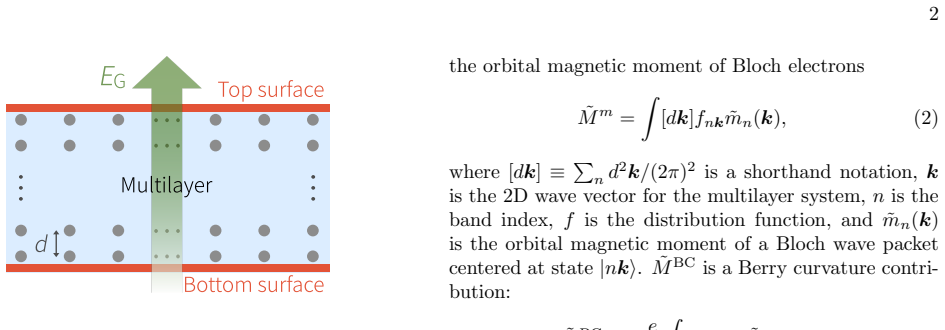
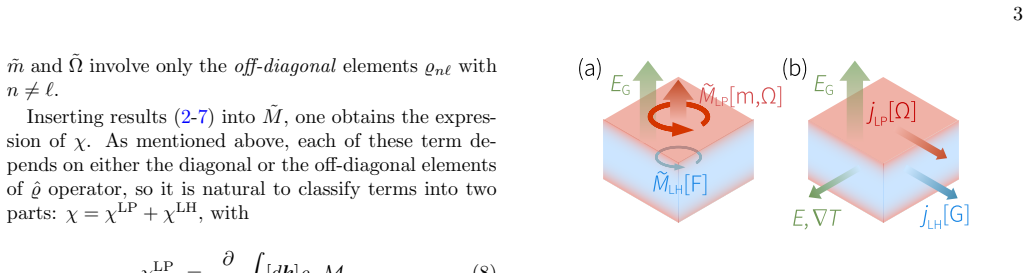
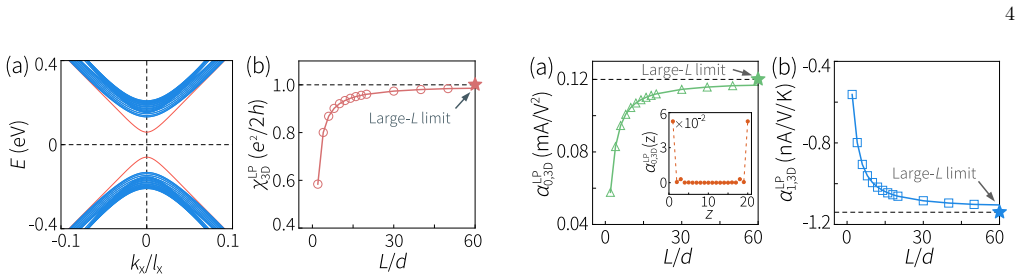
In material systems with slab geometry, the surface contribution to physical responses is commonly expected to diminish rapidly with increasing thickness, giving way to the bulk response. Here, we show that this conventional wisdom is violated in a class of gate-induced responses, including gate-induced orbital and spin magnetization as well as cross-field anomalous thermoelectric transport. We develop a general framework for these effects, which naturally decomposes the total response into surface- and bulk-contributions treated on equal footing. Remarkably, the volume-averaged surface contribution remains finite in the thick-slab limit and exhibits the same thickness scaling as the bulk term. Furthermore, the surface response originates from band geometric quantities distinct from those in the bulk, being constrained solely by surface symmetries. As a result, it can dominate the overall response when the bulk contribution is symmetry-forbidden. Taking MnBi$_2$Te$_4$ multilayers as an example, we predict a strong surface-dominated cross-field anomalous Nernst effect arising from surface Berry curvature, which is readily accessible to experimental detection. These findings reveal a previously overlooked significance of surface response and open a new direction in the study of surface quantum geometry.
Editorial analysis
A structured set of objections, weighed in public.
Referee Report
Summary. The manuscript develops a general framework that decomposes gate-induced responses (orbital/spin magnetization and cross-field anomalous thermoelectric transport) in slab geometries into surface and bulk contributions placed on equal footing. It demonstrates that the volume-averaged surface contribution remains finite in the thick-slab limit, exhibits identical thickness scaling to the bulk term, and arises from distinct band-geometric quantities fixed solely by surface symmetries. Consequently the surface term can dominate when the bulk contribution is symmetry-forbidden. The authors apply the framework to MnBi₂Te₄ multilayers and predict a strong, experimentally accessible surface-dominated cross-field anomalous Nernst effect driven by surface Berry curvature.
Significance. If the decomposition and scaling arguments hold, the work would be significant for revealing a previously overlooked finite surface contribution in thick slabs for a class of gate-induced responses, thereby elevating the role of surface quantum geometry in magnetoelectric multilayers. The concrete, falsifiable prediction of a surface-dominated anomalous Nernst effect in MnBi₂Te₄ supplies a clear experimental target and strengthens the central claim.
minor comments (3)
- [Framework section] The abstract states that surface symmetries alone constrain the surface geometric quantities; the main text should include an explicit symmetry-table or character-table comparison (e.g., in the section introducing the framework) to make this constraint transparent to readers.
- [MnBi₂Te₄ application] The MnBi₂Te₄ prediction would benefit from a brief statement of the slab thickness range (in unit cells) over which the surface term is expected to dominate, together with an estimate of the required gate voltage or Fermi-level position.
- A small number of typographical inconsistencies appear in the figure captions (e.g., inconsistent use of “cross-field” versus “cross field”); these should be standardized.
Simulated Author's Rebuttal
We thank the referee for the positive assessment of our manuscript, the accurate summary of our framework and results, and the recommendation of minor revision. We are pleased that the significance of the surface contribution to gate-induced responses and the concrete prediction for MnBi₂Te₄ are recognized.
Circularity Check
No significant circularity identified
full rationale
The provided text is limited to the abstract, which outlines a decomposition framework treating surface and bulk contributions on equal footing without any equations, derivations, or self-citations shown. No load-bearing steps reduce by construction to inputs, fitted parameters, or self-referential definitions. The scaling claim for the volume-averaged surface term is presented as a general result from band geometry constrained by surface symmetries, appearing self-contained and independent of the present paper's own prior results.
Axiom & Free-Parameter Ledger
Reference graph
Works this paper leans on
-
[1]
K. S. Burch, D. Mandrus, and J.-G. Park, Magnetism in two-dimensional van der waals materials, Nature563, 47 (2018)
2018
-
[2]
K. F. Mak, J. Shan, and D. C. Ralph, Probing and con- trolling magnetic states in 2d layered magnetic materials, Nat. Rev. Phys.1, 646 (2019)
2019
-
[3]
Kurebayashi, J
H. Kurebayashi, J. H. Garcia, S. Khan, J. Sinova, and S. Roche, Magnetism, symmetry and spin transport in van der waals layered systems, Nat. Rev. Phys.4, 150 (2022)
2022
-
[4]
H. Ohno, D. Chiba, F. Matsukura, T. Omiya, E. Abe, T. Dietl, Y. Ohno, and K. Ohtani, Electric-field control of ferromagnetism, Nature408, 944 (2000)
2000
-
[5]
H. Pan, M. Wu, Y. Liu, and S. A. Yang, Electric control of topological phase transitions in dirac semimetal thin films, Sci. Rep.5, 14639 (2015)
2015
-
[6]
Y. Deng, Y. Yu, Y. Song, J. Zhang, N. Z. Wang, Z. Sun, Y. Yi, Y. Z. Wu, S. Wu, J. Zhu, J. Wang, X. H. Chen, and Y. Zhang, Gate-tunable room-temperature ferro- magnetism in two-dimensional fe3gete2, Nature563, 94 (2018)
2018
-
[7]
Z. Wang, T. Zhang, M. Ding, B. Dong, Y. Li, M. Chen, X. Li, J. Huang, H. Wang, X. Zhao, Y. Li, D. Li, C. Jia, L. Sun, H. Guo, Y. Ye, D. Sun, Y. Chen, T. Yang, J. Zhang, S. Ono, Z. Han, and Z. Zhang, Electric-field control of magnetism in a few-layered van der waals fer- romagnetic semiconductor, Nat. Nanotechnol.13, 554 (2018)
2018
-
[8]
K. S. Burch, Electric switching of magnetism in 2d, Nat. Nanotechnol.13, 532 (2018)
2018
-
[9]
Jiang, J
S. Jiang, J. Shan, and K. F. Mak, Electric-field switching of two-dimensional van der waals magnets, Nat. Mater. 17, 406 (2018)
2018
-
[10]
Huang, G
B. Huang, G. Clark, D. R. Klein, D. MacNeill, E. Navarro-Moratalla, K. L. Seyler, N. Wilson, M. A. McGuire, D. H. Cobden, D. Xiao, W. Yao, P. Jarillo- Herrero, and X. Xu, Electrical control of 2d magnetism in bilayer CrI3, Nat. Nanotechnol.13, 544 (2018)
2018
-
[11]
J. L. Collins, A. Tadich, W. Wu, L. C. Gomes, J. N. B. Rodrigues, C. Liu, J. Hellerstedt, H. Ryu, S. Tang, S.-K. Mo, S. Adam, S. A. Yang, M. S. Fuhrer, and M. T. Ed- monds, Electric-field-tuned topological phase transition in ultrathin na3bi, Nature564, 390 (2018)
2018
-
[12]
I. A. Verzhbitskiy, H. Kurebayashi, H. Cheng, J. Zhou, S. Khan, Y. P. Feng, and G. Eda, Controlling the mag- netic anisotropy in cr2ge2te6 by electrostatic gating, Na- 6 ture Electronics3, 460 (2020)
2020
-
[13]
S. Du, P. Tang, J. Li, Z. Lin, Y. Xu, W. Duan, and A. Rubio, Berry curvature engineering by gating two- dimensional antiferromagnets, Phys. Rev. Res.2, 022025 (2020)
2020
-
[14]
Z.-M. Yu, S. Guan, X.-L. Sheng, W. Gao, and S. A. Yang, Valley-layer coupling: A new design principle for valleytronics, Phys. Rev. Lett.124, 037701 (2020)
2020
-
[15]
Gao, Y.-F
A. Gao, Y.-F. Liu, C. Hu, J.-X. Qiu, C. Tzschaschel, B. Ghosh, S.-C. Ho, D. B´ erub´ e, R. Chen, H. Sun, Z. Zhang, X.-Y. Zhang, Y.-X. Wang, N. Wang, Z. Huang, C. Felser, A. Agarwal, T. Ding, H.-J. Tien, A. Akey, J. Gardener, B. Singh, K. Watanabe, T. Taniguchi, K. S. Burch, D. C. Bell, B. B. Zhou, W. Gao, H.-Z. Lu, A. Ban- sil, H. Lin, T.-R. Chang, L. Fu,...
2021
-
[16]
Mei, Y.-F
R. Mei, Y.-F. Zhao, C. Wang, Y. Ren, D. Xiao, C.-Z. Chang, and C.-X. Liu, Electrically controlled anomalous hall effect and orbital magnetization in topological mag- net mnbi2te4, Phys. Rev. Lett.132, 066604 (2024)
2024
-
[17]
Cui, R.-W
C. Cui, R.-W. Zhang, Y. Qiu, Y. Han, Z.-M. Yu, and Y. Yao, Electric hall effect and quantum electric hall ef- fect, Phys. Rev. Lett.135, 116301 (2025)
2025
-
[18]
P. He, H. Isobe, D. Zhu, C.-H. Hsu, L. Fu, and H. Yang, Quantum frequency doubling in the topological insulator bi2se3, Nat. Commun.12, 698 (2021)
2021
-
[19]
Kumar, C.-H
D. Kumar, C.-H. Hsu, R. Sharma, T.-R. Chang, P. Yu, J. Wang, G. Eda, G. Liang, and H. Yang, Room- temperature nonlinear hall effect and wireless radiofre- quency rectification in weyl semimetal tairte4, Nat. Nan- otechnol.16, 421 (2021)
2021
-
[20]
U. Kar, E. C.-H. Lu, A. K. Singh, P. V. S. Reddy, Y. Han, X. Li, C.-T. Cheng, S. Yang, C.-Y. Lin, I.-C. Cheng, C.-H. Hsu, D. Hsieh, W.-C. Lee, G.-Y. Guo, and W.- L. Lee, Nonlinear and nonreciprocal transport effects in untwinned thin films of ferromagnetic weyl metal srruo3, Phys. Rev. X14, 011022 (2024)
2024
-
[21]
F. Hu, P. Zhao, L. Yang, S. Zhao, J. Lei, W. Li, J. Lai, Z. Yu, H. Park, C. Wong,et al., Ultrabroadband nonlin- ear hall rectifier using snte, Nat. Nanotechnol.20, 1588 (2025)
2025
-
[22]
J. G. Checkelsky, Y. S. Hor, R. J. Cava, and N. P. Ong, Bulk band gap and surface state conduction observed in voltage-tuned crystals of the topological insulator bi2se3, Phys. Rev. Lett.106, 196801 (2011)
2011
-
[23]
Syers, D
P. Syers, D. Kim, M. S. Fuhrer, and J. Paglione, Tuning bulk and surface conduction in the proposed topologi- cal kondo insulator smb 6, Phys. Rev. Lett.114, 096601 (2015)
2015
-
[24]
Y. Gao, S. A. Yang, and Q. Niu, Field induced positional shift of bloch electrons and its dynamical implications, Phys. Rev. Lett.112, 166601 (2014)
2014
-
[25]
H. Liu, J. Zhao, Y.-X. Huang, X. Feng, C. Xiao, W. Wu, S. Lai, W.-b. Gao, and S. A. Yang, Berry connection po- larizability tensor and third-order hall effect, Phys. Rev. B105, 045118 (2022)
2022
-
[26]
Zheng, D
H. Zheng, D. Zhai, C. Xiao, and W. Yao, Layer coherence origin of planar hall effect: From charge to multipole and valley, Nano Lett.25, 10096 (2025)
2025
-
[27]
D. Xiao, Y. Yao, Z. Fang, and Q. Niu, Berry-phase effect in anomalous thermoelectric transport, Phys. Rev. Lett. 97, 026603 (2006)
2006
-
[28]
Xiao, M.-C
D. Xiao, M.-C. Chang, and Q. Niu, Berry phase effects on electronic properties, Rev. Mod. Phys.82, 1959 (2010)
1959
-
[29]
F.-R. Fan, C. Xiao, and W. Yao, Intrinsic dipole hall effect in twisted mote2: magnetoelectricity and contact- free signatures of topological transitions, Nat. Commun. 15, 7997 (2024)
2024
-
[30]
See Supplemental Material for details of derivations
-
[31]
Y. Gao, S. A. Yang, and Q. Niu, Geometrical effects in orbital magnetic susceptibility, Phys. Rev. B91, 214405 (2015)
2015
-
[32]
C. Xiao, Y. Ren, and B. Xiong, Adiabatically induced orbital magnetization, Phys. Rev. B103, 115432 (2021)
2021
-
[33]
Wang, Y.-X
H. Wang, Y.-X. Huang, H. Liu, X. Feng, J. Zhu, W. Wu, C. Xiao, and S. A. Yang, Orbital origin of the intrinsic planar hall effect, Phys. Rev. Lett.132, 056301 (2024)
2024
-
[34]
L. Wang, J. Zhu, H. Chen, H. Wang, J. Liu, Y.-X. Huang, B. Jiang, J. Zhao, H. Shi, G. Tian, H. Wang, Y. Yao, D. Yu, Z. Wang, C. Xiao, S. A. Yang, and X. Wu, Or- bital magneto-nonlinear anomalous hall effect in kagome magnet fe3sn2, Phys. Rev. Lett.132, 106601 (2024)
2024
-
[35]
Xiao and Q
C. Xiao and Q. Niu, Unified bulk semiclassical theory for intrinsic thermal transport and magnetization currents, Phys. Rev. B101, 235430 (2020)
2020
-
[36]
C. Wang, Y. Gao, and D. Xiao, Intrinsic nonlinear hall effect in antiferromagnetic tetragonal cumnas, Phys. Rev. Lett.127, 277201 (2021)
2021
-
[37]
H. Liu, J. Zhao, Y.-X. Huang, W. Wu, X.-L. Sheng, C. Xiao, and S. A. Yang, Intrinsic second-order anoma- lous hall effect and its application in compensated anti- ferromagnets, Phys. Rev. Lett.127, 277202 (2021)
2021
-
[38]
C. Xiao, J. Cao, Q. Niu, and S. A. Yang, Proper defini- tion of intrinsic nonlinear current, Phys. Rev. Lett.135, 256306 (2025)
2025
-
[39]
Y. Gong, J. Guo, J. Li, K. Zhu, M. Liao, X. Liu, Q. Zhang, L. Gu, L. Tang, X. Feng,et al., Experimental realization of an intrinsic magnetic topological insulator, Chin. Phys. Lett.36, 076801 (2019)
2019
-
[40]
J. Li, Y. Li, S. Du, Z. Wang, B.-L. Gu, S.-C. Zhang, K. He, W. Duan, and Y. Xu, Intrinsic magnetic topolog- ical insulators in van der waals layered mnbi2te4-family materials, Sci. Adv.5, eaaw5685 (2019)
2019
-
[41]
M. M. Otrokov, I. I. Klimovskikh, H. Bentmann, D. Es- tyunin, A. Zeugner, Z. S. Aliev, S. Gaß, A. U. B. Wolter, A. V. Koroleva, A. M. Shikin, M. Blanco-Rey, M. Hoff- mann, I. P. Rusinov, A. Y. Vyazovskaya, S. V. Ere- meev, Y. M. Koroteev, V. M. Kuznetsov, F. Freyse, J. S´ anchez-Barriga, I. R. Amiraslanov, M. B. Babanly, N. T. Mamedov, N. A. Abdullayev, V...
2019
-
[42]
M. M. Otrokov, I. P. Rusinov, M. Blanco-Rey, M. Hoff- mann, A. Y. Vyazovskaya, S. V. Eremeev, A. Ernst, P. M. Echenique, A. Arnau, and E. V. Chulkov, Unique thickness-dependent properties of the van der waals in- terlayer antiferromagnet mnbi2te4 films, Phys. Rev. Lett. 122, 107202 (2019)
2019
-
[43]
C. Liu, Y. Wang, H. Li, Y. Wu, Y. Li, J. Li, K. He, Y. Xu, J. Zhang, and Y. Wang, Robust axion insulator and chern insulator phases in a two-dimensional antiferromagnetic topological insulator, Nat. Mater.19, 522 (2020). 7
2020
-
[44]
S. Yang, X. Xu, Y. Zhu, R. Niu, C. Xu, Y. Peng, X. Cheng, X. Jia, Y. Huang, X. Xu, J. Lu, and Y. Ye, Odd-even layer-number effect and layer-dependent mag- netic phase diagrams in mnbi 2te4, Phys. Rev. X11, 011003 (2021)
2021
-
[45]
Zhao, L.-J
Y.-F. Zhao, L.-J. Zhou, F. Wang, G. Wang, T. Song, D. Ovchinnikov, H. Yi, R. Mei, K. Wang, M. H. Chan, et al., Even–odd layer-dependent anomalous hall effect in topological magnet mnbi2te4 thin films, Nano Lett.21, 7691 (2021)
2021
-
[46]
Zhang, M
D. Zhang, M. Shi, T. Zhu, D. Xing, H. Zhang, and J. Wang, Topological axion states in the magnetic insu- lator mnbi2te4 with the quantized magnetoelectric effect, Phys. Rev. Lett.122, 206401 (2019)
2019
-
[47]
X.-L. Qi, T. L. Hughes, and S.-C. Zhang, Topological field theory of time-reversal invariant insulators, Phys. Rev. B78, 195424 (2008)
2008
-
[48]
A. M. Essin, J. E. Moore, and D. Vanderbilt, Magneto- electric polarizability and axion electrodynamics in crys- talline insulators, Phys. Rev. Lett.102, 146805 (2009)
2009
-
[49]
Qi and S.-C
X.-L. Qi and S.-C. Zhang, Topological insulators and su- perconductors, Rev. Mod. Phys.83, 1057 (2011)
2011
-
[50]
Vanderbilt,Berry Phases in Electronic Structure Theory: Electric Polarization, Orbital Magnetization and Topological Insulators(Cambridge University Press, 2018)
D. Vanderbilt,Berry Phases in Electronic Structure Theory: Electric Polarization, Orbital Magnetization and Topological Insulators(Cambridge University Press, 2018)
2018
-
[51]
Sakai, Y
A. Sakai, Y. P. Mizuta, A. A. Nugroho, R. Sihomb- ing, T. Koretsune, M.-T. Suzuki, N. Takemori, R. Ishii, D. Nishio-Hamane, R. Arita,et al., Giant anomalous nernst effect and quantum-critical scaling in a ferromag- netic semimetal, Nat. Phys.14, 1119 (2018)
2018
-
[52]
S. N. Guin, P. Vir, Y. Zhang, N. Kumar, S. J. Watzman, C. Fu, E. Liu, K. Manna, W. Schnelle, J. Gooth,et al., Zero-field nernst effect in a ferro- magnetic kagome-lattice weyl-semimetal co3sn2s2, Adv. Mater.31, 1806622 (2019)
2019
-
[53]
X. Li, L. Xu, L. Ding, J. Wang, M. Shen, X. Lu, Z. Zhu, and K. Behnia, Anomalous nernst and righi-leduc effects in mn3Sn: Berry curvature and entropy flow, Phys. Rev. Lett.119, 056601 (2017)
2017
-
[54]
Ikhlas, T
M. Ikhlas, T. Tomita, T. Koretsune, M.-T. Suzuki, D. Nishio-Hamane, R. Arita, Y. Otani, and S. Nakat- suji, Large anomalous nernst effect at room temperature in a chiral antiferromagnet, Nat. Phys.13, 1085 (2017)
2017
-
[55]
Wawrzik, J.-S
D. Wawrzik, J.-S. You, J. I. Facio, J. van den Brink, and I. Sodemann, Infinite berry curvature of weyl fermi arcs, Phys. Rev. Lett.127, 056601 (2021)
2021
-
[56]
D. G. Ovalle, A. Pezo, and A. Manchon, Influence of the surface states on the nonlinear hall effect in weyl semimetals, Phys. Rev. B106, 214435 (2022)
2022
discussion (0)
Sign in with ORCID, Apple, or X to comment. Anyone can read and Pith papers without signing in.