Projectional Decoding: Towards Semantic-Aware LLM Generation
Reviewed by Pith T0 review T1 audit T2 compute T3 formal T4 kernel 2026-06-29 06:17 UTCgrok-4.3pith:EFADKAODrecord.jsonopen to challenge →
The pith
Maintaining a partial graph model during LLM generation enables incremental semantic validation with provable guarantees for software artifacts.
A machine-rendered reading of the paper's core claim, the machinery that carries it, and where it could break.
Core claim
Projectional decoding integrates domain semantics directly into the generation process by maintaining, alongside text, a partial graph model as the primary artifact representation throughout generation. This abstract representation enables incremental semantic validation by explicitly capturing uncertainty and natively supporting error detection, while guiding generation toward semantically valid outputs with provable guarantees. Preliminary results on a program generation task demonstrate the potential to improve semantic validity of LLM-generated artifacts and to support verifiable automation across software engineering activities.
What carries the argument
projectional decoding, which treats a partial graph model as the primary representation maintained token-by-token to connect generated text to domain-specific semantic reasoning.
If this is right
- Semantic validation can occur incrementally as each token is generated rather than only after the full artifact is complete.
- Uncertainty in the artifact is represented explicitly inside the partial graph.
- Error detection is native to the representation instead of added as an external post-check.
- Generation can be steered toward outputs that satisfy semantic rules under provable guarantees.
- Verifiable automation becomes feasible for a range of software engineering tasks that require semantic correctness.
Where Pith is reading between the lines
- The same partial-graph approach could be tested on generation tasks outside software engineering that still require logical or domain constraints.
- Combining the graph model with existing syntactic constrained decoders might produce a single pipeline that enforces both syntax and semantics.
- Real-time tools such as IDEs could display the evolving graph to give developers immediate visibility into semantic issues during generation.
Load-bearing premise
A partial graph model can be built and updated incrementally during token-by-token generation in a way that captures enough domain semantics to enable validation with provable guarantees.
What would settle it
An experiment applying the method to program generation that produces outputs containing semantic errors the maintained graph model neither detected nor prevented.
Figures


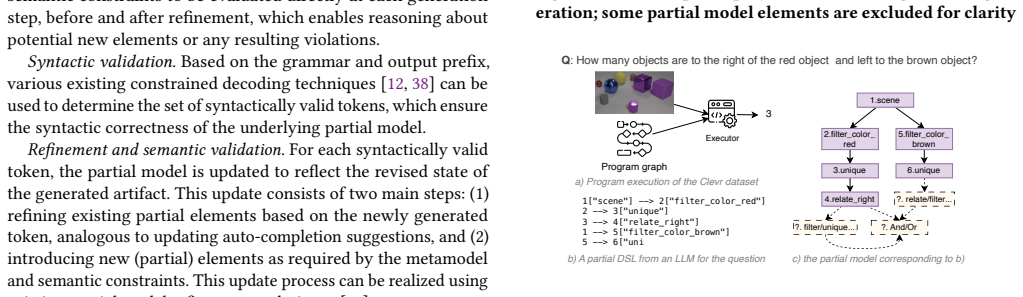
read the original abstract
Large language models (LLMs) are increasingly used to generate software artifacts across many software engineering (SE) tasks, yet ensuring the semantic validity of these artifacts remains a fundamental challenge. Existing constrained decoding techniques can enforce syntactic correctness and, in some cases, specific semantic rules, but lack a general representation that bridges LLM-generated text with the reasoning required for semantic validation in SE. In this paper, we propose projectional decoding, a novel conceptual framework that integrates domain semantics directly into the generation process by maintaining, alongside text, a partial graph model as the primary artifact representation throughout generation. This abstract representation enables incremental semantic validation by explicitly capturing uncertainty and natively supporting error detection, while guiding generation toward semantically valid outputs with provable guarantees. We present preliminary results on a program generation task which demonstrate the potential of this approach to improve the semantic validity of LLM-generated artifacts. We also discuss how projectional decoding can enable verifiable automation with LLMs across various SE activities.
Editorial analysis
A structured set of objections, weighed in public.
Referee Report
Summary. The manuscript proposes projectional decoding, a conceptual framework for LLM generation of software engineering artifacts. It maintains a partial graph model as the primary representation alongside generated text to enable incremental semantic validation, explicit uncertainty capture, native error detection, and guidance toward semantically valid outputs with provable guarantees. Preliminary results on a program generation task are cited to show potential for improved semantic validity, with discussion of broader SE applications.
Significance. A working realization of the framework could meaningfully advance reliable LLM use in SE by supplying a general semantic representation that goes beyond syntactic constraints. However, the manuscript supplies only a high-level description with no supporting formalization or evidence, so significance cannot yet be assessed.
major comments (3)
- [Abstract] Abstract: the central claim that the partial graph model 'enables incremental semantic validation ... with provable guarantees' is unsupported. The manuscript provides neither a definition of the graph representation, a projection operator from token sequences, update rules that preserve invariants, nor any proof sketch or pseudocode showing how uncertainty is captured or semantic validity enforced.
- [Abstract] Abstract (framework paragraph): the weakest assumption—that a partial graph model can be constructed and maintained incrementally during token-by-token generation while capturing sufficient domain semantics—receives no mechanism or formalization, leaving the guarantee claim uncheckable.
- [Preliminary results] Preliminary results: the text states that results 'demonstrate the potential' of the approach, yet supplies no data, error analysis, baseline comparisons, or quantitative metrics, so the empirical support for improved semantic validity cannot be evaluated.
minor comments (1)
- [Abstract] The abstract repeats the list of benefits ('incremental semantic validation', 'explicitly capturing uncertainty', 'natively supporting error detection', 'guiding generation') in consecutive sentences; a single consolidated statement would improve readability.
Simulated Author's Rebuttal
We thank the referee for the constructive and detailed comments. We agree that the current manuscript is primarily conceptual and high-level, and we will revise it to incorporate the requested formalizations, mechanisms, and empirical details to strengthen the presentation.
read point-by-point responses
-
Referee: [Abstract] Abstract: the central claim that the partial graph model 'enables incremental semantic validation ... with provable guarantees' is unsupported. The manuscript provides neither a definition of the graph representation, a projection operator from token sequences, update rules that preserve invariants, nor any proof sketch or pseudocode showing how uncertainty is captured or semantic validity enforced.
Authors: We acknowledge that the abstract summarizes the intended benefits of the framework without embedding the supporting formal elements. The body of the manuscript describes the overall approach at a conceptual level. To address this, the revised version will include an explicit section with the definition of the graph representation, the projection operator, update rules that preserve invariants, and a proof sketch demonstrating how uncertainty is captured and semantic validity is enforced. revision: yes
-
Referee: [Abstract] Abstract (framework paragraph): the weakest assumption—that a partial graph model can be constructed and maintained incrementally during token-by-token generation while capturing sufficient domain semantics—receives no mechanism or formalization, leaving the guarantee claim uncheckable.
Authors: The framework paragraph in the abstract is intentionally concise. The manuscript body provides an initial description of incremental maintenance, but we agree that the mechanisms require formalization to be verifiable. In revision, we will add explicit mechanisms, update rules, and formalization showing how the partial graph model is constructed and maintained token-by-token while capturing domain semantics. revision: yes
-
Referee: [Preliminary results] Preliminary results: the text states that results 'demonstrate the potential' of the approach, yet supplies no data, error analysis, baseline comparisons, or quantitative metrics, so the empirical support for improved semantic validity cannot be evaluated.
Authors: The current manuscript mentions preliminary results at a high level to indicate promise on a program generation task. We agree that this is insufficient for evaluation. The revised manuscript will expand the section to include the actual data, error analysis, baseline comparisons, and quantitative metrics supporting the claims of improved semantic validity. revision: yes
Circularity Check
No circularity: conceptual proposal with no equations, fits, or self-citation reductions
full rationale
The manuscript presents a high-level conceptual framework for projectional decoding without any equations, fitted parameters, or derivation steps. The central claim of 'provable guarantees' is asserted as a property of the proposed partial graph representation but is not derived from prior results, self-citations, or definitions that reduce to the claim itself. No load-bearing self-citations appear, and the framework is not shown to be equivalent to its inputs by construction. The absence of formalization means there are no steps that can be checked for circularity under the enumerated patterns; the proposal remains self-contained as an unproven idea rather than a circular derivation.
Axiom & Free-Parameter Ledger
axioms (1)
- domain assumption Domain semantics for SE artifacts can be captured sufficiently by a partial graph model that is updated token-by-token.
invented entities (1)
-
partial graph model
no independent evidence
Reference graph
Works this paper leans on
-
[1]
Thorsten Berger, Markus Völter, Hans Peter Jensen, Taweesap Dangprasert, and Janet Siegmund. 2016. Efficiency of projectional editing: A controlled experiment. InProceedings of the 24th ACM SIGSOFT International Symposium on Foundations of Software Engineering. ACM, 763–774
2016
-
[2]
Gábor Bergmann, Ákos Horváth, István Ráth, Dániel Varró, András Balogh, Zoltán Balogh, and András Ökrös. 2010. Incremental evaluation of model queries over EMF models. InModel Driven Engineering Languages and Systems - 13th International Conference. Springer, 76–90
2010
-
[3]
2016.Implementing domain-specific languages with Xtext and Xtend
Lorenzo Bettini. 2016.Implementing domain-specific languages with Xtext and Xtend. Packt Publishing Ltd
2016
-
[4]
Luca Beurer-Kellner, Marc Fischer, and Martin Vechev. 2023. Prompting is pro- gramming: A query language for large language models.Proceedings of the ACM on Programming Languages7, PLDI (2023), 1946–1969
2023
-
[5]
Boqi Chen, Ou Wei, Bingzhou Zheng, and Gunter Mussbacher. 2025. Accurate and Consistent Graph Model Generation from Text with Large Language Models. In 28th ACM/IEEE International Conference on Model Driven Engineering Languages and Systems. IEEE, 130–141
2025
-
[6]
Zhaorun Chen, Mintong Kang, and Bo Li. 2025. ShieldAgent: Shielding Agents via Verifiable Safety Policy Reasoning. InForty-second International Conference on Machine Learning
2025
-
[7]
Patrick Cousot and Radhia Cousot. 1977. Abstract interpretation: a unified lattice model for static analysis of programs by construction or approximation of fixpoints. InConference Record of the Fourth ACM Symposium on Principles of Programming Languages. ACM, 238–252
1977
-
[8]
Juri Di Rocco, Davide Di Ruscio, Claudio Di Sipio, Phuong T Nguyen, and Riccardo Rubei. 2025. On the use of large language models in model-driven engineering. Software and Systems Modeling24, 3 (2025), 923–948
2025
-
[9]
Yixin Dong, Charlie F Ruan, Yaxing Cai, Ziyi Xu, Yilong Zhao, Ruihang Lai, and Tianqi Chen. 2025. XGrammar: Flexible and efficient structured generation engine for large language models.Proceedings of Machine Learning and Systems 7 (2025)
2025
-
[10]
Michalis Famelis, Rick Salay, and Marsha Chechik. 2012. Partial models: Towards modeling and reasoning with uncertainty. In34th International Conference on Software Engineering. IEEE Computer Society, 573–583
2012
-
[11]
Usman Gohar, Michael C Hunter, Robyn R Lutz, and Myra B Cohen. 2024. Code- feater: Using LLMs to find defeaters in assurance cases. InProceedings of the 39th IEEE/ACM International Conference on Automated Software Engineering. ACM, 2262–2267
2024
-
[12]
Guidance AI. 2024. LLGuidance: Fast Structured Generation for Large Language Models. https://github.com/guidance-ai/llguidance
2024
-
[13]
Junda He, Christoph Treude, and David Lo. 2025. LLM-Based Multi-Agent Systems for Software Engineering: Literature Review, Vision, and the Road Ahead.ACM Transactions on Software Engineering and Methodology34, 5 (2025), 124:1–124:30
2025
-
[14]
Sirui Hong, Mingchen Zhuge, Jonathan Chen, Xiawu Zheng, Yuheng Cheng, Jinlin Wang, Ceyao Zhang, Zili Wang, Steven Ka Shing Yau, Zijuan Lin, et al
-
[15]
InThe Twelfth International Conference on Learning Representations
MetaGPT: Meta programming for a multi-agent collaborative framework. InThe Twelfth International Conference on Learning Representations
-
[16]
Dong Huang, Jie M Zhang, Michael Luck, Qingwen Bu, Yuhao Qing, and Heming Cui. 2023. Agentcoder: Multi-agent-based code generation with iterative testing and optimisation.arXiv preprint arXiv:2312.13010(2023)
work page internal anchor Pith review Pith/arXiv arXiv 2023
-
[17]
JetBrains. 2026. JetBrains MPS: The Meta Programming System. https://www. jetbrains.com/mps/. Accessed: 2026-01-22
2026
-
[18]
Justin Johnson, Bharath Hariharan, Laurens Van Der Maaten, Li Fei-Fei, C Lawrence Zitnick, and Ross Girshick. 2017. CLEVR: A diagnostic dataset for compositional language and elementary visual reasoning. InIEEE Conference on Computer Vision and Pattern Recognition. IEEE Computer Society, 1988–1997
2017
-
[19]
Parv Kapoor, Akila Ganlath, Michael Clifford, Changliu Liu, Sebastian Scherer, and Eunsuk Kang. 2025. Constrained Decoding for Robotics Foundation Models. arXiv preprint arXiv:2509.01728(2025)
work page internal anchor Pith review Pith/arXiv arXiv 2025
-
[20]
Louis-Edouard Lafontant and Eugene Syriani. 2020. Gentleman: a light-weight web-based projectional editor generator. InACM/IEEE 23rd International Confer- ence on Model Driven Engineering Languages and Systems, Companion Proceedings. ACM, 1:1–1:5
2020
-
[21]
José Antonio Hernandez López, Máté Földiák, and Dániel Varró. 2024. Text2VQL: teaching a model query language to open-source language models with ChatGPT. InProceedings of the ACM/IEEE 27th International Conference on Model Driven Engineering Languages and Systems. 13–24
2024
-
[22]
Michael R Lyu, Baishakhi Ray, Abhik Roychoudhury, Shin Hwei Tan, and Patana- mon Thongtanunam. 2025. Automatic programming: Large language models and beyond.ACM Transactions on Software Engineering and Methodology34, 5 (2025), 1–33
2025
-
[23]
Franklin Ma and Alan J Hu. 2025. Logically Constrained Decoding. InProceedings of The 3rd Workshop on Mathematical Natural Language Processing. ACL, 150–167
2025
-
[24]
Kristóf Marussy, Attila Ficsor, Oszkár Semeráth, and Dániel Varró. 2024. Refinery: Graph solver as a service: Refinement-based generation and analysis of consistent models. InProceedings of the 2024 IEEE/ACM 46th International Conference on Software Engineering: Companion Proceedings. ACM, 64–68
2024
-
[25]
Babikian, and Dániel Varró
Kristóf Marussy, Oszkár Semeráth, Aren A. Babikian, and Dániel Varró. 2020. A Specification Language for Consistent Model Generation based on Partial Models. Journal of Object Technology19, 3 (2020), 3:1–22
2020
-
[26]
Niels Mündler, Jingxuan He, Hao Wang, Koushik Sen, Dawn Song, and Mar- tin Vechev. 2025. Type-Constrained Code Generation with Language Models. Proceedings of the ACM on Programming Languages9, PLDI (2025), 601–626
2025
-
[27]
Shaan Nagy, Timothy Zhou, Nadia Polikarpova, and Loris D’Antoni. 2026. Chop- Chop: A Programmable Framework for Semantically Constraining the Output of Language Models.Proceedings of the ACM on Programming Languages10, POPL (2026), 1905–1932
2026
-
[28]
Amir Pnueli. 1977. The temporal logic of programs. In18th annual symposium on foundations of computer science. ieee, 46–57
1977
-
[29]
Mark Richters and Martin Gogolla. 2002. OCL: Syntax, semantics, and tools. InObject Modeling with the OCL: The Rationale behind the Object Constraint Language. Lecture Notes in Computer Science, Vol. 2263. Springer, 42–68
2002
-
[30]
Oszkár Semeráth and Dániel Varró. 2017. Graph Constraint Evaluation over Partial Models by Constraint Rewriting. InTheory and Practice of Model Trans- formation - 10th International Conference (Lecture Notes in Computer Science, Vol. 10374). Springer, 138–154
2017
- [31]
-
[32]
Bastien Sultan and Ludovic Apvrille. 2024. AI-driven consistency of SysML diagrams. InProceedings of the ACM/IEEE 27th International Conference on Model Driven Engineering Languages and Systems. ACM, 149–159
2024
-
[33]
Chuyue Sun, Ying Sheng, Oded Padon, and Clark Barrett. 2024. Clover: Closed- loop verifiable code generation. InAI Verification - First International Symposium. Springer, 134–155
2024
-
[34]
Runchu Tian, Yining Ye, Yujia Qin, Xin Cong, Yankai Lin, Yinxu Pan, Yesai Wu, Hui Haotian, Liu Weichuan, Zhiyuan Liu, et al. 2024. Debugbench: Evaluating debugging capability of large language models. InFindings of the Association for Computational Linguistics. ACL, 4173–4198
2024
-
[35]
Shubham Ugare, Rohan Gumaste, Tarun Suresh, Gagandeep Singh, and Sasa Misailovic. 2025. IterGen: Iterative Semantic-aware Structured LLM Genera- tion with Backtracking. InThe Thirteenth International Conference on Learning Representations
2025
-
[36]
Shubham Ugare, Tarun Suresh, Hangoo Kang, Sasa Misailovic, and Gagandeep Singh. 2025. SynCode: LLM Generation with Grammar Augmentation.Transac- tions on Machine Learning Research(2025)
2025
-
[37]
Dániel Varró, Oszkár Semeráth, Gábor Szárnyas, and Ákos Horváth. 2018. To- wards the automated generation of consistent, diverse, scalable and realistic graph models. InGraph Transformation, Specifications, and Nets - In Memory of Hartmut Ehrig (Lecture Notes in Computer Science, Vol. 10800). Springer, 285–312
2018
-
[38]
Markus Voelter, Tamás Szabó, Sascha Lisson, Bernd Kolb, Sebastian Erdweg, and Thorsten Berger. 2016. Efficient development of consistent projectional editors using grammar cells. InProceedings of the 2016 ACM SIGPLAN International Conference on Software Language Engineering. 28–40
2016
-
[39]
Brandon T Willard and Rémi Louf. 2023. Efficient guided generation for large language models.arXiv preprint arXiv:2307.09702(2023)
work page internal anchor Pith review Pith/arXiv arXiv 2023
-
[40]
An Yang, Anfeng Li, Baosong Yang, Beichen Zhang, Binyuan Hui, Bo Zheng, Bowen Yu, Chang Gao, Chengen Huang, Chenxu Lv, et al. 2025. Qwen3 technical report.arXiv preprint arXiv:2505.09388(2025)
work page internal anchor Pith review Pith/arXiv arXiv 2025
- [41]
- [42]
discussion (0)
Sign in with ORCID, Apple, or X to comment. Anyone can read and Pith papers without signing in.