Boosting Zero-Shot 3D Style Transfer with 2D Pre-trained Priors
Pith reviewed 2026-06-29 07:54 UTC · model grok-4.3
The pith
Integrating a decoder pre-trained on 2D content-style pairs into 3D Gaussian splatting produces high-quality zero-shot 3D style transfer with view consistency.
A machine-rendered reading of the paper's core claim, the machinery that carries it, and where it could break.
Core claim
By combining feature Gaussian splatting and deferred stylization, the Data-Sufficient StyleGaussian model leverages a decoder pre-trained on numerous 2D content-style pairs to perform high-quality stylization while unifying view-dependent operations into a view-invariant process, thereby achieving multi-view consistency and outperforming prior zero-shot 3D style transfer methods across datasets.
What carries the argument
Feature Gaussian splatting paired with deferred stylization that routes stylization through a 2D-pretrained decoder
If this is right
- The DS-StyleGaussian model achieves higher visual quality than existing zero-shot 3D style transfer methods on multiple datasets.
- View consistency is maintained by converting view-dependent operations into a view-invariant process.
- 2D pre-training supplies the supervisory signal that single-scene 3D data cannot provide.
- The approach demonstrates that 2D pre-training can enhance 3D tasks limited by data scarcity.
Where Pith is reading between the lines
- The same 2D-to-3D decoder transfer might improve other sparse-data 3D tasks such as novel-view synthesis or object editing.
- Testing the method on dynamic scenes or non-Gaussian 3D representations would reveal how far the view-invariance step generalizes.
- If the 2D decoder already encodes strong style priors, further fine-tuning on 3D data may not be necessary for many applications.
Load-bearing premise
A decoder trained only on 2D image pairs can be inserted into a 3D Gaussian splatting pipeline without creating view-inconsistent artifacts.
What would settle it
Rendering the same stylized 3D scene from multiple viewpoints and observing visible inconsistencies or quality drops when the 2D decoder is used would falsify the central claim.
Figures



read the original abstract
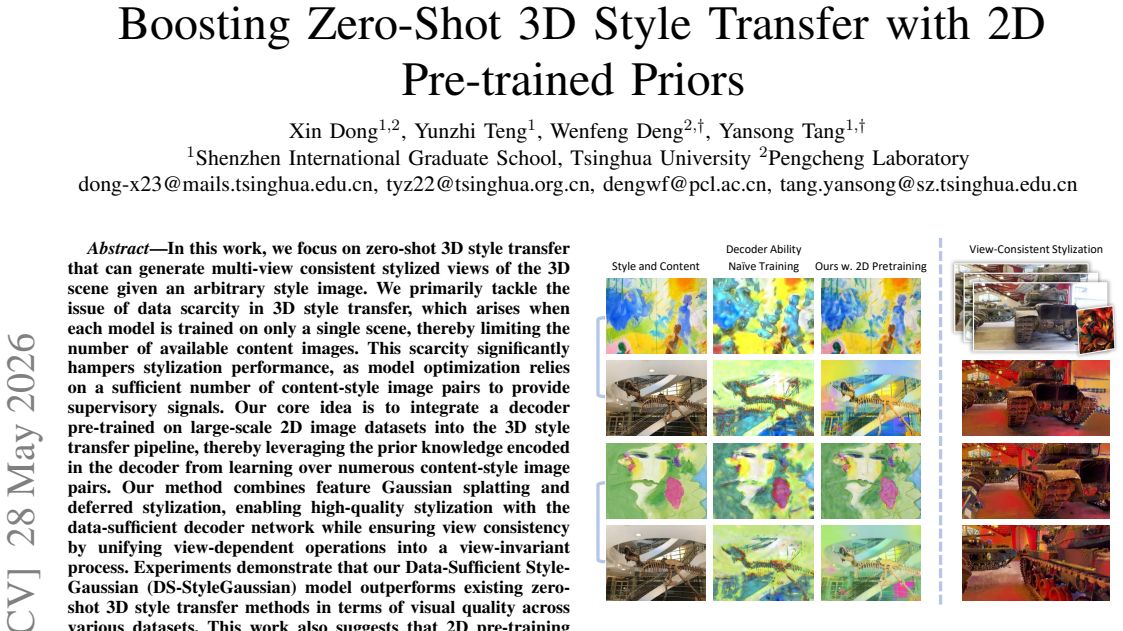
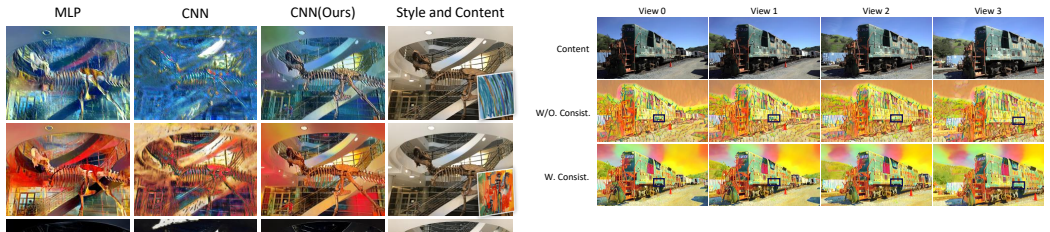
In this work, we focus on zero-shot 3D style transfer that can generate multi-view consistent stylized views of the 3D scene given an arbitrary style image. We primarily tackle the issue of data scarcity in 3D style transfer, which arises when each model is trained on only a single scene, thereby limiting the number of available content images. This scarcity significantly hampers stylization performance, as model optimization relies on a sufficient number of content-style image pairs to provide supervisory signals. Our core idea is to integrate a decoder pre-trained on large-scale 2D image datasets into the 3D style transfer pipeline, thereby leveraging the prior knowledge encoded in the decoder from learning over numerous content-style image pairs. Our method combines feature Gaussian splatting and deferred stylization, enabling high-quality stylization with the data-sufficient decoder network while ensuring view consistency by unifying view-dependent operations into a view-invariant process. Experiments demonstrate that our Data-Sufficient StyleGaussian (DS-StyleGaussian) model outperforms existing zero-shot 3D style transfer methods in terms of visual quality across various datasets. This work also suggests that 2D pre-training can serve as a strong enhancement for 3D tasks, bridging the data gap between 2D and 3D.
Editorial analysis
A structured set of objections, weighed in public.
Referee Report
Summary. The paper proposes DS-StyleGaussian for zero-shot 3D style transfer. It tackles data scarcity in 3D by integrating a decoder pre-trained on large-scale 2D content-style pairs into a 3D pipeline via feature Gaussian splatting and deferred stylization. The approach unifies view-dependent operations into a view-invariant process to maintain multi-view consistency while leveraging the data-sufficient 2D decoder for higher-quality stylization. Experiments are claimed to show outperformance over prior zero-shot 3D style transfer methods across datasets, suggesting 2D pre-training as a general enhancer for 3D tasks.
Significance. If the central claims hold, the work provides a practical way to bridge the data gap between 2D and 3D by reusing pre-trained 2D priors, which could generalize to other 3D tasks limited by scene-specific training. The specific integration of feature Gaussian splatting with deferred stylization offers a concrete mechanism for consistency that merits attention if supported by evidence.
major comments (2)
- [Method] Method section (feature Gaussian splatting and deferred stylization description): The claim that unifying view-dependent operations ensures view consistency rests on the untested assumption that the 2D pre-trained decoder maps nearby viewpoint-induced variations in splatted feature maps to stylizations whose differences are no larger than those from camera motion alone. No domain-adaptation step, feature-alignment module, or analysis of distribution shift between 2D training pairs and 3D splatted features is described, which directly bears on whether the deferred step preserves consistency.
- [Experiments] Experiments section: The assertion that DS-StyleGaussian outperforms existing methods lacks any cited quantitative tables, ablation results, or metrics (e.g., LPIPS, user studies) in the manuscript text; without these, the magnitude of improvement and the contribution of the 2D decoder versus the splatting components cannot be assessed.
minor comments (1)
- [Abstract] Abstract: The acronym DS-StyleGaussian is introduced without spelling out 'Data-Sufficient StyleGaussian' on first use, which could be clarified for readability.
Simulated Author's Rebuttal
We thank the referee for the constructive feedback. We address each major comment below and will revise the manuscript to improve clarity on the method assumptions and to include quantitative results in the main text.
read point-by-point responses
-
Referee: [Method] Method section (feature Gaussian splatting and deferred stylization description): The claim that unifying view-dependent operations ensures view consistency rests on the untested assumption that the 2D pre-trained decoder maps nearby viewpoint-induced variations in splatted feature maps to stylizations whose differences are no larger than those from camera motion alone. No domain-adaptation step, feature-alignment module, or analysis of distribution shift between 2D training pairs and 3D splatted features is described, which directly bears on whether the deferred step preserves consistency.
Authors: The core mechanism is that feature Gaussian splatting produces a view-invariant feature representation in 3D space before the decoder is applied in the deferred stylization step; this unifies any view-dependent effects into a single consistent process. While the manuscript does not contain an explicit domain-shift analysis or adaptation module, the 2D decoder was trained on diverse content-style pairs and the splatted features are constructed to lie in a compatible space. We will add a dedicated paragraph discussing this assumption and its implications for consistency in the revised Method section. revision: partial
-
Referee: [Experiments] Experiments section: The assertion that DS-StyleGaussian outperforms existing methods lacks any cited quantitative tables, ablation results, or metrics (e.g., LPIPS, user studies) in the manuscript text; without these, the magnitude of improvement and the contribution of the 2D decoder versus the splatting components cannot be assessed.
Authors: The current manuscript emphasizes qualitative comparisons, with supporting quantitative metrics and ablations provided in the supplementary material. To directly address the concern, we will move the key quantitative tables (including LPIPS, user-study scores, and component ablations) into the main Experiments section and cite them explicitly in the revised manuscript. revision: yes
Circularity Check
No circularity: method relies on external 2D pre-trained decoder without self-referential reduction
full rationale
The paper's core claim integrates a pre-trained 2D decoder into a 3D Gaussian splatting pipeline via feature splatting and deferred stylization. No equations, fitted parameters, or self-citations are presented that reduce the view-consistency or stylization quality result to a definition or input by construction. The derivation chain treats the 2D decoder as an independent external prior, and the unification of view-dependent operations is described as an architectural choice rather than a tautological mapping. This is the standard non-circular case for a method paper that imports a pre-trained component.
Axiom & Free-Parameter Ledger
axioms (1)
- domain assumption A decoder trained on large-scale 2D content-style pairs encodes priors that remain useful when inserted into a 3D style-transfer pipeline.
Reference graph
Works this paper leans on
-
[1]
Arf: Artistic radiance fields,
Kai Zhang, Nick Kolkin, Sai Bi, Fujun Luan, Zexiang Xu, Eli Shecht- man, and Noah Snavely, “Arf: Artistic radiance fields,” inEuropean Conference on Computer Vision. Springer, 2022, pp. 717–733
2022
-
[2]
Stylerf: Zero- shot 3d style transfer of neural radiance fields,
Kunhao Liu, Fangneng Zhan, Yiwen Chen, Jiahui Zhang, Yingchen Yu, Abdulmotaleb El Saddik, Shijian Lu, and Eric P Xing, “Stylerf: Zero- shot 3d style transfer of neural radiance fields,” inProceedings of the IEEE/CVF Conference on Computer Vision and Pattern Recognition, 2023, pp. 8338–8348
2023
-
[3]
Arbitrary style transfer in real-time with adaptive instance normalization,
Xun Huang and Serge Belongie, “Arbitrary style transfer in real-time with adaptive instance normalization,” inProceedings of the IEEE international conference on computer vision, 2017, pp. 1501–1510
2017
-
[4]
Image style transfer using convolutional neural networks,
Leon A Gatys, Alexander S Ecker, and Matthias Bethge, “Image style transfer using convolutional neural networks,” inProceedings of the IEEE conference on computer vision and pattern recognition, 2016, pp. 2414–2423
2016
-
[5]
Combining markov random fields and convolutional neural networks for image synthesis,
Chuan Li and Michael Wand, “Combining markov random fields and convolutional neural networks for image synthesis,” inProceedings of the IEEE conference on computer vision and pattern recognition, 2016, pp. 2479–2486
2016
-
[6]
Snerf: stylized neural im- plicit representations for 3d scenes,
Thu Nguyen-Phuoc, Feng Liu, and Lei Xiao, “Snerf: stylized neural im- plicit representations for 3d scenes,”arXiv preprint arXiv:2207.02363, 2022
-
[7]
In- stantstylegaussian: Efficient art style transfer with 3d gaussian splatting,
Xin-Yi Yu, Jun-Xin Yu, Li-Bo Zhou, Yan Wei, and Lin-Lin Ou, “In- stantstylegaussian: Efficient art style transfer with 3d gaussian splatting,” arXiv preprint arXiv:2408.04249, 2024
-
[8]
Stylesplat: 3d object style transfer with gaussian splatting,
Sahil Jain, Avik Kuthiala, Prabhdeep Singh Sethi, and Prakanshul Saxena, “Stylesplat: 3d object style transfer with gaussian splatting,” arXiv preprint arXiv:2407.09473, 2024
-
[9]
G- style: Stylized gaussian splatting,
´Aron Samuel Kov ´acs, Pedro Hermosilla, and Renata G Raidou, “G- style: Stylized gaussian splatting,” inComputer Graphics F orum, 2024, vol. 43, p. e15259
2024
-
[10]
Lavt: Language-aware vision transformer for referring image segmentation,
Zhao Yang, Jiaqi Wang, Yansong Tang, Kai Chen, Hengshuang Zhao, and Philip HS Torr, “Lavt: Language-aware vision transformer for referring image segmentation,” inProceedings of the CVPR, 2022, pp. 18155–18165
2022
-
[11]
Instant neural graphics primitives with a multiresolution hash encod- ing,
Thomas M ¨uller, Alex Evans, Christoph Schied, and Alexander Keller, “Instant neural graphics primitives with a multiresolution hash encod- ing,”ACM transactions on graphics (TOG), vol. 41, no. 4, pp. 1–15, 2022
2022
-
[12]
Reducing the memory footprint of 3d gaussian splatting,
Panagiotis Papantonakis, Georgios Kopanas, Bernhard Kerbl, Alexandre Lanvin, and George Drettakis, “Reducing the memory footprint of 3d gaussian splatting,”Proceedings of the ACM on Computer Graphics and Interactive Techniques, vol. 7, no. 1, pp. 1–17, 2024
2024
-
[13]
Feature 3dgs: Supercharging 3d gaussian splatting to enable distilled feature fields,
Shijie Zhou, Haoran Chang, Sicheng Jiang, Zhiwen Fan, Zehao Zhu, Dejia Xu, Pradyumna Chari, Suya You, Zhangyang Wang, and Achuta Kadambi, “Feature 3dgs: Supercharging 3d gaussian splatting to enable distilled feature fields,”arXiv preprint arXiv:2312.03203, 2023
-
[14]
Pgsr: Planar-based gaussian splatting for efficient and high-fidelity surface reconstruction,
Danpeng Chen, Hai Li, Weicai Ye, Yifan Wang, Weijian Xie, Shangjin Zhai, Nan Wang, Haomin Liu, Hujun Bao, and Guofeng Zhang, “Pgsr: Planar-based gaussian splatting for efficient and high-fidelity surface reconstruction,”IEEE Transactions on Visualization and Computer Graphics, 2024
2024
-
[15]
4d gaussian splatting for real-time dynamic scene rendering,
Guanjun Wu, Taoran Yi, Jiemin Fang, Lingxi Xie, Xiaopeng Zhang, Wei Wei, Wenyu Liu, Qi Tian, and Xinggang Wang, “4d gaussian splatting for real-time dynamic scene rendering,” inProceedings of the IEEE/CVF conference on computer vision and pattern recognition, 2024, pp. 20310–20320
2024
-
[16]
Zeyu Yang, Hongye Yang, Zijie Pan, and Li Zhang, “Real-time photo- realistic dynamic scene representation and rendering with 4d gaussian splatting,”arXiv preprint arXiv:2310.10642, 2023
-
[17]
Dynamic 3d gaussians: Tracking by persistent dynamic view synthesis,
Jonathon Luiten, Georgios Kopanas, Bastian Leibe, and Deva Ramanan, “Dynamic 3d gaussians: Tracking by persistent dynamic view synthesis,” in2024 International Conference on 3D Vision (3DV), 2024, pp. 800– 809
2024
-
[18]
Deformable 3d gaussians for high-fidelity monocular dynamic scene reconstruction,
Ziyi Yang, Xinyu Gao, Wen Zhou, and et al., “Deformable 3d gaussians for high-fidelity monocular dynamic scene reconstruction,” in Proceedings of the CVPR, 2024, pp. 20331–20341
2024
-
[19]
Sc-gs: Sparse- controlled gaussian splatting for editable dynamic scenes,
Yi-Hua Huang, Yang-Tian Sun, Ziyi Yang, and et al., “Sc-gs: Sparse- controlled gaussian splatting for editable dynamic scenes,” inProceed- ings of the CVPR, 2024, pp. 4220–4230
2024
-
[20]
Gaussianeditor: Swift and controllable 3d editing with gaussian splatting,
Yiwen Chen, Zilong Chen, Chi Zhang, Feng Wang, Xiaofeng Yang, Yikai Wang, Zhongang Cai, Lei Yang, Huaping Liu, and Guosheng Lin, “Gaussianeditor: Swift and controllable 3d editing with gaussian splatting,”arXiv preprint arXiv:2311.14521, 2023
-
[21]
Instruct-nerf2nerf: Editing 3d scenes with instructions,
Ayaan Haque, Matthew Tancik, Alexei A Efros, Aleksander Holynski, and Angjoo Kanazawa, “Instruct-nerf2nerf: Editing 3d scenes with instructions,” inProceedings of the IEEE/CVF International Conference on Computer Vision, 2023, pp. 19740–19750
2023
-
[22]
Vica-nerf: View-consistency-aware 3d editing of neural radiance fields,
Jiahua Dong and Yu-Xiong Wang, “Vica-nerf: View-consistency-aware 3d editing of neural radiance fields,”Advances in Neural Information Processing Systems, vol. 36, 2024
2024
-
[23]
Learning to stylize novel views,
Hsin-Ping Huang, Hung-Yu Tseng, Saurabh Saini, Maneesh Singh, and Ming-Hsuan Yang, “Learning to stylize novel views,” inProceedings of the IEEE/CVF International Conference on Computer Vision, 2021, pp. 13869–13878
2021
-
[24]
Stylizednerf: consistent 3d scene stylization as stylized nerf via 2d- 3d mutual learning,
Yi-Hua Huang, Yue He, Yu-Jie Yuan, Yu-Kun Lai, and Lin Gao, “Stylizednerf: consistent 3d scene stylization as stylized nerf via 2d- 3d mutual learning,” inProceedings of the IEEE/CVF Conference on Computer Vision and Pattern Recognition, 2022, pp. 18342–18352
2022
-
[25]
Stylegaussian: Instant 3d style transfer with gaussian splatting,
Kunhao Liu, Fangneng Zhan, Muyu Xu, Christian Theobalt, Ling Shao, and Shijian Lu, “Stylegaussian: Instant 3d style transfer with gaussian splatting,”arXiv preprint arXiv:2403.07807, 2024
-
[26]
Very Deep Convolutional Networks for Large-Scale Image Recognition
Karen Simonyan and Andrew Zisserman, “Very deep convolu- tional networks for large-scale image recognition,”arXiv preprint arXiv:1409.1556, 2014
work page internal anchor Pith review Pith/arXiv arXiv 2014
-
[27]
3d gaussian splatting for real-time radiance field rendering,
Bernhard Kerbl, Georgios Kopanas, Thomas Leimk ¨uhler, and George Drettakis, “3d gaussian splatting for real-time radiance field rendering,” ACM Transactions on Graphics, vol. 42, no. 4, pp. 1–14, 2023
2023
-
[28]
Optical models for direct volume rendering,
Nelson Max, “Optical models for direct volume rendering,”IEEE Transactions on Visualization and Computer Graphics, vol. 1, no. 2, pp. 99–108, 1995
1995
-
[29]
Microsoft coco: Common objects in context,
Tsung-Yi Lin, Michael Maire, Serge Belongie, James Hays, Pietro Per- ona, Deva Ramanan, Piotr Doll ´ar, and C Lawrence Zitnick, “Microsoft coco: Common objects in context,” inComputer Vision–ECCV 2014: 13th European Conference, Zurich, Switzerland, September 6-12, 2014, Proceedings, Part V 13. Springer, 2014, pp. 740–755
2014
-
[30]
Local light field fusion: Practical view synthesis with prescriptive sampling guidelines,
Ben Mildenhall, Pratul P Srinivasan, Rodrigo Ortiz-Cayon, Nima Khademi Kalantari, Ravi Ramamoorthi, Ren Ng, and Abhishek Kar, “Local light field fusion: Practical view synthesis with prescriptive sampling guidelines,”ACM Transactions on Graphics (TOG), vol. 38, no. 4, pp. 1–14, 2019
2019
-
[31]
Tanks and temples: Benchmarking large-scale scene reconstruction,
Arno Knapitsch, Jaesik Park, Qian-Yi Zhou, and Vladlen Koltun, “Tanks and temples: Benchmarking large-scale scene reconstruction,”ACM Transactions on Graphics (ToG), vol. 36, no. 4, pp. 1–13, 2017
2017
discussion (0)
Sign in with ORCID, Apple, or X to comment. Anyone can read and Pith papers without signing in.