Asymptotic magic state distillation with almost linear rate
Pith reviewed 2026-06-29 06:33 UTC · model grok-4.3
The pith
Magic state distillation protocols achieve near-linear asymptotic rates despite overhead exponents larger than one.
A machine-rendered reading of the paper's core claim, the machinery that carries it, and where it could break.
Core claim
We show that the overhead exponent is not a robust constraint on the asymptotic distillation rate by exhibiting a family of magic state distillation protocols with overhead exponent larger than one that nevertheless attain an asymptotic rate arbitrarily close to the linear rate. This implies that the distillation rate is not constrained by the overhead exponent within the sublinear rate regime. The protocols are built from error checking by measurements of logical Clifford operators.
What carries the argument
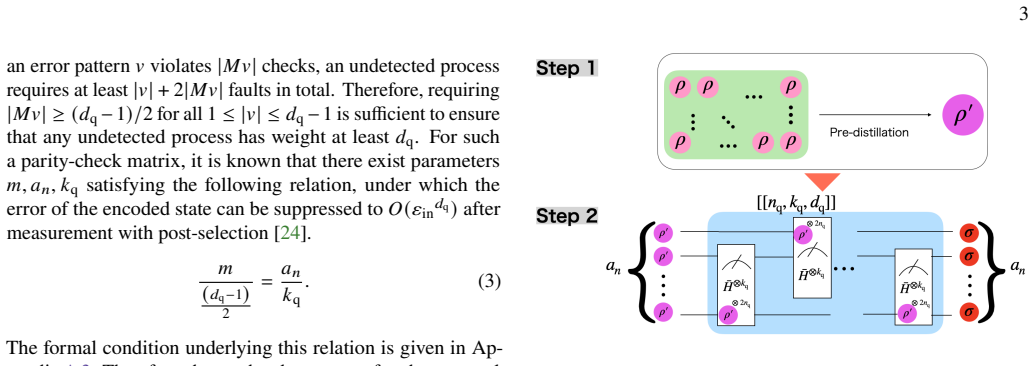
Family of protocols that perform error checking by measurements of logical Clifford operators, enabling an overhead exponent above one while still permitting the asymptotic rate to approach one.
If this is right
- The overhead exponent does not limit the achievable asymptotic rate inside the sublinear regime.
- Near-linear rates remain possible even when the number of input states grows faster than linearly with inverse error.
- Error checking via logical Clifford measurements can support asymptotic distillation tasks.
- Quantitative relations between distillation overhead and rate are not universally tight.
Where Pith is reading between the lines
- The same mechanism may be adaptable to distill other quantum resources beyond magic states.
- Fault-tolerant architectures could exploit flexible overhead-rate trade-offs instead of insisting on near-zero overhead.
- Explicit constructions of the claimed family would allow direct numerical checks of the rate-overhead decoupling.
- Similar decoupling might appear in related resource theories such as coherence or entanglement distillation.
Load-bearing premise
The family of protocols constructed from error checking by logical Clifford measurements actually attains both an overhead exponent larger than one and an asymptotic rate arbitrarily close to linear.
What would settle it
An explicit calculation or lower bound proving that no protocol with overhead exponent greater than one can make the asymptotic rate exceed some fixed fraction strictly less than one would refute the claim.
Figures
read the original abstract
The overhead exponent -- characterizing the scaling of the number of noisy magic states with respect to the target distillation error -- has been a central quantity to benchmark magic state distillation protocols. On the other hand, a related but less investigated quantity motivated by an information-theoretic viewpoint is the asymptotic distillation rate, the largest ratio of output to input magic states such that error vanishes asymptotically. These two quantities are tightly related in the specific case -- the overhead exponent is zero if and only if the asymptotic distillation rate is linear. However, their relationship in other regimes has been unclear. Here, we show that their quantitative relation is generally not robust, by presenting a family of magic state distillation protocols with an overhead exponent not close to zero -- in fact, larger than one -- that still achieves the asymptotic rate arbitrarily close to the linear rate. This implies that the distillation rate is not constrained by the overhead exponent within the sublinear rate regime. Notably, our protocol is based on error checking by measurements of logical Clifford operators, which underlies the recent magic state cultivation protocol, suggesting the potential of this mechanism for asymptotic magic state distillation.
Editorial analysis
A structured set of objections, weighed in public.
Referee Report
Summary. The paper constructs a family of magic state distillation protocols based on error checking via measurements of logical Clifford operators. It shows that this family achieves an overhead exponent strictly larger than one while making the asymptotic distillation rate arbitrarily close to linear (i.e., the ratio of output to input magic states approaches a positive constant as error vanishes). This decouples the two quantities in the sublinear-rate regime and contrasts with the known equivalence (overhead exponent zero iff linear rate) that holds only in the linear-rate case.
Significance. If the explicit construction and rate analysis hold, the result demonstrates that overhead exponent and asymptotic rate are not quantitatively linked outside the linear regime, opening new design space for distillation protocols. The connection to logical-Clifford error checking (as in recent cultivation work) is a concrete strength; the manuscript supplies reproducible parameter choices and explicit rate/overhead formulas rather than fitted parameters.
major comments (2)
- [§4.2, Theorem 2] §4.2, Theorem 2: the proof that the overhead exponent remains >1 while the rate approaches the linear bound relies on the specific choice of measurement set size scaling as n^α with α>1; the argument appears sound but would benefit from an explicit bound on the constant factors in the error probability to confirm the exponent does not drop below 1 for finite n.
- [§5.1, Eq. (18)] §5.1, Eq. (18): the claimed asymptotic rate r→1−ε is obtained by taking the number of logical checks to infinity; it is not immediately clear whether the same limit preserves the overhead exponent >1 when the target error δ is taken to zero after the rate limit, or whether an order-of-limits issue arises.
minor comments (2)
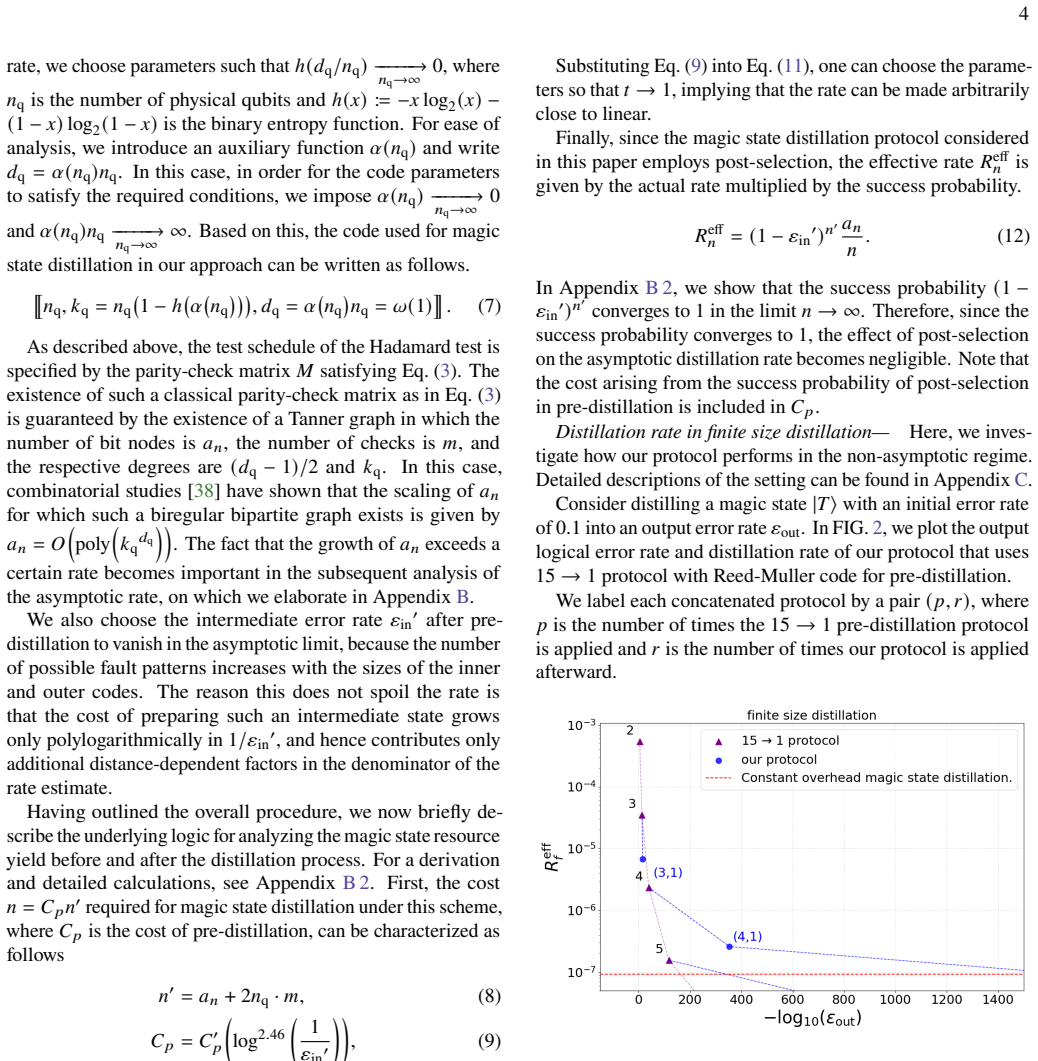
- [Figure 2] Figure 2 caption: the plotted curves for different α values should include error bars or a statement of the finite-n cutoff used in the numerical evaluation.
- [§3] Notation: the symbol R is used both for the asymptotic rate and for a finite-n ratio in §3; a subscript distinction would improve readability.
Simulated Author's Rebuttal
We thank the referee for the positive evaluation and the recommendation of minor revision. The comments highlight useful points for strengthening the presentation of the asymptotic results. We address each major comment below.
read point-by-point responses
-
Referee: [§4.2, Theorem 2] §4.2, Theorem 2: the proof that the overhead exponent remains >1 while the rate approaches the linear bound relies on the specific choice of measurement set size scaling as n^α with α>1; the argument appears sound but would benefit from an explicit bound on the constant factors in the error probability to confirm the exponent does not drop below 1 for finite n.
Authors: We agree that an explicit bound on the prefactors would make the finite-n behavior more transparent. Theorem 2 is an asymptotic statement, but the underlying error-probability estimates in §4.2 admit concrete constants that can be tracked through the Chernoff-type bounds used for the logical Clifford checks. In the revised manuscript we will add a short appendix deriving a uniform lower bound on these constants for n larger than an explicit threshold (dependent only on α and the target error regime), confirming that the overhead exponent stays strictly above 1. This is a straightforward but useful clarification. revision: yes
-
Referee: [§5.1, Eq. (18)] §5.1, Eq. (18): the claimed asymptotic rate r→1−ε is obtained by taking the number of logical checks to infinity; it is not immediately clear whether the same limit preserves the overhead exponent >1 when the target error δ is taken to zero after the rate limit, or whether an order-of-limits issue arises.
Authors: The construction separates the two limits cleanly. The number of logical checks M is first sent to infinity while keeping the block size n fixed (or growing slowly); this drives the rate to 1−ε for any fixed ε>0 while the per-check failure probability remains bounded away from 1. Only afterward is the target error δ driven to zero by increasing n, at which point the overhead exponent is controlled by the scaling α>1 of the check-set size. Because the rate limit is taken at fixed n (hence fixed α), the subsequent n→∞ limit inherits the same α>1 and therefore the same exponent strictly larger than 1. We will insert a brief paragraph in §5.1 spelling out this order of limits and the independence of the two parameters. revision: yes
Circularity Check
No significant circularity identified
full rationale
The paper asserts existence of a family of distillation protocols based on logical Clifford error checking that achieve overhead exponent >1 while asymptotic rate approaches linear. No equations, fitted parameters, or self-citations appear in the abstract or described claims that reduce the stated rates or existence result to the inputs by construction. The central claim rests on an independent protocol construction whose details (once supplied in the full manuscript) are presented as externally verifiable rather than tautological. This is the normal case of a non-circular result.
Axiom & Free-Parameter Ledger
Reference graph
Works this paper leans on
-
[1]
Conversely, if the linear asymptotic rate is nonzero, it must be the case that 𝛾=0 because any 𝛾 >0 results in the diverging overhead 𝑛 𝑎𝑛 in the limit of 𝜀𝑛 − − − − → 𝑛→∞ 0
This particularly means that the distillation rates 𝑎𝑛 𝑛 𝑛 can be made 𝑎𝑛 𝑛 − − − − → 𝑛→∞ 𝑅 >0 with some constant 𝑅, i.e., realizing a positive linear asymptotic rate. Conversely, if the linear asymptotic rate is nonzero, it must be the case that 𝛾=0 because any 𝛾 >0 results in the diverging overhead 𝑛 𝑎𝑛 in the limit of 𝜀𝑛 − − − − → 𝑛→∞ 0. Thus, only a p...
-
[2]
Bravyi and A
S. Bravyi and A. Kitaev,Universal quantum computation with ideal clifford gates and noisy ancillas,Phys. Rev. A71, 022316 (2005)
2005
-
[3]
Goto,Step-by-step magic state encoding for efficient fault- tolerant quantum computation,Scientific Reports4, 7501 (2014)
H. Goto,Step-by-step magic state encoding for efficient fault- tolerant quantum computation,Scientific Reports4, 7501 (2014)
2014
-
[4]
Itogawa, Y
T. Itogawa, Y. Takada, Y. Hirano, and K. Fujii,Efficient magic state distillation by zero-level distillation,PRX Quantum6, 020356 (2025)
2025
-
[5]
J. Haah, M. B. Hastings, D. Poulin, and D. Wecker,Magic state distillation at intermediate size,arXiv [quant-ph] (2017), 10.48550/arXiv.1709.02789, 1709.02789 [quant-ph]
work page internal anchor Pith review Pith/arXiv arXiv doi:10.48550/arxiv.1709.02789 2017
-
[6]
Haah and M
J. Haah and M. B. Hastings,Codes and Protocols for Distilling 𝑇, controlled-𝑆, and Toffoli Gates,Quantum2, 71 (2018)
2018
-
[7]
M. B. Hastings and J. Haah,Distillation with sublogarithmic over- head,Physical Review Letters120, 050504 (2018), 1709.03543
work page internal anchor Pith review Pith/arXiv arXiv 2018
-
[8]
A. Wills, M.-H. Hsieh, and H. Yamasaki,Constant- overhead magic state distillation,arXiv [quant-ph] (2024), 10.48550/arXiv.2408.07764, 2408.07764 [quant-ph]
-
[9]
T. R. Scruby, A. Pesah, and M. Webster,Quantum rainbow codes: Achieving linear rate, growing distance and transversal non-clifford gates with generalised colour codes,arXiv [quant-ph] (2025), 10.48550/arXiv.2408.13130, 2408.13130 [quant-ph]
-
[10]
L. Golowich and V. Guruswami,Asymptotically good quan- tum codes with transversal non-clifford gates,arXiv [quant-ph] (2024), 10.48550/arXiv.2408.09254, 2408.09254 [quant-ph]
-
[11]
A. M. Meier, B. Eastin, and E. Knill,Magic-state distil- lation with the four-qubit code,arXiv [quant-ph] (2012), 10.48550/arXiv.1204.4221, 1204.4221 [quant-ph]
work page internal anchor Pith review Pith/arXiv arXiv doi:10.48550/arxiv.1204.4221 2012
-
[12]
Q. T. Nguyen,Good binary quantum codes with transversal CCZ gate,arXiv [quant-ph] (2024), 10.48550/arXiv.2408.10140, 2408.10140 [quant-ph]
-
[13]
A. Krishna and J.-P. Tillich,Towards low overhead magic state distillation,Physical Review Letters123, 070507 (2019), 1811.08461
-
[14]
Magic state distillation with punctured polar codes
A. Krishna and J.-P. Tillich,Magic state distillation with punctured polar codes,arXiv [quant-ph] (2018), 10.48550/arXiv.1811.03112, 1811.03112 [quant-ph]
work page internal anchor Pith review Pith/arXiv arXiv doi:10.48550/arxiv.1811.03112 2018
-
[15]
Litinski,Magic State Distillation: Not as Costly as You Think, Quantum3, 205 (2019)
D. Litinski,Magic State Distillation: Not as Costly as You Think, Quantum3, 205 (2019)
2019
-
[16]
Prakash,Magic state distillation with the ternary golay code, Proceedings
S. Prakash,Magic state distillation with the ternary golay code, Proceedings. Mathematical, Physical, and Engineering Sciences 476, 20200187 (2020), 2003.02717
-
[17]
B. W. Reichardt,Quantum universality from magic states distilla- tion applied to CSS codes,Quantum Information Processing4, 251 (2005)
2005
-
[18]
E. T. Campbell, H. Anwar, and D. E. Browne,Magic-state distillation in all prime dimensions using quantum reed-muller codes,Physical Review. X2, 041021 (2012)
2012
-
[19]
A. R. Kalra and S. Prakash,Invariant theory, magic state distilla- tion, and bounds on classical codes,arXiv [quant-ph] (2026), 10.48550/arXiv.2501.10163, 2501.10163 [quant-ph]
-
[20]
Prakash and T
S. Prakash and T. Saha,Low Overhead Qutrit Magic State Distillation,Quantum9, 1768 (2025)
2025
-
[21]
Qutrit Magic State Distillation
H. Anwar, E. T. Campbell, and D. E. Browne,Qutrit magic state distillation,New Journal of Physics14, 063006 (2012), 1202.2326 [quant-ph]
work page internal anchor Pith review Pith/arXiv arXiv 2012
-
[22]
Bravyi and J
S. Bravyi and J. Haah,Magic-state distillation with low overhead, Phys. Rev. A86, 052329 (2012). 6
2012
-
[23]
M. M. Wilde,Quantum information theory(Cambridge university press, 2013)
2013
-
[24]
Horodecki, P
R. Horodecki, P. Horodecki, M. Horodecki, and K. Horodecki, Quantum entanglement,Rev. Mod. Phys.81, 865 (2009)
2009
-
[25]
J. Haah, M. B. Hastings, D. Poulin, and D. Wecker,Magic state distillation with low space overhead and optimal asymptotic input count,Quantum1, 31 (2017)
2017
-
[26]
Bravyi and J
S. Bravyi and J. Haah,Magic-state distillation with low overhead, Physical Review. A86, 052329 (2012)
2012
-
[27]
M. Shi, H. Lu, J.-L. Kim, and P. Sole,Triorthog- onal codes and self-dual codes,arXiv [cs.IT] (2024), 10.48550/arXiv.2408.09685, 2408.09685 [cs.IT]
-
[28]
L. Golowich and V. Guruswami,Near-asymptotically-good quan- tum codes with transversal CCZ gates and sublinear-weight parity- checks,arXiv [quant-ph] (2025), 10.48550/arXiv.2510.06798, 2510.06798 [quant-ph]
-
[29]
E. Knill,Fault-tolerant postselected quantum computation: Schemes,arXiv [quant-ph] (2004), 10.48550/arXiv.quant- ph/0402171, quant-ph/0402171 [quant-ph]
-
[30]
Magic state cultivation: growing T states as cheap as CNOT gates
C. Gidney, N. Shutty, and C. Jones,Magic state cultivation: growing T states as cheap as CNOT gates,arXiv [quant-ph] (2024), 10.48550/arXiv.2409.17595, 2409.17595 [quant-ph]
work page internal anchor Pith review Pith/arXiv arXiv doi:10.48550/arxiv.2409.17595 2024
-
[31]
Z.-H. Chen, M.-C. Chen, C.-Y. Lu, and J.-W. Pan,Efficient magic state cultivation onRP 2,arXiv:2503.18657 [quant-ph] (2025)
-
[32]
K. Sahay, P.-K. Tsai, K. Chang, Q. Su, T. B. Smith, S. Singh, and S. Puri,Fold-transversal surface code cultivation,arXiv [quant-ph] (2026), 10.48550/arXiv.2509.05212, 2509.05212 [quant-ph]
-
[33]
Efficientmagic state cultivation on the surface code
Y. Vaknin, S. Jacoby, A. Grimsmo, and A. Retzker,Efficient magic state cultivation on the surface code,arXiv [quant-ph] (2026), 10.48550/arXiv.2502.01743, 2502.01743 [quant-ph]
-
[34]
Y. Hirano, R. Toshio, T. Itogawa, and K. Fujii,Efficient magic state cultivation with lattice surgery,arXiv [quant-ph] (2025), 10.48550/arXiv.2510.24615, 2510.24615 [quant-ph]
-
[35]
CultivatingTstates on the surface code with only two-qubit gates
J. Claes,Cultivating T states on the surface code with only two-qubit gates,arXiv [quant-ph] (2025), 10.48550/arXiv.2509.05232, 2509.05232 [quant-ph]
-
[36]
T. Tansuwannont, Y. Takada, and K. Fujii,Clifford gates with logical transversality for self-dual CSS codes,arXiv [quant-ph] (2025), 10.48550/arXiv.2503.19790, 2503.19790 [quant-ph]
-
[37]
Quantum Error Detection II: Bounds
A. Ashikhmin, A. Barg, E. Knill, and S. Litsyn,Quan- tum error detection II: Bounds,arXiv [quant-ph] (1999), 10.48550/arXiv.quant-ph/9906131, quant-ph/9906131 [quant- ph]
work page internal anchor Pith review Pith/arXiv arXiv doi:10.48550/arxiv.quant-ph/9906131 1999
-
[38]
A. R. Calderbank and P. W. Shor,Good quantum error-correcting codes exist,Physical Review. A54, 1098 (1996), 9512032
1996
-
[39]
Furedi, F
Z. Furedi, F. Lazebnik, A. Seress, V. A. Ustimenko, and A. J. Woldar,Graphs of prescribed girth and bi-degree,Journal of Combinatorial Theory. Series B64, 228 (1995)
1995
-
[40]
M. Beverland, E. Campbell, M. Howard, and V. Kliuchnikov, Lower bounds on the non-clifford resources for quantum com- putations,Quantum Science and Technology5, 035009 (2020), 1904.01124 [quant-ph]
-
[41]
Efficient magic state factories with a catalyzed |CCZ> to 2|T> transformation
C. Gidney and A. G. Fowler,Efficient magic state factories with a catalyzed |𝐶𝐶 𝑍⟩ to 2|𝑇⟩ transformation,Quantum3, 135 (2019), 1812.01238 [quant-ph]. 7 Appendices CONTENTS A. Generalized Hadamard-test type magic state distillation 7
work page internal anchor Pith review Pith/arXiv arXiv 2019
-
[42]
Property of inner code 8
-
[43]
Input-output count of Hadamard-test type magic state distillation 11
Property of outer code 9 B. Input-output count of Hadamard-test type magic state distillation 11
-
[44]
Overhead exponent of Hadamard-test type magic state distillation 11
-
[45]
Finite size distillation 15
Analysis of sublinear rate protocol 12 C. Finite size distillation 15
-
[46]
Repetition of small protocol (15→1) 15
-
[47]
Protocol of constant overhead magic state distillation 16
-
[48]
GENERALIZED HADAMARD-TEST TYPE MAGIC STATE DISTILLATION
Sublinear protocol in finite size distillation 18 A. GENERALIZED HADAMARD-TEST TYPE MAGIC STATE DISTILLATION
-
[49]
The definition and notation of this paper are as follows
Setup In this section, we explain magic state distillation introduced in [24] based on the Hadamard test and discuss its distillation efficiency. The definition and notation of this paper are as follows. 𝑋= 0 1 1 0 , 𝑌= 0−𝑖 𝑖0 , 𝑍= 1 0 0−1 ,(13) 𝐻= 1√ 2 1 1 1−1 , 𝑇 𝐻 =𝑒 −𝑖 𝜋𝑌/8 = cos 𝜋 8 −sin 𝜋 8 sin 𝜋 8 cos 𝜋 8 , 𝑇= 1 0 0𝑒 𝑖 𝜋 4 .(14) We describe the met...
-
[50]
Property of inner code This section is devoted to the analysis of logical gates associated with the quantum error-correcting code called inner code. Definition 1(Inner code).The inner code is a quantum error-correcting code used to detect errors in the magic states, and is denoted by[[𝑛 q, 𝑘q, 𝑑q] ]in the family of weakly self-dual CSS codes. 9 By impleme...
-
[51]
Definition 3(Outer code).The outer code serves to detect errors that have escaped into the ancilla system
Property of outer code In this section, we explain what kinds of outer codes can be constructed for a given inner code. Definition 3(Outer code).The outer code serves to detect errors that have escaped into the ancilla system. The outer code is a classical code with a binary parity-check matrix, 𝑀, of size 𝑚 by 𝑎𝑛, which specifies which qubit will undergo...
-
[52]
First, we compute the input count based on FIG
Overhead exponent of Hadamard-test type magic state distillation In this section, we derive the input-output count and the overhead exponent of the Hadamard-test-type protocol when 𝑑qth-order error suppression is achieved by combining the inner code and outer code described above. First, we compute the input count based on FIG. S.6 and the discussion of t...
-
[53]
Our protocol consists of two parts: the pre-distillation part based on the 15→1 protocol, and the part that achieves 𝜀out →0 using a large inner code and outer code
Analysis of sublinear rate protocol In this section, we analyze the achievable distillation rate by our protocol with𝛾 >1 introduced in the previous section. Our protocol consists of two parts: the pre-distillation part based on the 15→1 protocol, and the part that achieves 𝜀out →0 using a large inner code and outer code. It is therefore necessary to anal...
-
[54]
The Reed–Muller code is a [[15,1,3] ] code and admits a transversal 𝑇 gate 𝑇 ⊗15 = ¯𝑇 here, ¯𝑇 means a logical 𝑇 gate
Repetition of small protocol (15→1) In this section, we describe the performance of magic state distillation based on the Reed–Muller code [21]. The Reed–Muller code is a [[15,1,3] ] code and admits a transversal 𝑇 gate 𝑇 ⊗15 = ¯𝑇 here, ¯𝑇 means a logical 𝑇 gate. That is, applying ¯𝑇 to the encoded state | ¯+⟩ in the Reed–Muller code, one can implement a ...
-
[55]
Their strategy does not use post-selection however rather corrects the error
Protocol of constant overhead magic state distillation Magic state distillation with asymptotically constant overhead has recently been achieved [7]. Their strategy does not use post-selection however rather corrects the error. Thus, we denote the quantum algebraic geometry code as [[𝑁, 𝐾, 𝐷, 𝑟 𝑑] ]qAG where 𝑟 is the decoding radius. First, we describe th...
-
[56]
Since our protocol has a sublinear rate, the distillation rate is monotonically decreasing with respect to 𝑛
Sublinear protocol in finite size distillation Next, we consider the degree of error rate reduction achieved by our protocol for comparison. Since our protocol has a sublinear rate, the distillation rate is monotonically decreasing with respect to 𝑛. That is, among the constructions for which the distillation rate of our protocol, calculated by Eq. (10), ...
discussion (0)
Sign in with ORCID, Apple, or X to comment. Anyone can read and Pith papers without signing in.