Beyond MSE: Improving Precipitation Nowcasting with Multi-Quantile Regression
Pith reviewed 2026-06-29 08:42 UTC · model grok-4.3
The pith
Reformulating precipitation nowcasting training as multi-quantile regression improves the central deterministic forecast by 8.6% MSE while also producing upper-quantile outputs for heavy rain risk.
A machine-rendered reading of the paper's core claim, the machinery that carries it, and where it could break.
Core claim
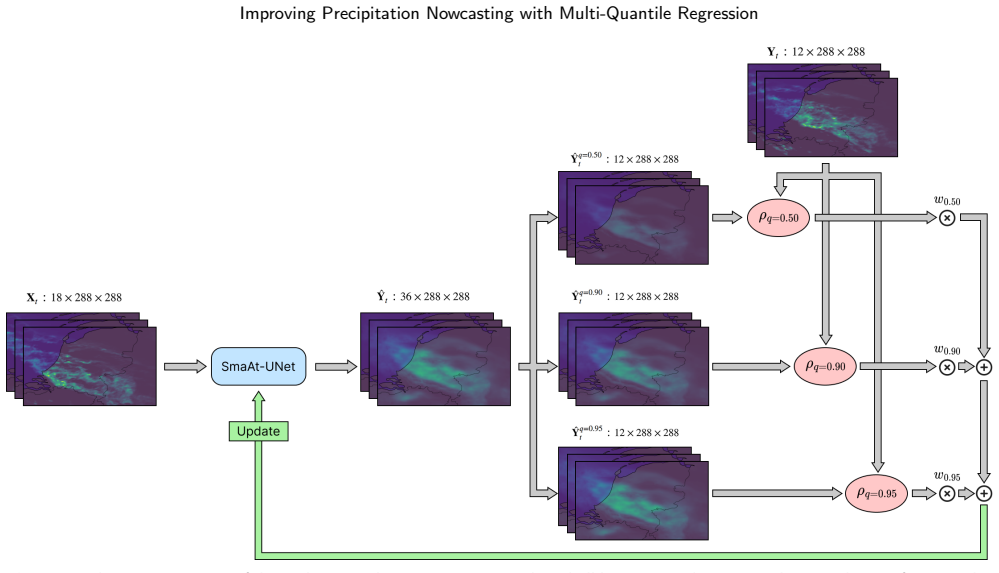
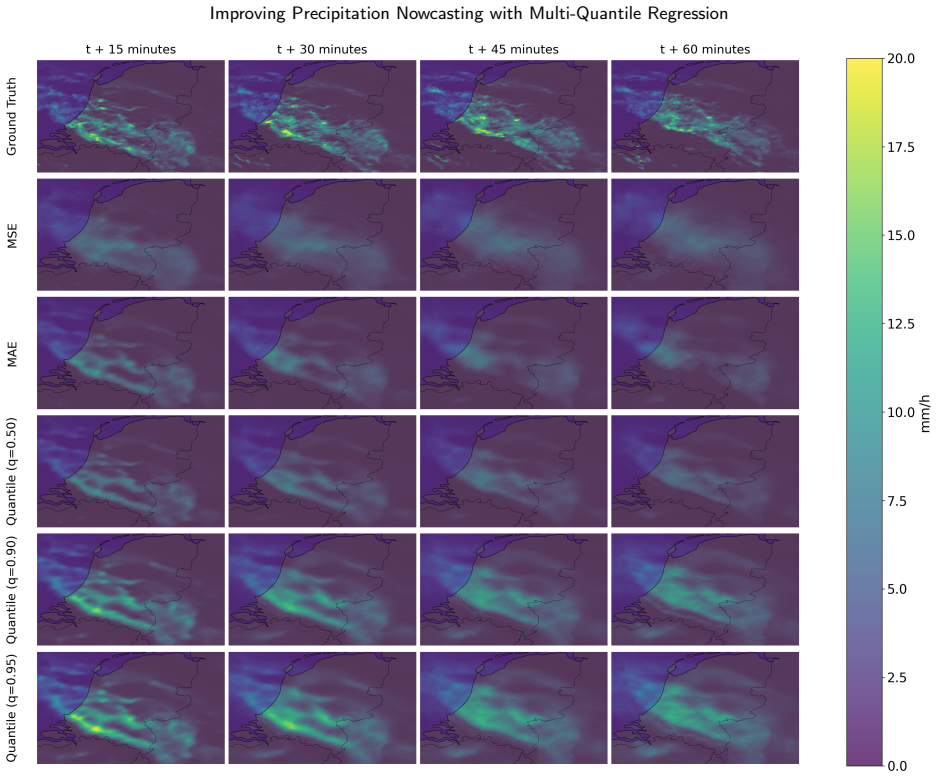
Using SmaAt-UNet as the base architecture, the study shows that multi-quantile training with pinball loss improves the central deterministic forecast, decreasing test-set MSE by 8.6% relative to a model trained with MSE, while simultaneously generating upper-quantile outputs that are useful for risk-sensitive prediction of heavy precipitation.
What carries the argument
The multi-quantile pinball loss, which jointly optimizes predictions at several quantile levels so that the median quantile serves as the deterministic forecast and the upper quantiles supply tail estimates.
If this is right
- An existing deterministic nowcasting architecture can be retrained with the new loss to obtain both a stronger central forecast and explicit upper-tail estimates.
- Upper-quantile outputs can be used directly for threshold-based warnings without post-processing or ensemble generation.
- The same training procedure offers a lightweight alternative to generative or sampling-based uncertainty methods in precipitation nowcasting.
- The approach requires no change to model architecture or inference procedure beyond the loss function.
Where Pith is reading between the lines
- Operational nowcasting pipelines could replace separate uncertainty modules with a single multi-quantile model if the gain generalizes to other regions and lead times.
- The method may extend to other meteorological regression tasks where both central accuracy and tail behavior matter, such as wind or temperature extremes.
- If the improvement holds under stricter controls, it suggests that quantile-based training can mitigate the smoothing bias common in MSE-optimized convolutional nowcasters.
Load-bearing premise
The measured MSE reduction and the usefulness of the upper quantiles result from the choice of multi-quantile loss rather than from differences in hyperparameter choices, preprocessing, or random seed effects.
What would settle it
Re-running the MSE and multi-quantile experiments with identical hyperparameters, data splits, and random seeds across multiple independent trials and finding that the 8.6% MSE gap disappears or reverses.
Figures


read the original abstract
Deep-learning precipitation nowcasting models are often optimized using pointwise losses such as mean squared error or mean absolute error, which can lead to overly smooth forecasts and poor representation of heavy rainfall. This study investigates whether the predictive performance of an established deterministic nowcasting architecture can be improved by reformulating training as a multi-quantile regression problem. Using SmaAt-UNet as a core model, we compare MSE, MAE, and multi-quantile pinball-loss training on radar precipitation nowcasting over the Netherlands. The results show that multi-quantile training improves the central deterministic forecast, decreasing test-set MSE by 8.6\% compared to a model trained using MSE, while also producing upper-quantile outputs that are useful for risk-sensitive prediction of heavy precipitation. These findings suggest that quantile regression provides a simple alternative to standard pointwise losses without requiring a new architecture or generative sampling procedure. The implementation of our models and training setup is available on \href{https://github.com/gijsvn/Multi-Quantile-Precipitation-Nowcasting}{GitHub}.
Editorial analysis
A structured set of objections, weighed in public.
Referee Report
Summary. The paper claims that reformulating training of the SmaAt-UNet architecture as a multi-quantile regression problem with pinball loss improves the central deterministic forecast on Dutch radar precipitation nowcasting data, yielding an 8.6% reduction in test-set MSE relative to MSE training while also producing useful upper-quantile outputs for heavy-precipitation risk assessment; the work positions this as a simple alternative to pointwise losses that requires no new architecture or generative sampling.
Significance. If the improvement is attributable to the loss formulation rather than uncontrolled experimental factors, the result would show that multi-quantile training can simultaneously boost deterministic accuracy and supply calibrated risk-sensitive predictions without architectural innovation. The public GitHub release of code and training setup is a clear strength that aids reproducibility and allows direct verification of the empirical protocol.
major comments (1)
- [Abstract] Abstract: the headline claim of an 8.6% test-set MSE reduction is presented without any description of whether the MSE-trained and multi-quantile models used identical hyperparameter search procedures, learning-rate schedules, data-augmentation policies, early-stopping criteria, random seeds, or validation-based model selection. Because the central claim is an empirical head-to-head comparison that attributes the gain specifically to the multi-quantile pinball loss, the absence of these controls is load-bearing; single-run point estimates without matched protocols cannot support the attribution.
Simulated Author's Rebuttal
We thank the referee for the constructive feedback on the need for explicit experimental controls to support the central empirical claim. We address the major comment below and will revise the manuscript to strengthen clarity.
read point-by-point responses
-
Referee: [Abstract] Abstract: the headline claim of an 8.6% test-set MSE reduction is presented without any description of whether the MSE-trained and multi-quantile models used identical hyperparameter search procedures, learning-rate schedules, data-augmentation policies, early-stopping criteria, random seeds, or validation-based model selection. Because the central claim is an empirical head-to-head comparison that attributes the gain specifically to the multi-quantile pinball loss, the absence of these controls is load-bearing; single-run point estimates without matched protocols cannot support the attribution.
Authors: We agree that the abstract does not explicitly describe the matched protocols and that this detail is important for attributing the MSE improvement to the pinball loss. The Methods section of the manuscript specifies that both models were trained using the same hyperparameter search, learning-rate schedules, data-augmentation policies, early-stopping criteria, random seeds, and validation-based selection. To make this explicit at the level of the headline claim, we will revise the abstract to include a concise statement confirming the identical experimental setup for the two training regimes. This change will be incorporated in the revised version. revision: yes
Circularity Check
No circularity: purely empirical loss-function comparison on fixed architecture
full rationale
The manuscript reports an experimental head-to-head evaluation of three training losses (MSE, MAE, multi-quantile pinball) applied to the identical SmaAt-UNet architecture on the same radar dataset. The headline 8.6% test-MSE reduction is presented as an observed outcome of that comparison, not as the output of any derivation, uniqueness theorem, or self-referential fitting step. No equations are shown that define a quantity in terms of itself, no parameter is fitted on a subset and then relabeled a prediction, and no load-bearing claim rests on a self-citation chain. The work is therefore self-contained against external benchmarks and receives the default non-circularity finding.
Axiom & Free-Parameter Ledger
axioms (2)
- domain assumption SmaAt-UNet is a suitable base architecture for the nowcasting task
- domain assumption The radar precipitation dataset over the Netherlands is representative for evaluating nowcasting performance
Reference graph
Works this paper leans on
-
[1]
Mehrkanoon, Deep shared representation learning for weather elements forecasting, Knowledge-Based Systems 179 (2019) 120– 128
S. Mehrkanoon, Deep shared representation learning for weather elements forecasting, Knowledge-Based Systems 179 (2019) 120– 128
2019
-
[2]
Trebing, S
K. Trebing, S. Mehrkanoon, Wind speed prediction using multidi- mensionalconvolutionalneuralnetworks, in:IEEEsymposiumseries on computational intelligence (SSCI), IEEE, 2020, pp. 713–720
2020
-
[3]
Y. Wang, M. Long, J. Wang, Z. Gao, P. S. Yu, Predrnn: Recurrent neural networks for predictive learning using spatiotemporal lstms, Advances in neural information processing systems 30 (2017)
2017
-
[4]
J. G. Fernández, I. A. Abdellaoui, S. Mehrkanoon, Deep coastal seaelementsforecastingusingunet-basedmodels, Knowledge-Based Systems 252 (2022) 109445
2022
-
[5]
Stańczyk, S
T. Stańczyk, S. Mehrkanoon, et al., Deep graph convolutional net- worksfor wind speedprediction, in: ESANN2021 Proceedings-29th European Symposium on Artificial Neural Networks, Computational IntelligenceandMachineLearning,i6doc.compublication,2021,pp. 147–152
2021
-
[6]
X. Shi, Z. Chen, H. Wang, D.-Y. Yeung, W.-K. Wong, W.-c. Woo, Convolutional lstm network: A machine learning approach for pre- cipitation nowcasting, Advances in neural information processing systems 28 (2015)
2015
-
[7]
Woo, Deep learning for precipitation nowcasting: A benchmark and a new model, Advances in neural information processing systems 30 (2017)
X.Shi,Z.Gao,L.Lausen,H.Wang,D.-Y.Yeung,W.-k.Wong,W.-c. Woo, Deep learning for precipitation nowcasting: A benchmark and a new model, Advances in neural information processing systems 30 (2017)
2017
-
[8]
K.Trebing,T.Stańczyk,S.Mehrkanoon, SmaAt-UNet:Precipitation nowcasting using a small attention-unet architecture, Pattern Recog- nition Letters 145 (2021) 178–186
2021
-
[9]
L.Vatamány,S.Mehrkanoon,Graphdual-streamconvolutionalatten- tionfusionforprecipitationnowcasting, EngineeringApplicationsof Artificial Intelligence 141 (2025) 109788
2025
-
[10]
Y. Yang, S. Mehrkanoon, AA-TransUNet: Attention augmented transunet for nowcasting tasks, in: International joint conference on neural networks (IJCNN), IEEE, 2022, pp. 01–08
2022
-
[11]
Kaparakis, S
C. Kaparakis, S. Mehrkanoon, WF-UNet: Weather data fusion using 3d-unetforprecipitationnowcasting, ProcediaComputerScience222 (2023) 223–232
2023
-
[12]
J. G. Fernández, S. Mehrkanoon, Broad-UNet: Multi-scale feature learningfornowcastingtasks, NeuralNetworks144(2021)419–427
2021
-
[13]
Espeholt, S
L. Espeholt, S. Agrawal, C. Sønderby, M. Kumar, J. Heek, C. Bromberg, C. Gazen, R. Carver, M. Andrychowicz, J. Hickey, et al., Deep learning for twelve hour precipitation forecasts, Nature communications 13 (2022) 5145
2022
- [14]
-
[15]
Ravuri, K
S. Ravuri, K. Lenc, M. Willson, D. Kangin, R. Lam, P. Mirowski, M. Fitzsimons, M. Athanassiadou, S. Kashem, S. Madge, et al., Skilful precipitation nowcasting using deep generative models of radar, Nature 597 (2021) 672–677
2021
-
[16]
Zhang, M
Y. Zhang, M. Long, K. Chen, L. Xing, R. Jin, M. I. Jordan, J. Wang, Skilful nowcasting of extreme precipitation with nowcastnet, Nature 619 (2023) 526–532
2023
-
[17]
J. Leinonen, U. Hamann, D. Nerini, U. Germann, G. Franch, La- tent diffusion models for generative precipitation nowcasting with accurateuncertaintyquantification, arXivpreprintarXiv:2304.12891 (2023)
-
[18]
Koenker, G
R. Koenker, G. Bassett Jr, Regression quantiles, Econometrica: journal of the Econometric Society (1978) 33–50
1978
-
[19]
Koenker, Quantile regression [m], Econometric Society Mono- graphs, Cambridge University Press, Cambridge (2005)
R. Koenker, Quantile regression [m], Econometric Society Mono- graphs, Cambridge University Press, Cambridge (2005)
2005
-
[20]
Q. Wang, Y. Ma, K. Zhao, Y. Tian, A comprehensive survey of loss functionsinmachinelearning, AnnalsofDataScience9(2022)187– 212
2022
-
[21]
G.Ayzel,T.Scheffer,M.Heistermann, Rainnetv1.0:aconvolutional neural network for radar-based precipitation nowcasting, Geoscien- tific Model Development 13 (2020) 2631–2644
2020
-
[22]
Y. Cao, L. Chen, D. Zhang, L. Ma, H. Shan, Hybrid weighting loss for precipitation nowcasting from radar images, in: ICASSP 2022- 2022IEEEInternationalConferenceonAcoustics,SpeechandSignal Processing (ICASSP), IEEE, 2022, pp. 3738–3742
2022
-
[23]
J. Ko, K. Lee, H. Hwang, S.-G. Oh, S.-W. Son, K. Shin, Effective training strategies for deep-learning-based precipitation nowcasting and estimation, Computers & Geosciences 161 (2022) 105072
2022
-
[24]
Z. Ma, H. Zhang, J. Liu, Focal frame loss: A simple but effective loss for precipitation nowcasting, IEEE Journal of Selected Topics in Applied Earth Observations and Remote Sensing 15 (2022) 6781– 6788
2022
-
[25]
Q.-K.Tran,S.-k.Song, Computervisioninprecipitationnowcasting: Applying image quality assessment metrics for training deep neural networks, Atmosphere 10 (2019) 244
2019
-
[26]
J. W. Taylor, A quantile regression neural network approach to estimating the conditional density of multiperiod returns, Journal of forecasting 19 (2000) 299–311
2000
-
[27]
S. Rasp, S. Lerch, Neural networks for postprocessing ensemble weather forecasts, Monthly Weather Review 146 (2018) 3885–3900
2018
-
[28]
Schaumann, M
P. Schaumann, M. Rempel, U. Blahak, V. Schmidt, Generating syn- theticrainfallfieldsbyr-vinecopulasappliedtoseamlessprobabilistic predictions, Quarterly Journal of the Royal Meteorological Society 150 (2024) 3078–3098
2024
-
[29]
P.Baron,A.Amell,S.Kawamura,S.Satoh,T.Ushio, 3dprecipitation nowcastingfromphasedarrayradarwithuncertaintyestimationusing aquantileregressionneuralnetwork,in:2025IEEERadarConference (RadarConf25), IEEE, 2025, pp. 01–06. G. van Nieuwkoop, S. Mehrkanoon:Preprint submitted to Pattern Recognition LettersPage 7 of 7
2025
discussion (0)
Sign in with ORCID, Apple, or X to comment. Anyone can read and Pith papers without signing in.