Carrier-coupled ultrafast structural dynamics and interlayer energy transport of supported transition metal dichalcogenide heterostructures
Pith reviewed 2026-06-29 05:54 UTC · model grok-4.3
The pith
Interlayer charge transfer launches ultrafast carrier-coupled atomic motions in MoS2/WS2 heterostructures that do not occur in individual monolayers.
A machine-rendered reading of the paper's core claim, the machinery that carries it, and where it could break.
Core claim
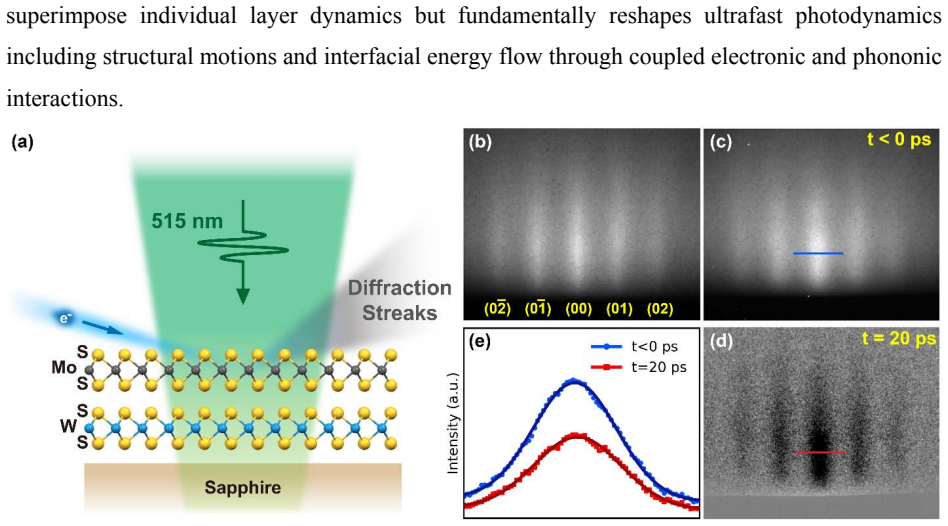
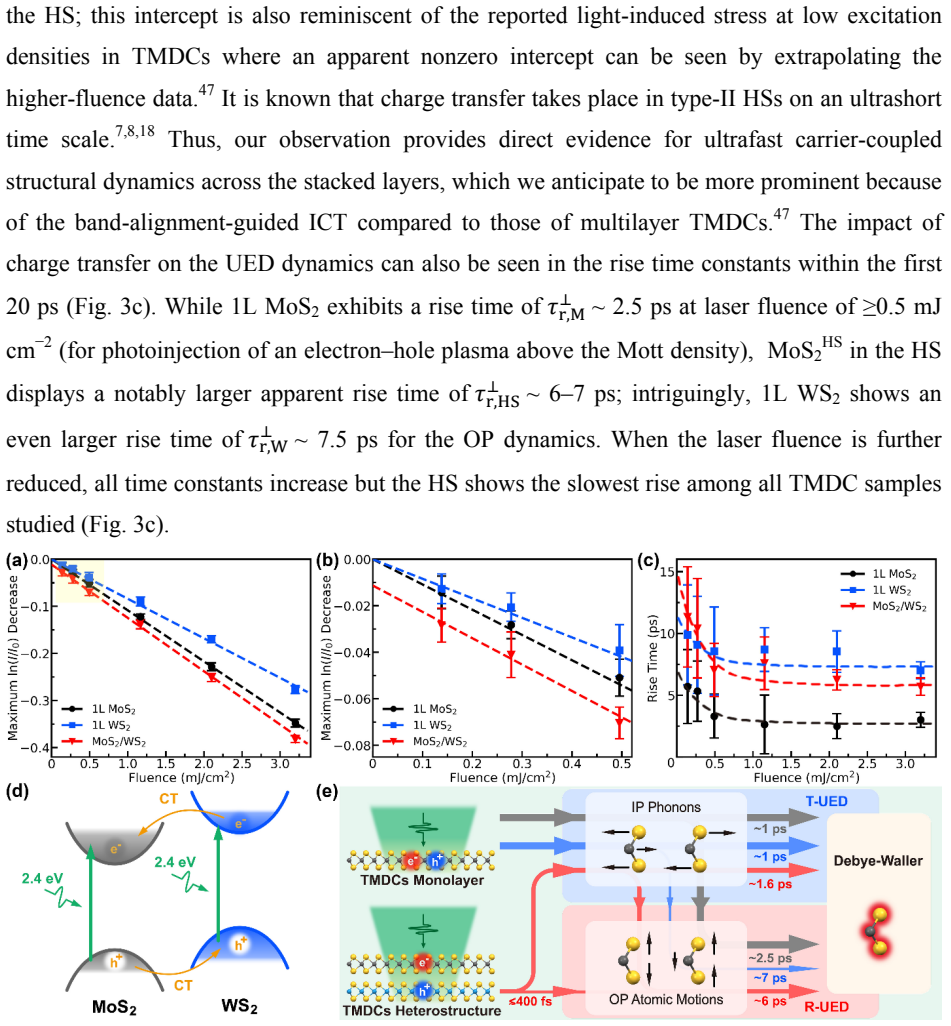
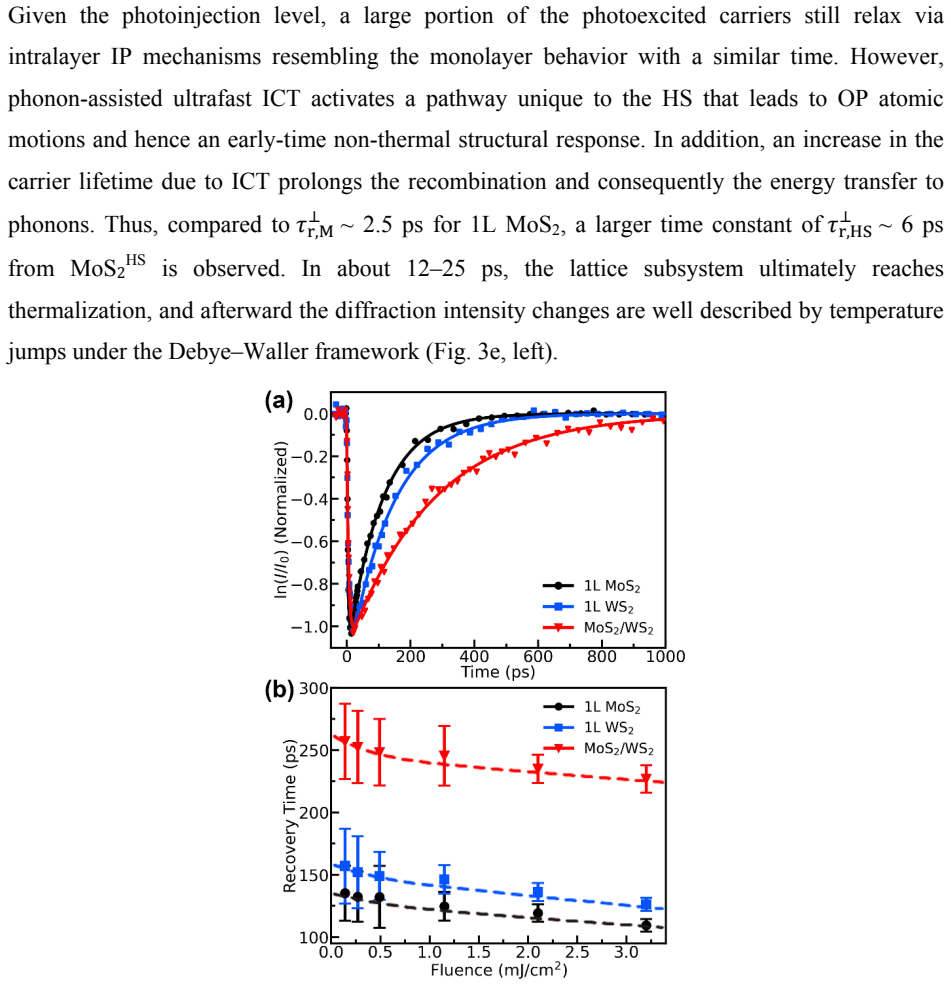
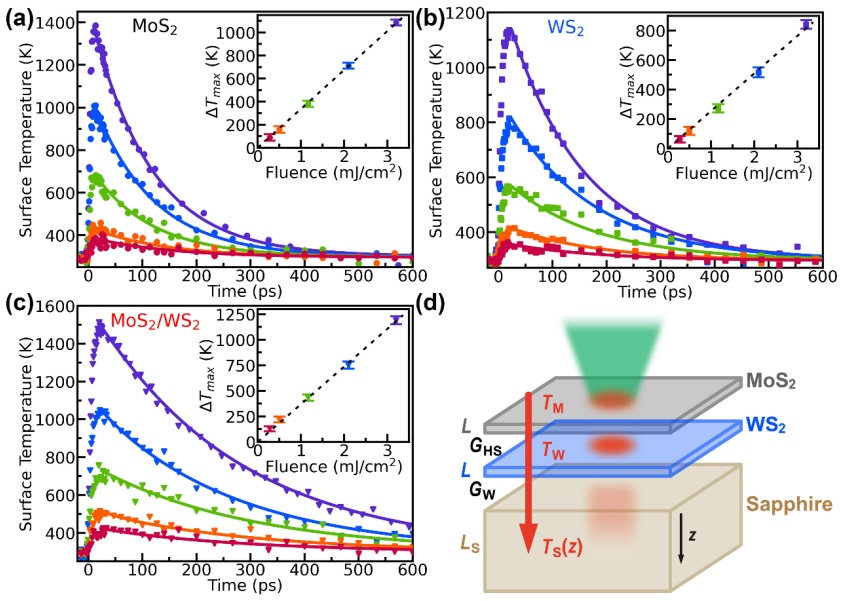
By applying reflection ultrafast electron diffraction to supported MoS2/WS2 bilayer heterostructures and their monolayers, the study reveals the launch of ultrafast carrier-coupled intralayer atomic motions due to interlayer charge transfer across the van der Waals heterojunctions, which is absent for individual monolayers. Such carrier-lattice correlation supplements the electronic coupling shown by enhanced optical absorption. Different energy flow pathways arise from carrier-phonon coupling and phonon scattering with corresponding times, and thermalized motions relax via a thermal transport model yielding higher thermal boundary conductance across the MoS2/WS2 heterostructures than at mon
What carries the argument
Reflection ultrafast electron diffraction revealing carrier-coupled intralayer atomic motions from interlayer charge transfer in supported TMD heterostructures.
If this is right
- Enhanced optical absorption occurs in the heterostructures due to electronic coupling.
- Different energy flow pathways result from carrier-phonon coupling and phonon scattering with characteristic times.
- Relaxation of thermalized atomic motions on longer timescales follows a thermal transport model.
- Higher thermal boundary conductance is obtained across MoS2/WS2 heterostructures compared to monolayer-substrate interfaces.
- Similar thermal boundary conductance values suggest comparable phonon couplings across van der Waals contacts.
Where Pith is reading between the lines
- Device designs could exploit charge transfer to control lattice dynamics on ultrafast timescales in 2D heterostructures.
- The results may generalize to other TMD combinations for optimizing thermal transport in stacks.
- Varying the substrate material could test whether support effects influence the charge-transfer-induced dynamics.
- Similar ultrafast diffraction studies on other van der Waals systems could reveal analogous carrier-lattice effects.
Load-bearing premise
The out-of-plane structural dynamics observed exclusively in the heterostructure result from interlayer charge transfer rather than other photoinduced processes or substrate interactions.
What would settle it
Observation of equivalent ultrafast out-of-plane atomic motions in the separate MoS2 and WS2 monolayers under the same supported conditions would falsify the attribution to interlayer charge transfer.
Figures
read the original abstract
Understanding the electronic coupling and energy flow across layered two-dimensional heterostructures (HSs) is crucial to the exploitation of carrier and phonon transports as well as thermal management in next-generation optoelectronic devices. By using reflection ultrafast electron diffraction, we directly examine photoinduced out-of-plane structural dynamics of supported MoS2/WS2 bilayer HSs and their individual monolayers. Experimental evidence reveals the launch of ultrafast carrier-coupled intralayer atomic motions due to interlayer charge transfer across the van der Waals (vdW) heterojunctions that is absent for individual monolayers. Such a notable carrier-lattice correlation is in addition to the electronic coupling manifested in the enhanced optical absorption for HSs. Also, different pathways of energy flow as a result of carrier-phonon coupling and phonon scattering are reported with the corresponding characteristic times. On longer timescales, relaxation of thermalized atomic motions can be sufficiently described by a thermal transport model. A higher thermal boundary conductance (TBC) across MoS2/WS2 HSs is obtained compared to those at the monolayer-substrate interfaces; however, the similar TBC values suggest comparable couplings of phonons across vdW contacts. These results further shed light on the optical, phonon, and interfacial thermal properties of vertically-stacked vdW HSs.
Editorial analysis
A structured set of objections, weighed in public.
Referee Report
Summary. The manuscript uses reflection ultrafast electron diffraction to examine photoinduced out-of-plane structural dynamics in supported MoS2/WS2 bilayer heterostructures and their individual monolayers. It claims direct experimental evidence for the launch of ultrafast carrier-coupled intralayer atomic motions due to interlayer charge transfer across the vdW heterojunction (absent in monolayers), in addition to enhanced optical absorption. It further reports distinct carrier-phonon and phonon-scattering energy flow pathways with characteristic times, and on longer timescales applies a thermal transport model yielding higher thermal boundary conductance (TBC) across the HS than at monolayer-substrate interfaces.
Significance. If the result holds, the work would provide useful direct structural evidence of interlayer carrier-lattice coupling in TMD heterostructures and quantitative constraints on interfacial thermal transport, relevant to optoelectronic and thermal management applications. The direct diffraction probe of atomic motions and the monolayer controls are strengths; the thermal model application on longer timescales is a clear, falsifiable element.
major comments (2)
- [Results section on monolayer comparison] The central claim that out-of-plane dynamics arise specifically from interlayer charge transfer (rather than intralayer carrier-phonon coupling at higher density) rests on the monolayer comparison. The abstract notes enhanced HS absorption, yet the results section on monolayer controls does not state whether pump fluences were adjusted to equalize absorbed photon number or effective carrier density per layer. Without this, the isolation of the transfer process is not demonstrated.
- [Methods and data analysis sections] Abstract and results present the ultrafast dynamics as direct experimental evidence from diffraction, but the methods and data analysis sections supply no details on data processing, background subtraction, error propagation, or quantitative fitting of the time-dependent diffraction intensities. This is load-bearing for assessing whether the reported carrier-lattice correlation is robust.
minor comments (2)
- [Abstract and thermal modeling paragraph] The abstract states that relaxation 'can be sufficiently described by a thermal transport model' but does not specify the fitting procedure or goodness-of-fit metrics for the TBC extraction.
- [Figure captions and results text] Notation for the out-of-plane displacement or diffraction spot intensity change should be defined consistently between figures and text.
Simulated Author's Rebuttal
We thank the referee for their careful reading of the manuscript and for the constructive comments, which help clarify the presentation of our results. We address each major comment below.
read point-by-point responses
-
Referee: [Results section on monolayer comparison] The central claim that out-of-plane dynamics arise specifically from interlayer charge transfer (rather than intralayer carrier-phonon coupling at higher density) rests on the monolayer comparison. The abstract notes enhanced HS absorption, yet the results section on monolayer controls does not state whether pump fluences were adjusted to equalize absorbed photon number or effective carrier density per layer. Without this, the isolation of the transfer process is not demonstrated.
Authors: We agree that explicit normalization to absorbed photon density would strengthen the isolation of the interlayer charge-transfer contribution. In the experiments, the incident pump fluence was held constant across HS and monolayer samples to enable direct comparison under identical excitation conditions. Because the HS exhibits enhanced absorption, the resulting carrier density per layer is higher than in the monolayers. We will revise the results section to state the incident fluences used, report estimated absorbed photon numbers (using the measured absorption spectra), and discuss the implications for the observed dynamics. If the referee deems it necessary, we can also add a supplementary note on why the distinct time scales and absence of the fast component in monolayers still support attribution to charge transfer rather than density alone. revision: partial
-
Referee: [Methods and data analysis sections] Abstract and results present the ultrafast dynamics as direct experimental evidence from diffraction, but the methods and data analysis sections supply no details on data processing, background subtraction, error propagation, or quantitative fitting of the time-dependent diffraction intensities. This is load-bearing for assessing whether the reported carrier-lattice correlation is robust.
Authors: We acknowledge that the current methods section is insufficiently detailed for full reproducibility and assessment of robustness. We will expand the Methods and Data Analysis sections to include: (i) the specific data-processing pipeline (including background subtraction procedure), (ii) how error bars were propagated from raw diffraction intensities, and (iii) the quantitative fitting model and criteria used to extract time constants from the time-dependent intensities. These additions will be placed in the main text or as a dedicated supplementary section, as appropriate. revision: yes
Circularity Check
No circularity: purely experimental observations with no derivation chain
full rationale
The manuscript reports direct experimental measurements via reflection ultrafast electron diffraction on supported MoS2/WS2 heterostructures versus monolayers. The central claim rests on observed out-of-plane dynamics present only in the heterostructure and attributed to interlayer charge transfer. No equations, fitted parameters renamed as predictions, or self-citation chains appear in the provided text; the thermal transport model is invoked descriptively on longer timescales without any result reducing to its inputs by construction. The analysis is therefore self-contained against external benchmarks.
Axiom & Free-Parameter Ledger
free parameters (1)
- thermal boundary conductance
axioms (1)
- domain assumption Relaxation of thermalized atomic motions on longer timescales can be sufficiently described by a thermal transport model.
Reference graph
Works this paper leans on
-
[1]
https://doi.org/10.1021/nn1003937
ACS Nano 2010, 4, 2695-2700. https://doi.org/10.1021/nn1003937. (S2) Berkdemir, A.; Gutiérrez, H. R.; Botello-Méndez, A. R.; Perea-López, N.; Elías, A. L.; Chia, C. I.; Wang, B.; Crespi, V. H.; López- Urías, F.; Charlier, J. C.; Terrones, H.; Terrones, M. Identification of Individual and Few Layers of WS 2 Using Raman Spectroscopy. Sci. Rep. 2013, 3,
-
[2]
https://doi.org/10.1038/srep01755. (S3) Wu, L.; Cong, C.; Shang, J.; Yang, W.; Ch en, Y.; Zhou, J.; Ai, W.; Wang, Y.; Feng, S.; Zhang, H.; Liu, Z.; Yu, T. Raman Sca ttering Investigation of Twisted WS 2/MoS2 Heterostructures: Interlay er Mechanical Coupling ve rsus Charge Transfer. Nano Res. 2021, 14, 2215-2223. https://doi.org/10.1007/s12274-020-3193-y. ...
-
[3]
https://doi.org/10.1364/JOSA.62.001336. (S6) Ermolaev, G. A.; Yakubovsky, D. I.; Stebuno v, Y. V.; Arsenin, A. V.; Volkov, V. S. Spectral Ellipsometry of Monolayer Transiti on Metal Dichalcogenides: Analysis of Excitonic Peaks in Dispersion. J. V. Sci. Technol. B, 2020, 38, 014002. https://doi.org/10.1116/1.5122683. (S7) Islam, K. M.; Synowicki, R.; Ismae...
-
[4]
Nano Lett. 2020, 20, 2026-2033. https://doi.org/10.1021/acs.nanolett.9b05344. (S10) Xu, K.; Skorda, S.; Xiao, P.; Coy, E.; Cartoi xà, X.; Rurali, R.; Reparaz, J. S.; El Sachat, A. Tunable Thermal Anisotropy Triggered by Quasi-Ballistic Heat Transport in WS 2 Crystals. Nano Lett. 2025, 25, 16006-16012. https://doi.org/10.1021/acs.nanolett.5c04514. (S11) Li...
-
[5]
https://doi.org/10.1039/D0NA00844C. (S13) Cheng, Z.; Koh, Y. R.; Ahmad, H.; Hu, R.; Sh i, J.; Liao, M. E.; Wang, Y.; Bai, T.; Li, R.; Lee, E.; Clinton, E. A.; Matthews, C. M.; E ngel, Z.; Yates, L.; L uo, T.; Goorsky, M. S.; Doolittle, W. A.; Tian, Z.; Hopkins, P. E.; Graham, S. Thermal Conductance across Harmonic-Matched Epitaxial Al-Sapphire Heterointer...
-
[6]
https://doi.org/10.1038/s42005-020-0383-6
discussion (0)
Sign in with ORCID, Apple, or X to comment. Anyone can read and Pith papers without signing in.