iLoRA: Bayesian Low-Rank Adaptation with Latent Interaction Graphs for Microbiome Diagnosis
Pith reviewed 2026-06-29 08:25 UTC · model grok-4.3
The pith
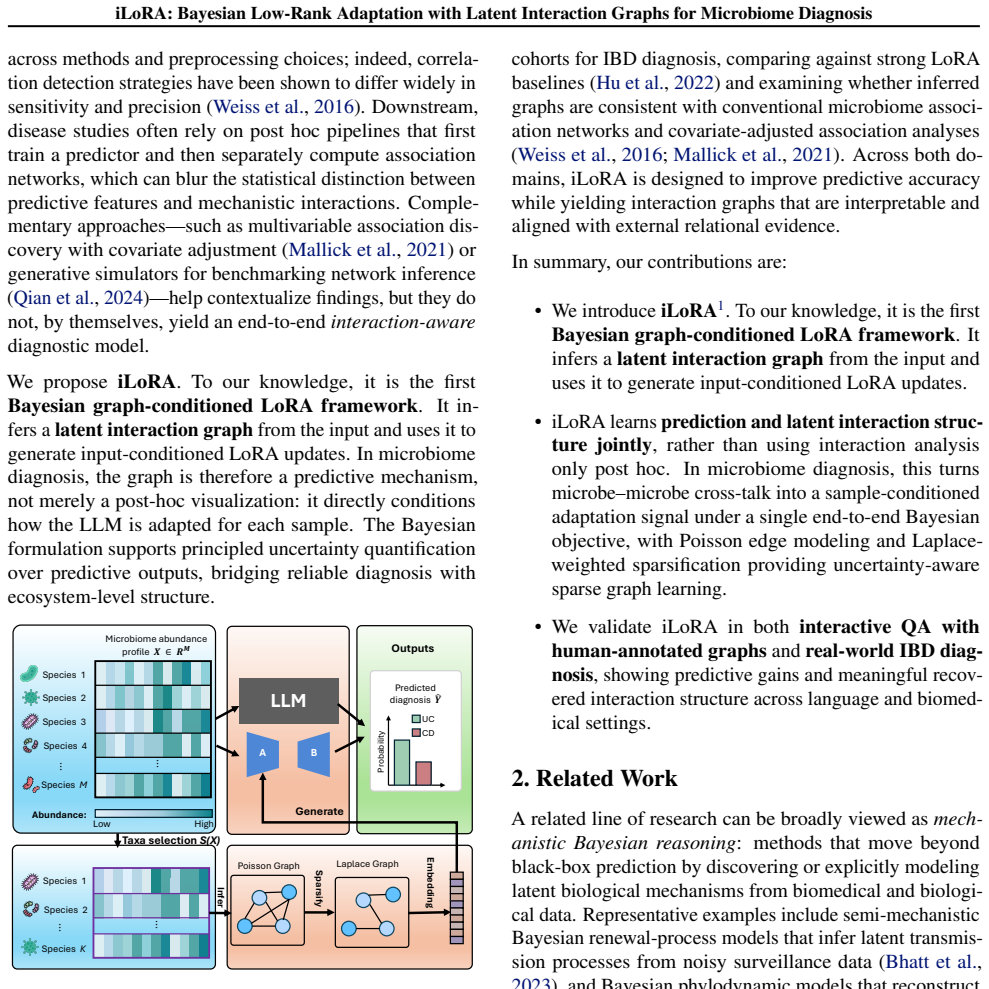
iLoRA infers a latent interaction graph from microbiome inputs to condition Bayesian LoRA updates and learn predictions jointly with structure.
A machine-rendered reading of the paper's core claim, the machinery that carries it, and where it could break.
Core claim
iLoRA is the first Bayesian graph-conditioned LoRA framework that infers a latent interaction graph from the input and uses it to generate input-conditioned LoRA updates, learning prediction and latent interaction structure jointly rather than training a predictor and applying interaction analysis only post hoc.
What carries the argument
The latent interaction graph inferred from input data, which conditions the generation of Bayesian LoRA updates for the downstream task.
If this is right
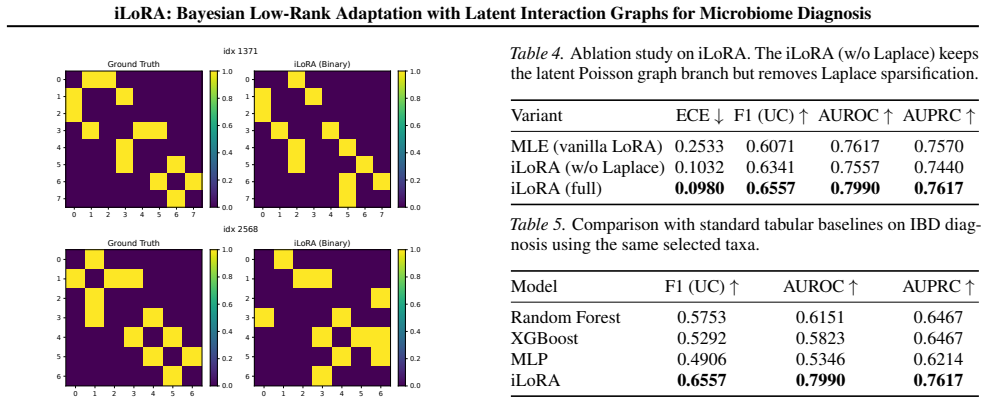
- iLoRA improves diagnosis performance over strong LoRA and Bayesian adaptation baselines on multi-cohort IBD tasks.
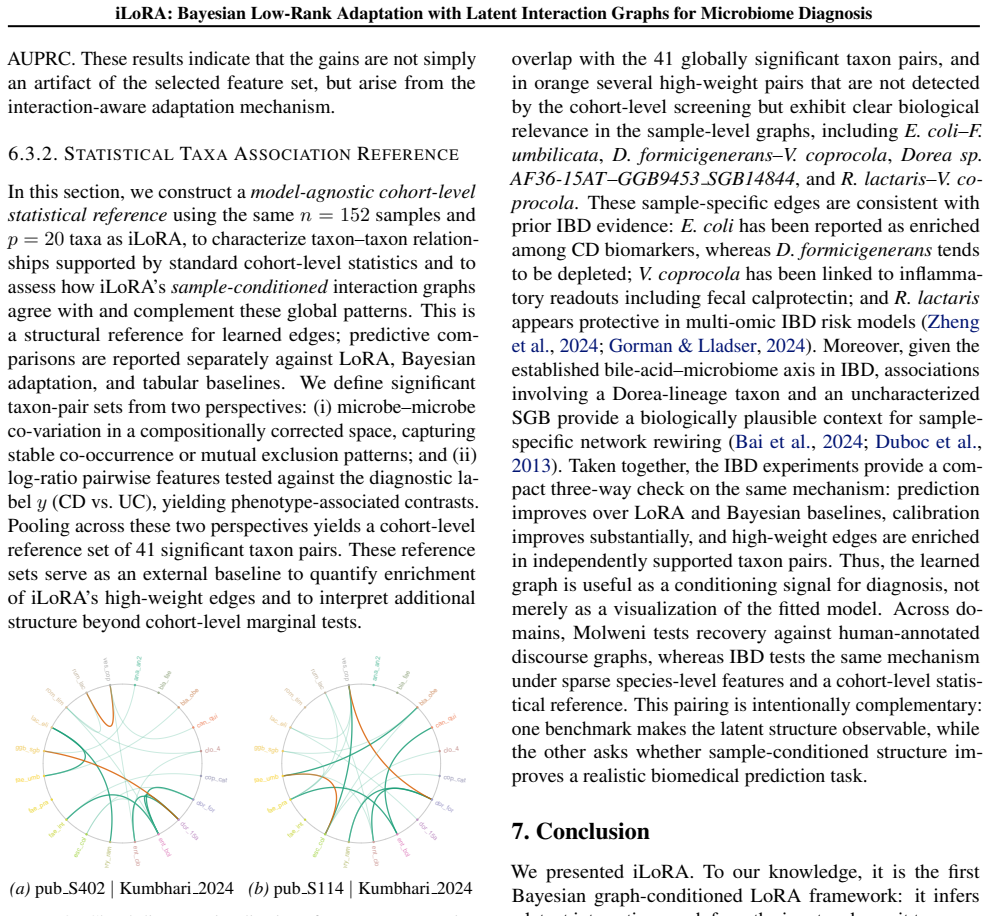
- Recovered graphs align with human annotations in interactive QA settings and with known cohort-level microbiome associations.
- The model supplies calibrated uncertainty estimates while adding only moderate overhead from the graph branch.
- Joint optimization removes the need for separate post-hoc interaction analysis after predictor training.
Where Pith is reading between the lines
- The same graph-conditioning idea could be tested on other high-dimensional biological data where interactions are hypothesized to drive outcomes, such as single-cell or metabolomic profiles.
- Calibrated uncertainty from the Bayesian component might support downstream uses like selective prediction or active learning in diagnostic pipelines.
- If the inferred graphs capture causal cross-talk, they could serve as hypotheses for targeted follow-up experiments in microbial ecology.
Load-bearing premise
A meaningful latent interaction graph can be inferred directly from input microbiome data in a way that reliably conditions and improves the LoRA updates for the diagnosis task.
What would settle it
Apply iLoRA to held-out microbiome cohorts and observe no gain in diagnosis accuracy over plain LoRA baselines or no alignment between recovered graphs and independent human or cohort-level annotations.
Figures
read the original abstract
Parameter-efficient adaptation has made LLMs practical for domain prediction, but standard LoRA still relies on a static low-rank update and does not expose the latent interactions that often drive scientific labels. We introduce iLoRA. To our knowledge, it is the first Bayesian graph-conditioned LoRA framework. It infers a latent interaction graph from the input and uses it to generate input-conditioned LoRA updates. As a result, iLoRA learns prediction and latent interaction structure jointly, rather than training a predictor and applying interaction analysis only post hoc. We instantiate this idea for microbiome diagnosis, where disease state can depend on both species-level abundance and microbe-microbe cross-talk, and evaluate it in two complementary settings: interactive QA with human-annotated graphs, which tests latent structure recovery, and multi-cohort IBD diagnosis, which tests biomedical utility. Across both settings, iLoRA improves over strong LoRA and Bayesian adaptation baselines, recovers graphs aligned with human annotations and cohort-level microbiome associations, and provides calibrated uncertainty with moderate graph-branch overhead.
Editorial analysis
A structured set of objections, weighed in public.
Referee Report
Summary. The manuscript introduces iLoRA as the first Bayesian graph-conditioned LoRA framework. It infers a latent interaction graph from microbiome inputs to generate input-conditioned LoRA updates, enabling joint learning of prediction and latent structure rather than post-hoc analysis. The approach is instantiated for microbiome diagnosis and evaluated in two settings: interactive QA with human-annotated graphs (for structure recovery) and multi-cohort IBD diagnosis (for biomedical utility). Claims include improvements over strong LoRA and Bayesian adaptation baselines, recovery of graphs aligned with human annotations and cohort associations, and provision of calibrated uncertainty at moderate overhead.
Significance. If the central claims hold under detailed scrutiny, the work could meaningfully extend parameter-efficient adaptation methods to scientific domains where input-dependent latent structures (such as microbe-microbe interactions) matter. The joint Bayesian inference of graph and predictor, along with explicit uncertainty calibration, would distinguish it from standard LoRA if empirically supported; the dual evaluation settings (annotation alignment and clinical utility) are a constructive design choice.
major comments (2)
- [Abstract] Abstract: The central claim that inferring and conditioning on a latent interaction graph improves both prediction and graph recovery rests on an unelaborated mechanism; without the specific form of the graph inference (e.g., variational posterior, prior, or conditioning operator on the LoRA factors), it is impossible to determine whether the graph step supplies non-redundant structure or reduces to standard input-dependent adaptation.
- [Abstract] Abstract: The assertion of joint learning 'rather than training a predictor and applying interaction analysis only post hoc' is load-bearing for novelty, yet the abstract provides no indication of how the graph posterior is optimized jointly with the diagnosis loss or whether the graph variables are marginalized in a way that avoids circular dependence on the predictor.
minor comments (1)
- The phrase 'to our knowledge, it is the first' requires a dedicated related-work paragraph with explicit comparisons to prior graph-augmented adaptation or Bayesian LoRA variants to be convincing.
Simulated Author's Rebuttal
We thank the referee for the detailed comments on the abstract. We address each point below. The abstract is intentionally concise, but we agree it can be improved to better indicate the inference mechanism and joint optimization; we will revise it accordingly while preserving brevity.
read point-by-point responses
-
Referee: [Abstract] Abstract: The central claim that inferring and conditioning on a latent interaction graph improves both prediction and graph recovery rests on an unelaborated mechanism; without the specific form of the graph inference (e.g., variational posterior, prior, or conditioning operator on the LoRA factors), it is impossible to determine whether the graph step supplies non-redundant structure or reduces to standard input-dependent adaptation.
Authors: The abstract provides a high-level summary of the approach. The full manuscript specifies the form of the graph inference, including the variational posterior, prior, and conditioning operator on the LoRA factors. This mechanism ensures the inferred graph supplies non-redundant structure for the adaptation. We will revise the abstract to briefly elaborate on the graph inference mechanism. revision: yes
-
Referee: [Abstract] Abstract: The assertion of joint learning 'rather than training a predictor and applying interaction analysis only post hoc' is load-bearing for novelty, yet the abstract provides no indication of how the graph posterior is optimized jointly with the diagnosis loss or whether the graph variables are marginalized in a way that avoids circular dependence on the predictor.
Authors: The full manuscript indicates how the graph posterior is optimized jointly with the diagnosis loss through a unified variational objective that marginalizes the graph variables, avoiding circular dependence. We will revise the abstract to provide an indication of this joint optimization process. revision: yes
Circularity Check
No significant circularity
full rationale
The provided abstract and description present iLoRA as a novel joint Bayesian graph-conditioned LoRA framework that infers latent interactions from inputs to produce conditioned updates, with evaluation on graph recovery and diagnosis tasks. No equations, self-citations, or derivation steps are visible that reduce any claimed prediction or result to a fitted parameter or prior self-referential definition by construction. The central claims rest on the joint learning setup and empirical improvements over baselines, which remain independent of the inputs described.
Axiom & Free-Parameter Ledger
axioms (1)
- standard math Standard assumptions of Bayesian modeling and low-rank adaptation hold for the microbiome domain
invented entities (1)
-
Latent interaction graph
no independent evidence
Reference graph
Works this paper leans on
-
[1]
LERD: Latent Event-Relational Dynamics for Neurodegenerative Classification
doi: 10.1136/gutjnl-2012-302578. URL https: //doi.org/10.1136/gutjnl-2012-302578. Faust, K. and Raes, J. Microbial interactions: from networks to models.Nature Reviews Microbiology, 10(8):538– 550, 2012. doi: 10.1038/nrmicro2832. URL https: //doi.org/10.1038/nrmicro2832. Feng, Y ., Chen, H., Jia, Z., Bhatt, S., and Huang, H. LERD: Latent event-relational ...
work page internal anchor Pith review Pith/arXiv arXiv doi:10.1136/gutjnl-2012-302578 2012
-
[2]
URL https: //doi.org/10.1038/nature23273
doi: 10.1038/nature23273. URL https: //doi.org/10.1038/nature23273. Houlsby, N., Giurgiu, A., Jastrzebski, S., Morrone, B., de Laroussilhe, Q., Gesmundo, A., Attariyan, M., and Gelly, S. Parameter-efficient transfer learning for NLP. InProceedings of the 36th International Conference on Machine Learning, volume 97 ofProceedings of Machine Learning Researc...
-
[3]
Huang, H., Shen, X., Hao, G.-Y ., Wang, S., Meng, L., Liu, D., Duchene, D
URL https://papers.nips.cc/paper _files/paper/2022/hash/e9e1a0abc1a5b 19a4aeb80dab19c82ae-Abstract-Confere nce.html. Huang, H., Shen, X., Hao, G.-Y ., Wang, S., Meng, L., Liu, D., Duchene, D. A., Wang, H., and Bhatt, S. Bayesagent: Bayesian agentic reasoning under uncertainty via verbal- ized probabilistic graphical modeling. InProceedings of the AAAI Con...
-
[4]
ISSN 1041-4347. doi: 10.1109/TKDE.2016.2606
-
[5]
URL https://doi.org/10.1109/TKDE.2 016.2606428. Wang, H. and Yeung, D.-Y . A survey on bayesian deep learning.ACM Comput. Surv., 53(5), September 2020. ISSN 0360-0300. doi: 10.1145/3409383. URL https: //doi.org/10.1145/3409383. Wang, H., Shi, X., and Yeung, D.-Y . Natural-parameter networks: A class of probabilistic neural networks. In Proceedings of the ...
-
[6]
doi: 10.1038/ismej.2015.235. URL https: //doi.org/10.1038/ismej.2015.235. Yang, A., Li, A., Yang, B., Zhang, B., Hui, B., Zheng, B., Yu, B., Gao, C., Huang, C., Lv, C., Zheng, C., Liu, D., Zhou, F., Huang, F., Hu, F., Ge, H., Wei, H., Lin, H., Tang, J., Yang, J., Tu, J., Zhang, J., Yang, J., Yang, J., Zhou, J., Zhou, J., Lin, J., Dang, K., Bao, K., Yang, ...
work page internal anchor Pith review Pith/arXiv arXiv doi:10.1038/ismej.2015.235 2015
-
[7]
+” root is strictly positive while the “−
URL https://iclr.cc/virtual/2024 /poster/19071. Zheng, J., Sun, Q., Zhang, M., Liu, C., Su, Q., Zhang, L., Xu, Z., Lu, W., Ching, J., Tang, W., Cheung, C. P., Hamilton, A. L., O’Brien, A. L. W., Wei, S. C., Bernstein, C. N., Rubin, D. T., Chang, E. B., Morrison, M., Kamm, M. A., Chan, F. K. L., Zhang, J., and Ng, S. C. Non- invasive, microbiome-based diag...
-
[8]
as the backbone. For theIBD Diagnosistask, we utilizedQwen3-8B(Yang et al., 2025). •LoRA Configuration: – Molweni:We applied LoRA to projection layers ( q proj, k proj, v proj, o proj) with rank r= 8 , scaling factorα= 16, and dropout0.05. – IBD Diagnosis:We applied LoRA to the same projection layers but with rank r= 16 and α= 32 . Additionally, we set th...
discussion (0)
Sign in with ORCID, Apple, or X to comment. Anyone can read and Pith papers without signing in.