Quantum optimization beyond QUBO for industrial logistics and scheduling
Pith reviewed 2026-06-29 06:56 UTC · model grok-4.3
The pith
HUBO formulations for logistics and scheduling use fewer qubits than QUBO encodings but add higher-order terms that increase circuit depth.
A machine-rendered reading of the paper's core claim, the machinery that carries it, and where it could break.
Core claim
Formulating representative logistics and manufacturing problems as HUBO instances captures process intricacies difficult to express faithfully with QUBO while reducing the number of binary variables required in the quantum mapping, thereby lowering qubit demand, although the added higher-order interaction terms increase circuit depth and limit feasibility on current hardware.
What carries the argument
Higher-order unconstrained binary optimization (HUBO) formulations of logistics and scheduling problems, which encode interactions beyond quadratic order.
If this is right
- HUBO encodings require fewer qubits than QUBO for the same logistics and scheduling instances.
- Higher-order terms increase the depth of circuits used in bias-field digitized counterdiabatic quantum optimization.
- Classical solvers confirm that the HUBO formulations correctly capture the original problem constraints.
- Resource analysis for the capacitated vehicle routing problem shows improved qubit scaling relative to QUBO.
- Practical deployment is constrained to hybrid quantum-classical workflows and early fault-tolerant regimes.
Where Pith is reading between the lines
- The qubit-depth trade-off may shift in favor of HUBO once qubit counts become the dominant hardware limit rather than gate error rates.
- Similar compact encodings could apply to other combinatorial problems where variable reduction outweighs interaction order.
- Direct hardware benchmarks on mid-scale routing instances would test whether the depth penalty is offset by the qubit savings in practice.
Load-bearing premise
The added circuit depth from higher-order terms stays manageable inside hybrid quantum-classical workflows or early fault-tolerant hardware without violating gate fidelity and coherence limits.
What would settle it
A concrete measurement, on a fixed routing instance, showing that the total gate count required to implement the HUBO mapping exceeds available coherence time while the corresponding QUBO mapping remains within that time.
Figures
read the original abstract
The increasing complexity of industrial scheduling and transport routing problems motivates the study of alternative optimization formulations and computational paradigms. In this work, we study how higher-order unconstrained binary optimization (HUBO) formulations of such problems map onto quantum optimization workflows in both noisy and fault-tolerant regimes. We consider three representative logistics and manufacturing use cases and formulate each as a HUBO problem. This captures process intricacies, such as highly correlated assembly-line scheduling rules, which are difficult to express faithfully with the standard quadratic (QUBO) form, while at the same time reducing the number of binary variables required in the quantum mapping, thus lowering qubit demand. We compare the HUBO formulations with corresponding QUBO encodings, highlighting a key trade-off: while HUBO reduces qubit requirements through compact binary encoding, it introduces higher-order interaction terms that increase circuit depth, limiting feasibility on current quantum hardware. The proposed formulations are validated using classical solvers across several problem instances and benchmark small routing problem instances using bias-field digitized counterdiabatic quantum optimization in classical simulation. We complement these results with a resource and scalability analysis, focusing on the capacitated vehicle routing problem as a representative large-scale industrial use case. Our analysis indicates that while HUBO formulations offer advantages in qubit scaling compared to QUBO encodings, their practical implementation is constrained by gate fidelity, coherence, and circuit depth, making hybrid quantum-classical workflows and early fault-tolerant quantum hardware the most plausible settings for their practical use.
Editorial analysis
A structured set of objections, weighed in public.
Referee Report
Summary. The paper claims that HUBO formulations for three logistics and scheduling problems in industry can capture complex constraints better than QUBO while reducing the number of binary variables needed for quantum mapping, thereby lowering qubit requirements, although at the expense of higher circuit depth due to higher-order terms. The formulations are validated classically, small instances are benchmarked using bias-field digitized counterdiabatic quantum optimization in simulation, and a resource analysis is provided for the capacitated vehicle routing problem, suggesting applicability in hybrid quantum-classical or early fault-tolerant regimes.
Significance. If the quantitative aspects of the qubit reduction and depth increase hold as claimed, this work offers a concrete demonstration of the qubit-depth trade-off in mapping real-world industrial optimization problems to quantum computers. The classical validation and simulation benchmarks add credibility, and the focus on practical use cases like CVRP highlights the potential for HUBO in scenarios where variable reduction is critical.
major comments (2)
- Abstract: The central claim of reduced qubit demand via compact binary encoding in HUBO is presented without any specific numerical comparisons to QUBO for the three use cases or the CVRP analysis, which is load-bearing for assessing the practical advantage.
- Benchmarking and simulation: The results from classical simulation of the quantum algorithm for small routing problem instances are mentioned but without reported metrics such as success probability, energy landscapes, or comparison to other methods, undermining the ability to verify the feasibility claims.
minor comments (1)
- Abstract: The three representative logistics and manufacturing use cases are not named or described in the abstract, making it hard to contextualize the formulations.
Simulated Author's Rebuttal
We thank the referee for the constructive feedback on our manuscript. We address the major comments point by point below, agreeing where revisions are warranted to improve clarity and verifiability.
read point-by-point responses
-
Referee: Abstract: The central claim of reduced qubit demand via compact binary encoding in HUBO is presented without any specific numerical comparisons to QUBO for the three use cases or the CVRP analysis, which is load-bearing for assessing the practical advantage.
Authors: We agree that the abstract would be strengthened by including specific numerical comparisons. The body of the manuscript provides detailed qubit-count comparisons between the HUBO and QUBO formulations for the three logistics and scheduling use cases, as well as the resource analysis for CVRP. We will revise the abstract to incorporate representative numerical examples of qubit reductions drawn from these sections. revision: yes
-
Referee: Benchmarking and simulation: The results from classical simulation of the quantum algorithm for small routing problem instances are mentioned but without reported metrics such as success probability, energy landscapes, or comparison to other methods, undermining the ability to verify the feasibility claims.
Authors: The referee correctly identifies that the simulation section mentions the benchmarking of small instances with bias-field digitized counterdiabatic quantum optimization but does not report quantitative metrics such as success probabilities, energy landscapes, or comparisons to alternative methods. We will add these specific results and comparisons to the revised manuscript to enable verification of the feasibility claims. revision: yes
Circularity Check
No significant circularity
full rationale
The manuscript defines HUBO and QUBO encodings as explicit mappings from problem constraints (assembly rules, routing capacities, etc.) to polynomial objective functions. These mappings are stated directly in the text, validated by classical solvers on concrete instances, and compared via explicit metrics (binary variable count, interaction order, estimated circuit depth). No parameter is fitted to a data subset and then relabeled as a prediction; no uniqueness theorem or ansatz is imported via self-citation as the sole justification for the central claim; the qubit-vs-depth trade-off is derived from the stated encodings themselves rather than from any self-referential reduction. The derivation chain therefore remains independent of its own outputs.
Axiom & Free-Parameter Ledger
axioms (1)
- domain assumption Standard assumptions of quantum computing hardware performance in noisy and fault-tolerant regimes, including gate fidelity and coherence limits.
Reference graph
Works this paper leans on
-
[1]
The cost should take into account the aerody- namic drag, but also ensure that the paired breaker and surfer match in their preferred driving speeds and arrival times
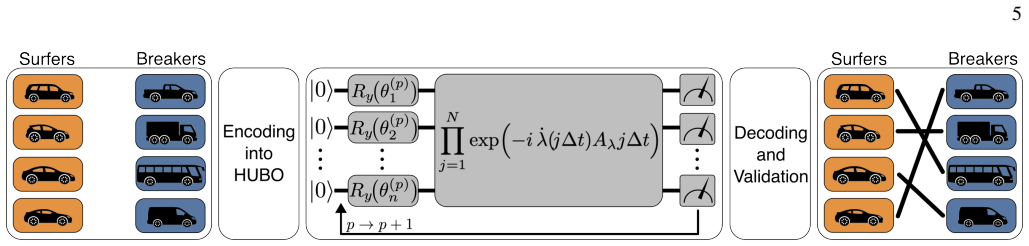
Problem formulation The goal of QUEST is to construct the bijective map from the sets of breakers to the set of surfers such that total costωs,b is minimized. The cost should take into account the aerody- namic drag, but also ensure that the paired breaker and surfer match in their preferred driving speeds and arrival times. The cost is thus defined as ωs...
-
[2]
1) on near-term quantum hardware by analyzing the BF-DCQO circuit resources required for our problem instances
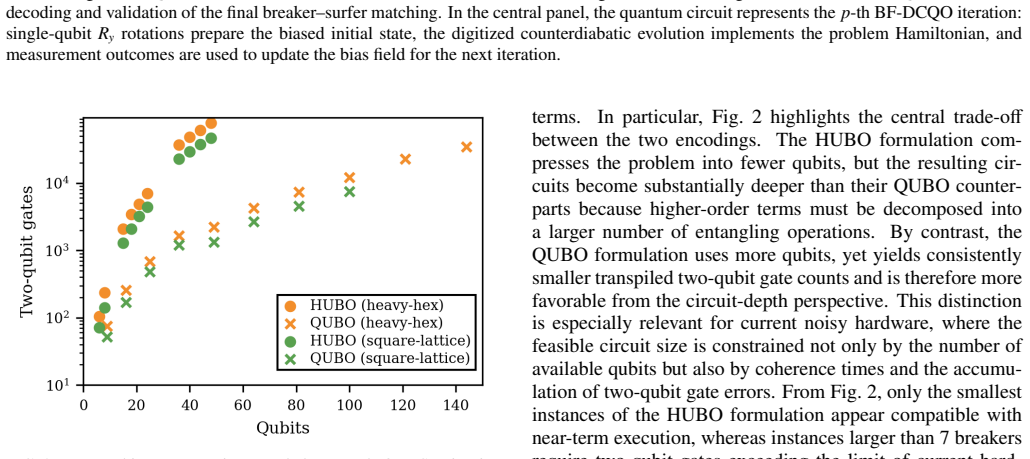
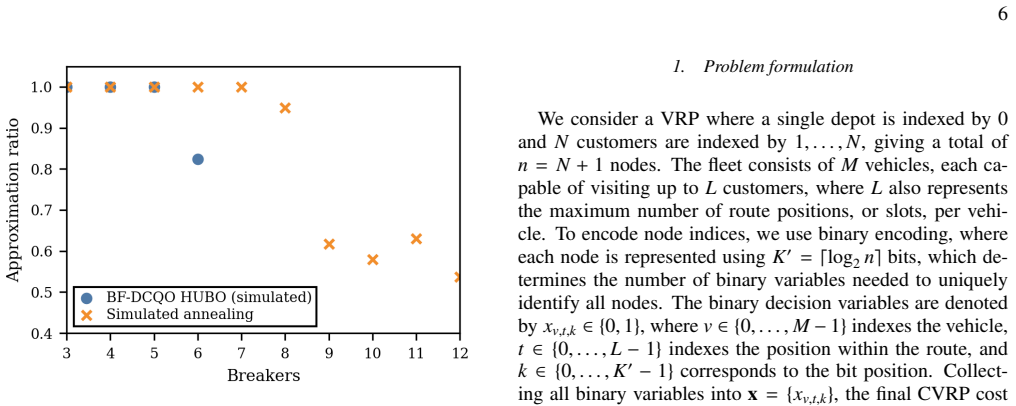
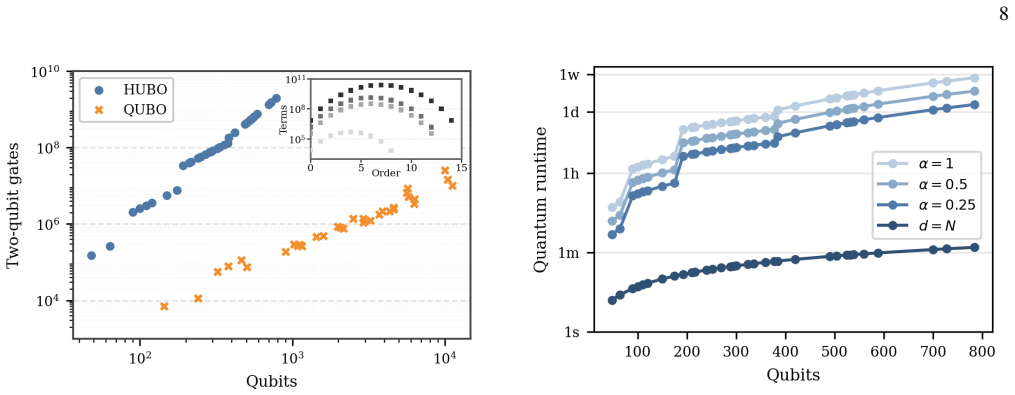
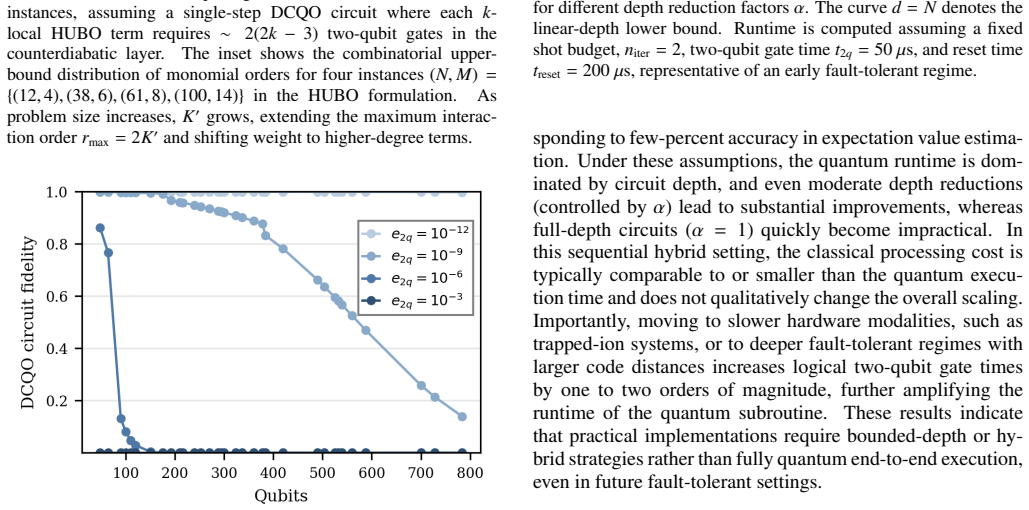
Results: feasibility and validation We begin by assessing the feasibility of executing the HUBO formulation (Fig. 1) on near-term quantum hardware by analyzing the BF-DCQO circuit resources required for our problem instances. Throughout this study, we assume a sin- gle Trotter step in the BF-DCQO implementation, consistent with empirical evidence from our...
-
[3]
,N, giving a total of n=N+1 nodes
Problem formulation We consider a VRP where a single depot is indexed by 0 andNcustomers are indexed by 1, . . . ,N, giving a total of n=N+1 nodes. The fleet consists ofMvehicles, each ca- pable of visiting up toLcustomers, whereLalso represents the maximum number of route positions, or slots, per vehi- cle. To encode node indices, we use binary encoding,...
-
[4]
softened
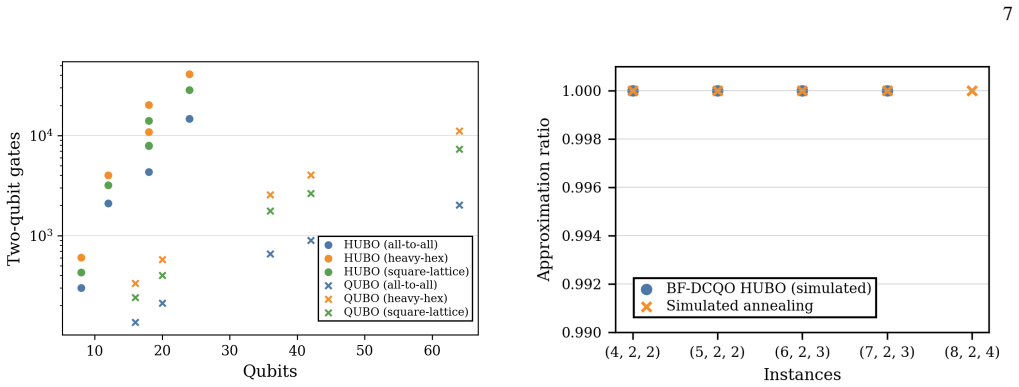
Results: feasibility and validation Figure 4 reports the transpiled two-qubit gate counts for a subset of CVRP instances under three different hardware- connectivity assumptions: all-to-all, heavy-hex, and square- lattice connectivity. The results, similar to the QUEST use case, highlight a clear trade-offbetween the HUBO and QUBO encodings. The HUBO form...
1959
-
[5]
Exactly one job per slot: Each slotℓmust contain ex- actly one job, with Hslot(y)=λ slot X ℓ∈L 1− X j∈J y jℓ 2 .(C3)
-
[6]
At most one slot per job: Each jobjcan be assigned to at most one slotℓ, with Hjob(y)=λ job X j∈J X ℓ,ℓ′∈L ℓ<ℓ′ y jℓ y jℓ′ .(C4) 14
-
[7]
For each criterioncrequiring additional free variables, the job assigned at slotℓshould also carry that criterion, which is enforced via a quadratic penalty Hlink(x,y)=λ link X c∈C X ℓ∈L xcℓ − X j∈J m j,c y jℓ 2 ,(C5) ensuring consistency between job assignments and ac- tivated criteria. The penalty coefficients for these hard constraints...
-
[8]
ex- act” or “at least
Gap constraints. For a criterioncrequiring either “ex- act” or “at least” spacingd c (in slots) between two jobs holding the same criterion, we define Hexact gap (x)=λ gap MX ℓ=1 dcX h=1 xc,ℓ xc,ℓ−h +x c,ℓ 1−x c,ℓ−dc−1 , (C6) Hatleast gap (x)=λ gap M−dcX ℓ=1 dcX h=1 xc,ℓ xc,ℓ+h.(C7) In the implementation, the slot indexing is extended to...
-
[9]
exact” or an “at most
Group constraints. For a criterionc, group rules may enforce either an “exact” or an “at most” contiguous block. An exact group lengthU c is enforced by penal- izing all maximal runs shorter or longer thanU c as Hexact grp (x)=λ under Uc−1X r=1 M−rX ℓ=1 (1−x c,ℓ−1) r−1Y h=0 xc,ℓ+h(1−x c,ℓ+r) +λ over M−UcX ℓ=1 UcY h=0 xc,ℓ+h.(C8) Alternatively, an at-most ...
-
[10]
at least
Simultaneous group and gap constraints. For a crite- rioncwith an exact gapd c(,0) between consecutive groups of length exactlyU c, we define Hexact grp+gap(x)=H exact grp (x)+λ short M−UcX ℓ=1 Uc−1Y h=0 xc,ℓ+h dc−1X i=0 xc,ℓ+Uc+i +λ long M−(Uc+dc+1)X ℓ=1 Uc−1Y h=0 xc,ℓ+h dcY i=0 1−x c,ℓ+Uc+i ...
-
[11]
step- ups
Sequence-number (FIFO) constraints. In addition to criterion-based rules, we impose soft constraints based on the input sequence numbere j of itemj. Ideally,e i should be lower thane k if jobiis placed before jobk, and the gap between the sequence numbers should not exceed a certain value. Hdown FIFO(y)=λ down M−1X ℓ=1 X i∈J X k∈J max{0,e i −e k}y iℓ yk,ℓ...
-
[12]
Lucas, Frontiers in Physics2, 5 (2014)
A. Lucas, Frontiers in Physics2, 5 (2014)
2014
-
[13]
A Quantum Approximate Optimization Algorithm
E. Farhi, J. Goldstone, and S. Gutmann, arXiv preprint arXiv:1411.4028 (2014), arXiv:1411.4028
work page internal anchor Pith review Pith/arXiv arXiv 2014
-
[14]
Hauke, H
P. Hauke, H. G. Katzgraber, W. Lechner, H. Nishimori, and W. D. Oliver, Reports on Progress in Physics83, 054401 (2020)
2020
-
[15]
Boros and P
E. Boros and P. L. Hammer, Discrete Applied Mathematics123, 155 (2002)
2002
-
[16]
Chancellor, New Journal of Physics19, 023024 (2017)
N. Chancellor, New Journal of Physics19, 023024 (2017)
2017
-
[17]
I. G. Rosenberg, Cahiers du Centre d’Etudes de Recherche 16 Op´erationnelle17, 71 (1975)
1975
-
[18]
Hadfield, Z
S. Hadfield, Z. Wang, B. O’Gorman, E. G. Rieffel, D. Ven- turelli, and R. Biswas, Algorithms12, 34 (2019)
2019
-
[19]
Cerezo, A
M. Cerezo, A. Arrasmith, R. Babbush, S. C. Benjamin, S. Endo, K. Fujii, J. R. McClean, K. Mitarai, X. Yuan, L. Cincio, and P. J. Coles, Nature Reviews Physics3, 625 (2021)
2021
-
[20]
P. Chandarana, A. G. Cadavid, S. V . Romero, A. Simen, E. Solano, and N. N. Hegade, Runtime Quantum Advantage with Digital Quantum Optimization (2025), arXiv:2505.08663 [quant-ph]
-
[21]
T. Koch, D. E. B. Neira, Y . Chen, G. Cortiana, D. J. Eg- ger, R. Heese, N. N. Hegade, A. G. Cadavid, R. Huang, T. Itoko, T. Kleinert, P. M. Xavier, N. Mohseni, J. A. Montanez- Barrera, K. Nakano, G. Nannicini, C. O’Meara, J. Pauckert, M. Proissl, A. Ramesh, M. Schicker, N. Shimada, M. Takeori, V . Valls, D. V . Bulck, S. Woerner, and C. Zoufal, Quantum O...
-
[22]
Quantum Annealing Implementation of Job-Shop Scheduling
D. Venturelli, D. J. J. Marchand, and G. Rojo, Quan- tum annealing implementation of job-shop scheduling (2015), arXiv:1506.08479 [quant-ph]
work page internal anchor Pith review Pith/arXiv arXiv 2015
-
[23]
Carugno, M
C. Carugno, M. Ferrari Dacrema, and P. Cremonesi, Scientific Reports12, 6539 (2022)
2022
-
[24]
Schworm, X
P. Schworm, X. Wu, M. Klar, M. Glatt, and J. C. Aurich, Journal of Manufacturing Systems72, 142 (2024)
2024
-
[25]
Amaro, M
D. Amaro, M. Rosenkranz, N. Fitzpatrick, K. Hirano, and M. Fiorentini, EPJ Quantum Technology9, 5 (2022)
2022
-
[26]
Dantzig, R
G. Dantzig, R. Fulkerson, and S. Johnson, Operations Research 2, 393 (1954)
1954
-
[27]
Osaba, E
E. Osaba, E. Villar-Rodriguez, and I. Oregi, IEEE Access10, 55805 (2022)
2022
-
[28]
Osaba, E
E. Osaba, E. Villar-Rodriguez, and A. Asla, Scientific Reports 14, 24791 (2024)
2024
-
[29]
Fitzek, T
D. Fitzek, T. Ghandriz, L. Laine, M. Granath, and A. F. Kockum, Scientific Reports14, 25415 (2024)
2024
- [30]
- [31]
-
[32]
G. B. Dantzig and J. H. Ramser, Management Science6, 80 (1959)
1959
-
[33]
Toth and D
P. Toth and D. Vigo, eds.,V ehicle Routing: Problems, Methods, and Applications, 2nd ed. (SIAM, 2014)
2014
-
[34]
S. V . Romero, A. M. Visuri, A. G. Cadavid,et al., Communica- tions Physics8, 348 (2025)
2025
-
[35]
Nocedal and S
J. Nocedal and S. J. Wright,Numerical Optimization, 2nd ed. (Springer, 2006)
2006
-
[36]
Conforti, G
M. Conforti, G. Cornu ´ejols, and G. Zambelli,Integer Program- ming(Springer, 2014)
2014
-
[37]
Kirkpatrick, C
S. Kirkpatrick, C. D. Gelatt, and M. P. Vecchi, Science220, 671 (1983)
1983
-
[38]
L. K. Grover, inProceedings of the Twenty-Eighth Annual ACM Symposium on Theory of Computing, STOC ’96 (Asso- ciation for Computing Machinery, New York, NY , USA, 1996) p. 212–219
1996
- [39]
-
[40]
Kadowaki and H
T. Kadowaki and H. Nishimori, Phys. Rev. E58, 5355 (1998)
1998
-
[41]
Quantum approximate optimization is computationally universal
S. Lloyd, Quantum approximate optimization is computation- ally universal (2018), arXiv:1812.11075 [quant-ph]
work page internal anchor Pith review Pith/arXiv arXiv 2018
-
[42]
Pellow-Jarman, S
A. Pellow-Jarman, S. McFarthing, I. Sinayskiy, D. K. Park, A. Pillay, and F. Petruccione, Scientific Reports14(2024)
2024
-
[43]
T. M ¨uller, A. Singh, F. K. Wilhelm, and T. Bode, Physical Re- view Research7, 10.1103/PhysRevResearch.7.023165 (2025)
-
[44]
N. N. Hegade, K. Paul, Y . Ding, M. Sanz, F. Albarr ´an- Arriagada, E. Solano, and X. Chen, Physical Review Applied 15, 024038 (2021)
2021
-
[45]
N. N. Hegade, X. Chen, and E. Solano, Physical Review Re- search4, L042030 (2022)
2022
-
[46]
A. G. Cadavid, A. Dalal, A. Simen, E. Solano, and N. N. Hegade, Physical Review Research7, 10.1103/physrevre- search.7.l022010 (2025)
-
[47]
N. N. Hegade, X. Chen, and E. Solano, Phys. Rev. Res.4, L042030 (2022)
2022
-
[48]
Kolodrubetz, D
M. Kolodrubetz, D. Sels, P. Mehta, and A. Polkovnikov, Physics Reports697, 1 (2017), geometry and non-adiabatic response in quantum and classical systems
2017
-
[49]
D. Sels and A. Polkovnikov, Proceedings of the Na- tional Academy of Sciences114, E3909 (2017), https://www.pnas.org/doi/pdf/10.1073/pnas.1619826114
-
[50]
P. W. Claeys, M. Pandey, D. Sels, and A. Polkovnikov, Phys. Rev. Lett.123, 090602 (2019)
2019
-
[51]
Hatomura and K
T. Hatomura and K. Takahashi, Phys. Rev. A103, 012220 (2021)
2021
-
[52]
Q. Xie, K. Seki, and S. Yunoki, Phys. Rev. B106, 155153 (2022)
2022
-
[53]
Takahashi and A
K. Takahashi and A. del Campo, Phys. Rev. X14, 011032 (2024)
2024
-
[54]
A. G. Cadavid, A. Dalal, A. Simen, E. Solano, and N. N. Hegade, Phys. Rev. Res.7, L022010 (2025)
2025
- [55]
-
[56]
P. Chandarana, S. V . Romero, A. Gomez Cadavid, A. Simen, E. Solano, and N. N. Hegade, arXiv e-prints , arXiv:2510.05851 (2025), arXiv:2510.05851 [quant-ph]
-
[57]
E. L. Lawler, J. K. Lenstra, A. H. G. Rinnooy Kan, and D. B. Shmoys,The Traveling Salesman Problem(Wiley, 1985)
1985
-
[58]
D. L. Applegate, R. E. Bixby, V . Chv´atal, and W. J. Cook,The Traveling Salesman Problem: A Computational Study(Prince- ton University Press, 2006)
2006
- [59]
- [60]
-
[61]
IBM, IBM Delivers New Quantum Processors, Software, and Algorithm Breakthroughs on Path to Advantage and Fault Tol- erance,https://newsroom.ibm.com/2025-11-12-ibm-d elivers-new-quantum-processors,-software,-and-a lgorithm-breakthroughs-on-path-to-advantage-and -fault-tolerance(2025), accessed: 2026-04-28
2025
-
[62]
Silva, L
A. Silva, L. C. Coelho, and M. Darvish, European Journal of Operational Research292, 1066 (2021)
2021
- [63]
discussion (0)
Sign in with ORCID, Apple, or X to comment. Anyone can read and Pith papers without signing in.