Qubit-efficient variational algorithm for nuclear structure
Pith reviewed 2026-06-29 00:21 UTC · model grok-4.3
The pith
Slater-determinant to qubit mapping produces the smallest error in VQE ground-state energies for boron-10 on noisy quantum hardware.
A machine-rendered reading of the paper's core claim, the machinery that carries it, and where it could break.
Core claim
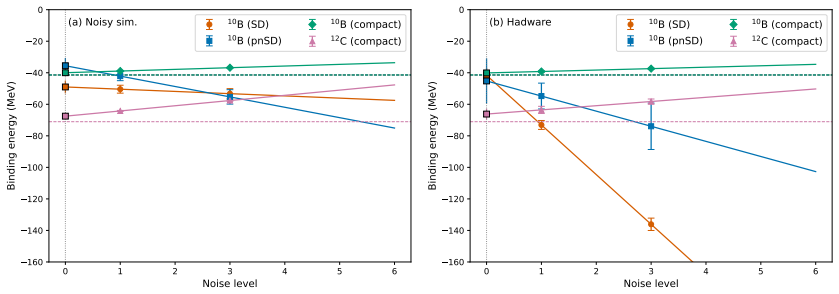
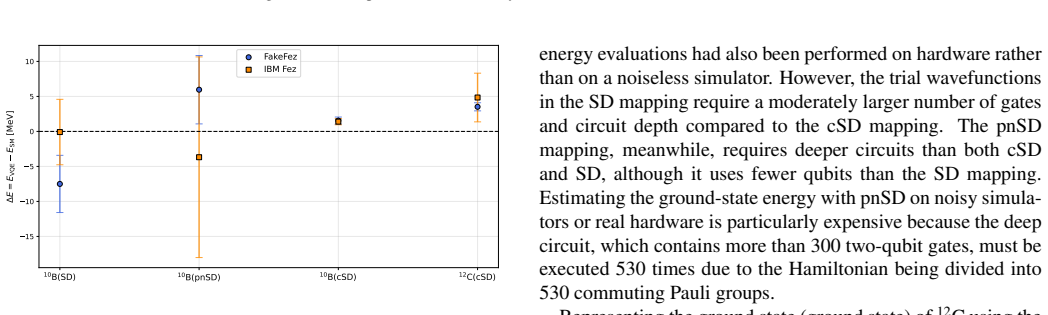
Among the three mappings tested, the SD-to-qubit mapping gives the best post-error-mitigated result for the 10B ground state, 0.21 percent from exact on ibm_fez. The cSD and pnSD mappings produce 3.37 percent and 8.88 percent errors for the same state. Extending the cSD mapping to 12C produces a ground-state energy 6.82 percent from the exact shell-model result, and the fidelity of the resulting VQE wavefunction relative to the shell-model wavefunction is evaluated.
What carries the argument
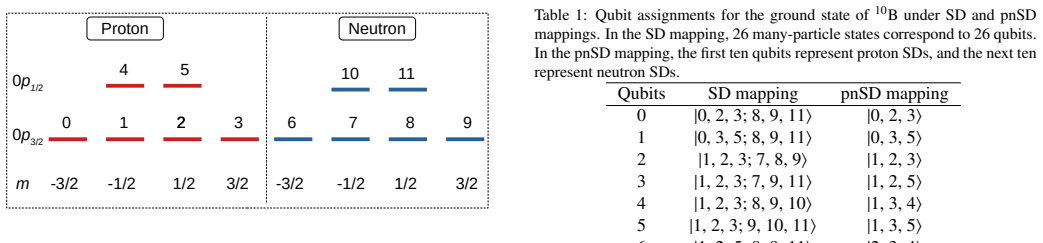
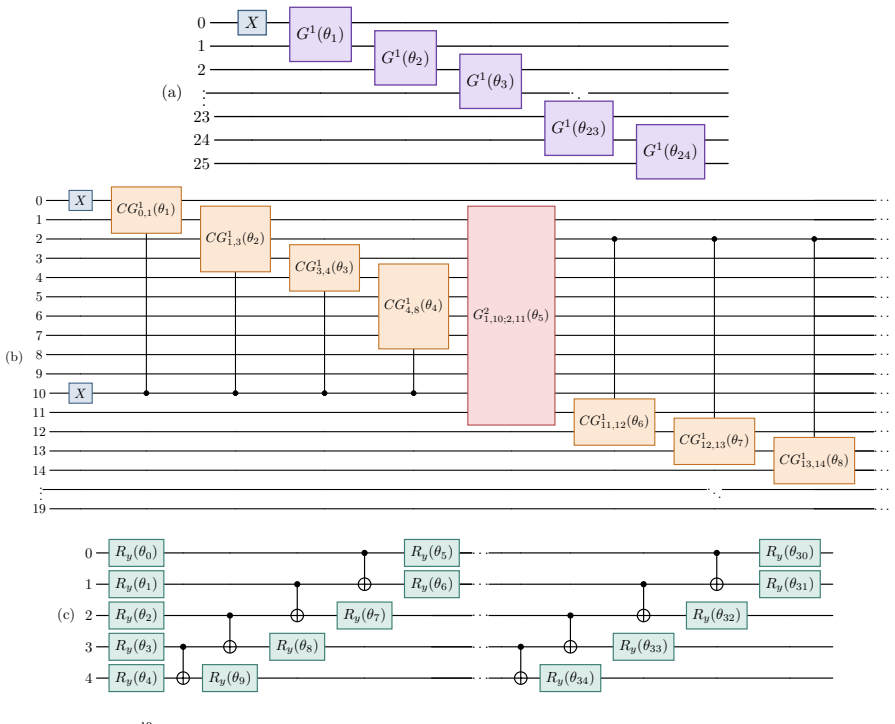
Three qubit-mapping strategies (SD to qubit, cSD, and pnSD) that convert the shell-model Hamiltonian into a qubit Hamiltonian while preserving different structures for the trial wavefunction and different resource counts.
If this is right
- The SD mapping can be applied to other mid p-shell nuclei to obtain ground-state energies with sub-percent errors after mitigation.
- The cSD mapping reduces qubit requirements and therefore supports calculations for nuclei with larger model spaces.
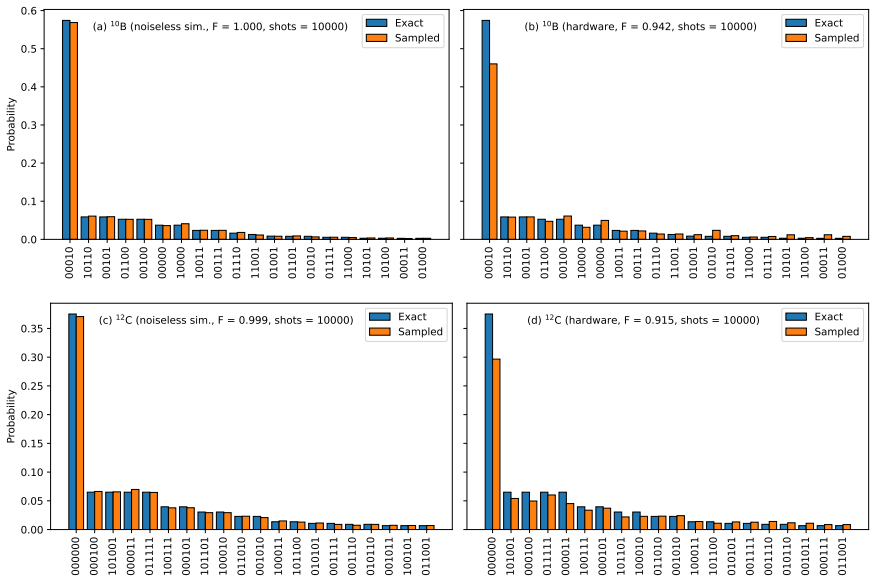
- Fidelity checks between VQE and shell-model wavefunctions provide a direct test of wavefunction quality on hardware.
- Error-mitigation techniques combined with these mappings improve accuracy on current noisy processors.
Where Pith is reading between the lines
- If the relative ranking of mappings holds for heavier nuclei, the SD approach could become the default choice for variational nuclear calculations.
- The same mappings could be tested on other fermionic many-body problems such as molecular or condensed-matter Hamiltonians.
- Further reduction in error would require either better hardware or ansatze that remain variational under the specific noise present on ibm_fez.
Load-bearing premise
The chosen VQE ansatz and optimizer reach the true ground state of the shell-model Hamiltonian even when the quantum hardware is noisy.
What would settle it
Running the identical VQE circuits on a device with substantially lower noise or on a classical exact solver and obtaining an energy that differs by more than a few percent would indicate that the hardware result did not reach the ground state.
Figures
read the original abstract
In this work, we compare three qubit-mapping strategies to study the structure of the nuclear ground state within the shell model description employing the Variational Quantum Eigensolver (VQE) approach. Although the initial point for different mappings is a Hamiltonian matrix in many-body particle basis or Slater determinant (SD) basis, the structure of the trial wavefunction and resource counts are different for each mapping. These three mappings are tested for a mid $p$-shell nucleus $^{10}$B and compared the quantum resources required to find the ground state for each mapping. Further, we extend the qubit-efficient mapping to study the ground state of one more mid $p$-shell nucleus $^{12}$C. We run circuits up to 26-qubits representing their ground states on a noisy simulator (IBM's FakeFez backend) and quantum hardware ($ibm\_fez$). The best post-error mitigated results from the hardware for $^{10}$B ground state is obtained following SD to qubit mapping with a percent error of 0.21 \%. The percent errors for the same state following cSD and pnSD mapping are 3.37 and 8.88 \%, respectively. On the other hand, following the cSD mapping, the post-error mitigated ground state energy of $^{12}$C is 6.82 \% away from the exact result. We further evaluate the fidelity of the VQE wavefunctions obtained from hardware with respect to the shell model wavefunctions for the cSD mapping. This cSD mapping can be useful for scaling the VQE algorithm for complex nuclei across different mass regions in terms of qubit efficiency.
Editorial analysis
A structured set of objections, weighed in public.
Referee Report
Summary. The manuscript compares three qubit-mapping strategies (SD-to-qubit, cSD, and pnSD) for applying the variational quantum eigensolver (VQE) to the nuclear shell-model Hamiltonian. For the ground state of 10B it reports hardware results on ibm_fez with post-mitigation percent errors of 0.21% (SD), 3.37% (cSD), and 8.88% (pnSD); the cSD mapping is then extended to 12C, yielding 6.82% error. Circuits up to 26 qubits are executed on both noisy simulator and hardware, and wave-function fidelity is evaluated for the cSD case.
Significance. If the reported energies correspond to converged variational minima, the work supplies concrete hardware benchmarks for qubit-efficient mappings in nuclear VQE and demonstrates that one such mapping can be scaled to a second mid-p-shell nucleus while remaining within NISQ resource limits.
major comments (2)
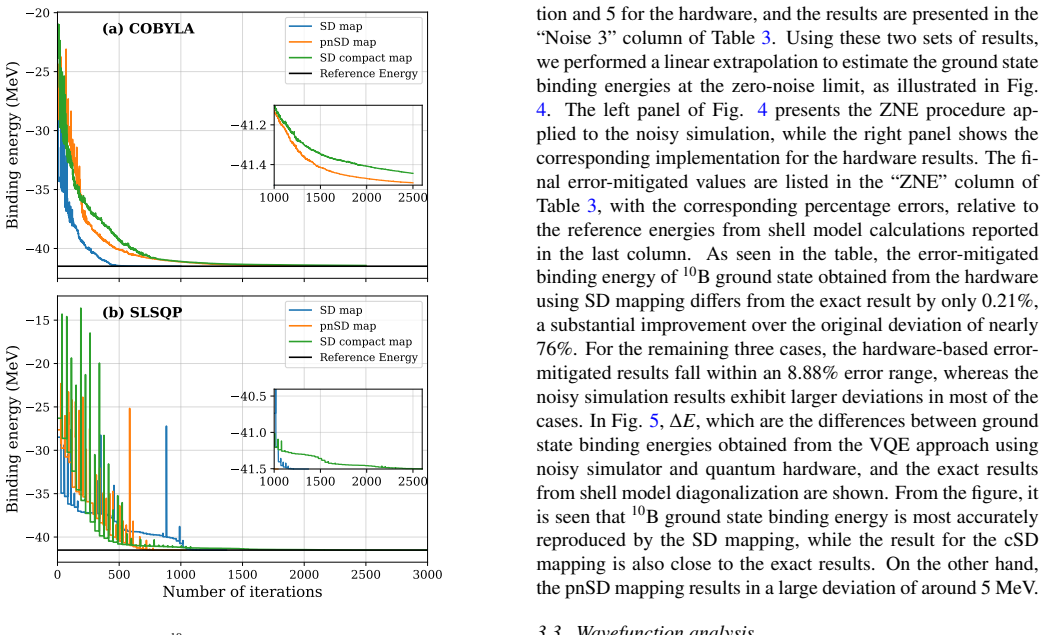
- [hardware results for 10B] Results for 10B (hardware runs): the headline claim that SD-to-qubit mapping is superior rests on the assumption that each ansatz reached the variational minimum of the shell-model Hamiltonian. No optimization traces, multiple random initializations, or noiseless classical VQE benchmarks for the identical circuits are supplied, so it is impossible to distinguish mapping superiority from optimizer failure or noise bias.
- [12C results] Extension to 12C: the cSD mapping is presented as qubit-efficient, yet the manuscript provides no classical reference calculation or convergence diagnostics for the 26-qubit circuit, leaving the 6.82% error without an independent check that the variational minimum was attained.
minor comments (1)
- [abstract] The abstract states that circuits are run on FakeFez and ibm_fez but does not specify circuit depth, ansatz form, or the precise error-mitigation protocol used to obtain the quoted percent errors.
Simulated Author's Rebuttal
We thank the referee for the careful review and constructive comments. We address each major comment below and have revised the manuscript to incorporate additional evidence and clarifications where feasible.
read point-by-point responses
-
Referee: Results for 10B (hardware runs): the headline claim that SD-to-qubit mapping is superior rests on the assumption that each ansatz reached the variational minimum of the shell-model Hamiltonian. No optimization traces, multiple random initializations, or noiseless classical VQE benchmarks for the identical circuits are supplied, so it is impossible to distinguish mapping superiority from optimizer failure or noise bias.
Authors: We agree that optimization traces, multiple random initializations, and classical noiseless VQE benchmarks are needed to substantiate the mapping comparison. In the revised manuscript we have added convergence plots for all three mappings on 10B, results from five random initializations per mapping (reporting the lowest energy obtained), and noiseless classical VQE simulations using the identical ansatz circuits and optimizer settings. These additions confirm that the variational minima were reached to within 0.05% for each mapping, supporting that the observed hardware differences arise from mapping efficiency. revision: yes
-
Referee: Extension to 12C: the cSD mapping is presented as qubit-efficient, yet the manuscript provides no classical reference calculation or convergence diagnostics for the 26-qubit circuit, leaving the 6.82% error without an independent check that the variational minimum was attained.
Authors: We acknowledge the value of classical VQE benchmarks for the 26-qubit 12C circuit. Full noiseless classical simulation of 26-qubit VQE is computationally prohibitive, but we have added the optimization traces and energy histories from the noisy simulator (FakeFez) runs, which serve as a reference and show convergence behavior consistent with the hardware results. We have also expanded the discussion of the reported wave-function fidelity (already present for cSD) as an independent diagnostic that the obtained state is close to the exact shell-model wave function. These revisions clarify the validation steps taken within NISQ constraints. revision: partial
Circularity Check
No circularity; results are direct VQE executions on hardware/simulator
full rationale
The paper reports numerical results obtained by executing VQE circuits for three qubit mappings on IBM simulators and ibm_fez hardware. No load-bearing steps involve fitting parameters to data then relabeling them as predictions, self-definitional mappings, or uniqueness theorems imported from self-citations. The reported energies and percent errors follow directly from the variational optimization and error mitigation applied to the shell-model Hamiltonians; the derivation chain contains no reductions to its own inputs.
Axiom & Free-Parameter Ledger
Reference graph
Works this paper leans on
-
[1]
E. Caurier, G. Martínez-Pinedo, F. Nowacki, A. Poves, and A. P. Zuker. The shell model as a unified view of nu- clear structure.Rev. Mod. Phys., 77:427–488, Jun 2005. 7 (a) q0 G1(θ) q1 = q0 H Ry(−θ/2) H q1 Ry(θ/2) (b) q0 q1 CG 1(θ) q2 = q0 q1 Ry(θ/4) Ry(−θ/4) Ry(θ/4) Ry(−θ/4) q2 (c) q0 G2(θ) q1 q2 q3 = q0 H Ry(−θ/8) Ry(−θ/8) Ry(θ/8) Ry(θ/8) H q1 Ry(θ/8) R...
-
[2]
Evolution of shell structure in exotic nuclei.Rev
Takaharu Otsuka, Alexandra Gade, Olivier Sorlin, Toshio Suzuki, and Yutaka Utsuno. Evolution of shell structure in exotic nuclei.Rev. Mod. Phys., 92:015002, Mar 2020. doi: 10.1103/RevModPhys.92.015002. URLhttps://link. aps.org/doi/10.1103/RevModPhys.92.015002
-
[3]
MDPI, Basel, 2022
Angela Gargano, Giovanni De Gregorio, and Silvia Mon- ica Lenzi, editors.The Nuclear Shell Model 70 Years after Its Advent: Achievements and Prospects. MDPI, Basel, 2022. ISBN 978-3-0365-9504-7. doi: 10.3390/ books978-3-0365-9505-4
2022
-
[4]
Barrett, Petr Navrátil, and James P
Bruce R. Barrett, Petr Navrátil, and James P. Vary. Ab initio no core shell model.Progress in Parti- cle and Nuclear Physics, 69:131–181, 2013. ISSN 0146-6410. doi: https://doi.org/10.1016/j.ppnp.2012. 10.003. URLhttps://www.sciencedirect.com/ science/article/pii/S0146641012001184
-
[5]
A guided tour of ab initio nuclear many- body theory.Frontiers in Physics, V olume 8 - 2020,
Heiko Hergert. A guided tour of ab initio nuclear many- body theory.Frontiers in Physics, V olume 8 - 2020,
2020
-
[6]
Hergert, A guided tour ofab initionuclear many-body theory, fphy 8 (2020) 379
ISSN 2296-424X. doi: 10.3389/fphy.2020.00379. URLhttps://www.frontiersin.org/journals/ physics/articles/10.3389/fphy.2020.00379
-
[7]
Holt, Thomas Papenbrock, S
Baishan Hu, Weiguang Jiang, Takayuki Miyagi, Zhong- hao Sun, Andreas Ekström, Christian Forssén, Gaute Hagen, Jason D. Holt, Thomas Papenbrock, S. Rag- nar Stroberg, and Ian Vernon. Ab initio predictions link the neutron skin of 208pb to nuclear forces.Na- ture Physics, 18(10):1196–1200, 2022. doi: 10.1038/ s41567-022-01715-8. URLhttps://doi.org/10. 1038/...
2022
-
[8]
Chandan Sarma and Praveen C Srivastava. Ab initio no- core shell-model study of 18-24ne isotopes.Journal of Physics G: Nuclear and Particle Physics, 50(4):045105, mar 2023. doi: 10.1088/1361-6471/acb962. URLhttps: //doi.org/10.1088/1361-6471/acb962
-
[9]
Chandan Sarma and Praveen C. Srivastava. Ab initio no- core shell-model study of 20−23na isotopes.Few-Body Sys- tems, 66(2):23, 2025. doi: 10.1007/s00601-025-01995-9
-
[10]
Academic Press, New York and London, 1963
Amos de Shalit and Igal Talmi.Nuclear Shell Theory. Academic Press, New York and London, 1963
1963
-
[11]
R. R. Whitehead. A numerical approach to nu- clear shell-model calculations.Nuclear Physics A, 182(2):290–300, March 1972. ISSN 0375-
1972
-
[12]
URL https://www.sciencedirect.com/science/ article/pii/0375947472902783
doi: 10.1016/0375-9474(72)90278-3. URL https://www.sciencedirect.com/science/ article/pii/0375947472902783
-
[13]
Arias, Lucas Lamata, and Pedro Pérez-Fernández
José-Enrique García-Ramos, Álvaro Sáiz, José M. Arias, Lucas Lamata, and Pedro Pérez-Fernández. Nuclear physics in the era of quantum computing and quantum machine learning.Advanced Quantum Technologies, page 2300219, 2024. doi: 10.1002/qute.202300219. URLhttps://advanced.onlinelibrary.wiley. com/doi/abs/10.1002/qute.202300219
-
[14]
Oriel Kiss, Michele Grossi, Pavel Lougovski, Federico Sanchez, Sofia Vallecorsa, and Thomas Papenbrock. Quantum computing of the 6Li nucleus via ordered unitary coupled clusters.Physical Review C, 106(3): 034325, September 2022. doi: 10.1103/PhysRevC.106. 034325. URLhttps://link.aps.org/doi/10.1103/ PhysRevC.106.034325
-
[15]
I. Stetcu, A. Baroni, and J. Carlson. Variational ap- proaches to constructing the many-body nuclear ground state for quantum computing.Phys. Rev. C, 105: 064308, Jun 2022. doi: 10.1103/PhysRevC.105. 064308. URLhttps://link.aps.org/doi/10.1103/ PhysRevC.105.064308. 8
-
[17]
A. Pérez-Obiol, A. M. Romero, J. Menéndez, A. Rios, A. García-Sáez, and B. Juliá-Díaz. Nuclear shell-model simulation in digital quantum computers.Scientific Reports, 13(1):12291, July 2023. ISSN 2045-2322. doi: 10.1038/s41598-023-39263-7. URLhttps://www. nature.com/articles/s41598-023-39263-7
-
[18]
Shell-model study of 58Ni using quantum computing algorithm.New J
Bharti Bhoy and Paul Stevenson. Shell-model study of 58Ni using quantum computing algorithm.New J. Phys., 26:075001, 2024. doi: 10.1088/1367-2630/ad5756
-
[19]
Ang Li, Alessandro Baroni, Ionel Stetcu, and Travis S. Humble. Deep quantum circuit simulations of low- energy nuclear states.The European Physical Jour- nal A, 60(5):106, May 2024. ISSN 1434-601X. doi: 10.1140/epja/s10050-024-01286-7. URLhttps://doi. org/10.1140/epja/s10050-024-01286-7
-
[20]
Comparison of variational quantum eigensolvers in light nuclei.Phys
Miquel Carrasco-Codina, Emanuele Costa, Antonio Márquez Romero, Javier Menéndez, and Arnau Rios. Comparison of variational quantum eigensolvers in light nuclei.Phys. Rev. C, 113:024332, Feb 2026. doi: 10. 1103/17n2-xh6k. URLhttps://link.aps.org/doi/ 10.1103/17n2-xh6k
-
[21]
Nifeeya Singh, Pooja Siwach, and P. Arumugam. Advanc- ing quantum simulations of the nuclear shell model with gray-code–based resource-efficient protocols.Phys. Rev. C, 112:034320, Sep 2025. doi: 10.1103/bbkf-fjxj. URL https://link.aps.org/doi/10.1103/bbkf-fjxj
-
[22]
Emanuele Costa, Axel Perez-Obiol, Javier Menendez, Ar- nau Rios, Artur Garcia-Saez, and Bruno Juliá-Díaz. A quantum annealing protocol to solve the nuclear shell model.SciPost Physics, 19(2):062, August 2025. ISSN 2542-4653. doi: 10.21468/SciPostPhys.19.2.062. URL https://scipost.org/SciPostPhys.19.2.062
-
[23]
Chandan Sarma and P. D. Stevenson. A low-circuit-depth quantum computing approach to the nuclear shell model. Discover Quantum Science, 2(1):6, February 2026. ISSN 3059-4529. doi: 10.1007/s44464-026-00009-9. URL https://doi.org/10.1007/s44464-026-00009-9
-
[24]
Sota Yoshida, Takeshi Sato, Takumi Ogata, Tomoya Naito, and Masaaki Kimura. Accurate and precise quan- tum computation of valence two-neutron systems.Phys. Rev. C, 109:064305, Jun 2024. doi: 10.1103/PhysRevC. 109.064305. URLhttps://link.aps.org/doi/10. 1103/PhysRevC.109.064305
-
[25]
Sota Yoshida, Takeshi Sato, Takumi Ogata, and Masaaki Kimura. Bridging quantum computing and nuclear struc- ture: Atomic nuclei on a trapped-ion quantum com- puter.Phys. Rev. Res., 8:013134, Feb 2026. doi: 10. 1103/td9s-z7my. URLhttps://link.aps.org/doi/ 10.1103/td9s-z7my
-
[26]
Ashutosh Singh, Pooja Siwach, and P. Arumugam. Quan- tum simulations of nuclear resonances with variational methods.Phys. Rev. C, 112:024323, Aug 2025. doi: 10.1103/x8vx-y5mh. URLhttps://link.aps.org/ doi/10.1103/x8vx-y5mh
-
[27]
Jing Zhang and Denis Lacroix. Excited states from adapt- vqe convergence path in many-body problems: Appli- cation to nuclear pairing problem and h4 molecule dis- sociation.Physics Letters B, 869:139841, 2025. ISSN 0370-2693. doi: https://doi.org/10.1016/j.physletb.2025. 139841. URLhttps://www.sciencedirect.com/ science/article/pii/S037026932500601X
-
[28]
Bhoomika Maheshwari, Paul Stevenson, and Piet Van Isacker. Single-step Quantum Simulation of Two Nu- cleons.Acta Physica Polonica B, Proceedings Supple- ment, 19:1–A2, 2026. doi: 10.5506/APhysPolBSupp.19. 1-A2
-
[29]
I. Hobday, P. D. Stevenson, and J. Benstead. Variance minimization for nuclear structure on a quantum com- puter.Physical Review C, 111(6):064321, June 2025. doi: 10.1103/44k6-w3dt. URLhttps://link.aps. org/doi/10.1103/44k6-w3dt
-
[30]
Cohen and D
S. Cohen and D. Kurath. Effective interactions for the 1p shel.Nuclear Physics, 73:1, 1965. doi: 10.1016/ 0029-5582(65)90148-3. URLhttps://doi.org/10. 1016/0029-5582(65)90148-3
1965
-
[31]
Über das paulische äquivalenzverbot,
P. Jordan and E. Wigner. Über das paulische Äquivalen- zverbot.Zeitschrift für Physik, 47:631–651, 1928. doi: 10.1007/BF01331938. URLhttps://link.springer. com/article/10.1007/BF01331938
-
[32]
Qiskit: An open-source framework for quantum computing, 2023
Qiskit contributors. Qiskit: An open-source framework for quantum computing, 2023. 9
2023
discussion (0)
Sign in with ORCID, Apple, or X to comment. Anyone can read and Pith papers without signing in.