Reconciling GW170817 and GW190814 with a Nonmonotonic Sound-Speed Equation of State
Pith reviewed 2026-06-30 18:15 UTC · model grok-4.3
The pith
Double-peaked sound speeds reconcile GW170817 and GW190814 within general relativity.
A machine-rendered reading of the paper's core claim, the machinery that carries it, and where it could break.
Core claim
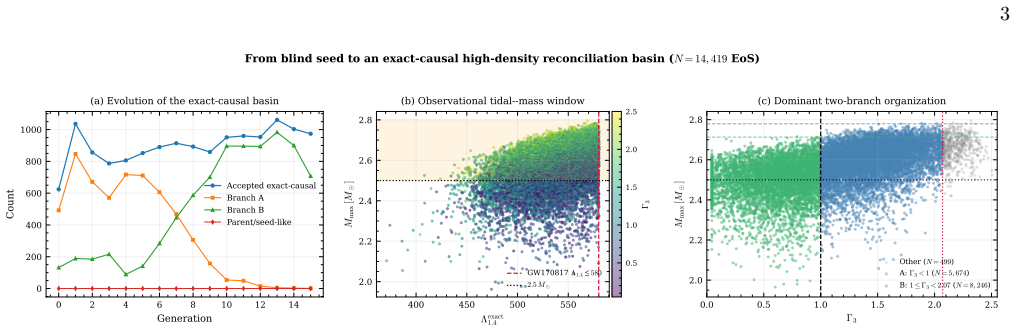
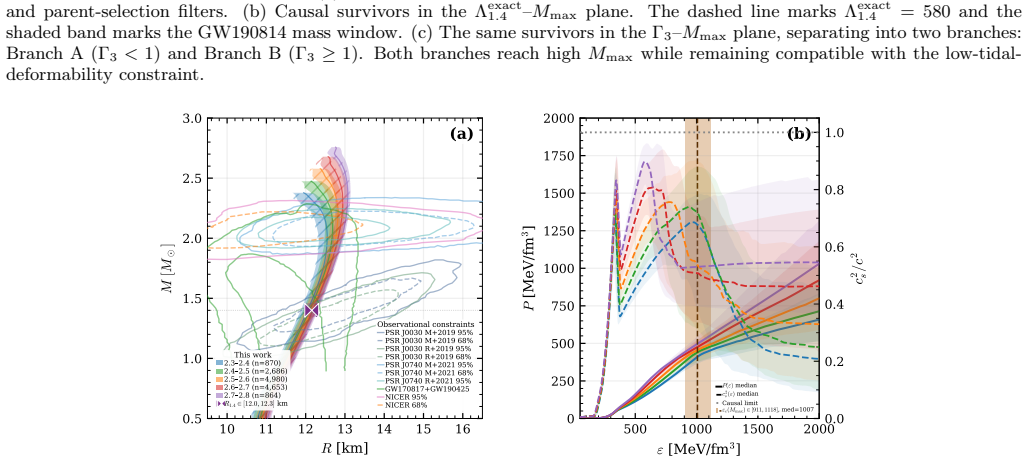
The GW170817-GW190814 tension can be reconciled within General Relativity by a structured causal EoS basin found with a Constrained Evolutionary TOV Discovery pipeline (CETD). The basin contains ~1.4x10^4 unique EoS with M_max = 2.3-2.8 M_sun, R_1.4 = 11.97-12.29 km, Lambda_1.4 <= 580, and double-peaked sound speeds reaching c_s^2/c^2 = 0.86-0.99.
What carries the argument
The Constrained Evolutionary TOV Discovery (CETD) pipeline, which systematically generates and filters causal equations of state against gravitational-wave constraints to locate a connected basin of viable solutions.
If this is right
- Roughly 14,000 distinct causal equations of state satisfy the joint constraints from both events.
- Maximum neutron-star masses lie between 2.3 and 2.8 solar masses.
- Radii of 1.4-solar-mass stars are confined to 11.97–12.29 km.
- Tidal deformabilities of 1.4-solar-mass stars do not exceed 580.
- Sound-speed profiles must exhibit two distinct peaks reaching 0.86–0.99 c².
Where Pith is reading between the lines
- Future radius or tidal measurements could further restrict the allowed locations and heights of the sound-speed peaks.
- The same search strategy could be applied to other pairs of apparently conflicting compact-object observations.
- Double-peaked sound speeds may correspond to one or more phase transitions inside neutron-star cores.
- If the basin survives additional data, it would indicate that general relativity alone is sufficient to describe both events without modified-gravity extensions.
Load-bearing premise
The Constrained Evolutionary TOV Discovery pipeline correctly and exhaustively samples the space of causal equations of state without introducing selection bias or missing observationally allowed solutions.
What would settle it
Detection of a neutron star with mass above 2.8 solar masses, or a 1.4-solar-mass star whose radius lies outside the 11.97–12.29 km window, would falsify the existence of the reported EoS basin.
Figures
read the original abstract
We show that the GW170817-GW190814 tension can be reconciled within General Relativity by a structured causal EoS basin found with a Constrained Evolutionary TOV Discovery pipeline (CETD). The basin contains ~1.4x10^4 unique EoS with M_max = 2.3-2.8 M_sun, R_1.4 = 11.97-12.29 km, Lambda_1.4 <= 580, and double-peaked sound speeds reaching c_s^2/c^2 = 0.86-0.99.
Editorial analysis
A structured set of objections, weighed in public.
Referee Report
Summary. The manuscript claims that the tension between GW170817 and GW190814 can be reconciled within General Relativity by a structured causal EoS basin containing ~1.4×10^4 unique equations of state, discovered via a Constrained Evolutionary TOV Discovery (CETD) pipeline. These EoS satisfy M_max = 2.3-2.8 M_⊙, R_1.4 = 11.97-12.29 km, Λ_1.4 ≤ 580, and exhibit double-peaked sound speeds with c_s²/c² reaching 0.86-0.99 while remaining causal.
Significance. If the CETD pipeline is shown to exhaustively sample the space of causal EoS without selection bias or artificial clustering, the result would be significant: it would demonstrate that non-monotonic sound-speed profiles can simultaneously accommodate the relatively compact radius and low tidal deformability from GW170817 with the high maximum mass from GW190814, supplying a large, observationally viable sample for neutron-star modeling.
major comments (1)
- [Abstract] Abstract: the central claim that the CETD pipeline discovers a genuine basin of ~1.4×10^4 EoS satisfying both GW events rests on the unverified assumptions that the evolutionary algorithm (1) enforces the TOV equations and causality at every generation, (2) samples the full space of causal EoS without convergence bias, and (3) does not miss viable solutions outside the reported basin. No cross-check against standard parametrizations (piecewise polytropes or spectral representations) is described, rendering the reconciliation claim unverifiable from the supplied text.
Simulated Author's Rebuttal
We thank the referee for their thoughtful review and the opportunity to address the concerns regarding verification of the CETD pipeline. We respond point by point below.
read point-by-point responses
-
Referee: [Abstract] Abstract: the central claim that the CETD pipeline discovers a genuine basin of ~1.4×10^4 EoS satisfying both GW events rests on the unverified assumptions that the evolutionary algorithm (1) enforces the TOV equations and causality at every generation, (2) samples the full space of causal EoS without convergence bias, and (3) does not miss viable solutions outside the reported basin. No cross-check against standard parametrizations (piecewise polytropes or spectral representations) is described, rendering the reconciliation claim unverifiable from the supplied text.
Authors: We thank the referee for highlighting these points. Section 2 details that the CETD algorithm parametrizes the squared sound speed directly with an explicit upper bound of 1 to enforce causality at every generation; candidate profiles are then integrated via the TOV equations and discarded if they fail to yield stable configurations. Population diversity is maintained through explicit mutation and crossover operators, with convergence monitored via the standard deviation of the two sound-speed peak locations across generations (Figure 4). We agree that exhaustive coverage of the full causal EoS space cannot be rigorously proven for any finite sampling method. A direct comparison to piecewise-polytropic or spectral representations is not included in the current text; we will add a concise consistency check in the revised manuscript. revision: partial
- Demonstrating that the evolutionary algorithm samples the entire space of causal EoS without convergence bias or missing viable solutions outside the reported basin.
Circularity Check
No circularity: numerical search result, not derivation by construction
full rationale
The paper reports a numerical discovery via the CETD evolutionary pipeline of a large set of causal EoS satisfying the stated GW170817 and GW190814 constraints plus causality. This is a search outcome in parameter space rather than a claimed first-principles derivation or prediction that reduces to its inputs by definition. No equations, self-citations, or load-bearing steps are exhibited in the supplied text that would trigger any of the enumerated circularity patterns. The result that such a non-monotonic basin exists is independent of the search method itself provided the pipeline enforces TOV, causality, and the observational bounds without embedding the target conclusion.
Axiom & Free-Parameter Ledger
axioms (1)
- domain assumption Sound speed must satisfy c_s <= c everywhere (causality)
Reference graph
Works this paper leans on
-
[1]
B. P. Abbottet al., GW170817: Observation of gravita- tional waves from a binary neutron star inspiral, Physical Review Letters119, 161101 (2017)
2017
-
[2]
B. P. Abbottet al., GW170817: Measurements of neu- tron star radii and equation of state, Physical Review Letters121, 161101 (2018)
2018
-
[3]
C. D. Capano, I. Tews, S. M. Brown, B. Margalit, S. De, S. Kumar, D. A. Brown, B. Krishnan, and S. Reddy, Stringent constraints on neutron-star radii from multi- messenger observations and nuclear theory, Nature As- tronomy4, 625 (2020)
2020
-
[4]
Abbottet al., GW190814: Gravitational waves from the coalescence of a 23m ⊙ black hole with a 2.6m ⊙ compact object, The Astrophysical Journal Letters896, L44 (2020)
R. Abbottet al., GW190814: Gravitational waves from the coalescence of a 23m ⊙ black hole with a 2.6m ⊙ compact object, The Astrophysical Journal Letters896, L44 (2020)
2020
-
[5]
A. G. Abacet al.(LIGO Scientific Collaboration and Virgo Collaboration and KAGRA Collaboration), Ob- servation of gravitational waves from the coalescence of a 2.5–4.5M⊙ compact object and a neutron star, The Astrophysical Journal Letters970, L34 (2024)
2024
-
[6]
H. Tan, J. Noronha-Hostler, and N. Yunes, Neutron star equation of state in light of GW190814, Physical Review Letters125, 261104 (2020)
2020
-
[7]
F. J. Fattoyev, C. J. Horowitz, J. Piekarewicz, and B. Reed, GW190814: Impact of a 2.6 solar mass neu- tron star on the nucleonic equations of state, Physical Review C102, 065805 (2020)
2020
-
[8]
Nathanail, E
A. Nathanail, E. R. Most, and L. Rezzolla, GW170817 and GW190814: Tension on the maximum mass, The Astrophysical Journal Letters908, L28 (2021)
2021
-
[9]
Annala, T
E. Annala, T. Gorda, A. Kurkela, J. Nättilä, and A. Vuorinen, Evidence for quark-matter cores in massive neutron stars, Nature Physics16, 907 (2020)
2020
-
[10]
Kojo, Qcd equations of state and speed of sound in neutron stars, AAPPS Bulletin31, 11 (2021)
T. Kojo, Qcd equations of state and speed of sound in neutron stars, AAPPS Bulletin31, 11 (2021)
2021
-
[11]
N. Yao, A. Sorensen, V. Dexheimer, and J. Noronha- Hostler, Structure in the speed of sound: From neutron stars to heavy-ion collisions, Physical Review C109, 065803 (2024), arXiv:2311.18819
arXiv 2024
-
[12]
K. C. Gendreau, Z. Arzoumanian, P. W. Adkins, et al., The Neutron star Interior Composition Explorer (NICER): Design and development, inSpace Telescopes and Instrumentation 2016: Ultraviolet to Gamma Ray, Proc. SPIE, Vol. 9905, edited by J.-W. A. den Herder, T. Takahashi, and M. Bautz (2016) p. 99051H
2016
-
[13]
M. C. Miller, F. K. Lamb, A. J. Dittmann,et al., The ra- diusofPSRJ0740+6620fromNICERandXMM-Newton data, The Astrophysical Journal Letters918, L28 (2021)
2021
-
[14]
T. E. Riley, A. L. Watts, P. S. Ray,et al., A NICER view of the massive pulsar PSR J0740+6620 informed by radio timing and XMM-Newton spectroscopy, The Astrophys- ical Journal Letters918, L27 (2021)
2021
-
[15]
B. T. Reed, F. J. Fattoyev, C. J. Horowitz, and J. Piekarewicz, Implications of PREX-2 on the equation of state of neutron-rich matter, Physical Review Letters 126, 172503 (2021)
2021
-
[16]
F. J. Fattoyev, J. Piekarewicz, and C. J. Horowitz, Neu- tron skins and neutron stars in the multimessenger era, Physical Review Letters120, 172702 (2018)
2018
-
[17]
D. Zhou, Bayesian evidence for two peaks in the sound speed in cold dense QCD (2024), arXiv:2412.08760 [nucl- th]
arXiv 2024
-
[18]
B.-J. Cai and B.-A. Li, Strong gravity extruding peaks in speed of sound profiles of massive neutron stars, Physical Review D109, 083015 (2024), arXiv:2311.13037
arXiv 2024
-
[19]
D. Mroczek, M. C. Miller, J. Noronha-Hostler, and N. Yunes, Nontrivial features in the speed of sound inside neutron stars, Physical Review D110, 123009 (2024), arXiv:2309.02345 [astro-ph.HE]
arXiv 2024
-
[20]
C. Ecker and L. Rezzolla, A general, scale-independent description of the sound speed in neutron stars, The Astrophysical Journal Letters939, L35 (2022), arXiv:2207.04417 [astro-ph.HE]
arXiv 2022
-
[21]
J. S. Read, B. D. Lackey, B. J. Owen, and J. L. Fried- man,Constraintsonaphenomenologicallyparameterized neutron-star equation of state, Physical Review D79, 124032 (2009), arXiv:0812.2163 [astro-ph]
Pith/arXiv arXiv 2009
-
[22]
R.C.Tolman,Staticsolutionsofeinstein’sfieldequations for spheres of fluid, Physical Review55, 364 (1939)
1939
-
[23]
J. R. Oppenheimer and G. M. Volkoff, On massive neu- tron cores, Physical Review55, 374 (1939)
1939
-
[24]
B. P. Abbottet al.(LIGO Scientific Collaboration and Virgo Collaboration), Properties of the binary neutron star merger GW170817, Physical Review X9, 011001 (2019), arXiv:1805.11579 [gr-qc]
Pith/arXiv arXiv 2019
-
[25]
M. C. Miller, F. K. Lamb, A. J. Dittmann,et al., PSR J0030+0451 mass and radius from NICER data and implications for the properties of neutron star mat- ter, The Astrophysical Journal Letters887, L24 (2019), arXiv:1912.05705 [astro-ph.HE]
Pith/arXiv arXiv 2019
-
[26]
T. E. Riley, A. L. Watts, S. Bogdanov,et al., A NICER view of PSR J0030+0451: Millisecond pulsar parameter estimation, The Astrophysical Journal Letters887, L21 (2019), arXiv:1912.05702 [astro-ph.HE]
arXiv 2019
-
[27]
P. B. Demorest, T. Pennucci, S. M. Ransom, M. S. E. Roberts, and J. W. T. Hessels, A two-solar-mass neu- tron star measured using shapiro delay, Nature467, 1081 (2010)
2010
-
[28]
J. Antoniadis, P. C. C. Freire, N. Wex,et al., A mas- sive pulsar in a compact relativistic binary, Science340, 1233232 (2013), arXiv:1304.6875 [astro-ph.HE]
Pith/arXiv arXiv 2013
-
[29]
H. T. Cromartie, E. Fonseca, S. M. Ransom,et al., Rela- tivistic shapiro delay measurements of an extremely mas- sive millisecond pulsar, Nature Astronomy4, 72 (2020), arXiv:1904.06759 [astro-ph.HE]
arXiv 2020
-
[30]
E. Fonseca, H. T. Cromartie, T. T. Pennucci,et al., Refined mass and geometric measurements of the high- mass PSR J0740+6620, The Astrophysical Journal Let- ters915, L12 (2021), arXiv:2104.00880 [astro-ph.HE]
arXiv 2021
-
[31]
Efron, Bootstrap methods: Another look at the jack- knife, The Annals of Statistics7, 1 (1979)
B. Efron, Bootstrap methods: Another look at the jack- knife, The Annals of Statistics7, 1 (1979)
1979
-
[32]
Efron and R
B. Efron and R. J. Tibshirani,An Introduction to the Bootstrap(Chapman and Hall, New York, 1993)
1993
-
[33]
T. Hinderer, Tidal love numbers of neutron stars, The Astrophysical Journal677, 1216 (2008), arXiv:0711.2420 [astro-ph]
Pith/arXiv arXiv 2008
-
[34]
K. Yagi and N. Yunes, I-Love-Q: Unexpected universal relations for neutron stars and quark stars, Science341, 365 (2013), arXiv:1302.4499 [gr-qc]
Pith/arXiv arXiv 2013
-
[35]
K. Yagi and N. Yunes, I-Love-Q relations in neutron stars and their applications to astrophysics, gravitational waves, and fundamental physics, Physical Review D88, 6 023009 (2013), arXiv:1303.1528 [gr-qc]
Pith/arXiv arXiv 2013
-
[36]
O. Komoltsev and A. Kurkela, How perturbative QCD constrains the equation of state at neutron-star den- sities, Physical Review Letters128, 202701 (2022), arXiv:2111.05350 [nucl-th]
arXiv 2022
-
[37]
Bedaque and A
P. Bedaque and A. W. Steiner, Sound velocity bound and neutron stars, Physical Review Letters114, 031103 (2015)
2015
-
[38]
S. Huth, P. T. H. Pang, I. Tews, T. Dietrich, A. Le Fèvre, A. Schwenk, W. Trautmann, K. Agarwal, M. Bulla, M. W. Coughlin, and C. Van Den Broeck, Constraining neutron-star matter with microscopic and macroscopic collisions, Nature606, 276 (2022)
2022
-
[39]
P.T.H.Pang, T.Dietrich, M.W.Coughlin,et al.,Anup- dated nuclear-physics and multi-messenger astrophysics framework for binary neutron star mergers, Nature Com- munications14, 8352 (2023)
2023
-
[40]
R. D. Sorkin, A criterion for the onset of instability at a turning point, The Astrophysical Journal249, 254 (1981)
1981
-
[41]
J. L. Friedman, J. R. Ipser, and R. D. Sorkin, Turning- point method for axisymmetric stability of rotating rela- tivistic stars, The Astrophysical Journal325, 722 (1988)
1988
-
[42]
Chandrasekhar, Dynamical instability of gaseous massesapproachingtheschwarzschildlimitingeneralrel- ativity, The Astrophysical Journal140, 417 (1964)
S. Chandrasekhar, Dynamical instability of gaseous massesapproachingtheschwarzschildlimitingeneralrel- ativity, The Astrophysical Journal140, 417 (1964)
1964
-
[43]
J. M. Bardeen, K. S. Thorne, and D. W. Meltzer, A cat- alogue of methods for studying the normal modes of ra- dial pulsation of general-relativistic stellar models, The Astrophysical Journal145, 505 (1966)
1966
-
[44]
K. D. Kokkotas and J. Ruoff, Radial oscillations of rela- tivisticstars,Astronomy&Astrophysics366,565(2001), arXiv:gr-qc/0011093
Pith/arXiv arXiv 2001
-
[45]
F. Douchin and P. Haensel, A unified equation of state of dense matter and neutron star structure, Astronomy & Astrophysics380, 151 (2001), arXiv:astro-ph/0111092
Pith/arXiv arXiv 2001
-
[46]
S. Typel, M. Oertel, and T. Klähn, Compose compstar online supernova equations of state harmonising the con- cert of nuclear physics and astrophysics, Physics of Par- ticles and Nuclei46, 633 (2015), arXiv:1307.5715 [astro- ph.SR]
Pith/arXiv arXiv 2015
-
[47]
J. W. Moffat, Modified gravity (MOG) and heavy neu- tron star in mass gap (2020), arXiv:2008.04404 [gr-qc]
arXiv 2020
-
[48]
A. V. Astashenok, S. Capozziello, S. D. Odintsov, and V. K. Oikonomou, Extended gravity description for the GW190814 supermassive neutron star, Physics Letters B 811, 135910 (2020), arXiv:2008.10884 [gr-qc]
arXiv 2020
-
[49]
R. C. Nunes, J. G. Coelho, and J. C. N. de Araujo, Weighing massive neutron star with screening gravity: a lookonPSRJ0740+6620andGW190814secondarycom- ponent, European Physical Journal C80, 1115 (2020), arXiv:2008.10395 [astro-ph.HE]
arXiv 2020
- [50]
-
[51]
C. Charmousis, A. Lehébel, E. Smyrniotis, and N. Ster- gioulas, Astrophysical constraints on compact objects in 4D Einstein–Gauss–Bonnet gravity, Journal of Cos- mology and Astroparticle Physics2022(02), 033, arXiv:2109.01149 [gr-qc]
-
[52]
C. Reyes and J. Sakstein, Parameterized post-Tolman– Oppenheimer–Volkoff framework for screened modified gravity with an application to the secondary component of GW190814, Physical Review D109, 084080 (2024), arXiv:2403.03399 [gr-qc]
arXiv 2024
-
[53]
M. Maggioreet al., Science case for the Einstein Tele- scope, Journal of Cosmology and Astroparticle Physics 2020(03), 050, arXiv:1912.02622 [astro-ph.CO]
Pith/arXiv arXiv 2020
-
[54]
Reitzeet al., Cosmic Explorer: The U.S
D. Reitzeet al., Cosmic Explorer: The U.S. contribution to gravitational-wave astronomy beyond LIGO, Bulletin of the American Astronomical Society51, 035 (2019), arXiv:1907.04833 [astro-ph.IM]
Pith/arXiv arXiv 2019
-
[55]
A. Bauswein, N.-U. F. Bastian, D. B. Blaschke, K. Chatziioannou, J. A. Clark, T. Fischer, and M. Oertel, Identifying a first-order phase transition in neutron-star mergers through gravitational waves, Physical Review Letters122, 061102 (2019), arXiv:1809.01116 [astro- ph.HE]
Pith/arXiv arXiv 2019
-
[56]
S. Bernuzzi, Neutron star merger remnants, General Rel- ativity and Gravitation52, 108 (2020), arXiv:2004.06419 [astro-ph.HE]
arXiv 2020
discussion (0)
Sign in with ORCID, Apple, or X to comment. Anyone can read and Pith papers without signing in.