The Saddle Point of Everything
Pith reviewed 2026-06-28 23:53 UTC · model grok-4.3
The pith
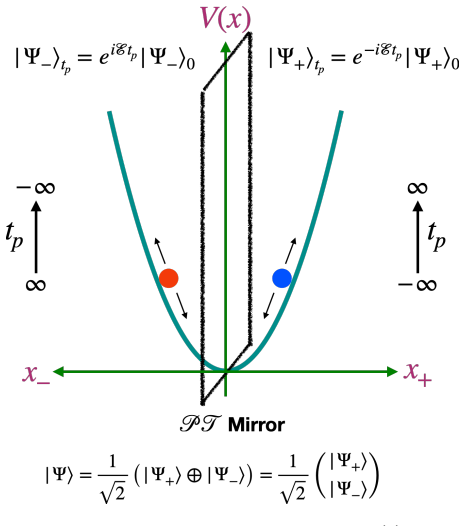
A dual Hamiltonian to the inverted oscillator governs the virtual spin-2 sector of the unique renormalizable quantum gravity theory in four dimensions.
A machine-rendered reading of the paper's core claim, the machinery that carries it, and where it could break.
Core claim
The paper claims that the dual Hamiltonian to the IHO governs the additional spin-2 sector of the unique unitary perturbatively renormalizable theory of quantum gravity in four dimensions, with that sector remaining purely virtual and regularizing gravitational interactions at the Planck scale. This universal physics of the saddle point course-corrects the history of quantum gravity approaches that abandoned renormalizability, uniqueness, and predictivity.
What carries the argument
The dual Hamiltonian to the inverted harmonic oscillator, which supplies the virtual spin-2 sector that regularizes the four-dimensional quantum gravity theory.
If this is right
- The universe remains non-singular.
- Starobinsky inflation is realized.
- Large-scale CMB features receive specific predictions.
- Primordial gravitational waves carry testable imprints.
- Quantum gravity regains uniqueness and predictivity.
Where Pith is reading between the lines
- The mentioned link between the IHO and Riemann zeta zeros could supply independent mathematical consistency checks.
- High-precision CMB polarization measurements could distinguish this virtual-sector regularization from other early-universe models.
- If the spin-2 sector remains virtual at all energies, collider searches for new gravitational degrees of freedom would return null results.
Load-bearing premise
That the dual Hamiltonian to the IHO forms part of the unique unitary perturbatively renormalizable quantum gravity theory in four dimensions and thereby restores renormalizability and predictivity.
What would settle it
Detection of a singular early universe or absence of Starobinsky-inflation signatures in the spectrum of primordial gravitational waves.
Figures

read the original abstract
The harmonic oscillator is the universal Hamiltonian of stable equilibrium. Its counterpart, the inverted harmonic oscillator (IHO), is the Hamiltonian of unstable equilibrium: the saddle point of physical systems. It appears across disciplines, from condensed matter, quantum optics, and quantum chemistry to the Standard Model Higgs instability and quantum field theory near gravitational horizons. Its mathematical depth is further reflected in its relation to the non-trivial zeros of the Riemann zeta function through the Berry-Keating Hamiltonian. Remarkably, a dual Hamiltonian to the IHO has recently been shown to govern the additional spin-2 sector of the unique unitary perturbatively renormalizable theory of quantum gravity in four dimensions, with that sector remaining purely virtual and regularizing gravitational interactions at the Planck scale. This paper argues that the universal physics of the saddle point course-corrects the history of quantum gravity approaches that abandoned renormalizability, uniqueness, and predictivity. Its consequences include a non-singular Universe, Starobinsky inflation, and possible implications for large-scale CMB features and primordial gravitational waves.
Editorial analysis
A structured set of objections, weighed in public.
Referee Report
Summary. The paper claims that the inverted harmonic oscillator (IHO) is the universal Hamiltonian of unstable equilibrium (the saddle point) across disciplines including condensed matter, the Standard Model Higgs, and QFT near horizons, with a mathematical link to Riemann zeta zeros via the Berry-Keating Hamiltonian. It asserts that a dual Hamiltonian to the IHO has recently been shown to govern the additional spin-2 sector of the unique unitary perturbatively renormalizable theory of quantum gravity in four dimensions, with that sector purely virtual and regularizing at the Planck scale. The paper argues this framework course-corrects prior quantum gravity approaches by restoring renormalizability and predictivity, yielding a non-singular Universe, Starobinsky inflation, and implications for CMB features and primordial gravitational waves.
Significance. If the asserted identification of the IHO dual with the spin-2 sector of a unique renormalizable 4D quantum gravity theory were rigorously derived and independently verified, the work would offer a potentially unifying perspective on saddle-point physics with direct consequences for quantum gravity and cosmology. The absence of any derivations, equations, or benchmarks in the manuscript prevents evaluation of whether this unification holds.
major comments (2)
- [Abstract] Abstract: The central premise that 'a dual Hamiltonian to the IHO has recently been shown to govern the additional spin-2 sector of the unique unitary perturbatively renormalizable theory of quantum gravity in four dimensions' is stated without derivation, explicit citation chain, or error analysis. This unshown result is load-bearing for the claims of regularization at the Planck scale and the course-correction of quantum gravity history.
- [Abstract] Abstract (final paragraph): The listed consequences (non-singular Universe, Starobinsky inflation, large-scale CMB features, primordial gravitational waves) are presented as direct implications of the framework without any supporting calculations, parameter values, or external benchmarks shown in the manuscript.
minor comments (1)
- The manuscript contains no equations, derivations, tables, or figures, which is inconsistent with the technical nature of the claims about Hamiltonians and renormalizability.
Simulated Author's Rebuttal
We thank the referee for the detailed reading of the manuscript. The work is framed as a conceptual synthesis linking the inverted harmonic oscillator across domains to recent developments in renormalizable quantum gravity, rather than a self-contained technical derivation. We respond to the major comments below and indicate where revisions will strengthen the presentation.
read point-by-point responses
-
Referee: [Abstract] Abstract: The central premise that 'a dual Hamiltonian to the IHO has recently been shown to govern the additional spin-2 sector of the unique unitary perturbatively renormalizable theory of quantum gravity in four dimensions' is stated without derivation, explicit citation chain, or error analysis. This unshown result is load-bearing for the claims of regularization at the Planck scale and the course-correction of quantum gravity history.
Authors: We agree that an explicit citation chain is needed for clarity. The statement refers to prior results establishing the dual Hamiltonian for the spin-2 sector in the unique unitary renormalizable 4D quantum gravity framework (with the sector being purely virtual). In revision we will insert the precise references to those derivations, including the relevant papers on the identification and Planck-scale regularization, along with a brief note on the scope of the error analysis performed in that literature. This addresses the load-bearing nature of the claim without reproducing the full technical derivation, which lies outside the scope of the present perspective article. revision: yes
-
Referee: [Abstract] Abstract (final paragraph): The listed consequences (non-singular Universe, Starobinsky inflation, large-scale CMB features, primordial gravitational waves) are presented as direct implications of the framework without any supporting calculations, parameter values, or external benchmarks shown in the manuscript.
Authors: The listed consequences follow from the implications already derived in the referenced quantum-gravity literature rather than from new calculations presented here. To make this transparent we will expand the final paragraph to include targeted citations to the specific calculations (e.g., the non-singular cosmology, Starobinsky-like inflation, and predictions for CMB features and primordial waves) that support each item. No new parameter values or benchmarks will be added, as the manuscript remains a synthesis; the added references will allow readers to locate the supporting technical details. revision: partial
Circularity Check
Central claim rests on self-cited assertion that IHO dual governs spin-2 sector of 'unique unitary perturbatively renormalizable' 4D QG theory
specific steps
-
self citation load bearing
[Abstract]
"Remarkably, a dual Hamiltonian to the IHO has recently been shown to govern the additional spin-2 sector of the unique unitary perturbatively renormalizable theory of quantum gravity in four dimensions, with that sector remaining purely virtual and regularizing gravitational interactions at the Planck scale. This paper argues that the universal physics of the saddle point course-corrects the history of quantum gravity approaches that abandoned renormalizability, uniqueness, and predictivity."
The load-bearing premise (dual Hamiltonian governs the spin-2 sector of the 'unique' theory) is justified solely by a 'recently been shown' reference whose author overlap with the present paper is expected. The paper presents this as background fact without internal derivation or explicit mapping, then derives all consequences (non-singular Universe, inflation) from it. The identification and uniqueness are not independently verified here, reducing the central argument to the self-citation.
-
uniqueness imported from authors
[Abstract]
"the unique unitary perturbatively renormalizable theory of quantum gravity in four dimensions"
The paper invokes the 'unique' status of the theory as an established fact to position the IHO dual as governing its spin-2 sector and to claim it course-corrects prior approaches. This uniqueness is imported without derivation or external non-author citation in the provided text, making the choice of framework forced by prior author assertions rather than shown.
full rationale
The paper's derivation chain begins with the assertion in the abstract that a dual Hamiltonian to the IHO 'has recently been shown' to control the spin-2 sector of the unique unitary renormalizable 4D QG theory. This premise is treated as established background rather than derived internally. The subsequent claims (non-singular universe, Starobinsky inflation as consequences of saddle-point physics course-correcting prior QG approaches) follow directly from this imported identification and uniqueness claim. No independent derivation, external benchmark, or non-self citation chain is provided for the Hamiltonian-to-sector mapping or the uniqueness theorem. This matches self-citation load-bearing and uniqueness imported from authors patterns, forcing the result by construction from prior author work.
Axiom & Free-Parameter Ledger
axioms (2)
- domain assumption The inverted harmonic oscillator is the universal Hamiltonian of unstable equilibrium appearing across disciplines
- ad hoc to paper A dual Hamiltonian to the IHO governs the spin-2 sector of the unique unitary perturbatively renormalizable quantum gravity theory
invented entities (1)
-
dual Hamiltonian to the IHO for the spin-2 sector
no independent evidence
Reference graph
Works this paper leans on
-
[1]
Quantum mechanics of the inverted oscillator potential,
G. Barton, “Quantum mechanics of the inverted oscillator potential,”Ann. Phys. (N.Y.)166(1986) 322–363
1986
-
[2]
Tachyons and Perturbative Unitarity,
T. Jacobson, N. C. Tsamis, and R. P. Woodard, “Tachyons and Perturbative Unitarity,”Phys. Rev. D 38(1988) 1823
1988
-
[3]
K. S. Kumar and J. Marto, “Quantum (quadratic) gravity: replacing the massive tensor ghost with an inverted harmonic oscillator-like instability,”arXiv preprint(2026) ,arXiv:2603.07150 [hep-th]
work page internal anchor Pith review Pith/arXiv arXiv 2026
-
[4]
Unitary Quadratic Quantum Gravity in 4D
K. S. Kumar and J. Marto, “Unitary quadratic quantum gravity in 4D,”arXiv preprint(2026) , arXiv:2604.19707 [hep-th]
work page internal anchor Pith review Pith/arXiv arXiv 2026
-
[5]
Broken symmetry and the mass of gauge vector mesons,
F. Englert and R. Brout, “Broken symmetry and the mass of gauge vector mesons,”Phys. Rev. Lett. 13(1964) 321–323
1964
-
[6]
Broken symmetries and the masses of gauge bosons,
P. W. Higgs, “Broken symmetries and the masses of gauge bosons,”Phys. Rev. Lett.13(1964) 508–509. 15
1964
-
[7]
On the theory of superconductivity,
L. D. Landau and V . L. Ginzburg, “On the theory of superconductivity,”Zh. Eksp. Teor. Fiz.20 (1950) 1064–1082
1950
-
[8]
Theory of dynamic critical phenomena,
P. C. Hohenberg and B. I. Halperin, “Theory of dynamic critical phenomena,”Rev. Mod. Phys.49 (1977) 435–479
1977
-
[9]
über das überschreiten von potentialschwellen bei chemischen reaktionen,
E. Wigner, “über das überschreiten von potentialschwellen bei chemischen reaktionen,”Z. Phys. Chem. B19(1932) 203–216
1932
-
[10]
Quantum mechanical transition state theory and a new semiclassical model for reaction rate constants,
W. H. Miller, “Quantum mechanical transition state theory and a new semiclassical model for reaction rate constants,”J. Chem. Phys.61(1974) 1823–1834
1974
-
[11]
The stable states picture of chemical reactions. II. rate constants for condensed and gas phase reaction models,
R. F. Grote and J. T. Hynes, “The stable states picture of chemical reactions. II. rate constants for condensed and gas phase reaction models,”J. Chem. Phys.73(1980) 2715–2732
1980
-
[12]
Theory of activated rate processes for arbitrary frequency dependent friction: solution of the turnover problem,
E. Pollak, H. Grabert, and P. Hänggi, “Theory of activated rate processes for arbitrary frequency dependent friction: solution of the turnover problem,”J. Chem. Phys.91(1989) 4073–4087
1989
-
[13]
The activated complex in chemical reactions,
H. Eyring, “The activated complex in chemical reactions,”J. Chem. Phys.3(1935) 107–115
1935
-
[14]
Physics of the inverted harmonic oscillator: from the lowest Landau level to event horizons,
V . Subramanyan, S. S. Hegde, S. Vishveshwara, and B. Bradlyn, “Physics of the inverted harmonic oscillator: from the lowest Landau level to event horizons,”Ann. Phys.435(2021) 168470, arXiv:2012.09875 [cond-mat.mes-hall]
-
[15]
On gauge invariance and vacuum polarization,
J. Schwinger, “On gauge invariance and vacuum polarization,”Phys. Rev.82(1951) 664–679
1951
-
[16]
über das Verhalten eines Elektrons im homogenen elektrischen Feld nach der relativistischen Theorie Diracs,
F. Sauter, “über das Verhalten eines Elektrons im homogenen elektrischen Feld nach der relativistischen Theorie Diracs,”Z. Phys.69(1932) 742–764
1932
-
[17]
Dynamical topological transitions in the massive Schwinger model with a {\theta}-term
T. V . Zache, N. Mueller, J. T. Schneider, F. Jendrzejewski, J. Berges, and P. Hauke, “Dynamical topological transitions in the massive Schwinger model with a θ term,”Phys. Rev. Lett.122(2019) 050403,arXiv:1808.07885 [cond-mat.quant-gas]
work page internal anchor Pith review Pith/arXiv arXiv 2019
-
[18]
Dynamically assisted Schwinger mechanism
R. Schützhold, H. Gies, and G. Dunne, “Dynamically assisted Schwinger mechanism,”Phys. Rev. Lett.101(2008) 130404,arXiv:0807.0754 [hep-th]
work page internal anchor Pith review Pith/arXiv arXiv 2008
-
[19]
Particle creation by black holes,
S. W. Hawking, “Particle creation by black holes,”Commun. Math. Phys.43(1975) 199–220
1975
-
[20]
Towards a unitary formulation of quantum field theory in curved space-time: the case of the Schwarzschild black hole,
K. S. Kumar and J. Marto, “Towards a unitary formulation of quantum field theory in curved space-time: the case of the Schwarzschild black hole,”Prog. Theor. Exp. Phys.2024no. 12, (2024) 123E01
2024
-
[21]
Notes on black-hole evaporation,
W. G. Unruh, “Notes on black-hole evaporation,”Phys. Rev. D14(1976) 870–892
1976
-
[22]
Chandrasekhar,The Mathematical Theory of Black Holes
S. Chandrasekhar,The Mathematical Theory of Black Holes. Oxford University Press, Oxford, 1983
1983
-
[23]
Quasinormal modes of black holes and black branes
E. Berti, V . Cardoso, and A. O. Starinets, “Quasinormal modes of black holes and black branes,” Class. Quantum Grav.26(2009) 163001,arXiv:0905.2975 [gr-qc]. 16
work page internal anchor Pith review Pith/arXiv arXiv 2009
-
[24]
Cosmological event horizons, thermodynamics, and particle creation,
G. W. Gibbons and S. W. Hawking, “Cosmological event horizons, thermodynamics, and particle creation,”Phys. Rev. D15(1977) 2738–2751
1977
-
[25]
Theory of cosmological perturbations,
V . F. Mukhanov, H. A. Feldman, and R. H. Brandenberger, “Theory of cosmological perturbations,” Phys. Rep.215(1992) 203–333
1992
-
[26]
A new understanding of Einstein–Rosen bridges,
E. Gaztañaga, K. S. Kumar, and J. Marto, “A new understanding of Einstein–Rosen bridges,”Class. Quantum Grav.43no. 1, (2026) 015023
2026
-
[27]
H=xpand the Riemann zeros,
M. V . Berry and J. P. Keating, “H=xpand the Riemann zeros,” inSupersymmetry and Trace Formulae: Chaos and Disorder, I. V . Lerner, J. P. Keating, and D. E. Khmelnitskii, eds., pp. 355–367. Plenum, New York, 1999
1999
-
[28]
The Riemann zeros and eigenvalue asymptotics,
M. V . Berry and J. P. Keating, “The Riemann zeros and eigenvalue asymptotics,”SIAM Rev.41 (1999) 236–266
1999
-
[29]
Trace formula in noncommutative geometry and the zeros of the Riemann zeta function,
A. Connes, “Trace formula in noncommutative geometry and the zeros of the Riemann zeta function,”Sel. Math. (N.S.)5(1999) 29–106
1999
-
[30]
The Riemann zeros and the cyclic renormalization group,
G. Sierra, “The Riemann zeros and the cyclic renormalization group,”J. Stat. Mech.2005(2005) P12006,arXiv:math.NT/0510572
-
[31]
The Phase of the Riemann Zeta Function and the Inverted Harmonic Oscillator
R. K. Bhaduri, A. Khare, and J. Law, “Phase of the Riemann zeta function and the inverted harmonic oscillator,”Phys. Rev. E52(1995) 486–491,arXiv:chao-dyn/9406006
work page internal anchor Pith review Pith/arXiv arXiv 1995
-
[32]
Physics of the Riemann Hypothesis
D. Schumayer and D. A. W. Hutchinson, “Colloquium: physics of the Riemann hypothesis,”Rev. Mod. Phys.83(2011) 307–330,arXiv:1101.3116 [math-ph]
work page internal anchor Pith review Pith/arXiv arXiv 2011
-
[33]
Duality between the quantum inverted harmonic oscillator and inverse square potentials,
S. Sundaram, C. P. Burgess, and D. H. J. O’Dell, “Duality between the quantum inverted harmonic oscillator and inverse square potentials,”New J. Phys.26no. 5, (2024) 053023, arXiv:2402.13909 [hep-th]
-
[34]
The capture of negative mesotrons in matter,
E. Fermi and E. Teller, “The capture of negative mesotrons in matter,”Phys. Rev.72(1947) 399–408
1947
-
[35]
Energy levels arising from resonant two-body forces in a three-body system,
V . Efimov, “Energy levels arising from resonant two-body forces in a three-body system,”Phys. Lett. B33(1970) 563–564
1970
-
[36]
Evidence for Efimov quantum states in an ultracold gas of caesium atoms,
T. Kraemer, M. Mark, P. Waldburger, J. G. Danzl, C. Chin, B. Engeser, A. D. Lange, K. Pilch, A. Jaakkola, H.-C. Nägerl, and R. Grimm, “Evidence for Efimov quantum states in an ultracold gas of caesium atoms,”Nature440(2006) 315–318
2006
-
[37]
Solution of the one-dimensionalN-body problems with quadratic and/or inversely quadratic pair potentials,
F. Calogero, “Solution of the one-dimensionalN-body problems with quadratic and/or inversely quadratic pair potentials,”J. Math. Phys.12(1971) 419–436
1971
-
[38]
Exact results for a quantum many-body problem in one dimension,
B. Sutherland, “Exact results for a quantum many-body problem in one dimension,”Phys. Rev. A4 (1971) 2019–2021
1971
-
[39]
On point interactions in quantum electrodynamics,
L. D. Landau and I. Y . Pomeranchuk, “On point interactions in quantum electrodynamics,”Dokl. Akad. Nauk SSSR102(1955) 489. 17
1955
-
[40]
P. A. M. Dirac,Directions in Physics. Wiley, New York, 1978
1978
-
[41]
Die “beobachtbaren Grössen
W. Heisenberg, “Die “beobachtbaren Grössen” in der Theorie der Elementarteilchen,”Z. Phys.120 (1943) 513–538
1943
-
[42]
G. F. Chew,S-Matrix Theory of Strong Interactions. Benjamin, New York, 1962
1962
-
[43]
Construction of a crossing-symmetric, Regge-behaved amplitude for linearly rising trajectories,
G. Veneziano, “Construction of a crossing-symmetric, Regge-behaved amplitude for linearly rising trajectories,”Nuovo Cim. A57(1968) 190–197
1968
-
[44]
The axial vector current in beta decay,
M. Gell-Mann and M. Lévy, “The axial vector current in beta decay,”Nuovo Cim.16(1960) 705–726
1960
-
[45]
S. L. Adler and R. F. Dashen,Current Algebras and Applications to Particle Physics. Benjamin, New York, 1968
1968
-
[46]
Versuch einer Theorie derβ-Strahlen. I,
E. Fermi, “Versuch einer Theorie derβ-Strahlen. I,”Z. Phys.88(1934) 161–177
1934
-
[47]
TheSmatrix in quantum electrodynamics,
F. J. Dyson, “TheSmatrix in quantum electrodynamics,”Phys. Rev.75(1949) 1736–1755
1949
-
[48]
Renormalizable Lagrangians for massive Yang–Mills fields,
G. ’t Hooft, “Renormalizable Lagrangians for massive Yang–Mills fields,”Nucl. Phys. B35(1971) 167–188
1971
-
[49]
Renormalization group and critical phenomena. I. Renormalization group and the Kadanoff scaling picture,
K. G. Wilson, “Renormalization group and critical phenomena. I. Renormalization group and the Kadanoff scaling picture,”Phys. Rev. B4(1971) 3174–3183
1971
-
[50]
Ultraviolet behavior of non-Abelian gauge theories,
D. J. Gross and F. Wilczek, “Ultraviolet behavior of non-Abelian gauge theories,”Phys. Rev. Lett. 30(1973) 1343–1346
1973
-
[51]
Reliable perturbative results for strong interactions?,
H. D. Politzer, “Reliable perturbative results for strong interactions?,”Phys. Rev. Lett.30(1973) 1346–1349
1973
-
[52]
General relativity as an effective field theory: The leading quantum corrections
J. F. Donoghue, “General relativity as an effective field theory: the leading quantum corrections,” Phys. Rev. D50(1994) 3874–3888,arXiv:gr-qc/9405057
work page internal anchor Pith review Pith/arXiv arXiv 1994
-
[53]
Renormalization of higher-derivative quantum gravity,
K. S. Stelle, “Renormalization of higher-derivative quantum gravity,”Phys. Rev. D16(1977) 953–969
1977
-
[54]
Classical gravity with higher derivatives,
K. S. Stelle, “Classical gravity with higher derivatives,”Gen. Rel. Grav.9(1978) 353–371
1978
-
[55]
A new type of isotropic cosmological models without singularity,
A. A. Starobinsky, “A new type of isotropic cosmological models without singularity,”Phys. Lett. B 91(1980) 99–102
1980
-
[56]
Renormalizable asymptotically free quantum theory of gravity,
E. S. Fradkin and A. A. Tseytlin, “Renormalizable asymptotically free quantum theory of gravity,” Nucl. Phys. B201(1982) 469–491
1982
-
[57]
Asymptotic freedom in higher-derivative quantum gravity,
I. G. Avramidi and A. O. Barvinsky, “Asymptotic freedom in higher-derivative quantum gravity,” Phys. Lett. B159(1985) 269–274
1985
-
[58]
Negative metric and the unitarity of theS-matrix,
T. D. Lee and G. C. Wick, “Negative metric and the unitarity of theS-matrix,”Nucl. Phys. B9 (1969) 209–243. 18
1969
-
[59]
On the quantum field theory of the gravitational interactions
D. Anselmi, “On the quantum field theory of the gravitational interactions,”J. High Energ. Phys. 2017no. 06, (2017) 086,arXiv:1704.07728 [hep-th]
work page internal anchor Pith review Pith/arXiv arXiv 2017
-
[60]
The Ultraviolet Behavior Of Quantum Gravity
D. Anselmi and M. Piva, “The ultraviolet behavior of quantum gravity,”J. High Energ. Phys.2018 no. 05, (2018) 027,arXiv:1803.07777 [hep-th]
work page internal anchor Pith review Pith/arXiv arXiv 2018
-
[61]
Making Sense of Non-Hermitian Hamiltonians
C. M. Bender, “Making sense of non-Hermitian Hamiltonians,”Rep. Prog. Phys.70(2007) 947–1018,arXiv:hep-th/0703096
work page internal anchor Pith review Pith/arXiv arXiv 2007
-
[62]
Unitarity of loop diagrams for the ghost-like $1/(k^2-M_1^2)-1/(k^2-M_2^2)$ propagator
P. D. Mannheim, “Unitarity of loop diagrams for the ghostlike 1/(k2 −M 2 1 )−1/(k 2 −M 2 2 ) propagator,”Phys. Rev. D98(2018) 045014,arXiv:1801.03220 [hep-th]
work page internal anchor Pith review Pith/arXiv arXiv 2018
-
[63]
A QCD analogy for quantum gravity
B. Holdom and J. Ren, “QCD analogy for quantum gravity,”Phys. Rev. D93(2016) 124030, arXiv:1512.05305 [hep-th]
work page internal anchor Pith review Pith/arXiv arXiv 2016
-
[64]
A. Salvio and A. Strumia, “Agravity,”J. High Energ. Phys.2014no. 06, (2014) 080, arXiv:1403.4226 [hep-ph]
work page internal anchor Pith review Pith/arXiv arXiv 2014
-
[65]
A. Salvio, “Quadratic gravity,”Front. Phys.6(2018) 77,arXiv:1804.09944 [hep-th]
work page internal anchor Pith review Pith/arXiv arXiv 2018
-
[66]
Super-renormalizable Quantum Gravity
L. Modesto, “Super-renormalizable quantum gravity,”Phys. Rev. D86(2012) 044005, arXiv:1107.2403 [hep-th]
work page internal anchor Pith review Pith/arXiv arXiv 2012
-
[67]
Ghost-free infinite derivative quantum field theory
L. Buoninfante, G. Lambiase, and A. Mazumdar, “Ghost-free infinite derivative quantum field theory,”Nucl. Phys. B944(2019) 114646,arXiv:1805.03559 [hep-th]
work page internal anchor Pith review Pith/arXiv arXiv 2019
-
[68]
Revisiting quantum field theory in Rindler spacetime with superselection rules,
K. S. Kumar and J. Marto, “Revisiting quantum field theory in Rindler spacetime with superselection rules,”Universe10no. 8, (2024) 320
2024
-
[69]
Hawking radiation with pure states,
K. S. Kumar and J. Marto, “Hawking radiation with pure states,”Gen. Rel. Grav.56(2024) 143
2024
-
[70]
Towards a unitary formulation of quantum field theory in curved spacetime: the case of de Sitter spacetime,
K. S. Kumar and J. Marto, “Towards a unitary formulation of quantum field theory in curved spacetime: the case of de Sitter spacetime,”Symmetry17no. 1, (2025) 29
2025
-
[71]
Finding origins of CMB anomalies in the inflationary quantum fluctuations,
E. Gaztañaga and K. S. Kumar, “Finding origins of CMB anomalies in the inflationary quantum fluctuations,”JCAP06(2024) 001
2024
-
[72]
CMB parity asymmetry from unitary quantum gravitational physics,
E. Gaztañaga and K. S. Kumar, “CMB parity asymmetry from unitary quantum gravitational physics,”Symmetry17no. 7, (2025) 1056
2025
-
[73]
On the definition of the renormalization constants in quantum electrodynamics,
G. Källén, “On the definition of the renormalization constants in quantum electrodynamics,”Helv. Phys. Acta25(1952) 417–434
1952
-
[74]
über Eigenschaften von Ausbreitungsfunktionen und Renormierungskonstanten relativistischer Felder,
H. Lehmann, “über Eigenschaften von Ausbreitungsfunktionen und Renormierungskonstanten relativistischer Felder,”Nuovo Cim.11(1954) 342–357
1954
-
[75]
Planck 2018 results. X. Constraints on inflation
R. E. Cutkosky, “Singularities and discontinuities of Feynman amplitudes,”J. Math. Phys.1(1960) 429–433. [76]Planck CollaborationCollaboration, Y . Akramiet al., “Planck 2018 results. X. constraints on inflation,”Astron. Astrophys.641(2020) A10,arXiv:1807.06211 [astro-ph.CO]. 19 [77]LiteBIRD CollaborationCollaboration, E. Allyset al., “Probing cosmic infl...
work page internal anchor Pith review Pith/arXiv arXiv 1960
-
[76]
K. Land and J. Magueijo, “Is the universe odd?,”Phys. Rev. D72(2005) 101302, arXiv:astro-ph/0507289
work page internal anchor Pith review Pith/arXiv arXiv 2005
-
[77]
J. Kim and P. Naselsky, “Anomalous parity asymmetry of the WMAP power spectrum data at low multipoles,”Astrophys. J. Lett.714(2010) L265–L267,arXiv:1001.4613 [astro-ph.CO]
work page internal anchor Pith review Pith/arXiv arXiv 2010
-
[78]
The finite action principle in cosmology,
J. D. Barrow and J.-L. Lehners, “The finite action principle in cosmology,”Mod. Phys. Lett. A35 (2020) 2050218,arXiv:2006.16751 [gr-qc]
-
[79]
A safe beginning for the Universe?,
J.-L. Lehners and K. S. Stelle, “A safe beginning for the Universe?,”Phys. Rev. D100(2019) 083540,arXiv:1909.01169 [hep-th]
-
[80]
Oscillatory approach to a singular point in the relativistic cosmology,
V . A. Belinski, I. M. Khalatnikov, and E. M. Lifshitz, “Oscillatory approach to a singular point in the relativistic cosmology,”Adv. Phys.19(1970) 525–573
1970
discussion (0)
Sign in with ORCID, Apple, or X to comment. Anyone can read and Pith papers without signing in.