A Bandpass Axion Or: How I Learned To Stop Worrying About Stars And Love The Lab
Pith reviewed 2026-06-29 06:19 UTC · model grok-4.3
The pith
Axion-photon coupling from non-anomalous PQ symmetry suppresses high- and low-energy probes while leaving lab experiments unaffected
A machine-rendered reading of the paper's core claim, the machinery that carries it, and where it could break.
Core claim
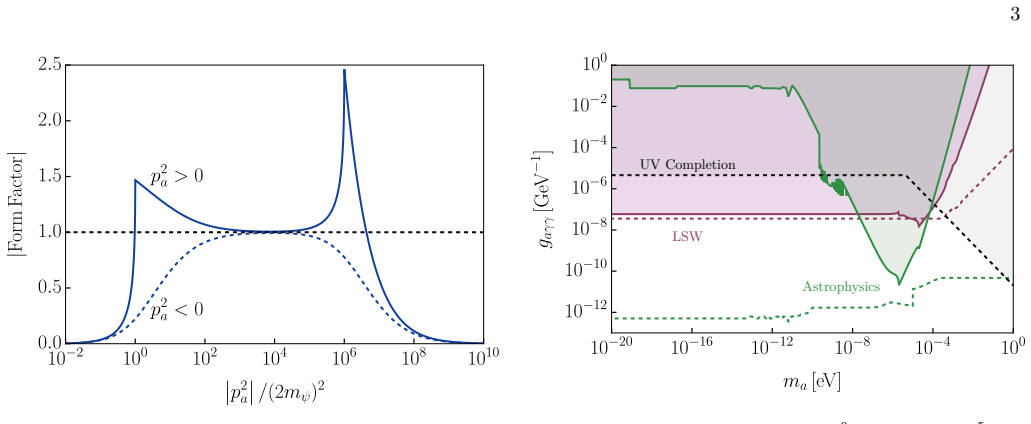
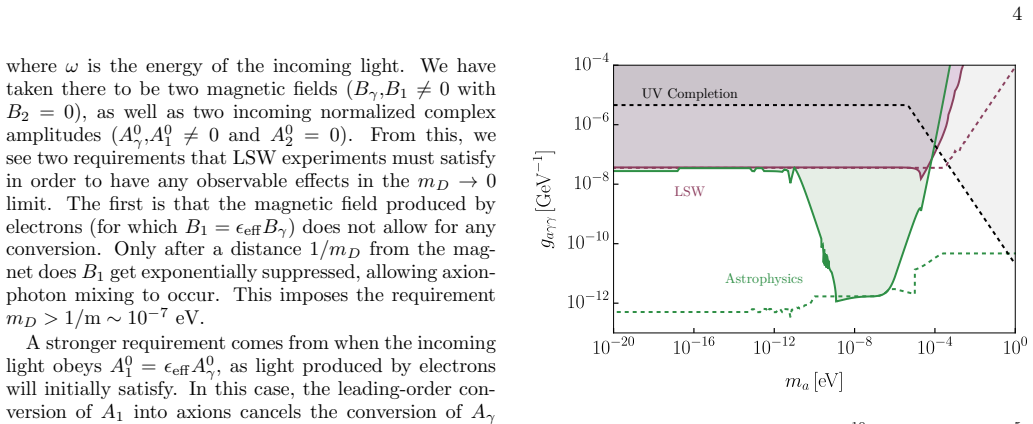
An axion-photon coupling resulting from a non-anomalous PQ symmetry under which light fermions are charged acts as a bandpass filter: both high- and low-energy probes experience a parametrically suppressed coupling while intermediate-energy probes remain unaffected. An immediate result of this bandpass is that lab-based constraints can naturally be the dominant constraint for almost all values of the axion mass. High-energy constraints coming from stellar dynamics as well as low-energy constraints coming from photon-axion conversion in galactic/stellar magnetic fields are simultaneously suppressed, while lab-based experiments, such as light-shining-through-a-wall experiments, done at interme
What carries the argument
The bandpass filter on the axion-photon coupling induced by the non-anomalous PQ symmetry that charges light fermions
If this is right
- Stellar-dynamics bounds become parametrically weaker.
- Photon-axion conversion constraints from galactic and stellar magnetic fields are suppressed.
- Laboratory experiments at intermediate energies remain at full strength.
- Laboratory constraints dominate for almost all axion masses.
Where Pith is reading between the lines
- Axion model building could deliberately use this symmetry to reconcile laboratory and astrophysical data.
- Similar energy-dependent suppression mechanisms may exist for other axion couplings or in related dark-sector models.
- Experimental roadmaps should prioritize intermediate-energy laboratory searches over astrophysical ones when this symmetry is assumed.
Load-bearing premise
A viable non-anomalous Peccei-Quinn symmetry exists that charges light fermions.
What would settle it
Detection of an axion-induced effect in stellar cooling or galactic magnetic-field conversion at the full coupling strength expected without the bandpass suppression.
Figures
read the original abstract
Axion-like particles coupled to photons are one of the most compelling new physics scenarios. We demonstrate that an axion-photon coupling resulting from a non-anomalous PQ symmetry under which light fermions are charged acts as a bandpass filter: both high- and low-energy probes experience a parametrically suppressed coupling while intermediate-energy probes remain unaffected. An immediate result of this bandpass is that lab-based constraints can naturally be the dominant constraint for almost all values of the axion mass. High-energy constraints coming from stellar dynamics as well as low-energy constraints coming from photon-axion conversion in galactic/stellar magnetic fields are simultaneously suppressed, while lab-based experiments, such as light-shining-through-a-wall experiments, done at intermediate energies are unsuppressed.
Editorial analysis
A structured set of objections, weighed in public.
Referee Report
Summary. The manuscript claims that an axion-photon coupling generated by a non-anomalous PQ symmetry under which light fermions carry PQ charge functions as a bandpass filter: the effective coupling is parametrically suppressed for both high-energy (stellar) and low-energy (galactic magnetic field conversion) probes, while remaining unsuppressed at intermediate energies relevant to laboratory experiments such as light-shining-through-a-wall. As a direct consequence, laboratory bounds become the dominant constraints for essentially all axion masses.
Significance. If the central construction is viable, the result would be significant for axion phenomenology: it supplies a symmetry-based mechanism that simultaneously evades stellar cooling bounds and astrophysical conversion limits while preserving sensitivity in controlled laboratory settings, thereby altering the relative weight of experimental programs across the axion mass range.
major comments (2)
- [model construction (implicit in abstract)] The bandpass suppression is generated only when the PQ symmetry is non-anomalous yet light fermions carry PQ charge. The manuscript does not exhibit an explicit UV completion or anomaly-cancellation mechanism that realizes this charge assignment without reintroducing anomalies or additional light degrees of freedom; this assumption is load-bearing for the claimed parametric suppression at both high and low energies.
- [effective coupling derivation] The energy dependence of the effective axion-photon coupling is stated to arise from the fermion loop or form factor. Without the explicit loop calculation or form-factor derivation, it is impossible to verify that the suppression is parametric rather than accidental and that it correctly vanishes in the stated limits.
minor comments (2)
- The title is colloquial; a more descriptive title would better suit the journal format.
- The abstract refers to 'light fermions' without specifying the generation or flavor structure; a brief clarification in the model section would aid readability.
Simulated Author's Rebuttal
We thank the referee for their thoughtful review and for identifying two points where the manuscript's presentation can be improved. We address each major comment below and will incorporate clarifications and explicit derivations in a revised version. The central bandpass mechanism remains intact under the stated assumptions.
read point-by-point responses
-
Referee: [model construction (implicit in abstract)] The bandpass suppression is generated only when the PQ symmetry is non-anomalous yet light fermions carry PQ charge. The manuscript does not exhibit an explicit UV completion or anomaly-cancellation mechanism that realizes this charge assignment without reintroducing anomalies or additional light degrees of freedom; this assumption is load-bearing for the claimed parametric suppression at both high and low energies.
Authors: We agree that an explicit UV completion would strengthen the manuscript. While the paper focuses on the phenomenological consequences of the non-anomalous PQ charge assignment for light fermions, such assignments can be realized by extending the model with heavy vector-like fermions that cancel the anomalies without introducing additional light states. We will add a short section sketching one such construction (e.g., a minimal extension with two heavy vector-like pairs) to demonstrate consistency. revision: yes
-
Referee: [effective coupling derivation] The energy dependence of the effective axion-photon coupling is stated to arise from the fermion loop or form factor. Without the explicit loop calculation or form-factor derivation, it is impossible to verify that the suppression is parametric rather than accidental and that it correctly vanishes in the stated limits.
Authors: The suppression follows from the standard one-loop triangle diagram for the axion-photon vertex when the PQ-charged fermions are integrated out. The form factor is the usual Passarino-Veltman function that approaches zero both for momentum transfer much larger than the fermion mass (high-energy decoupling) and much smaller (low-energy suppression). We will include the explicit loop integral and the resulting parametric limits in a new appendix of the revised manuscript. revision: yes
Circularity Check
No circularity; derivation is a standard model calculation from stated assumptions
full rationale
The paper assumes a non-anomalous PQ symmetry under which light fermions carry charge and computes the resulting axion-photon coupling's energy dependence, which produces the bandpass suppression at high and low energies. This follows from explicit calculation of the effective operator or loop effects rather than redefinition, fitting, or self-citation. The central claim that lab bounds can dominate is a direct consequence of that computed energy dependence, not an input renamed as output. No load-bearing steps reduce by construction to the paper's own definitions or prior self-citations; the symmetry choice is an independent model-building assumption whose UV viability is separate from the derivation.
Axiom & Free-Parameter Ledger
axioms (1)
- domain assumption Existence of a non-anomalous Peccei-Quinn symmetry under which light fermions are charged.
Reference graph
Works this paper leans on
-
[1]
R. D. Peccei and H. R. Quinn,Constraints Imposed by CP Conservation in the Presence of Instantons,Phys. Rev. D16(1977) 1791–1797
1977
-
[2]
R. D. Peccei and H. R. Quinn,CP Conservation in the Presence of Instantons,Phys. Rev. Lett.38(1977) 1440–1443
1977
-
[3]
Weinberg,A New Light Boson?,Phys
S. Weinberg,A New Light Boson?,Phys. Rev. Lett.40 (1978) 223–226
1978
-
[4]
Wilczek,Problem of StrongPandTInvariance in the Presence of Instantons,Phys
F. Wilczek,Problem of StrongPandTInvariance in the Presence of Instantons,Phys. Rev. Lett.40(1978) 279–282
1978
-
[5]
A. R. Zhitnitsky,On Possible Suppression of the Axion Hadron Interactions. (In Russian),Sov. J. Nucl. Phys. 31(1980) 260
1980
-
[6]
M. Dine, W. Fischler, and M. Srednicki,A Simple Solution to the Strong CP Problem with a Harmless Axion,Phys. Lett. B104(1981) 199–202
1981
-
[7]
J. E. Kim,Weak Interaction Singlet and Strong CP Invariance,Phys. Rev. Lett.43(1979) 103
1979
-
[8]
M. A. Shifman, A. I. Vainshtein, and V. I. Zakharov, Can Confinement Ensure Natural CP Invariance of Strong Interactions?,Nucl. Phys. B166(1980) 493–506. 6
1980
-
[9]
Preskill, M
J. Preskill, M. B. Wise, and F. Wilczek,Cosmology of the Invisible Axion,Phys. Lett. B120(1983) 127–132
1983
-
[10]
Dine and W
M. Dine and W. Fischler,The Not So Harmless Axion, Phys. Lett. B120(1983) 137–141
1983
-
[11]
L. F. Abbott and P. Sikivie,A Cosmological Bound on the Invisible Axion,Phys. Lett. B120(1983) 133–136
1983
-
[12]
P. Svrcek and E. Witten,Axions In String Theory, JHEP06(2006) 051, [hep-th/0605206]
work page internal anchor Pith review Pith/arXiv arXiv 2006
-
[13]
A. Arvanitaki, S. Dimopoulos, S. Dubovsky, N. Kaloper, and J. March-Russell,String Axiverse, Phys. Rev. D81(2010) 123530, [arXiv:0905.4720]
work page internal anchor Pith review Pith/arXiv arXiv 2010
-
[14]
M. Demirtas, C. Long, L. McAllister, and M. Stillman, The Kreuzer-Skarke Axiverse,JHEP04(2020) 138, [arXiv:1808.01282]
work page internal anchor Pith review Pith/arXiv arXiv 2020
-
[15]
Ringwald,Review on Axions, 4, 2024
A. Ringwald,Review on Axions, 4, 2024. arXiv:2404.09036
-
[16]
cajohare/axionlimits: Axionlimits
C. O’Hare, “cajohare/axionlimits: Axionlimits.” https://cajohare.github.io/AxionLimits/, July, 2020. [17]Particle Data GroupCollaboration, S. Navas et al., Review of particle physics,Phys. Rev. D110(2024), no. 3 030001
2020
-
[17]
Evading Astrophysical Constraints on Axion-Like Particles
E. Masso and J. Redondo,Evading astrophysical constraints on axion-like particles,JCAP09(2005) 015, [hep-ph/0504202]
work page internal anchor Pith review Pith/arXiv arXiv 2005
-
[18]
Compatibility of CAST search with axion-like interpretation of PVLAS results
E. Masso and J. Redondo,Compatibility of CAST search with axion-like interpretation of PVLAS results, Phys. Rev. Lett.97(2006) 151802, [hep-ph/0606163]
work page internal anchor Pith review Pith/arXiv arXiv 2006
-
[19]
R. N. Mohapatra and S. Nasri,Reconciling the CAST and PVLAS results,Phys. Rev. Lett.98(2007) 050402, [hep-ph/0610068]. [21]PVLASCollaboration, E. Zavattini et al., Experimental observation of optical rotation generated in vacuum by a magnetic field,Phys. Rev. Lett.96 (2006) 110406, [hep-ex/0507107]. [Erratum: Phys.Rev.Lett. 99, 129901 (2007)]
work page internal anchor Pith review Pith/arXiv arXiv 2007
-
[20]
Probing Axions with Radiation from Magnetic Stars
D. Lai and J. Heyl,Probing Axions with Radiation from Magnetic Stars,Phys. Rev. D74(2006) 123003, [astro-ph/0609775]
work page internal anchor Pith review Pith/arXiv arXiv 2006
-
[21]
Constraining the photon-axion coupling constant with magnetic white dwarfs
R. Gill and J. S. Heyl,Constraining the photon-axion coupling constant with magnetic white dwarfs,Phys. Rev. D84(2011) 085001, [arXiv:1105.2083]
work page internal anchor Pith review Pith/arXiv arXiv 2011
-
[22]
C. Dessert, D. Dunsky, and B. R. Safdi,Upper limit on the axion-photon coupling from magnetic white dwarf polarization,Phys. Rev. D105(2022), no. 10 103034, [arXiv:2203.04319]
- [23]
- [24]
- [25]
-
[26]
A. Berlin and A. Hook,Searching for Millicharged Particles with Superconducting Radio-Frequency Cavities,Phys. Rev. D102(2020), no. 3 035010, [arXiv:2001.02679]
- [27]
- [28]
-
[29]
Automatized One-Loop Calculations in 4 and D dimensions
T. Hahn and M. Perez-Victoria,Automatized one loop calculations in four-dimensions and D-dimensions, Comput. Phys. Commun.118(1999) 153–165, [hep-ph/9807565]
work page internal anchor Pith review Pith/arXiv arXiv 1999
-
[30]
New axion and hidden photon constraints from a solar data global fit
N. Vinyoles, A. Serenelli, F. L. Villante, S. Basu, J. Redondo, and J. Isern,New axion and hidden photon constraints from a solar data global fit,JCAP10(2015) 015, [arXiv:1501.01639]
work page internal anchor Pith review Pith/arXiv arXiv 2015
-
[31]
H. An, M. Pospelov, J. Pradler, and A. Ritz,New limits on dark photons from solar emission and keV scale dark matter,Phys. Rev. D102(2020) 115022, [arXiv:2006.13929]. [34]XENONCollaboration, E. Aprile et al.,Emission of single and few electrons in XENON1T and limits on light dark matter,Phys. Rev. D106(2022), no. 2 022001, [arXiv:2112.12116]. [Erratum: Ph...
-
[32]
Updated Bounds on Milli-Charged Particles
S. Davidson, S. Hannestad, and G. Raffelt,Updated bounds on millicharged particles,JHEP05(2000) 003, [hep-ph/0001179]
work page internal anchor Pith review Pith/arXiv arXiv 2000
-
[33]
First results from the new PVLAS apparatus: a new limit on vacuum magnetic birefringence
F. Della Valle, E. Milotti, A. Ejlli, G. Messineo, L. Piemontese, G. Zavattini, U. Gastaldi, R. Pengo, and G. Ruoso,First results from the new PVLAS apparatus: A new limit on vacuum magnetic birefringence,Phys. Rev. D90(2014), no. 9 092003, [arXiv:1406.6518]
work page internal anchor Pith review Pith/arXiv arXiv 2014
-
[34]
New ALPS Results on Hidden-Sector Lightweights
K. Ehret et al.,New ALPS Results on Hidden-Sector Lightweights,Phys. Lett. B689(2010) 149–155, [arXiv:1004.1313]. [38]OSQARCollaboration, R. Ballou et al.,New exclusion limits on scalar and pseudoscalar axionlike particles from light shining through a wall,Phys. Rev. D92 (2015), no. 9 092002, [arXiv:1506.08082]
work page internal anchor Pith review Pith/arXiv arXiv 2010
-
[35]
F. Della Valle, A. Ejlli, U. Gastaldi, G. Messineo, E. Milotti, R. Pengo, G. Ruoso, and G. Zavattini,The PVLAS experiment: measuring vacuum magnetic birefringence and dichroism with a birefringent Fabry–Perot cavity,Eur. Phys. J. C76(2016), no. 1 24, [arXiv:1510.08052]
work page internal anchor Pith review Pith/arXiv arXiv 2016
-
[36]
J. S. Reyn´ es, J. H. Matthews, C. S. Reynolds, H. R. Russell, R. N. Smith, and M. C. D. Marsh,New constraints on light axion-like particles using Chandra transmission grating spectroscopy of the powerful cluster-hosted quasar H1821+643,Mon. Not. Roy. Astron. Soc.510(2021), no. 1 1264–1277, [arXiv:2109.03261]. [41]F ermi-LA TCollaboration, M. Ajello et al...
-
[37]
O. Ning and B. R. Safdi,Leading Axion-Photon Sensitivity with NuSTAR Observations of M82 and M87,Phys. Rev. Lett.134(2025), no. 17 171003, [arXiv:2404.14476]
-
[38]
D. Noordhuis, A. Prabhu, S. J. Witte, A. Y. Chen, F. Cruz, and C. Weniger,Novel Constraints on Axions Produced in Pulsar Polar-Cap Cascades,Phys. Rev. Lett.131(2023), no. 11 111004, [arXiv:2209.09917]
-
[39]
Ruz et al.,NuSTAR as an Axion Helioscope,Phys
J. Ruz et al.,NuSTAR as an Axion Helioscope,Phys. Rev. Lett.135(2025), no. 14 141001, 7 [arXiv:2407.03828]
-
[40]
Revisiting the bound on axion-photon coupling from Globular Clusters
A. Ayala, I. Dom´ ınguez, M. Giannotti, A. Mirizzi, and O. Straniero,Revisiting the bound on axion-photon coupling from Globular Clusters,Phys. Rev. Lett.113 (2014), no. 19 191302, [arXiv:1406.6053]
work page internal anchor Pith review Pith/arXiv arXiv 2014
- [41]
- [42]
-
[43]
Raffelt and L
G. Raffelt and L. Stodolsky,Mixing of the Photon with Low Mass Particles,Phys. Rev. D37(1988) 1237
1988
-
[44]
M. Betz, F. Caspers, M. Gasior, M. Thumm, and S. W. Rieger,First results of the CERN Resonant Weakly Interacting sub-eV Particle Search (CROWS),Phys. Rev. D88(2013), no. 7 075014, [arXiv:1310.8098]
work page internal anchor Pith review Pith/arXiv arXiv 2013
-
[45]
M. C. D. Marsh, H. R. Russell, A. C. Fabian, B. P. McNamara, P. Nulsen, and C. S. Reynolds,A New Bound on Axion-Like Particles,JCAP12(2017) 036, [arXiv:1703.07354]. [51]ALPSCollaboration, K. Ehret et al.,Resonant laser power build-up in ALPS: A ’Light-shining-through-walls’ experiment,Nucl. Instrum. Meth. A612(2009) 83–96, [arXiv:0905.4159]
work page internal anchor Pith review Pith/arXiv arXiv 2017
discussion (0)
Sign in with ORCID, Apple, or X to comment. Anyone can read and Pith papers without signing in.