Exact Mass Conservation in Binary Neutron Star Merger Simulations
Pith reviewed 2026-06-29 05:43 UTC · model grok-4.3
The pith
A rescaling algorithm applied to the artificial atmosphere in neutron star merger simulations guarantees exact conservation of baryon mass and electron number to round-off precision.
A machine-rendered reading of the paper's core claim, the machinery that carries it, and where it could break.
Core claim
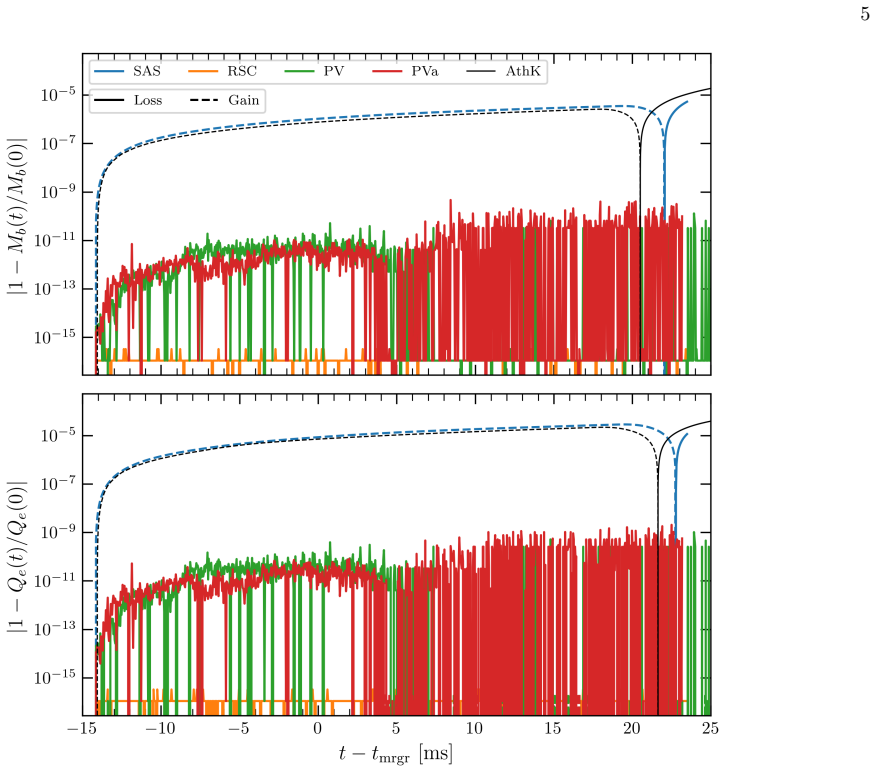
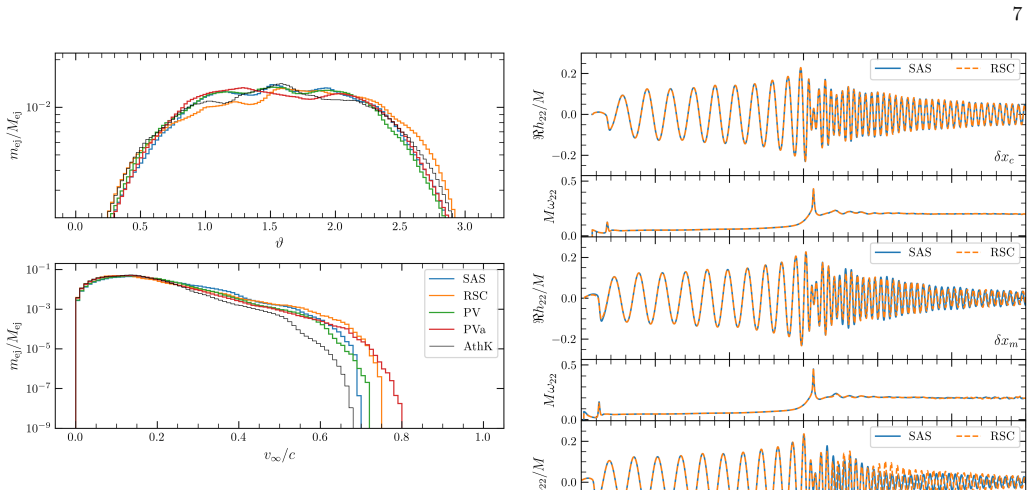
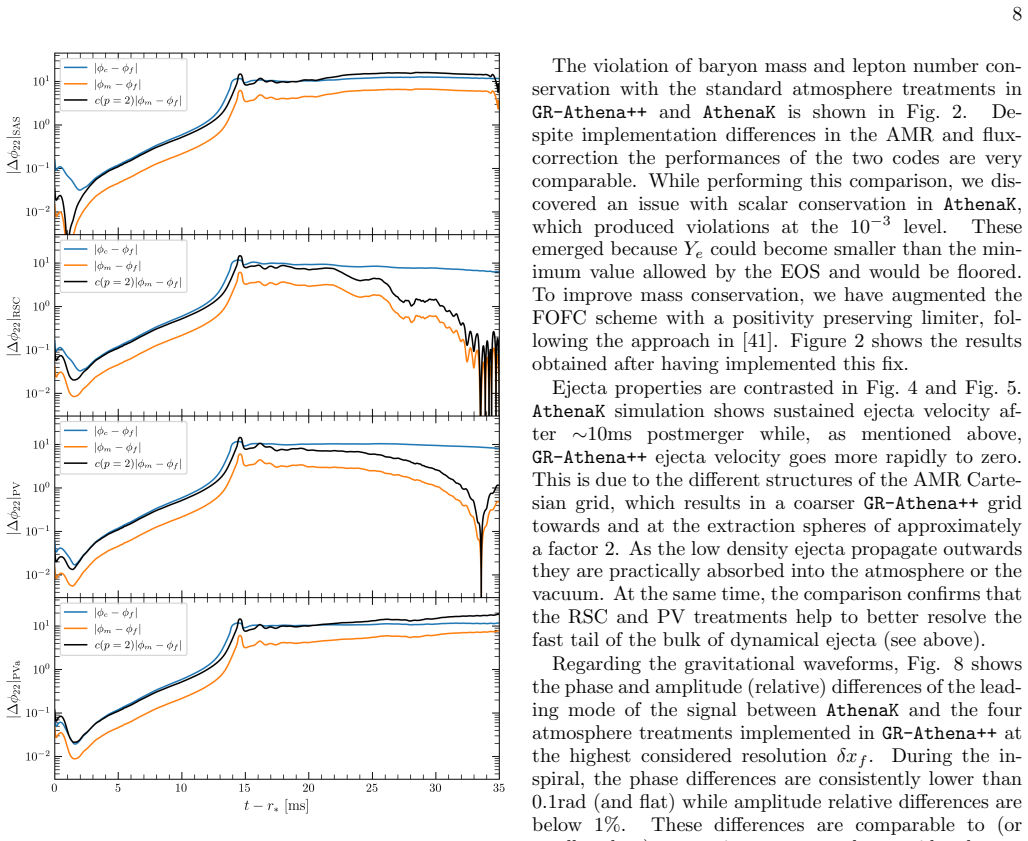
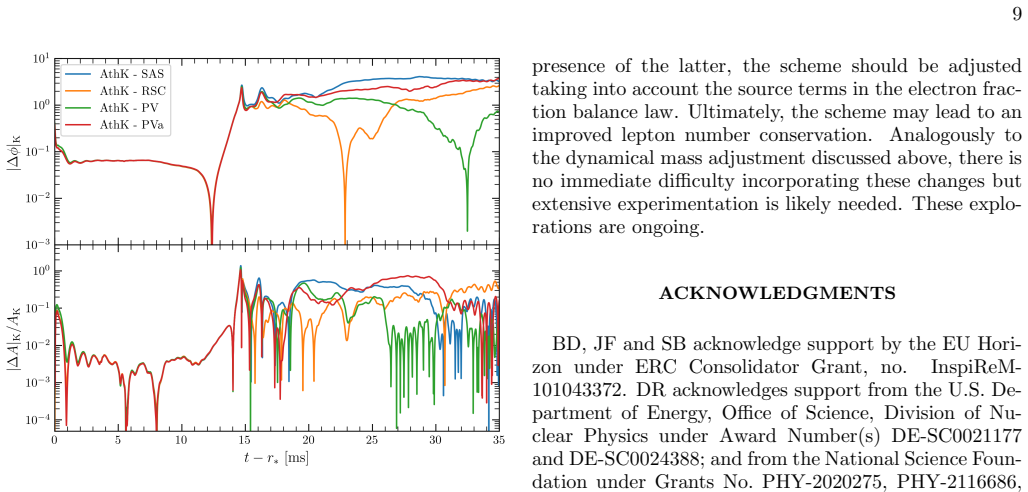
The authors show that their rescaling algorithm for the artificial atmosphere guarantees mass and electron number conservation to round-off precision. The pseudo-vacuum treatment shows slightly larger but approximately constant violations and improves computation of fast tail ejecta while providing convergent gravitational waves of quality comparable to the standard atmosphere. Results suggest that current computations of gravitational waves and dynamical ejecta are robust provided conservative adaptive mesh refinement with flux correction is employed.
What carries the argument
The local rescaling algorithm that adjusts the density in the artificial atmosphere to enforce global conservation constraints.
If this is right
- Baryon mass and electron number conservation holds to round-off precision throughout the simulation.
- The pseudo-vacuum option improves accuracy for fast tail ejecta.
- Gravitational wave signals converge at quality levels comparable to standard treatments.
- Merger simulations remain robust across different atmosphere treatments when using conservative AMR and flux correction.
Where Pith is reading between the lines
- This rescaling could be adapted for other Eulerian simulations that use artificial atmospheres, such as those involving black holes or accretion disks.
- The approximately constant violations in the pseudo-vacuum case suggest that error accumulation is predictable and may not grow with simulation time.
- Better ejecta modeling might lead to more accurate predictions for electromagnetic counterparts like kilonovae.
Load-bearing premise
That locally rescaling the artificial atmosphere density does not introduce unphysical effects that change the evolution of the neutron star matter or observable quantities.
What would settle it
A simulation test where the total baryon mass after rescaling differs from the initial mass by an amount larger than round-off error would falsify the exact conservation guarantee.
Figures


read the original abstract
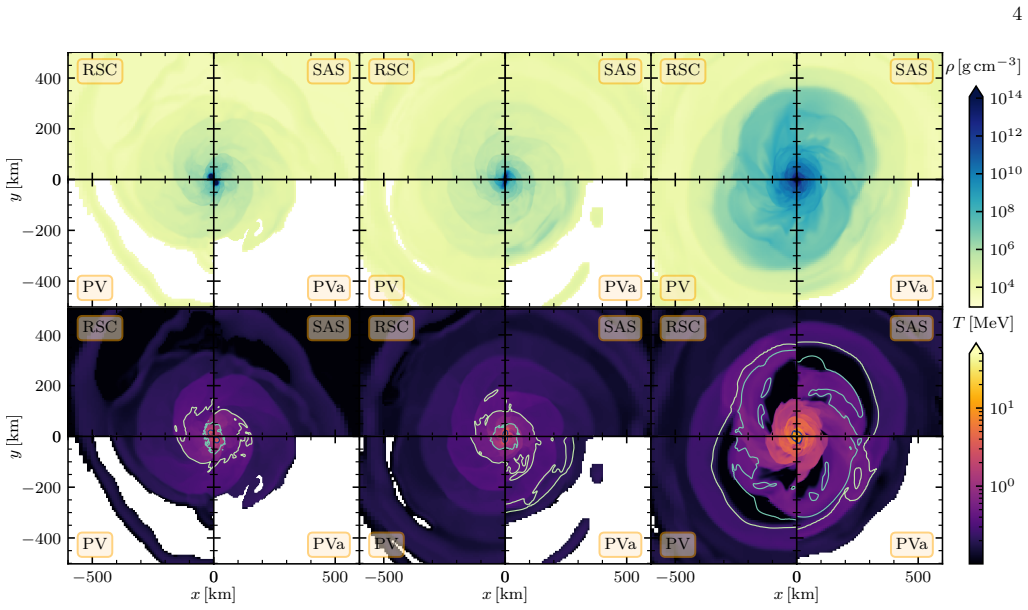
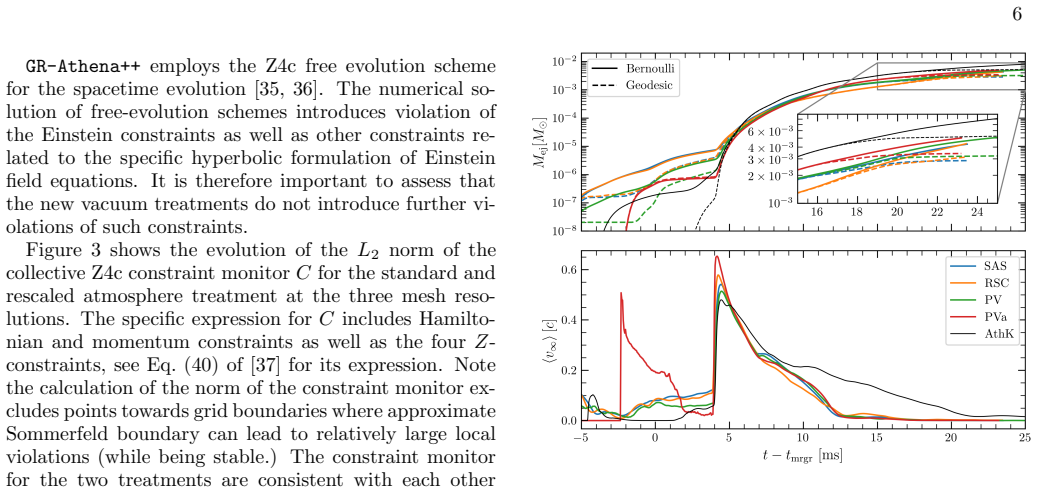
A long-standing problem in the simulation of neutron star spacetimes is the treatment of vacuum regions outside the stars. The use of an artificial low-density atmosphere is a common robust approach within Eulerian hydrodynamics that, however, introduces baryon-mass violation even with conservative numerical schemes. We propose a simple numerical algorithm that ensures exact mass conservation by means of an appropriate local rescaling of the atmosphere. The scheme is combined with a low-order flux correction and it can be further augmented by a pseudo-vacuum treatment that enforces strict vacuum in the outer regions far from the central objects. We demonstrate the effectiveness of these vacuum treatments with binary neutron star mergers simulations spanning multiple orbits and the postmerger phase, and including a microphysical equation of state. The rescaling algorithm guarantees mass and electron number conservation to round-off precision. The pseudo-vacuum treatment shows slightly larger but approximately constant violations and can improve the computation of fast tail ejecta as well as provide convergent gravitational waves of quality comparable to the standard atmosphere. Overall, results from different atmosphere treatments and a two-code comparison suggest that current computations of gravitational waves and (dynamical) ejecta in the presence of an artifical atmosphere are robust, provided that conservative adaptive mesh refinement with flux correction is employed.
Editorial analysis
A structured set of objections, weighed in public.
Referee Report
Summary. The manuscript presents a numerical algorithm for treating artificial low-density atmospheres in Eulerian hydrodynamics simulations of binary neutron star mergers. It proposes local rescaling of the atmosphere density after the conservative update, combined with low-order flux correction, to enforce exact baryon mass and electron number conservation to round-off precision. An optional pseudo-vacuum treatment is also introduced for outer regions. The scheme is tested on multi-orbit BNS mergers with a microphysical equation of state, claiming that the rescaling achieves the stated conservation while the pseudo-vacuum yields slightly larger but constant violations, and that results for gravitational waves and dynamical ejecta are comparable across treatments, indicating robustness when conservative AMR with flux correction is used.
Significance. If the central claims hold, the work addresses a persistent practical issue in numerical relativity by providing a simple, exact-conservation fix for atmosphere treatments without apparent loss of accuracy in key observables. The use of microphysical EOS and multi-orbit runs, plus the two-code comparison, supports broader applicability. The explicit demonstration of round-off conservation is a clear strength for reproducibility in the field.
major comments (1)
- [Abstract] Abstract: the claim that results from different atmosphere treatments are comparable (and thus that computations are robust) is invoked to support the overall conclusion, but the manuscript provides no quantitative bound on the magnitude of interface perturbations from local density rescaling before they would affect GW strains or ejecta properties at the level of the reported conservation gains. This assumption is load-bearing for the robustness statement.
Simulated Author's Rebuttal
We thank the referee for the positive assessment of the work and the constructive comment. We address the major comment below and will incorporate revisions as indicated.
read point-by-point responses
-
Referee: [Abstract] Abstract: the claim that results from different atmosphere treatments are comparable (and thus that computations are robust) is invoked to support the overall conclusion, but the manuscript provides no quantitative bound on the magnitude of interface perturbations from local density rescaling before they would affect GW strains or ejecta properties at the level of the reported conservation gains. This assumption is load-bearing for the robustness statement.
Authors: We agree that the current manuscript does not supply an explicit quantitative bound on the size of interface perturbations from the rescaling that would begin to affect GW strains or ejecta at the scale of the reported conservation improvements. The robustness statement rests on the empirical finding that GW and ejecta quantities remain comparable across atmosphere treatments and between independent codes when conservative AMR with flux correction is used. While this provides practical evidence of robustness, a formal a priori bound would require additional analysis of the rescaling operator's effect on the solution that is not present. We will revise the abstract to moderate the language on robustness and add a short discussion quantifying the typical magnitude of the density adjustments introduced by the rescaling (which are localized and at the level of the atmosphere floor) together with their observed impact on the reported observables. revision: yes
Circularity Check
Numerical conservation scheme is self-contained with external verification
full rationale
The paper presents an explicit numerical algorithm that enforces exact mass and electron-number conservation via post-update local rescaling of the artificial atmosphere density, combined with low-order flux correction. This guarantee to round-off precision is a direct consequence of the rescaling construction itself rather than a derived prediction or first-principles result that reduces to fitted inputs. No load-bearing self-citations, uniqueness theorems, or ansatzes appear in the provided text; results are instead validated against independent external benchmarks including conservation laws, multi-orbit BNS simulations, microphysical EOS, and cross-code comparisons. The contribution therefore remains self-contained against external requirements without circular reduction.
Axiom & Free-Parameter Ledger
free parameters (1)
- atmosphere density floor
axioms (1)
- domain assumption Eulerian hydrodynamics schemes remain conservative away from the artificial atmosphere
Reference graph
Works this paper leans on
-
[1]
J. A. Fontet al., Phys. Rev.D65, 084024 (2002), arXiv:gr-qc/0110047
work page internal anchor Pith review Pith/arXiv arXiv 2002
-
[2]
Relativistic simulations of rotational core collapse. I. Methods, initial models, and code tests
H. Dimmelmeier, J. A. Font, and E. M¨ uller, Astron. 10 Astrophys.388, 917 (2002), arXiv:astro-ph/0204288
work page internal anchor Pith review Pith/arXiv arXiv 2002
-
[3]
L. Baiotti, I. Hawke, P. J. Montero, F. Loffler, L. Rez- zolla,et al., Phys.Rev.D71, 024035 (2005), arXiv:gr- qc/0403029 [gr-qc]
-
[4]
Numerical relativity simulations of binary neutron stars
M. Thierfelder, S. Bernuzzi, and B. Br¨ ugmann, Phys.Rev.D84, 044012 (2011), arXiv:1104.4751 [gr-qc]
work page internal anchor Pith review Pith/arXiv arXiv 2011
- [5]
-
[6]
W. Kastaun, J. V. Kalinani, and R. Ciolfi, Phys. Rev. D103, 023018 (2021), arXiv:2005.01821 [gr-qc]
-
[7]
P. Hammond, I. Hawke, and N. Andersson, Phys. Rev. D104, 103006 (2021), arXiv:2108.08649 [astro-ph.HE]
-
[8]
E. F. Toro,Riemann Solvers and Numerical Methods for Fluid Dynamics, 2nd ed. (Springer-Verlag, 1999)
1999
-
[9]
R. J. LeVeque,Finite Volume Methods for Hyperbolic Problems(Cambridge University Press, 2002)
2002
-
[10]
P. Chandrashekar and C. Klingenberg, SIAM Jour- nal on Scientific Computing37, B382 (2015), https://doi.org/10.1137/140984373
- [11]
- [12]
-
[13]
W. E. East, F. Pretorius, and B. C. Stephens, Phys.Rev. D85, 124010 (2012), arXiv:1112.3094 [gr-qc]
work page internal anchor Pith review Pith/arXiv arXiv 2012
-
[14]
C. Reisswig, R. Haas, C. D. Ott, E. Abdikamalov, P. M¨ osta, D. Pollney, and E. Schnetter, Phys. Rev.D87, 064023 (2013), arXiv:1212.1191 [astro-ph.HE]
work page internal anchor Pith review Pith/arXiv arXiv 2013
-
[15]
Numerical relativity simulations of neutron star merger remnants using conservative mesh refinement
T. Dietrich, S. Bernuzzi, M. Ujevic, and B. Br¨ ugmann, Phys. Rev.D91, 124041 (2015), arXiv:1504.01266 [gr- qc]
work page internal anchor Pith review Pith/arXiv arXiv 2015
- [16]
- [17]
-
[18]
Calibration of Moving Puncture Simulations
B. Br¨ ugmann, J. A. Gonzalez, M. Hannam, S. Husa, U. Sperhake,et al., Phys.Rev.D77, 024027 (2008), arXiv:gr-qc/0610128 [gr-qc]
work page internal anchor Pith review Pith/arXiv arXiv 2008
-
[19]
M. N. Lemaster and J. M. Stone, Astrophys. J.691, 1092 (2009), arXiv:0809.4005 [astro-ph]
work page internal anchor Pith review Pith/arXiv arXiv 2009
- [20]
- [21]
-
[22]
GR-Athena++: Magnetohy- drodynamical Evolution with Dynamical Space-Time,
B. Daszuta and W. Cook, “GR-Athena++: Magnetohy- drodynamical Evolution with Dynamical Space-Time,” (2025) arXiv:2406.05126 [gr-qc]
-
[23]
B. Daszuta, W. Cook, P. Hammond, J. Fields, E. M. Guti´ errez, S. Bernuzzi, and D. Radice, Phys. Rev. D 112, 103006 (2025), arXiv:2406.09139 [gr-qc]
-
[24]
Banyuls, J
F. Banyuls, J. A. Font, J. M. A. Ibanez, J. M. A. Marti, and J. A. Miralles, Astrophys. J.476, 221 (1997)
1997
-
[25]
A. Neumaier, ZAMM - Journal of Applied Math- ematics and Mechanics / Zeitschrift f¨ ur Ange- wandte Mathematik und Mechanik54, 39 (1974), https://onlinelibrary.wiley.com/doi/pdf/10.1002/zamm.19740540106
-
[26]
B. Daszuta, S. Bernuzzi, M. Jacobi, E. M. Guti´ errez, P. Hammond, W. Cook, and D. Radice, (2026), arXiv:2602.18290 [gr-qc]
-
[27]
Borges, M
R. Borges, M. Carmona, B. Costa, and W. S. Don, Jour- nal of Computational Physics227, 3191 (2008)
2008
-
[28]
L. D. Zanna and N. Bucciantini, Astron. Astrophys.390, 1177 (2002), arXiv:astro-ph/0205290
work page internal anchor Pith review Pith/arXiv arXiv 2002
-
[29]
van Leer, Journal of Computational Physics14, 361 (1974)
B. van Leer, Journal of Computational Physics14, 361 (1974)
1974
-
[30]
E. Gourgoulhon, P. Grandclement, K. Taniguchi, J.- A. Marck, and S. Bonazzola, Phys.Rev.D63, 064029 (2001), arXiv:gr-qc/0007028 [gr-qc]
work page internal anchor Pith review Pith/arXiv arXiv 2001
-
[31]
New Equations of State in Simulations of Core-Collapse Supernovae
M. Hempel, T. Fischer, J. Schaffner-Bielich, and M. Liebendorfer, Astrophys. J.748, 70 (2012), arXiv:1108.0848 [astro-ph.HE]
work page internal anchor Pith review Pith/arXiv arXiv 2012
-
[32]
Gottlieb and C.-W
S. Gottlieb and C.-W. Ketcheson, David I.and Shu, Jour- nal of Scientific Computing38, 251 (2009)
2009
- [33]
- [34]
-
[35]
S. Bernuzzi and D. Hilditch, Phys. Rev.D81, 084003 (2010), arXiv:0912.2920 [gr-qc]
work page internal anchor Pith review Pith/arXiv arXiv 2010
-
[36]
Compact binary evolutions with the Z4c formulation
D. Hilditch, S. Bernuzzi, M. Thierfelder, Z. Cao, W. Tichy, and B. Bruegmann, Phys. Rev.D88, 084057 (2013), arXiv:1212.2901 [gr-qc]
work page internal anchor Pith review Pith/arXiv arXiv 2013
-
[37]
Constraint damping for the Z4c formulation of general relativity
A. Weyhausen, S. Bernuzzi, and D. Hilditch, Phys. Rev. D85, 024038 (2012), arXiv:1107.5539 [gr-qc]
work page internal anchor Pith review Pith/arXiv arXiv 2012
-
[38]
Binary Neutron Star Mergers: Mass Ejection, Electromagnetic Counterparts and Nucleosynthesis
D. Radice, A. Perego, K. Hotokezaka, S. A. Fromm, S. Bernuzzi, and L. F. Roberts, Astrophys. J.869, 130 (2018), arXiv:1809.11161 [astro-ph.HE]
work page internal anchor Pith review Pith/arXiv arXiv 2018
-
[39]
Properties of hypermassive neutron stars formed in mergers of spinning binaries
W. Kastaun and F. Galeazzi, Phys.Rev.D91, 064027 (2015), arXiv:1411.7975 [gr-qc]
work page internal anchor Pith review Pith/arXiv arXiv 2015
-
[40]
Notes on the integration of numerical relativity waveforms
C. Reisswig and D. Pollney, Class.Quant.Grav.28, 195015 (2011), arXiv:1006.1632 [gr-qc]
work page internal anchor Pith review Pith/arXiv arXiv 2011
-
[41]
High-Order Fully General-Relativistic Hydrodynamics: new Approaches and Tests
D. Radice, L. Rezzolla, and F. Galeazzi, Class.Quant.Grav.31, 075012 (2014), arXiv:1312.5004 [gr-qc]
work page internal anchor Pith review Pith/arXiv arXiv 2014
discussion (0)
Sign in with ORCID, Apple, or X to comment. Anyone can read and Pith papers without signing in.