Entanglement entropy of an acoustic black hole
Pith reviewed 2026-06-28 23:45 UTC · model grok-4.3
The pith
Entanglement entropy of an acoustic black hole scales linearly with subregion size for large regions due to horizon phonon pairs.
A machine-rendered reading of the paper's core claim, the machinery that carries it, and where it could break.
Core claim
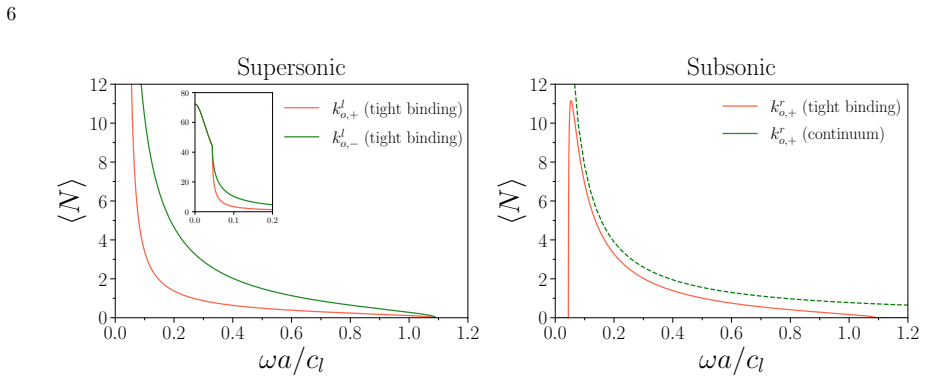
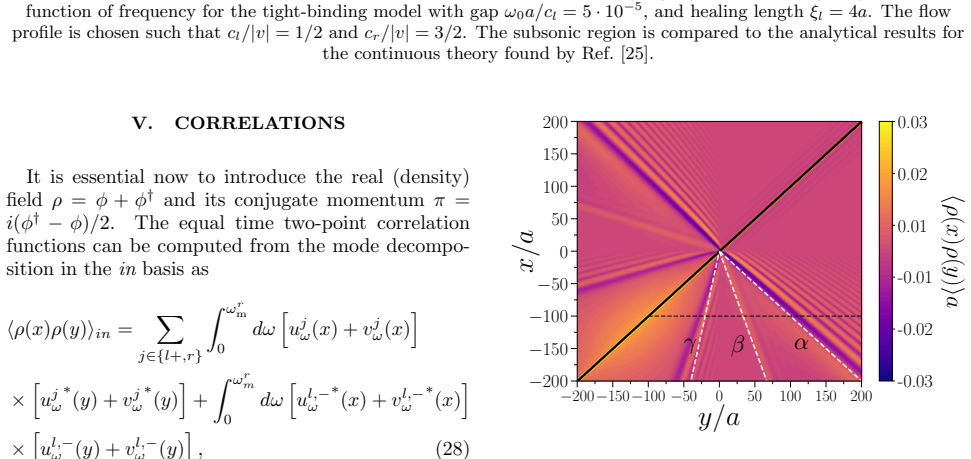
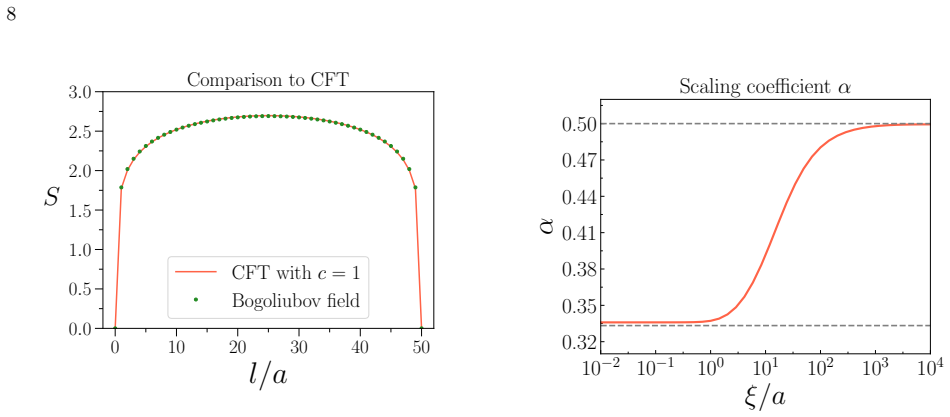
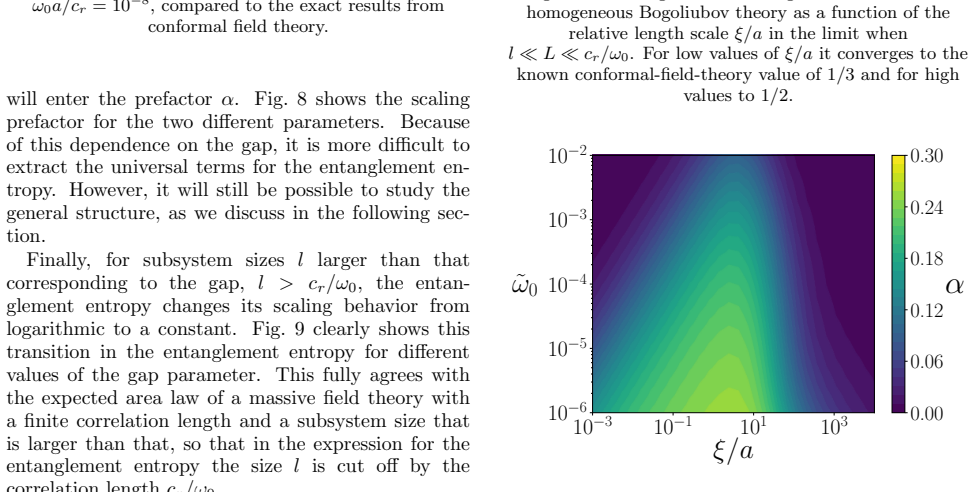
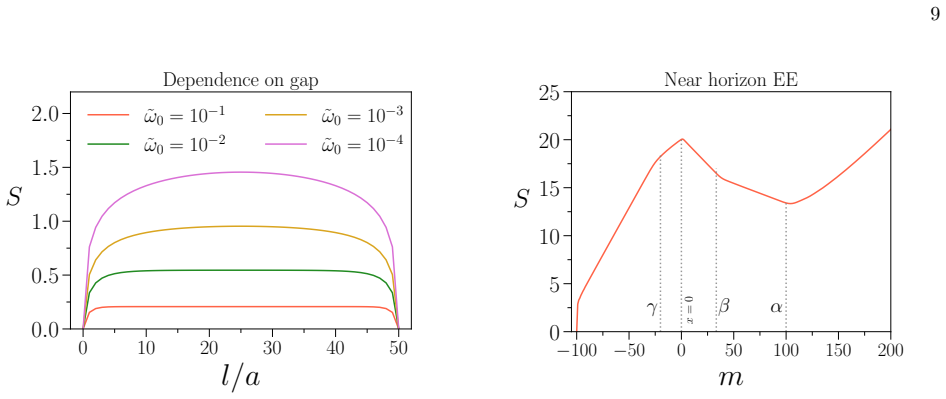
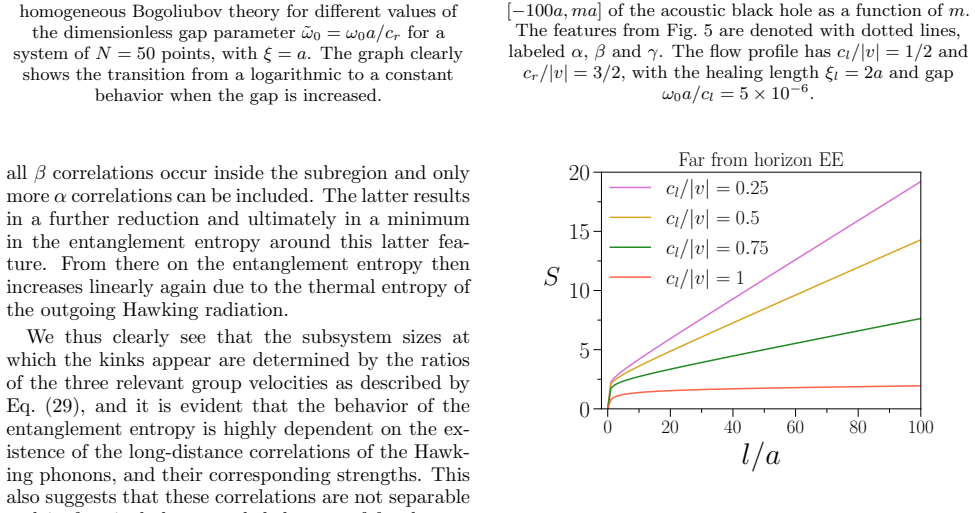
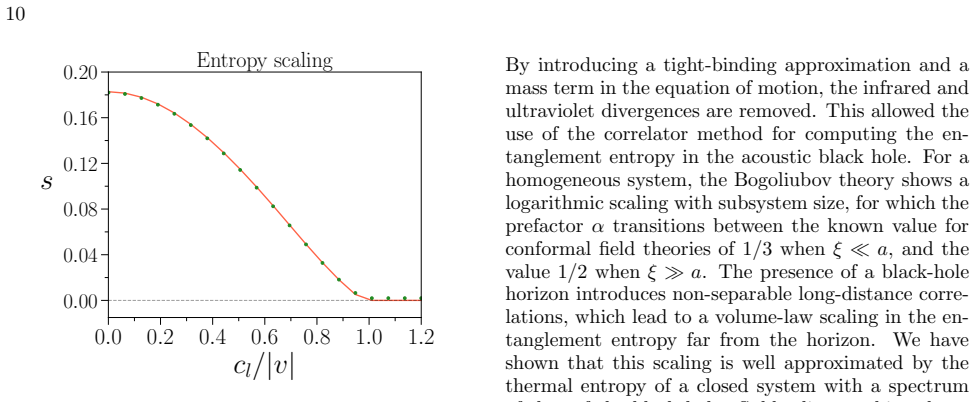
The entanglement entropy of sufficiently large subregions scales linearly with size and thus shows a volume law instead of an area law. The origin of this scaling can be traced back to the non-separable long-distance correlations due to the production of phonon pairs at the horizon. The system is shown to be locally thermal, such that the part of the entanglement entropy scaling with volume is well approximated by the thermal entropy of the outgoing Hawking radiation.
What carries the argument
Numerical computation of entanglement entropy that captures non-separable long-distance correlations generated by phonon pair production at the horizon.
If this is right
- The volume-law scaling replaces the usual area law once subregions exceed a threshold size set by the horizon correlations.
- The volume contribution to entropy equals the thermal entropy of Hawking radiation because the system is locally thermal.
- Long-range correlations from horizon phonon pairs are the mechanism that produces the volume law.
- The numerical method provides a concrete way to extract these correlations in analog black-hole systems.
Where Pith is reading between the lines
- If the same numerical approach works in other analog systems, it could be used to test whether volume-law entanglement appears whenever horizons produce paired excitations.
- The local thermality result suggests that entanglement entropy measurements in cold-atom setups could serve as a proxy for Hawking-radiation properties without needing direct temperature probes.
- The finding that horizon correlations dominate over short-range ones implies that entanglement-based probes of analog gravity may need to focus on scales much larger than the healing length.
Load-bearing premise
The numerical method accurately captures the long-distance non-separable correlations from phonon pair production at the horizon without significant artifacts from finite system size or discretization choices.
What would settle it
A calculation for large subregions that finds entanglement entropy scaling with boundary area rather than volume, or that deviates strongly from the thermal entropy of the outgoing radiation, would falsify the central claim.
Figures
read the original abstract
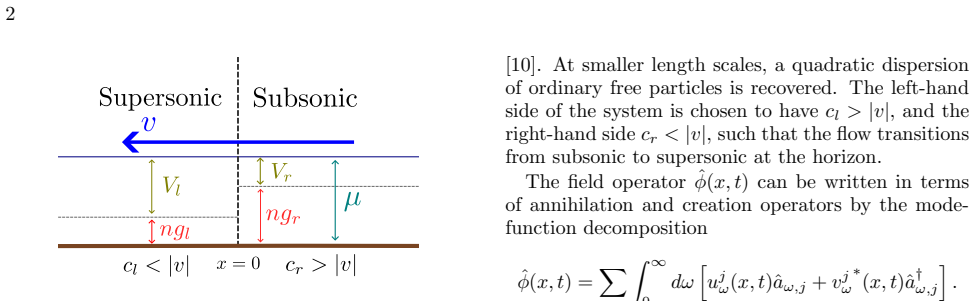
We introduce a method to numerically compute the entanglement entropy of an acoustic black hole. It is shown that the entanglement entropy of sufficiently large subregions scales linearly with size and thus shows a volume law instead of an area law. The origin of this scaling can be traced back to the non-separable long-distance correlations due to the production of phonon pairs at the horizon. The system is shown to be locally thermal, such that the part of the entanglement entropy scaling with volume is well approximated by the thermal entropy of the outgoing Hawking radiation.
Editorial analysis
A structured set of objections, weighed in public.
Referee Report
Summary. The manuscript introduces a numerical method to compute the entanglement entropy (EE) of an acoustic black hole. It claims that EE for sufficiently large subregions exhibits linear (volume-law) scaling rather than area-law scaling, with the origin traced to non-separable long-distance correlations generated by phonon-pair production at the horizon. The system is reported to be locally thermal, allowing the volume-scaling portion of the EE to be approximated by the thermal entropy of the outgoing Hawking radiation.
Significance. If the numerical results are free of artifacts, the work would provide a concrete demonstration that horizon-induced correlations in an analog gravity system can produce volume-law entanglement, offering a controllable setting to study modifications to standard area-law expectations. This could serve as a benchmark for theoretical models connecting Hawking radiation to quantum information measures.
major comments (2)
- [Numerical method (around the description of the covariance matrix and Bogoliubov modes)] The numerical method section provides insufficient detail on discretization scheme, covariance-matrix construction for the Gaussian state, and convergence tests with system size (while holding the horizon region fixed in physical units). Without explicit demonstration that the linear coefficient in the EE scaling converges and is insensitive to periodic-boundary or mode-truncation artifacts, the central claim that the volume law originates from physical long-distance phonon-pair correlations cannot be substantiated.
- [Results section discussing local thermality and thermal-entropy approximation] The assertion that the volume-scaling part of the EE is 'well approximated' by the thermal entropy of outgoing Hawking radiation requires a quantitative comparison (e.g., explicit subtraction or ratio plot) that is independent of the local-thermality definition used to identify the radiation. If local thermality is inferred from the same correlation functions that enter the EE, the approximation risks circularity and must be shown to hold under controlled variations of the cutoff or dispersion relation.
minor comments (1)
- [Abstract and introduction] The qualifier 'sufficiently large subregions' in the abstract and main text should be accompanied by explicit bounds relative to the computational domain size and the horizon scale to allow readers to assess whether the reported regime remains free of finite-size contamination.
Simulated Author's Rebuttal
We thank the referee for the careful reading and constructive comments on our manuscript. We address each major comment below and will revise the manuscript to incorporate additional details and quantitative comparisons as requested.
read point-by-point responses
-
Referee: [Numerical method (around the description of the covariance matrix and Bogoliubov modes)] The numerical method section provides insufficient detail on discretization scheme, covariance-matrix construction for the Gaussian state, and convergence tests with system size (while holding the horizon region fixed in physical units). Without explicit demonstration that the linear coefficient in the EE scaling converges and is insensitive to periodic-boundary or mode-truncation artifacts, the central claim that the volume law originates from physical long-distance phonon-pair correlations cannot be substantiated.
Authors: We agree that the numerical method section would benefit from expanded detail. In the revised manuscript we will add: (i) a precise description of the spatial discretization of the acoustic metric and the associated Bogoliubov mode equations, (ii) the explicit construction of the covariance matrix from the mode functions for the Gaussian state, and (iii) systematic convergence tests in which the total system size is increased while the physical horizon region is held fixed. These tests will include explicit checks of the linear coefficient in the entanglement entropy against periodic-boundary conditions and mode truncation, thereby confirming that the reported volume-law scaling is insensitive to these numerical choices and originates from the physical long-range correlations. revision: yes
-
Referee: [Results section discussing local thermality and thermal-entropy approximation] The assertion that the volume-scaling part of the EE is 'well approximated' by the thermal entropy of outgoing Hawking radiation requires a quantitative comparison (e.g., explicit subtraction or ratio plot) that is independent of the local-thermality definition used to identify the radiation. If local thermality is inferred from the same correlation functions that enter the EE, the approximation risks circularity and must be shown to hold under controlled variations of the cutoff or dispersion relation.
Authors: We acknowledge the need for an explicit, non-circular quantitative comparison. In the revision we will include a new figure or subsection that directly compares the volume-law coefficient extracted from the entanglement entropy with the thermal entropy of the outgoing Hawking radiation (via subtraction or ratio plots). We will also report results under controlled variations of the ultraviolet cutoff and dispersion relation to demonstrate that the approximation remains valid independently of the specific local-thermality criterion employed. revision: yes
Circularity Check
Numerical computation yields volume-law EE without definitional reduction to inputs
full rationale
The paper introduces a numerical method for computing entanglement entropy in an acoustic black hole and reports a volume-law scaling for large subregions, attributing it to non-separable phonon-pair correlations at the horizon. It separately observes local thermality and notes that the volume-scaling portion approximates the thermal entropy of outgoing Hawking radiation. No quoted step reduces the central claims by construction to fitted parameters, self-citations, or ansatzes; the results emerge from the simulation rather than being tautological with the method's definition. The derivation chain is self-contained against external benchmarks of the acoustic metric and covariance-matrix EE formula.
Axiom & Free-Parameter Ledger
axioms (1)
- domain assumption The acoustic black hole model accurately reproduces the quantum field theory behavior near the horizon for phonon modes.
Reference graph
Works this paper leans on
-
[1]
in-basis 1 0 Sl,− l,− Sl,− l,+ =M 0 0 Al,− r,− Al,− r,+ , 0 1 Sl,+ l,− Sl,+ l,+ =M 0 0 Al,+ r,− Al,+ r,+
-
[2]
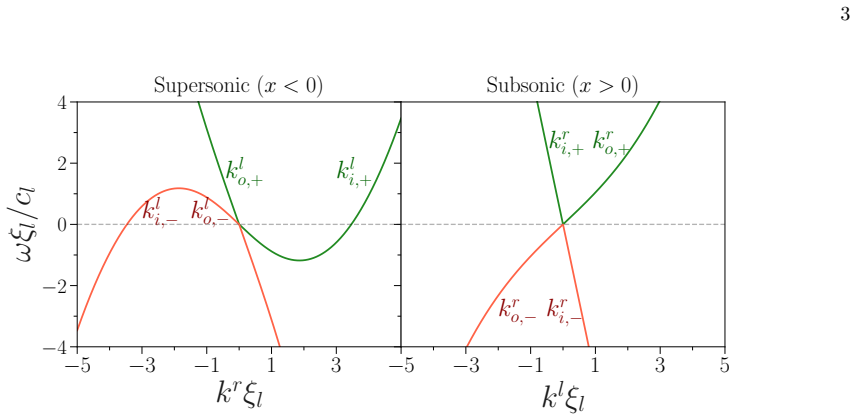
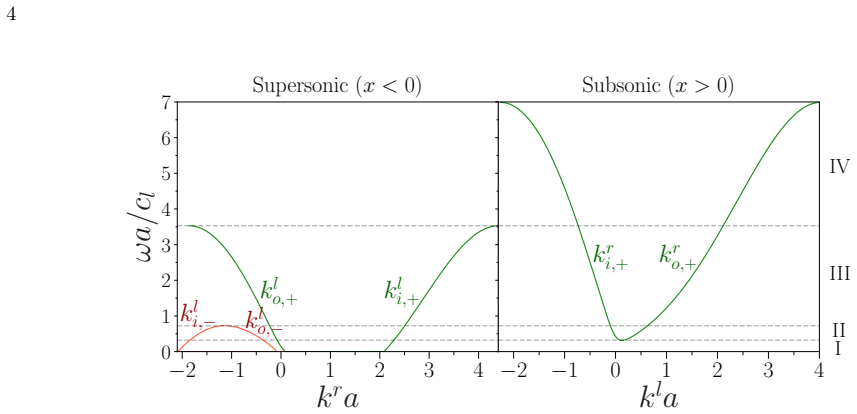
out-basis Sl,− l,− ∗ Sl,+ l,− ∗ 1 0 =M 0 0 Br,− l,− Br,+ l,− , Sl,− l,+ ∗ Sl,+ l,+ ∗ 0 1 =M 0 0 Br,− l,+ Br,+ l,+ . k I II III IV kl i,− ✓ ✓ × × kl i,+ ✓ ✓ ✓ × kl o,− ✓ ✓ ev ev kl o,+ ✓ ✓ ✓ ev kr i,− × × × × kr i,+ × ✓ ✓ ✓ kr o,− ev ev ev ev kr o,+ ev ✓ ✓ ✓ Table I: A table that labels which ...
-
[3]
in-basis 1 0 Sl,− l,− Sl,− l,+ =M 0 0 Al,− r,− Sl,− r,+ , 0 1 Sl,+ l,− Sl,+ l,+ =M 0 0 Al,+ r,− Sl,+ r,+ , 0 0 Sr,+ l,− Sr,+ l,+ =M 0 1 Ar,+ r,− Sr,+ r,+
-
[4]
out-basis Sl,− l,− ∗ Sl,+ l,− ∗ 1 0 =M 0 Sr,+ l,− ∗ Br,− l,− 0 , Sl,− l,+ ∗ Sl,+ l,+ ∗ 0 1 =M 0 Sr,+ l,+ ∗ Br,− l,+ 0 , Sl,− r,+ ∗ Sl,+ r,+ ∗ 0 0 =M 0 Sr,+ r,+ ∗ Br,− r,+ 1 . C. Regime III Regime III has two propagating modes in the su- personic and subsonic re...
-
[5]
in-basis 0 1 Al,+ l,− Sl,+ l,+ =M 0 0 Al,+ r,− Sl,+ r,+ , 0 0 Ar,+ l,− Sr,+ l,+ =M 0 1 Ar,+ r,− Sr,+ r,+
-
[6]
out-basis 0 Sl,+ l,+ ∗ Bl,− l,+ 1 =M 0 Sr,+ l,+ ∗ Br,− l,+ 0 , 0 Sl,+ r,+ ∗ Bl,− r,+ 0 =M 0 Sr,+ r,+ ∗ Br,− r,+ 1 . 12 D. Regime IV Finally, in the last regime there are only two real solutions left in the subsonic region. This leads to only one ingoing mode with momentumk r i,+ and one outgo...
-
[7]
in-basis 0 0 Ar,+ l,− Ar,+ l,+ =M 0 1 Ar,+ r,− Sr,+ r,+
-
[8]
out-basis 0 0 Bl,− r,+ Bl,+ r,+ =M 0 Sr,+ r,+ ∗ Br,− r,+ 1 E. Entropy computation As discussed, the thermal entropy density can be computed by considering a finite-size system with pe- riodic boundary conditions, for which the right mov- ing modes are occupied according to Eq. (27). We consider only the subsonic region. How...
-
[9]
J. D. Bekenstein, Phys. Rev. D7, 2333 (1973)
1973
-
[10]
S. W. Hawking, Communications in Mathematical Physics43, 199 (1975)
1975
-
[11]
Susskind, Journal of Mathematical Physics36, 6377–6396 (1995)
L. Susskind, Journal of Mathematical Physics36, 6377–6396 (1995)
1995
-
[12]
Dimensional Reduction in Quantum Gravity
G. ’t Hooft, (2009), arXiv:gr-qc/9310026 [gr-qc]
work page internal anchor Pith review Pith/arXiv arXiv 2009
-
[13]
Susskind, Nature Phys.2, 665 (2006)
L. Susskind, Nature Phys.2, 665 (2006)
2006
-
[14]
Bombelli, R
L. Bombelli, R. K. Koul, J. Lee, and R. D. Sorkin, Phys. Rev. D34, 373 (1986)
1986
-
[15]
’t Hooft, Nucl
G. ’t Hooft, Nucl. Phys. B256, 727 (1985)
1985
-
[16]
Strominger and C
A. Strominger and C. Vafa, Physics Letters B379, 99–104 (1996)
1996
-
[17]
S. Ryu and T. Takayanagi, Physical Review Letters 96, 10.1103/physrevlett.96.181602 (2006)
-
[18]
W. G. Unruh, Phys. Rev. Lett.46, 1351 (1981)
1981
-
[19]
S. Weinfurtner, E. W. Tedford, M. C. J. Penrice, W. G. Unruh, and G. A. Lawrence, Physical Review Letters106, 10.1103/physrevlett.106.021302 (2011)
-
[20]
T. A. Jacobson and G. E. Volovik, Physical Review D58, 10.1103/physrevd.58.064021 (1998)
-
[21]
Leonhardt and P
U. Leonhardt and P. Piwnicki, Phys. Rev. Lett.84, 822 (2000)
2000
-
[23]
Giovanazzi, Physical Review Letters94, 10.1103/physrevlett.94.061302 (2005)
S. Giovanazzi, Physical Review Letters94, 10.1103/physrevlett.94.061302 (2005)
-
[24]
Elazar, V
M. Elazar, V. Fleurov, and S. Bar-Ad, Phys. Rev. A 86, 063821 (2012)
2012
-
[25]
G. E. Volovik, JETP Letters104, 645–648 (2016)
2016
-
[26]
D. D. Solnyshkov, H. Flayac, and G. Malpuech, Physi- cal Review B84, 10.1103/physrevb.84.233405 (2011)
-
[28]
A. L. Bassant, M. E. Y. Regout, J. S. Harms, and R. A. Duine, Phys. Rev. B110, 094441 (2024)
2024
-
[29]
Surpassing the en- ergy resolution limit with ferromagnetic torque sensors,
A. Rold´ an-Molina, A. S. Nunez, and R. Duine, Physical Review Letters118, 10.1103/phys- revlett.118.061301 (2017)
-
[30]
Steinhauer, Nature Physics12, 959–965 (2016)
J. Steinhauer, Nature Physics12, 959–965 (2016)
2016
-
[31]
C. C. H. Ribeiro, S.-S. Baak, and U. R. Fischer, Phys- ical Review D105, 10.1103/physrevd.105.124066 (2022)
-
[32]
Steinhauer, Nature Physics10, 864–869 (2014)
J. Steinhauer, Nature Physics10, 864–869 (2014)
2014
-
[33]
A. Recati, N. Pavloff, and I. Carusotto, Physical Re- view A80, 10.1103/physreva.80.043603 (2009)
-
[34]
Serafini, F
A. Serafini, F. Illuminati, and S. D. Siena, Journal of Physics B: Atomic, Molecular and Optical Physics 37, L21–L28 (2003)
2003
-
[35]
Srednicki, Physical Review Letters71, 666–669 (1993)
M. Srednicki, Physical Review Letters71, 666–669 (1993)
1993
-
[36]
H. T. C. Stoof, K. B. Gubbels, and D. B. M. Dick- erscheid,Ultracold Quantum Fields, Theoretical and Mathematical Physics (Springer, Berlin, Germany, 2009)
2009
-
[37]
Carusotto, S
I. Carusotto, S. Fagnocchi, A. Recati, R. Balbinot, and A. Fabbri, New Journal of Physics10, 103001 (2008)
2008
-
[38]
Belfiglio, S
A. Belfiglio, S. M. Chandran, O. Luongo, and S. Mancini, Phys. Rev. D111, 024013 (2025)
2025
-
[39]
Huang, X
S. Huang, X. Fang, and J. Jing, Gen. Rel. Grav.50, 70 (2018)
2018
-
[40]
S. S. Kumar and S. Shankaranarayanan, The Euro- pean Physical Journal C76, 10.1140/epjc/s10052- 016-4241-3 (2016)
-
[41]
Melkani, Physical Review Research5, 10.1103/physrevresearch.5.023035 (2023)
A. Melkani, Physical Review Research5, 10.1103/physrevresearch.5.023035 (2023)
-
[42]
Casini and M
H. Casini and M. Huerta, Journal of Physics A: Math- ematical and Theoretical42, 504007 (2009)
2009
-
[43]
Williamson, American Journal of Mathematics58, 141 (1936)
J. Williamson, American Journal of Mathematics58, 141 (1936)
1936
-
[44]
Calabrese and J
P. Calabrese and J. Cardy, Journal of Physics A: Mathematical and Theoretical42, 504005 (2009)
2009
-
[45]
M. K. Parikh and F. Wilczek, Physical Review Letters 85, 5042–5045 (2000)
2000
-
[46]
Del Porro, S
F. Del Porro, S. Liberati, and M. Schneider, Comptes Rendus. Physique25, 1–27 (2025)
2025
-
[47]
T. F. Demarie, (2012), arXiv:1209.2748 [quant-ph]
work page internal anchor Pith review Pith/arXiv arXiv 2012
-
[48]
L. Liao, E. C. I. van der Wurff, D. van Oosten, and H. T. C. Stoof, Phys. Rev. A99, 023850 (2019)
2019
-
[49]
S. M. Chandran and U. R. Fischer, (2026), arXiv:2604.02075 [gr-qc]
work page internal anchor Pith review Pith/arXiv arXiv 2026
discussion (0)
Sign in with ORCID, Apple, or X to comment. Anyone can read and Pith papers without signing in.