Scientific Machine Learning for Engine Health Management and Remaining Useful Life Prediction
Pith reviewed 2026-06-29 08:23 UTC · model grok-4.3
The pith
A multi-task model with shared encoder jointly predicts turbine temperatures, delta, and remaining useful life along with validated prediction intervals.
A machine-rendered reading of the paper's core claim, the machinery that carries it, and where it could break.
Core claim
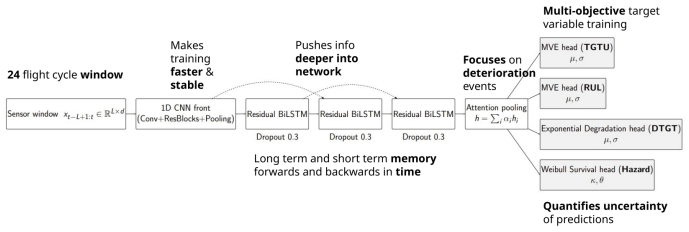
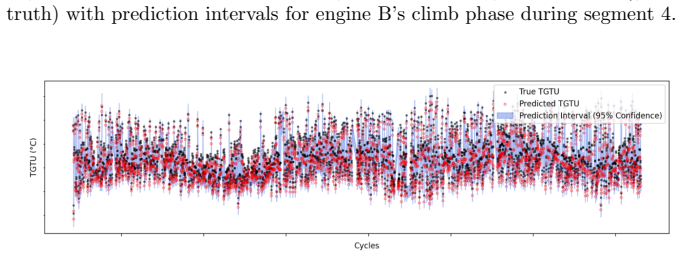
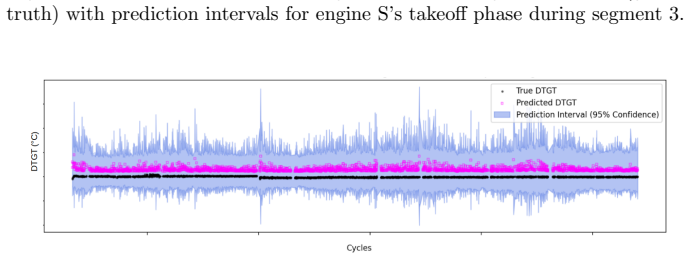
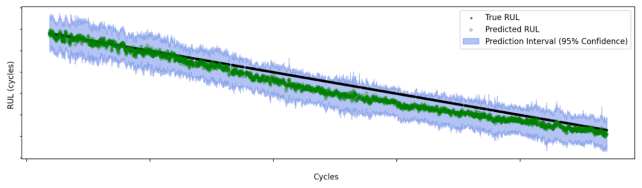
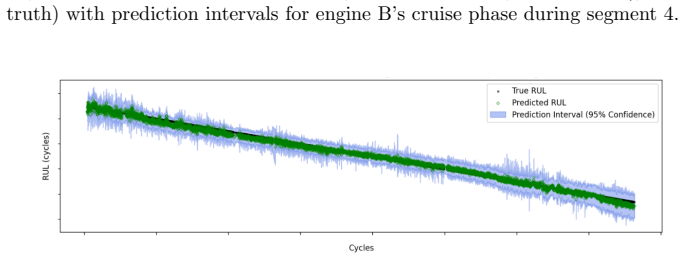
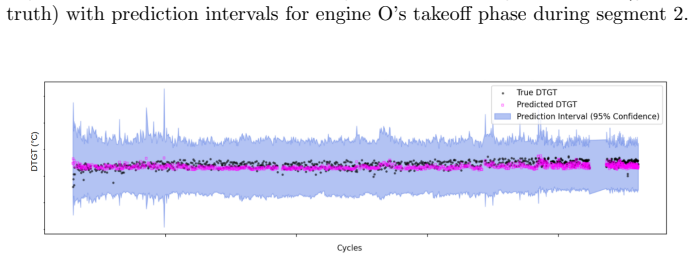
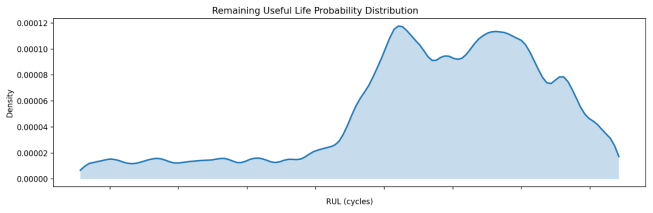
A shared sequence encoder built from a convolutional front-end, residual bidirectional LSTM layers, and attention pooling extracts features from heterogeneous time series that are then fed to task-specific heads; mean-variance estimation supplies prediction intervals for TGTU, DTGT, and RUL whose empirical coverage is checked both overall and when data are split by flight phase and maintenance segment.
What carries the argument
Shared sequence encoder (convolutional front-end with residual bidirectional LSTM layers and attention pooling) that supplies features to task-specific heads using mean-variance estimation for probabilistic regression.
If this is right
- Joint training produces predictions that remain consistent across the three related engine health quantities.
- Evaluated prediction intervals allow maintenance decisions that account for uncertainty rather than relying on point estimates alone.
- Performance differences appear when results are broken down by flight phase and maintenance segment, showing the value of context-aware evaluation.
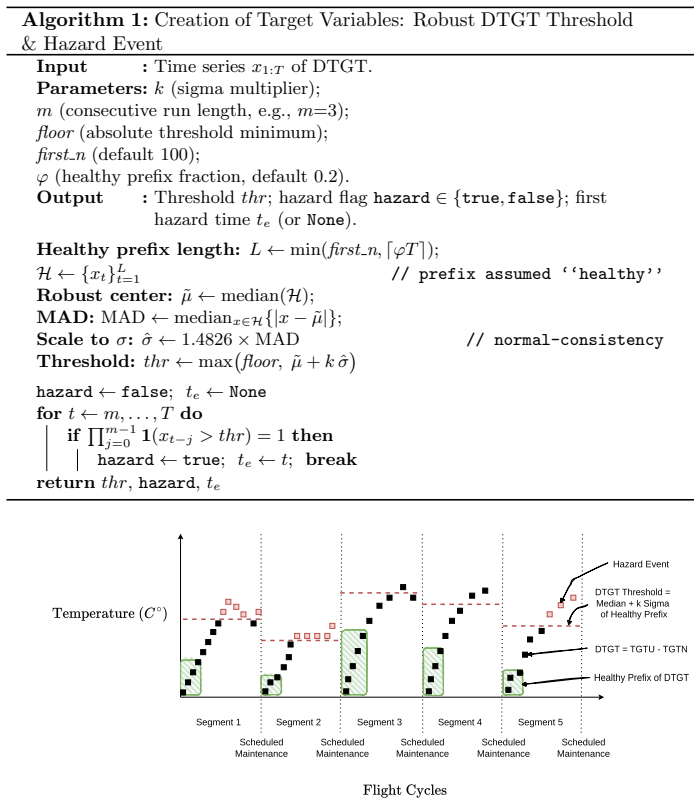
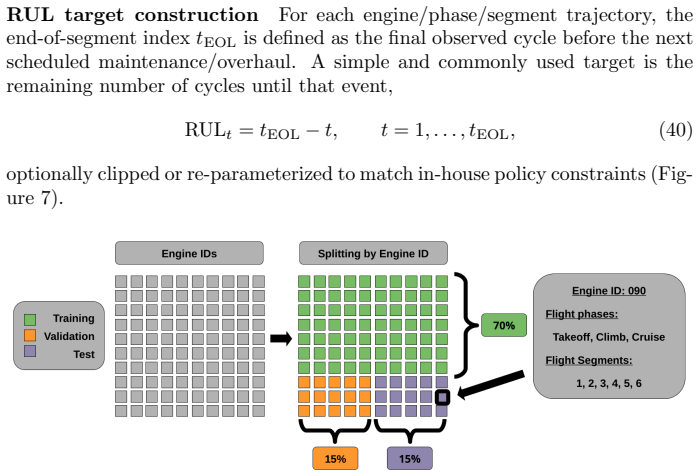
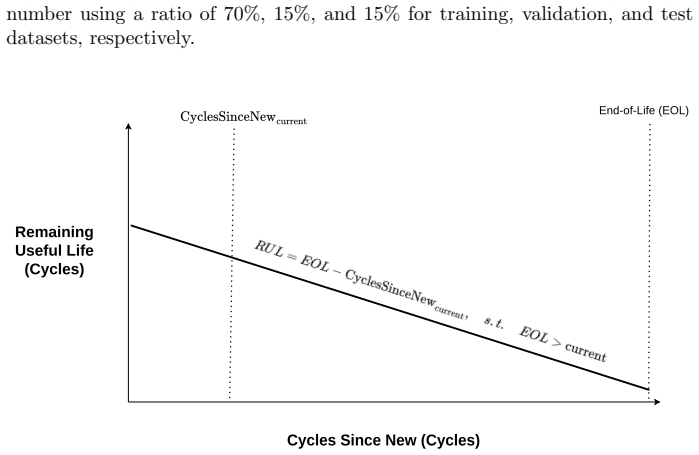
- A small number of practitioner parameters let the same framework adapt to different company rules for thresholds and target construction.
Where Pith is reading between the lines
- Adding new task heads for additional engine parameters could reuse the same encoder without full retraining.
- The stratified results suggest testing whether phase-specific encoders would reduce error further on non-stationary segments.
- The tunable design could support direct comparison against purely physics-based or hybrid models on the same fleet data.
Load-bearing premise
One shared encoder can learn features good enough for accurate joint prediction of the three tasks from varied real-world engine data without needing large task-specific changes to the architecture.
What would settle it
If the prediction interval coverage probability on new fleet data falls well below the nominal level, especially in particular flight phases or maintenance segments, the uncertainty estimates would be shown to be unreliable.
Figures
read the original abstract
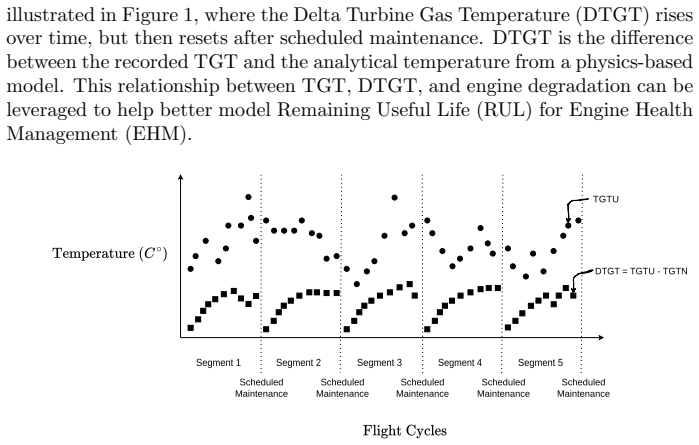
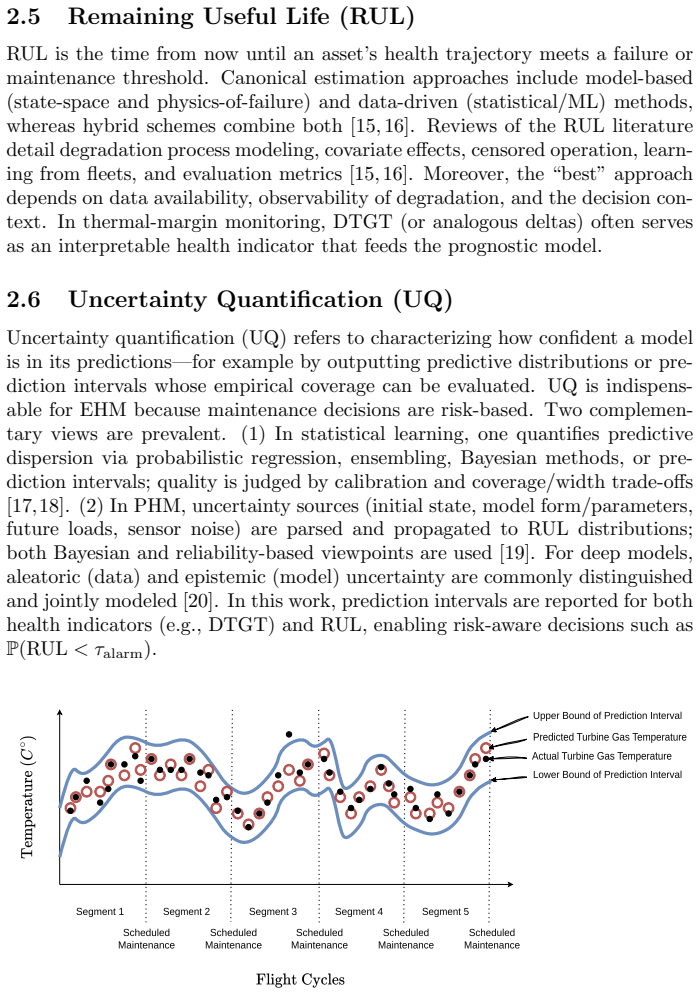
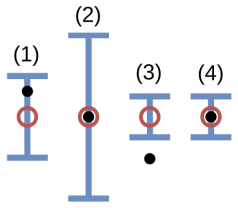
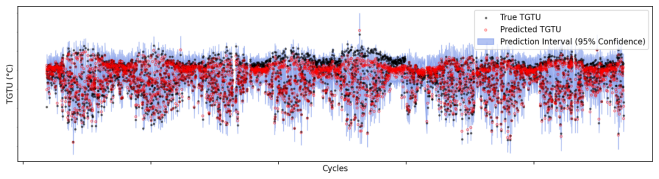
Engine Health Management (EHM) depends on reliable forecasting of Remaining Useful Life (RUL) and on tracking thermal indicators such as turbine gas temperature (TGT). In practice, real-world fleet data are heterogeneous and non-stationary, and point predictions alone are insufficient for risk-aware maintenance decisions. This paper presents a multi-task scientific machine learning framework for turbine prognostics that jointly predicts turbine gas temperature untrimmed (TGTU), Delta Turbine Gas Temperature (DTGT), and RUL, with quantified uncertainty in the form of prediction intervals whose empirical coverage is evaluated. A shared sequence encoder (convolutional front-end with residual bidirectional LSTM layers and attention pooling) feeds task-specific heads, including mean--variance estimation for probabilistic regression and, optionally, a survival head for threshold-based event modeling. The framework is designed to be tunable via a small set of practitioner-facing parameters (e.g., DTGT thresholding rules and RUL target construction) so that deployment can align with in-house policies and proprietary criteria. The predictive performance of the proposed framework is evaluated using both point and interval metrics, including mean absolute error (MAE), prediction interval coverage probability (PICP), mean prediction interval width (MPIW), and the coverage--width criterion (CWC). Results are reported both in aggregate and stratified by flight phase and maintenance segment to highlight operational-context effects and to support uncertainty-aware monitoring.
Editorial analysis
A structured set of objections, weighed in public.
Referee Report
Summary. The manuscript presents a multi-task scientific machine learning framework for turbine engine prognostics. It employs a shared sequence encoder (convolutional front-end, residual bidirectional LSTM layers, and attention pooling) that feeds task-specific heads for joint prediction of turbine gas temperature untrimmed (TGTU), Delta Turbine Gas Temperature (DTGT), and Remaining Useful Life (RUL). Uncertainty is quantified via mean-variance estimation for prediction intervals (with optional survival modeling), and performance is assessed using point metrics (MAE) and interval metrics (PICP, MPIW, CWC) on stratified real-world fleet data. The framework is designed to be tunable via practitioner parameters such as DTGT thresholding and RUL target construction.
Significance. If the reported results demonstrate that the shared encoder yields accurate joint predictions with well-calibrated intervals on heterogeneous, non-stationary fleet data, the work would offer a practical, tunable approach to uncertainty-aware engine health management. The explicit focus on operational stratification and alignment with in-house policies is a positive feature for deployment relevance. However, the absence of any numerical results, ablation studies, baseline comparisons, or derivation details in the manuscript text prevents a concrete assessment of whether these benefits are realized.
major comments (1)
- [Abstract] Abstract: The central claim that the framework 'delivers reliable joint predictions with proper interval coverage' cannot be evaluated because the text supplies no numerical results, tables, figures, or ablation studies for MAE, PICP, MPIW, or CWC (aggregate or stratified). Without these data the soundness of the multi-task architecture and the shared-encoder assumption remains untestable.
Simulated Author's Rebuttal
We thank the referee for the constructive feedback highlighting the need for concrete numerical evidence. We address the single major comment below.
read point-by-point responses
-
Referee: [Abstract] Abstract: The central claim that the framework 'delivers reliable joint predictions with proper interval coverage' cannot be evaluated because the text supplies no numerical results, tables, figures, or ablation studies for MAE, PICP, MPIW, or CWC (aggregate or stratified). Without these data the soundness of the multi-task architecture and the shared-encoder assumption remains untestable.
Authors: We agree that the manuscript as currently written does not supply the specific numerical values, tables, figures, ablation studies, or baseline comparisons needed to evaluate the central claims. Although the abstract states that results are reported using the listed metrics (both aggregate and stratified), the body text does not include them. In the revised version we will add a dedicated Results section containing the MAE, PICP, MPIW, and CWC values, together with ablations on the shared encoder, baseline comparisons, and any derivation details for the mean-variance and survival heads. The abstract will be updated to reference these additions if necessary. revision: yes
Circularity Check
No significant circularity detected
full rationale
The paper describes a multi-task framework with a shared convolutional-residual-biLSTM-attention encoder feeding mean-variance and optional survival heads for joint TGTU/DTGT/RUL prediction and interval evaluation via PICP/MPIW/CWC. No equations, fitted parameters, or derivation steps are shown that reduce any reported prediction to a quantity defined by the same fitted inputs. The architecture is presented as a tunable design choice evaluated on stratified fleet data rather than derived from self-referential definitions or prior self-citations. The central claims rest on empirical performance metrics and practitioner parameters, remaining self-contained without reduction to tautology.
Axiom & Free-Parameter Ledger
free parameters (2)
- DTGT thresholding rules
- RUL target construction
axioms (1)
- domain assumption A single shared sequence encoder can extract features adequate for all three downstream tasks (TGTU, DTGT, RUL) from heterogeneous fleet data.
Reference graph
Works this paper leans on
-
[1]
N.-H. Kim, D. An, and J.-H. Choi,Prognostics and Health Management of Engineering Systems: An Introduction. Cham: Springer, 2017
2017
-
[2]
Gas turbine engine health management: Past, present, and future trends,
A. J. Volponi, “Gas turbine engine health management: Past, present, and future trends,”Journal of Engineering for Gas Turbines and Power, vol. 136, no. 5, p. 051201, 2014. [Online]. Available: https://asmedigitalcollection.asme.org/gasturbinespower/article/136/5/ 051201/373592/Gas-Turbine-Engine-Health-Management-Past-Present
2014
-
[3]
A review on gas turbine gas-path diagnostics: State-of-the-art methods, challenges and opportunities,
A. D. Fentaye, A. T. Baheta, S. I. Gilani, and K. G. Kyprianidis, “A review on gas turbine gas-path diagnostics: State-of-the-art methods, challenges and opportunities,”Aerospace, vol. 6, no. 7, p. 83, 2019. [Online]. Available: https://www.mdpi.com/2226-4310/6/7/83
2019
-
[4]
M. Tahan, E. Tsoutsanis, M. Muhammad, and Z. A. Abdul Karim, “Performance-based health monitoring, diagnostics and prognostics for condition-based maintenance of gas turbines: A review,”Applied Energy, vol. 198, pp. 122–144, 2017. [Online]. Available: https: //doi.org/10.1016/j.apenergy.2017.04.048 35
-
[5]
An assessment of weighted-least-squares-based gas path analysis,
D. L. Doel, “An assessment of weighted-least-squares-based gas path analysis,”Journal of Engineering for Gas Turbines and Power, vol. 116, no. 2, pp. 366–373, 1994. [Online]. Available: https: //asmedigitalcollection.asme.org/gasturbinespower/article/116/2/366/40 8351/An-Assessment-of-Weighted-Least-Squares-Based-Gas
1994
-
[6]
A comparison of filtering approaches for aircraft engine health estimation,
D. Simon, “A comparison of filtering approaches for aircraft engine health estimation,”Aerospace Science and Technology, vol. 12, no. 4, pp. 276–284,
-
[7]
Available: https://doi.org/10.1016/j.ast.2007.06.002
[Online]. Available: https://doi.org/10.1016/j.ast.2007.06.002
-
[8]
Three ways to estimate remaining useful life: Predictive maintenance with MATLAB,
MathWorks, “Three ways to estimate remaining useful life: Predictive maintenance with MATLAB,” Ebook, The MathWorks, Inc., 2022. [Online]. Available: https://www.mathworks.com/content/dam/mathwo rks/ebook/estimating-remaining-useful-life-ebook.pdf
2022
-
[9]
Introduction (predictive maintenance, part 1),
M. Ulusoy, “Introduction (predictive maintenance, part 1),” Online video, MathWorks, dec 2018. [Online]. Available: https://www.mathworks.com/ videos/predictive-maintenance-part-1-introduction-1545827554336.html
2018
-
[10]
What is predictive maintenance?
MathWorks, “What is predictive maintenance?” MathWorks Discovery article, 2025, accessed: 2025-12-30. [Online]. Available: https: //www.mathworks.com/discovery/predictive-maintenance.html
2025
-
[11]
Rul estimation using rul estimator models,
——, “Rul estimation using rul estimator models,” MATLAB Predictive Maintenance Toolbox documentation, 2025, accessed: 2025-12-30. [Online]. Available: https://www.mathworks.com/help/predmaint/ug/rul-estimat ion-using-rul-estimator-models.html
2025
-
[12]
Overcoming four common obstacles to predictive maintenance with MATLAB and Simulink,
——, “Overcoming four common obstacles to predictive maintenance with MATLAB and Simulink,” White paper, 2018. [Online]. Available: https://www.mathworks.com/content/dam/mathworks/white-paper/gat ed/predictive-maintenance-challenges-whitepaper.pdf
2018
-
[13]
I. Yilmaz, “Evaluation of the relationship between exhaust gas temperature and operational parameters in cfm56-7b engines,”Proceedings of the Institution of Mechanical Engineers, Part G: Journal of Aerospace Engineering, vol. 223, no. 4, pp. 433–440, 2009. [Online]. Available: https://doi.org/10.1243/09544100JAERO474
-
[14]
Temper—a gas-path analysis tool for commercial jet engines,
D. L. Doel, “Temper—a gas-path analysis tool for commercial jet engines,”Journal of Engineering for Gas Turbines and Power, vol. 116, no. 1, pp. 82–89, 1994. [Online]. Available: https: //asmedigitalcollection.asme.org/gasturbinespower/article/116/1/82/407 947/TEMPER-A-Gas-Path-Analysis-Tool-for-Commercial-Jet
1994
-
[15]
Data-driven exhaust gas temperature baseline predictions for aeroengine based on machine learning algorithms,
Z. Wang and Y. Zhao, “Data-driven exhaust gas temperature baseline predictions for aeroengine based on machine learning algorithms,” Aerospace, vol. 10, no. 1, p. 17, 2023. [Online]. Available: https: //www.mdpi.com/2226-4310/10/1/17 36
2023
-
[16]
Rotating machinery prognostics: State of the art, challenges and opportunities,
A. Heng, S. Zhang, A. C. P. Tan, and J. Mathew, “Rotating machinery prognostics: State of the art, challenges and opportunities,”Mechanical Systems and Signal Processing, vol. 23, no. 3, pp. 724–739, 2009. [Online]. Available: https://www.sciencedirect.com/science/article/pii/S088832700 8001968
2009
-
[17]
Remaining useful life estimation – a review on the statistical data driven approaches,
X.-S. Si, W. Wang, C.-H. Hu, and D.-H. Zhou, “Remaining useful life estimation – a review on the statistical data driven approaches,”IEEE Trans. Systems, Man, and Cybernetics, Part C, vol. 213, no. 1, pp. 1248–1263, 2011. [Online]. Available: https://www.sciencedirect.com/science/article/pii/S0377221710007903
2011
-
[18]
Comprehensive Review of Neural Network-Based Prediction Intervals and New Advances,
A. Khosravi, S. Nahavandi, D. Creighton, and A. A. Karr, “Comprehensive Review of Neural Network-Based Prediction Intervals and New Advances,” IEEE Transactions on Neural Networks, vol. 22, no. 9, pp. 1341–1356,
-
[19]
Available: https://ieeexplore.ieee.org/document/5995614
[Online]. Available: https://ieeexplore.ieee.org/document/5995614
-
[20]
A review of uncertainty quantification in deep learning: Techniques, applications and challenges,
M. Abdaret al., “A review of uncertainty quantification in deep learning: Techniques, applications and challenges,”Information Fusion, vol. 76, pp. 243–297, 2021. [Online]. Available: https://www.sciencedirect.com/scienc e/article/pii/S1566253521001081
2021
-
[21]
Significance, interpretation, and quantification of uncertainty in prognostics and remaining useful life prediction,
S. Sankararaman, “Significance, interpretation, and quantification of uncertainty in prognostics and remaining useful life prediction,” Mechanical Systems and Signal Processing, vol. 52–53, pp. 228–247, 2015. [Online]. Available: https://www.sciencedirect.com/science/article/pii/S0 888327014002052
2015
-
[22]
Multi-task learning using uncertainty to weigh losses for scene geometry and semantics,
A. Kendall, Y. Gal, and R. Cipolla, “Multi-task learning using uncertainty to weigh losses for scene geometry and semantics,” inProc. CVPR, 2018, pp. 7482–7491
2018
-
[23]
Can you trust your model’s uncertainty? evaluating predictive uncertainty under dataset shift,
Y. Ovadia, E. Fertig, J. Ren, Z. Nado, D. Sculley, S. Nowozin, J. Dillon, B. Lakshminarayanan, and J. Snoek, “Can you trust your model’s uncertainty? evaluating predictive uncertainty under dataset shift,” inAdvances in Neural Information Processing Systems, vol. 32, 2019. [Online]. Available: https://proceedings.neurips.cc/paper/2019/hash/855 8cb408c1d76...
2019
-
[24]
Journal of the American Statistical Association 102, 359–378
T. Gneiting and A. E. Raftery, “Strictly proper scoring rules, prediction, and estimation,”Journal of the American Statistical Association, vol. 102, no. 477, pp. 359–378, 2007. [Online]. Available: https://doi.org/10.1198/016214506000001437
-
[25]
A Gentle Introduction to Conformal Prediction and Distribution-Free Uncertainty Quantification
A. N. Angelopoulos and S. Bates, “A gentle introduction to conformal prediction and distribution-free uncertainty quantification,” 2022. [Online]. Available: https://arxiv.org/abs/2107.07511 37
work page internal anchor Pith review Pith/arXiv arXiv 2022
-
[26]
Turbofan Engine Degradation Simulation Data Set (C-MAPSS),
A. Saxena and K. Goebel, “Turbofan Engine Degradation Simulation Data Set (C-MAPSS),” NASA Ames Prognostics Data Repository, Moffett Field, CA, USA, Tech. Rep., 2008
2008
-
[27]
S. B. Giduthuri, P. Zhao, and X. Li, “Deep convolutional neural network based regression approach for estimation of remaining useful life,” in International Conference on Database Systems for Advanced Applications (DASFAA). Cham: Springer International Publishing, 2016, pp. 214–228. [Online]. Available: https://link.springer.com/chapter/10.1007/978-3-319 ...
-
[28]
Remaining useful life estimation in prognostics using deep convolution neural networks,
X. Li, Q. Ding, and J.-Q. Sun, “Remaining useful life estimation in prognostics using deep convolution neural networks,”Reliability Engineering & System Safety, vol. 172, pp. 1–11, 2018. [Online]. Available: https://doi.org/10.1016/j.ress.2017.11.021
-
[29]
Inception-based deep convolutional neural network for remaining useful life estimation of turbofan engines,
N. DeVol, C. Saldana, and K. Fu, “Inception-based deep convolutional neural network for remaining useful life estimation of turbofan engines,” inProceedings of the Annual Conference of the PHM Society, vol. 13, no. 1, 2021. [Online]. Available: http://papers.phmsociety.org/index.php/ phmconf/article/view/3109
2021
-
[30]
A stacked deep convolutional neural network to predict the remaining useful life of a turbofan engine,
D. Solis-Martin, J. Gal´ an-P´ aez, and J. Borrego-Diaz, “A stacked deep convolutional neural network to predict the remaining useful life of a turbofan engine,” 2021. [Online]. Available: https://arxiv.org/pdf/2111.1 2689
2021
-
[31]
Remaining useful life prognosis for turbofan engine using explainable deep neural networks with dimensionality reduction,
C. W. Hong, C. Lee, K. Lee, M. S. Ko, D. E. Kim, and K. Hur, “Remaining useful life prognosis for turbofan engine using explainable deep neural networks with dimensionality reduction,”Sensors, vol. 20, no. 22, p. 6626,
-
[32]
Available: https://www.mdpi.com/1424-8220/20/22/6626
[Online]. Available: https://www.mdpi.com/1424-8220/20/22/6626
-
[33]
A remaining useful life prognosis of turbofan engine using temporal and spatial feature fusion,
C. Peng, Y. Chen, Q. Chen, Z. Tang, L. Li, and W. Gui, “A remaining useful life prognosis of turbofan engine using temporal and spatial feature fusion,”Sensors, vol. 21, no. 2, p. 418, 2021. [Online]. Available: https://www.mdpi.com/1424-8220/21/2/418
2021
-
[34]
An enhanced CNN-LSTM remaining useful life prediction model for aircraft engine with attention mechanism,
H. Li, Z. Wang, and Z. Li, “An enhanced CNN-LSTM remaining useful life prediction model for aircraft engine with attention mechanism,” PeerJ Computer Science, vol. 8, p. e1084, 2022. [Online]. Available: https://peerj.com/articles/cs-1084.pdf
2022
-
[35]
P. R. d. O. da Costa, A. Akcay, Y. Zhang, and U. Kaymak, “Attention and long short-term memory network for remaining useful lifetime predictions of turbofan engine degradation,”International Journal of Prognostics and Health Management, vol. 10, p. 034, 2019, alternate URL: https://pure.tue.nl/ws/portalfiles/portal/146883988/ijphm 19 034.pdf. [Online]. Av...
-
[36]
Spatial correlation and temporal attention-based LSTM for remaining useful life prediction of turbofan engine,
H. Tian, L. Yang, and B. Ju, “Spatial correlation and temporal attention-based LSTM for remaining useful life prediction of turbofan engine,”Measurement, vol. 214, p. 112816, 2023. [Online]. Available: https: //www.sciencedirect.com/science/article/abs/pii/S0263224123003809
2023
-
[37]
Y. Qin, N. Cai, C. Gao, Y. Zhang, Y. Cheng, and X. Chen, “Remaining useful life prediction using temporal deep degradation network for complex machinery with attention-based feature extraction,” 2022. [Online]. Available: https://arxiv.org/abs/2202.10916
-
[38]
A deep-learning method for remaining useful life prediction of power machinery via dual-attention mechanism,
F. Wang, A. Liu, C. Qu, R. Xiong, and L. Chen, “A deep-learning method for remaining useful life prediction of power machinery via dual-attention mechanism,”Sensors, vol. 25, no. 2, p. 497, 2025. [Online]. Available: https://www.mdpi.com/1424-8220/25/2/497
2025
-
[39]
Remaining useful life prediction for turbofan engine using SAE-TCN model,
X. Liu, L. Xiong, Y. Zhang, and C. Luo, “Remaining useful life prediction for turbofan engine using SAE-TCN model,”Aerospace, vol. 10, no. 8, p. 715, 2023. [Online]. Available: https://www.mdpi.com/2226-4310/10/8/7 15
2023
-
[40]
A two-stage attention-based hierarchical transformer for turbofan engine remaining useful life prediction,
Z. Fan, W. Li, and K.-C. Chang, “A two-stage attention-based hierarchical transformer for turbofan engine remaining useful life prediction,”Sensors, vol. 24, no. 3, p. 824, 2024. [Online]. Available: https://www.mdpi.com/1424-8220/24/3/824
2024
-
[41]
A. Vaswani, N. Shazeer, N. Parmar, J. Uszkoreit, L. Jones, A. N. Gomez, L. Kaiser, and I. Polosukhin, “Attention is all you need,” inAdvances in Neural Information Processing Systems (NeurIPS), vol. 30, 2017, pp. 5998–6008. [Online]. Available: https://arxiv.org/abs/1706.03762
work page internal anchor Pith review Pith/arXiv arXiv 2017
-
[42]
Deep residual learning for image recognition,
K. He, X. Zhang, S. Ren, and J. Sun, “Deep residual learning for image recognition,” inProc. CVPR, 2016, pp. 770–778
2016
-
[43]
Long short-term memory,
S. Hochreiter and J. Schmidhuber, “Long short-term memory,”Neural Computation, vol. 9, no. 8, pp. 1735–1780, 1997
1997
-
[44]
Bidirectional recurrent neural networks,
M. Schuster and K. K. Paliwal, “Bidirectional recurrent neural networks,” IEEE Transactions on Signal Processing, vol. 45, no. 11, pp. 2673–2681,
-
[45]
Available: https://doi.org/10.1109/78.650093
[Online]. Available: https://doi.org/10.1109/78.650093
-
[46]
Neural machine translation by jointly learning to align and translate,
D. Bahdanau, K. Cho, and Y. Bengio, “Neural machine translation by jointly learning to align and translate,” inInternational Conference on Learning Representations (ICLR), 2015
2015
-
[47]
Estimating the mean and variance of the target probability distribution,
D. A. Nix and A. S. Weigend, “Estimating the mean and variance of the target probability distribution,” inProceedings of 1994 ieee international conference on neural networks (ICNN’94), vol. 1. IEEE, 1994, pp. 55–60. 39
1994
-
[48]
Residual-life distributions from component degradation signals: A bayesian approach,
N. Z. Gebraeel, H. Elwany, and M. A. Lawley, “Residual-life distributions from component degradation signals: A bayesian approach,”IIE Transac- tions, vol. 37, no. 6, pp. 543–557, 2005
2005
-
[49]
A statistical distribution function of wide applicability,
W. Weibull, “A statistical distribution function of wide applicability,”Jour- nal of Applied Mechanics, vol. 18, pp. 293–297, 1951
1951
-
[50]
W. Q. Meeker and L. A. Escobar,Statistical Methods for Reliability Data. New York: Wiley, 1998
1998
-
[51]
S. Arik, T. Huang, W. K. Lai, and Q. Liu, Eds.,Neural Information Pro- cessing: 22nd International Conference, ICONIP 2015, Istanbul, Turkey, November 9–12, 2015, Proceedings Part III, ser. Lecture Notes in Computer Science, vol. 9491. Cham: Springer, 2015
2015
-
[52]
SGDR: Stochastic Gradient Descent with Warm Restarts
I. Loshchilov and F. Hutter, “SGDR: Stochastic gradient descent with warm restarts,”arXiv preprint arXiv:1608.03983, 2016. [Online]. Available: https://openreview.net/forum?id=Skq89Scxx
work page internal anchor Pith review Pith/arXiv arXiv 2016
-
[53]
Scikit- learn: Machine learning in Python,
F. Pedregosa, G. Varoquaux, A. Gramfort, V. Michel, B. Thirion, O. Grisel, M. Blondel, P. Prettenhofer, R. Weiss, V. Dubourg, J. Vanderplas, A. Pas- sos, D. Cournapeau, M. Brucher, M. Perrot, and E. Duchesnay, “Scikit- learn: Machine learning in Python,”Journal of Machine Learning Re- search, vol. 12, pp. 2825–2830, 2011
2011
-
[54]
API design for machine learn- ing software: experiences from the scikit-learn project,
L. Buitinck, G. Louppe, M. Blondel, F. Pedregosa, A. Mueller, O. Grisel, V. Niculae, P. Prettenhofer, A. Gramfort, J. Grobler, R. Layton, J. Vander- Plas, A. Joly, B. Holt, and G. Varoquaux, “API design for machine learn- ing software: experiences from the scikit-learn project,” inECML PKDD Workshop: Languages for Data Mining and Machine Learning, 2013, p...
2013
-
[55]
A new approach to linear filtering and prediction prob- lems,
R. E. Kalman, “A new approach to linear filtering and prediction prob- lems,”Transactions of the ASME–Journal of Basic Engineering, vol. 82, no. Series D, pp. 35–45, 1960
1960
-
[56]
Tutorial: The kalman filter,
T. Lacey, “Tutorial: The kalman filter,”Georgia Institute of Technology, vol. 139, 1998
1998
-
[57]
Sliding Windows and Persistence: An Application of Topological Methods to Signal Analysis
J. Perea and J. Harer, “Sliding windows and persistence: An application of topological methods to signal analysis,” 2013. [Online]. Available: https://arxiv.org/abs/1307.6188
work page internal anchor Pith review Pith/arXiv arXiv 2013
- [58]
- [59]
- [60]
-
[61]
Median absolute deviation,
National Institute of Standards and Technology (NIST), “Median absolute deviation,” 2016. [Online]. Available: https://www.itl.nist.gov/div898/so ftware/dataplot/refman2/auxillar/mad.htm
2016
-
[62]
6.3.1. what are control charts?Engineering Statistics Handbook, chapter 6: Process or product monitoring and control, subchapter 6.3,
——, “6.3.1. what are control charts?Engineering Statistics Handbook, chapter 6: Process or product monitoring and control, subchapter 6.3,” n.d. [Online]. Available: https://www.itl.nist.gov/div898/handbook/pmc /section3/pmc31.htm
-
[63]
Indianapolis, Indiana: Western Electric Co., 1956
Western Electric Company,Statistical Quality Control Handbook, 1st ed. Indianapolis, Indiana: Western Electric Co., 1956. [Online]. Available: https://search.worldcat.org/title/33858387
-
[64]
What are the nelson rules for control charts?
QI Macros, “What are the nelson rules for control charts?” n.d. [Online]. Available: https://www.qimacros.com/control-chart/nelson-rules/
-
[65]
Dropout as a Bayesian approximation: Rep- resenting model uncertainty in deep learning,
Y. Gal and Z. Ghahramani, “Dropout as a Bayesian approximation: Rep- resenting model uncertainty in deep learning,” inProc. International Con- ference on Machine Learning (ICML). PMLR, 2016, pp. 1050–1059
2016
-
[66]
Bootstrap methods: Another look at the jackknife
B. Efron, “Bootstrap methods: Another look at the jackknife,”The Annals of Statistics, vol. 7, no. 1, pp. 569–593, 1979. [Online]. Available: https://doi.org/10.1214/aos/1176344552
-
[67]
Simple and scalable predictive uncertainty estimation using deep ensembles,
B. Lakshminarayanan, A. Pritzel, and C. Blundell, “Simple and scalable predictive uncertainty estimation using deep ensembles,” inAdvances in Neural Information Processing Systems 30 (NIPS 2017), 2017, pp. 6402– 6413
2017
-
[68]
Anomaly detection: A survey,
V. Chandola, A. Banerjee, and V. Kumar, “Anomaly detection: A survey,” ACM Computing Surveys, vol. 41, no. 3, pp. 15:1–15:58, 2009
2009
-
[69]
A baseline for detecting misclassified and out-of-distribution examples in neural networks,
D. Hendrycks and K. Gimpel, “A baseline for detecting misclassified and out-of-distribution examples in neural networks,” inInternational Confer- ence on Learning Representations (ICLR), 2017. 41
2017
discussion (0)
Sign in with ORCID, Apple, or X to comment. Anyone can read and Pith papers without signing in.