Quantification of the parameter estimation error from Rotating Core Collapse supernovae
Pith reviewed 2026-06-29 05:35 UTC · model grok-4.3
The pith
An analytical model for core-bounce gravitational waves matches numerical templates with 94 percent accuracy and bounds estimation error for the rotation parameter β below 0.1.
A machine-rendered reading of the paper's core claim, the machinery that carries it, and where it could break.
Core claim
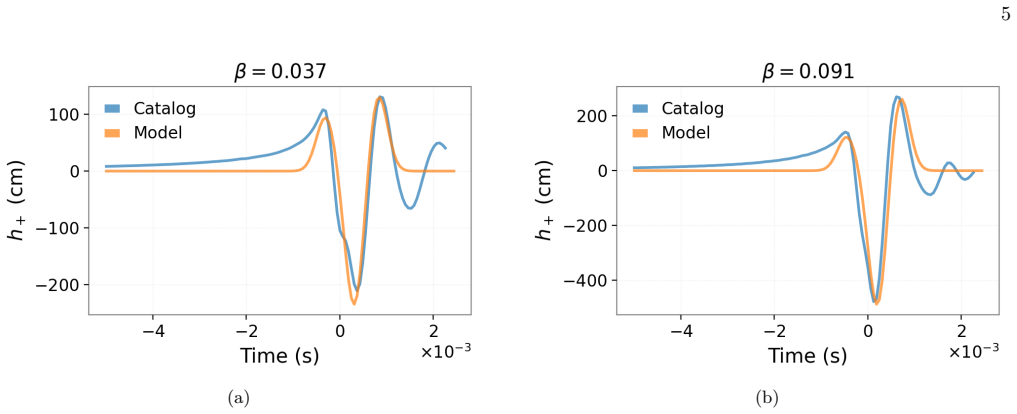
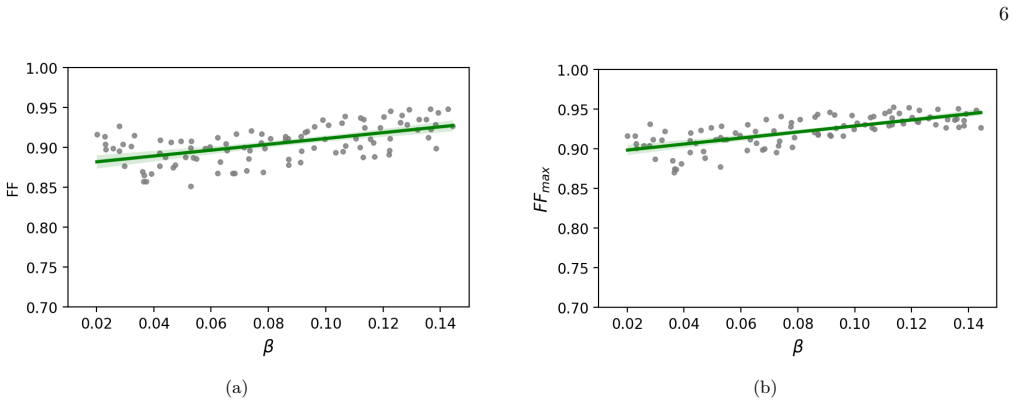
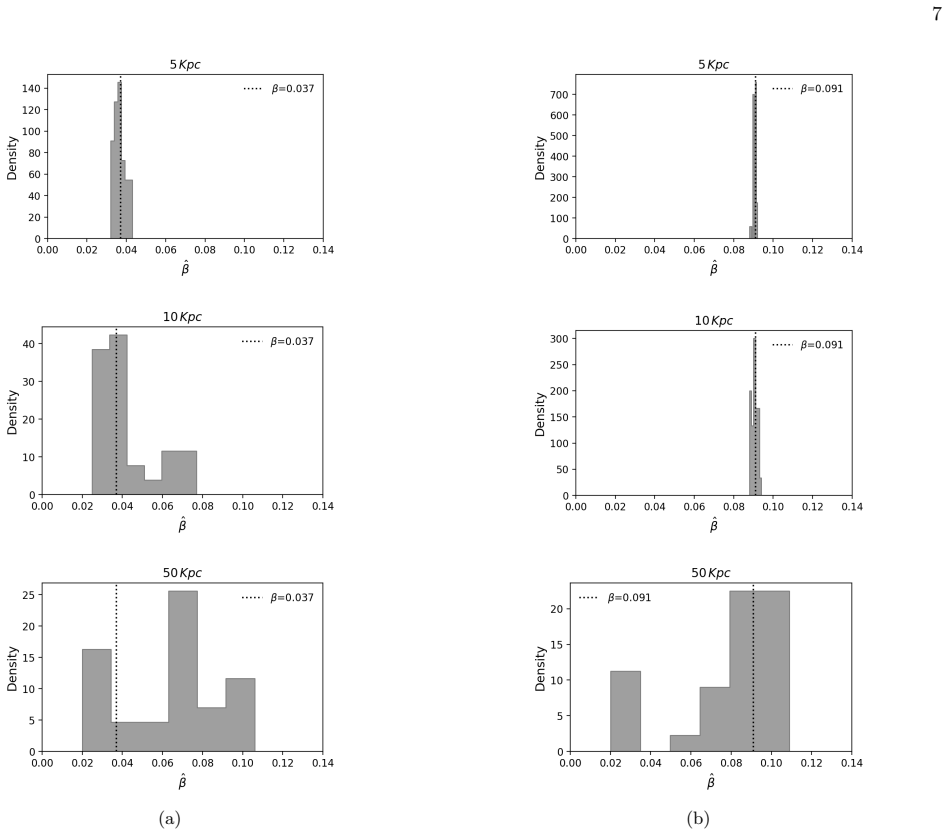
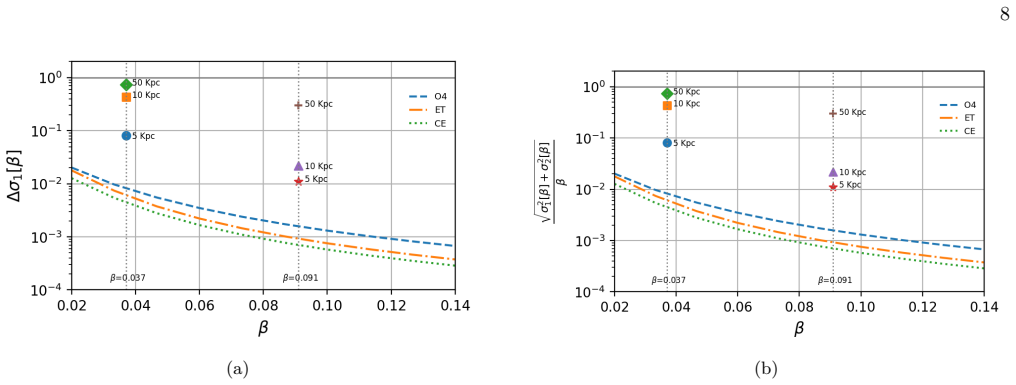
The central claim is that the analytical model achieves an average fitting factor of 94% over the interval 0.02 < β < 0.14, reproducing key characteristics of the core-bounce waveform with high accuracy and only a 6% reduction in optimal signal to noise ratio. Parameter estimation of β via the matched filter method, when compared to the Cramer-Rao lower bound using simulated O4 noise at 5, 10, and 50 kpc, yields a theoretical lower bound for the error that falls below 10^{-1} when the parameter β decreases with distance.
What carries the argument
The analytical model for the gravitational wave signal during the core bounce phase, used to estimate the dimensionless parameter β representing the ratio of rotational kinetic energy to gravitational potential energy.
If this is right
- The 94 percent fitting factor shows the analytical model captures essential waveform features sufficiently for matched-filter parameter estimation.
- Error analysis performed at galactic distances of 5, 10, and 50 kpc demonstrates the feasibility of recovering β from realistic detector noise.
- The asymptotic expansion supplies a concrete distance-dependent theoretical lower bound on the variance of the β estimator.
- Comparison with the Cramer-Rao bound confirms that the matched-filter results approach the fundamental statistical limit.
Where Pith is reading between the lines
- If the model continues to match new numerical waveforms outside the catalog, it could serve as a fast surrogate for real-time analysis pipelines at gravitational-wave detectors.
- The explicit distance scaling of the error bound suggests that events closer than 10 kpc would yield the tightest constraints on progenitor rotation.
- The approach isolates the core-bounce phase, so extending the same verification procedure to post-bounce or ring-down segments of the signal would test whether the same accuracy holds across the full waveform.
- Because the bound improves as β decreases, the method may be especially effective for distinguishing slowly rotating from non-rotating progenitors.
Load-bearing premise
The numerical template bank from the gravitational waveform catalog and the simulated O4 noise accurately represent real astrophysical signals and detector conditions.
What would settle it
A direct comparison showing that the analytical model's recovered β values deviate by more than the derived bound from those obtained with the full numerical waveform catalog on independent signals would falsify the claimed accuracy.
Figures
read the original abstract
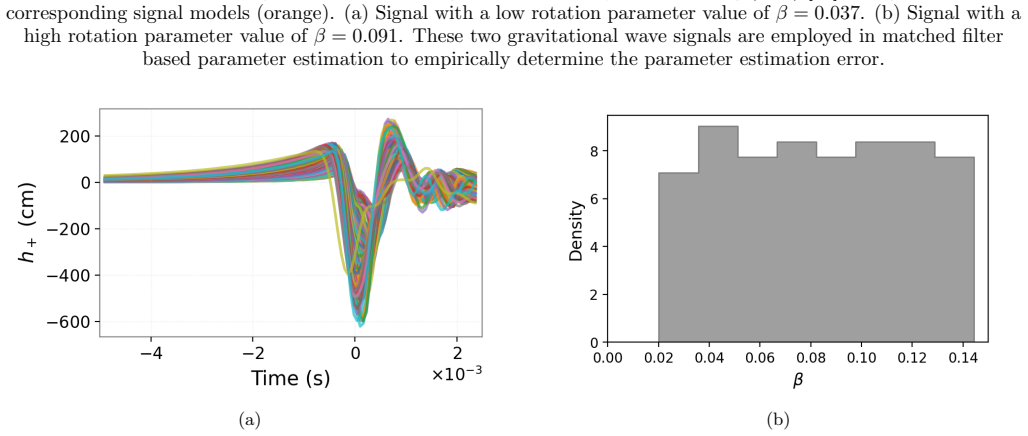
In this paper, we perform parameter estimation with an analytical model to simulate the gravitational wave emission during the core bounce phase of a rapidly rotating core collapse supernova progenitor. This approach enables us to estimate the parameter $\beta$, defined as the ratio of rotational kinetic energy to gravitational potential energy in core collapse supernovae. To verify the reliability of both the analytical model and the inferred value of $\beta$, we use a numerical template bank constructed from Abylkairov\'s gravitational waveform catalog and simulate O4 noise, characterized by the interferometers power spectral density. An average fitting factor of 94\% over the interval 0.02 $< \beta <$ 0.14 shows that our analytical model reproduces the key characteristics of the core-bounce waveform with high accuracy, leading to only a 6\% reduction in the optimal signal to noise ratio. This provides a quantitative measure of how well the analytical model performs. Subsequently, we analyze the error in estimating $\beta$ using a Matched Filter method and compare it to the corresponding Cram\'er Rao Lower Bound. The results obtained by considering noise and waveforms at distances of 5, 10, and 50 kpc enable an assessment of how accurately the selected statistical model fits the observed data. From the asymptotic expansion of the variance, we derive a theoretical lower bound for the error that falls below $10^{-1}$ when the parameter $\beta$ decreases with distance.
Editorial analysis
A structured set of objections, weighed in public.
Referee Report
Summary. The paper claims that an analytical model for the core-bounce gravitational waveform of rotating core-collapse supernovae reproduces numerical templates with an average 94% fitting factor over 0.02 < β < 0.14, incurring only a 6% SNR penalty, and that matched-filter parameter estimation of β yields errors below 0.1 (compared to the Cramér-Rao lower bound and an asymptotic variance expansion) at distances of 5, 10, and 50 kpc when using simulated O4 noise.
Significance. If the mismatch between the analytical model and numerical waveforms is shown to produce negligible bias in β recovery and if the CRLB comparison is adjusted accordingly, the work would supply a fast, semi-analytic route to β estimation with explicit statistical error bounds for nearby core-collapse events.
major comments (1)
- [Abstract] Abstract: the comparison of matched-filter errors to the CRLB (and the claim that the asymptotic variance expansion yields a lower bound < 10^{-1}) is performed under the assumption that the analytical waveform is the exact signal model. With only a 94% fitting factor the numerical injections will generally produce both systematic bias in recovered β and variance larger than the CRLB computed for the analytical template; the manuscript gives no indication that this bias was quantified or that the CRLB was corrected for mismatch.
minor comments (2)
- [Abstract] Abstract: the phrase 'asymptotic expansion of the variance' is invoked without an equation number or derivation sketch, making it impossible to verify that the reported bound follows directly from the paper's own statistical model.
- [Abstract] Abstract: no information is supplied on how the numerical template bank was selected, whether any waveforms were excluded, or how the O4 noise PSD was implemented, all of which are required to assess reproducibility of the 94% fitting factor.
Simulated Author's Rebuttal
We thank the referee for their careful review and for identifying an important consideration regarding the effects of waveform mismatch. We address the major comment below.
read point-by-point responses
-
Referee: [Abstract] Abstract: the comparison of matched-filter errors to the CRLB (and the claim that the asymptotic variance expansion yields a lower bound < 10^{-1}) is performed under the assumption that the analytical waveform is the exact signal model. With only a 94% fitting factor the numerical injections will generally produce both systematic bias in recovered β and variance larger than the CRLB computed for the analytical template; the manuscript gives no indication that this bias was quantified or that the CRLB was corrected for mismatch.
Authors: We agree with the referee that the CRLB and asymptotic variance comparisons are derived under the assumption that the analytical waveform is the exact signal. The manuscript reports the 94% fitting factor and 6% SNR penalty but does not include an explicit quantification of the systematic bias in recovered β when numerical waveforms are injected and recovered with the analytical model, nor does it adjust the CRLB for mismatch. Although the high fitting factor suggests modest mismatch effects, this does not replace direct verification. In the revised manuscript we will add an analysis that injects the numerical templates, recovers β with the analytical model, computes the resulting bias, and discusses its relation to the reported statistical errors and CRLB. revision: yes
Circularity Check
No significant circularity; external catalog and standard CRLB used
full rationale
The paper computes a 94% fitting factor directly against the external Abylkairov numerical waveform catalog and compares matched-filter errors to the standard Cramér-Rao Lower Bound. The asymptotic expansion yielding the theoretical error bound <10^{-1} is a mathematical derivation from the variance, independent of the paper's fitted values. No load-bearing step reduces by the paper's own equations to a self-defined input, fitted parameter renamed as prediction, or self-citation chain. The derivation chain is self-contained against external benchmarks.
Axiom & Free-Parameter Ledger
axioms (1)
- standard math The Cramér-Rao lower bound provides the theoretical minimum variance for unbiased estimators in this matched-filter setting.
Reference graph
Works this paper leans on
-
[1]
These waveforms exhibit a close morphology to the Richers et
has recently generated a new catalog of gravitational-wave signals; these waveforms are employed in this study because their improved numerical errors enable more accurate parameter estimation. These waveforms exhibit a close morphology to the Richers et. al. catalog. The waveforms presented examine the slow, moderate, and rapid rotation regimes, which ar...
-
[2]
GW150914: The Advanced LIGO Detectors in the Era of First Discoveries
Abbott BP, Abbott R, Abbott TD, Abernathy MR, Acernese F, Ackley K, et al. GW150914: The Advanced LIGO Detectors in the Era of First Discoveries. Phys Rev Lett. 2016 Mar;116:131103. Available from:https://link.aps.org/ doi/10.1103/PhysRevLett.116.131103
-
[3]
Collaboration TLS, Aasi J, Abbott BP, Abbott R, Abbott T, Abernathy MR, et al. Advanced LIGO. Classical and Quantum Gravity. 2015 mar;32(7):074001. Available from:https://doi.org/10.1088/0264-9381/32/7/074001
-
[4]
2015, Classical and Quantum Gravity, 32, 024001, doi: 10.1088/0264-9381/32/2/024001
Acernese F, Agathos M, Agatsuma K, Aisa D, Allemandou N, Allocca A, et al. Advanced Virgo: a second-generation interferometric gravitational wave detector. Classical and Quantum Gravity. 2014 dec;32(2):024001. Available from: https://doi.org/10.1088/0264-9381/32/2/024001
-
[5]
Akutsu T, Ando M, Arai K, Arai Y, Araki S, Araya A, et al. Overview of KAGRA: Detector design and construction history. Progress of Theoretical and Experimental Physics. 2021 05;2021(5):05A101. Available from:https://doi.org/ 10.1093/ptep/ptaa125
-
[6]
Measuring the angular momentum distribution in core-collapse supernova progenitors with gravitational waves
Abdikamalov E, Gossan S, DeMaio AM, Ott CD. Measuring the angular momentum distribution in core-collapse supernova progenitors with gravitational waves. Physical Review D. 2014 Aug;90(4). Available from:http://dx.doi.org/10.1103/ PhysRevD.90.044001
2014
-
[7]
Theory of core-collapse supernovae
Janka H, Langanke K, Marek A, Pinedo GM, Muller B. Theory of core-collapse supernovae. Physics Reports. 2007 apr;442(1-6):38-74. Available from:https://doi.org/10.1016%2Fj.physrep.2007.02.002
2007
-
[8]
A new Gravitational-Wave signature from standing accretion shock instability in supernovae
Kuroda T, Kotake K, Takiwaki T. A new Gravitational-Wave signature from standing accretion shock instability in supernovae. The Astrophysical Journal. 2016 sep;829(1):L14. Available from:https://doi.org/10.3847%2F2041-8205% 2F829%2F1%2Fl14
2016
-
[9]
Detecting and reconstructing gravitational waves from the next galactic core-collapse supernova in the advanced detector era
Szczepa´ nczyk MJ, et al. Detecting and reconstructing gravitational waves from the next galactic core-collapse supernova in the advanced detector era. Physical Review D. 2021 nov;104(10). Available from:https://doi.org/10.1103%2Fphysrevd. 104.102002
2021
-
[10]
Gravitational wave astrophysics, data analysis and multimessenger astronomy
Lee HM, Le Bigot EO, Du Z, Lin Z, Guo X, Wen L, et al. Gravitational wave astrophysics, data analysis and multimessenger astronomy. Science China Physics, Mechanics & Astronomy. 2015 Dec;58(12). Available from:http://dx.doi.org/10. 1007/s11433-015-5740-1
2015
-
[11]
Multi-messenger astrophysics of black holes and neutron stars as probed by ground-based gravitational wave detectors: from present to future
Corsi A, et al. Multi-messenger astrophysics of black holes and neutron stars as probed by ground-based gravitational wave detectors: from present to future. Front Astron Space Sci. 2024;11:1386748
2024
-
[12]
Equation of state effects on gravitational waves from rotating core collapse
Richers S, Ott CD, Abdikamalov E, O’Connor E, Sullivan C. Equation of state effects on gravitational waves from rotating core collapse. Phys Rev D. 2017 Mar;95:063019. Available from:https://link.aps.org/doi/10.1103/PhysRevD.95. 063019
-
[13]
Ott CD, Abdikamalov E, O’Connor E, Reisswig C, Haas R, Kalmus P, et al. Correlated gravitational wave and neutrino signals from general-relativistic rapidly rotating iron core collapse. Physical Review D. 2012;86(2). Available from:http: //dx.doi.org/10.1103/PhysRevD.86.024026
-
[14]
Explosion mechanism, neutrino burst and gravitational wave in core-collapse supernovae
Kotake K, Sato K, Takahashi K. Explosion mechanism, neutrino burst and gravitational wave in core-collapse supernovae. Reports on Progress in Physics. 2006 mar;69(4):971-1143. Available from:https://doi.org/10.1088%2F0034-4885%2F69% 2F4%2Fr03
2006
-
[15]
Asymmetric core collapse of rapidly rotating massive star
Gilkis A. Asymmetric core collapse of rapidly rotating massive star. Monthly Notices of the Royal Astronomical Society. 2017 Nov;474(2):2419–2429. Available from:http://dx.doi.org/10.1093/mnras/stx2934
-
[16]
High Resolution three-dimensional simulations of core-collase supernovae in multiple progenitors
Couch SM, O’Connor EP. High Resolution three-dimensional simulations of core-collase supernovae in multiple progenitors. The Astrophysical Journal. 2014 apr;785(2):123. Available from:https://doi.org/10.1088/0004-637X/785/2/123
-
[17]
Two-dimensional Core-collapse Supernova Explosions Aided by General Relativity with Multi- dimensional Neutrino Transport
O’Connor EP, Couch SM. Two-dimensional Core-collapse Supernova Explosions Aided by General Relativity with Multi- dimensional Neutrino Transport. The Astrophysical Journal. 2018 feb;854(1):63. Available from:https://doi.org/10. 3847/1538-4357/aaa893
2018
-
[18]
Gravitational-wave signals for supernova explosions of three-dimensional progenitors
Lella A, Lucente G, Kresse D, Glas R, Janka HT, Mirizzi A. Gravitational-wave signals for supernova explosions of three-dimensional progenitors. Phys Rev D. 2026 Apr;113:083034. Available from:https://link.aps.org/doi/10.1103/ f3n4-k2cq
2026
-
[19]
Gravitational wave burst signal from core collapse of rotating stars
Dimmelmeier H, Ott CD, Marek A, Janka HT. Gravitational wave burst signal from core collapse of rotating stars. Phys Rev D. 2008 Sep;78:064056. Available from:https://link.aps.org/doi/10.1103/PhysRevD.78.064056
-
[20]
Determining the Structure of Rotating Massive Stellar Cores with Gravitational Waves
Pajkos MA, Warren ML, Couch SM, O’Connor EP, Pan KC. Determining the Structure of Rotating Massive Stellar Cores with Gravitational Waves. The Astrophysical Journal. 2021;914(2). Available from:http://dx.doi.org/10.3847/ 1538-4357/abfb65
2021
-
[21]
Villegas LO, Moreno C, Pajkos MA, Zanolin M, Antelis JM. Parameter estimation from the core-bounce phase of rotating core collapse supernovae in real interferometer noise. Class Quant Grav. 2025;42(11):115001. Available from:https: //iopscience.iop.org/article/10.1088/1361-6382/add235
-
[22]
Evaluating machine learning models for supernova gravitational wave signal classification
Abylkairov YS, Edwards MC, Orel D, Mitra A, Shukirgaliyev B, Abdikamalov E. Evaluating machine learning models for supernova gravitational wave signal classification. Machine Learning: Science and Technology. 2025 jan;5(4):045077. Available from:https://doi.org/10.1088/2632-2153/ada33a
-
[23]
Shibagaki S, Kuroda T, Kotake K, Takiwaki T. A new gravitational-wave signature of low-T/W instability in rapidly ro- 10 tating stellar core collapse. Monthly Notices of the Royal Astronomical Society: Letters. 2020 03;493(1):L138-42. Available from:https://doi.org/10.1093/mnrasl/slaa021
-
[24]
Gravitational-wave sensitivity curves
Moore CJ, Cole RH, Berry CPL. Gravitational-wave sensitivity curves. Classical and Quantum Gravity. 2014 dec;32(1):015014. Available from:https://doi.org/10.1088/0264-9381/32/1/015014
-
[25]
Noise curves used for Simulations in the update of the Observing Scenarios Paper; 2020
Abbott R, et al. Noise curves used for Simulations in the update of the Observing Scenarios Paper; 2020. LIGO-T2000012. Available from:https://dcc.ligo.org/LIGO-T2000012/public
2020
-
[26]
Detection prospects of core-collapse supernovae with supernova-optimized third-generation gravitational-wave detectors
Srivastava V, Ballmer S, Brown DA, Afle C, Burrows A, Radice D, et al. Detection prospects of core-collapse supernovae with supernova-optimized third-generation gravitational-wave detectors. Physical Review D. 2019 aug;100(4). Available from:https://doi.org/10.1103%2Fphysrevd.100.043026
2019
-
[27]
Classical and Quantum Gravity , year = 2010, month = oct, volume =
Punturo M, Abernathy M, Acernese F, Allen B, Andersson N, Arun K, et al. The Einstein Telescope: a third-generation gravitational wave observatory. Classical and Quantum Gravity. 2010 sep;27(19):194002. Available from:https://doi. org/10.1088/0264-9381/27/19/194002
-
[28]
Zanolin M, Vitale S, Makris N. Application of asymptotic expansions for maximum likelihood estimators errors to gravi- tational waves from binary mergers: The single interferometer case. Physical Review D. 2010 Jun;81(12). Available from: http://dx.doi.org/10.1103/PhysRevD.81.124048
-
[29]
Vitale S, Zanolin M. Parameter estimation from gravitational waves generated by nonspinning binary black holes with laser interferometers: Beyond the Fisher information. Physical Review D. 2010 Dec;82(12). Available from:http: //dx.doi.org/10.1103/PhysRevD.82.124065
-
[30]
Martynov DV, Hall ED, Abbott BP, Abbott R, Abbott TD, Adams C, et al. Sensitivity of the Advanced LIGO detectors at the beginning of gravitational wave astronomy. Phys Rev D. 2016 Jun;93:112004. Available from:https://link.aps. org/doi/10.1103/PhysRevD.93.112004
-
[31]
Search templates for gravitational waves from precessing, inspiraling binaries
Apostolatos TA. Search templates for gravitational waves from precessing, inspiraling binaries. Phys Rev D. 1995 Jul;52:605-20. Available from:https://link.aps.org/doi/10.1103/PhysRevD.52.605
-
[32]
Gravitational wave searches for aligned-spin binary neutron stars using nonspinning templates
Cho HS, Lee CH. Gravitational wave searches for aligned-spin binary neutron stars using nonspinning templates. Journal of the Korean Physical Society. 2018 Jan;72(1):1–5. Available from:http://dx.doi.org/10.3938/jkps.72.1
-
[33]
Template bank to search for exotic gravitational wave signals from astrophysical compact binaries
Sharma A, Roy S, Sengupta AS. Template bank to search for exotic gravitational wave signals from astrophysical compact binaries. Physical Review D. 2024 Jun;109(12). Available from:http://dx.doi.org/10.1103/PhysRevD.109.124049
discussion (0)
Sign in with ORCID, Apple, or X to comment. Anyone can read and Pith papers without signing in.