REVIEW 3 minor 1 cited by
A single normalizing flow can both propose samples for MCMC and supply automatic spectral-gap bounds that certify convergence.
Reviewed by Pith at T0; open to challenge. T0 means a machine referee read the full paper against a public rubric. the ladder, T0–T4 →
T0 review · grok-4.3
2026-06-28 23:32 UTC pith:WEDH5LXF
load-bearing objection The quantile-core certificate gives dimension-independent convergence bounds for flow-based MCMC that track ESS in experiments up to D=20.
Self-Certifying Transport MCMC via Dual Spectral-Gap Certificates
The pith
A machine-rendered reading of the paper's core claim, the machinery that carries it, and where it could break.
Core claim
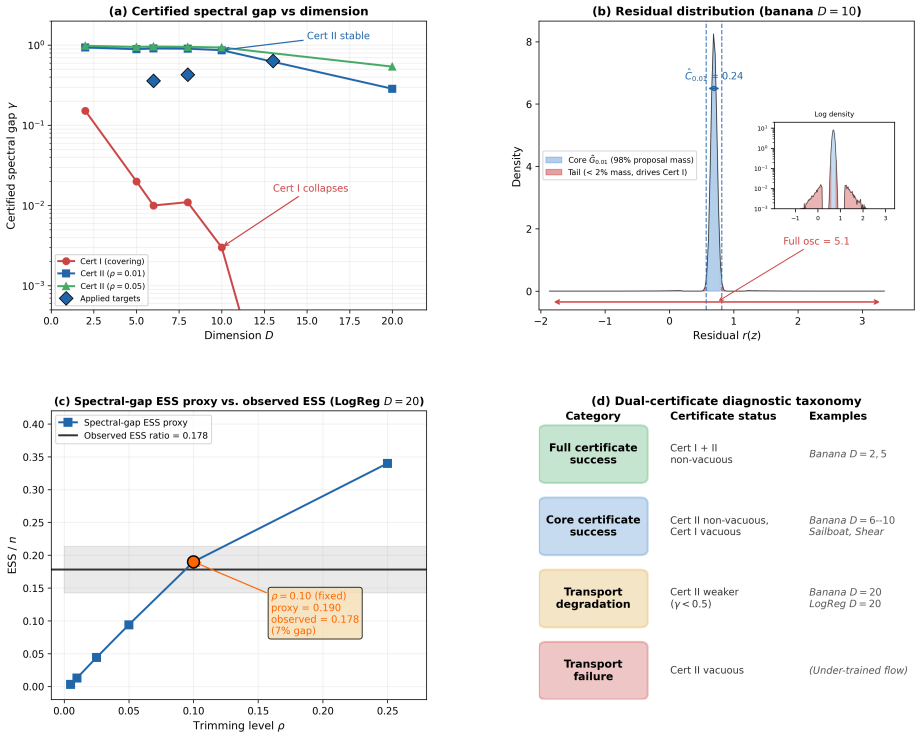
CerT-MCMC equips learned-transport MCMC with automatic spectral-gap certificates by reusing the same normalizing flow as both the independence Metropolis-Hastings proposal and the basis for two complementary bounds. The covering certificate controls weight-ratio oscillation over the entire support via finite-sample covering numbers and a conservative gradient bound, but its correction term is O(n^{-1/D}) and a matching lower bound shows the scaling is intrinsic to pointwise Lipschitz certification. The quantile-core certificate instead restricts to a high-probability residual core on which oscillation is bounded by empirical quantiles, incurring only O(n^{-1/2}) probability slack independent
What carries the argument
Dual spectral-gap certificates: the covering certificate (finite-sample covering arguments over full support) and the quantile-core certificate (empirical quantiles on a high-probability residual core).
Load-bearing premise
The same flow used to approximate the target posterior can also be treated as a valid independence Metropolis-Hastings proposal whose weight ratios admit controllable oscillation bounds.
What would settle it
Apply the quantile-core certificate to a deliberately poor flow on a low-dimensional target where the true spectral gap is known to be near zero and verify whether the resulting bound is also near zero.
If this is right
- The quantile-core certificate remains non-vacuous on targets up to dimension 20 where the covering certificate fails.
- The spectral-gap proxy from the quantile-core bound tracks empirical effective sample sizes within 7 percent.
- The framework distinguishes genuine transport failure from proof-technique limitations by a factor exceeding 10 times.
- The O(n^{-1/2}) slack of the quantile-core certificate is independent of dimension.
Where Pith is reading between the lines
- If the quantile-core method extends beyond the tested dimensions, it could certify samplers for posteriors common in high-dimensional Bayesian inference.
- Combining the two certificates on the same chain might produce tighter bounds than either certificate alone.
- The dimension-independent slack suggests the approach could be tested on problems where full-support Lipschitz bounds are known to be impractical.
Editorial analysis
A structured set of objections, weighed in public.
Referee Report
Summary. The manuscript introduces CerT-MCMC, a framework that equips learned-transport MCMC with automatic, rigorous convergence certificates. A normalizing flow approximates the target posterior and is used both as an independence Metropolis-Hastings proposal and to derive computable spectral-gap bounds. Two complementary certificates are developed: a covering certificate based on finite-sample covering arguments that yields full-support bounds but with O(n^{-1/D}) correction (and a matching Omega(n^{-1/D}) lower bound proving the scaling is intrinsic), and a quantile-core certificate that restricts to a high-probability core controlled by one-dimensional empirical quantiles with O(n^{-1/2}) probability slack independent of dimension. Experiments on synthetic targets (D=2-20), structural-engineering posteriors (D=6,8), logistic regression on Heart Disease data (D=13), and synthetic Bayesian logistic regression (D=20) show the quantile-core certificate remains non-vacuous where the covering one fails, tracks empirical ESS within 7%, and discriminates flow quality by >10x in a negative control (versus 1.15x for acceptance rate).
Significance. If the central derivations hold, this is a notable advance in providing the first automatic, dimension-aware convergence certificates for learned-transport MCMC, explicitly distinguishing genuine transport failure from proof-technique limitations. Credit is due for the dual-certificate construction, the matching lower bound establishing an intrinsic barrier, the negative-control experiment as an independent check, and the empirical tracking of ESS. These elements strengthen the case for reliable use of transport-based samplers in moderate-to-high dimensions.
minor comments (3)
- The description of how the conservative gradient bound is obtained for the covering certificate (abstract) would benefit from an explicit statement of the assumptions required on the flow and target density.
- In the experimental section, the precise architecture and training details of the normalizing flows used across the D=2-20 suite should be stated to support reproducibility of the reported 7% ESS tracking.
- Notation for the spectral-gap proxy versus the true spectral gap could be clarified to avoid any ambiguity when comparing to empirical ESS.
Simulated Author's Rebuttal
We thank the referee for the positive summary, significance assessment, and recommendation of minor revision. No specific major comments appear in the report.
Circularity Check
No significant circularity identified
full rationale
The paper derives its dual certificates from explicit finite-sample covering arguments and one-dimensional quantile controls on the learned flow, with the O(n^{-1/D}) weakening and its matching lower bound stated as intrinsic barriers rather than hidden assumptions. The quantile-core certificate replaces the dimension-dependent term with an O(n^{-1/2}) slack derived directly from empirical quantiles. The negative-control experiment supplies an independent empirical falsification that the bound responds to flow quality beyond acceptance rate. No load-bearing step reduces by construction to a fitted parameter, self-citation, or ansatz imported from prior work by the same authors; the framework is self-contained against the stated finite-sample arguments.
Axiom & Free-Parameter Ledger
axioms (2)
- standard math Standard Markov chain theory relating weight-ratio oscillation to spectral gap in independence Metropolis-Hastings
- domain assumption Existence of a conservative gradient bound on the target density
read the original abstract
We propose CerT-MCMC, a framework that equips learned-transport Markov chain Monte Carlo with automatic, rigorous convergence certificates. A normalising flow maps a Gaussian reference to an approximation of the target posterior; the same flow then serves as both the independence Metropolis-Hastings proposal and the basis for a computable spectral-gap bound. We develop two complementary certificates. The covering certificate bounds the weight-ratio oscillation over the full proposal support via finite-sample covering arguments, yielding full-support spectral-gap bounds when a conservative gradient bound is available; its correction term scales as O(n^{-1/D}), making it rapidly weak and eventually vacuous as dimension increases. We prove a matching Omega(n^{-1/D}) lower bound, establishing that this barrier is intrinsic to pointwise Lipschitz certification. The quantile-core certificate restricts attention to a high-probability residual core on which the oscillation is controlled by one-dimensional empirical quantiles, with a finite-sample probability slack of O(n^{-1/2}), independent of the ambient dimension. On synthetic targets (D=2-20), structural-engineering posteriors (D=6,8), real-data logistic regression on the Heart Disease data set (D=13), and synthetic Bayesian logistic regression (D=20), the quantile-core certificate delivers non-vacuous spectral-gap bounds where the covering certificate is vacuous, and its spectral-gap proxy tracks empirical effective sample sizes within 7%. A negative control experiment confirms that the certificate discriminates flow quality by a factor exceeding 10x, whereas acceptance rates differ by only 1.15x. To our knowledge, the dual-certificate framework is the first to provide automatic, dimension-aware convergence certificates for learned-transport MCMC, distinguishing genuine transport failure from proof-technique limitations.
Figures


Forward citations
Cited by 1 Pith paper
-
Folded Transport MCMC: Eliminating Label Switching by Sampling on a Fundamental Domain
Folded Transport MCMC eliminates label switching in exchangeable-component models by restricting the Markov chain to a fundamental domain with a symmetrised normalising flow proposal while preserving a computable conv...
Reference graph
Works this paper leans on
-
[1]
Brooks, S. P. & Gelman, A. (1998), ‘General methods for monitoring convergence of iterative simulations’,Journal of Computational and Graphical Statistics7(4), 434–455. 32 Table 11: Bayesian logistic regression (D= 20): full quantile-core sweep (n= 200,000). ρ ˆCρ γII ESS proxyˆπ(˜Gρ) 0.005 5.74 0.006 0.003 — 0.01 4.34 0.026 0.013 0.901 0.025 3.13 0.084 0...
1998
-
[2]
H., Lee, S
0.01 1.29 0.430 0.989 0.974 0.05 0.60 0.742 0.912 — Detrano, R., Janosi, A., Steinbrunn, W., Pfisterer, M., Schmid, J.-J., Sandhu, S., Guppy, K. H., Lee, S. & Froelicher, V. (1989), ‘International application of a new probability algorithm for the diagnosis of coronary artery disease’,American Journal of Cardiology 64(5), 304–310. Dinh, L., Sohl-Dickstein...
1989
-
[3]
Gabrié, M., Rotskoff, G. M. & Vanden-Eijnden, E. (2022), ‘Adaptive Monte Carlo aug- mented with normalizing flows’,Proceedings of the National Academy of Sciences 119(10), e2109420119. Gelman, A. & Rubin, D. B. (1992), ‘Inference from iterative simulation using multiple sequences’,Statistical Science7(4), 457–472. Hoffman, M., Sountsov, P., Dillon, J. V.,...
work page internal anchor Pith review Pith/arXiv arXiv 2022
-
[4]
Rosenthal, J. S. (1995), ‘Minorization conditions and convergence rates for Markov chain Monte Carlo’,Journal of the American Statistical Association90(430), 558–566. Street, W. N., Wolberg, W. H. & Mangasarian, O. L. (1993), ‘Nuclear feature extraction for breast tumor diagnosis’,Proceedings of SPIE1905, 861–870. Tierney, L. (1994), ‘Markov chains for ex...
1995
discussion (0)
Sign in with ORCID, Apple, or X to comment. Anyone can read and Pith papers without signing in.