A Padding Method for Enhanced Encoding of Inorganic Structures with Varying Chemical Compositions
Pith reviewed 2026-06-28 22:15 UTC · model grok-4.3
The pith
Wyckoff position length-aware padding produces more robust encodings for generative models of inorganic crystal structures.
A machine-rendered reading of the paper's core claim, the machinery that carries it, and where it could break.
Core claim
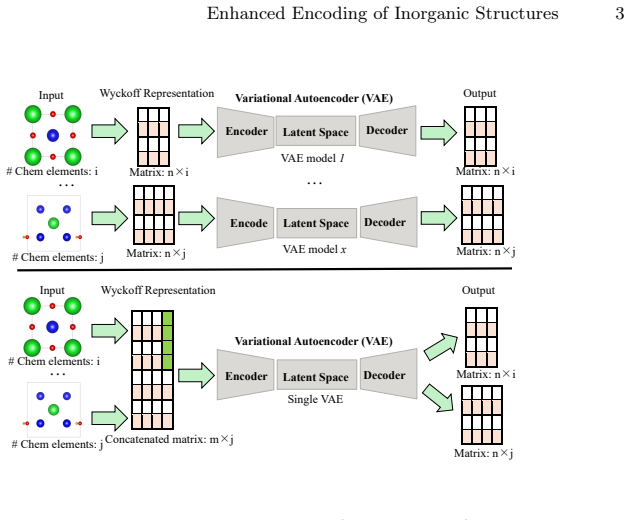
Central to our methodology is a novel padding technique that exploits crystal symmetry information to enhance the encoding process. By integrating Wyckoff position length-aware padding into an encoder architecture, we achieve a more robust informed representation of inorganic materials. This symmetry-driven enhancement improves deep learning models to generate stable, previously unexplored inorganic structures with superior accuracy and computational efficiency. Furthermore, we introduce an end-to-end system that leverages the machine learning potential models to seamlessly generate novel, even those unseen in the training data, and stable inorganic materials from initial data to validated o
What carries the argument
Wyckoff position length-aware padding, which adjusts sequence or feature padding according to the lengths of Wyckoff positions dictated by crystal symmetry so that structures of different sizes and compositions receive consistent, symmetry-informed encodings.
If this is right
- Reconstruction accuracy on proton conductor data rises by 5.3 percent.
- The number of novel stable inorganic materials generated on the perov-5 dataset increases by 63.5 percent relative to the baseline model.
- The encoder supports generation of stable structures absent from the training set.
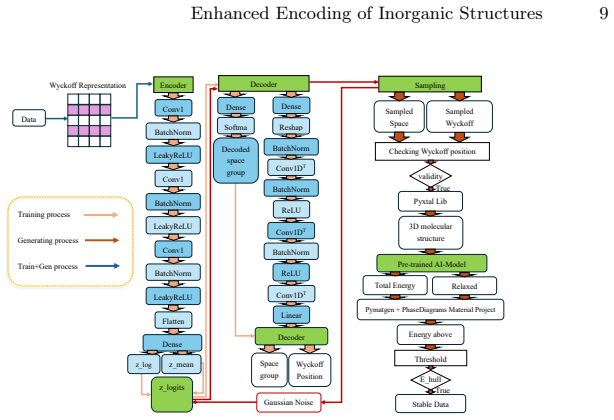
- An end-to-end pipeline becomes available that moves from initial data through generation to stability validation.
- Computational efficiency of the overall generation process improves.
Where Pith is reading between the lines
- The same padding rule could be inserted into non-generative models such as property predictors to test whether symmetry length awareness transfers beyond generation tasks.
- If the gains hold on datasets with wider ranges of unit-cell sizes, the method might reduce reliance on explicit data augmentation for variable-length crystal inputs.
- Combining this padding with graph-based rather than sequence-based encoders could be tested to see whether the benefit is architecture-specific or general to symmetry handling.
- The approach suggests a route to parameter-free handling of composition variation that might be compared against learned positional encodings on the same benchmarks.
Load-bearing premise
The Wyckoff position length-aware padding itself produces the more robust representation that drives the measured gains in reconstruction accuracy and novel stable material output rather than other unmentioned differences in architecture, training, or data handling.
What would settle it
Train and evaluate the identical generative model and pipeline twice on the same data, once with the Wyckoff-aware padding and once with standard fixed or random padding, then compare reconstruction accuracy on proton conductor data and the count of novel stable outputs on perov-5; equal or lower performance with the new padding would falsify the causal claim.
Figures
read the original abstract
Designing novel inorganic materials through generative models remains an important challenge for material science, driven by the complexity and diversity of inorganic structures across expansive chemical compositions and structural landscape. The vast combinatorial space of inorganic compounds demands innovative, AI-driven approaches to overcome limitations in generative accuracy and efficiency. To address this, we introduce a novel method that redefines the encoding and generation of inorganic materials by utilizing domain-specific symmetry-aware representation. Our approach not only refines the representation of intricate inorganic structures but also contributes to the field of material discovery by enhancing the precision and stability of generated candidates. Central to our methodology is a novel padding technique that exploits crystal symmetry information to enhance the encoding process. By integrating Wyckoff position length-aware padding into an encoder architecture, we achieve a more robust informed representation of inorganic materials. This symmetry-driven enhancement improves deep learning models to generate stable, previously unexplored inorganic structures with superior accuracy and computational efficiency. Furthermore, we introduce an end-to-end system that leverages the machine learning potential models to seamlessly generate novel, even those unseen in the training data, and stable inorganic materials from initial data to validated output. This pipeline integrates advanced generative models with stability analysis, marking a significant leap forward in the automated exploration and design of next-generation inorganic materials. Our method improved reconstruction accuracy 5.3% in proton conductor data, and generated 63.5% more novel stable inorganic material to baseline model on the perov-5 dataset.
Editorial analysis
A structured set of objections, weighed in public.
Referee Report
Summary. The manuscript introduces a Wyckoff position length-aware padding technique for encoding inorganic crystal structures with varying compositions into deep learning generative models. It claims that integrating this symmetry-aware padding yields more robust representations, enabling an end-to-end pipeline that improves reconstruction accuracy by 5.3% on proton conductor data and generates 63.5% more novel stable materials on the perov-5 dataset relative to a baseline model.
Significance. If the numerical gains are causally attributable to the padding method and survive rigorous controls, the approach could advance symmetry-informed encodings for inorganic materials generation, supporting more efficient exploration of stable compounds. The end-to-end generation-plus-validation pipeline is a constructive element, but the absence of supporting experimental details prevents a firm assessment of impact.
major comments (2)
- [Abstract] Abstract: The specific claims of 5.3% reconstruction accuracy improvement and 63.5% increase in novel stable materials are presented without any description of the baseline model architecture, training procedure, dataset sizes, statistical tests, error bars, or ablation experiments that vary only the padding while holding all other factors fixed.
- [Abstract] Abstract/Methods: No information is supplied on whether padding length or related hyperparameters were selected or tuned using the same data splits used for the reported evaluation metrics, leaving open the possibility that the gains arise from unstated differences in model or training rather than the padding itself.
Simulated Author's Rebuttal
We thank the referee for the constructive comments highlighting the need for greater transparency in the abstract. We have revised the manuscript to address both points by expanding the abstract and adding clarifying text in the Methods section.
read point-by-point responses
-
Referee: [Abstract] Abstract: The specific claims of 5.3% reconstruction accuracy improvement and 63.5% increase in novel stable materials are presented without any description of the baseline model architecture, training procedure, dataset sizes, statistical tests, error bars, or ablation experiments that vary only the padding while holding all other factors fixed.
Authors: We agree that the original abstract was too concise and omitted key experimental context. In the revised version we have expanded the abstract to briefly describe the baseline as a standard variational autoencoder without Wyckoff-position padding, note the proton-conductor and perov-5 dataset sizes, reference the ablation studies that isolate the padding component, and mention that error bars and statistical tests appear in the main text and supplementary material. revision: yes
-
Referee: [Abstract] Abstract/Methods: No information is supplied on whether padding length or related hyperparameters were selected or tuned using the same data splits used for the reported evaluation metrics, leaving open the possibility that the gains arise from unstated differences in model or training rather than the padding itself.
Authors: We confirm that padding length and other hyperparameters were tuned exclusively on a held-out validation split that was never used for final evaluation. This detail was inadvertently omitted from the original submission. We have added an explicit statement in the Methods section describing the data-splitting protocol and confirming that hyperparameter search was performed on the validation set only. revision: yes
Circularity Check
No significant circularity; empirical claims are self-contained
full rationale
The paper proposes a Wyckoff position length-aware padding method for encoding inorganic structures and reports empirical improvements (5.3% reconstruction accuracy on proton conductor data; 63.5% more novel stable materials on perov-5) relative to a baseline. No equations, self-citations, or derivations are shown that define the reported metrics in terms of the padding itself, fit parameters on the evaluation data and relabel them as predictions, or reduce the central claim to a self-citation chain. The performance deltas are presented as outcomes of model training and evaluation on held-out data, rendering the contribution self-contained against external benchmarks rather than tautological.
Axiom & Free-Parameter Ledger
Reference graph
Works this paper leans on
-
[1]
Physical Review Materials2(10), 103804 (2018)
Anelli, A., Engel, E.A., Pickard, C.J., Ceriotti, M.: Generalized convex hull con- struction for materials discovery. Physical Review Materials2(10), 103804 (2018)
2018
-
[2]
Energy & Environmental Sci- ence5(10), 9034–9043 (2012)
Castelli, I.E., Landis, D.D., Thygesen, K.S., Dahl, S., Chorkendorff, I., Jaramillo, T.F., Jacobsen, K.W.: New cubic perovskites for one-and two-photon water split- ting using the computational materials repository. Energy & Environmental Sci- ence5(10), 9034–9043 (2012)
2012
-
[3]
Nature Computational Science2(11), 718–728 (2022)
Chen, C., Ong, S.P.: A universal graph deep learning interatomic potential for the periodic table. Nature Computational Science2(11), 718–728 (2022)
2022
-
[4]
The Journal of Physical Chemistry Letters15(27), 6909–6917 (2024)
Choudhary, K.: Atomgpt: Atomistic generative pretrained transformer for forward and inverse materials design. The Journal of Physical Chemistry Letters15(27), 6909–6917 (2024)
2024
-
[5]
npj Computational Materials6(1), 84 (2020)
Dan, Y., Zhao, Y., Li, X., Li, S., Hu, M., Hu, J.: Generative adversarial networks (gan) based efficient sampling of chemical composition space for inverse design of inorganic materials. npj Computational Materials6(1), 84 (2020)
2020
-
[6]
Nature Machine Intelligence p
Deng, B., Zhong, P., Jun, K., Riebesell, J., Han, K., Bartel, C.J., Ceder, G.: Chgnet as a pretrained universal neural network potential for charge-informed atomistic modelling. Nature Machine Intelligence p. 1–11 (2023)
2023
-
[7]
Chemical Reviews 121(16), 10073–10141 (2021)
Deringer, V.L., Bartók, A.P., Bernstein, N., Wilkins, D.M., Ceriotti, M., Csányi, G.: Gaussian process regression for materials and molecules. Chemical Reviews 121(16), 10073–10141 (2021)
2021
-
[8]
Computer Physics Communications 261, 107810 (2021)
Fredericks, S., Parrish, K., Sayre, D., Zhu, Q.: Pyxtal: A python library for crystal structure generation and symmetry analysis. Computer Physics Communications 261, 107810 (2021)
2021
-
[9]
Frontiers in Materials9, 865270 (2022)
Fuhr, A.S., Sumpter, B.G.: Deep generative models for materials discovery and machine learning-accelerated innovation. Frontiers in Materials9, 865270 (2022)
2022
-
[10]
a case of study in sentiment analysis
Gimenez, M., Palanca, J., Botti, V.: Semantic-based padding in convolutional neu- ral networks for improving the performance in natural language processing. a case of study in sentiment analysis. Neurocomputing378, 315–323 (2020)
2020
-
[11]
In: ICLR (2024)
Gruver, N., Sriram, A., Madotto, A., Wilson, A.G., Zitnick, C.L., Ulissi, Z.W.: Fine-tuned language models generate stable inorganic materials as text. In: ICLR (2024)
2024
-
[12]
Journal of Chemical Information and Modeling63(18), 5755–5763 (2023)
Han, S., Lee, J., Han, S., Moosavi, S.M., Kim, J., Park, C.: Design of new inorganic crystals with the desired composition using deep learning. Journal of Chemical Information and Modeling63(18), 5755–5763 (2023)
2023
-
[13]
Cell Reports Physical Science4(10) (2023)
Höskuldsson, Á.B., Dang, T., Sakai, Y., Ishikawa, A., Skúlason, E.: High- throughput computational screening of doped transition metal oxides as catalysts for nitrogen reduction. Cell Reports Physical Science4(10) (2023)
2023
-
[14]
APL materials 1(1) (2013)
Jain, A., Ong, S.P., Hautier, G., Chen, W., Richards, W.D., Dacek, S., Cholia, S., Gunter, D., Skinner, D., Ceder, G., et al.: Commentary: The materials project: A materials genome approach to accelerating materials innovation. APL materials 1(1) (2013)
2013
-
[15]
https://doi.org/10.6084/m9.figshare.22715158.v27, dataset 16 Thang Dang et al
Janosh, R.: Matbench discovery data files (April 2023). https://doi.org/10.6084/m9.figshare.22715158.v27, dataset 16 Thang Dang et al
-
[16]
Chem- istry of Materials35(3), 1062–1079 (2023)
Karpovich, C., Pan, E., Jensen, Z., Olivetti, E.: Interpretable machine learning enabled inorganic reaction classification and synthesis condition prediction. Chem- istry of Materials35(3), 1062–1079 (2023)
2023
-
[17]
npj Computational Materials10(1), 287 (2024)
Karpovich, C., Pan, E., Olivetti, E.A.: Deep reinforcement learning for inverse inorganic materials design. npj Computational Materials10(1), 287 (2024)
2024
-
[18]
In: ICLR (2025)
Levy, D., Panigrahi, S.S., Kaba, S.O., Zhu, Q., Lee, K.L.K., Galkin, M., Miret, S., Ravanbakhsh, S.: Symmcd: Symmetry-preserving crystal generation with diffusion models. In: ICLR (2025)
2025
-
[19]
Chemical Engineering Journal p
Liu, X., Fan, K., Huang, X., Ge, J., Liu, Y., Kang, H.: Recent advances in artificial intelligence boosting materials design for electrochemical energy storage. Chemical Engineering Journal p. 151625 (2024)
2024
-
[20]
npj Computational Materials 10(1), 254 (2024)
Luo, X., Wang, Z., Gao, P., Lv, J., Wang, Y., Chen, C., Ma, Y.: Deep learning generative model for crystal structure prediction. npj Computational Materials 10(1), 254 (2024)
2024
-
[21]
In: ICLR (2024)
Miller, B.K., Chen, R.T., Sriram, A., Wood, B.M.: Flowmm: Generating materials with riemannian flow matching. In: ICLR (2024)
2024
-
[22]
Computational Materials Science68, 314–319 (2013)
Ong, S.P., Richards, W.D., Jain, A., Hautier, G., Kocher, M., Cholia, S., Gunter, D., Chevrier, V.L., Persson, K.A., Ceder, G.: Python materials genomics (pymat- gen): A robust, open-source python library for materials analysis. Computational Materials Science68, 314–319 (2013)
2013
-
[23]
Nano-Micro Letters15(1), 66 (2023)
Qiao, Y., Luo, J., Cui, T., Liu, H., Tang, H., Zeng, Y., Liu, C., Li, Y., Jian, J., Wu, J., et al.: Soft electronics for health monitoring assisted by machine learning. Nano-Micro Letters15(1), 66 (2023)
2023
-
[24]
Communications Materials3(1), 93 (2022)
Reiser, P., Neubert, M., Eberhard, A., Torresi, L., Zhou, C., Shao, C., Metni, H., van Hoesel, C., Schopmans, H., Sommer, T., et al.: Graph neural networks for materials science and chemistry. Communications Materials3(1), 93 (2022)
2022
-
[25]
Matter5(1), 314–335 (2022)
Ren, Z., Tian, S.I.P., Noh, J., Oviedo, F., Xing, G., Li, J., Liang, Q., Zhu, R., Aberle, A.G., Sun, S., et al.: An invertible crystallographic representation for gen- eral inverse design of inorganic crystals with targeted properties. Matter5(1), 314–335 (2022)
2022
-
[26]
Procedia Computer Science222, 458–467 (2023)
Sakai, Y., Dang, T., Fukuta, S., Shirahata, K., Ishikawa, A., Inoue, A., Kawaguchi, H., Höskuldsson, Á.B., Skúlason, E.: Self-supervised learning with atom replace- ment for catalyst energy prediction by graph neural networks. Procedia Computer Science222, 458–467 (2023)
2023
-
[27]
Müller, Piotr Kawa, Wei Herng Choong, et al
Sakai, Y., Matsumura, N., Inoue, A., Kawaguchi, H., Thang, D., Ishikawa, A., Höskuldsson, Á.B., Skúlason, E.: Active learning for graph neu- ral networks training in catalyst energy prediction. In: 2024 Interna- tional Joint Conference on Neural Networks (IJCNN). pp. 1–8 (2024). https://doi.org/10.1109/IJCNN60899.2024.10650978
-
[28]
Journal of Physics: Materials2(3), 032001 (2019)
Schleder, G.R., Padilha, A.C., Acosta, C.M., Costa, M., Fazzio, A.: From dft to ma- chine learning: recent approaches to materials science–a review. Journal of Physics: Materials2(3), 032001 (2019)
2019
-
[29]
Journal of Power Sources603, 234411 (2024)
Szaro, N.A., Ammal, S.C., Chen, F., Heyden, A.: First principles material screen- ing and trend discovery for the development of perovskite electrolytes for proton- conducting solid oxide fuel cells. Journal of Power Sources603, 234411 (2024)
2024
-
[30]
Progress in Solid State Chemistry p
Thakur, N., Kumar, P., Kumar, S., Singh, A.K., Sharma, H., Thakur, N., Dahshan, A.,Sharma,P.:Areviewoftwo-dimensionalinorganicmaterials:Types,properties, and their optoelectronic applications. Progress in Solid State Chemistry p. 100443 (2024)
2024
-
[31]
In: ICLR (2022) Enhanced Encoding of Inorganic Structures 17
Xie, T., Fu, X., Ganea, O.E., Barzilay, R., Jaakkola, T.S.: Crystal diffusion varia- tional autoencoder for periodic material generation. In: ICLR (2022) Enhanced Encoding of Inorganic Structures 17
2022
-
[32]
Xie, T., Grossman, J.C.: Crystal graph convolutional neural networks for an ac- curate and interpretable prediction of material properties. Phys. Rev. Lett.120, 145301 (Apr 2018)
2018
-
[33]
In: NeurIPS 2023 AI for Science Workshop (2023)
Yang, S., Cho, K., Merchant, A., Abbeel, P., Schuurmans, D., Mordatch, I., Cubuk, E.D.: Scalable diffusion for materials generation. In: NeurIPS 2023 AI for Science Workshop (2023)
2023
-
[34]
Nature pp
Zeni, C., Pinsler, R., Zügner, D., Fowler, A., Horton, M., Fu, X., Wang, Z., Shysheya, A., Crabbé, J., Ueda, S., et al.: A generative model for inorganic mate- rials design. Nature pp. 1–3 (2025)
2025
-
[35]
Matter7(10), 3469–3488 (2024)
Zhu, R., Nong, W., Yamazaki, S., Hippalgaonkar, K.: Wycryst: Wyckoff inorganic crystal generator framework. Matter7(10), 3469–3488 (2024)
2024
discussion (0)
Sign in with ORCID, Apple, or X to comment. Anyone can read and Pith papers without signing in.