Real-Time Quantum Error Correction System Stack: Architecture, Algorithms, and Engineering Practice
Pith reviewed 2026-06-28 22:19 UTC · model grok-4.3
The pith
Real-time quantum error correction has shifted from needing better decoder algorithms to solving system-level engineering problems in latency and coordination.
A machine-rendered reading of the paper's core claim, the machinery that carries it, and where it could break.
Core claim
The paper claims that the core challenge of real-time decoding has shifted from algorithmic capability to system-level engineering, with the binding constraints now located in QEC round time, tail latency, and end-to-end data path coordination; it quantifies the performance gap of existing decoders and supplies a six-layer reference architecture with defined interfaces and latency budget models as the structure needed to close that gap.
What carries the argument
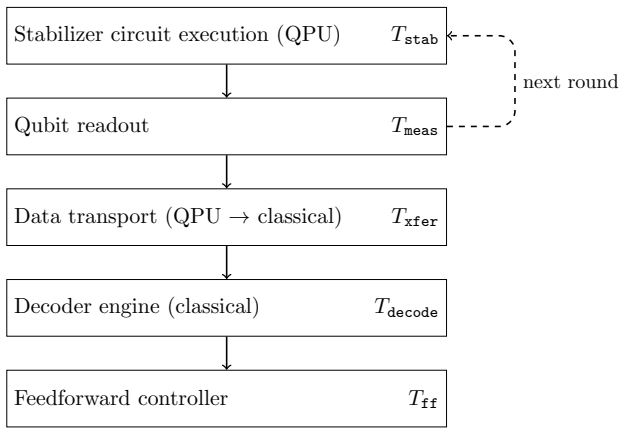
Six-layer reference architecture from syndrome acquisition to logical operations, equipped with interface definitions and latency budget models.
If this is right
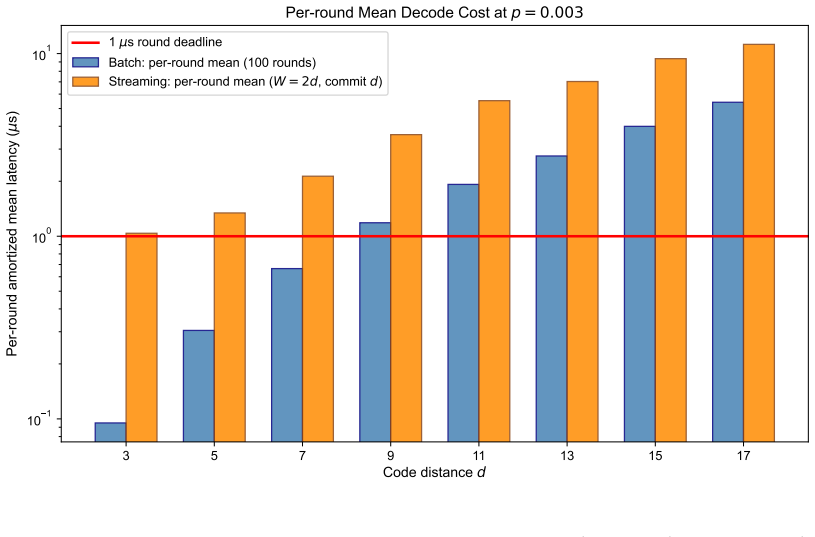
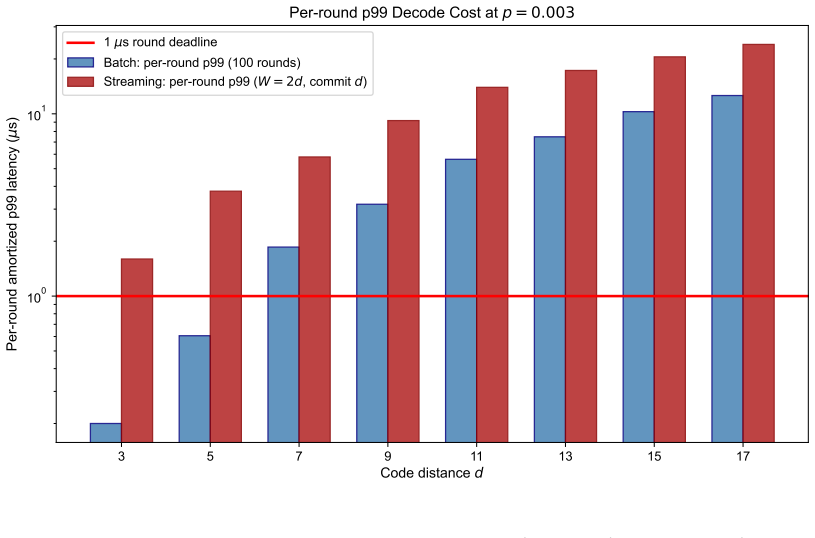
- Mainstream decoders for surface codes and qLDPC codes fall short of real-time requirements primarily in tail latency and integration coordination.
- Explicit latency budgets per layer become the practical design constraint for hardware control systems.
- Defined interfaces between layers enable modular replacement of components while preserving overall timing.
- System-level coordination, rather than isolated decoder speed, determines whether fault-tolerant operation remains feasible.
- Architectural choices at the data-path level directly affect the distance between laboratory demonstrations and scalable FTQC.
Where Pith is reading between the lines
- Adoption of the layered model could allow hardware teams to test one layer at a time without rebuilding the entire control stack.
- Emphasis on tail latency implies that future decoder research will need to optimize worst-case rather than average-case performance.
- The architecture may generalize to other error-correcting codes once the interface definitions are standardized.
- Control electronics designers will face new requirements to guarantee bounded response times across the full data path.
Load-bearing premise
The proposed six-layer architecture with its latency budget models will close the identified engineering gap once the decoder benchmarks are realized in integrated hardware.
What would settle it
A physical implementation of the six-layer stack in which measured end-to-end latency from syndrome acquisition to correction feedback exceeds the QEC round time on the target hardware.
Figures
read the original abstract
Quantum error correction (QEC) is transitioning from physical feasibility demonstrations to systems engineering challenges. Google has achieved below-threshold performance on distance-5/7 surface codes, while Riverlane and Rigetti have demonstrated hardware-integrated low-latency feedback loops. These milestones indicate that the core challenge of real-time decoding has shifted from algorithmic capability to system-level engineering. However, a substantial engineering gap remains between laboratory demonstrations and scalable fault-tolerant quantum computing (FTQC). This white paper addresses three questions: (1) Where are the real bottlenecks in real-time QEC: beyond average decoder speed, the constraints lie in QEC round time, tail latency, and end-to-end data path coordination; (2) How mature are mainstream decoder algorithms: we benchmark the major decoders for both surface codes and quantum low-density parity-check (qLDPC) codes, evaluating their real-time readiness; (3) What system stack do we propose: a six-layer reference architecture from syndrome acquisition to logical operations, with interface definitions and latency budget models. Our results quantify the gap between current decoder performance and real-time requirements, and identify the architectural choices needed to close it.
Editorial analysis
A structured set of objections, weighed in public.
Referee Report
Summary. The paper claims that real-time QEC has transitioned from an algorithmic problem to a systems-engineering challenge, with primary bottlenecks now in QEC round time, tail latency, and end-to-end data-path coordination rather than average decoder speed. It benchmarks mainstream decoders for both surface codes and qLDPC codes to assess real-time readiness, and proposes a six-layer reference architecture (from syndrome acquisition through logical operations) that includes explicit interface definitions and latency-budget models. The work quantifies the gap between current decoder performance and FTQC requirements and identifies the architectural choices needed to close it.
Significance. If the latency models and decoder benchmarks hold under realistic hardware constraints, the six-layer stack could provide a concrete engineering reference that helps close the gap between laboratory QEC demonstrations and scalable FTQC. The explicit treatment of tail latency and data-path coordination, together with the benchmarking across code families, supplies a practical contribution that is often missing from purely algorithmic papers.
minor comments (3)
- [Abstract] The abstract states that decoder benchmarks 'quantify the gap,' yet the provided text gives only summary-level descriptions; the manuscript would be strengthened by including at least one concrete table or figure (with numerical latency values and hardware assumptions) in the main body so readers can directly assess the claimed shortfall.
- The six-layer architecture is introduced with interface definitions and latency budgets, but the text does not specify how these budgets were derived or validated against measured hardware round times; adding a short derivation or reference to the underlying timing model would improve reproducibility.
- Minor typographical inconsistencies appear in the description of qLDPC versus surface-code decoder readiness; a uniform terminology check across sections would aid clarity.
Simulated Author's Rebuttal
We thank the referee for the positive assessment of our white paper on the real-time QEC system stack and for recommending minor revision. The summary accurately captures our focus on shifting bottlenecks from algorithmic speed to system-level issues such as round time, tail latency, and data-path coordination, as well as our benchmarks and six-layer architecture proposal.
Circularity Check
No significant circularity detected
full rationale
The paper is an engineering white paper focused on system architecture, latency budgets, and decoder benchmarking at a summary level. It contains no mathematical derivations, equations, fitted parameters, or predictions that reduce to inputs by construction. Central claims about shifting bottlenecks from algorithms to integration are presented as engineering observations rather than self-referential results, with no load-bearing self-citations or ansatzes. The derivation chain is self-contained against external benchmarks and does not exhibit any of the enumerated circularity patterns.
Axiom & Free-Parameter Ledger
Reference graph
Works this paper leans on
-
[1]
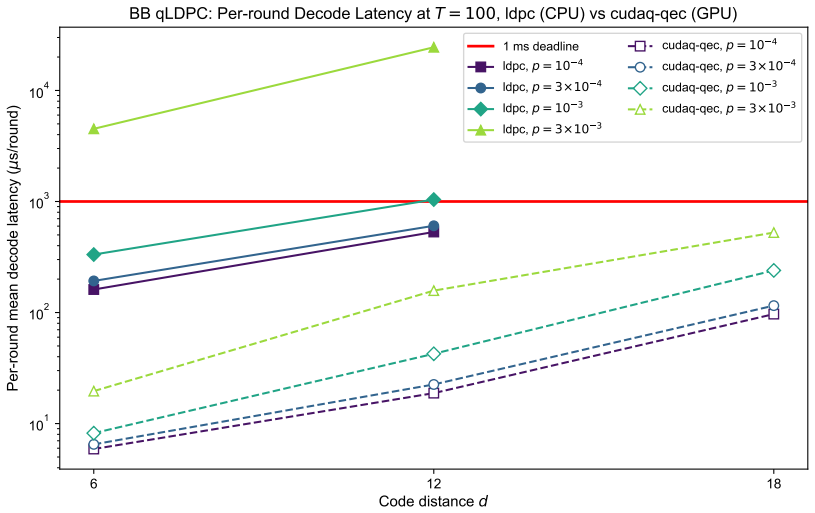
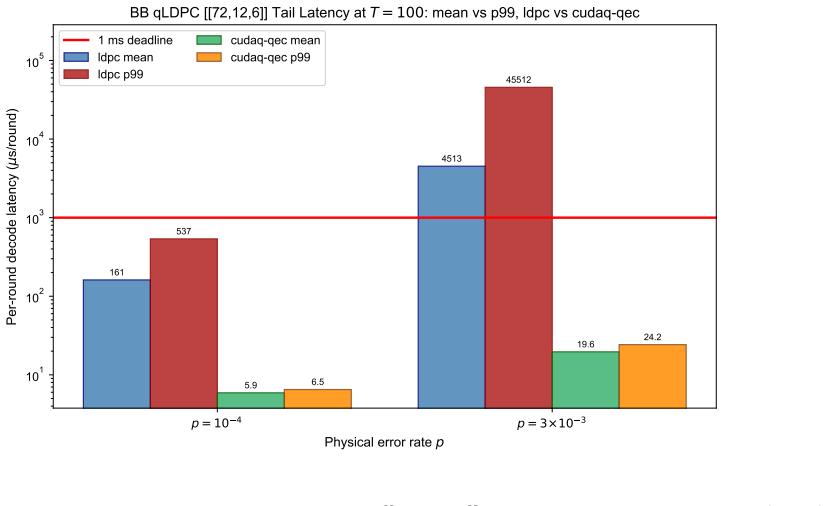
Atp= 0.003 thep 99 tail exceeds the mean by∼10×already at [[72,12,6]], making worst-case provisioning impractical
BP+OSD on a single CPU core meets a 1 ms-per-round budget only at low noise and small codes. Atp= 0.003 thep 99 tail exceeds the mean by∼10×already at [[72,12,6]], making worst-case provisioning impractical
-
[2]
GPU batching closes most of the gap.cudaq-qecsustains<1 ms/round throughput up to [[288,12,18]], and its bounded tail makes it a more credible target for streaming or sliding-window decoding of qLDPC codes. 35 p = 10 4 p = 3×10 3 /uni00000033/uni0000004b/uni0000005c/uni00000056/uni0000004c/uni00000046/uni00000044/uni0000004f/uni00000003/uni00000048/uni000...
-
[3]
closed-branch decoders) and dedicated qLDPC accelerators on FPGA/ASIC, which remains an open direction
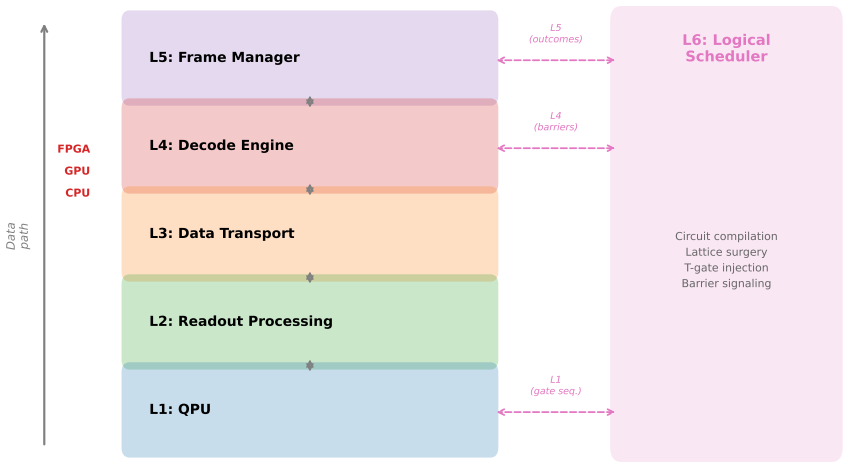
Approaches that may help include algorithmic alternatives to OSD (e.g. closed-branch decoders) and dedicated qLDPC accelerators on FPGA/ASIC, which remains an open direction. VII. SYSTEM ARCHITECTURE AND SCALING The preceding chapters analyzed codes, decoders, and benchmarks for latency and accu- racy. This chapter integrates them into a layered reference...
-
[4]
Trapped ions In trapped-ion QEC, the Layer 1 QPU is built from laser- or microwave-driven gates, state-dependent fluorescence readout, and shared motional modes. Small and interme- diate trapped-ion systems benefit from flexible connectivity, which has enabled real-time QEC with the [[7,1,3]] color code and fault-tolerant logical primitives with Bacon–Sho...
-
[5]
The Layer 1 QPU is typically an optical tweezer array with Rydberg-mediated entangling gates and dynamic atom rearrangement
Neutral atoms Neutral-atom QEC has a different system profile. The Layer 1 QPU is typically an optical tweezer array with Rydberg-mediated entangling gates and dynamic atom rearrangement. Atoms can be routed between storage, entangling, readout, and reservoir zones. A stack in which array reconfiguration, readout metadata, and decoder feedback are tightly...
2048
-
[6]
Preskill, Quantum computing in the NISQ era and beyond, Quantum2, 79 (2018)
J. Preskill, Quantum computing in the NISQ era and beyond, Quantum2, 79 (2018)
2018
-
[7]
Google Quantum AI and Collaborators, Quantum error correction below the surface code threshold, Nature638, 920 (2025)
2025
-
[8]
L. Caune, L. Skoric, N. S. Blunt, A. Ruban, J. McDaniel, J. A. Valery, A. D. Patterson, A. V. Gramolin, J. Majaniemi, K. M. Barnes, T. Bialas, O. Bu˘ gdaycı, O. Crawford, G. P. Geh´ er, H. Krovi, E. Matekole, C. Topal, S. Poletto, M. Bryant, K. Snyder, N. I. Gillespie, G. Jones, K. Johar, E. T. Campbell, and A. D. Hill, Demonstrating real-time and low-lat...
-
[9]
Ryan-Anderson, N
C. Ryan-Anderson, N. C. Brown, C. H. Baldwin, J. M. Dreiling, C. Foltz, J. P. Gaebler, T. M. Gatterman, N. Hewitt, C. Holliman, C. V. Horst, J. Johansen, D. Lucchetti, T. Men- gle, M. Matheny, Y. Matsuoka, K. Mayer, M. Mills, S. A. Moses, B. Neyenhuis, J. Pino, P. Siegfried, R. P. Stutz, J. Walker, and D. Hayes, High-fidelity teleportation of a logical qu...
2024
-
[10]
Demonstration of logical qubits and repeated error correction with better-than-physical error rates
A. Paetznick, M. P. da Silva, C. Ryan-Anderson, J. M. Bello-Rivas, J. P. C. III, A. Chernogu- zov, J. M. Dreiling, C. Foltz, F. Frachon, J. P. Gaebler, T. M. Gatterman, L. Grans- Samuelsson, D. Gresh, D. Hayes, N. Hewitt, C. Holliman, C. V. Horst, J. Johansen, D. Luc- chetti, Y. Matsuoka, M. Mills, S. A. Moses, B. Neyenhuis, A. Paz, J. Pino, P. Siegfried,...
work page internal anchor Pith review Pith/arXiv arXiv 2024
- [11]
-
[12]
Bluvstein, S
D. Bluvstein, S. J. Evered, A. A. Geim, S. H. Li, H. Zhou, T. Manovitz, S. Ebadi, M. Cain, M. Kalinowski, D. Hangleiter, J. P. Bonilla Ataides, N. Maskara, I. Cong, X. Gao, P. Sales Ro- driguez, T. Karolyshyn, G. Semeghini, M. J. Gullans, M. Greiner, V. Vuleti´ c, and M. D. Lukin, Logical quantum processor based on reconfigurable atom arrays, Nature626, 58 (2024)
2024
-
[13]
B. M. Terhal, Quantum error correction for quantum memories, Rev. Mod. Phys.87, 307 (2015)
2015
-
[14]
A. G. Fowler, M. Mariantoni, J. M. Martinis, and A. N. Cleland, Surface codes: Towards practical large-scale quantum computation, Phys. Rev. A86, 032324 (2012)
2012
-
[15]
Bravyi, A
S. Bravyi, A. W. Cross, J. M. Gambetta, D. Maslov, P. Rall, and T. J. Yoder, High-threshold and low-overhead fault-tolerant quantum memory, Nature627, 778 (2024)
2024
-
[16]
Fast and accurate AI-based pre-decoders for surface codes
C. Chamberland, J. Olle, M. Li, S. Thornton, and I. Baratta, Fast and accurate AI-based pre-decoders for surface codes (2026), arXiv:2604.12841
work page internal anchor Pith review Pith/arXiv arXiv 2026
-
[17]
Skoric, D
L. Skoric, D. E. Browne, K. M. Barnes, N. I. Gillespie, and E. T. Campbell, Parallel window decoding enables scalable fault tolerant quantum computation, Nat. Commun.14, 7040 (2023)
2023
-
[18]
Horsman, A
C. Horsman, A. G. Fowler, S. Devitt, and R. Van Meter, Surface code quantum computing by lattice surgery, New J. Phys.14, 123011 (2012)
2012
-
[19]
Litinski, Magic state distillation: not as costly as you think, Quantum3, 205 (2019)
D. Litinski, Magic state distillation: not as costly as you think, Quantum3, 205 (2019)
2019
-
[20]
Bravyi and A
S. Bravyi and A. Kitaev, Universal quantum computation with ideal Clifford gates and noisy ancillas, Phys. Rev. A71, 022316 (2005)
2005
-
[21]
M. A. Nielsen and I. L. Chuang, Quantum Computation and Quantum Information, 10th ed. (Cambridge University Press, 2010). 51
2010
-
[22]
Gidney and M
C. Gidney and M. Eker˚ a, How to factor 2048 bit RSA integers in 8 hours using 20 million noisy qubits, Quantum5, 433 (2021)
2048
-
[23]
Battistel, C
F. Battistel, C. Chamberland, K. Johar, R. W. J. Overwater, F. Sebastiano, L. Skoric, Y. Ueno, and M. Usman, Real-time decoding for fault-tolerant quantum computing: progress, challenges and outlook, Nano Futures7, 032003 (2023)
2023
-
[24]
Higgott and C
O. Higgott and C. Gidney, Sparse blossom: correcting a million errors per core second with minimum-weight matching, Quantum9, 1600 (2025)
2025
-
[25]
Y. Wu, N. Liyanage, and L. Zhong, Micro blossom: Accelerated minimum- weight perfect matching decoding for quantum error correction, in Proceedings of the 30th ACM International Conference on Architectural Support for Programming Languages and Operating Systems, Volume 2, ASPLOS ’25 (Association for Computing Machinery, New York, NY, USA, 2025) p. 639–654
2025
-
[26]
P. Das, C. A. Pattison, S. Manne, D. Carmean, K. Svore, M. Qureshi, and N. Delfosse, AFS: Accurate, fast, and scalable error-decoding for fault-tolerant quantum computers, in 2022 IEEE International Symposium on High-Performance Computer Architecture (HPCA) (2022) pp. 259–273
2022
-
[27]
Bausch, A
J. Bausch, A. W. Senior, F. J. H. Heras, T. Edlich, A. Davies, M. Newman, C. Jones, K. Satzinger, M. Y. Niu, S. Blackwell, G. Holland, D. Kafri, J. Atalaya, C. Gidney, D. Has- sabis, S. Boixo, H. Neven, and P. Kohli, Learning high-accuracy error decoding for quantum processors, Nature635, 834 (2024)
2024
-
[28]
A. W. Senior, T. Edlich, F. J. H. Heras, L. M. Zhang, O. Higgott, J. S. Spencer, T. Applebaum, S. Blackwell, J. Ledford, A. ˇZemgulyt˙ e, A.ˇZ´ ıdek, N. Shutty, A. Cowie, Y. Li, G. Holland, P. Brooks, C. Beattie, M. Newman, A. Davies, C. Jones, S. Boixo, H. Neven, P. Kohli, and J. Bausch, A scalable and real-time neural decoder for topological quantum cod...
-
[29]
Gidney, Stim: a fast stabilizer circuit simulator, Quantum5, 497 (2021)
C. Gidney, Stim: a fast stabilizer circuit simulator, Quantum5, 497 (2021)
2021
-
[30]
Roffe, D
J. Roffe, D. R. White, S. Burton, and E. T. Campbell, Decoding across the quantum low- density parity-check code landscape, Phys. Rev. Res.2, 043423 (2020)
2020
-
[31]
Kielpinski, C
D. Kielpinski, C. Monroe, and D. J. Wineland, Architecture for a large-scale ion-trap quantum computer, Nature417, 709 (2002)
2002
-
[32]
Bluvstein, A
D. Bluvstein, A. A. Geim, S. H. Li, S. J. Evered, J. P. Bonilla Ataides, G. Baranes, A. Gu, T. Manovitz, M. Xu, M. Kalinowski, S. Majidy, C. Kokail, N. Maskara, E. C. Trapp, L. M. 52 Stewart, S. Hollerith, H. Zhou, M. J. Gullans, S. F. Yelin, M. Greiner, V. Vuleti´ c, M. Cain, and M. D. Lukin, A fault-tolerant neutral-atom architecture for universal quant...
2026
-
[33]
M. Cain, Q. Xu, R. King, L. R. B. Picard, H. Levine, M. Endres, J. Preskill, H.-Y. Huang, and D. Bluvstein, Shor’s algorithm is possible with as few as 10,000 reconfigurable atomic qubits (2026), arXiv:2603.28627
work page internal anchor Pith review Pith/arXiv arXiv 2026
-
[34]
L. Egan, D. M. Debroy, C. Noel, A. Risinger, D. Zhu, D. Biswas, M. Newman, M. Li, K. R. Brown, M. Cetina, and C. Monroe, Fault-tolerant control of an error-corrected qubit, Nature 598, 281 (2021)
2021
-
[35]
Dean and L
J. Dean and L. A. Barroso, The tail at scale, Commun. ACM56, 74 (2013)
2013
-
[36]
Dennis, A
E. Dennis, A. Kitaev, A. Landahl, and J. Preskill, Topological quantum memory, J. Math. Phys.43, 4452 (2002)
2002
-
[37]
Raussendorf and J
R. Raussendorf and J. Harrington, Fault-tolerant quantum computation with high threshold in two dimensions, Physical Review Letters98, 190504 (2007)
2007
-
[38]
Delfosse and N
N. Delfosse and N. H. Nickerson, Almost-linear time decoding algorithm for topological codes, Quantum5, 595 (2021)
2021
-
[39]
Liyanage, Y
N. Liyanage, Y. Wu, S. Tagare, and L. Zhong, FPGA-based distributed union-find decoder for surface codes, IEEE Trans. Quantum Eng.5, 1 (2024)
2024
-
[40]
Bombin and M
H. Bombin and M. A. Martin-Delgado, Topological quantum distillation, Phys. Rev. Lett.97, 180501 (2006)
2006
-
[41]
A. J. Landahl, J. T. Anderson, and P. R. Rice, Fault-tolerant quantum computing with color codes (2011), arXiv:1108.5738
work page internal anchor Pith review Pith/arXiv arXiv 2011
-
[42]
J. T. Anderson, G. Duclos-Cianci, and D. Poulin, Fault-tolerant conversion between the Steane and Reed–Muller quantum codes, Phys. Rev. Lett.113, 080501 (2014)
2014
-
[43]
Bombin, Gauge color codes: optimal transversal gates and gauge fixing in topological stabilizer codes, New J
H. Bombin, Gauge color codes: optimal transversal gates and gauge fixing in topological stabilizer codes, New J. Phys.17, 083002 (2015)
2015
-
[44]
Ryan-Anderson, J
C. Ryan-Anderson, J. G. Bohnet, K. Lee, D. Gresh, A. Hankin, J. P. Gaebler, D. Francois, A. Chernoguzov, D. Lucchetti, N. C. Brown, T. M. Gatterman, S. K. Halit, K. Gilmore, J. Gerber, B. Neyenhuis, D. Hayes, and R. P. Stutz, Realization of real-time fault-tolerant quantum error correction, Phys. Rev. X11, 041058 (2021)
2021
-
[45]
S. Dasu, M. DeCross, A. Y. Guo, A. Lavasani, J. Behrends, A. Benhemou, Y.-H. Chen, 53 K. Mayer, C. N. Self, S. Simsek, B. Srivastava, M. S. Allman, J. Arkinstall, J. G. Bohnet, N. Q. Burdick, J. P. C. III, A. Chernoguzov, S. F. Cooper, R. D. Delaney, J. M. Dreiling, B. Estey, C. Figgatt, C. Foltz, J. P. Gaebler, A. Hall, C. A. Holliman, A. A. Husain, A. I...
-
[46]
Y. Wu, S. Kolkowitz, S. Puri, and J. D. Thompson, Erasure conversion for fault-tolerant quantum computing in alkaline earth rydberg atom arrays, Nat. Commun.13, 4657 (2022)
2022
-
[47]
A. G. Fowler, Minimum weight perfect matching of fault-tolerant topological quantum error correction in averageO(1) parallel time, Quantum Inf. Comput.15, 145 (2015)
2015
-
[48]
Barber, K
B. Barber, K. M. Barnes, T. Bialas, O. Bu˘ gdaycı, E. T. Campbell, N. I. Gillespie, K. Johar, R. Rajan, A. W. Richardson, C. Sherborne, L. Skoric, C. Topal, M. L. Turner, and A. B. Ziad, A real-time, scalable, fast and resource-efficient decoder for a quantum computer, Nat. Electron.8, 84 (2025)
2025
-
[49]
A. B. Ziad, A. Zalawadiya, C. Topal, J. Camps, G. P. Geh´ er, M. P. Stafford, and M. L. Turner, Local clustering decoder as a fast and adaptive hardware decoder for the surface code, Nat. Commun.16, 11048 (2025)
2025
-
[50]
Panteleev and G
P. Panteleev and G. Kalachev, Degenerate quantum LDPC codes with good finite length performance, Quantum5, 585 (2021)
2021
-
[51]
Torlai and R
G. Torlai and R. G. Melko, Neural decoder for topological codes, Phys. Rev. Lett.119, 030501 (2017)
2017
-
[52]
Gicev, L
S. Gicev, L. C. L. Hollenberg, and M. Usman, A scalable and fast artificial neural network syndrome decoder for surface codes, Quantum7, 1058 (2023)
2023
-
[53]
Roffe, LDPC: Python tools for low density parity check codes (2022)
J. Roffe, LDPC: Python tools for low density parity check codes (2022)
2022
-
[54]
NVIDIA, CUDA-Q QEC: GPU-accelerated quantum error correction (2026)
2026
-
[55]
GPU-Accelerated Syndrome Decoding for Quantum LDPC Codes below the 63 $\mu$s Latency Threshold
O. Ferraz, B. Coutinho, G. Falcao, M. Gomes, F. A. Monteiro, and V. Silva, GPU-accelerated syndrome decoding for quantum LDPC codes below the 63µs latency threshold (2025), arXiv:2508.07879
work page internal anchor Pith review Pith/arXiv arXiv 2025
-
[56]
T. M¨ uller, T. Alexander, M. E. Beverland, M. B¨ uhler, B. R. Johnson, T. Maurer, and D. Van- deth, Improved belief propagation is sufficient for real-time decoding of quantum memory 54 (2025), arXiv:2506.01779
- [57]
-
[58]
NVIDIA, NVIDIA NVQLink for Quantum Computing (2026). 55
2026
discussion (0)
Sign in with ORCID, Apple, or X to comment. Anyone can read and Pith papers without signing in.