Saturated and Anisotropic Magnetostriction in an Altermagnet
Pith reviewed 2026-06-28 22:07 UTC · model grok-4.3
The pith
MnTe shows magnetostriction that saturates at 0.7 T with two-fold anisotropy due to allowed strain-Néel coupling.
A machine-rendered reading of the paper's core claim, the machinery that carries it, and where it could break.
Core claim
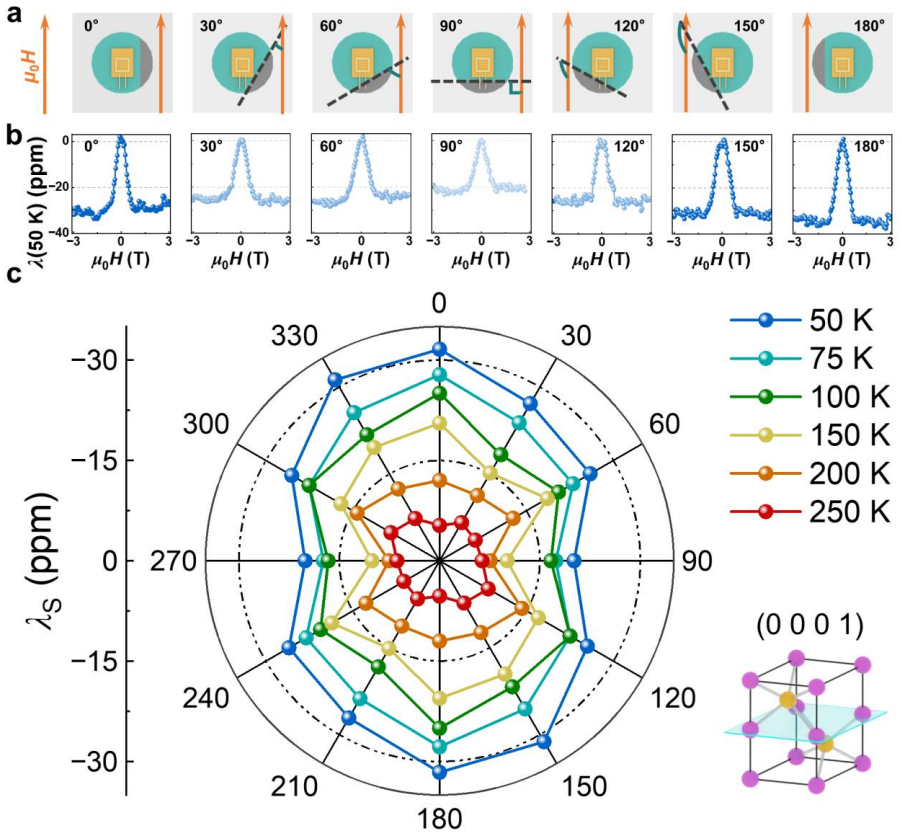
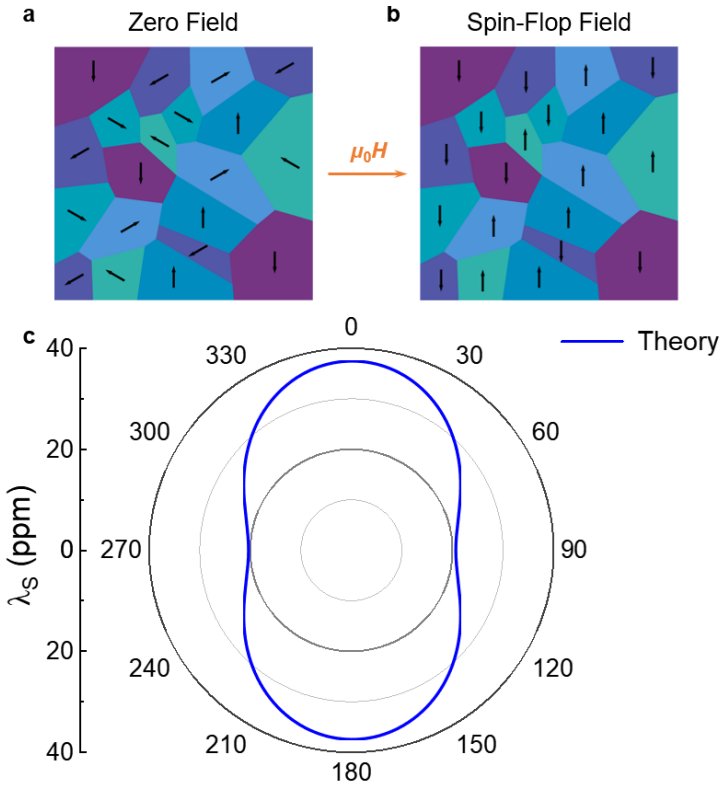
For high-quality MnTe single crystals, the magnetostriction saturates under a moderate field of ~0.7 T with an intriguing two-fold-symmetry anisotropy. First-principles calculations reveal that the saturated and anisotropic magnetostriction originates from symmetry-allowed coupling between elastic strain and its Néel order parameter. These findings break the traditional wisdom on antiferromagnetic magnetostriction.
What carries the argument
Symmetry-allowed coupling between elastic strain and the Néel order parameter
If this is right
- Antiferromagnets can display saturating magnetostriction under moderate fields when their symmetry permits coupling to the Néel order.
- The magnetostriction anisotropy in MnTe follows two-fold symmetry consistent with the allowed strain-Néel interaction.
- Altermagnets become candidates for magnetomechanical devices that operate at accessible field strengths.
- The effect provides a route to mechanical readout of the Néel vector orientation in collinear antiferromagnets.
Where Pith is reading between the lines
- Similar saturated and anisotropic magnetostriction may appear in other altermagnets sharing comparable crystal symmetries.
- Strain could serve as a control knob for Néel order in altermagnetic devices, extending beyond magnetic-field control.
- Measurements across a range of sample qualities would isolate whether the saturation requires the ideal altermagnetic symmetry or persists under disorder.
Load-bearing premise
The saturation and two-fold anisotropy arise specifically from the altermagnetic symmetry permitting direct strain-Néel coupling rather than from sample quality, experimental details, or other material-specific effects.
What would settle it
Magnetostriction measurements on high-quality MnTe crystals that fail to saturate near 0.7 T or lack the reported two-fold anisotropy, or first-principles calculations that reproduce the data without invoking the symmetry-allowed strain-Néel coupling, would falsify the central claim.
Figures
read the original abstract
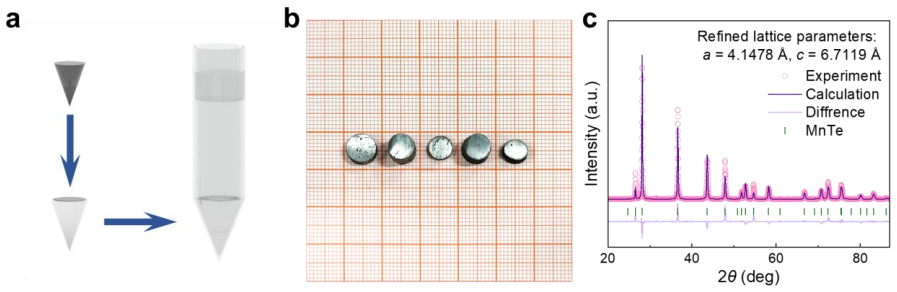
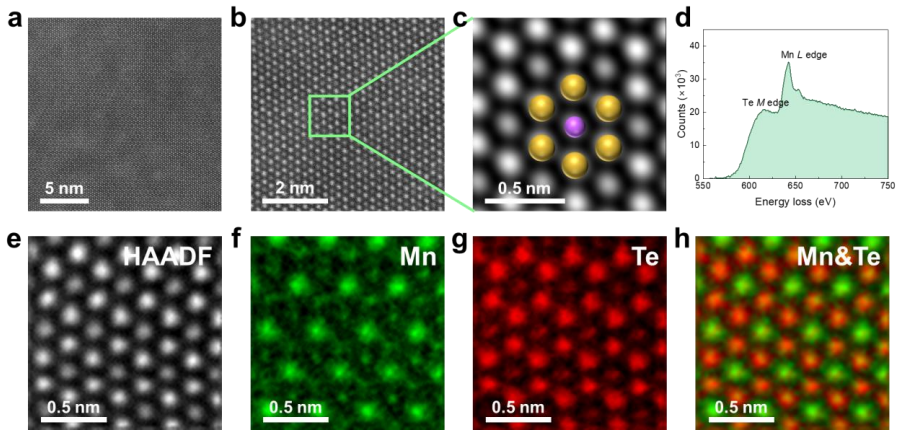
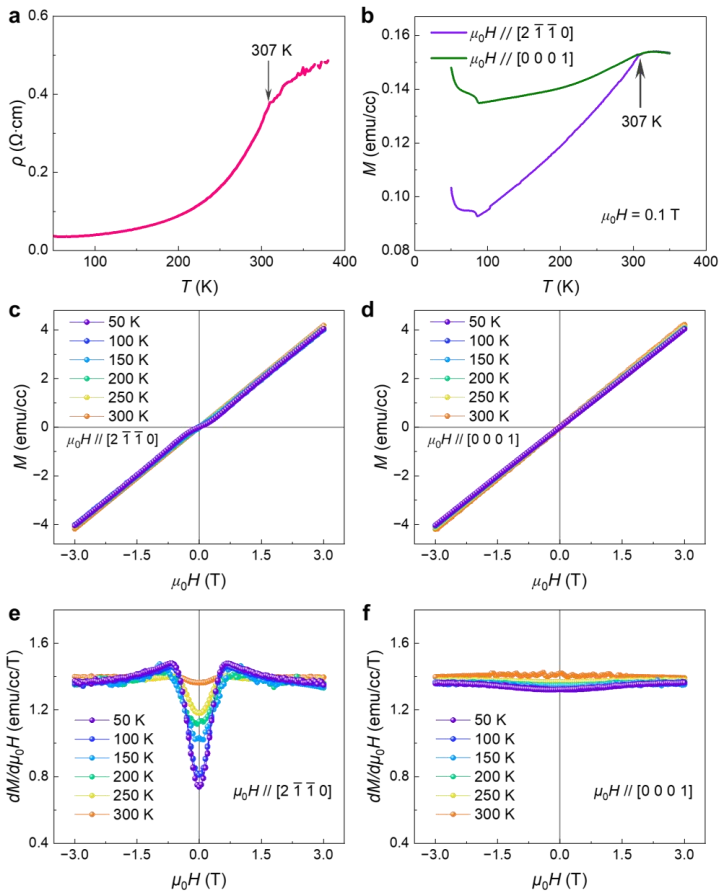
Magnetostriction, a fundamental phenomenon bridging magnetism and mechanics, has enabled a broad spectrum of applications. For almost two centuries, it has been mainly investigated for ferromagnets. Regarding the magnetostriction of antiferromagnets (AFMs), limitedly known examples for both conventional collinear AFMs and noncollinear AFMs predominantly exhibit non-saturating magnetic-field dependence. Herein, we report an easily saturated magnetostriction effect in a prototypical altermagnet - MnTe, which is an emerging class of collinear AFMs with special crystal symmetries. For high-quality MnTe single crystals, the magnetostriction saturates under a moderate field of ~0.7 T with an intriguing two-fold-symmetry anisotropy. First-principles calculations reveal that the saturated and anisotropic magnetostriction originates from symmetry-allowed coupling between elastic strain and its N\'eel order parameter. These findings break the traditional wisdom on antiferromagnetic magnetostriction.
Editorial analysis
A structured set of objections, weighed in public.
Referee Report
Summary. The manuscript reports saturated magnetostriction (~0.7 T) with two-fold anisotropy in high-quality MnTe single crystals, an altermagnet. First-principles calculations attribute the saturation and anisotropy to symmetry-allowed coupling between elastic strain and the Néel order parameter, which is permitted by the altermagnetic point group but forbidden in conventional collinear antiferromagnets; this is presented as breaking traditional expectations for AFM magnetostriction.
Significance. If the experimental saturation and anisotropy are robustly supported by the data and the DFT correctly isolates the symmetry-allowed strain-Néel term as the origin, the result would be significant for altermagnetism and magnetoelasticity. It supplies a concrete mechanism distinguishing altermagnets from conventional AFMs and offers a falsifiable route (via symmetry analysis and strain-Néel coupling strength) for predicting similar behavior in other altermagnets. The combination of single-crystal experiment and first-principles calculation is a clear strength.
minor comments (2)
- [Abstract] Abstract: the phrase 'high-quality MnTe single crystals' is used without reference to the characterization metrics (e.g., rocking-curve width, residual resistivity ratio) that appear later; a brief parenthetical or citation to the methods section would improve clarity.
- The two-fold anisotropy is stated to match the altermagnetic symmetry, but the manuscript should explicitly note which irreducible representation of the strain tensor couples to the Néel vector in the point group (e.g., in the supplementary symmetry table) to make the 'symmetry-allowed' claim immediately verifiable.
Simulated Author's Rebuttal
We thank the referee for the positive assessment of our manuscript and the recommendation for minor revision. The referee summary accurately captures our key experimental observation of easily saturated, two-fold anisotropic magnetostriction in MnTe single crystals and the first-principles attribution to symmetry-allowed strain-Néel coupling permitted by the altermagnetic point group. No specific major comments are listed in the report, so we have no individual points requiring point-by-point rebuttal or revision.
Circularity Check
No significant circularity detected
full rationale
The abstract and available description present an experimental observation of saturated magnetostriction with two-fold anisotropy in MnTe, followed by first-principles calculations attributing it to symmetry-allowed strain-Néel coupling. No equations, parameter fits, or self-citations are shown that reduce any claimed prediction or result to the inputs by construction. The symmetry argument is a direct consequence of the altermagnetic point group rather than an imported uniqueness theorem or ansatz. The derivation chain is self-contained against external benchmarks with no load-bearing circular steps.
Axiom & Free-Parameter Ledger
axioms (1)
- domain assumption Symmetry-allowed coupling between elastic strain and Néel order parameter exists and dominates the magnetostriction response
Reference graph
Works this paper leans on
-
[1]
T.; Troncoso, R
(1) Simensen, H. T.; Troncoso, R. E.; Kamra, A.; Brataas, A. Magnon-Polarons in Cubic Collinear Antiferromagnets. Phys. Rev. B 2019, 99 (6), 064421. (2) Steward, C. R. W.; Fernandes, R. M.; Schmalian, J. Dynamic Paramagnon-Polarons in Altermagnets. Phys. Rev. B 2023, 108 (14), 144418. (3) Baral, R.; Abeykoon, A. M. M.; Campbell, B. J.; Frandsen, B. A. Gia...
2019
discussion (0)
Sign in with ORCID, Apple, or X to comment. Anyone can read and Pith papers without signing in.