REVIEW 1 major objections 1 cited by
Generalizing polar code decoding beyond the 1 to N order enables rateless IR-HARQ codes that match the performance of fixed-rate codes at every rate and length.
Reviewed by Pith at T0; open to challenge. T0 means a machine referee read the full paper against a public rubric. the ladder, T0–T4 →
T0 review · grok-4.3
2026-06-28 21:20 UTC pith:UK6V5YRT
load-bearing objection The paper gives a rateless polar code for IR-HARQ that generalizes decoding order and uses capacity-aware scheduling to match fixed-rate coding gain across rates and lengths. the 1 major comments →
Beyond 1toN Decoding: Capacity-Aware Rateless Polar Codes for IR-HARQ
The pith
A machine-rendered reading of the paper's core claim, the machinery that carries it, and where it could break.
Core claim
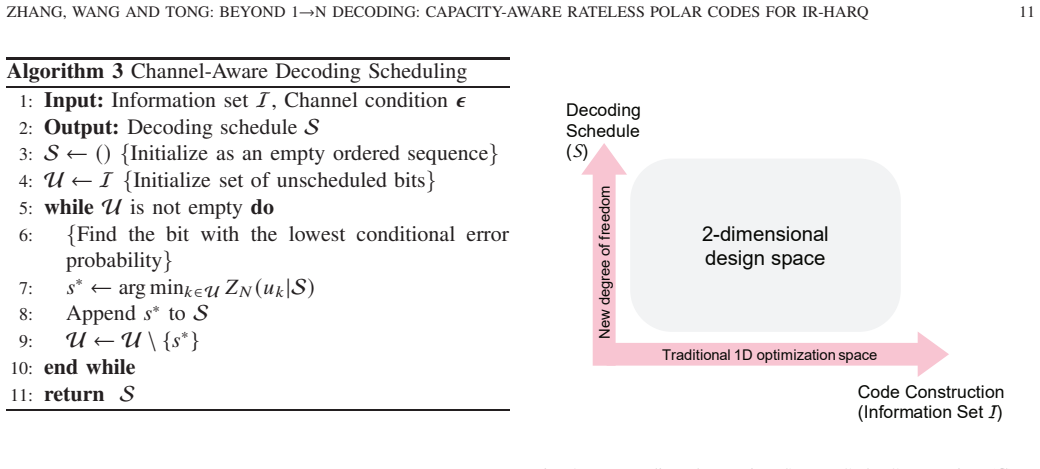
By generalizing the decoding order beyond the standard 1→N sequence, the framework enables a capacity-aware scheduling strategy that prioritizes the decoding of reliable subblocks. The integration of nested parity-check polar construction and reverse bit-mapping supports continuous and arbitrary transmission lengths E in [N_min, N_max]. Simulation results show that the proposed rateless codes match the coding gain of independently optimized fixed-rate codes across the entire range of rates and lengths.
What carries the argument
capacity-aware scheduling strategy that prioritizes reliable subblocks, enabled by generalizing the decoding order beyond 1 to N together with nested parity-check polar construction and reverse bit-mapping
Load-bearing premise
The nested parity-check polar construction combined with reverse bit-mapping supports continuous and arbitrary transmission lengths while enabling capacity-aware scheduling.
What would settle it
A set of block-error-rate curves at several rates and lengths inside the supported range where the proposed rateless code performs worse than a separately optimized fixed-rate polar code of identical parameters would disprove the matching-gain claim.
If this is right
- A single code construction can serve all redundancy levels in IR-HARQ instead of storing multiple fixed-rate codes.
- Transmission length can be varied continuously inside the supported interval without redesign.
- Hardware implementations can handle variable-length transmissions without per-rate optimization.
- Error-correction performance stays comparable to the best fixed-rate polar codes at every operating point.
Where Pith is reading between the lines
- Reordering techniques of this kind could extend to other successive-cancellation decodable code families.
- Prioritizing reliable subblocks first may also reduce average decoding latency in addition to preserving coding gain.
- If the construction works on other channel models, it could simplify adaptive rate selection in communication systems.
Editorial analysis
A structured set of objections, weighed in public.
Referee Report
Summary. The paper introduces a framework for polar codes tailored to flexible IR-HARQ by generalizing the decoding order beyond the standard 1 o N sequence. This enables a capacity-aware scheduling strategy that prioritizes reliable subblocks. The approach integrates nested parity-check polar construction and reverse bit-mapping to support continuous and arbitrary transmission lengths E otin [N_min, N_max]. Simulation results are asserted to demonstrate that the proposed rateless codes achieve coding gains matching those of independently optimized fixed-rate polar codes across the full range of rates and lengths, with an accompanying hardware validation.
Significance. If the simulation equivalence holds under rigorous validation, the work would provide a practical rateless polar coding solution for IR-HARQ that maintains performance parity with fixed-rate designs while enabling continuous rate adaptation. This could be relevant for next-generation wireless systems requiring flexible redundancy.
major comments (1)
- [Abstract] Abstract: the central claim that 'simulation results show that the proposed rateless codes match the coding gain of independently optimized fixed-rate codes' is presented without any description of simulation parameters, channel models, code lengths/rates tested, error metrics, or comparison methodology. This prevents evaluation of whether the equivalence holds or is load-bearing for the framework's utility.
Simulated Author's Rebuttal
We thank the referee for their review and for highlighting the need for greater clarity in the abstract regarding our simulation results. We address this point directly below and will revise the manuscript accordingly.
read point-by-point responses
-
Referee: [Abstract] Abstract: the central claim that 'simulation results show that the proposed rateless codes match the coding gain of independently optimized fixed-rate codes' is presented without any description of simulation parameters, channel models, code lengths/rates tested, error metrics, or comparison methodology. This prevents evaluation of whether the equivalence holds or is load-bearing for the framework's utility.
Authors: We agree that the abstract would be strengthened by including a concise summary of the simulation parameters. The full details (AWGN channel, E ranging continuously over [N_min, N_max], tested rates, BLER metric, and independent fixed-rate polar code baselines) are provided in Section IV of the manuscript. We will revise the abstract to briefly state these elements so that the central claim is self-contained and easier to evaluate. revision: yes
Circularity Check
No significant circularity detected
full rationale
The paper's central claim is an empirical simulation result showing that the proposed rateless polar construction matches the performance of independently optimized fixed-rate codes. No derivation chain, equations, or self-referential definitions are present in the provided material that would reduce a 'prediction' to a fitted input or self-citation by construction. The enabling techniques (nested parity-check polar construction and reverse bit-mapping) are described as design choices supporting arbitrary E, not as outputs derived from the simulation results. The comparison is to external benchmarks, making the result falsifiable outside the paper's own fitted values. This is a standard non-circular engineering contribution.
Axiom & Free-Parameter Ledger
axioms (1)
- standard math Standard channel polarization and successive cancellation decoding properties of polar codes
Cite this review
Pith. "Pith review of Beyond 1$\to$N Decoding: Capacity-Aware Rateless Polar Codes for IR-HARQ." pith.science (2026). https://pith.science/paper/UK6V5YRT
@misc{pith2026260530885,
  author       = {Pith},
  title        = {Pith review of: Beyond 1$\to$N Decoding: Capacity-Aware Rateless Polar Codes for IR-HARQ},
  year         = {2026},
  howpublished = {\url{https://pith.science/paper/UK6V5YRT}},
  note         = {Machine review of arXiv:2605.30885}
}
read the original abstract
This paper introduces a novel framework for polar codes, designed for flexible Incremental Redundancy Hybrid Automatic Repeat Request (IR-HARQ). By generalizing the decoding order beyond the standard 1$\to$N sequence, we enable a capacity-aware scheduling strategy that prioritizes the decoding of reliable subblocks. The framework integrates nested parity-check polar construction and reverse bit-mapping to support continuous and arbitrary transmission lengths $E \in [N_{\min}, N_{\max}]$. Simulation results show that the proposed rateless codes match the coding gain of independently optimized fixed-rate codes across the entire range of rates and lengths. With a validated hardware implementation, this work provides a practical solution for next-generation wireless data channels.
Figures




Forward citations
Cited by 1 Pith paper
-
Enhanced Feedback Mechanisms for Resource-Efficient Incremental Redundancy
IR-HARQ can request exactly the needed retransmission size by predicting it from SNR or first-transmission reliability values, approaching the undetected-error floor with up to 60% smaller retransmissions.
Reference graph
Works this paper leans on
-
[1]
Rate-compatible punctured convolution al codes (RCPC codes) and their applications
J. Hagenauer, “Rate-compatible punctured convolution al codes (RCPC codes) and their applications”, IEEE Transactions on Communications, vol. 36, no. 4, pp. 389–400, April 1988
1988
-
[2]
LT codes
M. Luby, “LT codes”, in 43rd Annual IEEE Symposium on F oundations of Computer Science, V ancouver, BC, Canada, 2002, pp. 271–280
2002
-
[3]
Universal Mobile Telecommunications System (UM TS); Multiplexing and channel coding (FDD) (3GPP TS 25.212),
3GPP , “Universal Mobile Telecommunications System (UM TS); Multiplexing and channel coding (FDD) (3GPP TS 25.212),” Oct. 1999
1999
-
[4]
Near optimum error correctin g coding and decoding: turbo-codes
C. Berrou and A. Glavieux, “Near optimum error correctin g coding and decoding: turbo-codes”, IEEE Transactions on Com- munications, vol. 44, no. 10, pp. 1261–1271, Oct. 1996
1996
-
[5]
Evolved Universal Terrestrial Radio Access (E-U TRA); Multiplexing and channel coding (3GPP TS 36.212),
3GPP , “Evolved Universal Terrestrial Radio Access (E-U TRA); Multiplexing and channel coding (3GPP TS 36.212),” Sep. 200 7
-
[6]
New Radio (NR); Multiplexing and channel coding (3GPP TS 38.212),
3GPP , “New Radio (NR); Multiplexing and channel coding (3GPP TS 38.212),” Jun. 2018
2018
-
[7]
Low-density parity-check codes
R. Gallager, “Low-density parity-check codes”, IRE Transactions on Information Theory , vol. 8, no. 1, pp. 21–28, Jan. 1962
1962
-
[8]
Protograph-Based Raptor-Like LDPC Codes
T. -Y . Chen, K. V akilinia, D. Divsalar and R. D. Wesel, “Protograph-Based Raptor-Like LDPC Codes”, IEEE Transac- tions on Communications , vol. 63, no. 5, pp. 1522–1532, May 2015
2015
-
[9]
Channel polarization: A method for construc ting capacity-achieving codes for symmetric binary-input memo ryless channels
E. Arıkan, “Channel polarization: A method for construc ting capacity-achieving codes for symmetric binary-input memo ryless channels”, IEEE Transactions on Information Theory , vol. 55, no. 7, pp. 3051–3073, Jul. 2009
2009
-
[10]
Beyond Turbo codes: Rate- compatible punctured Polar codes
K. Niu, K. Chen and J. R. Lin, “Beyond Turbo codes: Rate- compatible punctured Polar codes”, in IEEE International Con- ference on Communications (ICC) , pp. 3423–3427, Jun. 2013
2013
-
[11]
A novel puncturing scheme for polar codes
R. Wang and R. Liu, “A novel puncturing scheme for polar codes”, IEEE Communications Letters, vol. 18, no. 12, pp. 2081– 2084, 2014
2081
-
[12]
Capacity-achieving rateless polar codes
B. Li, D. Tse, K. Chen, and H. Shen, “Capacity-achieving rateless polar codes”, in IEEE International Symposium Inf. Theory, pp. 46–50, July 2016
2016
-
[13]
An Adaptive IR-HARQ Scheme for Polar Codes by Polarizing Matrix Extension
M.-M. Zhao, G. Zhang, C. Xu, H. Zhang, R. Li, and J. Wang, “An Adaptive IR-HARQ Scheme for Polar Codes by Polarizing Matrix Extension”, IEEE Commun. Lett. , vol. 22, pp. 1306–1309, July 2018
2018
-
[14]
6G The Next Horizon
W. Tong and P . Zhu, “6G The Next Horizon”, Cambridge Univ . Press, Cambridge, U.K., 2021
2021
-
[15]
Performance of polar codes with t he construction using density evolution
R. Mori and T. Tanaka, “Performance of polar codes with t he construction using density evolution”, IEEE Commun. Lett. , vol. 13, no. 7, pp. 519–521, 2009
2009
-
[16]
How to construct polar codes
I. Tal and A. V ardy, “How to construct polar codes”, IEEE Transactions on Information Theory , vol. 59, no. 10, pp. 6562– 6582, July 2013
2013
-
[17]
Efficient design and decoding of polar cod es
P . Trifonov, “Efficient design and decoding of polar cod es”, IEEE Transactions on Communications vol. 60, no. 11 pp. 3221– 3227, Nov. 2012
2012
-
[18]
Polar code design and rate matching
R1-167209, “Polar code design and rate matching”, 3GPP TSG RAN WG1 Meeting #86, Gothenburg, Sweden, Aug. 2016
2016
-
[19]
/u1D6FD-expansion: A theoretical framework for fast and recursive construction of polar code s
G. He, J. Belfiore, I. Land, G. Yang, X. Liu, Y . Chen, R. Li, J. Wang, Y . Ge, R. Zhang and W. Tong, “/u1D6FD-expansion: A theoretical framework for fast and recursive construction of polar code s”, in IEEE Global Communications Conference , pp. 1–6, Dec. 2017
2017
-
[20]
AI coding: Learning toconstruct error correction codes
L. Huang, H. Zhang, R. Li, Y . Ge, and J. Wang, “AI coding: Learning toconstruct error correction codes”, IEEE Trans. Com- mun., vol. 68, no. 1,pp. 26–39, 2019
2019
-
[21]
Partial Orders of Rate-Compatible Polar Codes
Z. Liu et al., “Partial Orders of Rate-Compatible Polar Codes”, in IEEE International Symposium on Information Theory (ISIT) , Ann Arbor, MI, USA, 2025, pp. 1–6. ZHANG, W ANG AND TONG: BEYOND 1→ N DECODING: CAPACITY -AW ARE RA TELESS POLAR CODES FOR IR-HARQ 19
2025
-
[22]
List decoding of polar codes
I. Tal and A. V ardy, “List decoding of polar codes”, IEEE Transactions on Information Theroy , vol. 61, no. 5, pp. 2213– 2226, May 2015
2015
-
[23]
CRC-aided decoding of polar codes
K. Niu and K. Chen, “CRC-aided decoding of polar codes”, IEEE Communications Letters , vol. 16, no. 10, pp. 1668–1671, Oct. 2012
2012
-
[24]
An Incremental Redundancy HARQ Scheme for Polar Code
M. Li and Y . Wei, “An incremental redundancy HARQ scheme for polar code,” arXiv preprint arXiv:1708.09679 , 2017
work page internal anchor Pith review Pith/arXiv arXiv 2017
-
[25]
Flexibl e IR- HARQ scheme for polar-coded modulation,
P . Y uan, F. Steiner, T. Prinz, and G. Bocherer, “Flexibl e IR- HARQ scheme for polar-coded modulation,” in Proc. IEEE Wire- less Commun. Netw. Conf. W orkshops (WCNCW) , Barcelona, Spain, Apr. 2018, pp. 49–54
2018
-
[26]
A hybrid ARQ scheme based on polar codes,
K. Chen, K. Niu, and J. Lin, “A hybrid ARQ scheme based on polar codes,” IEEE Commun. Lett. , vol. 17, no. 10, pp. 1996– 1999, Oct. 2013
1996
-
[27]
An incremental redundancy hy brid ARQ scheme via puncturing and extending of polar codes,
H. Saber and I. Marsland, “An incremental redundancy hy brid ARQ scheme via puncturing and extending of polar codes,” IEEE Trans. Commun., vol. 63, no. 11, pp. 3964–3973, Nov. 2015
2015
-
[28]
A hybrid ARQ scheme based on equivalent puncturing patterns of polar cod es,
Y . Zhang, K. Qin, C. Jiao, and Z. Zhang, “A hybrid ARQ scheme based on equivalent puncturing patterns of polar cod es,” in Proc. IEEE 88th V eh. Technol. Conf. (VTC-Fall), Chicago, IL, USA, Aug. 2018, pp. 1–5
2018
-
[29]
A Simplified Successive-Cancellation Decoder for Polar Codes
A. Alamdar-Yazdi and F. R. Kschischang, “A Simplified Successive-Cancellation Decoder for Polar Codes”, IEEE Com- munications Letters , vol. 15, no. 12, pp. 1378–1380, December 2011
2011
-
[30]
Fast Polar Decoders: Algorithm and Implementation
G. Sarkis, P . Giard, A. V ardy, C. Thibeault and W. J. Gros s, “Fast Polar Decoders: Algorithm and Implementation”, IEEE Journal on Selected Areas in Communications , vol. 32, no. 5, pp. 946–957, May 2014
2014
-
[31]
Enabling Fast Polar SC Decoding with IR-HARQ
M. Jalaleddine, J. A. Mohamad, J. Li and W. J. Gross, “En- abling Fast Polar SC Decoding with IR-HARQ”, arXiv preprint arXiv:2512.04418 (2025)
work page internal anchor Pith review Pith/arXiv arXiv 2025
-
[32]
Hardware-Friend ly IR-HARQ for Polar SCL Decoders
M. Jalaleddine, J. Li and W. J. Gross, “Hardware-Friend ly IR-HARQ for Polar SCL Decoders”, in IEEE International Conference on Communications (ICC) , Montreal, QC, Canada, 2025, pp. 2008-2013
2025
discussion (0)
Sign in with ORCID, Apple, or X to comment. Anyone can read and Pith papers without signing in.