Nuclear matter and proton parton distributions in a light-front Hamiltonian framework
Pith reviewed 2026-06-28 22:08 UTC · model grok-4.3
The pith
At nuclear saturation density the nucleon gains slight gluon probability while valence probability and quark momentum fraction drop, with quark and gluon distributions enhanced at large x.
A machine-rendered reading of the paper's core claim, the machinery that carries it, and where it could break.
Core claim
Within this light-front framework, at nuclear saturation density the gluon probability in the nucleon wave function increases slightly while the valence probability and quark momentum fraction decrease. The unpolarized quark and gluon distributions exhibit a noticeable enhancement at large momentum fraction x ≳ 0.4 when evolved to Q² = 10 GeV².
What carries the argument
Basis Light-Front Quantization of the in-medium nucleon eigenvalue problem inside the quark-meson coupling model with mean-field scalar and vector fields and truncation to one dynamical gluon
If this is right
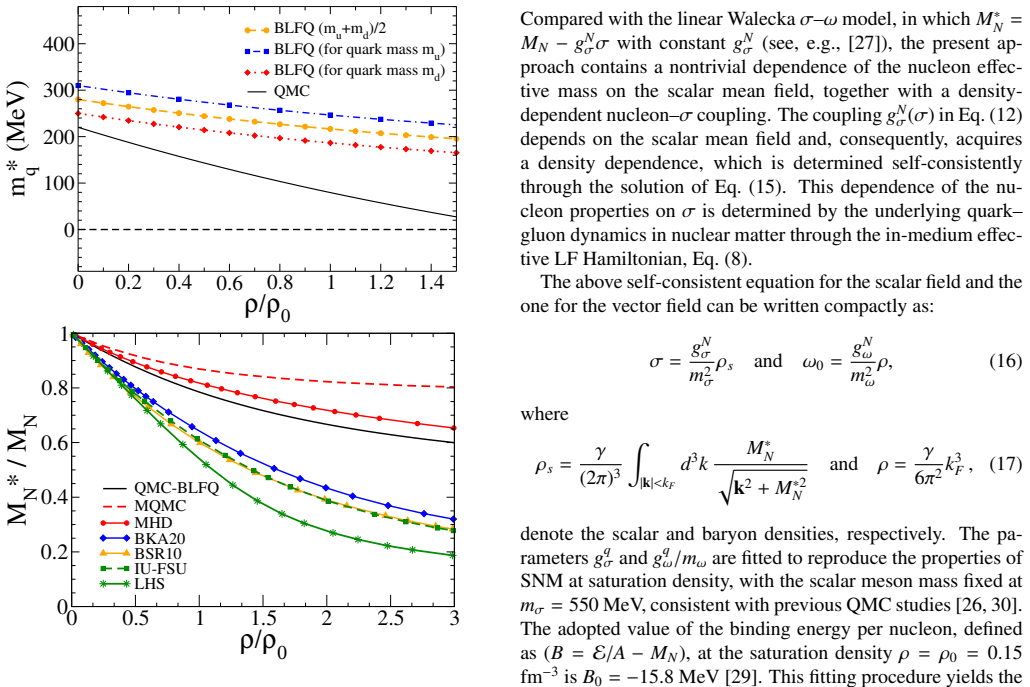
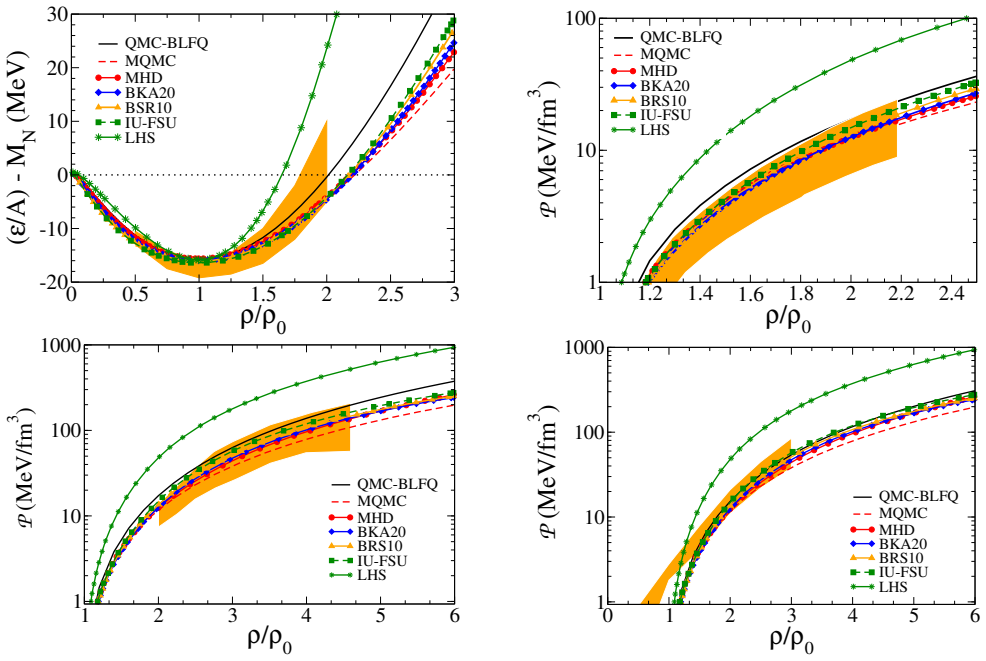
- Energy per nucleon, pressure, and incompressibility remain consistent with empirical constraints at saturation density.
- Gluon probability in the nucleon wave function rises slightly at saturation density.
- Valence probability and quark momentum fraction decrease at the same density.
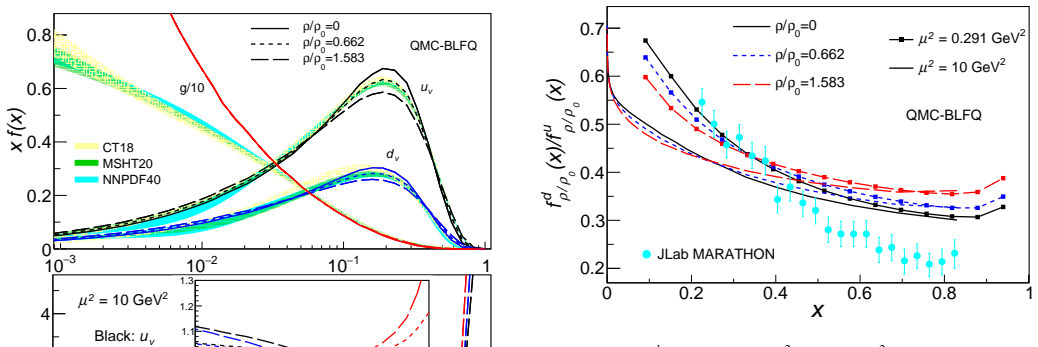
- Unpolarized quark and gluon distributions are enhanced at x ≳ 0.4 at the evolved scale Q² = 10 GeV².
Where Pith is reading between the lines
- The same framework could be used to compute nuclear modification factors for deep-inelastic scattering at high x.
- Extending the gluon truncation beyond one dynamical gluon would test the robustness of the large-x enhancement.
- The density-dependent mass shift could be applied to other observables such as the EMC effect in different nuclei.
Load-bearing premise
The truncation of the Hamiltonian to at most one dynamical gluon together with the mean-field treatment of medium effects.
What would settle it
A measurement showing no enhancement in nuclear quark or gluon distributions at x ≳ 0.4 when evolved to Q² = 10 GeV² would contradict the predicted medium-induced changes.
Figures

read the original abstract
We develop a light-front Hamiltonian formulation of symmetric nuclear matter within the quark-meson coupling model, using Basis Light-Front Quantization to solve the in-medium nucleon eigenvalue problem. The Hamiltonian incorporates confinement in the valence sector and is truncated to include up to one dynamical gluon. Medium effects are introduced via scalar and vector mean fields, yielding a self-consistent, density-dependent effective quark mass and modified nucleon structure. The resulting energy per nucleon, pressure, and incompressibility are consistent with empirical constraints at the saturation point. At nuclear saturation density, the gluon probability in the nucleon wave function increases slightly, while the valence probability and quark momentum fraction decrease. The unpolarized quark and gluon distributions show a noticeable enhancement at large momentum fraction ($x \gtrsim 0.4$), illustrated at an evolved scale of $Q^{2} = 10 \mathrm{GeV}^{2}$.
Editorial analysis
A structured set of objections, weighed in public.
Referee Report
Summary. The paper develops a light-front Hamiltonian formulation of symmetric nuclear matter in the quark-meson coupling model, solved via Basis Light-Front Quantization (BLFQ). The Hamiltonian includes confinement in the valence sector and is truncated to at most one dynamical gluon; medium effects enter through self-consistent, density-dependent scalar and vector mean fields that modify the effective quark mass and nucleon structure. At saturation density the calculation yields a slight increase in gluon probability, a decrease in valence probability and quark momentum fraction, and an enhancement of unpolarized quark and gluon distributions at x ≳ 0.4 (shown at Q² = 10 GeV²), while the energy per nucleon, pressure, and incompressibility remain consistent with empirical constraints.
Significance. If the reported medium-induced shifts in parton distributions survive beyond the one-gluon truncation, the work supplies a Hamiltonian-based route from nuclear saturation properties to modifications of nucleon PDFs. The self-consistent mean-field treatment combined with BLFQ offers a technically novel framework that could be extended to polarized distributions or finite nuclei. The strength of the approach lies in its explicit light-front dynamics and the direct link between bulk nuclear observables and parton-level quantities.
major comments (2)
- [Abstract] Abstract (and the description of the Hamiltonian truncation): the central claims of a slight increase in gluon probability and a noticeable large-x enhancement rest on a Fock-space cutoff limited to valence plus at most one dynamical gluon. Because the gluon sector cannot accommodate additional emission or absorption channels, the medium-induced redistribution of momentum between quarks and gluons is computed in a restricted Hilbert space whose response may not be representative of the full theory.
- [Abstract] Abstract: the self-consistent solution at saturation density employs free parameters (confinement strength and quark-meson coupling constants) that are adjusted to nuclear data. It is therefore unclear whether the reported changes in valence probability, gluon probability, and large-x distributions constitute independent predictions or are largely shaped by those fits.
Simulated Author's Rebuttal
We thank the referee for the detailed and constructive report. We address each major comment below, clarifying the scope of our approximations and the predictive nature of the parton-distribution results within the model. We propose targeted revisions to the abstract and text to improve clarity.
read point-by-point responses
-
Referee: [Abstract] Abstract (and the description of the Hamiltonian truncation): the central claims of a slight increase in gluon probability and a noticeable large-x enhancement rest on a Fock-space cutoff limited to valence plus at most one dynamical gluon. Because the gluon sector cannot accommodate additional emission or absorption channels, the medium-induced redistribution of momentum between quarks and gluons is computed in a restricted Hilbert space whose response may not be representative of the full theory.
Authors: We agree that the Fock-space truncation to valence quarks plus at most one dynamical gluon restricts the gluon dynamics and that the reported medium-induced shifts are obtained within this limited Hilbert space. The manuscript already states the truncation explicitly in the Hamiltonian section and notes that higher Fock components are omitted. The results therefore constitute a controlled first exploration rather than a claim about the complete theory. We will revise the abstract to emphasize that all quantitative statements refer to the one-gluon truncation and will add a brief remark on the expected direction of future extensions. revision: yes
-
Referee: [Abstract] Abstract: the self-consistent solution at saturation density employs free parameters (confinement strength and quark-meson coupling constants) that are adjusted to nuclear data. It is therefore unclear whether the reported changes in valence probability, gluon probability, and large-x distributions constitute independent predictions or are largely shaped by those fits.
Authors: The confinement strength and quark-meson couplings are fixed once by reproducing the empirical saturation point (binding energy per nucleon and saturation density). With these parameters held fixed, the density-dependent mean fields are solved self-consistently and the resulting light-front wave functions determine the parton distributions. The modifications to valence and gluon probabilities and to the large-x distributions are therefore genuine predictions of the model at the parton level, given the nuclear-matter constraints. We will insert a clarifying sentence in the abstract and introduction to make this separation explicit. revision: yes
Circularity Check
Derivation chain is self-contained; no circular reductions identified
full rationale
The paper constructs the in-medium nucleon wave function by solving the light-front Hamiltonian eigenvalue problem in BLFQ under a Fock-space truncation (valence plus at most one dynamical gluon) with density-dependent scalar and vector mean fields taken from the quark-meson coupling model. The resulting probabilities, momentum fractions, and evolved distributions at saturation density are direct outputs of that solution; the reported consistency of energy per nucleon, pressure, and incompressibility with empirical values is presented as a validation check rather than an input that forces the parton-distribution shifts. No equations are shown that define a quantity in terms of itself, rename a fit as a prediction, or reduce the central claim to a self-citation chain. The derivation therefore remains independent of its own outputs.
Axiom & Free-Parameter Ledger
free parameters (2)
- confinement strength
- quark-meson coupling constants
axioms (2)
- domain assumption Hamiltonian truncated to at most one dynamical gluon
- domain assumption Medium effects captured entirely by uniform scalar and vector mean fields
Reference graph
Works this paper leans on
-
[1]
S. Aoki, T. Doi, Lattice QCD and Baryon-Baryon In- teractions, 2023, pp. 1–31.arXiv:2402.11759,doi: 10.1007/978-981-15-8818-1_50-1
-
[2]
P. A. M. Guichon, A possible quark mechanism for the saturation of nuclear matter, Phys. Lett. B 200 (1988) 235–240.doi:10.1016/0370-2693(88)90762-9
-
[3]
Frederico, B
T. Frederico, B. V . Carlson, R. A. Rego, M. S. Hus- sein, Quark Structure of the Nucleon and Quantum Hadro- dynamics, J. Phys. G 15 (1989) 297.doi:10.1088/ 0954-3899/15/3/007
1989
-
[4]
On the geometry of moduli space of vacua in n = 2 supersymmetric yang-mills theory,
K. Saito, A. W. Thomas, Self-consistent description of fi- nite nuclei based on a relativistic quark model, Phys. Lett. B 327 (1994) 9–15.doi:10.1016/0370-2693(94) 91555-0
-
[5]
S. J. Brodsky, H.-C. Pauli, S. S. Pinsky, Quantum chromodynamics and other field theories on the light cone, Phys. Rept. 301 (1998) 299–486.doi:10.1016/ S0370-1573(97)00089-6
1998
-
[6]
B. L. G. Bakker, et al., Light-Front Quantum Chromodynamics: A framework for the analy- sis of hadron physics, Nucl. Phys. B Proc. Suppl. 251-252 (2014) 165–174.arXiv:1309.6333, doi:10.1016/j.nuclphysbps.2014.05.004
work page internal anchor Pith review Pith/arXiv arXiv doi:10.1016/j.nuclphysbps.2014.05.004 2014
-
[8]
X. Zhao, J. P. Vary, Basis light-front quantization ap- proach to positronium, Phys. Rev. D 90 (2014) 034006. doi:10.1103/PhysRevD.90.034006
-
[9]
J. P. Vary, C. Mondal, et al., Nucleon structure from ba- sis light-front quantization: status and prospects, The Eu- ropean Physical Journal Special Topics (2025).doi: 10.1140/epjs/s11734-025-02084-y
-
[10]
P. A. M. Dirac, Forms of Relativistic Dynamics, Rev. Mod. Phys. 21 (1949) 392–399.doi:10.1103/ RevModPhys.21.392
1949
-
[11]
S. Xu, C. Mondal, X. Zhao, Y . Li, J. P. Vary, Quark and gluon spin and orbital angular momentum in the pro- ton, Phys. Rev. D 108 (9) (2023) 094002.arXiv:2209. 08584,doi:10.1103/PhysRevD.108.094002
-
[12]
B. Lin, S. Nair, S. Xu, Z. Hu, C. Mondal, X. Zhao, J. P. Vary, Generalized parton distributions of gluon in proton: A light-front quantization approach, Phys. Lett. B 847 (2023) 138305.arXiv:2308.08275,doi:10.1016/j. physletb.2023.138305
work page doi:10.1016/j 2023
-
[13]
H. Yu, Z. Hu, S. Xu, C. Mondal, X. Zhao, J. P. Vary, Transverse-momentum-dependent gluon distributions of proton within basis light-front quantization, Phys. Lett. B 855 (2024) 138831.arXiv:2403.06125,doi:10. 1016/j.physletb.2024.138831
arXiv 2024
-
[14]
Z. Zhu, S. Xu, J. Wu, H. Yu, Z. Hu, J. Lan, C. Mondal, X. Zhao, J. P. Vary, Transverse structure of the proton be- yond leading twist: A light-front Hamiltonian approach, 8 Phys. Lett. B 855 (2024) 138829.arXiv:2404.13720, doi:10.1016/j.physletb.2024.138829
-
[15]
B. Lin, S. Nair, C. Mondal, S. Xu, Z. Hu, P. Zhang, X. Zhao, J. P. Vary, Chiral-odd gluon generalized parton distributions in the proton: A light-front quantization ap- proach, Phys. Lett. B 860 (2025) 139153.arXiv:2408. 09988,doi:10.1016/j.physletb.2024.139153
-
[16]
P. Zhang, Y . Liu, S. Xu, C. Mondal, X. Zhao, J. P. Vary, Gluon skewed generalized parton distributions of proton from a light-front Hamiltonian approach, Phys. Lett. B 866 (2025) 139584.arXiv:2501.10119,doi: 10.1016/j.physletb.2025.139584
-
[17]
S. Nair, C. Mondal, S. Xu, X. Zhao, J. P. Vary, Pro- ton gravitational structure and mass decomposition on the light front, Phys. Rev. D 112 (11) (2025) 114001. arXiv:2506.07554,doi:10.1103/79fs-5ghd
- [18]
- [19]
-
[20]
S. D. Glazek, R. J. Perry, Special example of relativistic Hamiltonian field theory, Phys. Rev. D 45 (1992) 3740– 3754.doi:10.1103/PhysRevD.45.3740
-
[21]
S. J. Brodsky, G. F. de Teramond, H. G. Dosch, J. Erlich, Light-Front Holographic QCD and Emerging Confine- ment, Phys. Rept. 584 (2015) 1–105.arXiv:1407.8131, doi:10.1016/j.physrep.2015.05.001
work page internal anchor Pith review Pith/arXiv arXiv doi:10.1016/j.physrep.2015.05.001 2015
-
[23]
X. Zhao, H. Honkanen, P. Maris, J. P. Vary, S. J. Brodsky, Electron g-2 in Light-Front Quantization, Phys. Lett. B 737 (2014) 65–69.arXiv:1402.4195,doi:10.1016/ j.physletb.2014.08.020
Pith/arXiv arXiv 2014
-
[24]
J. Lan, C. Mondal, X. Zhao, T. Frederico, J. P. Vary, Glu- onic contributions to the pion parton distribution func- tions, Phys. Rev. D 111 (11) (2025) L111903.arXiv: 2406.18878,doi:10.1103/3z39-l1kg
-
[25]
J. Lan, K. Fu, C. Mondal, X. Zhao, j. P. Vary, Light mesons with one dynamical gluon on the light front, Phys. Lett. B 825 (2022) 136890.arXiv:2106.04954,doi: 10.1016/j.physletb.2022.136890
-
[26]
E. F. Batista, B. V . Carlson, T. Frederico, Mean field and pairing properties of nuclear matter in a quark me- son coupling model, Nucl. Phys. A 697 (2002) 469–491. doi:10.1016/S0375-9474(01)01250-7
-
[27]
B. D. Serot, J. D. Walecka, The Relativistic Nuclear Many Body Problem, Adv. Nucl. Phys. 16 (1986) 1–327
1986
-
[28]
G. H. S. O. Yabusaki, J. P. B. C. de Melo, K. Tsushima, T. Frederico, W. de Paula, Kaon structure in the nuclear medium within the light front approach, Phys. Rev. D 109 (5) (2024) 054024.arXiv:2310.11262,doi:10. 1103/PhysRevD.109.054024
arXiv 2024
-
[29]
P. G. Reinhard, The Relativistic Mean Field Description of Nuclei and Nuclear Dynamics, Rept. Prog. Phys. 52 (1989) 439.doi:10.1088/0034-4885/52/4/002
-
[30]
W. de Paula, C.-R. Ji, J. P. B. C. de Melo, T. Fred- erico, O. Lourenço, The holographic paradigm of hadron dynamics for medium modified nuclear matters, Phys. Lett. B 803 (2020) 135339.doi:10.1016/j.physletb. 2020.135339
-
[31]
B. K. Agrawal, Asymmetric nuclear matter and neutron- skin in extended relativistic mean field model, Phys. Rev. C 81 (2010) 034323.arXiv:1003.3295,doi:10.1103/ PhysRevC.81.034323
Pith/arXiv arXiv 2010
-
[32]
S. K. Dhiman, R. Kumar, B. K. Agrawal, Non-rotating and rotating neutron stars in the extended field theoretical model, Phys. Rev. C 76 (2007) 045801.arXiv:0709. 4081,doi:10.1103/PhysRevC.76.045801
-
[33]
F. J. Fattoyev, C. J. Horowitz, J. Piekarewicz, G. Shen, Relativistic effective interaction for nuclei, giant res- onances, and neutron stars, Phys. Rev. C 82 (2010) 055803.arXiv:1008.3030,doi:10.1103/PhysRevC. 82.055803
work page internal anchor Pith review Pith/arXiv arXiv doi:10.1103/physrevc 2010
-
[34]
S. Huth, et al., Constraining Neutron-Star Matter with Microscopic and Macroscopic Collisions, Nature 606 (2022) 276–280.arXiv:2107.06229,doi:10.1038/ s41586-022-04750-w
arXiv 2022
-
[35]
A. Le Fèvre, Y . Leifels, W. Reisdorf, J. Aichelin, C. Hart- nack, Constraining the nuclear matter equation of state around twice saturation density, Nucl. Phys. A 945 (2016) 112–133.arXiv:1501.05246,doi:10.1016/ j.nuclphysa.2015.09.015
Pith/arXiv arXiv 2016
-
[36]
Results of the ASY-EOS experiment at GSI: The symmetry energy at suprasaturation density
P. Russotto, et al., Results of the ASY-EOS experiment at GSI: The symmetry energy at suprasaturation density, Phys. Rev. C 94 (3) (2016) 034608.arXiv:1608.04332, doi:10.1103/PhysRevC.94.034608
work page internal anchor Pith review Pith/arXiv arXiv doi:10.1103/physrevc.94.034608 2016
-
[37]
W. G. Lynch, M. B. Tsang, Y . Zhang, P. Danielewicz, M. Famiano, Z. Li, A. W. Steiner, Probing the Symmetry Energy with Heavy Ions, Prog. Part. Nucl. Phys. 62 (2009) 427.arXiv:0901.0412,doi:10.1016/j.ppnp.2009. 01.001
work page internal anchor Pith review Pith/arXiv arXiv doi:10.1016/j.ppnp.2009 2009
-
[38]
P. Danielewicz, R. Lacey, W. G. Lynch, Determination of the equation of state of dense matter, Science 298 (2002) 1592–1596.arXiv:nucl-th/0208016,doi:10.1126/ science.1078070. 9
Pith/arXiv arXiv 2002
-
[39]
Y . Wang, C. Guo, Q. Li, A. Le Fèvre, Y . Leifels, W. Traut- mann, Determination of the nuclear incompressibility from the rapidity-dependent elliptic flow in heavy-ion col- lisions at beam energies 0.4 A –1.0 A GeV, Phys. Lett. B 778 (2018) 207–212.arXiv:1804.04293,doi:10. 1016/j.physletb.2018.01.035
Pith/arXiv arXiv 2018
-
[40]
LHAPDF6: parton density access in the LHC precision era
A. Buckley, J. Ferrando, S. Lloyd, K. Nordström, B. Page, M. Rüfenacht, M. Schönherr, G. Watt, LHAPDF6: parton density access in the LHC precision era, Eur. Phys. J. C 75 (2015) 132.arXiv:1412.7420,doi:10.1140/epjc/ s10052-015-3318-8
work page internal anchor Pith review Pith/arXiv arXiv doi:10.1140/epjc/ 2015
-
[41]
D. Abrams, et al., Measurement of the Nucleon Fn 2/F p 2 Structure Function Ratio by the Jefferson Lab MARATHON Tritium/Helium-3 Deep Inelastic Scattering Experiment, Phys. Rev. Lett. 128 (13) (2022) 132003.arXiv:2104.05850,doi:10.1103/ PhysRevLett.128.132003
arXiv 2022
-
[42]
D. F. Geesaman, K. Saito, A. W. Thomas, The nuclear EMC effect, Ann. Rev. Nucl. Part. Sci. 45 (1995) 337– 390.doi:10.1146/annurev.ns.45.120195.002005
-
[43]
P. R. Norton, The EMC effect, Rept. Prog. Phys. 66 (2003) 1253–1297.doi:10.1088/0034-4885/66/8/201
-
[44]
A. W. Denniston, et al., Modification of Quark-Gluon Dis- tributions in Nuclei by Correlated Nucleon Pairs, Phys. Rev. Lett. 133 (15) (2024) 152502.arXiv:2312.16293, doi:10.1103/PhysRevLett.133.152502
-
[45]
Fomin, et al., Long Range Outlook for Short-Range Correlations (1 2026).arXiv:2601.09568
N. Fomin, et al., Long Range Outlook for Short-Range Correlations (1 2026).arXiv:2601.09568
arXiv 2026
-
[46]
T. Malik, J. Cartaxo, C. Providência, Observational con- straints on neutron star matter equation of state, Journal of Subatomic Particles and Cosmology 4 (2025) 100086. doi:10.1016/j.jspc.2025.100086. 10
discussion (0)
Sign in with ORCID, Apple, or X to comment. Anyone can read and Pith papers without signing in.