Towards Effective Long-Video Event Prediction via Multi-Level Event Semantics Mining
Pith reviewed 2026-06-28 23:15 UTC · model grok-4.3
The pith
VISTA predicts future events in long videos by mining multi-level semantics with visual prompts and iterative retrieval.
A machine-rendered reading of the paper's core claim, the machinery that carries it, and where it could break.
Core claim
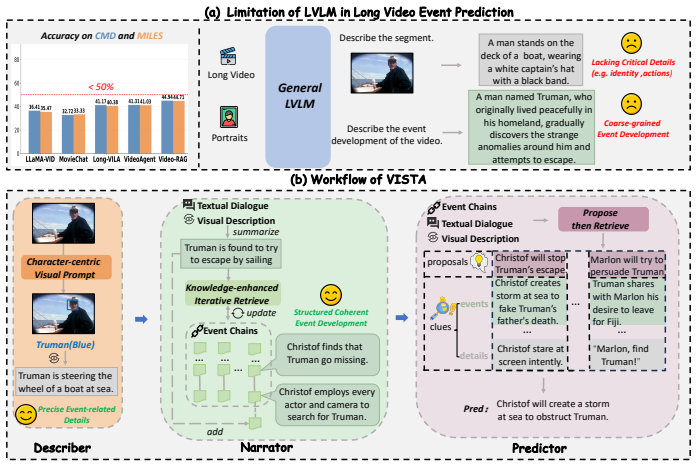
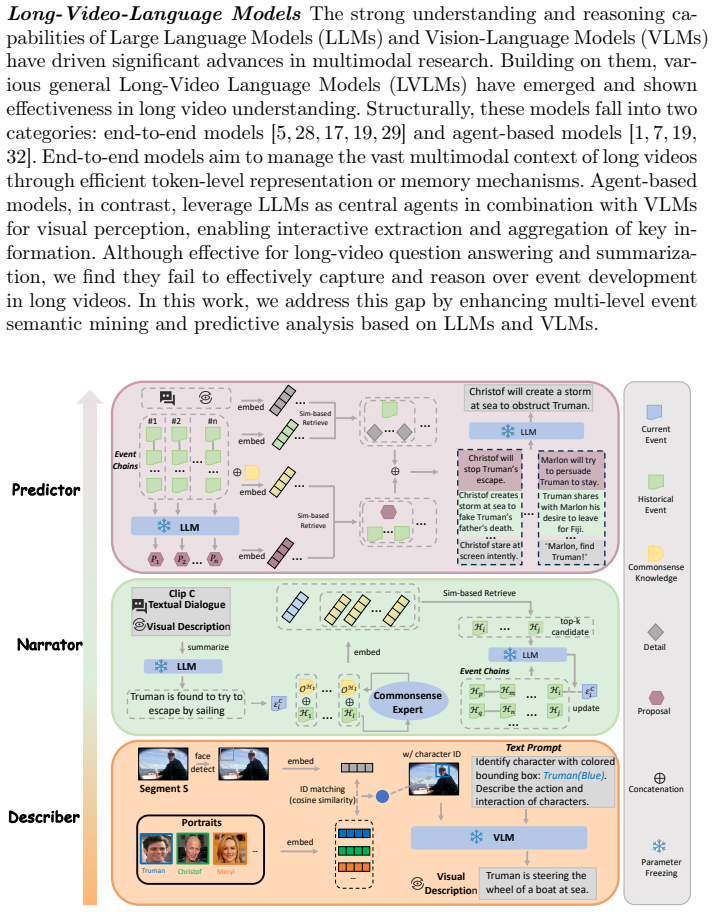
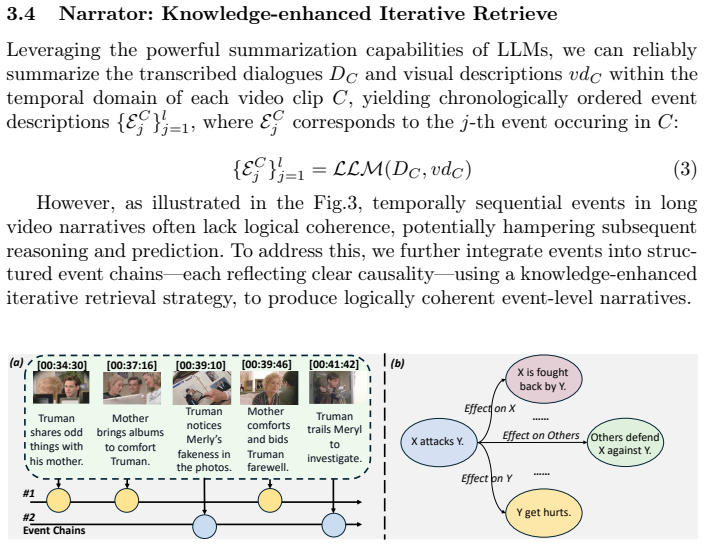
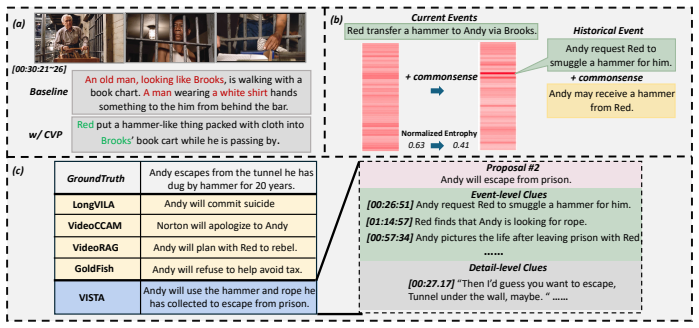
VISTA is a multi-level event semantics mining framework that first applies a character-centric visual prompt to extract event-related visual details at the detail level, then uses a knowledge-enhanced iterative retrieval strategy to construct logically coherent event chains at the event level, and finally adopts a propose-then-retrieve strategy to generate diverse proposals and integrate multi-level clues for robust future event predictions.
What carries the argument
The VISTA multi-level event semantics mining framework that combines character-centric visual prompts, knowledge-enhanced iterative retrieval, and propose-then-retrieve to extract and integrate semantics.
If this is right
- Enables more precise extraction of event-related visual details from extended video footage.
- Allows progressive construction of logically coherent event chains from extracted details.
- Yields more robust and accurate future event predictions by fusing clues across detail and narrative levels.
- Demonstrates effectiveness through validation on real-world long-video datasets.
Where Pith is reading between the lines
- The same layered mining approach might transfer to related tasks such as long-video summarization or anomaly detection by reusing the prompt and retrieval modules.
- Connecting the framework to external knowledge bases beyond the paper's iterative step could further stabilize narrative coherence in ambiguous videos.
- Testing VISTA on live or streaming video feeds would reveal whether the propose-then-retrieve step scales under time constraints.
Load-bearing premise
The three strategies of character-centric prompts, iterative retrieval, and propose-then-retrieve will succeed at precise detail extraction and fine-grained event analysis where current long-video models fail.
What would settle it
A head-to-head test on a standard long-video event prediction benchmark in which VISTA produces no measurable gain in prediction accuracy over unmodified long-video language models.
Figures
read the original abstract
Accurately predicting future events is fundamental to content understanding and decision-making across various domains. While prior research has primarily focused on text or short-video scenarios, long-video event prediction, characterized by vast multimodal context and more complex narratives, remains underexplored. Meanwhile, although recent Long-Video Language Models (LVLMs), built on Large Language Models (LLMs) and Vision-Language Models (VLMs), have shown promise in long-video question answering and summarization, they struggle to generalize to event prediction, as they can neither precisely extract event-related details nor perform fine-grained analysis of event development. To address this gap, we propose VISTA, a multi-level event semantics mining framework for long-video event prediction. Initially, VISTA applies a character-centric visual prompt to precisely extract event-related visual details, enhancing detail-level semantics; subsequently, it employs a knowledge-enhanced iterative retrieval strategy, guiding the LLM to progressively construct logically coherent event chains, thereby improving event-level narratives; ultimately, VISTA adopts a human-like propose-then-retrieve strategy to generate diverse future-oriented proposals and integrate multi-level clues, producing robust and accurate predictions. Extensive experiments on real-world datasets validate the effectiveness of VISTA for long-video event prediction.
Editorial analysis
A structured set of objections, weighed in public.
Referee Report
Summary. The manuscript presents VISTA, a multi-level event semantics mining framework designed for long-video event prediction. The framework comprises three main components: a character-centric visual prompt for extracting detail-level semantics, a knowledge-enhanced iterative retrieval strategy for constructing event-level narratives, and a propose-then-retrieve strategy for generating robust future predictions. The authors claim that these components address the limitations of existing Long-Video Language Models (LVLMs) in precisely extracting event-related details and performing fine-grained analysis, with effectiveness validated through experiments on real-world datasets.
Significance. Should the experimental validation hold, this work could offer a novel structured approach to long-video event prediction by mining semantics at multiple levels, potentially advancing the field beyond current LVLMs' capabilities in handling complex narratives. It emphasizes the role of character-centric and knowledge-guided strategies in improving prediction accuracy.
major comments (2)
- [Experiments] The claim of 'extensive experiments on real-world datasets' validating effectiveness lacks accompanying quantitative results, baseline comparisons, or error analysis, leaving the central claim of superior performance unsupported by visible evidence.
- [Method (Section 3)] While the three strategies are motivated by specific failure modes of LVLMs, the paper does not provide sufficient implementation details, such as prompt templates, retrieval algorithms, or integration steps, which are load-bearing for reproducing and verifying the proposed pipeline.
minor comments (1)
- [Abstract] The abstract could be strengthened by briefly mentioning the datasets used and key performance metrics to better support the effectiveness claim.
Simulated Author's Rebuttal
We thank the referee for the constructive feedback. We agree that the manuscript requires additional experimental evidence and implementation details to support the claims. We will revise accordingly to strengthen these aspects.
read point-by-point responses
-
Referee: [Experiments] The claim of 'extensive experiments on real-world datasets' validating effectiveness lacks accompanying quantitative results, baseline comparisons, or error analysis, leaving the central claim of superior performance unsupported by visible evidence.
Authors: We acknowledge this point. The current manuscript version does not include the quantitative results, baseline comparisons, or error analysis in the visible sections. We will add a full Experiments section with quantitative metrics on real-world datasets, comparisons against relevant LVLMs and other baselines, and error analysis to substantiate the effectiveness claims. revision: yes
-
Referee: [Method (Section 3)] While the three strategies are motivated by specific failure modes of LVLMs, the paper does not provide sufficient implementation details, such as prompt templates, retrieval algorithms, or integration steps, which are load-bearing for reproducing and verifying the proposed pipeline.
Authors: We agree that reproducibility requires more details. In the revision, we will expand Section 3 with explicit prompt templates for the character-centric visual prompt, the full algorithm (including pseudocode) for the knowledge-enhanced iterative retrieval, and detailed integration steps for the propose-then-retrieve strategy. revision: yes
Circularity Check
No significant circularity
full rationale
The paper presents VISTA as an engineering pipeline of three sequential components (character-centric visual prompt, knowledge-enhanced iterative retrieval, propose-then-retrieve) motivated by stated limitations of existing LVLMs. No equations, fitted parameters, or derivations appear in the provided abstract or description. No self-citations are used to justify uniqueness theorems or ansatzes, and no predictions reduce to inputs by construction. The approach is self-contained forward design validated by external dataset experiments.
Axiom & Free-Parameter Ledger
Reference graph
Works this paper leans on
-
[1]
arXiv preprint arXiv:2407.12679 (2024)
Ataallah, K., Shen, X., Abdelrahman, E., Sleiman, E., Zhuge, M., Ding, J., Zhu, D., Schmidhuber, J., Elhoseiny, M.: Goldfish: Vision-language understanding of arbitrarily long videos. arXiv preprint arXiv:2407.12679 (2024)
-
[2]
arXiv preprint arXiv:2303.00747 (2023)
Bain, M., Huh, J., Han, T., Zisserman, A.: Whisperx: Time-accurate speech tran- scription of long-form audio. arXiv preprint arXiv:2303.00747 (2023)
-
[3]
In: Proceedings of the Asian Conference on Computer Vision (2020)
Bain, M., Nagrani, A., Brown, A., Zisserman, A.: Condensed movies: Story based retrieval with contextual embeddings. In: Proceedings of the Asian Conference on Computer Vision (2020)
2020
-
[4]
In: Proceedings of the acl workshop on intrinsic and extrinsic evaluation measures for machine translation and/or summa- rization
Banerjee, S., Lavie, A.: Meteor: An automatic metric for mt evaluation with im- proved correlation with human judgments. In: Proceedings of the acl workshop on intrinsic and extrinsic evaluation measures for machine translation and/or summa- rization. pp. 65–72 (2005)
2005
-
[5]
LongVILA: Scaling Long-Context Visual Language Models for Long Videos
Chen, Y., Xue, F., Li, D., Hu, Q., Zhu, L., Li, X., Fang, Y., Tang, H., Yang, S., Liu, Z., et al.: Longvila: Scaling long-context visual language models for long videos. arXiv preprint arXiv:2408.10188 (2024)
work page internal anchor Pith review Pith/arXiv arXiv 2024
-
[6]
Journal of Machine Learning Research25(70), 1–53 (2024)
Chung, H.W., Hou, L., Longpre, S., Zoph, B., Tay, Y., Fedus, W., Li, Y., Wang, X., Dehghani, M., Brahma, S., et al.: Scaling instruction-finetuned language models. Journal of Machine Learning Research25(70), 1–53 (2024)
2024
-
[7]
In: European Conference on Computer Vision
Fan, Y., Ma, X., Wu, R., Du, Y., Li, J., Gao, Z., Li, Q.: Videoagent: A memory- augmented multimodal agent for video understanding. In: European Conference on Computer Vision. pp. 75–92. Springer (2025)
2025
-
[8]
arXiv preprint arXiv:2408.14023 (2024)
Fei, J., Li, D., Deng, Z., Wang, Z., Liu, G., Wang, H.: Video-ccam: Enhancing video-language understanding with causal cross-attention masks for short and long videos. arXiv preprint arXiv:2408.14023 (2024)
-
[9]
arXiv preprint arXiv:2406.10221 (2024)
Ghermi, R., Wang, X., Kalogeiton, V., Laptev, I.: Short film dataset (sfd): A benchmark for story-level video understanding. arXiv preprint arXiv:2406.10221 (2024)
-
[10]
arXiv e-prints pp
Grattafiori, A., Dubey, A., Jauhri, A., Pandey, A., Kadian, A., Al-Dahle, A., Let- man, A., Mathur, A., Schelten, A., Vaughan, A., et al.: The llama 3 herd of models. arXiv e-prints pp. arXiv–2407 (2024)
2024
-
[11]
arXiv preprint arXiv:2402.18563 (2024)
Halawi, D., Zhang, F., Yueh-Han, C., Steinhardt, J.: Approaching human-level forecasting with language models. arXiv preprint arXiv:2402.18563 (2024)
-
[12]
He, Y., Lin, Y., Wu, J., Zhang, H., Zhang, Y., Le, R.: Storyteller: Improving long video description through global audio-visual character identification. arXiv preprint arXiv:2411.07076 (2024)
-
[13]
Master’s thesis, University of Washington (2024)
Jiang, F.: Identifying and mitigating vulnerabilities in llm-integrated applications. Master’s thesis, University of Washington (2024)
2024
-
[14]
IEEE Transactions on Circuits and Systems for Video Technology (2024)
Lai, C., Wang, H., Ge, W., Xue, X.: Object-centric cross-modal knowledge rea- soning for future event prediction in videos. IEEE Transactions on Circuits and Systems for Video Technology (2024)
2024
-
[15]
arXiv preprint arXiv:2010.07999 (2020)
Lei, J., Yu, L., Berg, T.L., Bansal, M.: What is more likely to happen next? video- and-language future event prediction. arXiv preprint arXiv:2010.07999 (2020)
-
[16]
arXiv preprint arXiv:2104.06344 (2021)
Li, M., Li, S., Wang, Z., Huang, L., Cho, K., Ji, H., Han, J., Voss, C.: The future is not one-dimensional: Complex event schema induction by graph modeling for event prediction. arXiv preprint arXiv:2104.06344 (2021)
-
[17]
Li, Y., Wang, C., Jia, J.: Llama-vid: An image is worth 2 tokens in large lan- guagemodels.In:EuropeanConferenceonComputerVision.pp.323–340.Springer (2025)
2025
-
[18]
In: Text sum- marization branches out
Lin, C.Y.: Rouge: A package for automatic evaluation of summaries. In: Text sum- marization branches out. pp. 74–81 (2004)
2004
-
[19]
arXiv preprint arXiv:2411.13093 (2024)
Luo, Y., Zheng, X., Yang, X., Li, G., Lin, H., Huang, J., Ji, J., Chao, F., Luo, J., Ji, R.: Video-rag: Visually-aligned retrieval-augmented long video comprehension. arXiv preprint arXiv:2411.13093 (2024)
-
[20]
arXiv preprint arXiv:2409.09362 (2024)
Lyu, Y., Xu, T., Niu, Z., Peng, B., Ke, J., Chen, E.: Generating event-oriented at- tribution for movies via two-stage prefix-enhanced multimodal llm. arXiv preprint arXiv:2409.09362 (2024)
-
[21]
In: Proceedings of the 29th ACM SIGKDD Conference on Knowledge Discovery and Data Mining
Ma, Y., Ye, C., Wu, Z., Wang, X., Cao, Y., Chua, T.S.: Context-aware event forecasting via graph disentanglement. In: Proceedings of the 29th ACM SIGKDD Conference on Knowledge Discovery and Data Mining. pp. 1643–1652 (2023)
2023
-
[22]
In: International conference on machine learning
Radford, A., Kim, J.W., Hallacy, C., Ramesh, A., Goh, G., Agarwal, S., Sastry, G., Askell, A., Mishkin, P., Clark, J., et al.: Learning transferable visual models from natural language supervision. In: International conference on machine learning. pp. 8748–8763. PmLR (2021)
2021
-
[23]
Sentence-BERT: Sentence Embeddings using Siamese BERT-Networks
Reimers, N.: Sentence-bert: Sentence embeddings using siamese bert-networks. arXiv preprint arXiv:1908.10084 (2019)
work page internal anchor Pith review Pith/arXiv arXiv 1908
-
[24]
In: 2023 IEEE 17th International Conference on Automatic Face and Gesture Recognition (FG) (2023)
Ren, X., Lattas, A., Gecer, B., Deng, J., Ma, C., Yang, X.: Facial geometric detail recovery via implicit representation. In: 2023 IEEE 17th International Conference on Automatic Face and Gesture Recognition (FG) (2023)
2023
-
[25]
In: Proceedings of the AAAI conference on artificial intelligence
Sap, M., Le Bras, R., Allaway, E., Bhagavatula, C., Lourie, N., Rashkin, H., Roof, B., Smith, N.A., Choi, Y.: Atomic: An atlas of machine commonsense for if-then reasoning. In: Proceedings of the AAAI conference on artificial intelligence. vol. 33, pp. 3027–3035 (2019)
2019
-
[26]
In: Proceedings of the IEEE/CVF In- ternational Conference on Computer Vision
Shtedritski, A., Rupprecht, C., Vedaldi, A.: What does clip know about a red circle? visual prompt engineering for vlms. In: Proceedings of the IEEE/CVF In- ternational Conference on Computer Vision. pp. 11987–11997 (2023)
2023
-
[27]
In: Proceedings of the Computer Vision and Pattern Recognition Conference
Shu, Y., Liu, Z., Zhang, P., Qin, M., Zhou, J., Liang, Z., Huang, T., Zhao, B.: Video-xl: Extra-long vision language model for hour-scale video understanding. In: Proceedings of the Computer Vision and Pattern Recognition Conference. pp. 26160–26169 (2025)
2025
-
[28]
In: Proceedings of the IEEE/CVF Conference on Computer Vision and Pattern Recognition
Song, E., Chai, W., Wang, G., Zhang, Y., Zhou, H., Wu, F., Chi, H., Guo, X., Ye, T., Zhang, Y., et al.: Moviechat: From dense token to sparse memory for long video understanding. In: Proceedings of the IEEE/CVF Conference on Computer Vision and Pattern Recognition. pp. 18221–18232 (2024)
2024
-
[29]
arXiv preprint arXiv:2403.01422 (2024)
Song, Z., Wang, C., Sheng, J., Zhang, C., Yu, G., Fan, J., Chen, T.: Moviellm: Enhancing long video understanding with ai-generated movies. arXiv preprint arXiv:2403.01422 (2024)
-
[30]
Team, G., Kamath, A., Ferret, J., Pathak, S., Vieillard, N., Merhej, R., Perrin, S., Matejovicova, T., Ramé, A., Rivière, M., et al.: Gemma 3 technical report. arXiv preprint arXiv:2503.19786 (2025)
work page internal anchor Pith review Pith/arXiv arXiv 2025
-
[31]
In: Proceedings of the IEEE conference on computer vision and pattern recognition
Vedantam, R., Lawrence Zitnick, C., Parikh, D.: Cider: Consensus-based image description evaluation. In: Proceedings of the IEEE conference on computer vision and pattern recognition. pp. 4566–4575 (2015)
2015
-
[32]
In: European Conference on Computer Vision
Wang, X., Zhang, Y., Zohar, O., Yeung-Levy, S.: Videoagent: Long-form video understanding with large language model as agent. In: European Conference on Computer Vision. pp. 58–76. Springer (2025)
2025
-
[33]
arXiv preprint arXiv:2409.02889 (2024)
Wang, X., Song, D., Chen, S., Zhang, C., Wang, B.: Longllava: Scaling multi- modal llms to 1000 images efficiently via a hybrid architecture. arXiv preprint arXiv:2409.02889 (2024)
discussion (0)
Sign in with ORCID, Apple, or X to comment. Anyone can read and Pith papers without signing in.