REVIEW 2 major objections 1 minor 4 references
Reinforcement learning internalizes visual localization into textual chain-of-thought for multimodal models.
Reviewed by Pith at T0; open to challenge. T0 means a machine referee read the full paper against a public rubric. the ladder, T0–T4 →
T0 review · grok-4.3
2026-06-28 23:02 UTC pith:EKTWO4O3
load-bearing objection The paper's dual-stream RL with consistency reward aims to internalize visual localization into textual CoT so explicit boxes aren't needed at inference, but the evidence that this actually transfers localization skill rather than just text matching is not yet convincing. the 2 major comments →
iVGR: Internalizing Visually Grounded Reasoning for MLLMs with Reinforcement Learning
The pith
A machine-rendered reading of the paper's core claim, the machinery that carries it, and where it could break.
Core claim
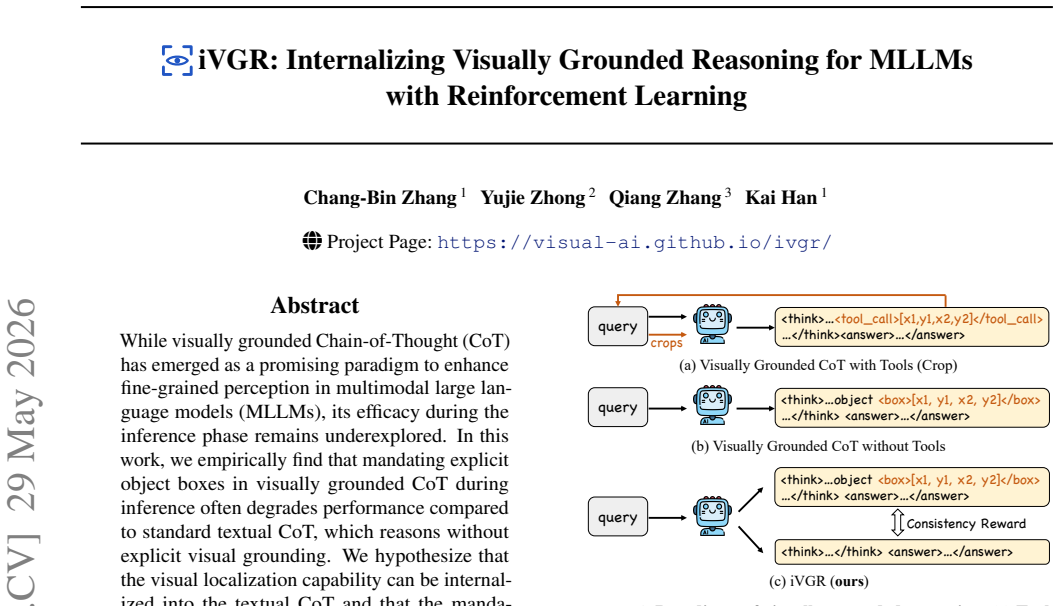
Mandating explicit object boxes in visually grounded CoT during inference degrades performance relative to standard textual CoT; a dual-stream reinforcement learning procedure with a consistency reward transfers localization skill into the textual reasoning process, yielding higher accuracy on fine-grained benchmarks without requiring explicit grounding at test time.
What carries the argument
Dual-stream training in which a textual reasoning stream is aligned to a visually grounded stream through a consistency reward inside reinforcement learning.
Load-bearing premise
The visual localization capability can be internalized into the textual chain-of-thought without explicit grounding at inference.
What would settle it
A controlled test in which the model trained with the consistency reward performs no better than, or worse than, a model that continues to output explicit boxes on the same fine-grained benchmarks.
If this is right
- Models achieve higher accuracy on fine-grained visual benchmarks than prior baselines.
- The trained model supports both pure text reasoning and optional tool-assisted inference workflows.
- Explicit visual grounding steps become unnecessary once localization has been internalized.
- The consistency reward successfully transfers grounding behavior from the visual stream to the text stream.
Where Pith is reading between the lines
- Training cost rises during the dual-stream phase but inference cost drops because box prediction is eliminated.
- The same alignment technique might apply to other cases where an auxiliary capability interferes with the main output objective.
- If the consistency reward generalizes, similar internalization could be attempted for other visual or multimodal skills that are currently expressed only through explicit intermediate outputs.
Editorial analysis
A structured set of objections, weighed in public.
Referee Report
Summary. The manuscript presents iVGR, a reinforcement learning framework for MLLMs that employs a dual-stream training strategy (textual stream aligned to a visually grounded stream) with a proposed consistency reward. The central claim is that this internalizes visual localization capability into textual CoT, avoiding performance degradation from explicit object boxes at inference while outperforming baselines on fine-grained benchmarks and supporting tool-assisted workflows.
Significance. If the empirical results and the internalization mechanism hold, the work addresses a practical limitation of visually grounded CoT by demonstrating a viable transfer mechanism via RL, potentially improving fine-grained perception in MLLMs without sacrificing inference flexibility. The dual-stream consistency approach is a concrete, testable contribution that could generalize beyond the reported setting.
major comments (2)
- [Abstract] Abstract: the claim that the method 'significantly outperforms existing baselines on fine-grained benchmarks' is presented without any metrics, dataset names, ablation controls, or significance tests. This absence directly impairs evaluation of the central empirical claim and must be addressed with concrete numbers from the experiments section.
- [Section 3.2] Section 3.2 (consistency reward definition): the reward aligns textual-stream outputs to the grounded stream. Because the reward is output-matching rather than feature-level, it is possible for the textual stream to achieve high reward via language-only pattern copying without ever using visual features for localization. An ablation that degrades or removes visual input to the grounded stream (or measures attention on visual tokens in the textual stream) is required to substantiate the internalization hypothesis; without it the central claim remains unverified.
minor comments (1)
- [Section 3] Notation for the two streams and the consistency reward should be introduced with explicit symbols or a small diagram in Section 3 to improve readability.
Simulated Author's Rebuttal
We thank the referee for the constructive feedback and recognition of the dual-stream consistency approach. We address each major comment below.
read point-by-point responses
-
Referee: [Abstract] Abstract: the claim that the method 'significantly outperforms existing baselines on fine-grained benchmarks' is presented without any metrics, dataset names, ablation controls, or significance tests. This absence directly impairs evaluation of the central empirical claim and must be addressed with concrete numbers from the experiments section.
Authors: We agree that the abstract would be strengthened by including specific quantitative results. In the revised manuscript we will update the abstract to report key metrics, dataset names, and references to the ablation studies and significance tests already present in the experiments section. revision: yes
-
Referee: [Section 3.2] Section 3.2 (consistency reward definition): the reward aligns textual-stream outputs to the grounded stream. Because the reward is output-matching rather than feature-level, it is possible for the textual stream to achieve high reward via language-only pattern copying without ever using visual features for localization. An ablation that degrades or removes visual input to the grounded stream (or measures attention on visual tokens in the textual stream) is required to substantiate the internalization hypothesis; without it the central claim remains unverified.
Authors: This concern is valid: output matching alone does not automatically guarantee that the textual stream has internalized visual localization rather than performing language-only copying. While the grounded stream's outputs are produced from visual inputs, an explicit ablation is needed to confirm the mechanism. We will add the requested ablation (degrading or removing visual input to the grounded stream) in the revised manuscript and report its effect on textual-stream performance. revision: yes
Circularity Check
No circularity detected; derivation relies on externally defined RL components
full rationale
The paper proposes iVGR as a dual-stream RL method with a consistency reward to internalize visual grounding into textual CoT. No equations, fitted parameters, or self-citations are shown that reduce any prediction or central claim to a self-referential definition or input by construction. The consistency reward is defined externally between streams, and the method is presented as a novel framework without load-bearing self-references or ansatzes smuggled via citation. The derivation chain is self-contained against external benchmarks.
Axiom & Free-Parameter Ledger
Cite this review
Pith. "Pith review of iVGR: Internalizing Visually Grounded Reasoning for MLLMs with Reinforcement Learning." pith.science (2026). https://pith.science/paper/EKTWO4O3
@misc{pith2026260531096,
  author       = {Pith},
  title        = {Pith review of: iVGR: Internalizing Visually Grounded Reasoning for MLLMs with Reinforcement Learning},
  year         = {2026},
  howpublished = {\url{https://pith.science/paper/EKTWO4O3}},
  note         = {Machine review of arXiv:2605.31096}
}
read the original abstract
While visually grounded Chain-of-Thought (CoT) has emerged as a promising paradigm to enhance fine-grained perception in multimodal large language models (MLLMs), its efficacy during the inference phase remains underexplored. In this work, we empirically find that mandating explicit object boxes in visually grounded CoT during inference often degrades performance compared to standard textual CoT, which reasons without explicit visual grounding. We hypothesize that the visual localization capability can be internalized into the textual CoT and that the mandatory explicit grounding introduces unnecessary interference with the model's primary objective of answer prediction. To address this problem, we propose Internalizing Visually Grounded Reasoning (\textbf{iVGR}), a novel reinforcement learning framework that transfers localization capabilities into the textual reasoning process. We employ a dual-stream training strategy, where a textual stream is aligned with a high-quality visually grounded stream via a proposed consistency reward, enabling the model to localize accurately without explicit grounding during inference. Extensive experiments demonstrate that our method significantly outperforms existing baselines on fine-grained benchmarks, while maintaining the flexibility to support tool-assisted inference workflows.
Figures


Reference graph
Works this paper leans on
-
[1]
Score 0.0:Target CoT containsANYcontradiction or conflict with Reference CoT’s image descriptions
-
[2]
Score 0.3:Target CoT hasNOcontradiction, BUT itBOTH: •Contains descriptions/detailsNOTpresent in Reference CoT,AND •Misses some descriptions/details thatAREpresent in Reference CoT
-
[3]
Score 0.7:Target CoT hasNOcontradiction, BUTONEof the following: •Contains descriptions/detailsNOTpresent in Reference CoT,OR •Misses some descriptions/details thatAREpresent in Reference CoT
-
[4]
37K” and “14K
Score 1.0: Target CoT’s image descriptions areFULL Y CONSISTENTwith Reference CoT – no contradiction, no extra details, no missing details. Input: Question:{question} Reference CoT (with boxes, assume correct):{reference_think} Target CoT (without boxes):{target_think} Output: Output ONL Y the score (0.0, 0.3, 0.7, or 1.0), nothing else. Score: B. Trainin...
2024
discussion (0)
Sign in with ORCID, Apple, or X to comment. Anyone can read and Pith papers without signing in.