Interplay of Cl Substitution and He⁺ Irradiation in CrSBr_(1-x)Cl_(x)
Pith reviewed 2026-06-28 21:21 UTC · model grok-4.3
The pith
Cl substitution and He+ irradiation in CrSBr reconstruct Raman spectra anisotropically yet preserve superlinear phonon scaling under near-resonant excitation.
A machine-rendered reading of the paper's core claim, the machinery that carries it, and where it could break.
Core claim
The combined effects of alloy disorder and externally introduced defects lead to strong anisotropic reconstruction of the Raman spectra and modification of the nonlinear Raman response under near-resonant 1.96 eV excitation, while power-dependent measurements reveal robust superlinear scaling of both intrinsic and substitution-induced phonon modes.
What carries the argument
Polarization-resolved Raman spectroscopy tracking intrinsic and defect-induced phonon modes under 1.96 eV near-resonant excitation, with power-dependent intensity scaling as the probe of coupling strength.
If this is right
- Resonance-enhanced electron-phonon coupling remains available for optical control even after substantial lattice disorder is introduced.
- Anisotropic spectral reconstruction offers a route to polarization-selective phonon engineering in 2D magnets.
- Both substitution-induced and irradiation-induced modes participate in the same superlinear response, implying a common underlying coupling mechanism.
Where Pith is reading between the lines
- The result implies that defect densities can be increased further before the resonant enhancement is lost, setting an experimental target for higher-dose irradiation studies.
- Similar preservation of superlinearity may occur in other van der Waals magnets when comparable substitution and irradiation protocols are applied.
- Device designs that rely on resonant Raman processes could tolerate moderate defect engineering without loss of the nonlinear optical signature.
Load-bearing premise
Superlinear growth of Raman intensity with excitation power is taken to mean that resonance-enhanced electron-phonon coupling survives the added disorder.
What would settle it
Observation of strictly linear (or sublinear) power scaling for the same phonon modes when the laser is tuned slightly off the 1.96 eV resonance in the same defect-engineered crystals.
Figures
read the original abstract
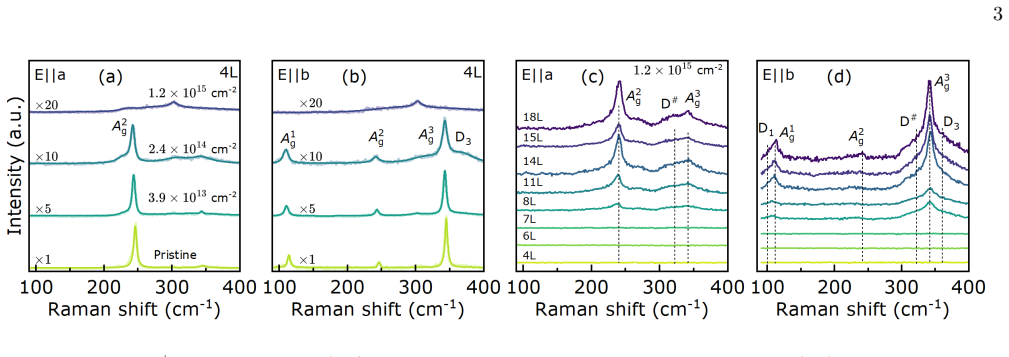
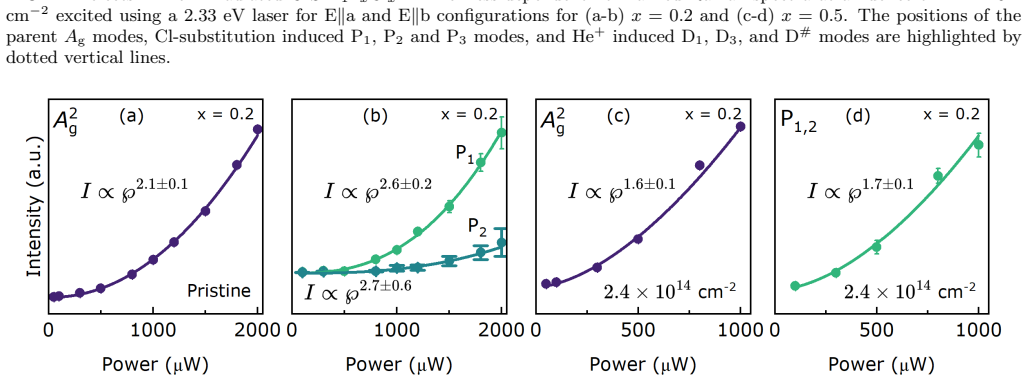
Two-dimensional magnetic semiconductors provide a promising platform for exploring the interplay between disorder, lattice dynamics, and resonant light--matter interactions. Among them, CrSBr exhibits strong in-plane anisotropy and pronounced resonance-enhanced Raman scattering. Here, we investigate the effects of Cl substitution and He$^{+}$ irradiation on the vibrational response of CrSBr using polarization-resolved Raman spectroscopy. Cl substitution activates additional phonon modes associated with local symmetry breaking, while He$^{+}$ irradiation introduces distinct defect-related scattering channels and enhanced phonon broadening. The combined effects of alloy disorder and externally introduced defects lead to strong anisotropic reconstruction of the Raman spectra and modification of the nonlinear Raman response under near-resonant 1.96 eV excitation. Power-dependent measurements reveal robust superlinear scaling of both intrinsic and substitution-induced phonon modes, indicating persistent resonance-enhanced electron--phonon coupling even in defect-engineered samples.
Editorial analysis
A structured set of objections, weighed in public.
Referee Report
Summary. The manuscript investigates the effects of Cl substitution and He^{+} irradiation on the Raman response of the 2D magnetic semiconductor CrSBr using polarization-resolved spectroscopy. Cl substitution activates additional modes due to local symmetry breaking, while irradiation introduces defect scattering and broadening. The combined disorder leads to anisotropic spectral reconstruction and altered nonlinear response under 1.96 eV near-resonant excitation. Power-dependent measurements show superlinear scaling of intrinsic and substitution-induced phonon intensities, which is interpreted as evidence that resonance-enhanced electron-phonon coupling persists in the defect-engineered samples.
Significance. If the central interpretation holds, the result would indicate that resonance-enhanced electron-phonon coupling in CrSBr is robust against both alloy disorder and ion-induced defects. This could be relevant for understanding light-matter interactions in disordered 2D magnets and for defect-tolerant optoelectronic devices. The work provides qualitative observations of spectral changes but does not include quantitative metrics, error analysis, or controls that would allow a full evaluation of the claimed persistence of the coupling.
major comments (2)
- [Power-dependent measurements (abstract)] Power-dependent measurements (abstract): The interpretation that robust superlinear scaling directly demonstrates persistent resonance-enhanced electron-phonon coupling is not supported without exclusion of alternatives. No mention is made of temperature monitoring (Stokes/anti-Stokes ratios), off-resonance controls, or checks for heating-induced resonance shifts, all of which can produce apparent superlinearity and are load-bearing for the central claim.
- [Abstract and results] Abstract and results presentation: The central claim rests on qualitative observations of scaling behavior, yet the manuscript supplies no quantitative intensity data, fitted exponents with uncertainties, sample characterization metrics, or statistical controls. This absence prevents assessment of whether the superlinear regime is statistically robust or reproducible across samples.
minor comments (1)
- [Abstract] The abstract states that power-dependent measurements 'reveal robust superlinear scaling' but does not define the power range, number of modes analyzed, or how linearity was quantified, which affects clarity of the nonlinear response claim.
Simulated Author's Rebuttal
We thank the referee for the careful and constructive review of our manuscript. The comments highlight important aspects of experimental controls and data presentation that we will address in revision to strengthen the support for our claims regarding persistent resonance-enhanced electron-phonon coupling.
read point-by-point responses
-
Referee: Power-dependent measurements (abstract): The interpretation that robust superlinear scaling directly demonstrates persistent resonance-enhanced electron-phonon coupling is not supported without exclusion of alternatives. No mention is made of temperature monitoring (Stokes/anti-Stokes ratios), off-resonance controls, or checks for heating-induced resonance shifts, all of which can produce apparent superlinearity and are load-bearing for the central claim.
Authors: We agree that explicit exclusion of heating artifacts and alternative explanations would strengthen the central claim. In the revised manuscript we will add a dedicated paragraph discussing the low excitation powers employed, the lack of observable spectral shifts or sample damage, and estimates of local heating based on the thermal properties of the material. We will also include off-resonance control spectra to demonstrate that the superlinear scaling is tied to the near-resonant condition. Stokes/anti-Stokes ratio measurements were not performed in the original study; we will note this limitation while arguing that the observed polarization anisotropy and consistency across multiple phonon modes make heating-induced resonance shifts unlikely to be the dominant cause. revision: partial
-
Referee: Abstract and results presentation: The central claim rests on qualitative observations of scaling behavior, yet the manuscript supplies no quantitative intensity data, fitted exponents with uncertainties, sample characterization metrics, or statistical controls. This absence prevents assessment of whether the superlinear regime is statistically robust or reproducible across samples.
Authors: We accept that quantitative metrics are needed for a rigorous evaluation. The revised version will include extracted Raman intensity versus power data with error bars, power-law fits reporting the exponents and their uncertainties, additional sample characterization details (e.g., estimated defect densities from He+ fluence), and a brief discussion of measurement reproducibility across multiple spots and samples. revision: yes
Circularity Check
No circularity; purely experimental observations with independent data
full rationale
The manuscript reports polarization-resolved Raman spectroscopy measurements on CrSBr_{1-x}Cl_x under Cl substitution and He+ irradiation. All central claims (anisotropic spectral reconstruction, superlinear power scaling of phonon modes, persistent resonance-enhanced electron-phonon coupling) rest on direct experimental spectra, intensity vs. power curves, and qualitative interpretation of those curves. No equations, fitted parameters, derivations, or self-citations are invoked that reduce any result to its own inputs by construction. The work contains no mathematical modeling chain, uniqueness theorems, or ansatzes; therefore none of the enumerated circularity patterns apply. This is a standard experimental paper whose findings are falsifiable by replication of the measurements.
Axiom & Free-Parameter Ledger
axioms (1)
- standard math Polarization selection rules govern Raman scattering intensity in anisotropic crystals
Reference graph
Works this paper leans on
-
[1]
The resulting spectra were then fitted using a Voigt line-shape function to extract the relevant parameters
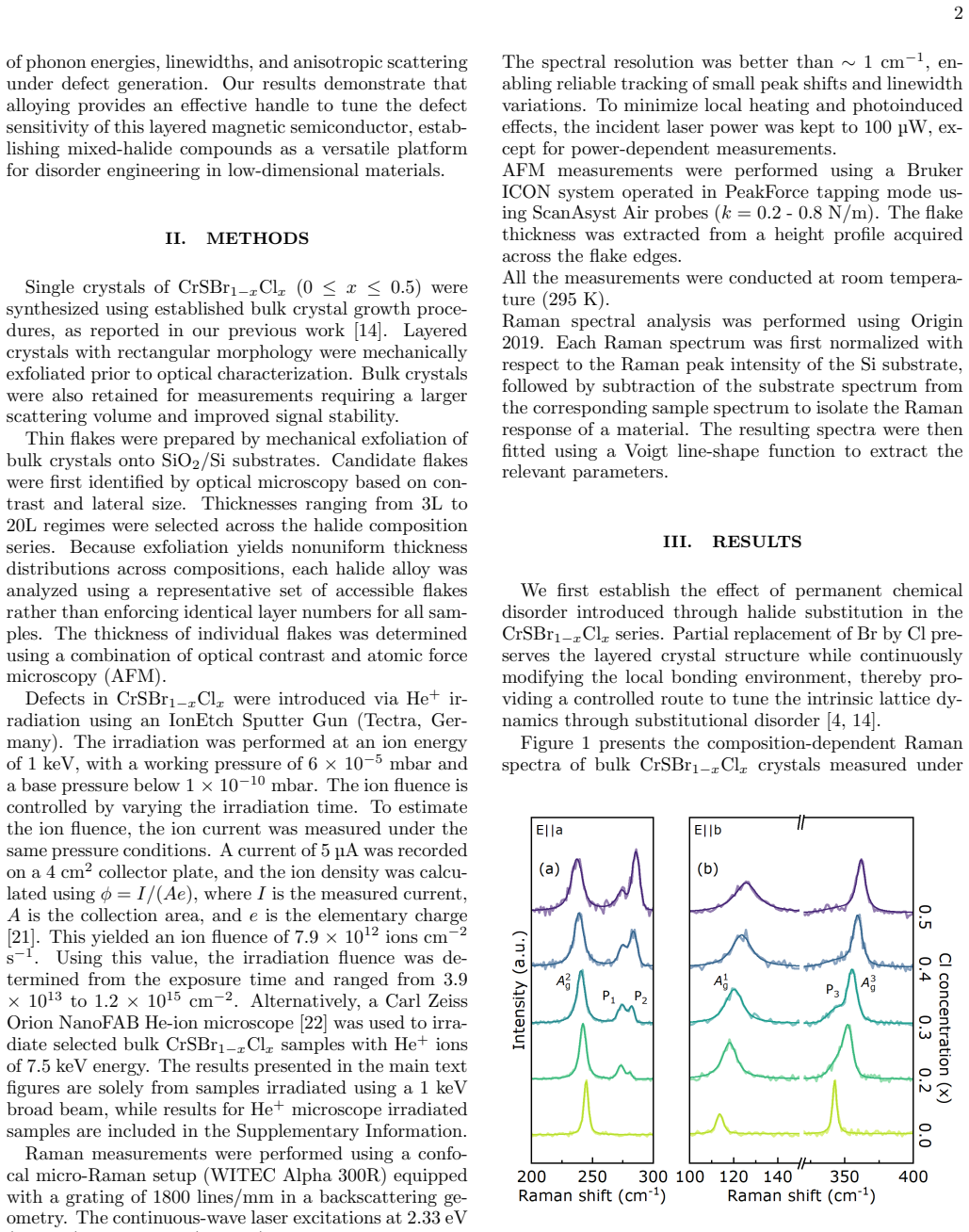
Each Raman spectrum was first normalized with respect to the Raman peak intensity of the Si substrate, followed by subtraction of the substrate spectrum from the corresponding sample spectrum to isolate the Raman response of a material. The resulting spectra were then fitted using a Voigt line-shape function to extract the relevant parameters. III. RESUL ...
-
[2]
Moreover, the appearance of both D# and P3 in a similar shift range further hints at the surface-related origin of the D # Ra- man mode
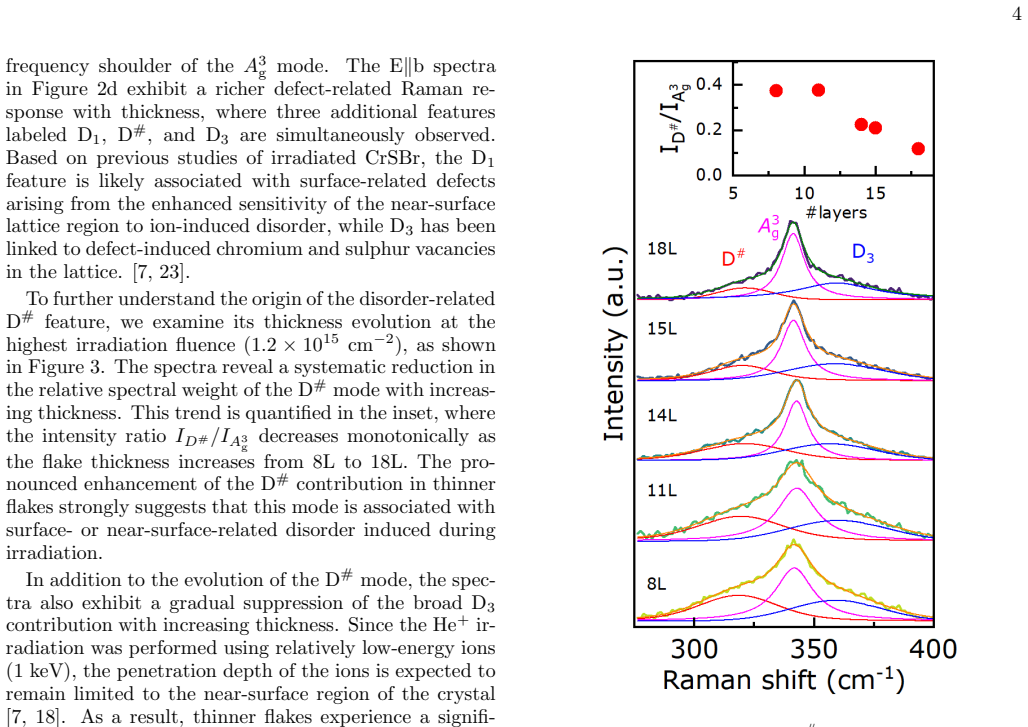
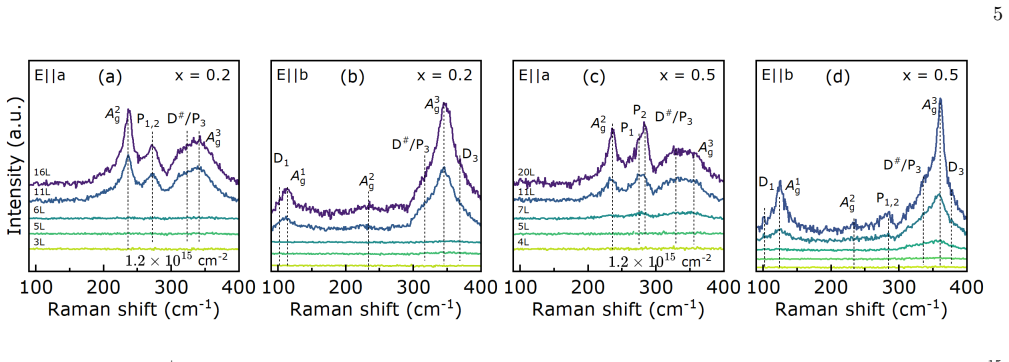
remain stable even in the alloyed system. Moreover, the appearance of both D# and P3 in a similar shift range further hints at the surface-related origin of the D # Ra- man mode. A recent work has shown a higher concentra- tion of Br vacancies at the CrSBr sample surfaces [23]. As P3 is closely related to the Cl substitution at Br sites [14], it can be in...
-
[3]
Blundo, E
E. Blundo, E. Cappelluti, M. Felici, G. Pettinari, and A. Polimeni, Strain-tuning of the electronic, optical, and vibrational properties of two-dimensional crystals, Ap- plied Physics Reviews8, 021318 (2021)
2021
-
[4]
Chegel and S
R. Chegel and S. Behzad, Tunable electronic, optical, and thermal properties of two-dimensional germanene via an external electric field, Scientific Reports10, 704 (2020)
2020
-
[5]
X. Chen, Z. Zhou, B. Deng, Z. Wu, F. Xia, Y. Cao, L. Zhang, W. Huang, N. Wang, and L. Wang, Electrically tunable physical properties of two-dimensional materials, Nano Today27, 99 (2019)
2019
-
[6]
E. J. Telford, D. G. Chica, M. E. Ziebel, K. Xie, N. S. Manganaro, C.-Y. Huang, J. Cox, A. H. Dis- mukes, X. Zhu, J. P. Walsh, T. Cao, C. R. Dean, and X. Roy, Designing magnetic properties in CrSBr through hydrostatic pressure and ligand substitution, Advanced Physics Research2, 2300036 (2023)
2023
-
[7]
Vincent, J
T. Vincent, J. Liang, S. Singh, E. G. Castanon, X. Zhang, A. McCreary, D. Jariwala, O. Kazakova, and Z. Y. Al Balushi, Opportunities in electrically tunable 2D ma- terials beyond graphene: Recent progress and future out- look, Applied Physics Reviews8, 041320 (2021)
2021
-
[8]
M. E. Ziebel, M. L. Feuer, J. Cox, X. Zhu, C. R. Dean, and X. Roy, CrSBr: An air-stable, two-dimensional mag- netic semiconductor, Nano Letters24, 4319 (2024)
2024
-
[9]
Torres, A
K. Torres, A. Kuc, L. Maschio, T. Pham, K. Reidy, L. Dekanovsky, Z. Sofer, F. M. Ross, and J. Klein, Prob- ing defects and spin-phonon coupling in CrSBr via reso- nant Raman scattering, Advanced Functional Materials 33, 2211366 (2023)
2023
-
[10]
Klein, B
J. Klein, B. Pingault, M. Florian, M.-C. Heißenb¨ uttel, A. Steinhoff, Z. Song, K. Torres, F. Dirnberger, J. B. Curtis, M. Weile, A. Penn, T. Deilmann, R. Dana, R. Bushati, J. Quan, J. Luxa, Z. Sofer, A. Al` u, V. M. Menon, U. Wurstbauer, M. Rohlfing, P. Narang, M. Lonˇ car, and F. M. Ross, The bulk van der Waals lay- ered magnet CrSBr is a quasi-1D mater...
2023
-
[11]
S. Sahu, C. Berrezueta-Palacios, S. Juergensen, K. Mosina, Z. Sofer, M. Velick´ y, P. Kusch, and O. Frank, Resonance Raman scattering and anomalous anti-Stokes phenomena in CrSBr, Nanoscale17, 11539 (2025)
2025
-
[12]
K. Lin, X. Sun, F. Dirnberger, Y. Li, J. Qu, P. Wen, Z. Sofer, A. S¨ oll, S. Winnerl, M. Helm,et al., Strong exciton–phonon coupling as a fingerprint of magnetic or- dering in van der Waals layered CrSBr, ACS Nano18, 2898 (2024)
2024
-
[13]
Antoniazzi, L
I. Antoniazzi, L. Kipczak, B. Camargo, Gayatri, C. Mo- hanty, W. Ali, K. Mosina, Z. Sofer, A. Babi´ nski, A. Kar- makar,et al., Magneto-excitonic duality from monolayer to trilayer CrSBr, 2D Materials13, 015032 (2026)
2026
-
[14]
Yang, L.-J
T. Yang, L.-J. Li, J. Zhao, and T. H. Ly, Precision chem- istry in two-dimensional materials: Adding, removing, and replacing the atoms at will, Accounts of Materials Research2, 863 (2021)
2021
-
[15]
Karthikeyan, H.-P
J. Karthikeyan, H.-P. Komsa, M. Batzill, and A. V. Krasheninnikov, Which transition metal atoms can be embedded into two-dimensional molybdenum dichalco- genides and add magnetism?, Nano Letters19, 4581 (2019)
2019
-
[16]
S. Sahu, A. Hashemi, M. Ghorbani-Asl, J. Koltai, J. Maˇ n´ ak, B. Wu, A. S¨ oll, Z. Sofer, M. Karttunen, A. V. Krasheninnikov,et al., Robust phonon engineering and symmetry-selective lattice dynamics in CrSBr 1−xClx, arXiv preprint arXiv:2601.13119 (2026)
arXiv 2026
-
[17]
Badola, A
S. Badola, A. Pawbake, B. Wu, A. S¨ oll, Z. Sofer, R. Heid, and C. Faugeras, Van der Waals CrSBr alloys with tun- able magnetic and optical properties, Nano Letters26, 773 (2026)
2026
-
[18]
A. V. Krasheninnikov, M. Batzill, A.-A. Delenda, M. Drndi´ c, C. Ewels, K. J. Franke, M. Ghorbani-Asl, A. Holleitner, A. Jorio, U. Kaiser,et al., Defects and defect-mediated engineering of two-dimensional materi- als: Challenges and open questions, Beilstein Journal of Nanotechnology17, 454 (2026)
2026
-
[19]
H. Ma, L. Yu, and R. Lv, Defect-induced enhanced Ra- man scattering of two-dimensional materials, Materials Today87, 287 (2025)
2025
-
[20]
F. Long, M. Ghorbani-Asl, K. Mosina, Y. Li, K. Lin, F. Ganss, R. H¨ ubner, Z. Sofer, F. Dirnberger, A. Kamra, et al., Ferromagnetic interlayer coupling in CrSBr crys- tals irradiated by ions, Nano Letters23, 8468 (2023)
2023
-
[21]
Klein, K
J. Klein, K. M. Roccapriore, M. Weile, S. Grytsiuk, A. R. Lupini, Z. Sofer, D. Pashov, M. van Schilfgaarde, S. Acharya, M. R¨ osner,et al., Mesoscale atomic engineer- ing in a crystal lattice, Nature653, 715 (2026)
2026
-
[22]
Jorio, M
A. Jorio, M. S. Dresselhaus, R. Saito, and G. Dresselhaus, Raman spectroscopy in graphene related systems(John Wiley & Sons, 2011)
2011
-
[23]
H. Park, J. Kim, S. Cho, K. Kim, S. Jang, Y. Choi, and H. Lee, Development of wafer-type plasma monitor- ing sensor with automated robot arm transfer capability for two-dimensional in situ processing plasma diagnosis, Sensors24, 1786 (2024)
2024
-
[24]
Hlawacek, V
G. Hlawacek, V. Veligura, R. Van Gastel, and B. Poelsema, Helium ion microscopy, Journal of Vacuum Science & Technology B32, 020801 (2014)
2014
-
[25]
Weile, S
M. Weile, S. Grytsiuk, A. Penn, D. G. Chica, X. Roy, K. Mosina, Z. Sofer, J. Schiøtz, S. Helveg, M. R¨ osner, et al., Defect complexes in CrSBr revealed through elec- tron microscopy and deep learning, Physical Review X 15, 021080 (2025)
2025
-
[26]
Hazem, M
R. Hazem, M. Izerrouken, A. Cheraitia, and A. Djehlane, Raman study of ion beam irradiation damage on nanos- tructured TiO2 thin film, Nuclear Instruments and Meth- ods in Physics Research Section B: Beam Interactions with Materials and Atoms444, 62 (2019)
2019
-
[27]
Mondal, D
P. Mondal, D. I. Markina, L. Hopf, L. Krelle, S. Shradha, J. Klein, M. M. Glazov, I. Gerber, K. Hagmann, R. v. Klitzing, K. Mosina, Z. Sofer, and B. Urbaszek, Raman polarization switching in CrSBr, npj 2D Materials and Applications9, 22 (2025). 8 Table of contents graphic. S-1 SUPPLEMENT AR Y INFORMA TION (a) (b) (c) (d) FIG. S1. Defects in He + irradiate...
2025
discussion (0)
Sign in with ORCID, Apple, or X to comment. Anyone can read and Pith papers without signing in.