From Local Geometry to Global Pseudo Labeling for Robust Positive Unlabeled Learning under Covariate Shift
Pith reviewed 2026-06-28 22:31 UTC · model grok-4.3
The pith
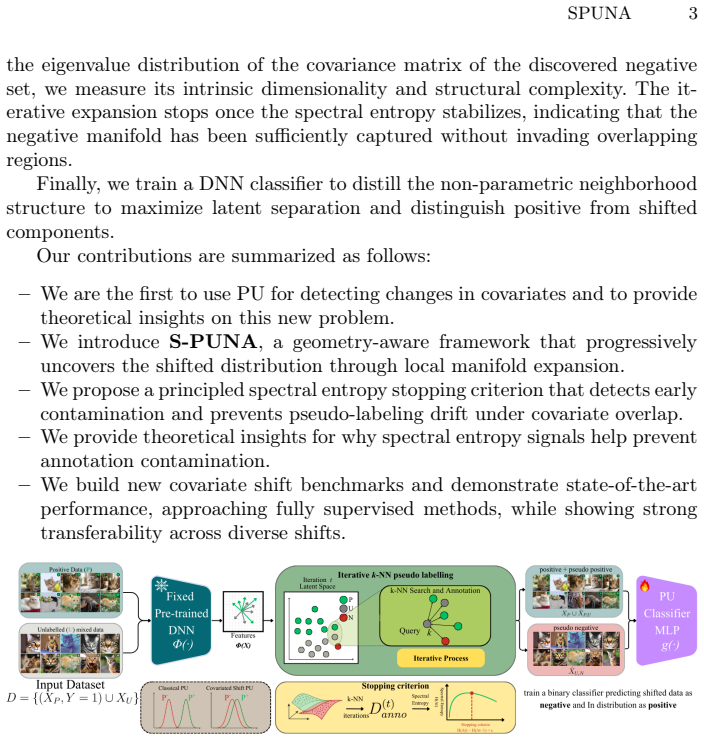
SPUNA turns positive-unlabeled data into reliable covariate-shift detection by using local manifold geometry to progressively label shifted samples.
A machine-rendered reading of the paper's core claim, the machinery that carries it, and where it could break.
Core claim
Covariate shift can be detected from positive-unlabeled data by progressively discovering shifted samples through spectral neighborhood annotation that respects the local manifold geometry of visual features; the resulting pseudo-labels remain stable despite significant overlap between the original and shifted distributions.
What carries the argument
Spectral PU Neighborhood Annotation (SPUNA), a progressive pseudo-labeling procedure that annotates points by examining local manifold neighborhoods in feature space to separate shifted samples from in-distribution ones.
If this is right
- Positive-unlabeled learning becomes a practical substitute for fully supervised shift detection when only in-distribution positives are labeled.
- Methods that rely on global distribution distances can be replaced by local geometry checks that scale to high-dimensional image features.
- A single model trained under this framework can handle multiple distinct shift types without retraining or additional labels.
- Pseudo-label quality improves iteratively as more shifted points are confidently added, rather than degrading from early errors.
Where Pith is reading between the lines
- The same local-geometry principle could be tested on non-image modalities such as tabular sensor data or text embeddings where manifold assumptions are weaker.
- If neighborhood preservation holds, the approach might extend to continual learning settings where new shifts arrive sequentially without any negative labels.
- An open question is whether the spectral component can be replaced by simpler nearest-neighbor rules while retaining the same stability under heavy overlap.
Load-bearing premise
The local neighborhood structure around visual features stays sufficiently intact and non-overlapping under covariate shift that neighborhood-based annotation can reliably expand the set of pseudo-labeled points without introducing instability.
What would settle it
Run SPUNA on a dataset where the shifted and original distributions are forced to have identical local neighborhoods (for example by adding strong adversarial perturbations that destroy manifold separability) and measure whether pseudo-label accuracy collapses below the level of classical PU baselines.
Figures
read the original abstract
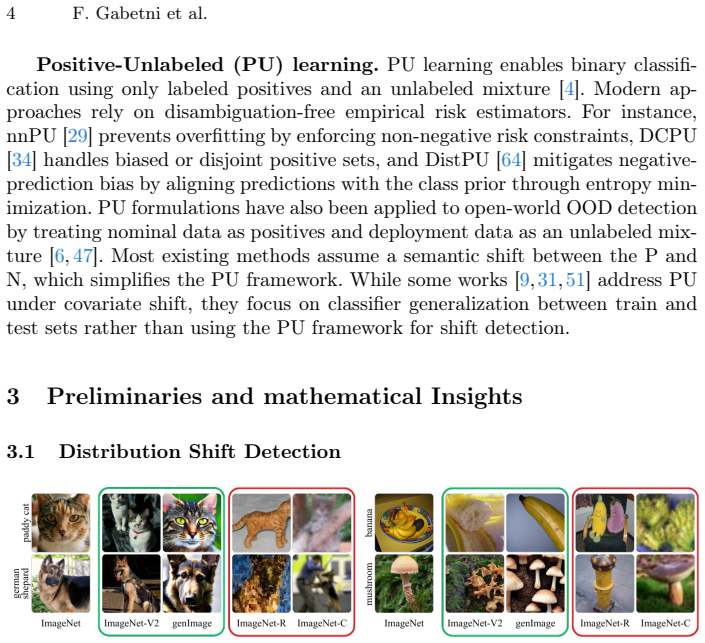
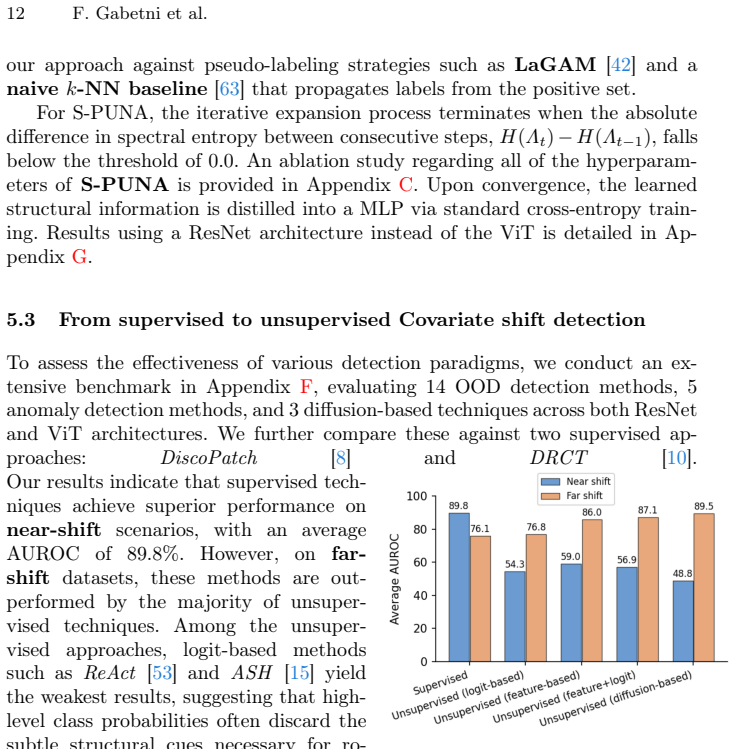
Detecting covariate shift is critical for building reliable vision systems. While most prior work focuses on improving robustness to shift, explicitly detecting covariate shift remains underexplored. Existing approaches typically rely on fully supervised training, requiring labeled examples from both original and shifted distributions, which is often impractical. In this paper, we show that covariate shift detection can be effectively addressed with weaker supervision using Positive Unlabeled (PU) learning. However, under covariate shift, in distribution and shifted data overlap significantly, making classical PU methods unstable and sensitive to noise. To overcome this challenge, we introduce Spectral PU Neighborhood Annotation (SPUNA), a geometry aware framework that progressively discovers shifted data by leveraging the local manifold structure of visual features. Extensive experiments show that SPUNA achieves state of the art performance in PU settings and remarkably matches the performances of fully supervised methods. Moreover, our approach transfers robustly across different types of shifts, demonstrating strong generalization capabilities.
Editorial analysis
A structured set of objections, weighed in public.
Referee Report
Summary. The paper claims that covariate shift detection in vision systems can be addressed via Positive Unlabeled (PU) learning rather than fully supervised methods. Classical PU approaches are unstable under significant overlap between in-distribution and shifted data. The authors introduce SPUNA (Spectral PU Neighborhood Annotation), a geometry-aware framework that progressively discovers shifted samples by leveraging the local manifold structure of visual features via neighborhood annotation. Extensive experiments are reported to show that SPUNA achieves state-of-the-art performance among PU methods, matches fully supervised baselines, and transfers robustly across shift types.
Significance. If the central claims hold, the work is significant for enabling reliable covariate shift detection under weaker supervision, which is practically important for vision systems. The emphasis on geometry-aware progressive pseudo-labeling and cross-shift robustness is a positive contribution. The reported experiments demonstrating matching of fully supervised performance constitute a strength worth crediting, provided they include proper controls and ablations.
major comments (2)
- [§3–4 (method description)] The central assumption underlying SPUNA (method section, likely §3–4): that local manifold structure of visual features remains sufficiently preserved and separable under covariate shift to support stable progressive discovery via spectral neighborhood annotation. This is load-bearing for the claim that SPUNA overcomes classical PU instability; without explicit verification (e.g., manifold preservation metrics, ablation on shift severity, or neighborhood stability analysis), the method risks reducing to standard PU learning whose sensitivity is asserted in the abstract.
- [§5 (experiments)] Experimental validation of the geometry assumption (results section, likely §5): the abstract and introduction assert robustness across shift types and matching of supervised performance, yet no details are visible on controls for overlap degree, error analysis of pseudo-labeling under increasing shift, or comparison against classical PU baselines with the same feature extractor. This undermines the claim that the local-geometry step is what enables the reported gains.
minor comments (2)
- [§3] Notation for spectral neighborhood annotation and the precise definition of the progressive discovery step should be clarified with a pseudocode or explicit algorithm box to aid reproducibility.
- [Abstract and §5] The abstract states 'remarkably matches the performances of fully supervised methods'—this phrasing is strong; the results section should report exact numbers, standard deviations, and statistical significance tests rather than qualitative descriptors.
Simulated Author's Rebuttal
We thank the referee for the constructive feedback highlighting the importance of verifying the manifold preservation assumption and strengthening the experimental controls. We address each major comment below.
read point-by-point responses
-
Referee: [§3–4 (method description)] The central assumption underlying SPUNA (method section, likely §3–4): that local manifold structure of visual features remains sufficiently preserved and separable under covariate shift to support stable progressive discovery via spectral neighborhood annotation. This is load-bearing for the claim that SPUNA overcomes classical PU instability; without explicit verification (e.g., manifold preservation metrics, ablation on shift severity, or neighborhood stability analysis), the method risks reducing to standard PU learning whose sensitivity is asserted in the abstract.
Authors: We agree that explicit verification of manifold preservation would strengthen the presentation. The current manuscript supports the assumption through consistent performance gains and cross-shift robustness, but we will add a dedicated analysis subsection with neighborhood stability metrics (e.g., preservation of k-NN graphs across shift intensities) and ablations on shift severity to directly substantiate the geometry-aware component. revision: yes
-
Referee: [§5 (experiments)] Experimental validation of the geometry assumption (results section, likely §5): the abstract and introduction assert robustness across shift types and matching of supervised performance, yet no details are visible on controls for overlap degree, error analysis of pseudo-labeling under increasing shift, or comparison against classical PU baselines with the same feature extractor. This undermines the claim that the local-geometry step is what enables the reported gains.
Authors: The concern is valid. While the manuscript reports comparisons to classical PU methods and matching of supervised performance, we will expand §5 with controlled overlap experiments (synthetic shifts at varying degrees), pseudo-labeling error curves as a function of shift severity, and explicit confirmation that all baselines share the identical feature extractor. These additions will isolate the contribution of spectral neighborhood annotation. revision: yes
Circularity Check
No circularity: empirical method with no derivation chain or fitted predictions presented as results
full rationale
The provided abstract and description contain no equations, derivations, or parameter-fitting steps. SPUNA is introduced as a geometry-aware framework whose claims rest on experimental performance matching supervised methods under shifts. No self-definitional relations, predictions that reduce to fitted inputs, or load-bearing self-citations appear. The central premise (local manifold preservation enabling progressive pseudo-labeling) is an empirical assumption, not a mathematical reduction to the method's own outputs. This is a standard non-circular empirical ML paper.
Axiom & Free-Parameter Ledger
Reference graph
Works this paper leans on
-
[1]
arXiv preprint arXiv:1909.11786 (2019) 16, 17
Ahuja, N.A., Ndiour, I., Kalyanpur, T., Tickoo, O.: Probabilistic modeling of deep features for out-of-distribution and adversarial detection. arXiv preprint arXiv:1909.11786 (2019) 16, 17
-
[2]
In: Computer Vision and Machine Intelligence: Proceedings of CVMI 2022, pp
Ajith, A., Gopakumar, G.: Domain adaptation: A survey. In: Computer Vision and Machine Intelligence: Proceedings of CVMI 2022, pp. 591–602. Springer (2023) 1
2022
-
[3]
arXiv preprint arXiv:2310.06823 (2023)
Ammar, M.B., Belkhir, N., Popescu, S., Manzanera, A., Franchi, G.: Neco: Neu- ral collapse based out-of-distribution detection. arXiv preprint arXiv:2310.06823 (2023) 3
-
[4]
Machine Learning109(4), 719–760 (2020) 2, 4
Bekker, J., Davis, J.: Learning from positive and unlabeled data: a survey. Machine Learning109(4), 719–760 (2020) 2, 4
2020
-
[5]
Bishop, C.M., Nasrabadi, N.M.: Pattern recognition and machine learning, vol. 4. Springer (2006) 7
2006
-
[6]
The Journal of Machine Learning Research11, 2973–3009 (2010) 4
Blanchard, G., Lee, G., Scott, C.: Semi-supervised novelty detection. The Journal of Machine Learning Research11, 2973–3009 (2010) 4
2010
-
[7]
In: Proceedings of the 2000 ACM SIGMOD international conference on Management of data
Breunig, M.M., Kriegel, H.P., Ng, R.T., Sander, J.: Lof: identifying density-based local outliers. In: Proceedings of the 2000 ACM SIGMOD international conference on Management of data. pp. 93–104 (2000) 16, 17
2000
-
[8]
In: Proceedings of the IEEE/CVF International Conference on Computer Vision (ICCV) (2025) 2, 3, 12, 16
Caetano, F., Viviers, C., Zavala-Mondragón, L.A., de With, P.H., van der Sommen, F.: Discopatch: Taming adversarially-driven batch statistics for improved out-of- distribution detection. In: Proceedings of the IEEE/CVF International Conference on Computer Vision (ICCV) (2025) 2, 3, 12, 16
2025
-
[9]
In: International conference on machine learning
Chan, A., Alaa, A., Qian, Z., Van Der Schaar, M.: Unlabelled data improves bayesian uncertainty calibration under covariate shift. In: International conference on machine learning. pp. 1392–1402. PMLR (2020) 4
2020
-
[10]
In: Forty-first International Conference on Machine Learning (2024) 12
Chen, B., Zeng, J., Yang, J., Yang, R.: Drct: Diffusion reconstruction contrastive training towards universal detection of diffusion generated images. In: Forty-first International Conference on Machine Learning (2024) 12
2024
-
[11]
In: Advances in Neu- ral Information Processing Systems (NeurIPS) (2025),https://openreview.net/ forum?id=gioV0q55AJ, neurIPS 2025 (poster) 11, 13, 14, 9, 10, 19
Dai,Y.,Hou,Z.,Li,C.,Xu,Y.,Wang,E.,Li,X.:Acloserlooktopositive-unlabeled learning from fine-grained perspectives: An empirical study. In: Advances in Neu- ral Information Processing Systems (NeurIPS) (2025),https://openreview.net/ forum?id=gioV0q55AJ, neurIPS 2025 (poster) 11, 13, 14, 9, 10, 19
2025
-
[12]
In: International conference on pattern recognition
Defard,T.,Setkov,A.,Loesch,A.,Audigier,R.:Padim:apatchdistributionmodel- ing framework for anomaly detection and localization. In: International conference on pattern recognition. pp. 475–489. Springer (2021) 16, 17
2021
-
[13]
In: 2009 IEEE conference on computer vision and pattern recognition
Deng, J., Dong, W., Socher, R., Li, L.J., Li, K., Fei-Fei, L.: Imagenet: A large- scale hierarchical image database. In: 2009 IEEE conference on computer vision and pattern recognition. pp. 248–255. Ieee (2009) 11
2009
-
[14]
Dixon, M.F., Halperin, I., Bilokon, P., et al.: Machine learning in finance, vol. 1170. Springer (2020) 2
2020
-
[15]
In: The Eleventh International Conference on Learning Representations (2022) 12, 16
Djurisic, A., Bozanic, N., Ashok, A., Liu, R.: Extremely simple activation shaping for out-of-distribution detection. In: The Eleventh International Conference on Learning Representations (2022) 12, 16
2022
-
[16]
In: International Conference on Learning Representations (2021) 8, 6
Dosovitskiy, A., Beyer, L., Kolesnikov, A., Weissenborn, D., Zhai, X., Unterthiner, T., Dehghani, M., Minderer, M., Heigold, G., Gelly, S., Uszkoreit, J., Houlsby, N.: An image is worth 16x16 words: Transformers for image recognition at scale. In: International Conference on Learning Representations (2021) 8, 6
2021
-
[17]
Advances in neural information processing systems27(2014) 6 SPUNA 23
Du Plessis, M.C., Niu, G., Sugiyama, M.: Analysis of learning from positive and unlabeled data. Advances in neural information processing systems27(2014) 6 SPUNA 23
2014
-
[18]
New England Journal of Medicine385(3), 283–286 (2021) 2
Finlayson, S.G., Subbaswamy, A., Singh, K., Bowers, J., Kupke, A., Zittrain, J., Kohane, I.S., Saria, S.: The clinician and dataset shift in artificial intelligence. New England Journal of Medicine385(3), 283–286 (2021) 2
2021
-
[19]
In: Proceedings of the IEEE/CVF conference on computer vision and pattern recognition
Graham, M.S., Pinaya, W.H., Tudosiu, P.D., Nachev, P., Ourselin, S., Cardoso, J.: Denoising diffusion models for out-of-distribution detection. In: Proceedings of the IEEE/CVF conference on computer vision and pattern recognition. pp. 2948–2957 (2023) 16
2023
-
[20]
In: International conference on machine learning
Guo, C., Pleiss, G., Sun, Y., Weinberger, K.Q.: On calibration of modern neural networks. In: International conference on machine learning. pp. 1321–1330. PMLR (2017) 16
2017
-
[21]
IEEE Journal of Selected Topics in Applied Earth Observations and Remote Sensing12(7), 2217– 2226 (2019) 11, 7
Helber, P., Bischke, B., Dengel, A., Borth, D.: Eurosat: A novel dataset and deep learning benchmark for land use and land cover classification. IEEE Journal of Selected Topics in Applied Earth Observations and Remote Sensing12(7), 2217– 2226 (2019) 11, 7
2019
-
[22]
In: International Conference on Machine Learning
Hendrycks, D., Basart, S., Mazeika, M., Zou, A., Kwon, J., Mostajabi, M., Stein- hardt, J., Song, D.: Scaling out-of-distribution detection for real-world settings. In: International Conference on Machine Learning. pp. 8759–8773. PMLR (2022) 16
2022
-
[23]
In: Proceedings of the IEEE/CVF international conference on computer vision
Hendrycks, D., Basart, S., Mu, N., Kadavath, S., Wang, F., Dorundo, E., Desai, R., Zhu, T., Parajuli, S., Guo, M., et al.: The many faces of robustness: A critical analysis of out-of-distribution generalization. In: Proceedings of the IEEE/CVF international conference on computer vision. pp. 8340–8349 (2021) 11
2021
-
[24]
Benchmarking Neural Network Robustness to Common Corruptions and Perturbations
Hendrycks,D.,Dietterich,T.:Benchmarkingneuralnetworkrobustnesstocommon corruptions and perturbations. arXiv preprint arXiv:1903.12261 (2019) 1, 11
work page internal anchor Pith review Pith/arXiv arXiv 1903
-
[25]
In: International Conference on Learning Representations (2017),https://openreview.net/forum?id=Hkg4TI9xl16
Hendrycks, D., Gimpel, K.: A baseline for detecting misclassified and out-of- distribution examples in neural networks. In: International Conference on Learning Representations (2017),https://openreview.net/forum?id=Hkg4TI9xl16
2017
-
[26]
Advances in Neural Information Processing Systems37, 43952–43974 (2024) 12, 16
Heng, A., Thiery, A.H., Soh, H.: Out-of-distribution detection with a single uncon- ditional diffusion model. Advances in Neural Information Processing Systems37, 43952–43974 (2024) 12, 16
2024
-
[27]
In: Proceed- ings of the IEEE/CVF conference on computer vision and pattern recognition
Hsu, Y.C., Shen, Y., Jin, H., Kira, Z.: Generalized odin: Detecting out-of- distribution image without learning from out-of-distribution data. In: Proceed- ings of the IEEE/CVF conference on computer vision and pattern recognition. pp. 10951–10960 (2020) 16
2020
-
[28]
In: International Conference on Machine Learning
Katz-Samuels, J., Nakhleh, J.B., Nowak, R., Li, Y.: Training ood detectors in their natural habitats. In: International Conference on Machine Learning. pp. 10848– 10865. PMLR (2022) 2
2022
-
[29]
In: Advances in Neural Information Processing Systems (NeurIPS) (2017) 4
Kiryo, R., Niu, G., du Plessis, M.C., Sugiyama, M.: Positive-unlabeled learning with non-negative risk estimator. In: Advances in Neural Information Processing Systems (NeurIPS) (2017) 4
2017
-
[30]
In: Proceedings of the 14th ACM SIGKDD international conference on Knowledge discovery and data mining
Kriegel, H.P., Zimek, A.: Angle-based outlier detection in high-dimensional data. In: Proceedings of the 14th ACM SIGKDD international conference on Knowledge discovery and data mining. pp. 444–452 (2008) 16, 17
2008
-
[31]
In: Forty-second Inter- national Conference on Machine Learning (2025) 4
Kumagai, A., Iwata, T., Takahashi, H., Nishiyama, T., Adachi, K., Fujiwara, Y.: Positive-unlabeled auc maximization under covariate shift. In: Forty-second Inter- national Conference on Machine Learning (2025) 4
2025
-
[32]
Advances in neural information processing systems31(2018) 12, 16
Lee, K., Lee, K., Lee, H., Shin, J.: A simple unified framework for detecting out- of-distribution samples and adversarial attacks. Advances in neural information processing systems31(2018) 12, 16
2018
-
[33]
IEEE Access10, 78446–78454 (2022) 16, 17 24 F
Lee, S., Lee, S., Song, B.C.: Cfa: Coupled-hypersphere-based feature adaptation for target-oriented anomaly localization. IEEE Access10, 78446–78454 (2022) 16, 17 24 F. Gabetni et al
2022
-
[34]
In: Advances in Neu- ral Information Processing Systems (NeurIPS) (2025),https://openreview.net/ forum?id=DTq0CLhN4A, neurIPS 2025 (poster) 4, 11, 13, 14, 9, 10, 19
Li, X., Dai, Y., Wang, B., Li, C., Qu, J., Guan, R.: Balancing positive and nega- tive classification error rates in positive-unlabeled learning. In: Advances in Neu- ral Information Processing Systems (NeurIPS) (2025),https://openreview.net/ forum?id=DTq0CLhN4A, neurIPS 2025 (poster) 4, 11, 13, 14, 9, 10, 19
2025
-
[35]
In: 2020 IEEE international conference on data mining (ICDM)
Li, Z., Zhao, Y., Botta, N., Ionescu, C., Hu, X.: Copod: copula-based outlier detec- tion. In: 2020 IEEE international conference on data mining (ICDM). pp. 1118–
2020
-
[36]
IEEE Transac- tions on Knowledge and Data Engineering35(12), 12181–12193 (2022) 16, 17
Li, Z., Zhao, Y., Hu, X., Botta, N., Ionescu, C., Chen, G.H.: Ecod: Unsupervised outlier detection using empirical cumulative distribution functions. IEEE Transac- tions on Knowledge and Data Engineering35(12), 12181–12193 (2022) 16, 17
2022
-
[37]
In: 2008 Eighth IEEE Interna- tional Conference on Data Mining
Liu, F.T., Ting, K.M., Zhou, Z.H.: Isolation forest. In: 2008 Eighth IEEE Interna- tional Conference on Data Mining. pp. 413–422. IEEE (2008) 16, 17
2008
-
[38]
Advances in neural information processing systems33, 21464–21475 (2020) 16
Liu, W., Wang, X., Owens, J., Li, Y.: Energy-based out-of-distribution detection. Advances in neural information processing systems33, 21464–21475 (2020) 16
2020
-
[39]
In: Proceedings of the IEEE/CVF conference on computer vision and pattern recognition
Liu, X., Lochman, Y., Zach, C.: Gen: Pushing the limits of softmax-based out-of- distribution detection. In: Proceedings of the IEEE/CVF conference on computer vision and pattern recognition. pp. 23946–23955 (2023) 16
2023
-
[40]
Liu, Z., Zhou, J.P., Wang, Y., Weinberger, K.Q.: Unsupervised out-of-distribution detectionwithdiffusioninpainting.In:InternationalConferenceonMachineLearn- ing. pp. 22528–22538. PMLR (2023) 16
2023
-
[41]
In: Proceedings of the IEEE/CVF conference on computer vision and pattern recognition
Liu, Z., Zhou, Y., Xu, Y., Wang, Z.: Simplenet: A simple network for image anomaly detection and localization. In: Proceedings of the IEEE/CVF conference on computer vision and pattern recognition. pp. 20402–20411 (2023) 3, 16, 17
2023
-
[42]
In: Proceedings of the IEEE/CVF Conference on Computer Vision and Pattern Recognition (CVPR) (2024) 12, 13, 14, 9, 10, 19
Long, L., Wang, H., Jiang, Z., Feng, L., Yao, C., Chen, G., Zhao, J.: Positive- unlabeled learning by latent group-aware meta disambiguation. In: Proceedings of the IEEE/CVF Conference on Computer Vision and Pattern Recognition (CVPR) (2024) 12, 13, 14, 9, 10, 19
2024
-
[43]
IEEE Transactions on Knowledge and Data Engineering31, 2346– 2363 (2019),https://api.semanticscholar.org/CorpusID:694494582
Lu, J., Liu, A., Dong, F., Gu, F., Gama, J., Zhang, G.: Learning under concept drift: A review. IEEE Transactions on Knowledge and Data Engineering31, 2346– 2363 (2019),https://api.semanticscholar.org/CorpusID:694494582
2019
-
[44]
Transactions on Machine Learning Research (2025),https://openreview.net/forum?id=FO3IA4lUEY13, 16
Miyai, A., Yang, J., Zhang, J., Ming, Y., Lin, Y., Yu, Q., Irie, G., Joty, S., Li, Y., Li, H.H., Liu, Z., Yamasaki, T., Aizawa, K.: Generalized out-of-distribution detection and beyond in vision language model era: A survey. Transactions on Machine Learning Research (2025),https://openreview.net/forum?id=FO3IA4lUEY13, 16
2025
-
[45]
MIT Press, Cambridge, MA, 2nd edn
Mohri, M., Rostamizadeh, A., Talwalkar, A.: Foundations of Machine Learning. MIT Press, Cambridge, MA, 2nd edn. (2018),https://mlcontroversial.com/ foundations-of-machine-learning-2nd-edition/6
2018
-
[46]
In: International Conference on Pattern Recognition
Oehri, S., Ebert, N., Abdullah, A., Stricker, D., Wasenmüller, O.: Genformer– generated images are all you need to improve robustness of transformers on small datasets. In: International Conference on Pattern Recognition. pp. 176–192. Springer (2024) 11, 7
2024
-
[47]
In: Proceedings of the 25th ACM SIGKDD international conference on knowledge discovery & data mining
Pang, G., Shen, C., Van Den Hengel, A.: Deep anomaly detection with deviation networks. In: Proceedings of the 25th ACM SIGKDD international conference on knowledge discovery & data mining. pp. 353–362 (2019) 4
2019
-
[48]
Recht, B., Roelofs, R., Schmidt, L., Shankar, V.: Do imagenet classifiers generalize to imagenet? In: International conference on machine learning. pp. 5389–5400. PMLR (2019) 11
2019
-
[49]
arXiv preprint arXiv:2106.09022 , year=
Ren, J., Fort, S., Liu, J., Roy, A.G., Padhy, S., Lakshminarayanan, B.: A sim- ple fix to mahalanobis distance for improving near-ood detection. arXiv preprint arXiv:2106.09022 (2021) 16 SPUNA 25
-
[50]
In: Proceedings of the IEEE/CVF conference on computer vision and pattern recognition
Roth, K., Pemula, L., Zepeda, J., Schölkopf, B., Brox, T., Gehler, P.: Towards total recall in industrial anomaly detection. In: Proceedings of the IEEE/CVF conference on computer vision and pattern recognition. pp. 14318–14328 (2022) 3, 16, 17
2022
-
[51]
In: Proceedings of the AAAI conference on artificial intelligence
Sakai, T., Shimizu, N.: Covariate shift adaptation on learning from positive and unlabeled data. In: Proceedings of the AAAI conference on artificial intelligence. vol. 33, pp. 4838–4845 (2019) 4
2019
-
[52]
Neural computation13(7), 1443–1471 (2001) 16, 17
Schölkopf, B., Platt, J.C., Shawe-Taylor, J., Smola, A.J., Williamson, R.C.: Esti- mating the support of a high-dimensional distribution. Neural computation13(7), 1443–1471 (2001) 16, 17
2001
-
[53]
Advances in neural information processing systems34, 144–157 (2021) 12, 16
Sun, Y., Guo, C., Li, Y.: React: Out-of-distribution detection with rectified activa- tions. Advances in neural information processing systems34, 144–157 (2021) 12, 16
2021
-
[54]
In: International conference on machine learning
Sun, Y., Ming, Y., Zhu, X., Li, Y.: Out-of-distribution detection with deep near- est neighbors. In: International conference on machine learning. pp. 20827–20840. PMLR (2022) 16
2022
-
[55]
arXiv preprint arXiv:2405.18929 (2024) 2
Takahashi, H., Iwata, T., Kumagai, A., Yamanaka, Y.: Deep positive- unlabeled anomaly detection for contaminated unlabeled data. arXiv preprint arXiv:2405.18929 (2024) 2
-
[56]
In: Proceedings of the IEEE/CVF conference on computer vision and pattern recognition
Wang, H., Li, Z., Feng, L., Zhang, W.: Vim: Out-of-distribution with virtual-logit matching. In: Proceedings of the IEEE/CVF conference on computer vision and pattern recognition. pp. 4921–4930 (2022) 12, 16
2022
-
[57]
In: The Twelfth International Confer- ence on Learning Representations (2024),https://openreview.net/forum?id= RDSTjtnqCg16
Xu, K., Chen, R., Franchi, G., Yao, A.: Scaling for training time and post-hoc out-of-distribution detection enhancement. In: The Twelfth International Confer- ence on Learning Representations (2024),https://openreview.net/forum?id= RDSTjtnqCg16
2024
-
[58]
Advances in Neural Information Processing Systems36, 28941–28959 (2023) 16
Xu, M., Lian, Z., Liu, B., Tao, J.: Vra: Variational rectified activation for out- of-distribution detection. Advances in Neural Information Processing Systems36, 28941–28959 (2023) 16
2023
-
[59]
Advances in Neural Information Processing Systems35, 32598–32611 (2022) 5, 15
Yang, J., Wang, P., Zou, D., Zhou, Z., Ding, K., Peng, W., Wang, H., Chen, G., Li, B., Sun, Y., et al.: Openood: Benchmarking generalized out-of-distribution detection. Advances in Neural Information Processing Systems35, 32598–32611 (2022) 5, 15
2022
-
[60]
International Journal of Computer Vision132(12), 5635–5662 (2024) 1, 3, 13, 16, 18
Yang, J., Zhou, K., Li, Y., Liu, Z.: Generalized out-of-distribution detection: A survey. International Journal of Computer Vision132(12), 5635–5662 (2024) 1, 3, 13, 16, 18
2024
-
[61]
Fastflow: Unsupervised anomaly detection and localization via 2d normalizing flows
Yu, J., Zheng, Y., Wang, X., Li, W., Wu, Y., Zhao, R., Wu, L.: Fastflow: Unsuper- vised anomaly detection and localization via 2d normalizing flows. arXiv preprint arXiv:2111.07677 (2021) 16, 17
-
[62]
Iet Biometrics 10(6), 607–624 (2021) 2
Yu, P., Xia, Z., Fei, J., Lu, Y.: A survey on deepfake video detection. Iet Biometrics 10(6), 607–624 (2021) 2
2021
-
[63]
Zhang, B., Zuo, W.: Reliable negative extracting based on knn for learning from positive and unlabeled examples. J. Comput.4(1), 94–101 (2009) 2, 12, 13, 14, 9, 10, 19
2009
-
[64]
In: Proceedings of the IEEE/CVF Conference on Computer Vision and Pattern Recognition (CVPR) (2022) 4, 11, 13, 14, 9, 10, 19
Zhao, Y., et al.: Dist-pu: Positive-unlabeled learning from a label distribution per- spective. In: Proceedings of the IEEE/CVF Conference on Computer Vision and Pattern Recognition (CVPR) (2022) 4, 11, 13, 14, 9, 10, 19
2022
-
[65]
IEEE transactions on pattern analysis and machine intelligence45(4), 4396–4415 (2022) 1 26 F
Zhou, K., Liu, Z., Qiao, Y., Xiang, T., Loy, C.C.: Domain generalization: A survey. IEEE transactions on pattern analysis and machine intelligence45(4), 4396–4415 (2022) 1 26 F. Gabetni et al
2022
-
[66]
arXiv preprint arXiv:2312.08880 (2023) 2
Zhu, M., Chen, H., Huang, M., Li, W., Hu, H., Hu, J., Wang, Y.: Gendet: Towards good generalizations for ai-generated image detection. arXiv preprint arXiv:2312.08880 (2023) 2
-
[67]
Advances in neural information processing systems36, 77771–77782 (2023) 11
Zhu, M., Chen, H., Yan, Q., Huang, X., Lin, G., Li, W., Tu, Z., Hu, H., Hu, J., Wang, Y.: Genimage: A million-scale benchmark for detecting ai-generated image. Advances in neural information processing systems36, 77771–77782 (2023) 11
2023
discussion (0)
Sign in with ORCID, Apple, or X to comment. Anyone can read and Pith papers without signing in.