What changes after deployment? A survey on On-device Learning in TinyML
Pith reviewed 2026-06-28 23:09 UTC · model grok-4.3
The pith
Organizing on-device learning papers by post-deployment distribution change regime shows how change type shapes feasible applications, hardware, and solution structures in TinyML.
A machine-rendered reading of the paper's core claim, the machinery that carries it, and where it could break.
Core claim
The survey claims that distribution change regimes supply the primary lens for characterizing on-device learning solutions: each regime determines the applications that can be handled on-device, the hardware that is employed, and the architectural form the solutions take, while also exposing a persistent gap between the evaluation settings used in methodological work and the conditions of real deployments.
What carries the argument
Distribution change regime, used as the single organizing principle that groups works according to the manner in which data distributions shift after deployment.
If this is right
- Applications that can run on-device are limited or enabled according to the specific distribution change regime present.
- Hardware selection for TinyML devices is driven by the requirements of the prevailing change regime.
- The internal structure of on-device learning algorithms varies systematically with the change regime they target.
- Evaluation benchmarks in current papers do not match the distribution changes that occur in deployed systems.
Where Pith is reading between the lines
- Designers of future on-device learning systems could first identify the expected change regime and then select matching hardware and algorithm families.
- Closing the benchmark-to-deployment gap would require new evaluation protocols that inject realistic distribution shifts drawn from target application domains.
- Hardware platforms might be co-designed with specific change regimes in mind rather than treated as general-purpose accelerators.
Load-bearing premise
That grouping the literature by distribution change regime captures the main structural differences among on-device learning solutions and that the chosen papers represent the field.
What would settle it
A new collection of on-device learning papers whose applications, hardware choices, and solution structures do not align with the distribution change regimes assigned to them would show the organizing principle does not hold.
Figures
read the original abstract
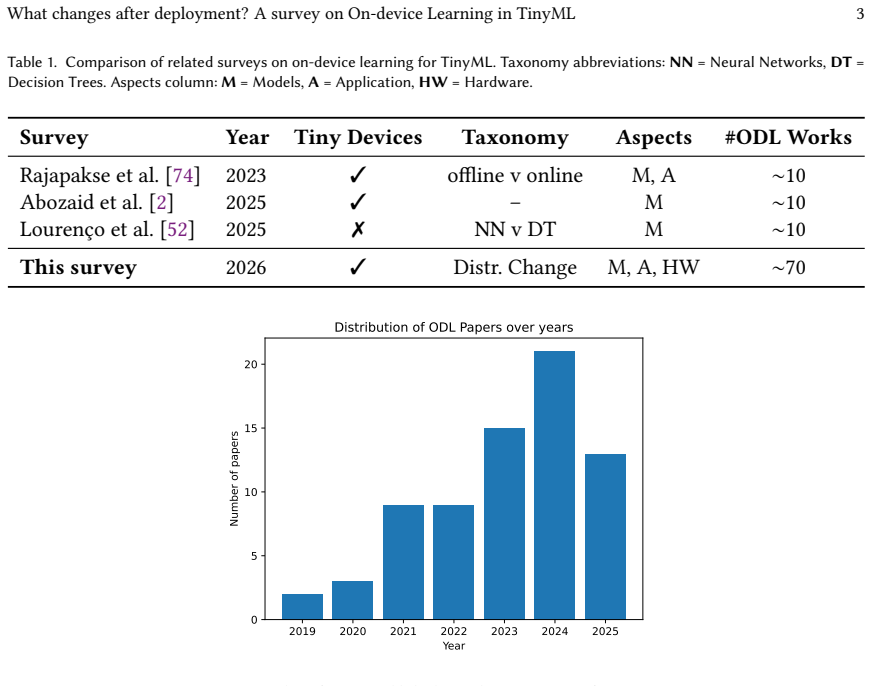
Machine learning models on microcontroller-class devices (TinyML) face a fundamental challenge: post-deployment distribution change undermines static models. On-device learning (ODL) addresses this by running the learning process directly on the device. The existing literature has not characterized how distribution change occurs or how different change types require different solutions. Approximately 70 ODL works are surveyed under one principle: the distribution change regime. The survey analyzes how different types of distribution change influence the applications addressable on-device, the hardware employed, and the structure of the solutions. A persistent gap between methodological benchmarks and real-world deployment scenarios is also identified.
Editorial analysis
A structured set of objections, weighed in public.
Referee Report
Summary. The manuscript is a survey of approximately 70 on-device learning (ODL) works in TinyML, organized under the principle of distribution change regimes. It analyzes how different regimes affect addressable applications, hardware choices, and solution structures, while identifying a persistent gap between typical methodological benchmarks and real-world deployment conditions.
Significance. If the surveyed corpus is representative and the distribution-change axis proves to be the dominant structural lens, the work could usefully organize a fragmented literature and highlight the need for more deployment-oriented evaluation protocols in TinyML.
major comments (1)
- [Methodology / Survey Scope] The central claim that the ~70 works are representative and that distribution change regime is the primary organizing principle rests on an unstated or undescribed paper-selection process. No search protocol, databases, keywords, or inclusion/exclusion criteria are supplied, preventing verification that the corpus adequately covers the field or that alternative TinyML constraints (memory footprint, power envelope) are not equally or more load-bearing.
Simulated Author's Rebuttal
We thank the referee for the constructive feedback on our survey. The major comment identifies a clear gap in methodological transparency, which we will address through revision.
read point-by-point responses
-
Referee: The central claim that the ~70 works are representative and that distribution change regime is the primary organizing principle rests on an unstated or undescribed paper-selection process. No search protocol, databases, keywords, or inclusion/exclusion criteria are supplied, preventing verification that the corpus adequately covers the field or that alternative TinyML constraints (memory footprint, power envelope) are not equally or more load-bearing.
Authors: We agree that the absence of an explicit paper-selection protocol is an oversight that undermines verifiability of the corpus and the choice of organizing axis. In the revised manuscript we will insert a new 'Survey Methodology' subsection (placed after the introduction) that specifies: (1) databases queried (Google Scholar, arXiv, IEEE Xplore, ACM DL); (2) search strings combining 'TinyML'/'microcontroller' with 'on-device learning', 'continual learning', 'online learning', 'distribution shift', 'concept drift', and hardware terms; (3) temporal scope (2018–2024); and (4) inclusion criteria (peer-reviewed or preprint works that implement at least one learning step on an MCU-class device with documented memory <1 MB and power constraints) together with exclusion criteria (pure simulation studies, cloud-offloaded training, or works lacking hardware evaluation). We will also add a short justification paragraph explaining why distribution-change regime was elevated as the primary lens: it directly governs which learning primitives are feasible on-device, whereas memory and power act as secondary filters applied uniformly across regimes. These additions will allow readers to assess coverage and the relative importance of the chosen axis without altering the survey's core findings or structure. revision: yes
Circularity Check
No circularity: survey organizes external literature without derivations or self-referential reductions
full rationale
This is a survey paper whose core activity is classifying ~70 external works by distribution change regime. No equations, fitted parameters, predictions, or mathematical derivations exist that could reduce to inputs by construction. The organization principle is an explicit classification choice stated in the abstract, not a claim derived from self-citation or ansatz. Selection of works is presented as a survey corpus without any load-bearing uniqueness theorem or self-citation chain. The paper is self-contained against external benchmarks as a literature review and receives the default non-finding for absence of any of the enumerated circularity patterns.
Axiom & Free-Parameter Ledger
Reference graph
Works this paper leans on
-
[1]
Norhen Abdennadher, Danilo Pau, and Arcangelo Bruna. 2021. Fixed complexity tiny reservoir heterogeneous network for on-line ECG learning of anomalies. In2021 IEEE 10th Global Conference on Consumer Electronics (GCCE). IEEE, Piscataway, NJ, USA, 233–237. doi:10.1109/GCCE53005.2021. 9622022 ISSN: 2378-8143
-
[2]
Omar Abozaid, Bassant Selim, and Brigitte Jaumard. 2025. Adaptive Embedded Machine Learning on IoT Devices: A Review. In2025 International Telecommunications Conference (ITC-Egypt). IEEE, Piscataway, NJ, USA, 553–560. doi:10.1109/ITC-Egypt66095.2025.11186607
-
[3]
Anguita, Alessandro Ghio, L
D. Anguita, Alessandro Ghio, L. Oneto, Xavier Parra, and Jorge Luis Reyes-Ortiz. 2013. A Public Domain Dataset for Human Activity Recognition using Smartphones. InThe European Symposium on Artificial Neural Networks. springer, Bruges (Belgium). https://api.semanticscholar.org/CorpusID: 6975432
2013
-
[4]
2009.Cortex-M0 Technical Reference Manual
Arm Limited. 2009.Cortex-M0 Technical Reference Manual. Technical Report ARM DDI 0432C. Arm Limited. https://developer.arm.com/ documentation/ddi0432/c/ Accessed: May 2026
2009
-
[5]
2010.Cortex-M4 Technical Reference Manual
Arm Limited. 2010.Cortex-M4 Technical Reference Manual. Technical Report ARM DDI 0439B. Arm Limited. https://developer.arm.com/ documentation/ddi0439/be/ Accessed: May 2026
2010
-
[6]
2015.Arm Cortex-M7 Processor Technical Reference Manual
Arm Limited. 2015.Arm Cortex-M7 Processor Technical Reference Manual. Technical Report ARM DDI 0489F. Arm Limited. https://developer.arm. com/documentation/ddi0489/f/ Accessed: May 2026
2015
-
[7]
2020.Arm Ethos-U55: Product Brief
Arm Limited. 2020.Arm Ethos-U55: Product Brief. Technical Report. Arm Limited. https://armkeil.blob.core.windows.net/developer/Files/pdf/ product-brief/arm-ethos-u55-product-brief.pdf Accessed: May 2026
2020
-
[8]
2020.Arm Ethos-U65 microNPU: Product Brief
Arm Limited. 2020.Arm Ethos-U65 microNPU: Product Brief. Technical Report. Arm Limited. https://developer.arm.com/-/media/Arm%20Developer% 20Community/PDF/Machine%20Learning/Arm_Ethos_U65_Product_Brief.pdf Accessed: May 2026
2020
-
[9]
Colby Banbury, Vijay Janapa Reddi, Peter Torelli, Jeremy Holleman, Nat Jeffries, Csaba Kiraly, Pietro Montino, David Kanter, Sebastian Ahmed, Danilo Pau, et al. 2021. MLPerf Tiny Benchmark.Proceedings of the Neural Information Processing Systems Track on Datasets and Benchmarks(2021)
2021
-
[10]
Simone Benatti, Fabio Montagna, Victor Kartsch, Abbas Rahimi, Davide Rossi, and Luca Benini. 2019. Online Learning and Classification of EMG-Based Gestures on a Parallel Ultra-Low Power Platform Using Hyperdimensional Computing.IEEE Transactions on Biomedical Circuits and Systems13, 3 (June 2019), 516–528. doi:10.1109/TBCAS.2019.2914476
-
[11]
Lukas Bossard, Matthieu Guillaumin, and Luc Van Gool. 2014. Food-101 – Mining Discriminative Components with Random Forests. InComputer Vision – ECCV 2014, David Fleet, Tomas Pajdla, Bernt Schiele, and Tinne Tuytelaars (Eds.). Springer International Publishing, Cham, 446–461
2014
-
[12]
A. Burrello, A. Garofalo, N. Bruschi, G. Tagliavini, D. Rossi, and F. Conti. 2021. DORY: Automatic End-to-End Deployment of Real-World DNNs on Low-Cost IoT MCUs.IEEE Trans. Comput.(2021), 1–1. doi:10.1109/TC.2021.3066883
-
[13]
Alessio Burrello, Marcello Zanghieri, Cristian Sarti, Leonardo Ravaglia, Simone Benatti, and Luca Benini. 2021. Tackling Time-Variability in sEMG-based Gesture Recognition with On-Device Incremental Learning and Temporal Convolutional Networks. In2021 IEEE Sensors Applications Symposium (SAS). IEEE, Piscataway, NJ, USA, 1–6. doi:10.1109/SAS51076.2021.9530007
-
[14]
Han Cai, Chuang Gan, Ligeng Zhu, and Song Han. 2021. TinyTL: Reduce Activations, Not Trainable Parameters for Efficient On-Device Learning. doi:10.48550/arXiv.2007.11622 arXiv:2007.11622 [cs]
-
[15]
Elia Cereda, Alessandro Giusti, and Daniele Palossi. 2024. Training on the Fly: On-device Self-supervised Learning aboard Nano-drones within 20 mW. doi:10.48550/arXiv.2408.03168 arXiv:2408.03168 [cs]
-
[16]
Elia Cereda, Manuele Rusci, Alessandro Giusti, and Daniele Palossi. 2024. On-device Self-supervised Learning of Visual Perception Tasks aboard Hardware-limited Nano-quadrotors. doi:10.48550/arXiv.2403.04071 arXiv:2403.04071 [cs]
-
[17]
Jagmohan Chauhan, Young D. Kwon, and Cecilia Mascolo. 2022. Exploring On-Device Learning Using Few Shots for Audio Classification. In 2022 30th European Signal Processing Conference (EUSIPCO). IEEE, Piscataway, NJ, USA, 424–428. doi:10.23919/EUSIPCO55093.2022.9909551 ISSN: 2076-1465
-
[18]
Mahesh Chowdhary and Swapnil Sayan Saha. 2023. On-Sensor Online Learning and Classification Under 8 KB Memory. In2023 26th International Conference on Information Fusion (FUSION). IEEE, Piscataway, NJ, USA, 1–8. doi:10.23919/FUSION52260.2023.10224228
-
[19]
Aakanksha Chowdhery, Pete Warden, Jonathon Shlens, Andrew Howard, and Rocky Rhodes. 2019. Visual Wake Words Dataset. arXiv:1906.05721 [cs.CV] https://arxiv.org/abs/1906.05721 Manuscript submitted to ACM What changes after deployment? A survey on On-device Learning in TinyML 29
work page internal anchor Pith review Pith/arXiv arXiv 2019
-
[20]
Cristian Cioflan, Lukas Cavigelli, and Luca Benini. 2024. Boosting keyword spotting through on-device learnable user speech characteristics. doi:10.48550/arXiv.2403.07802 arXiv:2403.07802 [cs]
-
[21]
Cristian Cioflan, Lukas Cavigelli, Manuele Rusci, Miguel De Prado, and Luca Benini. 2022. Towards On-device Domain Adaptation for Noise-Robust Keyword Spotting. In2022 IEEE 4th International Conference on Artificial Intelligence Circuits and Systems (AICAS). IEEE, Piscataway, NJ, USA, 82–85. doi:10.1109/AICAS54282.2022.9869990
-
[22]
Cristian Cioflan, Lukas Cavigelli, Manuele Rusci, Miguel de Prado, and Luca Benini. 2024. On-Device Domain Learning for Keyword Spotting on Low-Power Extreme Edge Embedded Systems. doi:10.48550/arXiv.2403.10549 arXiv:2403.10549 [cs]
-
[23]
Michele Craighero, Davide Quarantiello, Beatrice Rossi, Diego Carrera, Pasqualina Fragneto, and Giacomo Boracchi. 2024. On-Device Personalization for Human Activity Recognition on STM32.IEEE Embedded Systems Letters16, 2 (June 2024), 106–109. doi:10.1109/LES.2023.3293458
-
[24]
Matthias De Lange, Rahaf Aljundi, Marc Masana, Sarah Parisot, Xu Jia, Aleš Leonardis, Gregory Slabaugh, and Tinne Tuytelaars. 2021. A continual learning survey: Defying forgetting in classification tasks.IEEE transactions on pattern analysis and machine intelligence44, 7 (2021), 3366–3385
2021
-
[25]
Jia Deng, Wei Dong, Richard Socher, Li-Jia Li, Kai Li, and Li Fei-Fei. 2009. ImageNet: A large-scale hierarchical image database. In2009 IEEE Conference on Computer Vision and Pattern Recognition. IEEE, Piscataway, NJ, USA, 248–255. doi:10.1109/CVPR.2009.5206848
-
[26]
Mark Deutel, Frank Hannig, Christopher Mutschler, and Jürgen Teich. 2025. On-Device Training of Fully Quantized Deep Neural Networks on Cortex-M Microcontrollers.IEEE Transactions on Computer-Aided Design of Integrated Circuits and Systems44, 4 (April 2025), 1250–1261. doi:10.1109/TCAD.2024.3484354
-
[27]
Simone Disabato and Manuel Roveri. 2020. Incremental On-Device Tiny Machine Learning. InProceedings of the 2nd International Workshop on Challenges in Artificial Intelligence and Machine Learning for Internet of Things (AIChallengeIoT ’20). Association for Computing Machinery, New York, NY, USA, 7–13. doi:10.1145/3417313.3429378
-
[28]
Simone Disabato and Manuel Roveri. 2024. Tiny Machine Learning for Concept Drift.IEEE Transactions on Neural Networks and Learning Systems 35, 6 (June 2024), 8470–8481. doi:10.1109/TNNLS.2022.3229897
-
[29]
Gregory Ditzler, Manuel Roveri, Cesare Alippi, and Robi Polikar. 2015. Learning in nonstationary environments: A survey.IEEE Computational Intelligence Magazine10, 4 (2015), 12–25
2015
-
[30]
R. A. Fisher. 1936. Iris. UCI Machine Learning Repository. doi:10.24432/C56C76
-
[31]
Joao Gama, Raquel Sebastiao, and Pedro Pereira Rodrigues. 2013. On evaluating stream learning algorithms.Machine learning90 (2013), 317–346
2013
- [32]
-
[33]
Benchmarking Neural Network Robustness to Common Corruptions and Perturbations
Dan Hendrycks and Thomas G. Dietterich. 2019. Benchmarking Neural Network Robustness to Common Corruptions and Perturbations.CoRR abs/1903.12261 (2019). arXiv:1903.12261 http://arxiv.org/abs/1903.12261
work page internal anchor Pith review Pith/arXiv arXiv 2019
-
[34]
Maxwell L Hutchinson, Erin Antono, Brenna M Gibbons, Sean Paradiso, Julia Ling, and Bryce Meredig. 2017. Overcoming data scarcity with transfer learning.arXiv preprint arXiv:1711.05099(2017)
work page internal anchor Pith review Pith/arXiv arXiv 2017
-
[35]
Andras Janosi. 1989. Heart Disease. UCI Machine Learning Repository. doi:10.24432/C52P4X
-
[36]
Clancy, Metin Akay, and Wei Chen
Xinyu Jiang, Xiangyu Liu, Jiahao Fan, Xinming Ye, Chenyun Dai, Edward A. Clancy, Metin Akay, and Wei Chen. 2021. Open Access Dataset, Toolbox and Benchmark Processing Results of High-Density Surface Electromyogram Recordings.IEEE Transactions on Neural Systems and Rehabilitation Engineering29 (2021), 1035–1046. doi:10.1109/TNSRE.2021.3082551
-
[37]
Osama Khan, Gwanjong Park, and Euiseong Seo. 2023. DaCapo: An On-Device Learning Scheme for Memory-Constrained Embedded Systems. ACM Trans. Embed. Comput. Syst.22, 5s (2023), 142:1–142:23. doi:10.1145/3609121
- [38]
-
[39]
Jonathan Krause, Michael Stark, Jia Deng, and Li Fei-Fei. 2013. 3D Object Representations for Fine-Grained Categorization. In2013 IEEE International Conference on Computer Vision Workshops. IEEE, Piscataway, NJ, USA, 554–561. doi:10.1109/ICCVW.2013.77
-
[40]
2009.Learning multiple layers of features from tiny images
Alex Krizhevsky and Geoffrey Hinton. 2009.Learning multiple layers of features from tiny images. Technical Report 0. University of Toronto, Toronto, Ontario. https://www.cs.toronto.edu/~kriz/learning-features-2009-TR.pdf
2009
-
[41]
Jennifer R. Kwapisz, Gary M. Weiss, and Samuel A. Moore. 2011. Activity recognition using cell phone accelerometers.SIGKDD Explor. Newsl.12, 2 (March 2011), 74–82. doi:10.1145/1964897.1964918
-
[42]
Kwon, Jagmohan Chauhan, Hong Jia, Stylianos I
Young D. Kwon, Jagmohan Chauhan, Hong Jia, Stylianos I. Venieris, and Cecilia Mascolo. 2023. LifeLearner: Hardware-Aware Meta Continual Learning System for Embedded Computing Platforms. doi:10.48550/arXiv.2311.11420 arXiv:2311.11420 [cs]
-
[43]
Kwon, Jagmohan Chauhan, Abhishek Kumar, Pan Hui HKUST, and Cecilia Mascolo
Young D. Kwon, Jagmohan Chauhan, Abhishek Kumar, Pan Hui HKUST, and Cecilia Mascolo. 2021. Exploring System Performance of Continual Learning for Mobile and Embedded Sensing Applications. In2021 IEEE/ACM Symposium on Edge Computing (SEC). IEEE, Piscataway, NJ, USA, 319–332. doi:10.1145/3453142.3491285
-
[44]
Young D. Kwon, Rui Li, Stylianos I. Venieris, Jagmohan Chauhan, Nicholas D. Lane, and Cecilia Mascolo. 2024. TinyTrain: Resource-Aware Task-Adaptive Sparse Training of DNNs at the Data-Scarce Edge. doi:10.48550/arXiv.2307.09988 arXiv:2307.09988 [cs]
-
[45]
Lake, Ruslan Salakhutdinov, and Joshua B
Brenden M. Lake, Ruslan Salakhutdinov, and Joshua B. Tenenbaum. 2015. Human-level concept learning through probabilistic program induction. Science350, 6266 (2015), 1332–1338. arXiv:https://www.science.org/doi/pdf/10.1126/science.aab3050 doi:10.1126/science.aab3050
-
[46]
Y. Lecun, L. Bottou, Y. Bengio, and P. Haffner. 1998. Gradient-based learning applied to document recognition.Proc. IEEE86, 11 (1998), 2278–2324. doi:10.1109/5.726791 Manuscript submitted to ACM 30 Pavan et al
-
[47]
Clayton Frederick Souza Leite and Yu Xiao. 2022. Resource-Efficient Continual Learning for Sensor-Based Human Activity Recognition.ACM Trans. Embed. Comput. Syst.21, 6 (2022), 85:1–85:25. doi:10.1145/3530910
-
[48]
David Leroy, Alice Coucke, Thibaut Lavril, Thibault Gisselbrecht, and Joseph Dureau. 2019. Federated Learning for Keyword Spotting. arXiv:1810.05512 [eess.AS] https://arxiv.org/abs/1810.05512
work page internal anchor Pith review Pith/arXiv arXiv 2019
- [49]
-
[50]
Vincenzo Lomonaco and Davide Maltoni. 2017. CORe50: a New Dataset and Benchmark for Continuous Object Recognition. InProceedings of the 1st Annual Conference on Robot Learning (Proceedings of Machine Learning Research, Vol. 78), Sergey Levine, Vincent Vanhoucke, and Ken Goldberg (Eds.). PMLR, 17–26. https://proceedings.mlr.press/v78/lomonaco17a.html
2017
-
[51]
Afonso Lourenço, João Rodrigo, João Gama, and Goreti Marreiros. 2025. DFDT: Dynamic Fast Decision Tree for IoT Data Stream Mining on Edge Devices. doi:10.48550/arXiv.2502.14011 arXiv:2502.14011 [cs]
-
[52]
Afonso Lourenço, João Rodrigo, João Gama, and Goreti Marreiros. 2025. On-device edge learning for IoT data streams: a survey. doi:10.48550/arXiv. 2502.17788 arXiv:2502.17788 [cs]
work page internal anchor Pith review doi:10.48550/arxiv 2025
-
[53]
Jie Lu, Anjin Liu, Fan Dong, Feng Gu, Joao Gama, and Guangquan Zhang. 2018. Learning under concept drift: A review.IEEE transactions on knowledge and data engineering31, 12 (2018), 2346–2363
2018
-
[54]
EmbodiTTA: Resource-Efficient Test-Time Adaptation for Embodied Visual Systems
Xiao Ma, Young D. Kwon, and Dong Ma. 2025. On-demand Test-time Adaptation for Edge Devices. doi:10.48550/arXiv.2505.00986 arXiv:2505.00986 [cs]
work page internal anchor Pith review Pith/arXiv arXiv doi:10.48550/arxiv.2505.00986 2025
-
[55]
S. Maji, J. Kannala, E. Rahtu, M. Blaschko, and A. Vedaldi. 2013.Fine-Grained Visual Classification of Aircraft. Technical Report. arXiv:1306.5151 [cs- cv]
work page internal anchor Pith review Pith/arXiv arXiv 2013
-
[56]
Mark Mazumder, Sharad Chitlangia, Colby Banbury, Yiping Kang, Juan Manuel Ciro, Keith Achorn, Daniel Galvez, Mark Sabini, Peter Mattson, David Kanter, Greg Diamos, Pete Warden, Josh Meyer, and Vijay Janapa Reddi. 2021. Multilingual Spoken Words Corpus. InThirty-fifth Conference on Neural Information Processing Systems Datasets and Benchmarks Track (Round ...
2021
-
[57]
2022.Personalized Machine Learning
Julian McAuley. 2022.Personalized Machine Learning. Cambridge University Press
2022
-
[58]
Lan Mei, Cristian Cioflan, Thorir Mar Ingolfsson, Victor Kartsch, Andrea Cossettini, Xiaying Wang, and Luca Benini. 2024. Train-On-Request: An On-Device Continual Learning Workflow for Adaptive Real-World Brain Machine Interfaces. In2024 IEEE Biomedical Circuits and Systems Conference (BioCAS). IEEE, Piscataway, NJ, USA, 1–5. doi:10.1109/BioCAS61083.2024....
-
[59]
Lan Mei, Thorir Mar Ingolfsson, Cristian Cioflan, Victor Kartsch, Andrea Cossettini, Xiaying Wang, and Luca Benini. 2025. An Ultra-Low Power Wearable BMI System With Continual Learning Capabilities.IEEE Transactions on Biomedical Circuits and Systems19, 3 (June 2025), 511–522. doi:10.1109/TBCAS.2024.3457522
-
[60]
G.B. Moody and R.G. Mark. 2001. The impact of the MIT-BIH arrhythmia database.IEEE engineering in medicine and biology magazine : the quarterly magazine of the Engineering in Medicine & Biology Society20 (06 2001), 45–50. doi:10.1109/51.932724
-
[61]
Davide Nadalini, Manuele Rusci, Giuseppe Tagliavini, Leonardo Ravaglia, Luca Benini, and Francesco Conti. 2022. PULP-TrainLib: Enabling On-Device Training for RISC-V Multi-core MCUs Through Performance-Driven Autotuning. InEmbedded Computer Systems: Architectures, Modeling, and Simulation, Alex Orailoglu, Marc Reichenbach, and Matthias Jung (Eds.). Spring...
2022
-
[62]
Maria-Elena Nilsback and Andrew Zisserman. 2008. Automated Flower Classification over a Large Number of Classes. In2008 Sixth Indian Conference on Computer Vision, Graphics & Image Processing. 722–729. doi:10.1109/ICVGIP.2008.47
-
[63]
German I Parisi, Ronald Kemker, Jose L Part, Christopher Kanan, and Stefan Wermter. 2019. Continual lifelong learning with neural networks: A review.Neural networks113 (2019), 54–71
2019
-
[64]
Omkar M Parkhi, Andrea Vedaldi, Andrew Zisserman, and C. V. Jawahar. 2012. Cats and dogs. In2012 IEEE Conference on Computer Vision and Pattern Recognition. IEEE, Piscataway, NJ, USA, 3498–3505. doi:10.1109/CVPR.2012.6248092
-
[65]
Patil, Paras Jain, Prabal Dutta, Ion Stoica, and Joseph E
Shishir G. Patil, Paras Jain, Prabal Dutta, Ion Stoica, and Joseph E. Gonzalez. 2022. POET: Training Neural Networks on Tiny Devices with Integrated Rematerialization and Paging. doi:10.48550/arXiv.2207.07697 arXiv:2207.07697 [cs]
-
[66]
Danilo Pau, Prem Kumar Ambrose, Andrea Pisani, and Fabrizio M. Aymone. 2023. TinyRCE: Forward Learning Under Tiny Constraints. In2023 IEEE International Conference on Metrology for eXtended Reality, Artificial Intelligence and Neural Engineering (MetroXRAINE). IEEE, Piscataway, NJ, USA, 295–300. doi:10.1109/MetroXRAINE58569.2023.10405784
-
[67]
Danilo Pau, Abderrahim Khiari, and Davide Denaro. 2021. Online learning on tiny micro-controllers for anomaly detection in water distribution systems. In2021 IEEE 11th International Conference on Consumer Electronics (ICCE-Berlin). IEEE, Piscataway, NJ, USA, 1–6. doi:10.1109/ICCE- Berlin53567.2021.9720009 ISSN: 2166-6822
-
[68]
Danilo Pietro Pau, Andrea Pisani, Fabrizio Maria Aymone, and Gianluigi Ferrari. 2023. TinyRCE: Multipurpose Forward Learning for Resource Restricted Devices.IEEE Sensors Letters7, 10 (Oct. 2023), 1–4. doi:10.1109/LSENS.2023.3307119
-
[69]
Danilo Pietro Pau, Simone Tognocchi, and Marco Marcon. 2025. Learning Online MEMS Calibration with Time-Varying and Memory-Efficient Gaussian Neural Topologies.Sensors25, 12 (Jan. 2025), 3679. doi:10.3390/s25123679 Publisher: Multidisciplinary Digital Publishing Institute
-
[70]
Massimo Pavan, Claudio Galimberti, and Manuel Roveri. 2025. TActiLE: Tiny Active LEarning for wearable devices. In2025 International Joint Conference on Neural Networks (IJCNN). IEEE, IEEE, Piscataway, NJ, USA, 1–8
2025
-
[71]
Massimo Pavan, Gioele Mombelli, Francesco Sinacori, and Manuel Roveri. 2025. TinySV: Speaker Verification in TinyML with On-device Learning. InProceedings of the 4th International Conference on AI-ML Systems (AIMLSystems ’24). Association for Computing Machinery, New York, NY, USA, Manuscript submitted to ACM What changes after deployment? A survey on On-...
-
[72]
Massimo Pavan, Eugeniu Ostrovan, Armando Caltabiano, and Manuel Roveri. 2024. TyBox: An Automatic Design and Code Generation Toolbox for TinyML Incremental On-Device Learning.ACM Trans. Embed. Comput. Syst.23, 3 (2024), 42:1–42:27. doi:10.1145/3604566
-
[73]
Eduardo S. Pereira, Leonardo S. Marcondes, and Josemar M. Silva. 2023. On-Device Tiny Machine Learning for Anomaly Detection Based on the Extreme Values Theory.IEEE Micro43, 6 (Nov. 2023), 58–65. doi:10.1109/MM.2023.3316918
-
[74]
Visal Rajapakse, Ishan Karunanayake, and Nadeem Ahmed. 2023. Intelligence at the Extreme Edge: A Survey on Reformable TinyML.ACM Comput. Surv.55, 13s (2023), 282:1–282:30. doi:10.1145/3583683
-
[75]
Leonardo Ravaglia, Manuele Rusci, Davide Nadalini, Alessandro Capotondi, Francesco Conti, and Luca Benini. 2021. A TinyML Platform for On-Device Continual Learning with Quantized Latent Replays.IEEE Journal on Emerging and Selected Topics in Circuits and Systems11, 4 (Dec. 2021), 789–802. doi:10.1109/JETCAS.2021.3121554 arXiv:2110.10486 [cs]
-
[76]
Attila Reiss and Didier Stricker. 2012. Introducing a New Benchmarked Dataset for Activity Monitoring.2012 16th International Symposium on Wearable Computers(2012), 108–109. https://api.semanticscholar.org/CorpusID:10337279
2012
-
[77]
Haoyu Ren, Darko Anicic, Xue Li, and Thomas Runkler. 2024. On-device Online Learning and Semantic Management of TinyML Systems.ACM Trans. Embed. Comput. Syst.23, 4 (2024), 55:1–55:32. doi:10.1145/3665278
-
[78]
Haoyu Ren, Darko Anicic, and Thomas Runkler. 2021. TinyOL: TinyML with Online-Learning on Microcontrollers. doi:10.48550/arXiv.2103.08295 arXiv:2103.08295 [cs]
-
[79]
Flavio Renzi, Haoyu Ren, Alessio Bernardo, Giacomo Ziffer, Darko Anicic, and Emanuele Della Valle. 2025. Online Learning Techniques for Occupancy Detection on Resource Constrained Devices. In2025 IEEE International Parallel and Distributed Processing Symposium Workshops (IPDPSW). IEEE, Piscataway, NJ, USA, 1019–1026. doi:10.1109/IPDPSW66978.2025.00159 ISS...
-
[80]
Manuele Rusci, Francesco Paci, Marco Fariselli, Eric Flamand, and Tinne Tuytelaars. 2025. Self-Learning for Personalized Keyword Spotting on Ultra-Low-Power Audio Sensors.IEEE Internet of Things Journal12, 8 (April 2025), 10210–10221. doi:10.1109/JIOT.2024.3515143 arXiv:2408.12481 [cs]
discussion (0)
Sign in with ORCID, Apple, or X to comment. Anyone can read and Pith papers without signing in.