REVIEW 2 major objections 1 minor 15 references
Hierarchical features from action narrations allow zero-shot step detection by clustering in video procedures.
Reviewed by Pith at T0; open to challenge. T0 means a machine referee read the full paper against a public rubric. the ladder, T0–T4 →
T0 review · grok-4.3
2026-06-28 23:03 UTC pith:IQL2A3G2
load-bearing objection HiERO-StepG hits second on the Ego4D leaderboard with zero-shot clustering plus three rule tweaks, but the natural-emergence story looks incomplete without ablations. the 2 major comments →
HiERO-StepG @ Ego4D Step Grounding Challenge: hierarchical activity understanding enables zero-shot step grounding
The pith
A machine-rendered reading of the paper's core claim, the machinery that carries it, and where it could break.
Core claim
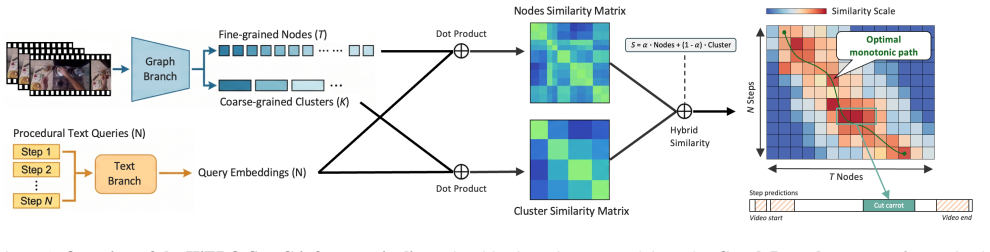
In the HiERO feature space, procedure steps can be detected by a simple clustering, with no additional task-specific fine-tuning. The approach augments this base method by ensuring fine and coarse level agreement in step assignments, enforcing strict temporal monotonicity of the grounded steps, and post-processing the detected steps to reduce the impact of noisy predictions.
What carries the argument
The HiERO feature space, produced by weakly-supervised representation learning that pulls functionally related actions close together using only fine-grained action narrations.
Load-bearing premise
The hierarchical structure of procedures emerges naturally from recurring patterns of co-occurring actions and activities in uncurated videos, so that simple clustering detects steps without task-specific fine-tuning.
What would settle it
If clusters formed in the HiERO feature space on a fresh collection of uncurated narrated videos show no systematic alignment with independently annotated procedure steps, the claim that clustering alone suffices would be falsified.
If this is right
- Step grounding becomes feasible on new procedures without collecting procedure-specific annotations.
- A single representation learned from action narrations supports detection across multiple hierarchy levels.
- Enforcing temporal monotonicity and cross-level agreement measurably improves grounding accuracy.
- The same pipeline can be applied to any video collection that supplies fine-grained action narrations.
Where Pith is reading between the lines
- The same representation might support zero-shot variants of related tasks such as long-term activity segmentation.
- If the emergence of hierarchy from co-occurrence generalizes, annotation budgets for procedural datasets could be redirected toward broader coverage rather than finer labeling.
- Evaluating the method on non-egocentric video domains would test whether the observed patterns are domain-specific.
Editorial analysis
A structured set of objections, weighed in public.
Referee Report
Summary. The paper proposes HiERO-StepG, a zero-shot approach to step grounding on the Ego4D challenge. It leverages HiERO's weakly-supervised features in which hierarchical structure of procedures is claimed to emerge naturally from co-occurring action patterns in uncurated videos; steps are then found by simple clustering without task-specific fine-tuning. The method augments this base approach with three mechanisms—fine/coarse level agreement in assignments, enforcement of strict temporal monotonicity, and post-processing to mitigate noise—yielding 56.27% R@1 (IoU=0.3) and second place on the leaderboard while requiring no procedure-specific annotations.
Significance. A validated demonstration that procedural hierarchies can be recovered zero-shot from existing weakly-supervised representations would reduce reliance on dense annotations for activity understanding and scale to new procedures. The reported leaderboard result provides a concrete, externally validated data point for zero-shot methods, though its attribution to the claimed natural emergence remains to be isolated.
major comments (2)
- [Abstract] Abstract: the claim that steps 'can be detected by a simple clustering, with no additional task-specific fine-tuning' is undercut by the immediate introduction of three explicit augmentations (fine/coarse agreement, temporal monotonicity, post-processing) that are presented as necessary to obtain the 56.27% score. If the hierarchy truly emerges naturally, these mechanisms should be shown to be optional; their inclusion as core components of HiERO-StepG indicates the natural-emergence premise is not self-sufficient.
- [Abstract] Abstract: no ablations, component-wise results, or error analysis are reported to quantify the contribution of the three added rules versus the base HiERO clustering, the choice of clustering algorithm, or other implementation details. Without such controls the leaderboard number cannot be attributed to the central hypothesis.
minor comments (1)
- The abstract references a project page but does not indicate whether code, feature extractors, or clustering hyperparameters are released, which would aid reproducibility of the zero-shot claim.
Simulated Author's Rebuttal
We thank the referee for their insightful comments regarding the presentation of our claims in the abstract and the lack of supporting ablations. We provide point-by-point responses below and will make revisions to address these issues.
read point-by-point responses
-
Referee: [Abstract] Abstract: the claim that steps 'can be detected by a simple clustering, with no additional task-specific fine-tuning' is undercut by the immediate introduction of three explicit augmentations (fine/coarse agreement, temporal monotonicity, post-processing) that are presented as necessary to obtain the 56.27% score. If the hierarchy truly emerges naturally, these mechanisms should be shown to be optional; their inclusion as core components of HiERO-StepG indicates the natural-emergence premise is not self-sufficient.
Authors: The abstract begins by describing the core idea from HiERO that hierarchical structures emerge naturally from co-occurring action patterns, allowing steps to be detected via simple clustering without task-specific fine-tuning. The three augmentations are then presented as enhancements specifically for the Ego4D challenge to reach the reported performance. We recognize that this structure may give the impression that the augmentations are integral to the natural emergence claim. To clarify, we will revise the abstract to separate the base method from the challenge adaptations and will include experiments showing performance with and without the augmentations to demonstrate their optional nature for the core hypothesis. revision: yes
-
Referee: [Abstract] Abstract: no ablations, component-wise results, or error analysis are reported to quantify the contribution of the three added rules versus the base HiERO clustering, the choice of clustering algorithm, or other implementation details. Without such controls the leaderboard number cannot be attributed to the central hypothesis.
Authors: We agree that without ablations it is difficult to attribute the leaderboard result specifically to the natural emergence of hierarchies. The manuscript reports the overall result of the augmented system. In the revised version, we will incorporate component-wise ablations to quantify the impact of each of the three mechanisms relative to the base HiERO clustering, as well as any relevant error analysis. revision: yes
Circularity Check
No circularity: external leaderboard evaluation with transparent post-processing on prior features
full rationale
The paper reports an externally evaluated zero-shot result (56.27% R@1 on Ego4D leaderboard) obtained by clustering in a pre-existing HiERO feature space plus explicitly described augmentations (fine/coarse agreement, monotonicity enforcement, noise-reducing post-processing). No equations, fitted parameters, or self-citation chains reduce the reported metric to its own inputs by construction; the derivation chain remains self-contained against the external benchmark.
Axiom & Free-Parameter Ledger
axioms (1)
- domain assumption Hierarchical structure of procedures emerges naturally from recurring patterns of co-occurring actions and activities in uncurated videos
read the original abstract
Procedural activities follow well-defined structures: whether we consider a cooking recipe or a mechanic repairing a car, these activities naturally decompose in a hierarchy of steps and sub-steps. Traditional approaches for step grounding require extensive annotations and scale poorly. Instead, we argue that such hierarchical structure can emerge naturally from uncurated videos of human activities through recurring patterns of co-occurring actions and activities. Our approach builds on HiERO, a weakly-supervised representation learning approach that maps close in the feature space actions that are functionally related to each other, leveraging only fine-grained action-level narrations. In this feature space, procedure steps can be detected by a simple clustering, with no additional task-specific fine-tuning. For the Ego4D Step Grounding challenge, we augment this approach by ensuring fine and coarse level agreement in step assignments, enforcing strict temporal monotonicity of the grounded steps and post-processing the detected steps to reduce the impact of noisy predictions. We call this approach HiERO-StepG and it achieves 56.27 % on the R@1 (IoU = 0.3) metric on the global leaderboard at submission time, ranking second while being completely zero-shot and not requiring procedure-specific annotations. Project page: https://github.com/andreazenotto/HiERO-StepG.
Figures
Reference graph
Works this paper leans on
-
[1]
My view is the best view: Procedure learning from egocentric videos
Siddhant Bansal, Chetan Arora, and CV Jawahar. My view is the best view: Procedure learning from egocentric videos. In ECCV, 2022. 1
2022
-
[2]
Opel: Optimal transport guided procedure learning
Sayeed Shafayet Chowdhury, Soumyadeep Chandra, and 4 Kaushik Roy. Opel: Optimal transport guided procedure learning. InNeurIPS, 2024. 1
2024
-
[3]
Stepformer: Self-supervised step discovery and localization in instruc- tional videos
Nikita Dvornik, Isma Hadji, Ran Zhang, Konstantinos G Der- panis, Richard P Wildes, and Allan D Jepson. Stepformer: Self-supervised step discovery and localization in instruc- tional videos. InCVPR, 2023. 1
2023
-
[4]
Osgnet@ ego4d episodic memory challenge 2025.arXiv preprint arXiv:2506.03710, 2025
Yisen Feng, Haoyu Zhang, Qiaohui Chu, Meng Liu, Weili Guan, Yaowei Wang, and Liqiang Nie. Osgnet@ ego4d episodic memory challenge 2025.arXiv preprint arXiv:2506.03710, 2025. 1, 4
-
[5]
Ego4d: Around the world in 3,000 hours of egocentric video
Kristen Grauman, Andrew Westbury, Eugene Byrne, Zachary Chavis, Antonino Furnari, Rohit Girdhar, Jackson Hamburger, Hao Jiang, Miao Liu, Xingyu Liu, et al. Ego4d: Around the world in 3,000 hours of egocentric video. InCVPR, 2022. 1, 3
2022
-
[6]
Unsupervised learning of action classes with continuous temporal embedding
Anna Kukleva, Hilde Kuehne, Fadime Sener, and Jurgen Gall. Unsupervised learning of action classes with continuous temporal embedding. InCVPR, 2019. 1
2019
-
[7]
Egocentric video-language pretraining
Kevin Qinghong Lin, Jinpeng Wang, Mattia Soldan, Michael Wray, Rui Yan, Eric Z XU, Difei Gao, Rong-Cheng Tu, Wen- zhe Zhao, Weijie Kong, et al. Egocentric video-language pretraining. InNeurIPS, 2022. 1, 3, 4
2022
-
[8]
Learning to recognize procedural activities with distant supervision
Xudong Lin, Fabio Petroni, Gedas Bertasius, Marcus Rohrbach, Shih-Fu Chang, and Lorenzo Torresani. Learning to recognize procedural activities with distant supervision. In CVPR, 2022. 1
2022
-
[9]
Egovideo: Exploring egocentric foundation model and downstream adaptation,
Baoqi Pei, Guo Chen, Jilan Xu, Yuping He, Yicheng Liu, Kanghua Pan, Yifei Huang, Yali Wang, Tong Lu, Limin Wang, et al. Egovideo: Exploring egocentric foundation model and downstream adaptation.arXiv preprint arXiv:2406.18070,
-
[10]
Hiero: understanding the hierarchy of human behavior enhances reasoning on egocentric videos
Simone Alberto Peirone, Francesca Pistilli, and Giuseppe Averta. Hiero: understanding the hierarchy of human behavior enhances reasoning on egocentric videos. InICCV, 2025. 1
2025
-
[11]
Carlos Plou, Lorenzo Mur-Labadia, Ruben Martinez-Cantin, and Ana C Murillo. Carlor@ ego4d step grounding challenge: Bayesian temporal-order priors for test time refinement.arXiv preprint arXiv:2406.09575, 2024. 1, 2, 4
-
[12]
Ego4d goal-step: Toward hierarchical understanding of procedural activities
Yale Song, Eugene Byrne, Tushar Nagarajan, Huiyu Wang, Miguel Martin, and Lorenzo Torresani. Ego4d goal-step: Toward hierarchical understanding of procedural activities. In NeurIPS, 2024. 1, 3, 4
2024
-
[13]
A tutorial on spectral clustering.Statis- tics and computing, 17:395–416, 2007
Ulrike V on Luxburg. A tutorial on spectral clustering.Statis- tics and computing, 17:395–416, 2007. 2
2007
-
[14]
Span-based localizing network for natural language video localization
Hao Zhang, Aixin Sun, Wei Jing, and Joey Tianyi Zhou. Span-based localizing network for natural language video localization. InProceedings of the 58th Annual Meeting of the Association for Computational Linguistics, 2020. 1
2020
-
[15]
Learning video representations from large language models
Yue Zhao, Ishan Misra, Philipp Kr ¨ahenb¨uhl, and Rohit Gird- har. Learning video representations from large language models. InCVPR, 2023. 2, 3, 4 5
2023
discussion (0)
Sign in with ORCID, Apple, or X to comment. Anyone can read and Pith papers without signing in.