Charged Bose polarons at finite momentum
Pith reviewed 2026-06-28 19:52 UTC · model grok-4.3
The pith
Finite-range ion-atom forces create a momentum scale that maximizes dressing and dissipation for charged Bose polarons.
A machine-rendered reading of the paper's core claim, the machinery that carries it, and where it could break.
Core claim
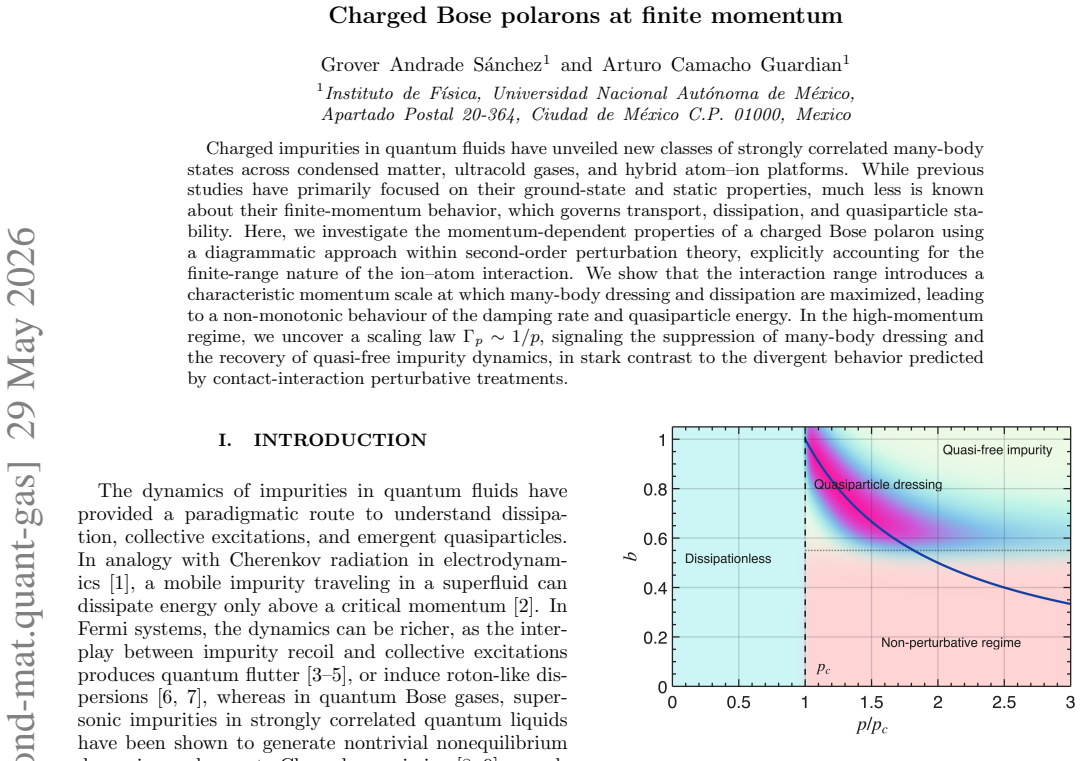
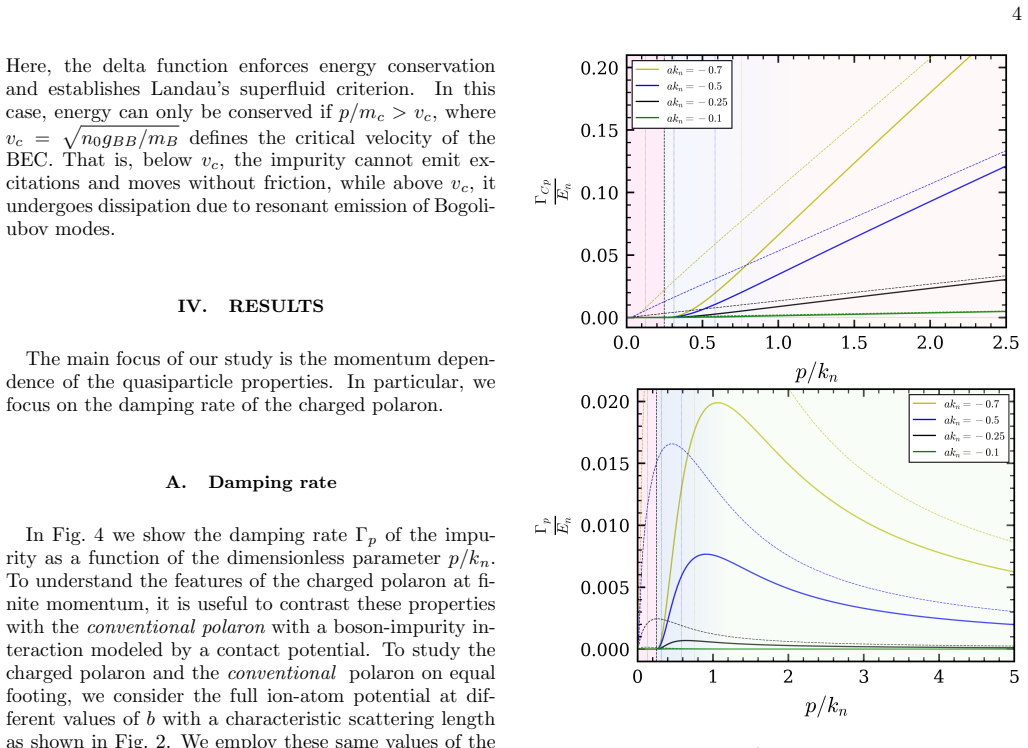
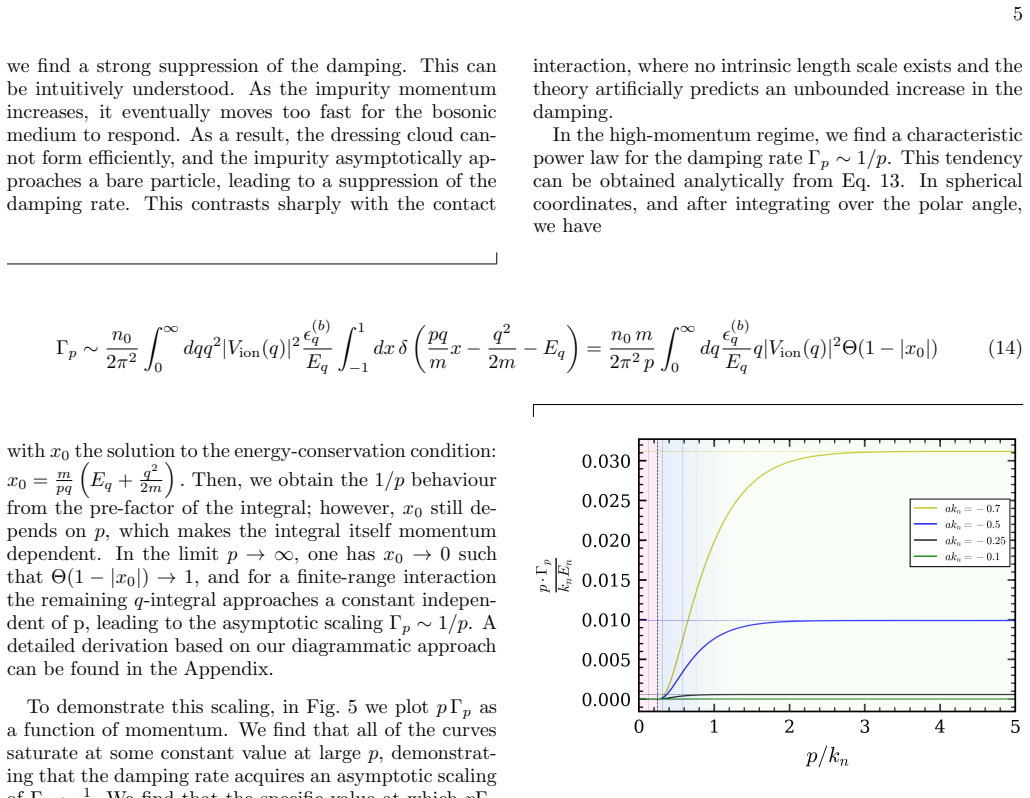
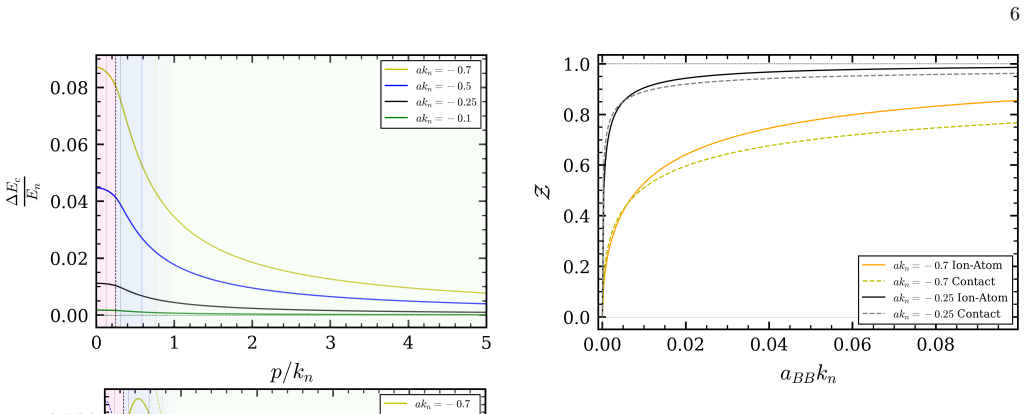
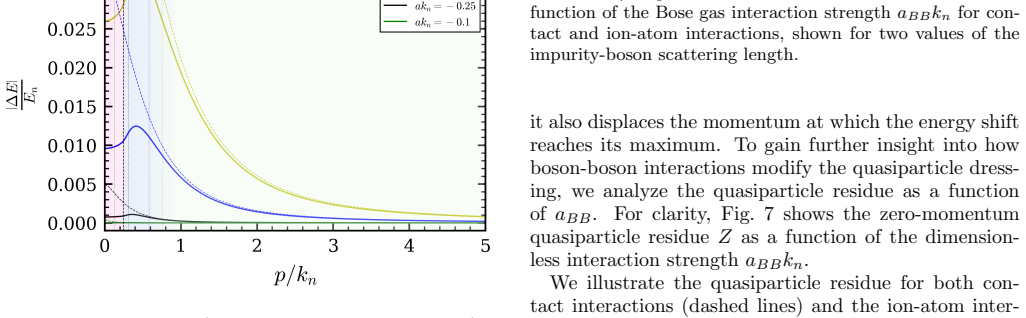
A diagrammatic calculation within second-order perturbation theory shows that the finite range of the ion-atom interaction introduces a characteristic momentum scale at which many-body dressing and dissipation are maximized, yielding non-monotonic momentum dependence of both the damping rate and the quasiparticle energy; in the high-momentum regime the damping rate obeys the scaling law Γ_p ~ 1/p, which signals suppression of many-body dressing and recovery of quasi-free impurity dynamics.
What carries the argument
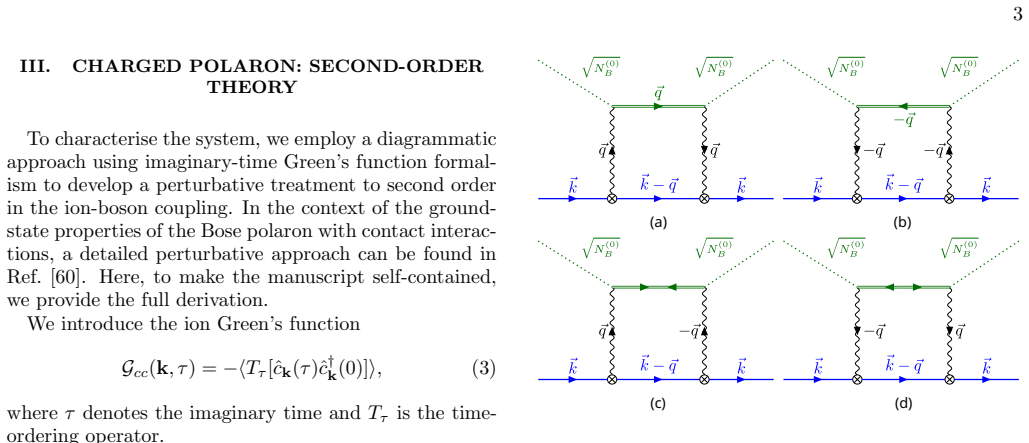
Diagrammatic second-order perturbation theory for the charged Bose polaron that incorporates the finite range of the ion-atom potential and thereby generates a characteristic momentum scale.
If this is right
- Damping rate reaches its largest value at the momentum set by the interaction range.
- Quasiparticle energy displays non-monotonic momentum dependence.
- At high momentum the damping rate obeys Γ_p ~ 1/p, suppressing many-body dressing.
- Contact-interaction treatments incorrectly predict divergent damping instead of the 1/p decay.
Where Pith is reading between the lines
- Transport coefficients and mobility in ion-atom mixtures should exhibit a peak near the interaction-range momentum.
- The same non-monotonic pattern may appear in other finite-range polaron problems once momentum dependence is examined.
- Direct measurement of the high-momentum 1/p tail would test the suppression of dressing predicted by the calculation.
Load-bearing premise
Second-order perturbation theory remains quantitatively accurate over the entire momentum range, including near the scale set by the interaction range, without higher-order diagrams becoming essential.
What would settle it
An experimental plot of damping rate versus impurity momentum that either shows a clear maximum at the momentum fixed by the interaction range followed by a 1/p decay, or fails to exhibit that non-monotonic pattern.
Figures
read the original abstract
Charged impurities in quantum fluids have unveiled new classes of strongly correlated many-body states across condensed matter, ultracold gases, and hybrid atom-ion platforms. While previous studies have primarily focused on their ground-state and static properties, much less is known about their finite-momentum behavior, which governs transport, dissipation, and quasiparticle stability. Here, we investigate the momentum-dependent properties of a charged Bose polaron using a diagrammatic approach within second-order perturbation theory, explicitly accounting for the finite-range nature of the ion-atom interaction. We show that the interaction range introduces a characteristic momentum scale at which many-body dressing and dissipation are maximized, leading to a non-monotonic behavior of the damping rate and quasiparticle energy. In the high-momentum regime, we uncover a scaling law $\Gamma_p \sim 1/p$, signaling the suppression of many-body dressing and the recovery of quasi-free impurity dynamics, in stark contrast to the divergent behavior predicted by contact-interaction perturbative treatments.
Editorial analysis
A structured set of objections, weighed in public.
Referee Report
Summary. The manuscript investigates the finite-momentum properties of charged Bose polarons in a quantum fluid using a diagrammatic second-order perturbation theory that incorporates the finite range of the ion-atom interaction. It claims that the interaction range sets a characteristic momentum scale at which many-body dressing and dissipation are maximized, producing non-monotonic behavior in the damping rate and quasiparticle energy; at high momenta the damping follows Γ_p ∼ 1/p, indicating suppression of dressing and recovery of quasi-free dynamics, in contrast to divergent behavior for contact interactions.
Significance. If the second-order results are quantitatively reliable, the work identifies how finite-range effects can produce a momentum scale that maximizes dissipation and a high-momentum scaling that suppresses many-body corrections, offering testable predictions for transport and stability in atom-ion platforms. The explicit inclusion of finite-range interactions over contact approximations is a clear technical advance within the perturbative framework.
major comments (2)
- [Abstract] Abstract and the perturbative framework: the central claims of non-monotonic damping maximized at a characteristic momentum and the Γ_p ∼ 1/p high-momentum scaling are obtained from second-order diagrammatic perturbation theory, yet no verification is supplied that the expansion parameter remains small near the interaction-range momentum scale where dressing peaks; without such control (e.g., third-order estimates or comparison to non-perturbative benchmarks), the reported location of the maximum and the scaling law rest on an untested assumption.
- [Abstract] The contrast with contact-interaction treatments: the manuscript states that contact interactions produce divergent high-momentum behavior while finite range yields Γ_p ∼ 1/p, but this distinction is derived entirely within the same second-order approximation; if vertex corrections or higher bubble diagrams become O(1) at the reported peak scale, both the non-monotonicity and the scaling could shift, making the contrast load-bearing on the unverified validity of the truncation.
Simulated Author's Rebuttal
We thank the referee for the careful reading and constructive comments. We address the two major comments on the perturbative framework point by point below.
read point-by-point responses
-
Referee: [Abstract] Abstract and the perturbative framework: the central claims of non-monotonic damping maximized at a characteristic momentum and the Γ_p ∼ 1/p high-momentum scaling are obtained from second-order diagrammatic perturbation theory, yet no verification is supplied that the expansion parameter remains small near the interaction-range momentum scale where dressing peaks; without such control (e.g., third-order estimates or comparison to non-perturbative benchmarks), the reported location of the maximum and the scaling law rest on an untested assumption.
Authors: We agree that the manuscript presents results exclusively within second-order perturbation theory and does not supply third-order estimates or non-perturbative benchmarks to confirm the expansion parameter remains small at the interaction-range momentum scale. The non-monotonic features and Γ_p ∼ 1/p scaling are direct consequences of the finite-range potential entering the second-order self-energy. We will revise by adding an explicit discussion of the expected validity regime, parameterized by the dimensionless interaction strength and the ratio of impurity momentum to the inverse range, while clarifying that the reported momentum scale and scaling are predictions of this controlled truncation. revision: partial
-
Referee: [Abstract] The contrast with contact-interaction treatments: the manuscript states that contact interactions produce divergent high-momentum behavior while finite range yields Γ_p ∼ 1/p, but this distinction is derived entirely within the same second-order approximation; if vertex corrections or higher bubble diagrams become O(1) at the reported peak scale, both the non-monotonicity and the scaling could shift, making the contrast load-bearing on the unverified validity of the truncation.
Authors: The contrast is obtained at the same perturbative order, where the finite-range form factor provides a natural cutoff that eliminates the ultraviolet divergence present for contact interactions. We will revise the abstract and main text to state explicitly that the comparison holds within second-order theory and that higher-order diagrams could modify quantitative details, while noting that the qualitative suppression of high-momentum dressing is tied to the range of the potential already at this order. revision: yes
- Explicit verification that the expansion parameter remains small near the interaction-range momentum scale, via third-order estimates or non-perturbative benchmarks
Circularity Check
No circularity; results are direct outputs of second-order perturbation theory
full rationale
The derivation proceeds from the finite-range ion-atom interaction via an explicit second-order diagrammatic expansion. The reported non-monotonic damping rate, characteristic momentum scale, and high-momentum scaling Γ_p ~ 1/p are obtained by direct evaluation of the resulting self-energy expressions; they are not fitted parameters renamed as predictions, not defined in terms of themselves, and not justified by self-citations or imported uniqueness theorems. The calculation is self-contained against the stated perturbative framework with no reduction of outputs to inputs by construction.
Axiom & Free-Parameter Ledger
axioms (1)
- domain assumption Second-order perturbation theory captures the essential momentum dependence of the charged Bose polaron without higher-order corrections dominating near the interaction-range scale.
Forward citations
Cited by 2 Pith papers
-
The moving Fermi polaron
Experiments map the dispersion of moving Fermi polarons, finding constant effective mass at low momentum, bare-particle behavior at high momentum, and a motion-induced transition into a molecule-hole continuum for att...
-
Effects of interaction range on the mean-field dynamics of Bose polarons
Finite-range interactions cause damped oscillatory impurity velocity relaxation in Bose polarons, with ion-atom potentials producing longer equilibration times and larger effective mass differences than local potentia...
Reference graph
Works this paper leans on
-
[1]
Cerenkovet al., Visible emission of clean liquids by action ofγradiation, inDokl
P. Cerenkovet al., Visible emission of clean liquids by action ofγradiation, inDokl. Akad. Nauk SSSR, Vol. 2 (1934) pp. 451–454
1934
-
[2]
K. K. Nielsen and L. P. Ardila, Critical slowdown of non- equilibrium polaron dynamics, New Journal of Physics 21, 043014 (2019)
2019
-
[3]
C. J. Mathy, M. B. Zvonarev, and E. Demler, Quantum flutter of supersonic particles in one-dimensional quan- tum liquids, Nature Physics8, 881 (2012)
2012
-
[4]
M. Knap, C. J. M. Mathy, M. Ganahl, M. B. Zvonarev, and E. Demler, Quantum flutter: Signatures and robust- ness, Phys. Rev. Lett.112, 015302 (2014)
2014
-
[5]
P. E. Dolgirev, Y.-F. Qu, M. B. Zvonarev, T. Shi, and E. Demler, Emergence of a sharp quantum collective mode in a one-dimensional fermi polaron, Physical Re- view X11, 041015 (2021)
2021
-
[6]
Schmidt, T
R. Schmidt, T. Enss, V. Pietil¨ a, and E. Demler, Fermi polarons in two dimensions, Phys. Rev. A85, 021602(R) (2012)
2012
-
[7]
Cotlet, D
O. Cotlet, D. S. Wild, M. D. Lukin, and A. Imamoglu, Rotons in optical excitation spectra of monolayer semi- conductors, Phys. Rev. B101, 205409 (2020)
2020
-
[8]
Seetharam, Y
K. Seetharam, Y. Shchadilova, F. Grusdt, M. B. Zvonarev, and E. Demler, Dynamical quantum cherenkov transition of fast impurities in quantum liquids, Phys. Rev. Lett.127, 185302 (2021)
2021
-
[9]
Seetharam, Y
K. Seetharam, Y. Shchadilova, F. Grusdt, M. Zvonarev, and E. Demler, Quantum cherenkov transition of finite- momentum bose polarons, Phys. Rev. A110, 063306 (2024)
2024
-
[10]
Polarons in atomic gases and two-dimensional semiconductors
P. Massignan, R. Schmidt, G. E. Astrakharchik, A. ˙Imamoglu, M. Zwierlein, J. J. Arlt, and G. M. Bruun, Polarons in atomic gases and two-dimensional semicon- ductors, arXiv preprint arXiv:2501.09618 (2025)
work page internal anchor Pith review Pith/arXiv arXiv 2025
-
[11]
Impurities and polarons in bosonic quantum gases: A review on recent progress, Reports on Progress in Physics 88, 066401 (2025)
2025
-
[12]
M.-G. Hu, M. J. Van de Graaff, D. Kedar, J. P. Corson, E. A. Cornell, and D. S. Jin, Bose polarons in the strongly interacting regime, Physical review letters117, 055301 (2016)
2016
-
[13]
N. B. Jørgensen, L. Wacker, K. T. Skalmstang, M. M. Parish, J. Levinsen, R. S. Christensen, G. M. Bruun, and J. J. Arlt, Observation of attractive and repulsive polarons in a bose-einstein condensate, Physical review letters117, 055302 (2016)
2016
-
[14]
L. P. Ardila and S. Giorgini, Impurity in a bose-einstein condensate: Study of the attractive and repulsive branch using quantum monte carlo methods, Physical Review A 92, 033612 (2015)
2015
-
[15]
M. G. Skou, T. G. Skov, N. B. Jørgensen, K. K. Nielsen, A. Camacho-Guardian, T. Pohl, G. M. Bruun, and J. J. Arlt, Non-equilibrium quantum dynamics and formation of the bose polaron, Nature Physics17, 731 (2021)
2021
-
[16]
M. G. Skou, K. K. Nielsen, T. G. Skov, A. M. Morgen, N. B. Jørgensen, A. Camacho-Guardian, T. Pohl, G. M. Bruun, and J. J. Arlt, Life and death of the bose polaron, Phys. Rev. Res.4, 043093 (2022)
2022
-
[17]
Z. Z. Yan, Y. Ni, C. Robens, and M. W. Zwierlein, Bose polarons near quantum criticality, Science368, 190 (2020)
2020
-
[18]
M. Sun, H. Zhai, and X. Cui, Visualizing the efimov cor- relation in bose polarons, Phys. Rev. Lett.119, 013401 (2017)
2017
-
[19]
Christianen, J
A. Christianen, J. I. Cirac, and R. Schmidt, Bose po- laron and the efimov effect: A gaussian-state approach, 8 Physical Review A105, 053302 (2022)
2022
-
[20]
Levinsen, M
J. Levinsen, M. M. Parish, and G. M. Bruun, Impurity in a bose-einstein condensate and the efimov effect, Physical Review Letters115, 125302 (2015)
2015
-
[21]
P. Naidon, Two Impurities in a Bose-Einstein Conden- sate: From Yukawa to Efimov Attracted Polarons, Jour- nal of the Physical Society of Japan87, 043002 (2018), arXiv:1607.04507 [cond-mat.quant-gas]
work page internal anchor Pith review Pith/arXiv arXiv 2018
-
[22]
A. M. Morgen, S. S. Balling, K. K. Nielsen, T. Pohl, G. M. Bruun, and J. J. Arlt, Quantum beat spectroscopy of repulsive bose polarons, Phys. Rev. Res.7, L022002 (2025)
2025
-
[23]
R. Paredes, G. Bruun, and A. Camacho-Guardian, Per- spective: Interactions mediated by atoms, photons, elec- trons, and excitons, arXiv preprint arXiv:2406.13795 (2024)
-
[24]
Role of impurity statistics and medium constraints in polaron-polaron interactions
J. Levinsen, F. M. Marchetti, O. Bleu, and M. M. Parish, Role of impurity statistics and medium con- straints in polaron-polaron interactions, arXiv preprint arXiv:2512.01413 (2025)
work page internal anchor Pith review Pith/arXiv arXiv 2025
-
[25]
Levinsen, O
J. Levinsen, O. Bleu, and M. M. Parish, Medium- enhanced polaron repulsion in a dilute bose mixture, Phys. Rev. Lett.135, 113402 (2025)
2025
-
[26]
A. M. Morgen, S. S. Balling, M. T. Strøe, T. G. Skov, M. R. Skou, K. K. Nielsen, A. Camacho-Guardian, G. M. Bruun, and J. J. Arlt, Observation of low- lying impurity states in Bose-Einstein condensates, arXiv e-prints , arXiv:2604.18033 (2026), arXiv:2604.18033 [cond-mat.quant-gas]
work page internal anchor Pith review Pith/arXiv arXiv 2026
-
[27]
S. Ding, G. Dom´ ınguez-Castro, A. Julku, A. Cama- cho Guardian, and G. M. Bruun, Polarons and bipolarons in a two-dimensional square lattice, SciPost Physics14, 143 (2023)
2023
-
[28]
Santiago-Garc´ ıa, S
M. Santiago-Garc´ ıa, S. G. Castillo-L´ opez, and A. Camacho-Guardian, Lattice polaron in a bose–einstein condensate of hard-core bosons, New Journal of Physics 26, 063015 (2024)
2024
-
[29]
Santiago-Garc´ ıa and A
M. Santiago-Garc´ ıa and A. Camacho-Guardian, Collec- tive excitations of a bose–einstein condensate of hard- core bosons and their mediated interactions: from two- body bound states to mediated superfluidity, New Jour- nal of Physics25, 093032 (2023)
2023
-
[30]
Alhyder and G
R. Alhyder and G. M. Bruun, Mobile impurity probing a two-dimensional superfluid phase transition, Phys. Rev. A105, 063303 (2022)
2022
-
[31]
Vashisht, I
A. Vashisht, I. Amelio, L. Vanderstraeten, G. M. Bruun, O. K. Diessel, and N. Goldman, Chiral polaron forma- tion on the edge of topological quantum matter, Nature communications16, 4918 (2025)
2025
-
[32]
Alhyder, V
R. Alhyder, V. Colussi, M. ˇCufar, J. Brand, A. Recati, and G. M. Bruun, Lattice bose polarons at strong cou- pling and quantum criticality, SciPost Physics19, 002 (2025)
2025
-
[33]
Isaule, A
F. Isaule, A. Rojo-Franc` as, L. Morales-Molina, and B. Juli´ a-D´ ıaz, Counterflow of lattice polarons in har- monically confined optical lattices, Phys. Rev. Lett.135, 023404 (2025)
2025
-
[34]
V. R. Yordanov and F. Isaule, Mobile impurities inter- acting with a few one-dimensional lattice bosons, Journal of Physics B: Atomic, Molecular and Optical Physics56, 045301 (2023)
2023
-
[35]
Hartweg, T
T. Hartweg, T. Gupta, and G. Pupillo, Bose-hubbard polaron from weak to strong coupling, Phys. Rev. B112, L220201 (2025)
2025
-
[36]
Rojo-Franc` as, F
A. Rojo-Franc` as, F. Isaule, and B. Juli´ a-D´ ıaz, Few par- ticles with an impurity in a one-dimensional harmonic trap, Physica Scripta99, 045408 (2024)
2024
-
[37]
Dom´ ınguez-Castro, L
G. Dom´ ınguez-Castro, L. Santos, and L. P. Ardila, Po- larons and bipolarons in the rydberg-dressed extended bose-hubbard model, Physical Review B113, 035111 (2026)
2026
-
[38]
Schmidt, J
R. Schmidt, J. D. Whalen, R. Ding, F. Camargo, G. Woehl, S. Yoshida, J. Burgd¨ orfer, F. B. Dunning, E. Demler, H. R. Sadeghpour, and T. C. Killian, Theory of excitation of rydberg polarons in an atomic quantum gas, Phys. Rev. A97, 022707 (2018)
2018
-
[39]
L. A. P. Ardila and T. Pohl, Ground-state properties of dipolar bose polarons, Journal of Physics B: Atomic, Molecular and Optical Physics52, 015004 (2018)
2018
-
[40]
A. G. Volosniev, G. Bighin, L. Santos, and L. A. P. Ardila, Non-equilibrium dynamics of dipolar polarons, SciPost Phys.15, 232 (2023)
2023
-
[41]
Hirzler, R
H. Hirzler, R. S. Lous, E. Trimby, J. P´ erez-R´ ıos, A. Safavi-Naini, and R. Gerritsma, Observation of chem- ical reactions between a trapped ion and ultracold fesh- bach dimers, Phys. Rev. Lett.128, 103401 (2022)
2022
-
[42]
R. S. Lous and R. Gerritsma, Chapter two - ultracold ion-atom experiments: cooling, chemistry, and quantum effects, inAdvances in Atomic, Molecular, and Optical Physics, Advances In Atomic, Molecular, and Optical Physics, Vol. 71, edited by L. F. DiMauro, H. Perrin, and S. F. Yelin (Academic Press, 2022) pp. 65–133
2022
-
[43]
Mohammadi, A
A. Mohammadi, A. Kr¨ ukow, A. Mahdian, M. Deiß, J. P´ erez-R´ ıos, H. da Silva, M. Raoult, O. Dulieu, and J. Hecker Denschlag, Life and death of a cold barb + molecule inside an ultracold cloud of rb atoms, Phys. Rev. Res.3, 013196 (2021)
2021
-
[44]
Dieterle, M
T. Dieterle, M. Berngruber, C. H¨ olzl, R. L¨ ow, K. Jachymski, T. Pfau, and F. Meinert, Inelastic collision dynamics of a single cold ion immersed in a bose-einstein condensate, Phys. Rev. A102, 041301 (2020)
2020
-
[45]
Dieterle, M
T. Dieterle, M. Berngruber, C. H¨ olzl, R. L¨ ow, K. Jachymski, T. Pfau, and F. Meinert, Transport of a single cold ion immersed in a bose-einstein condensate, Phys. Rev. Lett.126, 033401 (2021)
2021
-
[46]
Weckesser, F
P. Weckesser, F. Thielemann, D. Wiater, A. Wo- jciechowska, L. Karpa, K. Jachymski, M. Tomza, T. Walker, and T. Schaetz, Observation of feshbach reso- nances between a single ion and ultracold atoms, Nature 600, 429 (2021)
2021
-
[47]
Chowdhury and J
S. Chowdhury and J. Perez-R´ ıos, Ion solvation in atomic baths: from snowballs to polarons, Natural Sciences4, e20240006 (2024)
2024
-
[48]
Pessoa, S
R. Pessoa, S. A. Vitiello, and L. A. P. n. Ardila, Fermi po- laron in atom-ion hybrid systems, Phys. Rev. Lett.133, 233002 (2024)
2024
-
[49]
E. R. Christensen, A. Camacho-Guardian, and G. M. Bruun, Charged polarons and molecules in a bose- einstein condensate, Phys. Rev. Lett.126, 243001 (2021)
2021
-
[50]
G. E. Astrakharchik, L. A. P. Ardila, R. Schmidt, K. Jachymski, and A. Negretti, Ionic polaron in a bose-einstein condensate, Communications Physics4, 1 (2021)
2021
-
[51]
G. E. Astrakharchik, L. A. P. Ardila, K. Jachymski, and A. Negretti, Many-body bound states and induced inter- actions of charged impurities in a bosonic bath, Nature communications14, 1647 (2023)
2023
-
[52]
Cavazos Olivas, L
U. Cavazos Olivas, L. A. Pe˜ na Ardila, and K. Jachym- 9 ski, Modified mean-field ansatz for charged polarons in a bose-einstein condensate, Phys. Rev. A110, L011301 (2024)
2024
-
[53]
L. H. A. Simons, M. Wouters, and J. Tempere, Path- integral ground state and optical response of the charged bose polaron, Phys. Rev. A110, 043301 (2024)
2024
-
[54]
Wysocki, M
P. Wysocki, M. Tylutki, and K. Jachymski, Dynamics of a mobile ion in a bose–einstein condensate, New Journal of Physics28, 013201 (2026)
2026
-
[55]
Cˆ ot´ e, V
R. Cˆ ot´ e, V. Kharchenko, and M. D. Lukin, Mesoscopic molecular ions in bose-einstein condensates, Phys. Rev. Lett.89, 093001 (2002)
2002
-
[56]
Massignan, C
P. Massignan, C. J. Pethick, and H. Smith, Static proper- ties of positive ions in atomic bose-einstein condensates, Phys. Rev. A71, 023606 (2005)
2005
-
[57]
T. A. Yo˘ gurt and M. T. Eiles, Quasiparticle properties of long-range impurities in a bose condensate, Phys. Rev. A 112, 063313 (2025)
2025
-
[58]
S. Ding, M. Drewsen, J. J. Arlt, and G. M. Bruun, Me- diated interaction between ions in quantum degenerate gases, Phys. Rev. Lett.129, 153401 (2022)
2022
-
[59]
K. K. Nielsen, L. A. P. Ardila, G. M. Bruun, and T. Pohl, Critical slowdown of non-equilibrium polaron dynamics, New Journal of Physics21, 043014 (2019)
2019
-
[60]
R. S. Christensen, J. Levinsen, and G. M. Bruun, Quasi- particle properties of a mobile impurity in a bose-einstein condensate, Phys. Rev. Lett.115, 160401 (2015)
2015
-
[61]
S. P. Rath and R. Schmidt, Field-theoretical study of the bose polaron, Physical Review A88, 053632 (2013)
2013
-
[62]
Levinsen, M
J. Levinsen, M. M. Parish, R. S. Christensen, J. J. Arlt, and G. M. Bruun, Finite-temperature behavior of the bose polaron, Phys. Rev. A96, 063622 (2017)
2017
discussion (0)
Sign in with ORCID, Apple, or X to comment. Anyone can read and Pith papers without signing in.