Higher-Derivative Corrections to Reissner--Nordstr\"om Black Holes from Worldline QFT
Pith reviewed 2026-06-28 21:22 UTC · model grok-4.3
The pith
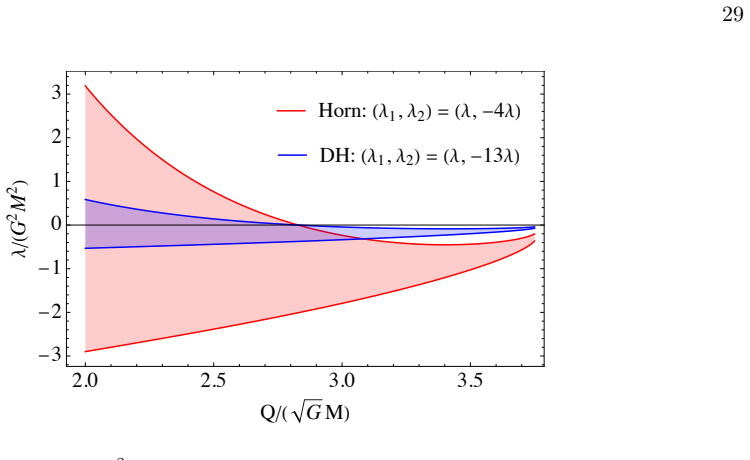
Higher-derivative corrections to Reissner-Nordström black holes make their extremal temperature non-negative only when the weak gravity conjecture is satisfied.
A machine-rendered reading of the paper's core claim, the machinery that carries it, and where it could break.
Core claim
The extremal black hole temperature is non-negative precisely when the weak gravity conjecture is satisfied. This condition on the extremal black hole temperature rules out Drummond-Hathrell theory.
What carries the argument
The worldline QFT computation of the leading post-Minkowskian corrections to the RN solution from RF² operators, which determine the sign of the extremal temperature.
If this is right
- The first law of thermodynamics is satisfied by the corrected black holes.
- The entropy of the perturbed black holes can be computed explicitly.
- The corrections are confirmed by closed-form solutions of the field equations to all orders in G.
- Drummond-Hathrell theory is ruled out because it would produce a negative extremal temperature.
Where Pith is reading between the lines
- This approach could be extended to other higher-derivative operators or to rotating black holes to test similar thermodynamic constraints.
- The link between extremal temperature and the weak gravity conjecture offers a thermodynamic criterion for consistency of effective field theories with quantum gravity.
- Similar analyses might apply to black holes in other dimensions or with different matter content.
Load-bearing premise
The only higher-derivative terms at this order are the RF² operators, and the worldline QFT calculation includes all contributions that affect the extremal temperature sign.
What would settle it
An explicit calculation showing that the extremal temperature in Drummond-Hathrell theory is negative, or a physical observation of an extremal black hole violating the temperature non-negativity condition.
Figures
read the original abstract
In this paper we derived the corrections to the Reissner-Nordstr\"om black hole when higher-derivative $RF^2$ terms (contractions of the Riemann tensor with the Maxwell field strength squared) are added to the Einstein-Maxwell action. Such terms arise naturally in the context of effective field theories. We used wordline QFT methods to obtain the leading order post-Minkowskian corrections. We verified these results by solving the modified Einstein-Maxwell field equations in closed form, to all orders in Newton's constant $G$. We discussed the first law and computed the entropy of the perturbed black holes. The extremal black hole temperature is non-negative precisely when the weak gravity conjecture is satisfied. This condition on the extremal black hole temperature rules out Drummond-Hathrell theory.
Editorial analysis
A structured set of objections, weighed in public.
Referee Report
Summary. The manuscript derives higher-derivative corrections to the Reissner-Nordström black hole metric from RF² operators added to the Einstein-Maxwell action. Leading post-Minkowskian corrections are obtained via worldline QFT and independently verified by solving the modified field equations in closed form to all orders in G. The first law and entropy are discussed, and the extremal black hole temperature is shown to be non-negative precisely when the weak gravity conjecture holds for the operator coefficient, thereby excluding Drummond-Hathrell theory.
Significance. If the central results hold, the work supplies a direct thermodynamic constraint on higher-derivative EFT coefficients via the sign of the extremal temperature. The dual-method agreement (worldline QFT plus all-orders closed-form field-equation solution) and explicit verification of the metric strengthen the reliability of the WGC-temperature link. This constitutes a concrete, falsifiable prediction relating EFT parameters to black-hole thermodynamics.
minor comments (2)
- [Abstract] Abstract: 'wordline QFT' is a typographical error and should read 'worldline QFT'.
- [Thermodynamics section] The relation between the RF² coefficient and the WGC bound is stated clearly in the abstract but would benefit from an explicit equation number or boxed statement in the main text for quick reference.
Simulated Author's Rebuttal
We thank the referee for their positive summary, recognition of the dual verification methods (worldline QFT and all-orders field-equation solution), and recommendation of minor revision. The link between non-negative extremal temperature and the weak gravity conjecture is correctly identified as a key result.
Circularity Check
No significant circularity detected
full rationale
The derivation proceeds by computing leading post-Minkowskian corrections to the RN metric from RF² operators via worldline QFT, then independently verifying the same metric by direct all-orders-in-G solution of the modified Einstein-Maxwell equations. Entropy, first law, and extremal temperature are then extracted from this metric. The statement that T_ext ≥ 0 precisely when the WGC bound on the operator coefficient holds is a direct algebraic consequence of the derived metric functions; it is not obtained by fitting, self-definition, or renaming. The WGC itself is an external conjecture, and Drummond-Hathrell coefficients are external input values. No load-bearing step reduces to a self-citation chain or to an ansatz smuggled from prior author work. The dual verification methods further confirm the result is not forced by construction.
Axiom & Free-Parameter Ledger
Reference graph
Works this paper leans on
-
[1]
For each graviton worldline vertex, include a factor of−iκP αPβ, whereP= p+p′ 2
-
[2]
For each photon worldline vertex, include a factor of−2iQP α
-
[3]
These follow from the integration over the emission timesτ i,i= 1,2
For theNvertices on the worldline (graviton and photon combined), includeN−1 delta functions, 2πδ(2P·k i), wherek i is the momentum of the emitted photon or graviton. These follow from the integration over the emission timesτ i,i= 1,2. . . , N−1 on the worldline, in the absence of any⟨xx⟩contractions. Next we need to glue this to a bulkN+ 1-point connecte...
-
[4]
Reissner, ¨Uber die Eigengravitation des elektrischen Feldes nach der Einsteinschen Theorie, Annalen der Physik355, 106 (1916)
H. Reissner, ¨Uber die Eigengravitation des elektrischen Feldes nach der Einsteinschen Theorie, Annalen der Physik355, 106 (1916)
1916
-
[5]
Nordstr¨ om, On the Energy of the Gravitation Field in Einstein’s Theory, Koninklijke Nederlandsche Akademie van Wetenschappen Proceedings20, 1238 (1918)
G. Nordstr¨ om, On the Energy of the Gravitation Field in Einstein’s Theory, Koninklijke Nederlandsche Akademie van Wetenschappen Proceedings20, 1238 (1918). 34
1918
-
[6]
I. T. Drummond and S. J. Hathrell, QED vacuum polarization in a background gravitational field and its effect on the velocity of photons, Phys. Rev. D22, 343 (1980)
1980
-
[7]
G. W. Horndeski, Conservation of Charge and the Einstein-Maxwell Field Equations, J. Math. Phys. 17, 1980 (1976)
1980
-
[8]
Y. Kats, L. Motl, and M. Padi, Higher-order corrections to mass-charge relation of extremal black holes, JHEP12, 068, arXiv:hep-th/0606100
-
[9]
W. Heisenberg and H. Euler, Consequences of Dirac’s theory of positrons, Z. Phys.98, 714 (1936), arXiv:physics/0605038
Pith/arXiv arXiv 1936
-
[10]
F. Bastianelli, J. M. Davila, and C. Schubert, Gravitational corrections to the Euler–Heisenberg La- grangian, JHEP03, 086, arXiv:0812.4849
-
[11]
M. Campanelli, C. O. Lousto, and J. Audretsch, Perturbative metric of charged black holes in quadratic gravity, Phys. Rev. D51, 6810 (1995), arXiv:gr-qc/9412001
Pith/arXiv arXiv 1995
-
[12]
S. Cremonini, J. T. Liu, and P. Szepietowski, Higher Derivative Corrections to R-charged Black Holes: Boundary Counterterms and the Mass-Charge Relation, JHEP03, 042, arXiv:0910.5159 [hep-th]
-
[13]
S. D’Onofrio, F. Fragomeno, C. Gambino, and F. Riccioni, The Reissner-Nordstr¨ om-Tangherlini solution from scattering amplitudes of charged scalars, JHEP09, 013, arXiv:2207.05841 [hep-th]
-
[14]
J. F. Donoghue, B. R. Holstein, B. Garbrecht, and T. Konstandin, Quantum Corrections to the Reissner- Nordstrom and Kerr-Newman Metrics, Phys. Lett. B529, 132 (2002), hep-th/0112237
Pith/arXiv arXiv 2002
-
[15]
S. Mougiakakos and P. Vanhove, Schwarzschild-Tangherlini metric from scattering amplitudes in various dimensions, Physical Review D103, 10.1103/physrevd.103.026001 (2021)
- [16]
-
[17]
Akiyamaet al.(Event Horizon Telescope), First Sagittarius A* Event Horizon Telescope Results
K. Akiyamaet al.(Event Horizon Telescope), First Sagittarius A* Event Horizon Telescope Results. I. The Shadow of the Supermassive Black Hole in the Center of the Milky Way, Astrophys. J. Lett.930, L12 (2022), arXiv:2311.08680 [astro-ph.HE]
Pith/arXiv arXiv 2022
- [18]
-
[19]
Y. Du, S. Ajith, R. Rajagopal, and D. Vaman, Worldline proof of eikonal exponentiation, JHEP09, 161, arXiv:2409.12895 [hep-th]
-
[20]
M. J. Strassler, Field theory without Feynman diagrams: One loop effective actions, Nucl. Phys. B385, 145 (1992), arXiv:hep-ph/9205205
Pith/arXiv arXiv 1992
-
[21]
Schubert, Perturbative quantum field theory in the string-inspired formalism, Physics Reports355, 73–234 (2001)
C. Schubert, Perturbative quantum field theory in the string-inspired formalism, Physics Reports355, 73–234 (2001)
2001
-
[22]
J. P. Edwards and C. Schubert, Quantum mechanical path integrals in the first quantised approach to quantum field theory (2019), arXiv:1912.10004 [hep-th]
arXiv 2019
-
[23]
J. F. Donoghue, Leading quantum correction to the Newtonian potential, Physical Review Letters72, 2996 (1994), arXiv:gr-qc/9310024
Pith/arXiv arXiv 1994
-
[24]
N. E. J. Bjerrum-Bohr, J. F. Donoghue, and B. R. Holstein, Quantum corrections to the Schwarzschild and Kerr metrics, Physical Review D68, 084005 (2003), arXiv:hep-th/0211071
Pith/arXiv arXiv 2003
-
[25]
S. Mougiakakos and P. Vanhove, Schwarzschild Metric from Scattering Amplitudes to All Orders in GN, Phys. Rev. Lett.133, 111601 (2024), arXiv:2405.14421 [hep-th]
arXiv 2024
-
[26]
A. del R´ ıo and E.-A. Ester, Electrically charged black hole solutions in semiclassical gravity and dy- 35 namics of linear perturbations, Phys. Rev. D109, 105022 (2024), arXiv:2401.08783 [gr-qc]
arXiv 2024
-
[27]
N. Arkani-Hamed, L. Motl, A. Nicolis, and C. Vafa, The String landscape, black holes and gravity as the weakest force, JHEP06, 060, arXiv:hep-th/0601001
-
[28]
J. M. Bardeen, B. Carter, and S. W. Hawking, The Four Laws of Black Hole Mechanics, Communications in Mathematical Physics31, 161 (1973)
1973
-
[29]
V. Iyer and R. M. Wald, Some properties of Noether charge and a proposal for dynamical black hole entropy, Phys. Rev. D50, 846 (1994), arXiv:gr-qc/9403028
Pith/arXiv arXiv 1994
-
[30]
J. D. Bekenstein, Black Holes and Entropy, Physical Review D7, 2333 (1973)
1973
-
[31]
S. W. Hawking, Particle Creation by Black Holes, Communications in Mathematical Physics43, 199 (1975)
1975
-
[32]
M. Campanelli, C. O. Lousto, and J. Audretsch, A Perturbative method to solve fourth order gravity field equations, Phys. Rev. D49, 5188 (1994), arXiv:gr-qc/9401013
Pith/arXiv arXiv 1994
-
[33]
C. Cheung, J. Liu, and G. N. Remmen, Proof of the Weak Gravity Conjecture from Black Hole Entropy, JHEP10, 004, arXiv:1801.08546 [hep-th]
-
[34]
Akiyamaet al.(Event Horizon Telescope), First M87 Event Horizon Telescope Results
K. Akiyamaet al.(Event Horizon Telescope), First M87 Event Horizon Telescope Results. I. The Shadow of the Supermassive Black Hole, Astrophys. J. Lett.875, L1 (2019), arXiv:1906.11238 [astro-ph.GA]
Pith/arXiv arXiv 2019
-
[35]
G. M. Shore, Quantum gravitational optics, Contemp. Phys.44, 503 (2003), arXiv:gr-qc/0304059
Pith/arXiv arXiv 2003
-
[36]
M. P. Hertzberg, R. Nathan, and S. E. Semaan, Solar System constraints on light propagation from higher-derivative corrections to general relativity and implications for fundamental physics, Phys. Rev. D112, 064078 (2025), arXiv:2503.19236
arXiv 2025
-
[37]
V. Perlick and O. Y. Tsupko, Calculating black hole shadows: Review of analytical studies, Phys. Rept. 947, 1 (2022), arXiv:2105.07101 [gr-qc]
arXiv 2022
-
[38]
S. Vagnozziet al., Horizon-scale tests of gravity theories and fundamental physics from the Event Horizon Telescope image of Sagittarius A, Class. Quant. Grav.40, 165007 (2023), arXiv:2205.07787 [gr-qc]
Pith/arXiv arXiv 2023
- [39]
-
[40]
T. Narikawa, N. Uchikata, and T. Tanaka, Gravitational-wave constraints on the GWTC-2 events by measuring the tidal deformability and the spin-induced quadrupole moment, Phys. Rev. D104, 084056 (2021), [Erratum: Phys.Rev.D 111, 089903 (2025)], arXiv:2106.09193 [gr-qc]
arXiv 2021
-
[41]
T. Katagiri, V. Cardoso, T. Ikeda, and K. Yagi, Tidal response beyond vacuum general relativity with a canonical definition, Phys. Rev. D111, 084081 (2025), arXiv:2410.02531 [gr-qc]
arXiv 2025
-
[42]
J. Maldacena, A. Milekhin, and F. Popov, Traversable wormholes in four dimensions, Class. Quant. Grav.40, 155016 (2023), arXiv:1807.04726 [hep-th]
arXiv 2023
-
[43]
N. Arkani-Hamed, Y.-t. Huang, and D. O’Connell, Kerr black holes as elementary particles, JHEP01, 046, arXiv:1906.10100 [hep-th]
arXiv 1906
-
[44]
E. T. Newman and A. I. Janis, Note on the Kerr spinning particle metric, J. Math. Phys.6, 915 (1965)
1965
-
[45]
D. J. Burger, W. T. Emond, and N. Moynihan, Rotating Black Holes in Cubic Gravity, Phys. Rev. D 101, 084009 (2020), arXiv:1910.11618 [hep-th]
arXiv 2020
discussion (0)
Sign in with ORCID, Apple, or X to comment. Anyone can read and Pith papers without signing in.