Crystallisation kinetics of supercooled liquid palladium
Pith reviewed 2026-06-28 21:36 UTC · model grok-4.3
The pith
MD simulations show homogeneous nucleation governs supercooling in palladium films
A machine-rendered reading of the paper's core claim, the machinery that carries it, and where it could break.
Core claim
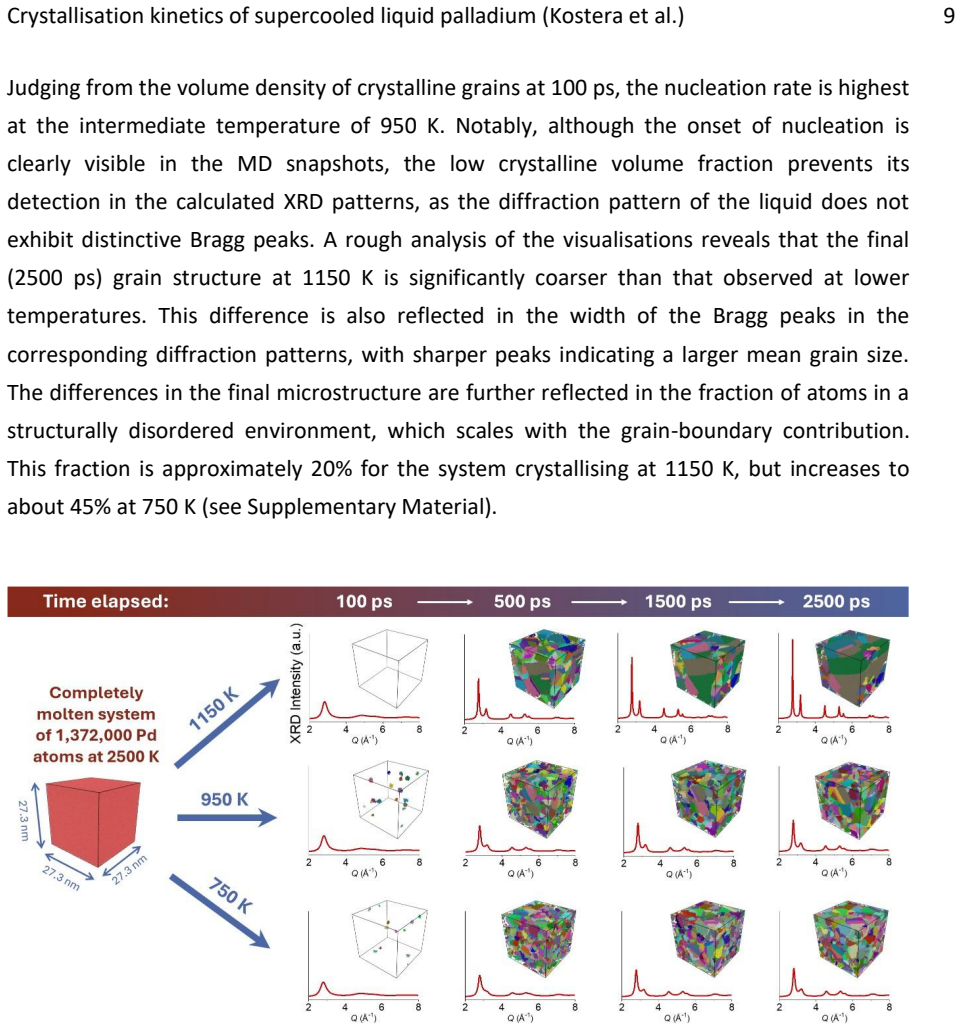
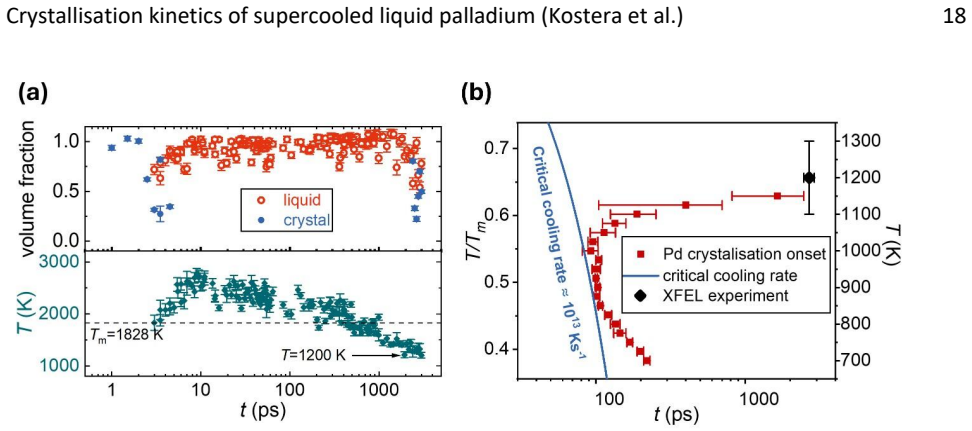
The simulations reproduce the crystallisation onset time and temperature observed in time-resolved X-ray diffraction experiments on optically molten Pd thin films quenched at 5 × 10^{11} K s^{-1}. These results indicate that homogeneous, rather than heterogeneous, nucleation governs the achievable supercooling in the experimentally studied films.
What carries the argument
The time-temperature-transformation diagram for crystallisation onset, constructed from statistically independent molecular dynamics simulations of nucleation and growth.
If this is right
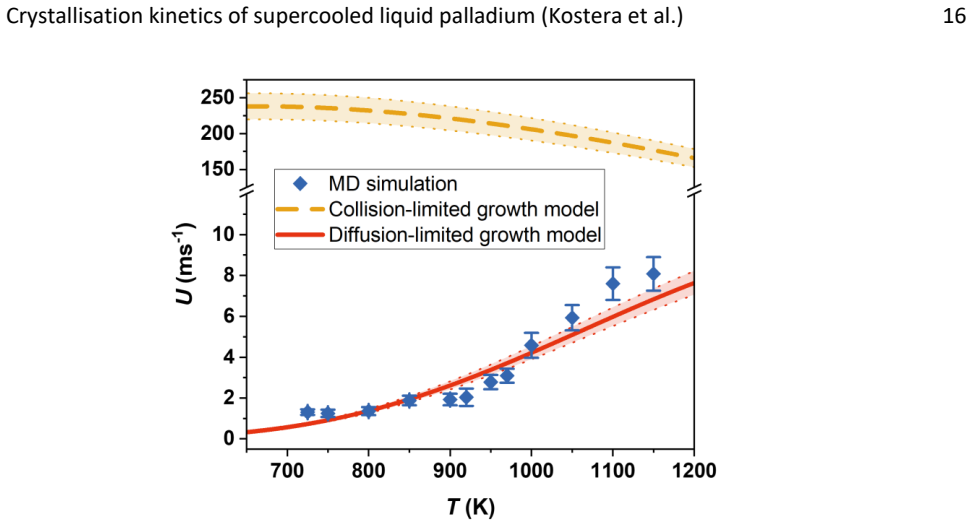
- Crystal growth velocities reach metres per second and follow diffusion-limited Wilson-Frenkel kinetics.
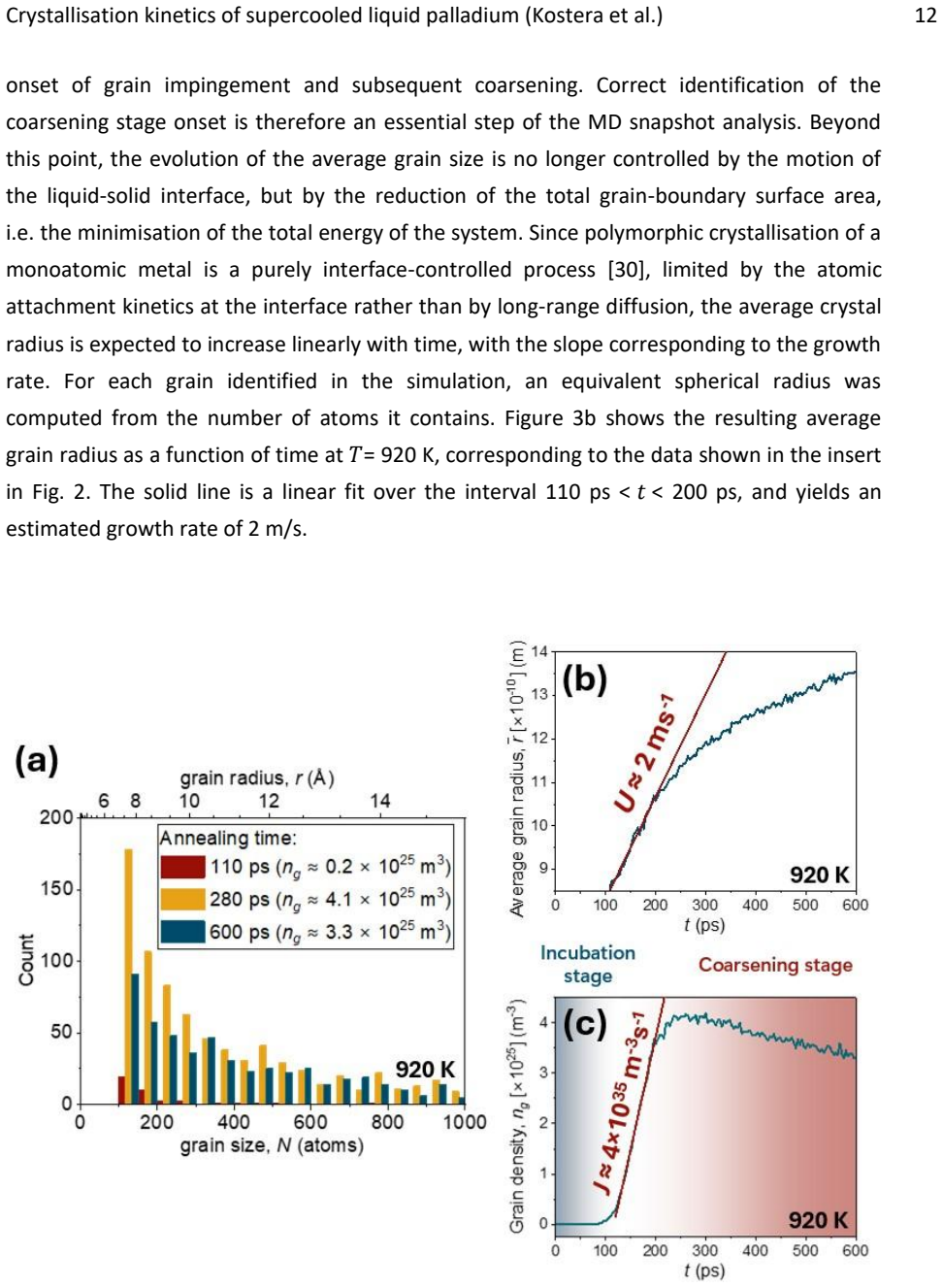
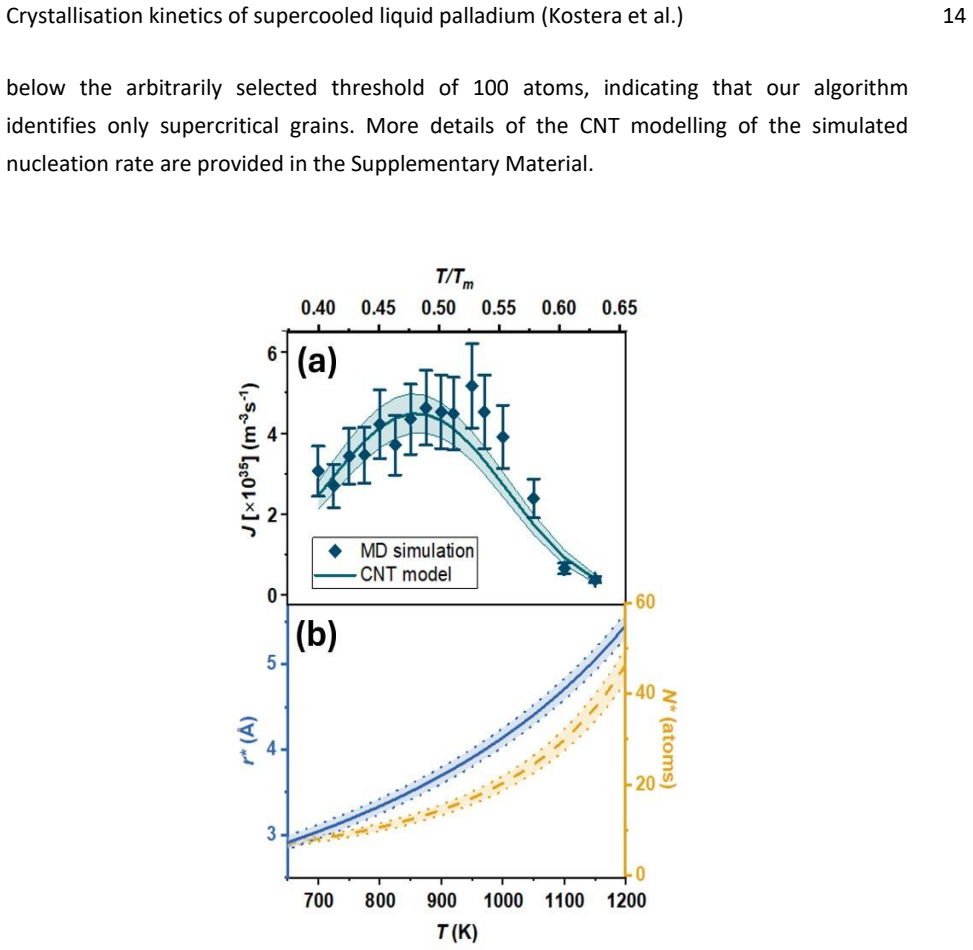
- The homogeneous nucleation rate peaks at approximately 4 × 10^{35} m^{-3} s^{-1} near 0.5 Tm.
- The critical cooling rate to avoid crystallisation is around 10^{13} K s^{-1}.
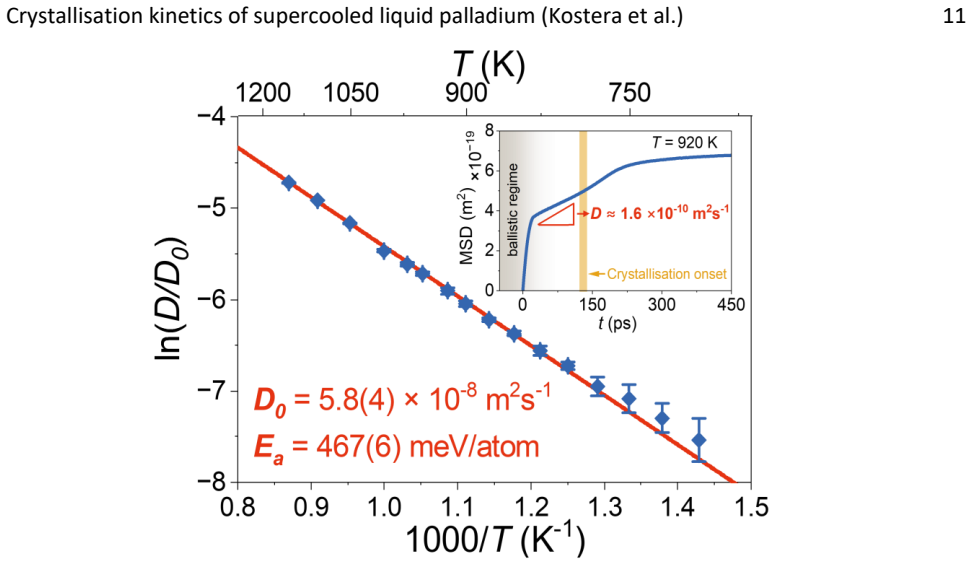
- Self-diffusion in the supercooled liquid follows Arrhenius behaviour with an activation energy of 467 meV per atom.
Where Pith is reading between the lines
- The agreement between simulation and experiment suggests that classical potentials can predict vitrification behavior in other pure metals.
- If homogeneous nucleation is confirmed, efforts to increase supercooling in Pd would need to target volume nucleation rates rather than surface effects.
- The TTT diagram provides a baseline for comparing glass-forming ability across different quenching methods or alloy compositions.
Load-bearing premise
The classical interatomic potential used in the MD simulations accurately captures the real atomic interactions and energetics of supercooled palladium, so that the simulated nucleation statistics and growth velocities correspond to physical behavior.
What would settle it
Observation of crystallisation starting preferentially at interfaces or defects in the Pd films, rather than uniformly in the bulk, would indicate that heterogeneous nucleation is actually dominant.
Figures
read the original abstract
In this study, we employ classical molecular dynamics (MD) simulations to investigate the crystallisation kinetics of supercooled liquid palladium and relate the results to time-resolved X-ray diffraction measurements on rapidly quenched Pd thin films. Crystal nucleation and growth rates are determined over the temperature range $700$--$1150~\mathrm{K}$ ($0.38$--$0.65 T_{\mathrm{m}}$) by analysing the evolution of the microstructure during the liquid-to-crystal transition. The self-diffusion coefficient of Pd, obtained from the atomic mean-squared displacement, follows Arrhenius behaviour over the investigated temperature range, with an activation energy of $467(6)~\mathrm{meV/atom}$, consistent with available data for supercooled liquid metals. The steady-state homogeneous nucleation rate exhibits a maximum of approximately $4 \times 10^{35}~\mathrm{m^{-3} s^{-1}}$ near $0.5 T_{\mathrm{m}}$. Crystal growth occurs at velocities of the order of metres per second, with a temperature dependence consistent with diffusion-limited Wilson-Frenkel kinetics rather than the collision-limited regime. Based on multiple statistically independent simulations, a time-temperature-transformation (TTT) diagram for crystallisation onset is constructed. The TTT curve exhibits a nose near $0.5 T_{\mathrm{m}}$ and $100~\mathrm{ps}$, corresponding to a critical cooling rate for vitrification on the order of $10^{13}~\mathrm{K s^{-1}}.$ The simulations reproduce the crystallisation onset time and temperature observed in time-resolved X-ray diffraction experiments on optically molten Pd thin films quenched at $5 \times 10^{11}~\mathrm{K s^{-1}}.$ These results indicate that homogeneous, rather than heterogeneous, nucleation governs the achievable supercooling in the experimentally studied films.
Editorial analysis
A structured set of objections, weighed in public.
Referee Report
Summary. The manuscript uses classical MD simulations to compute homogeneous nucleation rates (maximum ~4×10^{35} m^{-3} s^{-1} near 0.5 T_m) and diffusion-limited growth velocities for supercooled Pd over 700–1150 K. From multiple trajectories it constructs a TTT diagram with a nose at ~0.5 T_m and 100 ps (critical cooling rate ~10^{13} K s^{-1}) and reports that the simulated onset times and temperatures match those observed in time-resolved X-ray diffraction on Pd thin films quenched at 5×10^{11} K s^{-1}, concluding that homogeneous rather than heterogeneous nucleation governs the experimental supercooling.
Significance. If the interatomic potential is shown to be reliable, the work supplies a rare quantitative bridge between atomistic kinetics and high-rate quenching experiments, supporting the homogeneous-nucleation interpretation for Pd films and furnishing an independent estimate of the critical cooling rate for vitrification. The reported Arrhenius diffusion coefficient (activation energy 467(6) meV) is consistent with literature values for supercooled metals and bolsters the diffusion-limited growth analysis.
major comments (2)
- [Methodology] Methodology section: the specific classical interatomic potential is not identified and no validation against ab initio nucleation barriers, experimental critical undercooling, or alternative Pd potentials is presented. Because the nucleation-rate maximum and the claimed reproduction of the experimental onset at 5×10^{11} K s^{-1} rest entirely on this potential, the central claim that the match demonstrates homogeneous nucleation cannot be assessed without such checks.
- [Results] Results (TTT diagram and experimental comparison): system size, number of independent trajectories, and the statistical procedure used to identify nucleation events and onset times are not reported. These details are load-bearing for the reliability of the TTT nose position and the direct comparison to the X-ray data.
minor comments (2)
- [Abstract] Abstract: the melting temperature T_m should be stated explicitly when the temperature window is given as 0.38–0.65 T_m.
- [Results] Notation: the error on the activation energy is reported as 467(6) meV/atom; ensure this convention is used consistently for all fitted quantities.
Simulated Author's Rebuttal
We thank the referee for the constructive comments, which highlight areas where additional clarity will strengthen the manuscript. We will revise the text to address both major points.
read point-by-point responses
-
Referee: [Methodology] Methodology section: the specific classical interatomic potential is not identified and no validation against ab initio nucleation barriers, experimental critical undercooling, or alternative Pd potentials is presented. Because the nucleation-rate maximum and the claimed reproduction of the experimental onset at 5×10^{11} K s^{-1} rest entirely on this potential, the central claim that the match demonstrates homogeneous nucleation cannot be assessed without such checks.
Authors: We will revise the Methodology section to explicitly name the interatomic potential employed and cite its original parameterization. The potential was chosen because it reproduces the experimental melting temperature of Pd to within 2 % and yields self-diffusion coefficients consistent with literature values for the supercooled liquid. Direct ab initio nucleation-barrier calculations remain prohibitive for the required system sizes; we will add a brief statement acknowledging this limitation while noting that the potential’s thermodynamic fidelity and the observed match to the experimental onset temperature at the stated cooling rate provide indirect support for the homogeneous-nucleation interpretation. A short comparison to an alternative Pd potential will also be included if space permits. revision: yes
-
Referee: [Results] Results (TTT diagram and experimental comparison): system size, number of independent trajectories, and the statistical procedure used to identify nucleation events and onset times are not reported. These details are load-bearing for the reliability of the TTT nose position and the direct comparison to the X-ray data.
Authors: We agree these details should be stated explicitly. We will add the following information to the Results section: all production runs used cubic cells containing 32 000 atoms; between 8 and 12 independent trajectories were generated at each temperature by randomizing initial velocities; nucleation events were detected via the largest cluster of atoms whose local environment satisfies the fcc bond-order criterion (threshold Q6 > 0.3); onset time was defined as the first frame in which the crystalline volume fraction exceeds 5 %. These additions will allow readers to evaluate the statistical robustness of the reported TTT nose and the comparison with the X-ray data. revision: yes
Circularity Check
No circularity: MD-derived rates and TTT diagram are independent of the experimental benchmark
full rationale
The paper extracts nucleation rates, growth velocities, and the TTT diagram directly from classical MD trajectories by analyzing microstructure evolution and mean-squared displacement over independent runs. These quantities are then compared to, rather than fitted against, the X-ray diffraction onset times and temperatures. No self-citation chain, fitted parameter renamed as prediction, or ansatz smuggled via prior work is present in the reported derivation; the experimental match functions as an external validation rather than an input that forces the result by construction.
Axiom & Free-Parameter Ledger
free parameters (1)
- activation_energy =
467(6) meV/atom
axioms (2)
- domain assumption Classical interatomic potential reproduces real Pd energetics and dynamics in the supercooled liquid
- domain assumption Nucleation events observed in simulation cells are homogeneous and statistically representative of bulk behavior
Reference graph
Works this paper leans on
-
[1]
Chapter 6 Crystal growth in undercooled melts,
D. M. Herlach, P. Galenko, and D. Holland-Moritz, Eds., “Chapter 6 Crystal growth in undercooled melts,” in Metastable solids from undercooled melts, in Pergamon materials series, vol. 10. Pergamon, 2007, pp. 195–280. doi: https://doi.org/10.1016/S1470-1804(07)80030-7. Crystallisation kinetics of supercooled liquid palladium (Kostera et al.) 23
-
[2]
Crystal Nucleation in Liquids and Glasses,
K. F. Kelton, “Crystal Nucleation in Liquids and Glasses,” in Solid State Physics, Elsevier, 1991, pp. 75–177. doi: 10.1016/S0081-1947(08)60144-7
-
[3]
Formation of monatomic metallic glasses through ultrafast liquid quenching,
L. Zhong, J. Wang, H. Sheng, Z. Zhang, and S. X. Mao, “Formation of monatomic metallic glasses through ultrafast liquid quenching,” Nature, vol. 512, no. 7513, pp. 177–180, Aug. 2014, doi: 10.1038/nature13617
-
[4]
Kinetics of Solidification of Supercooled Liquid Mercury Droplets,
D. Turnbull, “Kinetics of Solidification of Supercooled Liquid Mercury Droplets,” The Journal of Chemical Physics, vol. 20, no. 3, pp. 411–424, Mar. 1952, doi: 10.1063/1.1700435
-
[5]
Probing the structure of a liquid metal during vitrification,
K. Georgarakis et al., “Probing the structure of a liquid metal during vitrification,” Acta Materialia, vol. 87, pp. 174–186, Apr. 2015, doi: 10.1016/j.actamat.2015.01.005
-
[6]
Bulk glass formation in the Pd–Ni–P system,
Y. He, R. B. Schwarz, and J. I. Archuleta, “Bulk glass formation in the Pd–Ni–P system,” Applied Physics Letters, vol. 69, no. 13, pp. 1861–1863, Sept. 1996, doi: 10.1063/1.117458
-
[7]
Y. Shibuta, S. Sakane, E. Miyoshi, S. Okita, T. Takaki, and M. Ohno, “Heterogeneity in homogeneous nucleation from billion-atom molecular dynamics simulation of solidification of pure metal,” Nat Commun, vol. 8, no. 1, p. 10, Apr. 2017, doi: 10.1038/s41467-017-00017-5
-
[8]
The mechanism of the ultrafast crystal growth of pure metals from their melts,
G. Sun, J. Xu, and P. Harrowell, “The mechanism of the ultrafast crystal growth of pure metals from their melts,” Nature Materials, vol. 17, no. 10, pp. 881–886, Oct. 2018, doi: 10.1038/s41563-018-0174-6
-
[9]
The Interface Kinetics of Crystal Growth Processes,
K. A. Jackson, “The Interface Kinetics of Crystal Growth Processes,” Interface Science, vol. 10, no. 2, pp. 159–169, July 2002, doi: 10.1023/A:1015824230008
-
[10]
A joint diffusion/collision model for crystal growth in pure liquid metals,
H. Men, “A joint diffusion/collision model for crystal growth in pure liquid metals,” Nature Communications, vol. 15, no. 1, p. 5749, July 2024, doi: 10.1038/s41467-024- 50182-7
-
[11]
S. R. Coriell and D. Turnbull, “Relative roles of heat transport and interface rearrangement rates in the rapid growth of crystals in undercooled melts,” Acta Metallurgica, vol. 30, no. 12, pp. 2135–2139, Dec. 1982, doi: 10.1016/0001- 6160(82)90134-1
-
[12]
New horizons for glass formation and stability,
A. L. Greer, “New horizons for glass formation and stability,” Nature Mater, vol. 14, no. 6, pp. 542–546, 2015, doi: 10.1038/nmat4292. Crystallisation kinetics of supercooled liquid palladium (Kostera et al.) 24
-
[13]
Molecular dynamics study of atomic transport properties in rapidly cooling liquid copper,
F. F. Chen, H. F. Zhang, F. X. Qin, and Z. Q. Hu, “Molecular dynamics study of atomic transport properties in rapidly cooling liquid copper,” The Journal of Chemical Physics, vol. 120, no. 4, pp. 1826–1831, Jan. 2004, doi: 10.1063/1.1636452
-
[14]
X. Sui, Y. Cheng, N. Zhou, B. Tang, and L. Zhou, “Molecular dynamics simulation of the solidification process of multicrystalline silicon from homogeneous nucleation to grain coarsening,” CrystEngComm, vol. 20, no. 25, pp. 3569–3580, 2018, doi: 10.1039/C8CE00767E
-
[15]
Large-Scale Molecular Dynamics Simulations of Homogeneous Nucleation of Pure Aluminium,
M. Papanikolaou, K. Salonitis, M. Jolly, and M. Frank, “Large-Scale Molecular Dynamics Simulations of Homogeneous Nucleation of Pure Aluminium,” Metals, vol. 9, no. 11, p. 1217, Nov. 2019, doi: 10.3390/met9111217
-
[16]
D. V. Louzguine-Luzgin, M. Miyama, K. Nishio, A. A. Tsarkov, and A. L. Greer, “Vitrification and nanocrystallization of pure liquid Ni studied using molecular- dynamics simulation,” The Journal of Chemical Physics, vol. 151, no. 12, p. 124502, Sept. 2019, doi: 10.1063/1.5119307
-
[17]
Crystallization of FCC and BCC Liquid Metals Studied by Molecular Dynamics Simulation,
D. V. Louzguine-Luzgin and A. I. Bazlov, “Crystallization of FCC and BCC Liquid Metals Studied by Molecular Dynamics Simulation,” Metals, vol. 10, no. 11, p. 1532, Nov. 2020, doi: 10.3390/met10111532
-
[18]
Atomic dynamics and local structural disorder during ultrafast melting of polycrystalline Pd,
A. Olczak et al., “Atomic dynamics and local structural disorder during ultrafast melting of polycrystalline Pd,” Scripta Materialia, vol. 267, p. 116826, Oct. 2025, doi: 10.1016/j.scriptamat.2025.116826
-
[19]
A. Mahata and M. Asle Zaeem, “Size effect in molecular dynamics simulation of nucleation process during solidification of pure metals: Investigating modified embedded atom method interatomic potentials,” Modelling and Simulation in Materials Science and Engineering, vol. 27, no. 8, p. 085015, Oct. 2019, doi: 10.1088/1361-651X/ab4b36
-
[20]
Beyond Finite-Size Scaling in Solidification Simulations,
F. H. Streitz, J. N. Glosli, and M. V. Patel, “Beyond Finite-Size Scaling in Solidification Simulations,” Physical Review Letters, vol. 96, no. 22, p. 225701, June 2006, doi: 10.1103/PhysRevLett.96.225701
-
[21]
Structural pathways for ultrafast melting of optically excited thin polycrystalline Palladium films,
J. Antonowicz et al., “Structural pathways for ultrafast melting of optically excited thin polycrystalline Palladium films,” Acta Materialia, vol. 276, p. 120043, Sept. 2024, doi: 10.1016/j.actamat.2024.120043. Crystallisation kinetics of supercooled liquid palladium (Kostera et al.) 25
-
[22]
Plimpton, Fast Parallel Algorithms for Short-Range Molecular Dynamics, J
S. Plimpton, “Fast Parallel Algorithms for Short-Range Molecular Dynamics,” Journal of Computational Physics, vol. 117, no. 1, pp. 1–19, Mar. 1995, doi: 10.1006/jcph.1995.1039
-
[23]
A. P. Thompson et al., “LAMMPS - a flexible simulation tool for particle-based materials modeling at the atomic, meso, and continuum scales,” Computer Physics Communications, vol. 271, p. 108171, Feb. 2022, doi: 10.1016/j.cpc.2021.108171
-
[24]
D. J. Evans and B. L. Holian, “The Nose–Hoover thermostat,” The Journal of Chemical Physics, vol. 83, no. 8, pp. 4069–4074, Oct. 1985, doi: 10.1063/1.449071
-
[26]
Finite element methods in ab initio electronic structure calculations,
P. M. Larsen, S. Schmidt, and J. Schiøtz, “Robust structural identification via polyhedral template matching,” Modelling and Simulation in Materials Science and Engineering, vol. 24, no. 5, p. 055007, May 2016, doi: 10.1088/0965- 0393/24/5/055007
-
[27]
D. Khakhulin et al., “Ultrafast X-ray Photochemistry at European XFEL: Capabilities of the Femtosecond X-ray Experiments (FXE) Instrument,” Applied Sciences, vol. 10, no. 3, p. 995, Feb. 2020, doi: 10.3390/app10030995
-
[28]
Molecular-dynamics study of self-diffusion in liquid transition metals,
J. Mei and J. W. Davenport, “Molecular-dynamics study of self-diffusion in liquid transition metals,” Physical Review B, vol. 42, no. 15, pp. 9682–9684, Nov. 1990, doi: 10.1103/PhysRevB.42.9682
-
[29]
Simulations of atomic structure, dynamics, and self-diffusion in liquid Au,
A. Bogicevic, L. B. Hansen, and B. I. Lundqvist, “Simulations of atomic structure, dynamics, and self-diffusion in liquid Au,” Physical Review E, vol. 55, no. 5, pp. 5535– 5545, May 1997, doi: 10.1103/PhysRevE.55.5535
-
[30]
K. F. Kelton and A. L. Greer, Nucleation in Condensed Matter - Applications in Materials and Biology, vol. 15. in Pergamon Materials Series, vol. 15. Elsevier, 2010. doi: 10.1016/C2009-0-04500-0
-
[31]
A Re-assessment of the Thermodynamic Properties of Palladium,
J. W. Arblaster, “A Re-assessment of the Thermodynamic Properties of Palladium,” Johnson Matthey Technology Review, 2018, doi: 10.1595/205651318X696648
-
[32]
Kittel, Introduction to solid state physics, 8th ed
C. Kittel, Introduction to solid state physics, 8th ed. New York, NY: John Wiley & Sons, 2004. Crystallisation kinetics of supercooled liquid palladium (Kostera et al.) 26
2004
-
[33]
Crystallization Rates of a Lennard- Jones Liquid,
J. Q. Broughton, G. H. Gilmer, and K. A. Jackson, “Crystallization Rates of a Lennard- Jones Liquid,” Physical Review Letters, vol. 49, no. 20, pp. 1496–1500, Nov. 1982, doi: 10.1103/PhysRevLett.49.1496
-
[34]
K. Georgarakis et al., “Variations in atomic structural features of a supercooled Pd– Ni–Cu–P glass forming liquid during in situ vitrification,” Acta Materialia, vol. 59, no. 2, pp. 708–716, Jan. 2011, doi: 10.1016/j.actamat.2010.10.009
-
[35]
Supercooling investigation and critical cooling rate for glass formation in Pd–Cu–Ni–P alloy,
N. Nishiyama and A. Inoue, “Supercooling investigation and critical cooling rate for glass formation in Pd–Cu–Ni–P alloy,” Acta Materialia, vol. 47, no. 5, pp. 1487–1495, Mar. 1999, doi: 10.1016/S1359-6454(99)00030-0
-
[36]
Formation, stability and structure of palladium-silicon based alloy glasses,
H. S. Chen and D. Turnbull, “Formation, stability and structure of palladium-silicon based alloy glasses,” Acta Metallurgica, vol. 17, no. 8, pp. 1021–1031, Aug. 1969, doi: 10.1016/0001-6160(69)90048-0
-
[37]
Amorphous Phase in Palladium— Silicon Alloys,
P. Duwez, R. H. Willens, and R. C. Crewdson, “Amorphous Phase in Palladium— Silicon Alloys,” Journal of Applied Physics, vol. 36, no. 7, pp. 2267–2269, July 1965, doi: 10.1063/1.1714461
-
[38]
Ultrafast Pulsed Laser Annealing of Pd100-xSix Thin Films,
O. Liubchenko et al., “Ultrafast Pulsed Laser Annealing of Pd100-xSix Thin Films,” Acta Physica Polonica A, vol. 148, no. 4, pp. 303–303, Dec. 2025, doi: 10.12693/APhysPolA.148.303
-
[39]
Microscopic Observation of the Solidification of Small Metal Droplets,
D. Turnbull and R. E. Cech, “Microscopic Observation of the Solidification of Small Metal Droplets,” Journal of Applied Physics, 1950, doi: 10.1063/1.1699763
-
[40]
Devitrification of thin film Cu–Zr metallic glass via ultrashort pulsed laser annealing,
J. Antonowicz et al., “Devitrification of thin film Cu–Zr metallic glass via ultrashort pulsed laser annealing,” Journal of Alloys and Compounds, vol. 887, p. 161437, Dec. 2021, doi: 10.1016/j.jallcom.2021.161437
-
[41]
A liquid-liquid transition can exist in monatomic transition metals with a positive melting slope,
B. Lee and G. W. Lee, “A liquid-liquid transition can exist in monatomic transition metals with a positive melting slope,” Scientific Reports, vol. 6, no. 1, p. 35564, Oct. 2016, doi: 10.1038/srep35564
-
[42]
A. Meyer, “The measurement of self-diffusion coefficients in liquid metals with quasielastic neutron scattering,” EPJ Web of Conferences, vol. 83, p. 01002, 2015, doi: 10.1051/epjconf/20158301002
-
[43]
Iida, The physical properties of liquid metals
T. Iida, The physical properties of liquid metals. Oxford : Clarendon Press ;, 1988. Available: http://www.loc.gov/catdir/enhancements/fy0635/86023616-d.html, http://www.loc.gov/catdir/enhancements/fy0635/86023616-t.html Crystallisation kinetics of supercooled liquid palladium (Kostera et al.) 27
1988
-
[44]
A. Mahata, M. A. Zaeem, and M. I. Baskes, “Understanding homogeneous nucleation in solidification of aluminum by molecular dynamics simulations,” Modelling and Simulation in Materials Science and Engineering, vol. 26, no. 2, p. 025007, Feb. 2018, doi: 10.1088/1361-651X/aa9f36
-
[45]
E. Asadi, M. Asle Zaeem, S. Nouranian, and M. I. Baskes, “Two-phase solid–liquid coexistence of Ni, Cu, and Al by molecular dynamics simulations using the modified embedded-atom method,” Acta Materialia, vol. 86, pp. 169–181, Mar. 2015, doi: 10.1016/j.actamat.2014.12.010
-
[46]
Bulk liquid undercooling and nucleation in gold,
G. Wilde, J. Sebright, and J. Perepezko, “Bulk liquid undercooling and nucleation in gold,” Acta Materialia, 2006, doi: 10.1016/j.actamat.2006.06.007
-
[47]
Predictions for the Sound Velocity in Various Liquid Metals at Their Melting Point Temperatures,
T. Iida and R. Guthrie, “Predictions for the Sound Velocity in Various Liquid Metals at Their Melting Point Temperatures,” Metallurgical and Materials Transactions B, vol. 40, no. 6, pp. 959–966, Dec. 2009, doi: 10.1007/s11663-009-9299-y
-
[48]
Y. Ashkenazy and R. S. Averback, “Kinetic stages in the crystallization of deeply undercooled body-centered-cubic and face-centered-cubic metals,” Acta Materialia, 2010, doi: 10.1016/j.actamat.2009.09.030. Crystallisation kinetics of supercooled liquid palladium -Supplementary Materials 1. Preliminary test – system size Each data point represents the mean...
discussion (0)
Sign in with ORCID, Apple, or X to comment. Anyone can read and Pith papers without signing in.