REVIEW 4 major objections 5 minor 61 references
Self-Tuning Regularization for Image Scanning Microscopy
T0 review · 4 major / 5 minor · reviewed 2026-08-02 · deepseek-v4-flash
Pith's one-line read This paper claims that explicitly regularized MID and s2ISM reconstructions, with the regularization weight chosen automatically by a masked residual-whiteness principle, produce stable, high-quality images in low-photon fluorescence micros
desk verdict A legitimate and well-executed variational extension of MID/s2ISM with automatic parameter selection, but the core whiteness heuristic needs broader validation before it can be called fully self-tuning. read the letter →
The pith
A machine-rendered reading of the paper's core claim, the machinery that carries it, and where it could break.
The reading
What carries the argument
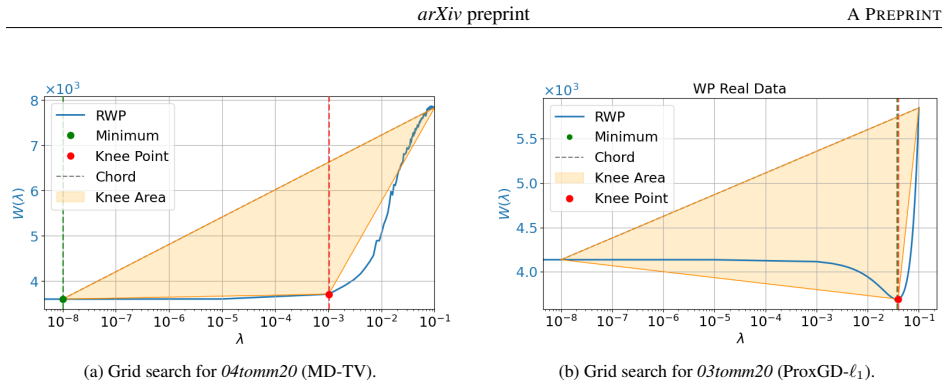
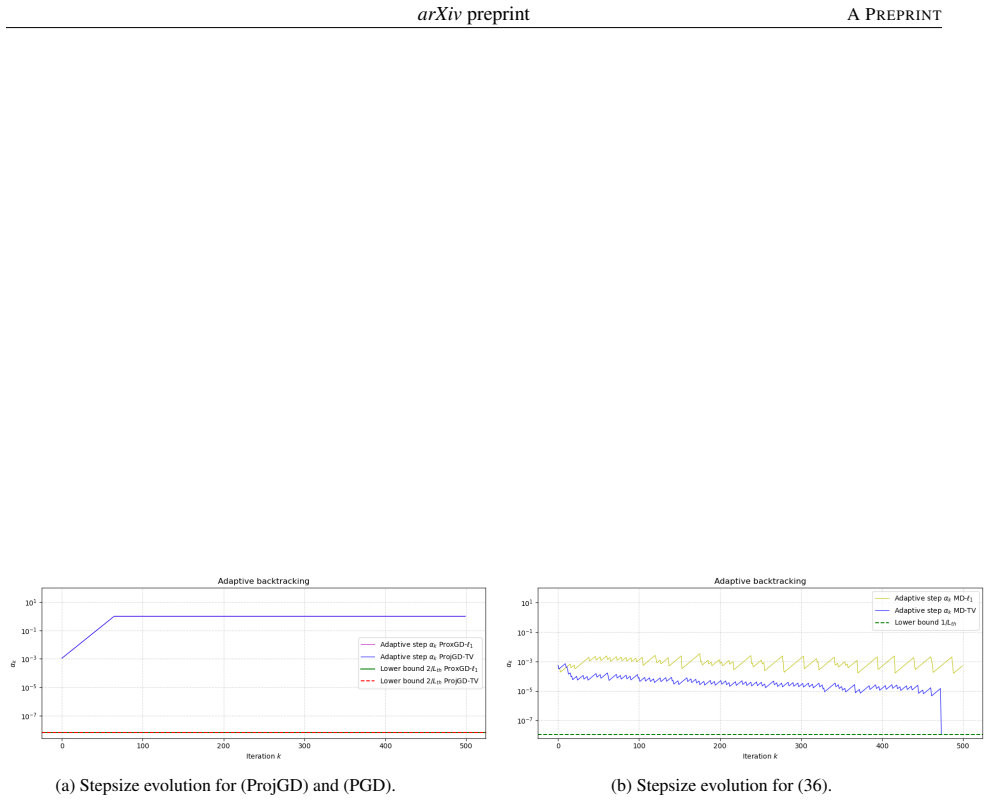
The load-bearing object is the whiteness functional W(Z) = Σ ĉ_{l,m}(Z)², computed from the standardized residual field Z_λ = (y − ν_λ)/√ν_λ via an FFT-based expression. Minimizing W over a grid of λ values selects the regularization weight; for s2ISM, W is evaluated on a high-pass-filtered power spectrum to prevent unregularized background errors from dominating, and masked residuals correct for the zero-truncated Poisson statistics of dark pixels. The reconstructions themselves are minimizers of the KL data fidelity term plus λR(x), with R either ℓ1 or smoothed total variation, solved by proximal gradient or mirror descent with adaptive backtracking stepsize selection.
What would settle it
Simulate ISM data with the same setup but a flux factor well below F=20 (e.g., F=2), run reconstructions over the full λ grid, and test whether the λ minimizing the masked whiteness functional coincides with the λ maximizing PSNR/MicroSSIM against the known ground truth. Any systematic divergence in this low-photon regime, where the zero-truncation correction dominates, would falsify the claim that the self-tuning rule selects the reconstruction closest to the truth.
Extended reading notes
Core claim
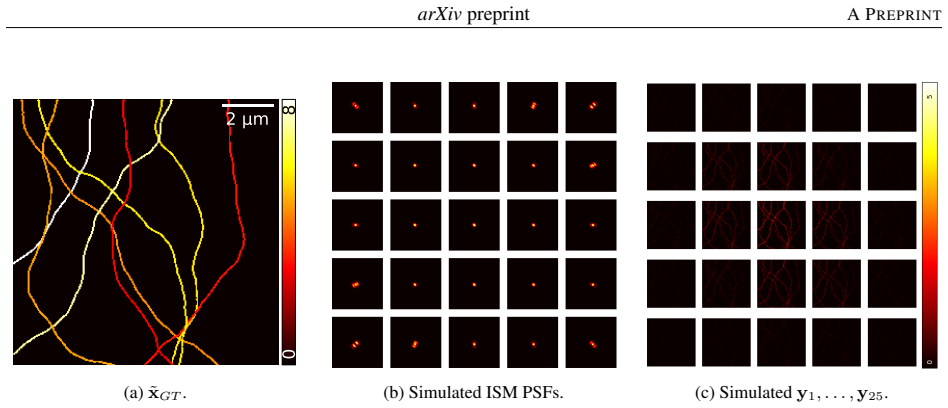
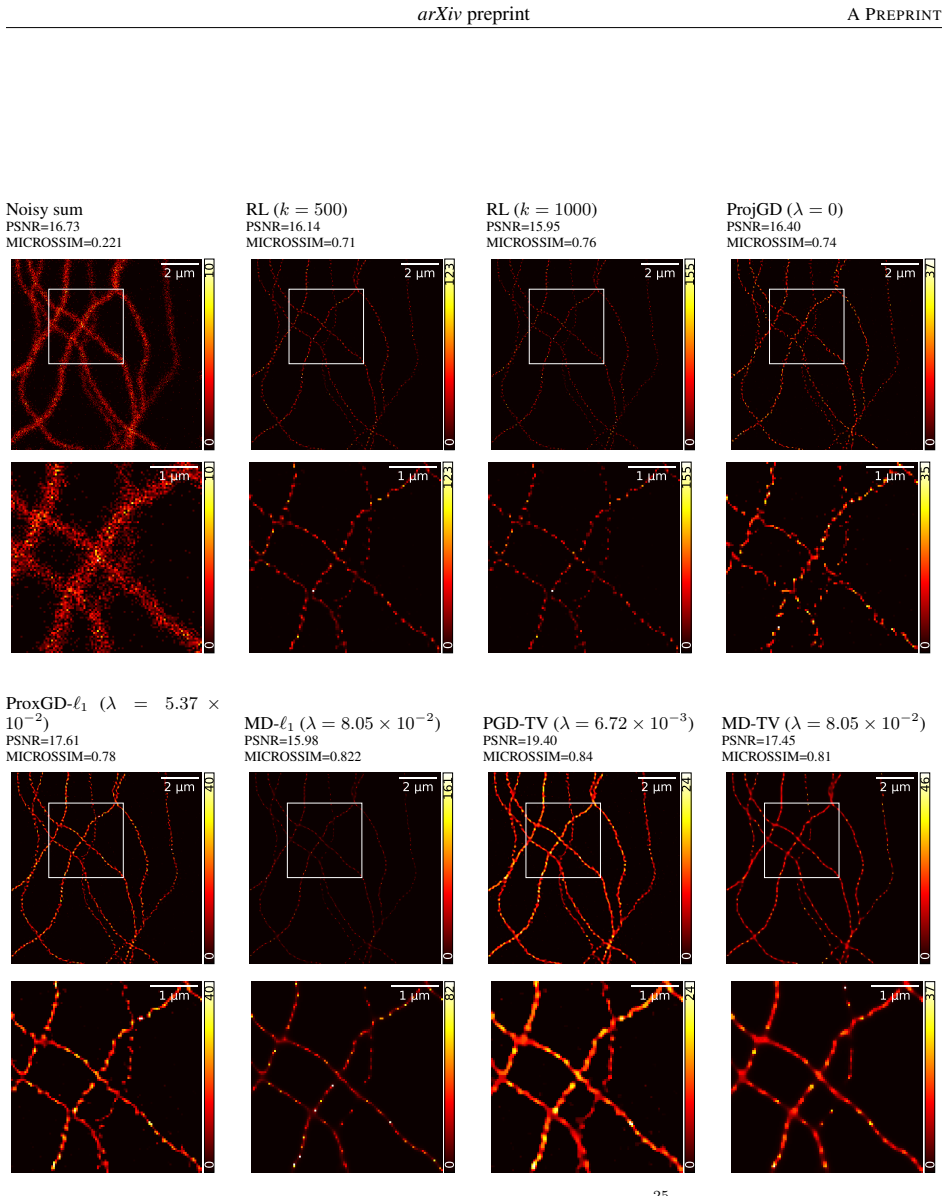
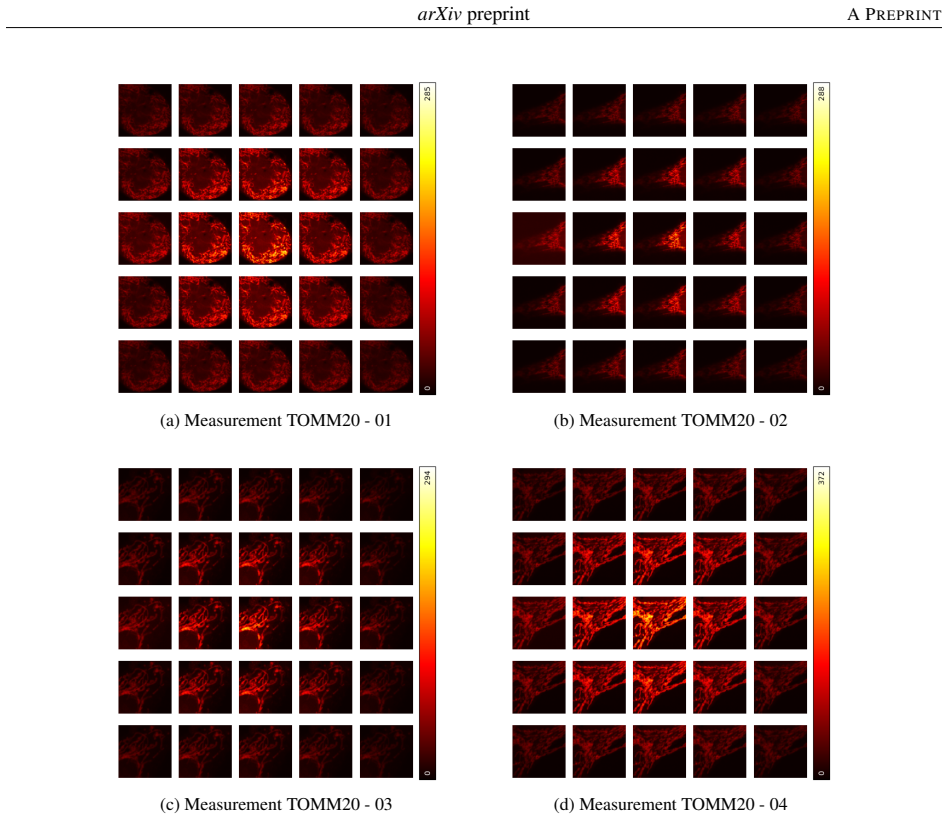
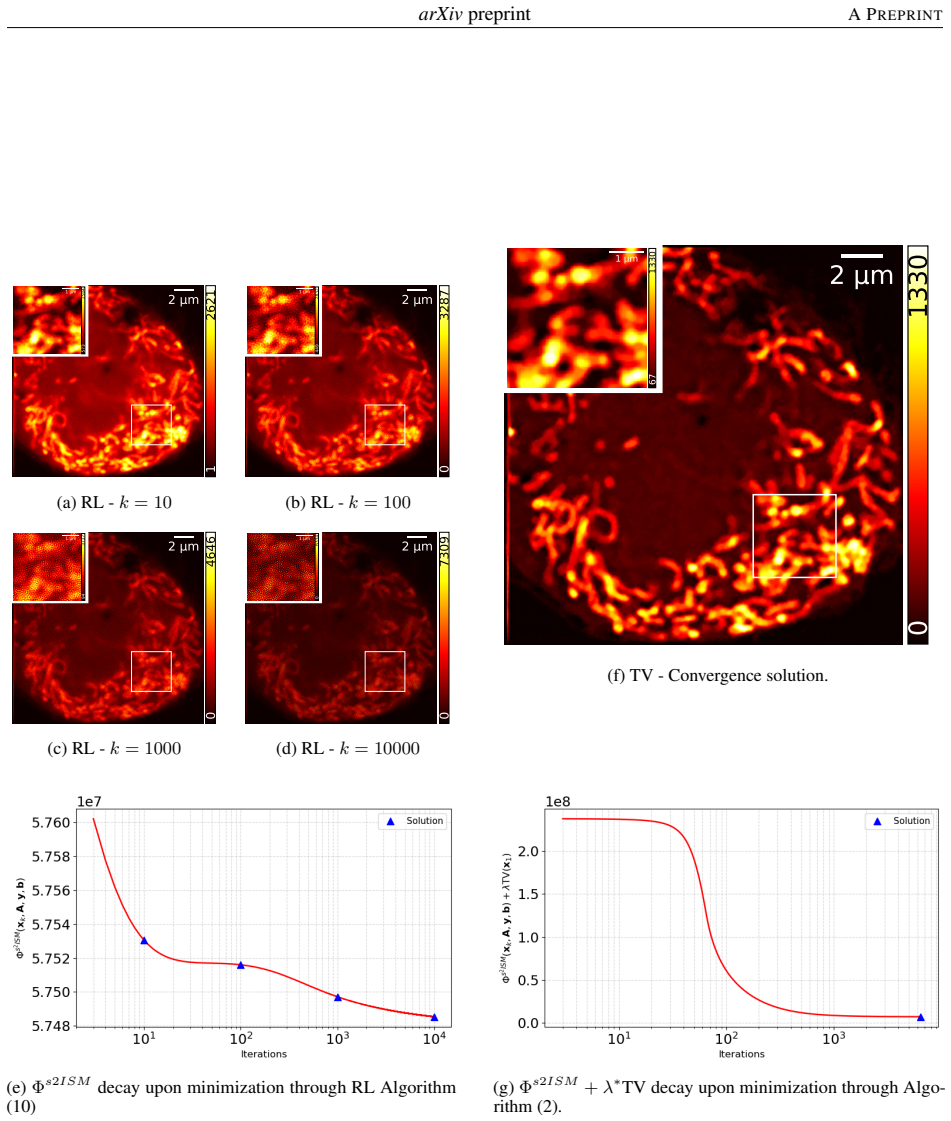
The central claim is that the residual whiteness principle, adapted to multi-frame Poisson data with masking for zero photon counts and a high-pass spectral correction for the two-plane s2ISM model, provides a valid unsupervised selector for the regularization parameter λ in explicitly regularized MID and s2ISM reconstruction. Under this choice, the authors report that the regularized reconstruction at convergence matches or exceeds the quality of Richardson–Lucy with carefully chosen early stopping, suppresses out-of-focus background, and avoids the characteristic noise amplification of late RL iterations. The validation includes simulated tubulin data, where the whiteness minimizer closely
Load-bearing premise
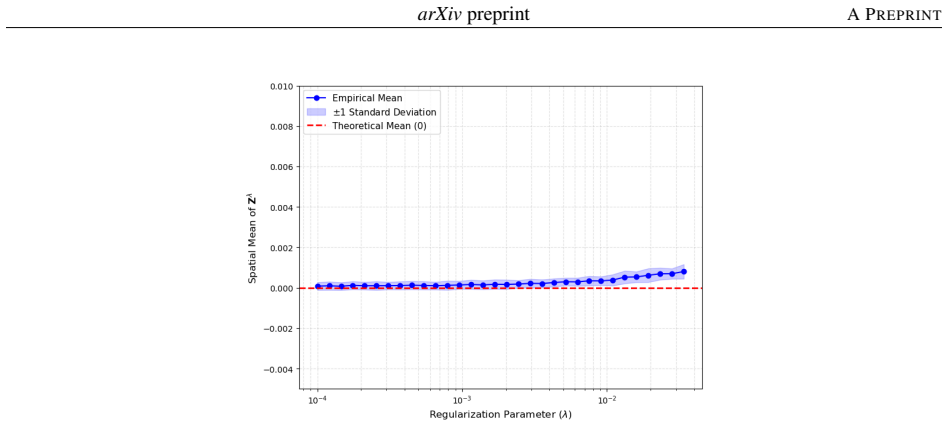
The load-bearing premise is that the standardized residual field is approximately centered (mean zero) and that minimizing its autocorrelation selects a reconstruction close to the ground truth; the paper verifies this empirically with one simulation but provides no proof and no quantitative check on real data.
Editorial extensions
If this is right
- MID and s2ISM reconstruction can be run to convergence without an empirically chosen stopping iteration, removing a major reproducibility bottleneck.
- Low-photon acquisitions become practical: explicit regularization plus automatic λ yields stable super-resolution and optical sectioning where Richardson–Lucy would amplify noise.
- The parameter-selection machinery is not tied to TV or ℓ1; it extends to other priors, including learned or plug-and-play regularizers, so the same whiteness principle could automate them.
- Because the criterion is ground-truth-free and computed from the same data, it can be deployed in routine microscopy pipelines without calibration images.
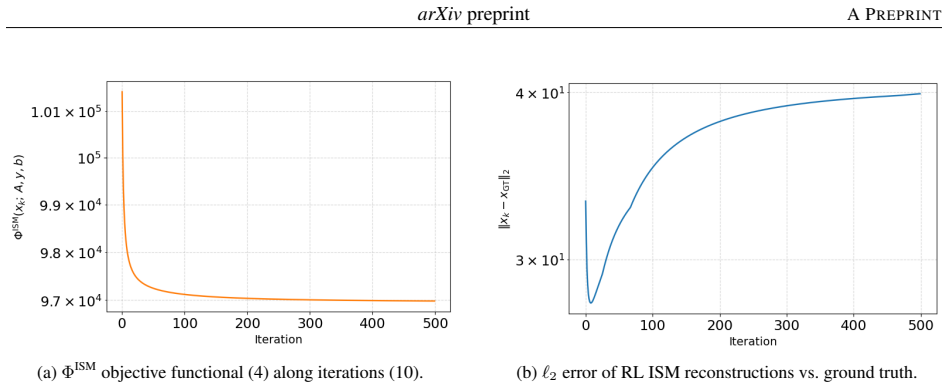
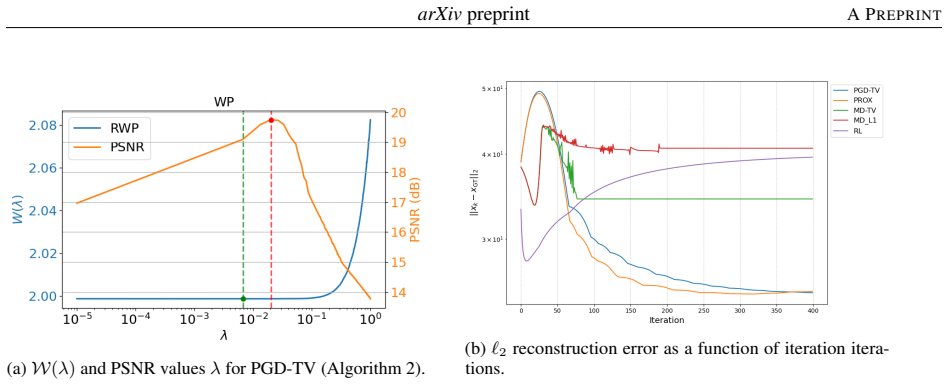
- Not every algorithm variant benefits equally: mirror-descent ℓ1 retains a multiplicative dynamics close to Richardson–Lucy and still shows semi-convergent oscillations, so the early-stopping problem is solved more convincingly for proximal-gradient variants.
Reading between the lines
- Inference: if the whiteness heuristic is accepted, it could serve as a general parameter-selection or stopping principle for other Poisson inverse problems in microscopy—such as single-molecule localization or light-sheet deconvolution—not just ISM.
- Inference: the paper's validation of the zero-mean residual assumption is a single simulation at one flux level; a natural stress test is to check whether the W minimizer still tracks the PSNR-optimal λ as photon flux drops toward zero counts in most pixels, where the zero-truncation correction dominates.
- Inference: the high-pass filtering for s2ISM may mask systematic low-frequency model error rather than correct it; if the background PSF is misspecified, the criterion could select an over-regularized foreground while still producing white-looking high-frequency residuals.
- Inference: a testable practical extension—mentioned by the authors as future work—is to optimize the whiteness functional directly in a bilevel framework, which would remove the grid search over 150 candidates and make the self-tuning procedure substantially faster.
Signed reviews
Editorial analysis
A structured set of objections, weighed in public.
Referee Report
Summary. The paper proposes an explicitly regularized variational framework for image scanning microscopy (ISM) and its sectioning variant s2ISM, replacing the implicit regularization of Richardson–Lucy-type methods. Within a MAP formulation, the multi-frame Poisson negative log-likelihood is combined with ℓ1 or smoothed total variation regularization, and the regularization parameter is selected automatically by a residual-whiteness principle adapted to Poisson statistics, including a masked version and a high-pass spectral extension for s2ISM. First-order optimization algorithms (proximal gradient, projected gradient, and mirror descent) with adaptive backtracking are analyzed and tested on one simulated tubulin dataset and several real TOMM20 acquisitions.
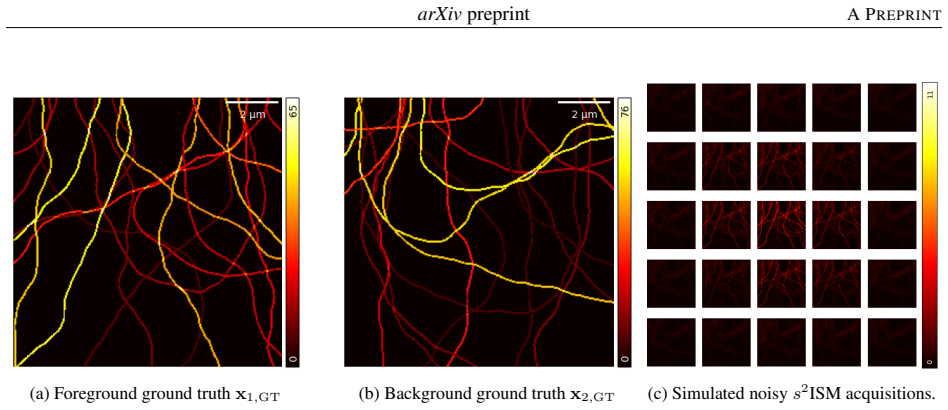
Significance. If the automatic parameter-selection claim holds, the paper would make a practical and timely contribution to computational ISM: it would remove the need for empirical early stopping and manual regularization tuning, which are known practical obstacles in RL-based MID/s2ISM reconstruction. The strengths of the paper include the clean Bayesian variational formulation, explicit Lipschitz bounds for the Poisson data term and smoothed TV, a correct derivation of the zero-truncated Poisson moments used for the masked residual, the use of the publicly available BrightEyes-ISM simulator, and transparent reporting of algorithmic complexity. The central novelty, however, is the whiteness-based 'self-tuning' mechanism, and the current evidence for that mechanism is narrow: one simulated dataset for validation, no quantitative real-data verification, and a dependence on an unspecified high-pass region in the s2ISM case. These issues need to be addressed before the main claim can be considered established.
major comments (4)
- [Section 6, Remark 1 and Eq. (26)] The central claim that minimizing the whiteness functional W(Z_λ) selects a near-optimal λ relies on the assumption E[Z_λ]≈0 and, more broadly, on W being a faithful proxy for reconstruction error. The paper itself flags this in Remark 1 as an assumption, not a theorem. The supporting evidence is limited to Figure 2 (mean residual over 50 realizations for PGD-TV on one simulated ISM dataset) and Figure 4a (agreement between λ* and PSNR-optimal λ for PGD-TV on one dataset). This is not sufficient to support the general claim that the method is 'fully automatic and ground-truth-free' across algorithms, regularizers, flux levels, and model-mismatch conditions. In particular, at low photon counts or under PSF/background mismatch, the standardized residual may be biased, and the selected λ may be systematically over- or under-regularizing. The authors should provide either a theoretical argum
- [Section 6.1.1, Eq. (32)] The high-pass extension for s2ISM introduces a low-frequency mask region B centered at ω=0, but the size and shape of B are never specified. This makes the method irreproducible and introduces a manual tuning parameter, which contradicts the paper's stated goal of a fully automatic parameter-selection strategy. The authors should specify how B is chosen (e.g., a fixed fraction of the frequency domain, a data-adaptive rule, or a calibration experiment) and provide a sensitivity analysis showing that the selected λ does not critically depend on the choice of B. Without this, the 'self-tuning' claim for s2ISM is incomplete.
- [Section 8.1.4, Fig. 4b and Section 7.1.1] The paper acknowledges that MD-ℓ1 'closely resembles' Richardson–Lucy and that MD-based schemes 'retain part of the transient semi-convergent behavior.' Yet the abstract and Section 8.1.4 state that the framework enables stable reconstructions without empirical early stopping. These statements are in tension: one of the four proposed algorithms still exhibits semi-convergence and may require a stopping iteration. The authors should either restrict the stability claim to the algorithms for which it holds, or provide a convergence/stopping analysis for MD-ℓ1 that explains why the RWP-selected λ and the convergence criterion (39) yield acceptable reconstructions despite the oscillatory error behavior. As written, the blanket claim is stronger than the reported results.
- [Section 7.2 and Appendix C] The convergence results in Appendix C are stated for fixed stepsizes satisfying a global Lipschitz/relative-smoothness condition. However, the implemented MD algorithms use the adaptive backtracking rule of Algorithm 5, and the paper states that the MD backtracking rule is adopted 'mainly from a practical perspective.' No convergence theorem is provided for the adaptive MD scheme, and the descent test in Algorithm 5 for the MD case (Δ = −(d/α)D_h(u_cand, u_k)) is not proven to guarantee sufficient decrease or convergence. If the paper claims that the proposed algorithms converge, the adaptive MD variant needs either a proof or an explicit statement that its convergence is empirical only.
minor comments (5)
- [Section 5.2.2, Eq. (15)-(16)] The smoothed TV functional is defined with +ε inside the square root, but the gradient formula in Eq. (16) uses ∥∇x∥²+ε² in the denominator. The Hessian proof in Appendix B similarly uses √(∥(∇x)_i∥²+ε²). The notation should be made consistent (likely the functional should read +ε², or the gradient denominator should use +ε).
- [Section 6, Eq. (21)] The empirical normalized autocorrelation in Eq. (21) does not normalize by the number of admissible pairs for each lag. The efficient FFT formula (23) relies on periodic boundary conditions, which is not stated in the main text and may be violated by the masked residual field (zeros on non-active pixels). Please clarify the boundary treatment and the effect of masking on the FFT-based whiteness evaluation.
- [Section 9.4 and Appendix E] The knee-point detection procedure introduces another heuristic decision (signed orthogonal distance to the chord). While the examples in Figure 10 illustrate its behavior, a robustness analysis with respect to the grid density and normalization would strengthen the claim that the knee-point criterion does not bias the parameter choice.
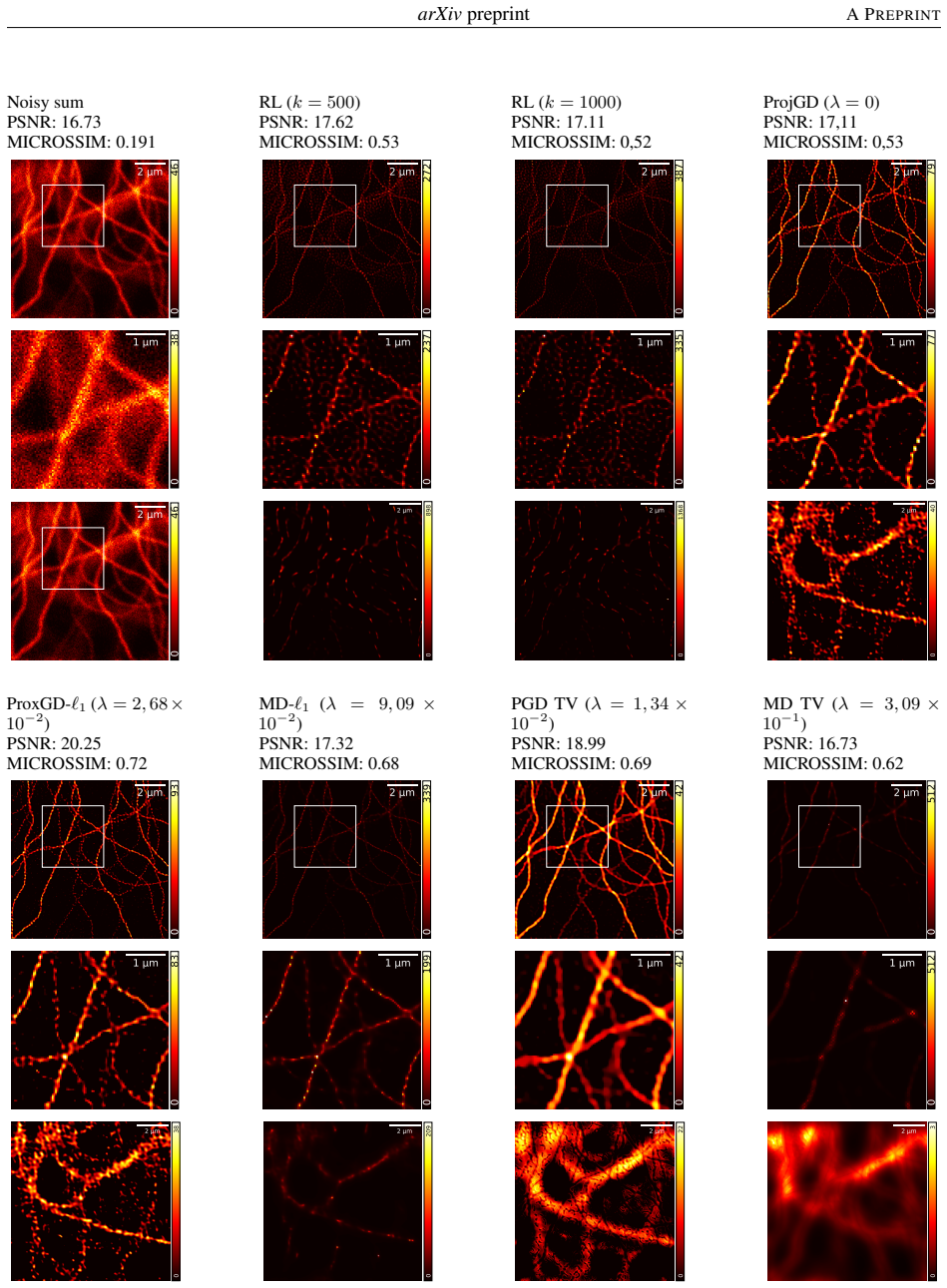
- [Throughout] There are several typographical and formatting issues: in Figure 8, decimal commas appear (e.g., '0,52' versus '0.52'), and the text contains OCR-like artifacts such as '2 /uni03BCμ'. These should be cleaned before publication.
- [Section 8.1.3] The validation of the RWP in Figure 4a is only for PGD-TV. It would be helpful to show the same W(λ) vs PSNR comparison for the other three algorithms in the supplementary material, since the selected λ depends on the optimization scheme and the manuscript claims the criterion works for all considered methods.
Circularity Check
No significant circularity: RWP parameter selection is an external statistical criterion, validated against PSNR rather than fitted to it.
full rationale
The claimed derivation is not circular. The regularization parameter λ is selected by minimizing the whiteness functional W(Z_λ) (Eq. 26), an adaptation of an external residual-whiteness principle [10,9,8]; PSNR is not used in the selection. The validation in Sec. 8.1.3 explicitly compares λ* from W with the PSNR-maximizing λ and reports agreement, which is an independent check, not an input. The masked and high-pass variants (Secs. 6.1, 6.1.1) are modifications of the same external criterion; the high-pass region B is under-specified, but that is a reproducibility/manual-tuning weakness, not a circular reduction. The zero-mean residual assumption is stated as an assumption in Remark 1 and supported by one simulation (Fig. 2), so the central 'self-tuning' claim rests on an unproven premise, but that premise is not equivalent to the conclusion by construction. The knee-point heuristic (Sec. 9.4) is a post hoc stability rule introduced after observing real-data curves; it is not fitted to ground truth or to PSNR, so it does not make the prediction forced. Self-citations (e.g., [44] in the whiteness list, [20] for a generalized Lipschitz remark) appear but are not load-bearing: convergence and parameter-selection theory are cited from external sources ([10,9,8,2,11,34]), and the semi-convergence motivation is re-demonstrated in Fig. 1. Hence no equation reduces a reported result to a fitted value or to a self-citation.
Assumptions & free parameters
free parameters (6)
- regularization weight lambda =
e.g., 6.72e-3 for PGD-TV on simulated data
- TV smoothing parameter epsilon =
not specified
- s2ISM high-pass mask region B =
not specified
- simulation flux factor F =
20
- simulation background scaling beta =
1e-1
- adaptive backtracking constants alpha_0, delta, eta =
not specified
assumptions (7)
- domain assumption Measurements are independent Poisson random variables across pixels and detector elements.
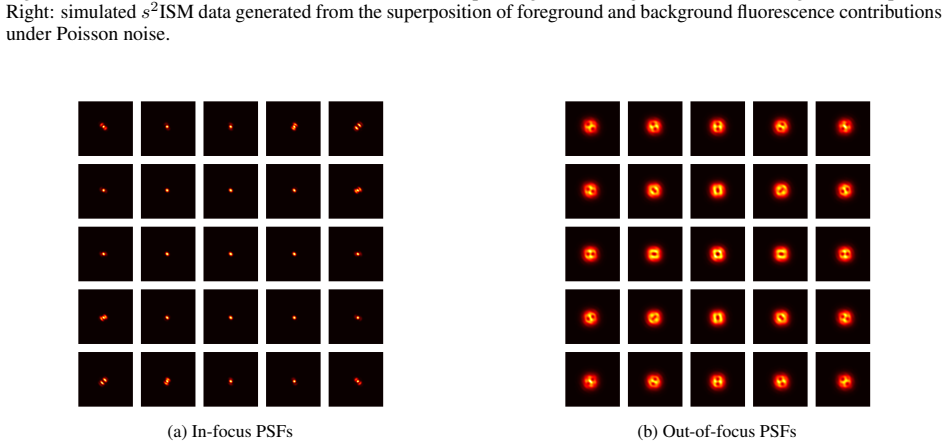
- domain assumption The PSFs h_d are known and the forward operators A_d are exact convolution matrices.
- domain assumption The background terms b_d are known, positive, and spatially constant.
- domain assumption At the true reconstruction, the standardized residuals form a white random field, and for near-ground-truth reconstructions E[Z_lambda] is approximately zero.
- domain assumption The s2ISM two-plane model (in-focus x1 plus a single out-of-focus plane x2) adequately represents the axial fluorescence distribution.
- domain assumption Periodic boundary conditions are used for the DFT-based evaluation of the whiteness functional.
- standard math The backtracking strategies for PGD and MD preserve the required descent and convergence properties.
Cite this review
Pith. "Pith review of Self-Tuning Regularization for Image Scanning Microscopy." pith.science (2026). https://pith.science/paper/YDD5FZQF
@misc{pith2026260531426,
  author       = {Pith},
  title        = {Pith review of: Self-Tuning Regularization for Image Scanning Microscopy},
  year         = {2026},
  howpublished = {\url{https://pith.science/paper/YDD5FZQF}},
  note         = {Machine review of arXiv:2605.31426}
}
abstract
Image Scanning Microscopy (ISM) is a fluorescence imaging technique that combines detector-array acquisition and computational reconstruction to achieve the theoretical resolution of an ideal confocal microscope, i.e., one operating with an infinitesimally small pinhole, while maintaining high signal-to-noise ratio. Among the reconstruction methods for obtaining the super-resolved image, multi-image deconvolution (MID) and its extension aimed at preserving the optical sectioning capability of confocal microscopy, known as super-resolution sectioning ISM (s$^2$ISM), are among the most widely used approaches. Both methods rely on Richardson--Lucy-type iterative schemes, whose semi-convergent behavior requires early stopping and often leads to noise amplification and reconstruction artifacts. In this work, we introduce a self-tuning explicit regularization framework for both MID and s$^2$ISM reconstruction. Within a Bayesian maximum a posteriori formulation, we combine a multi-frame Poisson data fidelity term with explicit regularization, considering $\ell_1$ and smoothed total variation penalties as representative examples. We further develop an automatic and ground-truth-free strategy for regularization parameter selection by adapting the residual whiteness principle to the multi-frame Poisson setting and introducing a spectral high-pass extension tailored to s$^2$ISM. The resulting framework enables stable reconstructions without empirical stopping rules. To demonstrate the proposed framework, we consider first-order optimization schemes based on proximal gradient and mirror descent methods with adaptive backtracking strategies. Experiments on simulated and real fluorescence ISM datasets demonstrate improved reconstruction stability and image quality with respect to unregularized approaches, while enabling robust super-resolution and optical sectioning in low-photon conditions.
Figures
Figures from the paper (9 more)
Reference graph
Works this paper leans on
-
[1]
Ashesh Ashesh, Joran Deschamps, and Florian Jug. MicroSSIM: Improved Structural Similarity for Comparing Microscopy Data.arXiv preprint arXiv:2408.08747, 2024
arXiv 2024
-
[2]
Bauschke, Jérôme Bolte, and Marc Teboulle
Heinz H. Bauschke, Jérôme Bolte, and Marc Teboulle. A Descent Lemma Beyond Lipschitz Gradient Continuity: First-Order Methods Revisited and Applications.Mathematics of Operations Research, 42(2):330–348, 2017
2017
-
[3]
SIAM, Philadelphia, PA, USA, 2017
Amir Beck.First-Order Methods in Optimization. SIAM, Philadelphia, PA, USA, 2017
2017
-
[4]
Plug and Play Splitting Techniques for poisson Image Restoration.Journal of Mathematical Imaging and Vision, 67(6):59, 2025
Alessandro Benfenati. Plug and Play Splitting Techniques for poisson Image Restoration.Journal of Mathematical Imaging and Vision, 67(6):59, 2025
2025
-
[5]
Bertero, P
M. Bertero, P. Boccacci, G. Talenti, R. Zanella, and L. Zanni. A Discrepancy Principle for poisson Data.Inverse Problems, 26(10):105004, 2010
2010
-
[6]
Resolution in Diffraction-Limited Imaging, a Singular Value Analysis.Optica Acta: International Journal of Optics, 29(6):727–746, 1982
M Bertero and ER Pike. Resolution in Diffraction-Limited Imaging, a Singular Value Analysis.Optica Acta: International Journal of Optics, 29(6):727–746, 1982
1982
-
[7]
2053-2563
Mario Bertero, Patrizia Boccacci, and Valeria Ruggiero.Inverse Imaging with poisson Data. 2053-2563. IOP Publishing, 2018
-
[8]
Nearly Exact Discrepancy Principle for Low-Count poisson Image Restoration.Journal of Imaging, 8(1):1, 2021
Francesca Bevilacqua, Alessandro Lanza, Monica Pragliola, and Fiorella Sgallari. Nearly Exact Discrepancy Principle for Low-Count poisson Image Restoration.Journal of Imaging, 8(1):1, 2021
2021
Show all 61 references
-
[9]
Masked Unbiased Principles for Parameter Selection in Variational Image Restoration under poisson Noise.Inverse Problems, 39(3):034002, 2023
Francesca Bevilacqua, Alessandro Lanza, Monica Pragliola, and Fiorella Sgallari. Masked Unbiased Principles for Parameter Selection in Variational Image Restoration under poisson Noise.Inverse Problems, 39(3):034002, 2023
2023
-
[10]
Whiteness-Based Parameter Selection for poisson Data in Variational Image Processing.Applied Mathematical Modelling, 117:197–218, 2023
Francesca Bevilacqua, Alessandro Lanza, Monica Pragliola, and Fiorella Sgallari. Whiteness-Based Parameter Selection for poisson Data in Variational Image Processing.Applied Mathematical Modelling, 117:197–218, 2023
2023
-
[11]
First Order Methods Beyond Convexity and Lipschitz Gradient Continuity with Applications to Quadratic Inverse Problems.SIAM Journal on Optimization, 28(3):2131–2151, 2018
Jérôme Bolte, Shoham Sabach, Marc Teboulle, and Yakov Vaisbourd. First Order Methods Beyond Convexity and Lipschitz Gradient Continuity with Applications to Quadratic Inverse Problems.SIAM Journal on Optimization, 28(3):2131–2151, 2018
2018
-
[12]
Total Generalized Variation.SIAM Journal on Imaging Sciences, 3(3):492–526, 2010
Kristian Bredies, Karl Kunisch, and Thomas Pock. Total Generalized Variation.SIAM Journal on Imaging Sciences, 3(3):492–526, 2010
2010
-
[13]
Backtracking Strategies for Accelerated Descent Methods with Smooth Composite Objectives.SIAM Journal on Optimization, 29(3):1772–1798, 2019
Luca Calatroni and Antonin Chambolle. Backtracking Strategies for Accelerated Descent Methods with Smooth Composite Objectives.SIAM Journal on Optimization, 29(3):1772–1798, 2019. 34 arXivpreprintA PREPRINT
2019
-
[14]
Candes and Michael B
Emmanuel J. Candes and Michael B. Wakin. An Introduction to Compressive Sampling.IEEE Signal Processing Magazine, 25(2):21–30, 2008
2008
-
[15]
Sparse poisson Noisy Image Deblurring.IEEE Transactions on Image Processing, 21(4):1834–1846, 2012
Mikael Carlavan and Laure Blanc-Feraud. Sparse poisson Noisy Image Deblurring.IEEE Transactions on Image Processing, 21(4):1834–1846, 2012
2012
-
[16]
A Robust and Versatile Platform for Image Scanning Microscopy Enabling Super-Resolution FLIM.Nature Methods, 16(2):175–178, 2019
Marco Castello, Giorgio Tortarolo, Mauro Buttafava, Takahiro Deguchi, Federica Villa, Sami Koho, Luca Pesce, Michele Oneto, Simone Pelicci, Luca Lanzanó, et al. A Robust and Versatile Platform for Image Scanning Microscopy Enabling Super-Resolution FLIM.Nature Methods, 16(2):1...
2019
-
[17]
An Algorithm for Total Variation Minimization and Applications.Journal of Mathematical Imaging and Vision, 20:89–97, 2004
Antonin Chambolle. An Algorithm for Total Variation Minimization and Applications.Journal of Mathematical Imaging and Vision, 20:89–97, 2004
2004
-
[18]
A First-Order Primal-Dual Algorithm for Convex Problems with Applica- tions to Imaging.Journal of Mathematical Imaging and Vision, 40(1):120–145, 2011
Antonin Chambolle and Thomas Pock. A First-Order Primal-Dual Algorithm for Convex Problems with Applica- tions to Imaging.Journal of Mathematical Imaging and Vision, 40(1):120–145, 2011
2011
-
[19]
Combettes and Valérie R
Patrick L. Combettes and Valérie R. Wajs. Signal Recovery by Proximal Forward–Backward Splitting.Multiscale Modeling & Simulation, 4(4):1168–1200, 2005
2005
-
[20]
Deep Equilibrium Models for poisson Imaging Inverse Problems via Mirror Descent.SIAM Journal on Imaging Sciences, 19(2):1077–1109, 2026
Christian Daniele, Silvia Villa, Samuel Vaiter, and Luca Calatroni. Deep Equilibrium Models for poisson Imaging Inverse Problems via Mirror Descent.SIAM Journal on Imaging Sciences, 19(2):1077–1109, 2026
2026
-
[21]
BrightEyes-MCS: A Control Software for Multichannel Scanning Microscopy.Journal of Open Source Software, 9(103):7125, 2024
Mattia Donato, Eli Slenders, Alessandro Zunino, Luca Bega, and Giuseppe Vicidomini. BrightEyes-MCS: A Control Software for Multichannel Scanning Microscopy.Journal of Open Source Software, 9(103):7125, 2024
2024
-
[22]
Fadili, and Jean-Luc Starck
François-Xavier Dupe, Jalal M. Fadili, and Jean-Luc Starck. A Proximal Iteration for Deconvolving poisson Noisy Images Using Sparse Representations.IEEE Transactions on Image Processing, 18(2):310–321, 2009
2009
-
[23]
Wavefront Estimation Through Structured Detection in Laser Scanning Microscopy.Biomedical Optics Express, 16(5):2135–2155, 2025
Francesco Fersini, Alessandro Zunino, Pietro Morerio, Francesca Baldini, Alberto Diaspro, Martin J Booth, Alessio Del Bue, and Giuseppe Vicidomini. Wavefront Estimation Through Structured Detection in Laser Scanning Microscopy.Biomedical Optics Express, 16(5):2135–2155, 2025
2025
-
[24]
Mário A. T. Figueiredo and José M. Bioucas-Dias. Restoration of poissonian Images Using Alternating Direction Optimization.IEEE Transactions on Image Processing, 19(12):3133–3145, 2010
2010
-
[25]
Analysis of Discrete Ill-Posed Problems by Means of the L-Curve.SIAM Review, 34(4):561–580, 1992
Per Christian Hansen. Analysis of Discrete Ill-Posed Problems by Means of the L-Curve.SIAM Review, 34(4):561–580, 1992
1992
-
[26]
Harmany, Roummel F
Zachary T. Harmany, Roummel F. Marcia, and Rebecca M. Willett. This is SPIRAL-TAP: Sparse poisson Intensity Reconstruction ALgorithms—Theory and Practice.IEEE Transactions on Image Processing, 21(3):1084–1096, 2012
2012
-
[27]
Learning Regularization Functionals for Inverse Problems: A Comparative Study
Johannes Hertrich, Hok Shing Wong, Alexander Denker, Stanislas Ducotterd, Zhenghan Fang, Markus Haltmeier, Zeljko Kereta, Erich Kobler, Oscar Leong, Mohammad Sadegh Salehi, Carola-Bibiane Schönlieb, Johannes Schwab, Zakhar Shumaylov, Jeremias Sulam, German Shâma Wache, Martin ...
2025
-
[28]
Convergent Bregman Plug-and-Play Image Restoration for poisson Inverse Problems
Samuel Hurault, Ulugbek Kamilov, Arthur Leclaire, and Nicolas Papadakis. Convergent Bregman Plug-and-Play Image Restoration for poisson Inverse Problems. InThirty-Seventh Conference on Neural Information Processing Systems, 2023
2023
-
[29]
Kamilov, Charles A
Ulugbek S. Kamilov, Charles A. Bouman, Gregery T. Buzzard, and Brendt Wohlberg. Plug-and-Play Methods for Integrating Physical and Learned Models in Computational Imaging: Theory, Algorithms, and Applications. IEEE Signal Processing Magazine, 40(1):85–97, 2023
2023
-
[30]
Whiteness Constraints in a Unified Variational Framework for Image Restoration.Journal of Mathematical Imaging and Vision, 60(9):1503–1526, 2018
Alessandro Lanza, Serena Morigi, Federica Sciacchitano, and Fiorella Sgallari. Whiteness Constraints in a Unified Variational Framework for Image Restoration.Journal of Mathematical Imaging and Vision, 60(9):1503–1526, 2018
2018
-
[32]
Residual Whiteness Principle for Parameter-Free Image Restoration.Electronic Transactions on Numerical Analysis, 53:329–351, 2020
Alessandro Lanza, Monica Pragliola, and Fiorella Sgallari. Residual Whiteness Principle for Parameter-Free Image Restoration.Electronic Transactions on Numerical Analysis, 53:329–351, 2020
2020
-
[33]
Noise Amplification and Ill-Convergence of Richardson–Lucy Deconvolution.Nature Communications, 16(1):911, 2025
Yiming Liu, Spozmai Panezai, Yutong Wang, and Sjoerd Stallinga. Noise Amplification and Ill-Convergence of Richardson–Lucy Deconvolution.Nature Communications, 16(1):911, 2025
2025
-
[34]
Relatively Smooth Convex Optimization by First-Order Methods, and Applications.SIAM Journal on Optimization, 28(1):333–354, 2018
Haihao Lu, Robert M Freund, and Yurii Nesterov. Relatively Smooth Convex Optimization by First-Order Methods, and Applications.SIAM Journal on Optimization, 28(1):333–354, 2018. 35 arXivpreprintA PREPRINT
2018
-
[35]
Leon B. Lucy. An Iterative Technique for the Rectification of Observed Distributions.Astronomical Journal, 79:745, 1974
1974
-
[36]
Fast Interscale Wavelet Denoising of poisson- Corrupted Images.Signal Processing, 90(2):415–427, 2010
Florian Luisier, Cédric V onesch, Thierry Blu, and Michael Unser. Fast Interscale Wavelet Denoising of poisson- Corrupted Images.Signal Processing, 90(2):415–427, 2010
2010
-
[37]
Predictive Risk Estimation for the Expectation Maximization Algorithm with poisson Data.Inverse Problems, 37(4):045013, 2021
Paolo Massa and Federico Benvenuto. Predictive Risk Estimation for the Expectation Maximization Algorithm with poisson Data.Inverse Problems, 37(4):045013, 2021
2021
-
[38]
Springer Science & Business Media, 2012
Vladimir Alekseevich Morozov.Methods for Solving Incorrectly Posed Problems. Springer Science & Business Media, 2012
2012
-
[39]
Image Scanning Microscopy.Physical Review Letters, 104(19):198101, 2010
Claus B Müller and Jörg Enderlein. Image Scanning Microscopy.Physical Review Letters, 104(19):198101, 2010
2010
-
[40]
Wiley-Interscience Series in Discrete Mathematics
Arkadi˘ı Semenovich Nemirovski˘ı and David Berkovich I ˘Udin.Problem Complexity and Method Efficiency in Optimization. Wiley-Interscience Series in Discrete Mathematics. John Wiley & Sons, Chichester / New York, 1983
1983
-
[41]
Open-Source 3D Active Sample Stabilization for Fluores- cence Microscopy.Biophysical Reports, 5(2), 2025
Sanket Patil, Giuseppe Vicidomini, and Eli Slenders. Open-Source 3D Active Sample Stabilization for Fluores- cence Microscopy.Biophysical Reports, 5(2), 2025
2025
-
[42]
Springer Science & Business Media, 2006
James Pawley.Handbook of Biological Confocal Microscopy, volume 236. Springer Science & Business Media, 2006
2006
-
[43]
Whiteness-Based Bilevel Estimation of Weighted TV Parameter Maps for Image Denoising
Monica Pragliola, Luca Calatroni, and Alessandro Lanza. Whiteness-Based Bilevel Estimation of Weighted TV Parameter Maps for Image Denoising. InScale Space and Variational Methods in Computer Vision, pages 159–172, Cham, 2025. Springer Nature Switzerland
2025
-
[44]
ADMM-Based Residual Whiteness Principle for Automatic Parameter Selection in Single Image Super-Resolution Problems.Journal of Mathematical Imaging and Vision, 65(1):99–123, 2023
Monica Pragliola, Luca Calatroni, Alessandro Lanza, and Fiorella Sgallari. ADMM-Based Residual Whiteness Principle for Automatic Parameter Selection in Single Image Super-Resolution Problems.Journal of Mathematical Imaging and Vision, 65(1):99–123, 2023
2023
-
[45]
On and Beyond Total Variation Regularization in Imaging: The Role of Space Variance.SIAM Review, 65(3):601–685, 2023
Monica Pragliola, Luca Calatroni, Alessandro Lanza, and Fiorella Sgallari. On and Beyond Total Variation Regularization in Imaging: The Role of Space Variance.SIAM Review, 65(3):601–685, 2023
2023
-
[46]
Proximity Operator of a Sum of Functions; Application to Depth Map Estimation.IEEE Signal Processing Letters, 24(12):1827–1831, 2017
Nelly Pustelnik and Laurent Condat. Proximity Operator of a Sum of Functions; Application to Depth Map Estimation.IEEE Signal Processing Letters, 24(12):1827–1831, 2017
2017
-
[47]
Scaled, Inexact, and Adaptive Generalized FISTA for Strongly Convex Optimization.SIAM Journal on Optimization, 32(3):2428–2459, 2022
Simone Rebegoldi and Luca Calatroni. Scaled, Inexact, and Adaptive Generalized FISTA for Strongly Convex Optimization.SIAM Journal on Optimization, 32(3):2428–2459, 2022
2022
-
[48]
Bayesian-Based Iterative Method of Image Restoration.Journal of the Optical Society of America, 62(1):55–59, 1972
William Hadley Richardson. Bayesian-Based Iterative Method of Image Restoration.Journal of the Optical Society of America, 62(1):55–59, 1972
1972
-
[49]
Rudin, Stanley Osher, and Emad Fatemi
Leonid I. Rudin, Stanley Osher, and Emad Fatemi. Nonlinear Total Variation Based Noise Removal Algorithms. Physica D: Nonlinear Phenomena, 60(1):259–268, 1992
1992
-
[50]
Whiteness-Based Bilevel Learning of Regularization Parameters in Imaging
Carlo Santambrogio, Monica Pragliola, Alessandro Lanza, Marco Donatelli, and Luca Calatroni. Whiteness-Based Bilevel Learning of Regularization Parameters in Imaging. In2024 32nd European Signal Processing Conference (EUSIPCO), pages 1801–1805, 2024
2024
-
[51]
Maximum Likelihood Reconstruction for Emission Tomography.IEEE Transactions on Medical Imaging, 1(2):113–122, 2007
Lawrence A Shepp and Yehuda Vardi. Maximum Likelihood Reconstruction for Emission Tomography.IEEE Transactions on Medical Imaging, 1(2):113–122, 2007
2007
-
[52]
Super-Resolution in Confocal Imaging.Optik, 80(2):53–54, 1988
C J Sheppard. Super-Resolution in Confocal Imaging.Optik, 80(2):53–54, 1988
1988
-
[53]
Pixel Reassignment in Image Scanning Microscopy: A Re-Evaluation.Journal of the Optical Society of America A, 37(1):154–162, 2019
Colin JR Sheppard, Marco Castello, Giorgio Tortarolo, Takahiro Deguchi, Sami V Koho, Giuseppe Vicidomini, and Alberto Diaspro. Pixel Reassignment in Image Scanning Microscopy: A Re-Evaluation.Journal of the Optical Society of America A, 37(1):154–162, 2019
2019
-
[54]
Signal-to-Noise Ratio in Confocal Microscopes
Colin JR Sheppard, Xiaosong Gan, Min Gu, and Maitreyee Roy. Signal-to-Noise Ratio in Confocal Microscopes. InHandbook of Biological Confocal Microscopy, pages 442–452. Springer, 2006
2006
-
[55]
Superresolution by Image Scanning Microscopy Using Pixel Reassignment.Optics Letters, 38(15):2889–2892, 2013
Colin JR Sheppard, Shalin B Mehta, and Rainer Heintzmann. Superresolution by Image Scanning Microscopy Using Pixel Reassignment.Optics Letters, 38(15):2889–2892, 2013
2013
-
[56]
Array Detection Enables Large Localization Range for Simple and Robust MINFLUX.Light: Science & Applications, 14(1):234, 2025
Eli Slenders, Sanket Patil, Marcus Oliver Held, Alessandro Zunino, and Giuseppe Vicidomini. Array Detection Enables Large Localization Range for Simple and Robust MINFLUX.Light: Science & Applications, 14(1):234, 2025
2025
-
[57]
Charles M. Stein. Estimation of the Mean of a Multivariate Normal Distribution.The Annals of Statistics, 9(6):1135–1151, 1981. 36 arXivpreprintA PREPRINT
1981
-
[58]
Regression Shrinkage and Selection via the LASSO.Journal of the Royal Statistical Society: Series B (Methodological), 58(1):267–288, 1996
Robert Tibshirani. Regression Shrinkage and Selection via the LASSO.Journal of the Royal Statistical Society: Series B (Methodological), 58(1):267–288, 1996
1996
-
[59]
Focus Image Scanning Microscopy for Sharp and Gentle Super-Resolved Microscopy.Nature Communications, 13(1):7723, 2022
Giorgio Tortarolo, Alessandro Zunino, Francesco Fersini, Marco Castello, Simonluca Piazza, Colin JR Sheppard, Paolo Bianchini, Alberto Diaspro, Sami Koho, and Giuseppe Vicidomini. Focus Image Scanning Microscopy for Sharp and Gentle Super-Resolved Microscopy.Nature Communicati...
2022
-
[60]
Reconstructing the Image Scanning Microscopy Dataset: An Inverse Problem.Inverse Problems, 39(6):064004, 2023
Alessandro Zunino, Marco Castello, and Giuseppe Vicidomini. Reconstructing the Image Scanning Microscopy Dataset: An Inverse Problem.Inverse Problems, 39(6):064004, 2023
2023
-
[61]
Structured Detection for Simultaneous Super-Resolution and Optical Sectioning in Laser Scanning Microscopy.Nature Photonics, 19(8):888–897, 2025
Alessandro Zunino, Giacomo Garrè, Eleonora Perego, Sabrina Zappone, Mattia Donato, Nadine Vastenhouw, and Giuseppe Vicidomini. Structured Detection for Simultaneous Super-Resolution and Optical Sectioning in Laser Scanning Microscopy.Nature Photonics, 19(8):888–897, 2025
2025
-
[62]
Open-Source Tools Enable Accessible and Advanced Image Scanning Microscopy Data Analysis.Nature Photonics, 17(6):457–458, 2023
Alessandro Zunino, Eli Slenders, Francesco Fersini, Andrea Bucci, Mattia Donato, and Giuseppe Vicidomini. Open-Source Tools Enable Accessible and Advanced Image Scanning Microscopy Data Analysis.Nature Photonics, 17(6):457–458, 2023. 37
2023
Reviewed August 2, 2026 · model on record in the stance chip above.
Discussion (0). Continue with ORCID to comment.