Ab Initio Spinor Kadanoff-Baym Approach to Nonequilibrium Electron, Phonon and Magnon Dynamics in Itinerant Ferromagnets
Pith reviewed 2026-06-28 21:54 UTC · model grok-4.3
The pith
A spinor Kadanoff-Baym framework derives first-principles equations coupling electron, phonon and magnon dynamics in itinerant ferromagnets.
A machine-rendered reading of the paper's core claim, the machinery that carries it, and where it could break.
Core claim
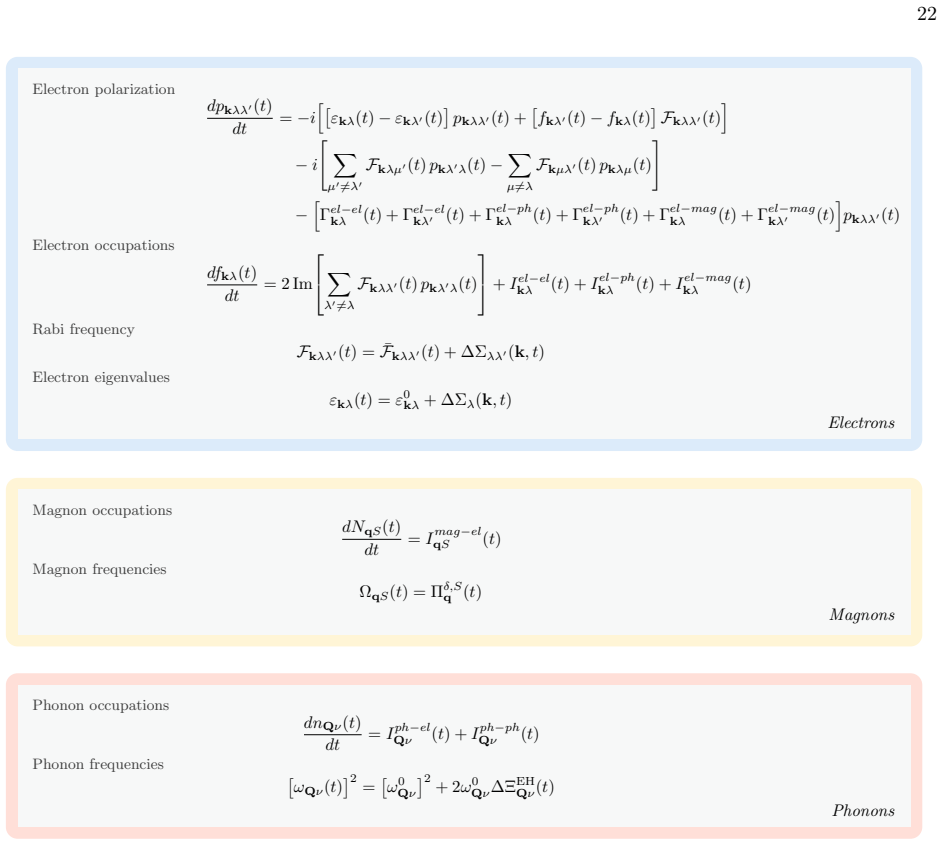
By placing the Kadanoff-Baym equations in spinor space and generalizing the self-energies beyond the charge sector, the work obtains scattering integrals that yield a tractable, closed system of equations for the simultaneous evolution of electron, phonon and magnon populations; these equations are solved from first principles and place coherent and incoherent magnetization dynamics on equal footing.
What carries the argument
Spinor Kadanoff-Baym equations with Markov-approximated, spin-dependent scattering integrals and quasiparticle renormalizations.
If this is right
- Coherent precessional motion and incoherent scattering contributions to magnetization change are obtained from the same set of equations.
- Ultrafast demagnetization timescales in periodic itinerant ferromagnets become computable without additional model Hamiltonians.
- Magnon populations and their coupling to electrons and phonons emerge directly from the electron and phonon self-energies.
- The framework extends standard many-body perturbation theory to magnetic degrees of freedom while retaining ab initio parameter-free character.
Where Pith is reading between the lines
- The equations could be discretized on a real-space or k-space grid to simulate laser-driven switching in thin-film ferromagnets.
- Temperature dependence would enter through the initial phonon and magnon distributions, allowing thermal demagnetization studies.
- Comparison with time-dependent density-functional theory results for the same material would test consistency between the two first-principles routes.
Load-bearing premise
The Markov approximation together with quasiparticle renormalizations remains valid once self-energies are extended to include spin-dependent interactions.
What would settle it
Numerical solution of the derived equations for nickel under femtosecond laser excitation, followed by direct comparison of the computed magnetization decay curve against time-resolved magneto-optical Kerr effect measurements.
Figures
read the original abstract
This work introduces a theoretical framework based on the Kadanoff-Baym equations in spinor space to study ultrafast magnetization dynamics in itinerant ferromagnetic systems from first principles. By incorporating spin-orbit coupling into the ab initio Hamiltonian and generalizing the self-energies to include terms beyond the charge sector, I derive scattering integrals within the Markov approximation and quasiparticle renormalizations for electrons and phonons in the presence of spin-dependent effective interactions within a many-body perturbation theory approach. I explicitly discuss how magnons emerge in this framework, and derive, through suitable approximations, a close and tractable set of equations for coupled electron,phonon and magnon dynamics that can be solved from first principles. This approach allows to treat coherent and incoherent magnetic dynamics on an equal footing, paving the way for a first principles understanding of ultrafast magnetic dynamics and demagnetization, and opening to a truly predictive theory of femtomagnetism in periodic systems.
Editorial analysis
A structured set of objections, weighed in public.
Referee Report
Summary. The paper introduces a theoretical framework based on the Kadanoff-Baym equations formulated in spinor space to study ultrafast magnetization dynamics in itinerant ferromagnetic systems from first principles. It incorporates spin-orbit coupling into the ab initio Hamiltonian, generalizes self-energies beyond the charge sector, derives scattering integrals under the Markov approximation with quasiparticle renormalizations for electrons and phonons, discusses the emergence of magnons, and obtains a tractable set of coupled equations for electron, phonon, and magnon dynamics that can be solved ab initio. The central claim is that this treats coherent and incoherent magnetic dynamics on an equal footing.
Significance. If the central approximations remain controlled, the framework would provide a first-principles route to predictive modeling of femtomagnetism and demagnetization in periodic systems by placing coherent and incoherent channels on the same footing within many-body perturbation theory.
major comments (1)
- [Derivation of tractable set of equations for coupled electron, phonon and magnon dynamics] The derivation of the coupled e-ph-magnon equations relies on the Markov approximation plus quasiparticle renormalizations after extending self-energies to spin-dependent interactions (including SOC and magnon channels). No explicit test or error estimate is supplied showing that the memory-kernel truncation and pole-shift renormalization remain valid once spin-flip and magnon scattering channels are active; this assumption is load-bearing for the claim that coherent and incoherent dynamics are treated on equal footing from first principles.
Simulated Author's Rebuttal
We thank the referee for the careful reading of our manuscript and the constructive feedback. We address the single major comment below.
read point-by-point responses
-
Referee: [Derivation of tractable set of equations for coupled electron, phonon and magnon dynamics] The derivation of the coupled e-ph-magnon equations relies on the Markov approximation plus quasiparticle renormalizations after extending self-energies to spin-dependent interactions (including SOC and magnon channels). No explicit test or error estimate is supplied showing that the memory-kernel truncation and pole-shift renormalization remain valid once spin-flip and magnon scattering channels are active; this assumption is load-bearing for the claim that coherent and incoherent dynamics are treated on equal footing from first principles.
Authors: We agree that the manuscript, being a formal derivation within many-body perturbation theory, does not supply explicit numerical tests or quantitative error estimates for the Markov approximation and quasiparticle pole-shift renormalization once spin-flip and magnon channels are included. The Markov truncation and renormalization steps are applied uniformly to the spinor self-energies after the extension to SOC and magnon-mediated interactions, following the same logic used in the charge sector. To strengthen the presentation, we will add a dedicated subsection that discusses the expected validity regime of these approximations, based on timescale separation arguments and comparisons with existing literature on spin-dependent scattering in ferromagnets. This addition will explicitly address the conditions under which coherent and incoherent channels remain on equal footing. revision: yes
- A quantitative numerical benchmark or error estimate for the Markov and quasiparticle approximations in the presence of active magnon scattering would require a full ab initio implementation and simulation of the derived equations, which lies outside the scope of the present theoretical framework paper.
Circularity Check
No circularity: derivation applies standard MBPT approximations to extended spinor Hamiltonian
full rationale
The provided abstract and framework description show a derivation that starts from the Kadanoff-Baym equations in spinor space, incorporates SOC into the ab initio Hamiltonian, generalizes self-energies beyond the charge sector, and then applies the Markov approximation plus quasiparticle renormalizations to obtain scattering integrals and coupled e-ph-magnon equations. These steps follow the conventional structure of nonequilibrium many-body perturbation theory without any quoted reduction of a claimed prediction back to a fitted parameter, self-definition, or load-bearing self-citation. The central claim that coherent and incoherent dynamics are treated on equal footing is presented as a consequence of the extended equations under the stated approximations, not as a tautology. No evidence of the enumerated circularity patterns appears in the given text.
Axiom & Free-Parameter Ledger
axioms (2)
- domain assumption Markov approximation applies to scattering integrals
- domain assumption Quasiparticle renormalizations remain valid with spin-dependent self-energies
Reference graph
Works this paper leans on
-
[1]
In metals, Kohn-Sham eigenvalues may already represent a good starting point 113
Ground state electron quasiparticle ener- gies are needed for the magnetic equilibrium state. In metals, Kohn-Sham eigenvalues may already represent a good starting point 113. These can be calculated through any (non- collinear) magnetic density-functional theory (DFT) implementation, for example employ- ing Quantum ESPRESSO104,154,155, or within many-bod...
-
[2]
Phonon frequencies for the magnetic ground state must be calculated, for example employ- ing the linear response algorithm implemented within Quantum ESPRESSO103 or through fi- nite differences methods. 26
-
[3]
This can be done for example starting from the electron-phonon coupling calculation for the noncollinear magnetic case, as implemented in Quantum ESPRESSO104,154,155
The Wannier interpolation procedure for the electron-phonon coupling157 must be ex- tended to the noncollinear magnetic case. This can be done for example starting from the electron-phonon coupling calculation for the noncollinear magnetic case, as implemented in Quantum ESPRESSO104,154,155
-
[4]
These can be obtained for example in the Kohn-Sham spin orbital basis at DFT level
Optical dipole matrix elements for the mag- netic noncollinear case are needed, Eq.6. These can be obtained for example in the Kohn-Sham spin orbital basis at DFT level
-
[5]
Electron-electron interaction matrix elements Win the noncollinear magnetic case for metal- lic systems, through any many body perturba- tion theory code, for example yambo or Berke- ley GW133,156,158
-
[6]
I note that the magnon frequencies in Fig.4 are in principle time-dependent
Magnon dispersions and their interpolation. I note that the magnon frequencies in Fig.4 are in principle time-dependent. However, I ex- pect the time-dependence to be weak in metal- lic systems because the time dependence is ul- timately related to the time-dependent change in screening. Thus, employing equilibrium (or linear response) magnon frequencies ...
-
[7]
Ultrafast optical manipulation of magnetic order,
A practical way to calculate the electron- magnon coupling, Eq.71, from first principles. This can be achieved through the knowledge ofWscreened Coulomb matrix elements and magnon wavefunction, which can be obtained through the solution of the BSE (see e.g. Refs.127–132), neglecting the residueR q and renormalizing magnon eigenvectors so that the magnetiz...
discussion (0)
Sign in with ORCID, Apple, or X to comment. Anyone can read and Pith papers without signing in.