Discovering Thermodynamically Admissible Dissipation Potentials via Grammar-Based Symbolic Regression
Pith reviewed 2026-06-28 19:52 UTC · model grok-4.3
The pith
A grammar-based symbolic regression discovers thermodynamically admissible dissipation potentials for inelastic materials.
A machine-rendered reading of the paper's core claim, the machinery that carries it, and where it could break.
Core claim
Candidate dual dissipation potentials are generated by a composition-extended convexity-preserving grammar that guarantees convexity and non-negativity by construction, thereby satisfying the subdifferential form of the Clausius-Duhem inequality and enabling unified discovery of rate-dependent viscoelastic and viscoplastic mechanisms, including those with genuine elastic domains.
What carries the argument
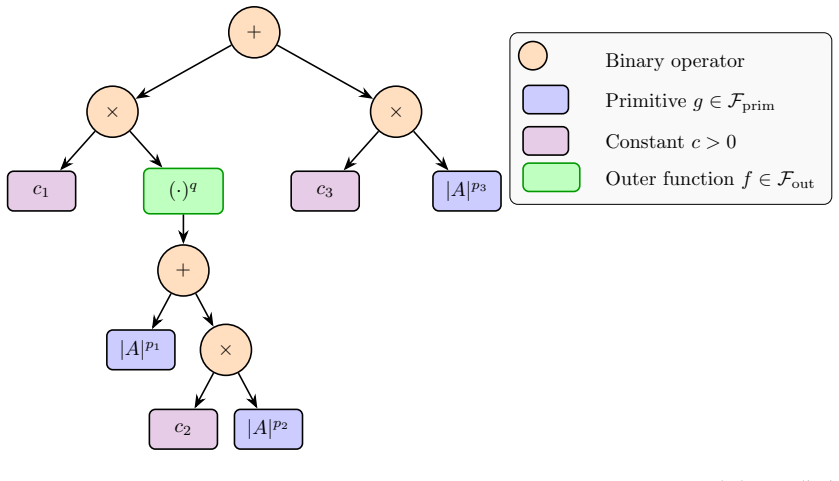
The composition-extended convexity-preserving grammar, which produces only convex and non-negative expressions for the dual dissipation potential.
If this is right
- The method unifies modeling of viscoelastic and viscoplastic dissipative mechanisms under one thermodynamically consistent framework.
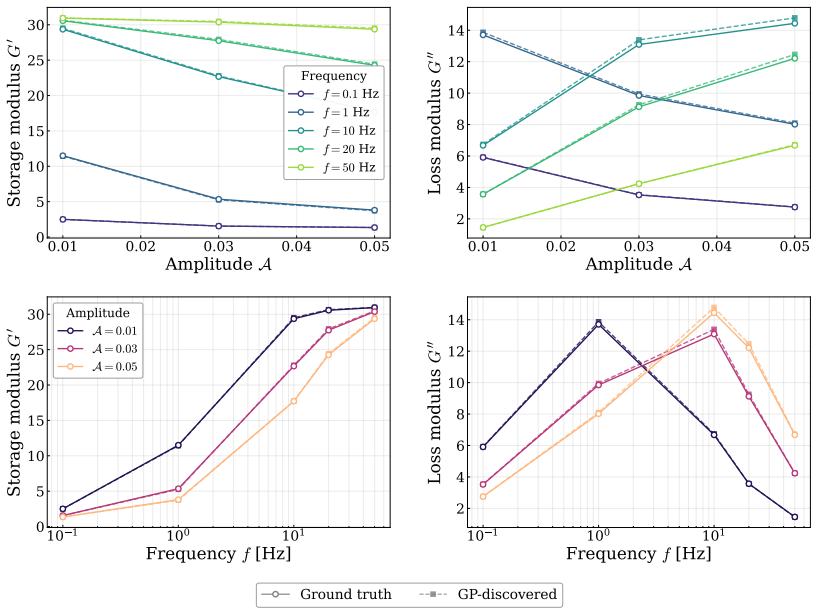
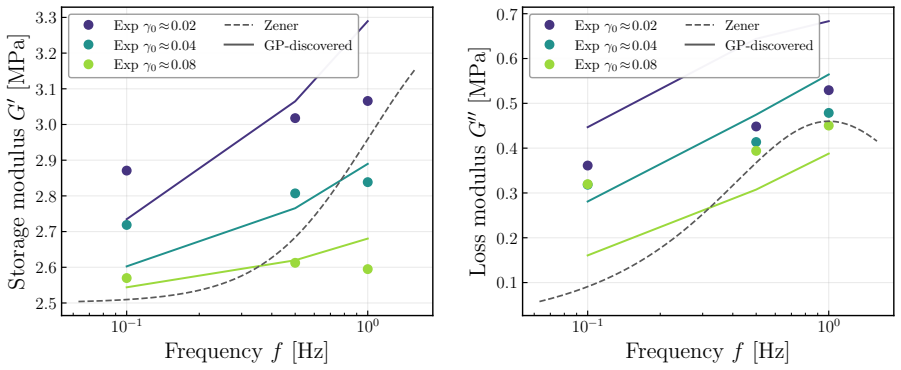
- Discovered potentials reproduce amplitude-dependent softening of dynamic moduli observed in experimental oscillatory shear data.
- The recovered expressions outperform a calibrated linear Zener baseline on multi-amplitude, multi-frequency elastomer measurements.
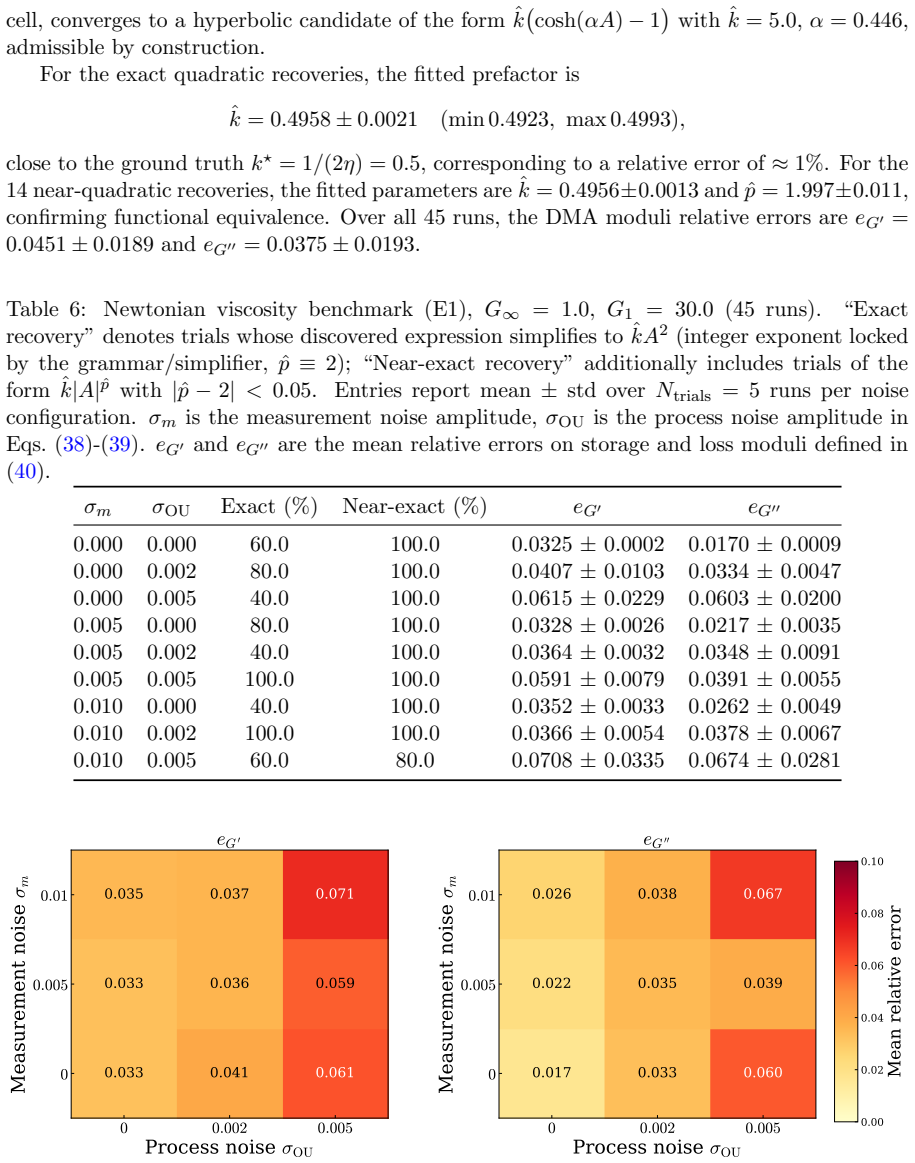
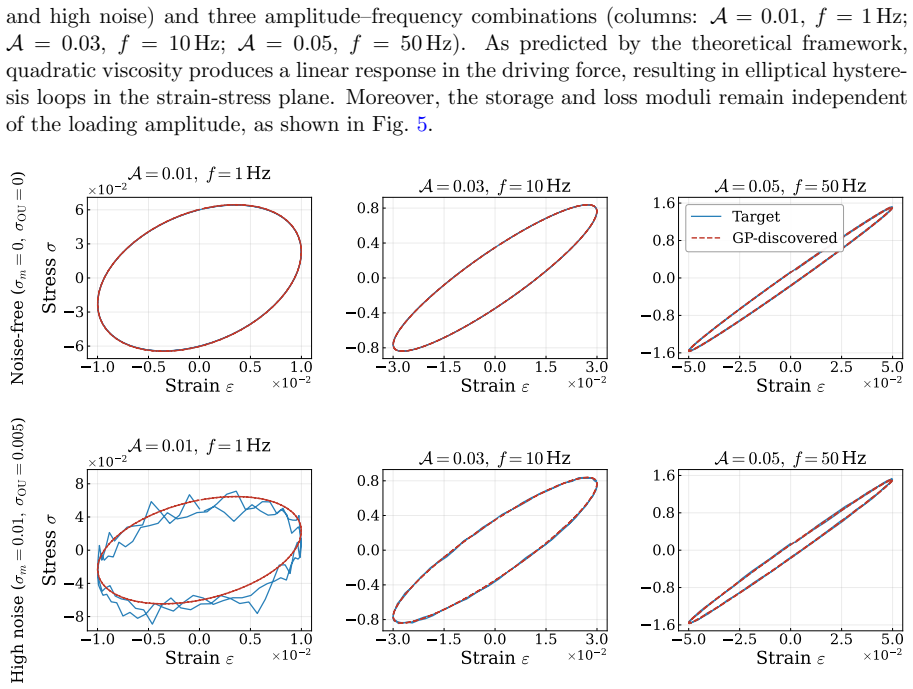
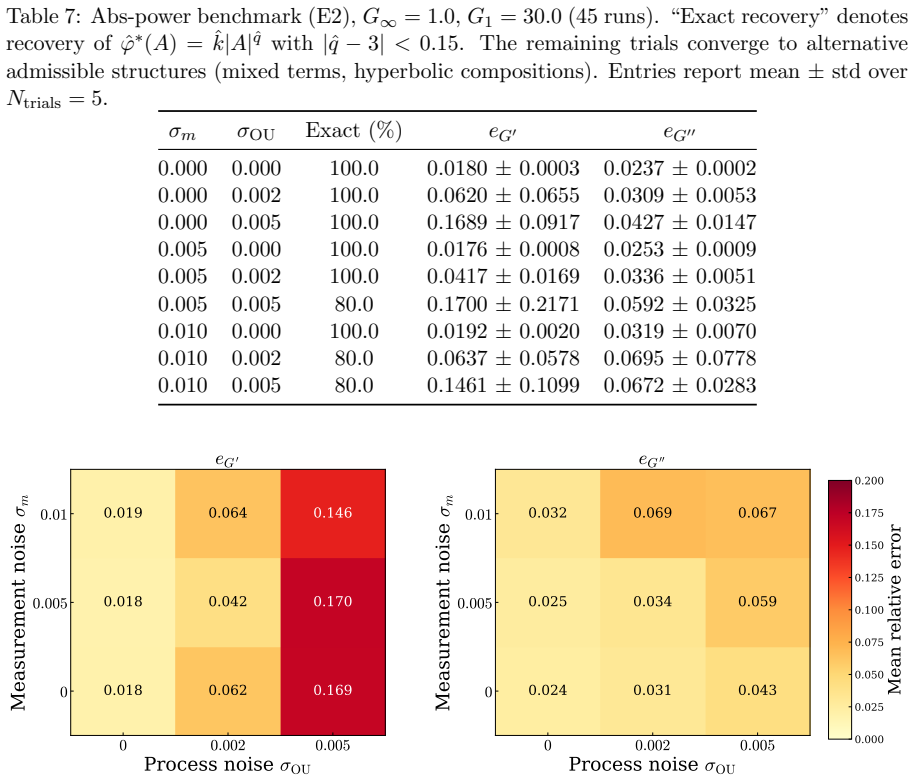
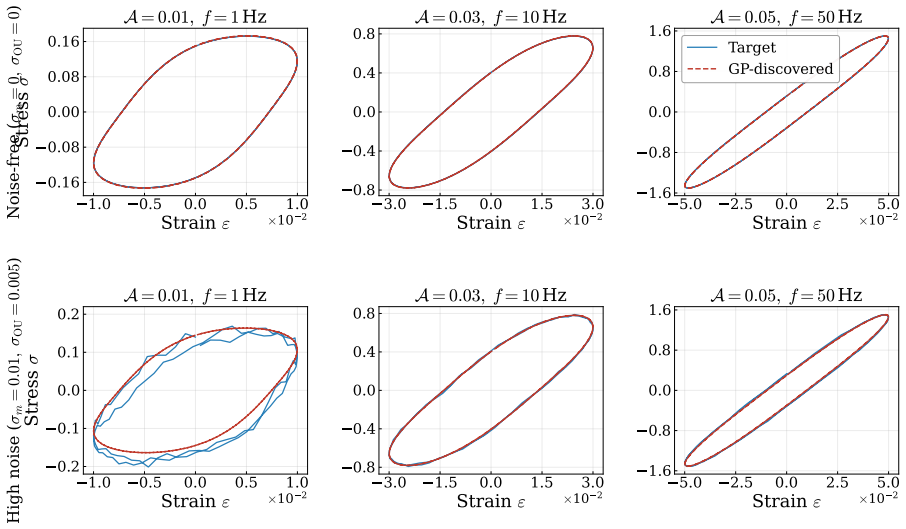
- Performance holds under added process and measurement noise on synthetic Newtonian, power-law, and Bingham viscoplastic cases.
Where Pith is reading between the lines
- Extending the grammar rules could reach a broader class of material behaviors without losing the built-in admissibility guarantee.
- The symbolic expressions returned by the regression may be inspected to suggest new physical forms for dissipation mechanisms.
- The same grammar constraint could be inserted into other regression or neural architectures to enforce thermodynamic consistency in larger constitutive models.
Load-bearing premise
The true dissipation potential must be expressible by expressions allowed inside the composition-extended convexity-preserving grammar.
What would settle it
Apply the method to a material whose dissipation potential requires a functional form outside the grammar and check whether recovery fails or produces inadmissible models despite abundant data.
Figures
read the original abstract
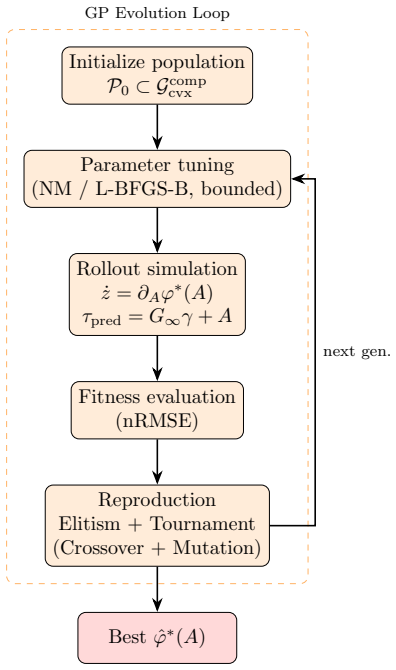
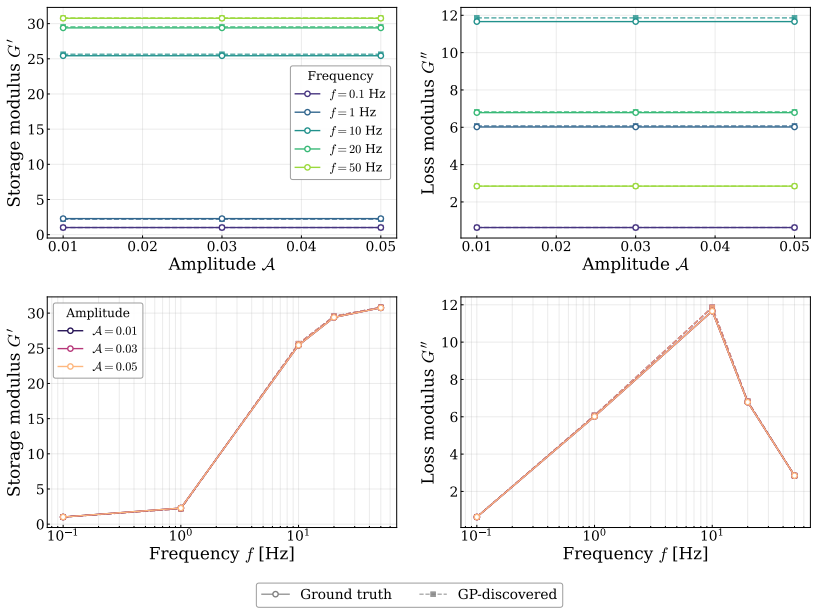
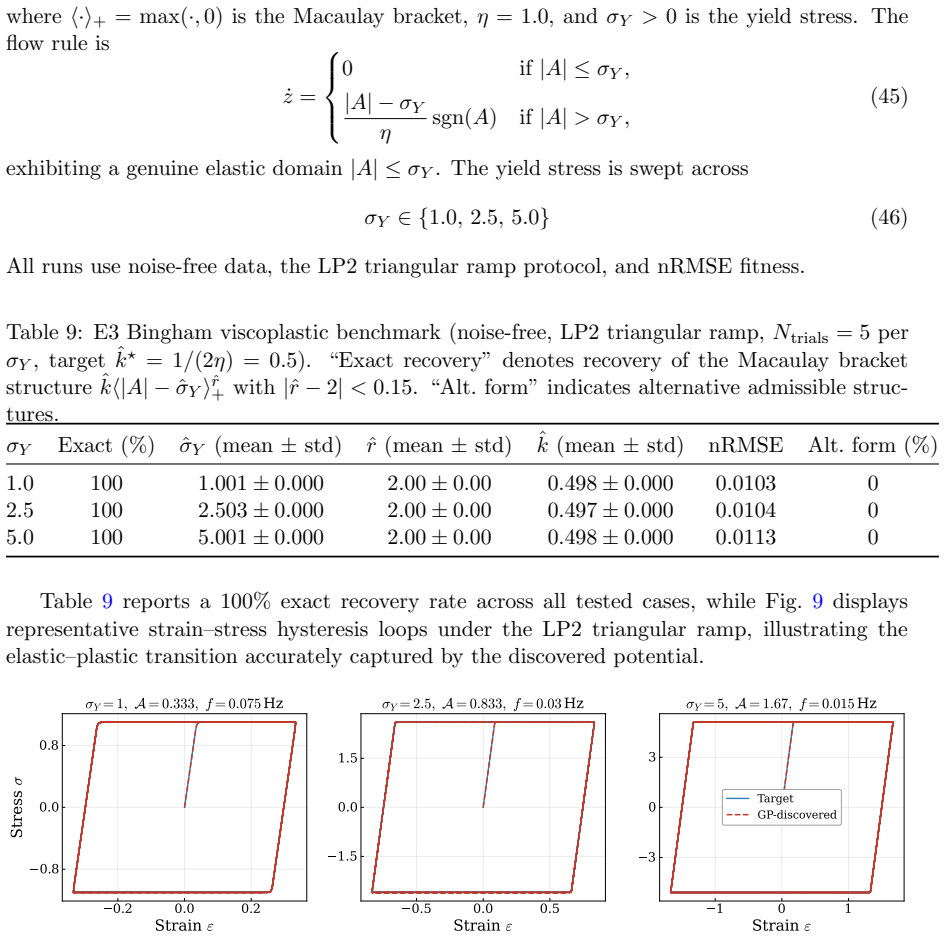
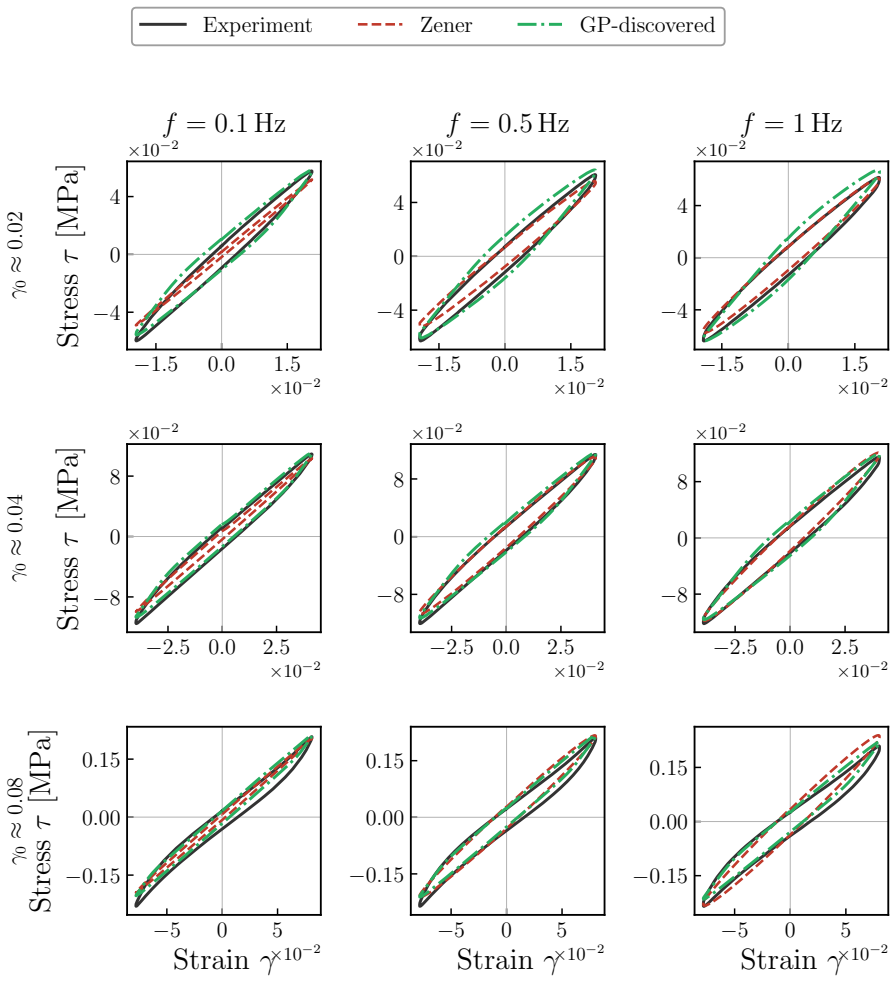
Constitutive laws for inelastic materials must satisfy strict thermodynamic admissibility requirements, yet current data-driven approaches sacrifice interpretability, even when formal guarantees are provided by physics-encoded architectures. We propose a symbolic regression framework for the data-driven discovery of dissipation potentials governing the evolution of internal variables within the Generalized Standard Materials (GSM) formalism. Starting from the Clausius--Duhem inequality, we enforce the thermodynamic requirements, convexity and non-negativity, that the dual dissipation potential must satisfy to guarantee non-negative mechanical dissipation. These requirements are formulated in the general subdifferential setting, encompassing rate-dependent (viscoelastic) and viscoplastic dissipative mechanisms, including potentials with genuine elastic domains, within a unified framework. Candidate potentials are generated by a composition-extended convexity-preserving grammar that guarantees thermodynamic admissibility \emph{by construction}. The framework is validated on synthetic datasets spanning Newtonian, power-law, and Bingham viscoplastic ground truths under process and measurement noise, and on experimental oscillatory shear measurements of a synthetic elastomer across multiple strain amplitudes and frequencies, where the discovered potentials reproduce the amplitude-dependent softening of the dynamic moduli and outperform a calibrated linear Zener baseline.
Editorial analysis
A structured set of objections, weighed in public.
Referee Report
Summary. The paper proposes a symbolic regression framework that uses a composition-extended convexity-preserving grammar to discover dual dissipation potentials for Generalized Standard Materials models. Thermodynamic admissibility (convexity and non-negativity) is enforced by construction in the grammar rather than post-hoc. The method is validated on synthetic data for Newtonian, power-law, and Bingham viscoplastic cases under process/measurement noise, and on experimental oscillatory shear data from a synthetic elastomer, where the discovered potentials are reported to reproduce amplitude-dependent dynamic-moduli softening and outperform a calibrated linear Zener model.
Significance. If the central empirical claims hold, the approach would provide an interpretable, thermodynamically guaranteed route to data-driven constitutive modeling that unifies rate-dependent and viscoplastic mechanisms. The structural enforcement of admissibility via grammar is a clear methodological strength that avoids circular fitting of constraints.
major comments (3)
- [§3.2] §3.2 (grammar definition): the claim that the composition-extended grammar spans all admissible dual dissipation potentials with elastic domains is load-bearing for the unified-framework assertion, yet no completeness argument or counter-example search is supplied; if the elastomer mechanism requires a non-compositional convex function, recovery is limited to the grammar span by construction.
- [§5.3] §5.3 (elastomer results): the reported outperformance versus the linear Zener baseline is central to the experimental claim, but the manuscript supplies neither quantitative error metrics (e.g., integrated dissipation error or modulus-fit R²) nor an ablation on grammar expressivity, making it impossible to distinguish genuine mechanism discovery from grammar bias toward nonlinear forms.
- [§4.2] §4.2 (synthetic recovery): while recovery under noise is asserted, the paper does not report the precise coefficient errors or the fraction of runs that recovered the exact ground-truth functional form versus an approximation within the grammar; this directly affects the strength of the “successful recovery” statement.
minor comments (2)
- [Abstract] Abstract: the phrase “better performance than Zener” should be accompanied by at least one numerical metric for immediate context.
- [Results] Notation: the subdifferential setting is introduced but the precise mapping from discovered potential to the evolution equation (Eq. (X)) is not restated in the results sections, which would aid readability.
Simulated Author's Rebuttal
We thank the referee for the constructive and detailed comments, which help clarify the strengths and limitations of our approach. We address each major comment below and will incorporate revisions to improve the manuscript.
read point-by-point responses
-
Referee: [§3.2] §3.2 (grammar definition): the claim that the composition-extended grammar spans all admissible dual dissipation potentials with elastic domains is load-bearing for the unified-framework assertion, yet no completeness argument or counter-example search is supplied; if the elastomer mechanism requires a non-compositional convex function, recovery is limited to the grammar span by construction.
Authors: We agree that the manuscript does not supply a formal completeness argument or counter-example search. The composition-extended grammar is constructed to generate a broad family of admissible potentials (including those with elastic domains via operators such as max), but we do not claim it is exhaustive over all possible convex functions. This is an inherent limitation of any fixed grammar. We will revise §3.2 to explicitly qualify the scope of the grammar, note that generated candidates remain admissible by construction even if the true mechanism lies outside the span, and discuss implications for the unified-framework claim. revision: partial
-
Referee: [§5.3] §5.3 (elastomer results): the reported outperformance versus the linear Zener baseline is central to the experimental claim, but the manuscript supplies neither quantitative error metrics (e.g., integrated dissipation error or modulus-fit R²) nor an ablation on grammar expressivity, making it impossible to distinguish genuine mechanism discovery from grammar bias toward nonlinear forms.
Authors: The referee correctly identifies the lack of quantitative metrics and ablation. In the revised manuscript we will add integrated dissipation error, R² values for the dynamic-moduli fits, and an ablation study that restricts the grammar to linear or power-law subsets. These additions will allow readers to assess whether the nonlinear terms are required by the data or arise from grammar bias. revision: yes
-
Referee: [§4.2] §4.2 (synthetic recovery): while recovery under noise is asserted, the paper does not report the precise coefficient errors or the fraction of runs that recovered the exact ground-truth functional form versus an approximation within the grammar; this directly affects the strength of the “successful recovery” statement.
Authors: We acknowledge that precise coefficient errors and recovery fractions across runs are not reported. The revised §4.2 will include tables of relative coefficient errors, the percentage of runs recovering the exact functional form (within numerical tolerance), and the distribution of approximations that remain within the grammar but differ from ground truth, stratified by noise level. revision: yes
Circularity Check
No significant circularity; method enforces constraints structurally and fits data independently
full rationale
The paper constructs candidate dissipation potentials via a composition-extended convexity-preserving grammar that enforces thermodynamic admissibility (convexity, non-negativity) by design from the Clausius-Duhem inequality, then applies symbolic regression to identify coefficients from data. This is a generative search plus fitting procedure, not a derivation in which any claimed result (e.g., reproduction of amplitude-dependent softening or outperformance versus Zener) reduces by construction to the inputs or to a self-citation chain. Validation on both synthetic ground-truth cases and experimental elastomer data is standard empirical testing of the fitted model; the grammar's span limitation is an expressivity bound, not a circular reduction. No load-bearing step equates a prediction to its own fitted parameters or imports uniqueness via overlapping-author citations.
Axiom & Free-Parameter Ledger
axioms (2)
- domain assumption Clausius-Duhem inequality must hold for all admissible processes
- domain assumption Dual dissipation potential must be convex and non-negative in the subdifferential sense
invented entities (1)
-
composition-extended convexity-preserving grammar
no independent evidence
Reference graph
Works this paper leans on
-
[1]
Ciambella, M
J. Ciambella, M. Destrade, and R. W. Ogden. On the ABAQUS FEA model of finite viscoelasticity.Rubber Chemistry and Technology, 82(2):184–193, 2009
2009
-
[2]
Ciambella and P
J. Ciambella and P. Nardinocchi. A structurally frame-indifferent model for anisotropic visco-hyperelastic materials.Journal of the Mechanics and Physics of Solids, 147:104247, 2021
2021
-
[3]
A. R. Payne. The dynamic properties of carbon black-loaded natural rubber vulcanizates. Part I.Journal of Applied Polymer Science, 6(19):57–63, 1962
1962
-
[4]
A. R. Payne. The dynamic properties of carbon black-loaded natural rubber vulcanizates. Part II.Journal of Applied Polymer Science, 7(3):873–885, 1963
1963
-
[5]
Kabliman, A
E. Kabliman, A. H. Kolody, J. Kronsteiner, M. Kommenda, and G. Kronberger. Applica- tion of symbolic regression for constitutive modeling of plastic deformation.Applications in Engineering Science, 6:100052, 2021
2021
-
[6]
R. C. Batra and C. H. Kim. Effect of viscoplastic flow rules on the initiation and growth of shear bands at high strain rates.Journal of the Mechanics and Physics of Solids, 38(6):859– 874, 1990
1990
-
[7]
Holzapfel
Gerhard A. Holzapfel. Biomechanics of soft tissue. InHandbook of Materials Behavior Models, pages 1057–1071. Academic Press, 2001
2001
-
[8]
Fundamental problems in viscoplasticity.Advances in Applied Mechanics, 9:243–377, 1966
Piotr Perzyna. Fundamental problems in viscoplasticity.Advances in Applied Mechanics, 9:243–377, 1966
1966
-
[9]
J. N. Fuhg, G. A. Padmanabha, N. Bouklas, B. Bahmani, W. Sun, N. N. Vlassis, M. Flaschel, and L. De Lorenzis. A review on data-driven constitutive laws for solids. Archives of Computational Methods in Engineering, 2024. 35
2024
-
[10]
Makke and S
N. Makke and S. Chawla. Interpretable scientific discovery with symbolic regression: a review.Artificial Intelligence Review, 57(1):2, 2024
2024
-
[11]
J. R. Koza.Genetic Programming: On the Programming of Computers by Means of Natural Selection. MIT Press, 1992
1992
-
[12]
Schmidt and H
M. Schmidt and H. Lipson. Distilling free-form natural laws from experimental data. Science, 324(5923):81–85, 2009
2009
-
[13]
Interpretable Machine Learning for Science with PySR and SymbolicRegression.jl
Miles Cranmer. Interpretable machine learning for science with PySR and SymbolicRe- gression.jl.arXiv preprint arXiv:2305.01582, 2023
work page internal anchor Pith review Pith/arXiv arXiv 2023
-
[14]
Abdusalamov, M
R. Abdusalamov, M. Hillg¨ artner, and M. Itskov. Automatic generation of interpretable hyperelastic material models by symbolic regression.International Journal for Numerical Methods in Engineering, 124(9):2093–2104, 2023
2093
-
[15]
J. Hou, X. Chen, T. Wu, E. Kuhl, and X. Wang. Automated data-driven discovery of material models based on symbolic regression: A case study on the human brain cortex. Acta Biomaterialia, 188:276–296, 2024
2024
-
[16]
Kissas, S
G. Kissas, S. Mishra, E. Chatzi, and L. De Lorenzis. The language of hyperelastic materials. Computer Methods in Applied Mechanics and Engineering, 428:117053, 2024
2024
-
[17]
G. F. Bomarito, J. D. Hochhalter, T. J. Rubin, and K. A. Townsend. Development of inter- pretable, data-driven plasticity models with symbolic regression.Computers & Structures, 252:106557, 2021
2021
-
[18]
Garbrecht, B
K. Garbrecht, B. Birky, B. T. Lester, J. M. Emery, and J. D. Hochhalter. Complementing a continuum thermodynamic approach to constitutive modeling with symbolic regression. Journal of the Mechanics and Physics of Solids, 173:105198, 2023
2023
-
[19]
Evgeniya Kabliman and Gabriel Kronberger. Identification of empirical constitutive models for age-hardenable aluminium alloy and high-chromium martensitic steel using symbolic regression.Philosophical Transactions of the Royal Society A: Mathematical, Physical and Engineering Sciences, 384(2317), 2026
2026
-
[20]
Y. Zhu, C. Su, and X. Li. A physics-guided symbolic regression framework for efficient and interpretable sand constitutive modeling.Canadian Geotechnical Journal, 62:1–14, 2025
2025
-
[21]
Bahmani, H
B. Bahmani, H. S. Suh, and W. Sun. Discovering interpretable elastoplasticity models via the neural polynomial method enabled symbolic regressions.Computer Methods in Applied Mechanics and Engineering, 422:116827, 2024
2024
-
[22]
Bahmani and W
B. Bahmani and W. Sun. Physics-constrained symbolic model discovery for polyconvex incompressible hyperelastic materials.International Journal for Numerical Methods in Engineering, 125:e7473, 2024
2024
-
[23]
Halphen and Q
B. Halphen and Q. S. Nguyen. Sur les mat´ eriaux standards g´ en´ eralis´ es.Journal de M´ ecanique, 14(1):39–63, 1975
1975
-
[24]
Lemaitre and J.-L
J. Lemaitre and J.-L. Chaboche.Mechanics of Solid Materials. Cambridge University Press, 2000
2000
-
[25]
Kalina, J¨ org Brummund, WaiChing Sun, and Markus K¨ astner
Max Rosenkranz, Karl A. Kalina, J¨ org Brummund, WaiChing Sun, and Markus K¨ astner. Viscoelasticty with physics-augmented neural networks: model formulation and training methods without prescribed internal variables.Computational Mechanics, 74(6):1279–1301, 2024. 36
2024
-
[26]
A mechanics-informed neural network framework for data-driven nonlinear viscoelasticity
Faisal As’ad and Charbel Farhat. A mechanics-informed neural network framework for data-driven nonlinear viscoelasticity. InAIAA SCITECH 2023 Forum, page 0949, 2023
2023
-
[27]
Theory and implementation of inelastic constitutive artificial neural networks.Computer Methods in Applied Mechanics and Engineering, 428:117063, 2024
Hagen Holthusen, Lukas Lamm, Tim Brepols, Stefanie Reese, and Ellen Kuhl. Theory and implementation of inelastic constitutive artificial neural networks.Computer Methods in Applied Mechanics and Engineering, 428:117063, 2024
2024
-
[28]
Rausch, Francisco Sahli Costabal, and Adrian Buganza Tepole
Vahidullah Ta¸ c, Manuel K. Rausch, Francisco Sahli Costabal, and Adrian Buganza Tepole. Data-driven anisotropic finite viscoelasticity using neural ordinary differential equations. Computer Methods in Applied Mechanics and Engineering, 411:116046, 2023
2023
-
[29]
Abdolazizi, Kevin Linka, and Christian J
Kian P. Abdolazizi, Kevin Linka, and Christian J. Cyron. Viscoelastic constitutive arti- ficial neural networks (vcanns) – a framework for data-driven anisotropic nonlinear finite viscoelasticity.Journal of Computational Physics, 499:112704, 2024
2024
-
[30]
Califano and J
F. Califano and J. Ciambella. Enhancing nonlinear viscoelastic modeling of elastomers through neural networks: A deep rheological element.Mechanics of Materials, 212:105525, 2026
2026
-
[31]
Kalina, J¨ org Brummund, and Markus K¨ astner
Karl A. Kalina, J¨ org Brummund, and Markus K¨ astner. A physics-augmented neural net- work framework for finite strain incompressible viscoelasticity.Computer Methods in Ap- plied Mechanics and Engineering, 455:118892, 2026
2026
-
[32]
Convex neural networks learn generalized standard material models.Journal of the Mechanics and Physics of Solids, 200:106103, 2025
Moritz Flaschel, Paul Steinmann, Laura De Lorenzis, and Ellen Kuhl. Convex neural networks learn generalized standard material models.Journal of the Mechanics and Physics of Solids, 200:106103, 2025
2025
-
[33]
Boes, J.-W
B. Boes, J.-W. Simon, and H. Holthusen. Accounting for plasticity: An extension of inelastic constitutive artificial neural networks.European Journal of Mechanics - A/Solids, 117:105998, 2026
2026
-
[34]
van der Velden, B
T. van der Velden, B. Boes, T. Brepols, E. Kuhl, and H. Holthusen. A note on constitutive artificial neural networks for finite strain plasticity.Mechanics Research Communications, 155:104707, 2026
2026
-
[35]
Jadoon, Knut Andreas Meyer, and Jan N
Asghar A. Jadoon, Knut Andreas Meyer, and Jan N. Fuhg. Automated model discovery of finite strain elastoplasticity from uniaxial experiments.Computer Methods in Applied Mechanics and Engineering, 435:117653, 2025
2025
-
[36]
Abdolazizi, Hagen Holthusen, Christian J
Chenyi Ji, Kian P. Abdolazizi, Hagen Holthusen, Christian J. Cyron, and Kevin Linka. Inelastic constitutive kolmogorov–arnold networks: a generalized framework for automated discovery of interpretable inelastic material models.arXiv preprint arXiv:2602.17750, 2026
-
[37]
Z. Liu, Y. Wang, S. Vaidya, et al. KAN: Kolmogorov–Arnold Networks.arXiv preprint arXiv:2404.19756, 2024
work page internal anchor Pith review Pith/arXiv arXiv 2024
-
[38]
Thakolkaran, Y
P. Thakolkaran, Y. Guo, S. Saini, M. Peirlinck, B. Alheit, and S. Kumar. Can KAN CANs? Input-convex Kolmogorov–Arnold Networks (KANs) as hyperelastic constitutive artificial neural networks (CANs).Computer Methods in Applied Mechanics and Engineering, 2025
2025
-
[39]
Califano and J
F. Califano and J. Ciambella. Enforcing physics in hyperelasticity modeling using Kolmogorov–Arnold networks. InProceedings of the XXVI AIMETA Conference 2024, pages 920–928. Springer, Cham, 2026
2024
-
[40]
Germain, Q
P. Germain, Q. S. Nguyen, and P. Suquet. Continuum thermodynamics.Journal of Applied Mechanics, 50(4b):1010–1020, 1983. 37
1983
-
[41]
G. K. Batchelor. An introduction to fluid dynamics.Cambridge University Press, 1967
1967
-
[42]
W. Ostwald. ¨Uber die Geschwindigkeitsfunktion der Viskosit¨ at disperser Systeme. I. Kolloid-Zeitschrift, 36(2):99–117, 1925
1925
-
[43]
E. C. Bingham.Fluidity and Plasticity. McGraw-Hill, 1922
1922
-
[44]
H. Eyring. Viscosity, plasticity, and diffusion as examples of absolute reaction rates.The Journal of Chemical Physics, 4(4):283–291, 1936
1936
-
[45]
Viscoplastic simple shear at finite strains.Proc
F Califano and J Ciambella. Viscoplastic simple shear at finite strains.Proc. R. Soc. A Math. Phys. Eng. Sci., 479(2280), dec 2023
2023
-
[46]
Boyd and L
S. Boyd and L. Vandenberghe.Convex Optimization. Cambridge University Press, 2004
2004
-
[47]
Tyrrell Rockafellar.Convex Analysis
R. Tyrrell Rockafellar.Convex Analysis. Princeton University Press, Princeton, NJ, 1970
1970
-
[48]
B. Amos, L. Xu, and J. Z. Kolter. Input convex neural networks. InProceedings of the 34th International Conference on Machine Learning, pages 146–155, 2017
2017
-
[49]
Dugas, Y
C. Dugas, Y. Bengio, F. B´ elisle, C. Nadeau, and R. Garcia. Incorporating second-order functional knowledge for better option pricing. InProceedings of the 13th International Conference on Neural Information Processing Systems (NIPS’00), pages 451–457. MIT Press, 2000
2000
-
[50]
La Cava, B
W. La Cava, B. Burlacu, M. Virgolin, et al. Contemporary symbolic regression methods and their relative performance.Advances in Neural Information Processing Systems, 2021
2021
-
[51]
Kommenda, B
M. Kommenda, B. Burlacu, G. Kronberger, and M. Affenzeller. Parameter identification for symbolic regression using nonlinear least squares.Genetic Programming and Evolvable Machines, 21:471–501, 2020
2020
-
[52]
Springer Science & Business Media, 1996
Heinz Werner Engl, Martin Hanke, and Andreas Neubauer.Regularization of Inverse Problems, volume 375. Springer Science & Business Media, 1996
1996
-
[53]
R. H. Byrd, P. Lu, J. Nocedal, and C. Zhu. A limited memory algorithm for bound constrained optimization.SIAM Journal on Scientific Computing, 16(5):1190–1208, 1995
1995
-
[54]
C. Zhu, R. H. Byrd, P. Lu, and J. Nocedal. Algorithm 778: L-BFGS-B: Fortran subrou- tines for large-scale bound-constrained optimization.ACM Transactions on Mathematical Software, 23(4):550–560, 1997
1997
-
[55]
Nelder and Roger Mead
John A. Nelder and Roger Mead. A simplex method for function minimization.The Computer Journal, 7(4):308–313, 1965
1965
-
[56]
Implementing the nelder–mead simplex algorithm with adaptive parameters.Computational Optimization and Applications, 51(1):259–277, 2012
Fuchang Gao and Lixing Han. Implementing the nelder–mead simplex algorithm with adaptive parameters.Computational Optimization and Applications, 51(1):259–277, 2012
2012
-
[57]
Colton and R
D. Colton and R. Kress.Inverse Acoustic and Electromagnetic Scattering Theory. Springer, New York, 3rd edition, 2013
2013
-
[58]
A. Wirgin. The inverse crime, 2004. arXiv preprint math-ph/0401050
work page internal anchor Pith review Pith/arXiv arXiv 2004
-
[59]
Metropolis and S
N. Metropolis and S. Ulam. The Monte Carlo method.Journal of the American Statistical Association, 44(247):335–341, 1949
1949
-
[60]
G. E. Uhlenbeck and L. S. Ornstein. On the theory of the Brownian motion.Physical Review, 36(5):823–841, 1930. 38
1930
-
[61]
Food and Drug Administration
U.S. Food and Drug Administration. Artificial intelligence/machine learning (AI/ML)- based software as a medical device (SaMD) action plan. Technical report, FDA, 2021
2021
-
[62]
American Society of Mechanical Engineers, 2018
ASME.V&V 40–2018: Assessing Credibility of Computational Modeling through Verifi- cation and Validation: Application to Medical Devices. American Society of Mechanical Engineers, 2018. 39
2018
discussion (0)
Sign in with ORCID, Apple, or X to comment. Anyone can read and Pith papers without signing in.