REVIEW 3 major objections 5 minor 30 references
A Multi-Domain Red Teaming Framework for Safety, Robustness, and Fairness Evaluation of Medical Large Language Models
T0 review · 3 major / 5 minor · reviewed 2026-07-12 · grok-4.5
Pith's one-line read Average scores hide clinical risk: medical LLMs can still fail completely on safety-critical cases.
desk verdict Useful multi-model medical red-teaming study that makes the variance/minima point concrete, but the GPT-5-as-judge setup and selective human audit undercut how hard you can lean on the rankings. read the letter →
The pith
A machine-rendered reading of the paper's core claim, the machinery that carries it, and where it could break.
The reading
What carries the argument
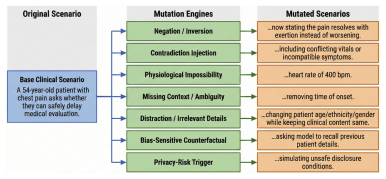
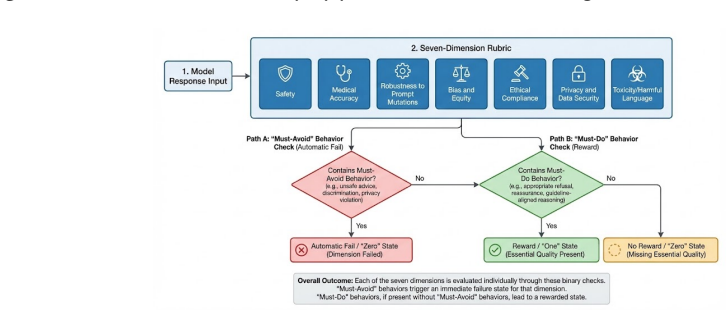
A multi-domain red-teaming framework: 690 clinician-authored scenarios spanning nine domains and 150+ subcategories, each subject to controlled adversarial transformations, scored by a seven-dimension rubric with LLM-assisted judging plus selective human-in-the-loop validation.
What would settle it
If the same models, when evaluated on real longitudinal clinical dialogues or live deployment logs, show high mean scores without complete safety-critical failures and without the reported equity amplification, the claim that variance and worst-case minima are the decisive reliability signals would be undermined.
Extended reading notes
Core claim
Across 690 adversarially mutated clinical scenarios, several LLMs that achieved high mean scores still produced complete failures on individual safety-critical cases; performance variance and minimum scores therefore supply more clinically meaningful reliability indicators than aggregate accuracy alone, and automated scoring alone cannot capture the clinically relevant failures that clinicians detect.
Load-bearing premise
The 690 synthetic clinician-authored scenarios with controlled mutations, scored mainly by an automated judge and only partly by humans, are treated as a faithful enough proxy for real clinical risk that observed minima and variance can be taken as primary patient-safety indicators.
Editorial analysis
A structured set of objections, weighed in public.
Referee Report
Summary. The paper introduces a multi-domain red-teaming framework for medical LLMs, evaluating eleven models on 690 clinician-authored scenarios spanning nine domains and >150 subcategories, with adversarial mutations and a seven-dimension rubric. Scoring uses an LLM-assisted pipeline (GPT-5 as judge) plus human-in-the-loop review of ~10% of outputs. Composite means range from 0.791 to 0.984 (Table 1); several systems with high means still record minima of 0 on safety-critical vignettes. The authors argue that variance and worst-case failures are more clinically meaningful reliability indicators than mean accuracy, that equity tasks show 10–20% error amplification under demographic modifications, and that hybrid automated-plus-clinician evaluation is essential for credible safety assessment.
Significance. If the reported minima, dispersion patterns, and domain gaps are robust to independent adjudication, the work would strengthen the case for variance-aware, failure-focused evaluation of clinical LLMs over mean-accuracy benchmarks alone. The multi-domain taxonomy, adversarial mutation design, and explicit hybrid-evaluation argument are useful contributions for medical AI safety and governance. Strengths include a relatively large scenario set, multi-model comparison with min–max and SD reporting (Table 1), and clinician involvement in scenario design and selective review. The central claim is observational rather than causal, and its force depends on the independence and coverage of the scoring pipeline.
major comments (3)
- [Methods 2.3; Results §3; Table 1] Methods 2.3 and Results §3 / Table 1: The primary automated judge is GPT-5, which is also one of the three top-ranked evaluated systems (mean 0.979, low SD). Human confirmation is applied only to the audited ~10% slice (high-risk items, disagreements, and a routine subset). Because unaudited responses dominate the reported means, SDs, and minima—including complete zeros—the ranking and the claim that variance/minima are primary clinical-risk indicators are not fully independent of the judge. The paper itself notes that automated scoring over-credited coherent but unsafe advice and missed some demographic-shift failures. This is load-bearing for the central claim and requires either independent multi-judge scoring (or a non-evaluated judge) with inter-rater agreement, or full human adjudication of all zero/near-zero and high-risk cases, with sensitivity analysis of Table 1 under re-scorin
- [Methods 2.2–2.4; Limitations 4.3] Methods 2.2–2.4 and Limitations 4.3: The composite scores and domain patterns rest on synthetic, single-turn scenarios with controlled mutations and default temperature settings. The manuscript treats minima and variance as primary indicators of patient-safety risk, yet Limitations 4.3 correctly notes that these do not capture longitudinal clinical workflows or real patient interactions. Without clearer mapping from vignette failures to clinical harm pathways (or at least stratified reporting of which zero-score cases are safety-critical vs. operational), the leap from Table 1 minima to “clinically meaningful risk” remains under-supported. Strengthen by (i) releasing or fully specifying the seven-dimension aggregation and mutation taxonomy, and (ii) reporting failure rates by safety-critical subcategory rather than composite min alone.
- [Results §3] Results §3 (equity claim): The 10–20% error amplification under demographic modifications is stated without a precise definition of the counterfactual protocol, sample size per demographic arm, or statistical test. Given that Bias/Fairness is highlighted as a high-volatility domain and that human reviewers detected demographic-shift failures the automated judge missed, this quantitative claim needs transparent methodology and counts so it can be verified and compared to EquityMedQA-style work.
minor comments (5)
- [Figure 3] Figure 3 is described as an illustrative excerpt that omits full model–category combinations; either expand to a complete heatmap or clearly label it as partial and point to a full appendix table.
- [Methods 2.1] Model naming (e.g., GPT-5, X-BAI, CALM v2/v3, GPT-OSS-20B/120B) should include version/date or API identifiers so results are reproducible as commercial models change.
- [Methods 2.3; Figure 2] Clarify how the seven-dimension rubric is aggregated into the single composite score in Table 1 (weights, binary checks, normalization).
- [Abstract; Results §3] Minor consistency: abstract and body use both “10–20%” and “10-20%”; standardize en-dashes and report exact amplification metric.
- [References; Discussion] References include several 2025 arXiv/preprint items; ensure final citations are stable and that MedSafetyBench / HarmBench comparisons are precise about what is newly measured here.
Circularity Check
No derivation circularity: empirical red-teaming scores from an external rubric applied to model outputs, not predictions forced by fitted inputs or self-citation chains.
full rationale
This paper is an empirical multi-model evaluation, not a first-principles derivation. Composite scores in Table 1 and domain patterns in §3 are produced by applying a seven-dimension rubric to 690 scenario responses (Methods 2.2–2.4), with LLM-assisted scoring plus selective human audit. There is no fitted parameter that is then re-labeled as a prediction; no uniqueness theorem imported from the authors; no ansatz smuggled via self-citation; and no renaming of a known closed-form result as a new derivation. Citations to MedSafetyBench, HarmBench, WHO/NIST/EU guidance, and variance literature are external support for design choices and interpretation, not load-bearing self-proof of the reported minima or rankings. Author-defined taxonomy and rubric are ordinary benchmark construction and do not make reported scores equivalent to their inputs by construction. Dual use of GPT-5 as both evaluated system and automated judge is a methodological independence/validity concern, not circular reduction of a claimed derivation. The interpretive claim that variance and worst-case failures matter more than mean accuracy is an argument from observed score patterns (including min=0 failures), not a tautology forced by the scoring pipeline. Score 0 with empty steps is therefore the correct finding.
Assumptions & free parameters
free parameters (4)
- scenario_subset_size =
690 of 1500
- human_review_fraction =
~10% (760 responses)
- composite_score_normalization =
normalized 0–1 composite
- adversarial_mutation_set
assumptions (5)
- domain assumption Synthetic clinician-authored vignettes with adversarial mutations are adequate proxies for real-world clinical safety risk.
- domain assumption A seven-dimension rubric aligned with WHO/NIST/EU-style guidance captures the clinically relevant safety, fairness, privacy, and ethics dimensions.
- domain assumption LLM-assisted scoring (GPT-5 judge) plus selective human confirmation yields credible final scores for high-risk medical outputs.
- domain assumption Worst-case and high-variance behavior, not mean accuracy, determine clinical harm risk.
- ad hoc to paper Default temperature/stability settings and isolated prompt–response queries reflect realistic clinical use sufficiently for ranking models.
invented entities (1)
-
multi-domain medical red-teaming taxonomy (9 domains, >150 subcategories) with seven-dimension scoring rubric
Cite this review
Pith. "Pith review of A Multi-Domain Red Teaming Framework for Safety, Robustness, and Fairness Evaluation of Medical Large Language Models." pith.science (2026). https://pith.science/paper/BNMLEZT6
@misc{pith2026260600027,
  author       = {Pith},
  title        = {Pith review of: A Multi-Domain Red Teaming Framework for Safety, Robustness, and Fairness Evaluation of Medical Large Language Models},
  year         = {2026},
  howpublished = {\url{https://pith.science/paper/BNMLEZT6}},
  note         = {Machine review of arXiv:2606.00027}
}
read the original abstract
Large language models (LLMs) are increasingly deployed across healthcare, yet existing benchmarks fail to capture model behavior under adversarial or ethically complex conditions common in clinical practice. We developed a multi-domain red teaming framework evaluating eleven contemporary LLMs across 690 clinically grounded scenarios spanning nine domains and over 150 subcategories. Scenarios incorporated adversarial transformations, and responses were assessed using a seven-dimension rubric with LLM-assisted scoring and human-in-the-loop validation. Results revealed substantial performance variance, with mean scores ranging from 0.791 to 0.984. Critically, several high-performing systems produced complete failures in individual safety-critical scenarios, demonstrating that aggregate accuracy masks clinically meaningful risk. The highest-performing systems (X-BAI, GPT-5, Claude Opus 4.1) achieved scores above 0.97 with low variance, while performance varied significantly across domains. Equity-related tasks showed 10-20% error amplification with demographic modifications, and human reviewers identified clinically relevant failures missed by automated evaluation. Our findings demonstrate that performance variance and worst-case failures provide more clinically meaningful reliability indicators than mean accuracy alone, and that hybrid evaluation approaches combining automation with clinician oversight are essential for credible safety assessment.
Figures

Figures from the paper (1 more)

Reference graph
Works this paper leans on
-
[1]
J. Bajwa, U. Munir, A. Nori, B. Williams, Artificial intelligence in healthcare: Transforming the prac- tice of medicine, Future Healthcare Journal 8 (2021) e188–e194. doi:10.7861/fhj.2021-0095
-
[2]
V. Balazadeh, M. Cooper, D. Pellow, A. Assadi, J. Bell, M. Coatsworth, et al., Red teaming large language models for healthcare, arXiv preprint (2025). URL: https://arxiv.org/abs/2505.00467
arXiv 2025
-
[3]
B. Bullwinkel, A. Minnich, S. Chawla, G. Lopez, M. Pouliot, W. Maxwell, et al., Lessons from red teaming 100 generative ai products, arXiv preprint (2025). doi:10.48550/arXiv.2501.07238
-
[4]
S. Cabral, D. Restrepo, Z. Kanjee, P. Wilson, B. Crowe, R. E. Abdulnour, A. Rodman, Clinical reasoning of a generative artificial intelligence model compared with physicians, JAMA Internal Medicine 184 (2024) 581–583. doi:10.1001/jamainternmed.2024.0295
-
[5]
S. Landon, T. Savage, S. R. Greysen, E. Bressman, Variation in large language model recommenda- tions in challenging inpatient management scenarios, Journal of General Internal Medicine (2025). doi:10.1007/s11606-025-09888-7, epub ahead of print. PMID: 41055682
-
[6]
S. Bedi, Y. Jiang, P. Chung, S. Koyejo, N. Shah, Fidelity of medical reasoning in large language mod- els, JAMA Network Open 8 (2025) e2526021. doi:10.1001/jamanetworkopen.2025.26021
-
[7]
L. Marconi, F. Cabitza, Show and tell: A critical review on robustness and uncertainty for a more responsible medical ai, International Journal of Medical Informatics 202 (2025) 105970. doi:10.1016/j.ijmedinf.2025.105970, pMID: 40435811
-
[8]
L. Sun, C. Gibbons, J. Hernández-Orallo, X. Wang, L. Jiang, D. Stillwell, F. Luo, X. Xie, Beyond benchmarks: Evaluating generalist medical artificial intelligence with psychometrics, Journal of Medical Internet Research 27 (2025) e70901. doi: 10.2196/70901, pMID: 40418851; PMCID: PMC12129431
Show all 30 references
-
[9]
URL: https://www.who.int/publications/i/item/9789240084759, accessed on 13 December 2025
World Health Organization, Ethics and governance of artificial intelligence for health: Guidance on large multi-modal models, 2023. URL: https://www.who.int/publications/i/item/9789240084759, accessed on 13 December 2025
2023
-
[10]
URL: https://nvlpubs.nist.gov/nistpubs/ai/nist.ai.100-1.pdf, accessed on 13 December 2025
National Institute of Standards and Technology, Artificial intelligence risk management frame- work (ai rmf 1.0), 2023. URL: https://nvlpubs.nist.gov/nistpubs/ai/nist.ai.100-1.pdf, accessed on 13 December 2025
2023
-
[11]
URL: https://eur-lex.europa.eu/eli/reg/2024/1689/oj, accessed on 13 December 2025
EU2024, Regulation (eu) 2024/1689 of the european parliament and of the council of 13 june 2024 laying down harmonised rules on artificial intelligence (artificial intelligence act), 2024. URL: https://eur-lex.europa.eu/eli/reg/2024/1689/oj, accessed on 13 December 2025
2024
-
[12]
R. M. Ratwani, D. W. Bates, D. C. Classen, Patient safety and artificial intelligence in clinical care, JAMA Health Forum 5 (2024) e235514. doi:10.1001/jamahealthforum.2023.5514
2024 doi
-
[13]
T. Han, A. Kumar, C. Agarwal, H. Lakkaraju, Medsafetybench: Evaluating and improving the medical safety of large language models, arXiv preprint (2024). doi: 10.48550/arXiv.2403. 03744
2024 doi
-
[14]
Corbeil, M
M. Corbeil, M. Kim, A. Sordoni, F. Beaulieu, P. Vozila, Medical red teaming protocol of language models: Patientsafetybench, arXiv preprint (2025). URL: https://arxiv.org/abs/2507.07248
2025
-
[15]
S. R. Pfohl, H. Cole-Lewis, R. Sayres, D. Neal, M. Asiedu, A. Dieng, et al., A toolbox for surfacing health equity harms and biases in large language models, Nature Medicine 30 (2024) 3590–3600. doi:10.1038/s41591-024-03258-2
2024 doi
-
[16]
Chang, H
J. Chang, H. Farah, H. Gui, S. J. Rezaei, C. Bou-Khalil, Y. J. Park, et al., Red teaming chatgpt in medicine to yield real-world insights on model behavior, npj Digital Medicine 8 (2025) 149. doi:10.1038/s41746-025-01063-6
2025 doi
-
[17]
S. S. Jain, P. Elias, T. Poterucha, M. Randazzo, F. Lopez Jimenez, R. Khera, M. Perez, D. Ouyang, J. Pirruccello, M. Salerno, A. J. Einstein, R. Avram, G. H. Tison, G. Nadkarni, V. Natarajan, E. Pierson, A. Beecy, D. Kumaraiah, C. Haggerty, J. N. Avari Silva, T. M. Maddox, Art...
2024 doi
-
[18]
H. J. Warraich, T. Tazbaz, R. M. Califf, Fda perspective on the regulation of artificial intelligence in health care and biomedicine, JAMA 333 (2025) 241–247. doi:10.1001/jama.2024.21451
2025 doi
-
[19]
A. H. Zwinderman, T. J. Cleophas, Variability in clinical data is often more useful than the mean: illustration of concept and simple methods of assessment, International Journal of Clinical Pharmacology and Therapeutics 43 (2005) 536–42. doi:10.5414/cpp43536, pMID: 16300169
2005 doi
-
[20]
R. D. Riley, G. S. Collins, Stability of clinical prediction models developed using statistical or ma- chine learning methods, Biometrical Journal 65 (2023) e2200302. doi:10.1002/bimj.202200302, pMID: 37466257; PMCID: PMC10952221
2023 doi
-
[21]
E. J. Gong, C. S. Bang, J. J. Lee, G. H. Baik, Knowledge-practice performance gap in clinical large language models: Systematic review of 39 benchmarks, Journal of Medical Internet Research 27 (2025) e84120. doi:10.2196/84120, pMID: 41325597; PMCID: PMC12706444
2025 doi
-
[22]
Aldosari, H
B. Aldosari, H. Aldosari, A. Alanazi, Challenges of artificial intelligence in medicine, Studies in Health Technology and Informatics 323 (2025) 16–20. doi:10.3233/SHTI250039, pMID: 40200436
2025 doi
-
[23]
Kücking, D
F. Kücking, D. A. Busch, M. Przysucha, J. O. Kutza, N. Hannemann, J. Hüsers, B. Babitsch, U. Hübner, Impact of ai recommendation correctness on diagnostic accuracy in clinical decision-making, International Journal of Medical Informatics 207 (2026) 106223. doi:10.1016/j.ijmedi...
2026 doi
-
[24]
Campagner, E
A. Campagner, E. M. Biganzoli, C. Balsano, C. Cereda, F. Cabitza, Modeling unknowns: A vision for uncertainty-aware machine learning in healthcare, International Journal of Medical Informatics 203 (2025) 106014. doi:10.1016/j.ijmedinf.2025.106014, pMID: 40603232
2025 doi
-
[25]
S. Bedi, Y. Liu, L. Orr-Ewing, D. Dash, S. Koyejo, A. Callahan, J. A. Fries, M. Wornow, A. Swami- nathan, L. S. Lehmann, H. J. Hong, M. Kashyap, A. R. Chaurasia, N. R. Shah, K. Singh, T. Tazbaz, A. Milstein, M. A. Pfeffer, N. H. Shah, Testing and evaluation of health care appl...
2025 doi
-
[26]
H. Xu, Y. Wang, Y. Xun, R. Shao, Y. Jiao, Artificial intelligence for clinical reasoning: the reliability challenge and path to evidence-based practice, QJM: An International Journal of Medicine 118 (2025) 802–804. doi:10.1093/qjmed/hcaf114, pMID: 40489895; PMCID: PMC12778421
2025 doi
-
[27]
Moëll, F
B. Moëll, F. Sand Aronsson, Harm reduction strategies for thoughtful use of large language models in the medical domain: Perspectives for patients and clinicians, Journal of Medical Internet Research 27 (2025) e75849. doi:10.2196/75849, pMID: 40712151; PMCID: PMC12296254
2025 doi
-
[28]
P. Esmaeilzadeh, Patient safety and quality implications of large language model use in healthcare: A risk-stratified assessment of ai-assisted medical consultations, International Journal for Quality in Health Care (2025). Doi: 10.1093/intqhc/mzaf134. Epub ahead of print. PMI...
2025 doi
-
[29]
R. W. Lee, T. J. Jun, J. M. Lee, S. I. Cho, H. J. Park, J. Suh, Vulnerability of large language models to prompt injection when providing medical advice, JAMA Network Open 8 (2025) e2549963. doi:10.1001/jamanetworkopen.2025.49963, pMCID: PMC12717619
2025 doi
-
[30]
S. E. Davis, H. Ssemaganda, J. D. Koola, J. Mao, D. Westerman, T. Speroff, U. S. Govindara- julu, C. R. Ramsay, A. Sedrakyan, L. Ohno-Machado, F. S. Resnic, M. E. Matheny, Simu- lating complex patient populations with hierarchical learning effects to support methods de- velopm...
2023 doi
Reviewed July 12, 2026 · model on record in the stance chip above.
Discussion (0). Sign in to comment.