Physics-Informed Neural Networks for Radial Consolidation of Combined Electroosmotic, Vacuum and Surcharge Preloading Considering Smear Effects
Pith reviewed 2026-06-30 17:58 UTC · model grok-4.3
The pith
A modified gated PINN with hard-constrained boundaries accurately simulates electro-osmotic radial consolidation under combined loadings and smear effects.
A machine-rendered reading of the paper's core claim, the machinery that carries it, and where it could break.
Core claim
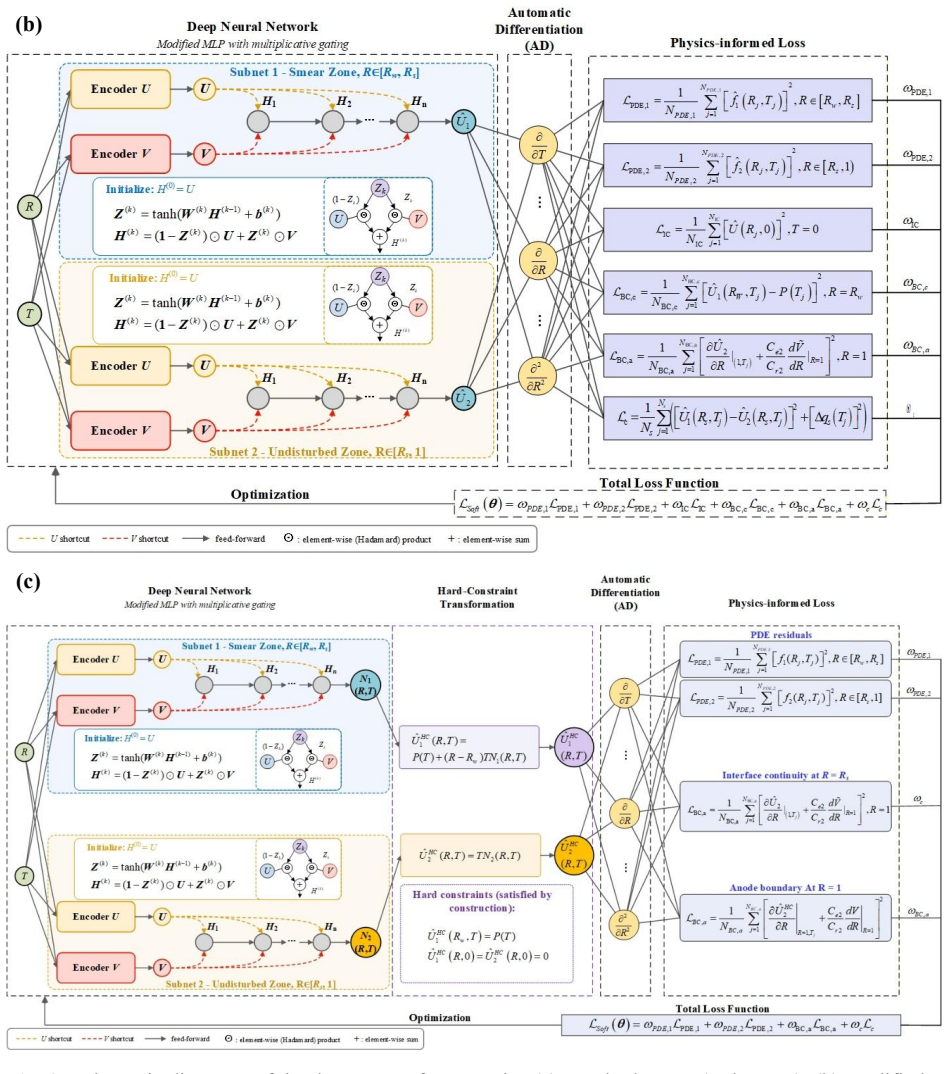
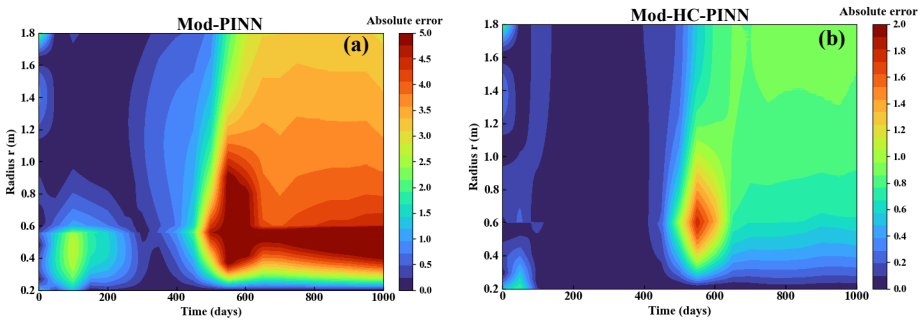
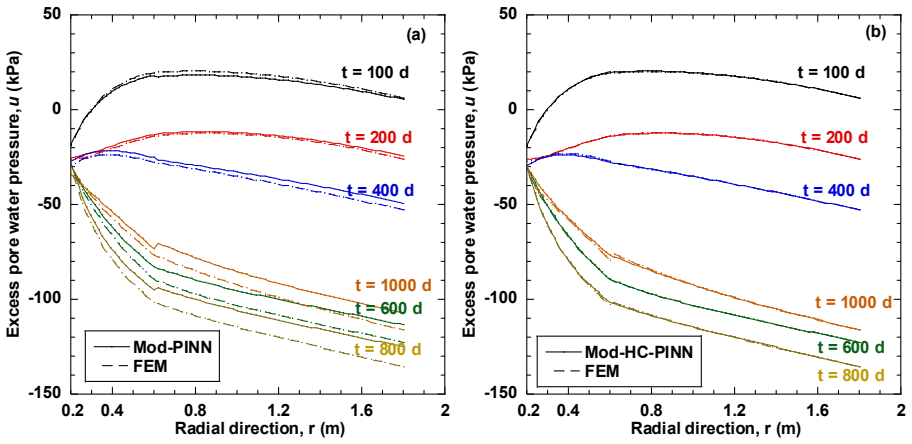
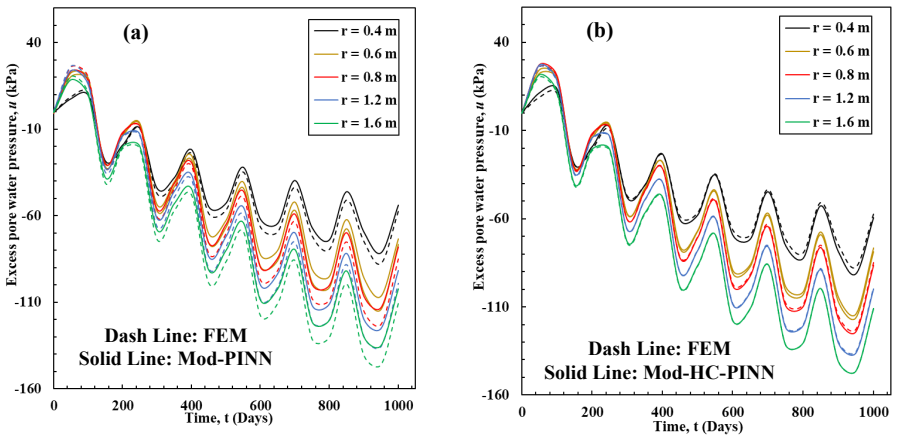
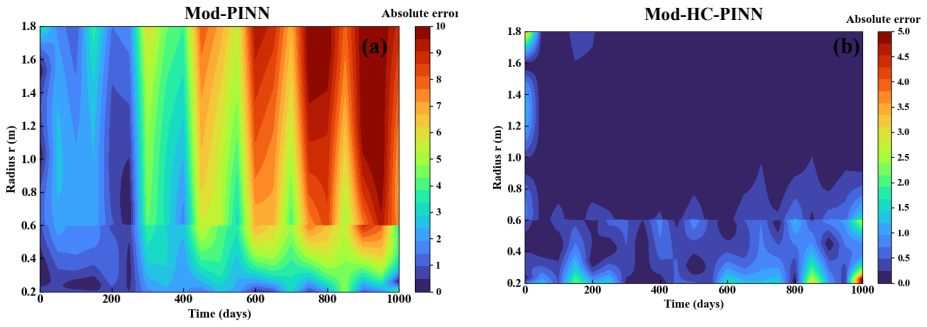
The study develops a dimensionless multi-domain physics-informed neural network framework for electro-osmotic radial consolidation that incorporates smear effects and combined vacuum and surcharge loading. The modified gated PINN with hard-constraint boundary encoding (Mod-HC-PINN) achieves the lowest mean absolute errors of 0.43 kPa, 0.41 kPa, and 0.27 kPa for exponential vacuum, ramp surcharge, and cyclic haversine surcharge cases by embedding the cathode boundary and initial conditions directly into the output structure, thereby reducing the optimization burden and improving physical consistency compared with soft-constrained models.
What carries the argument
The Mod-HC-PINN architecture, which combines a gated network with hard encoding of the cathode boundary and initial conditions to enforce physical consistency across multiple loading domains.
If this is right
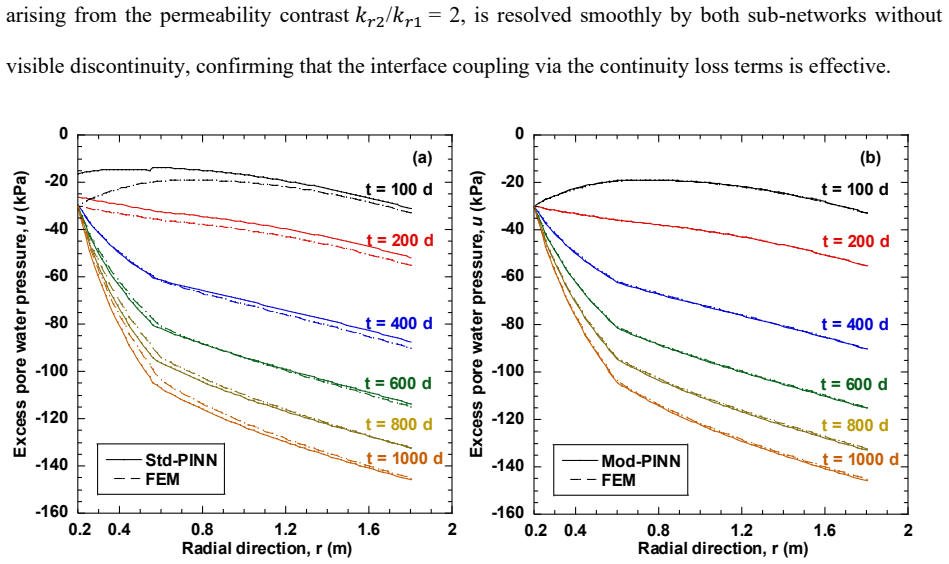
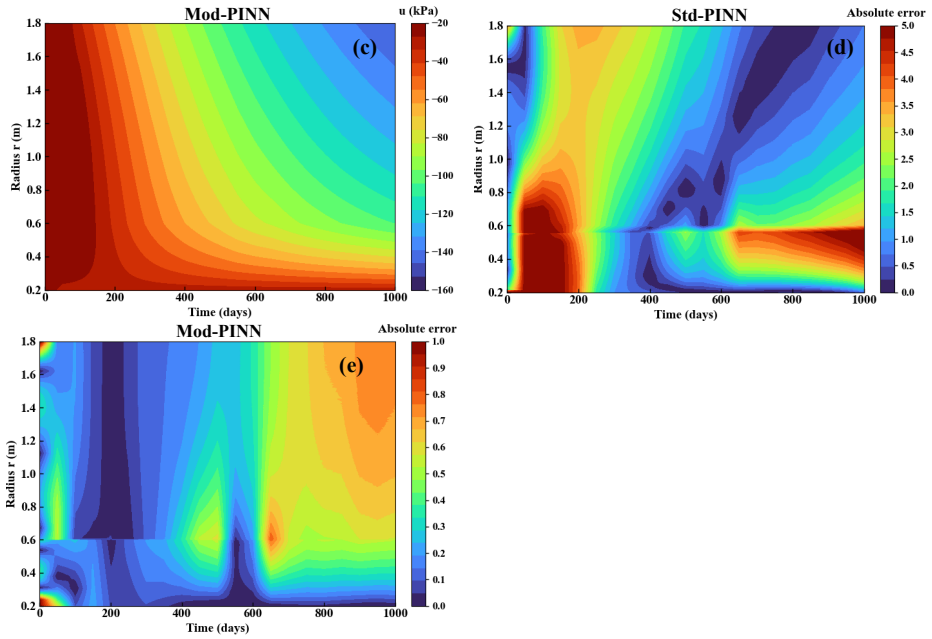
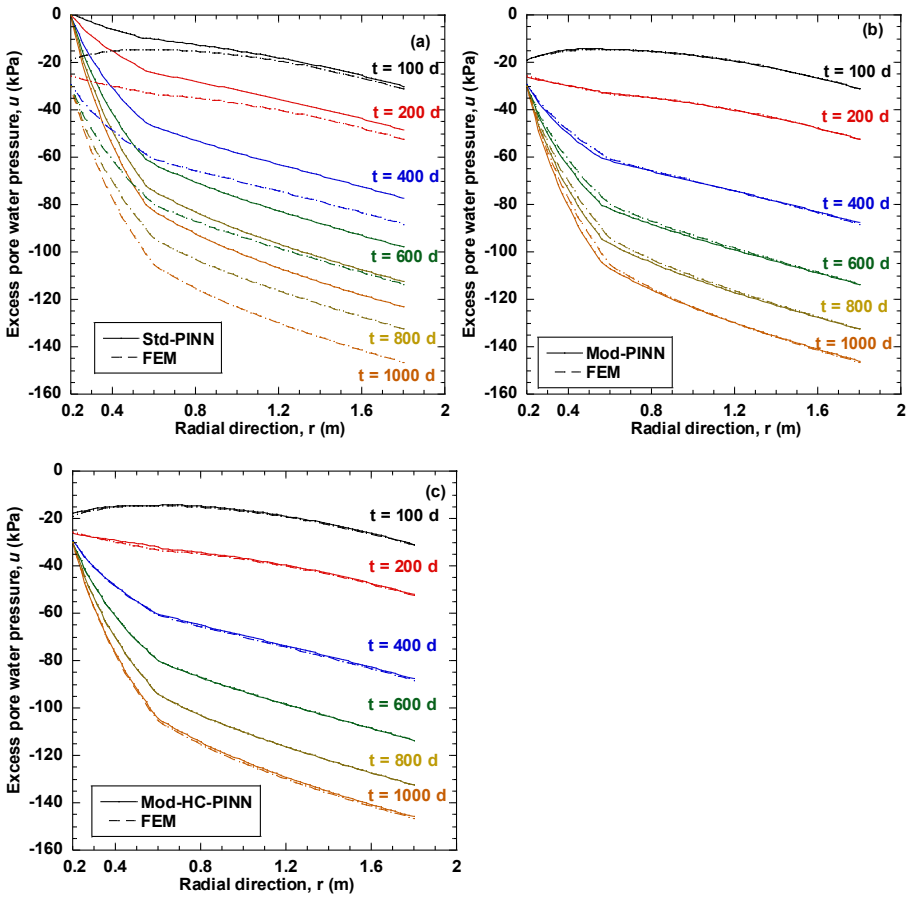
- The gated architecture resolves steep pressure gradients near the cathode and smear-zone interface under constant vacuum loading.
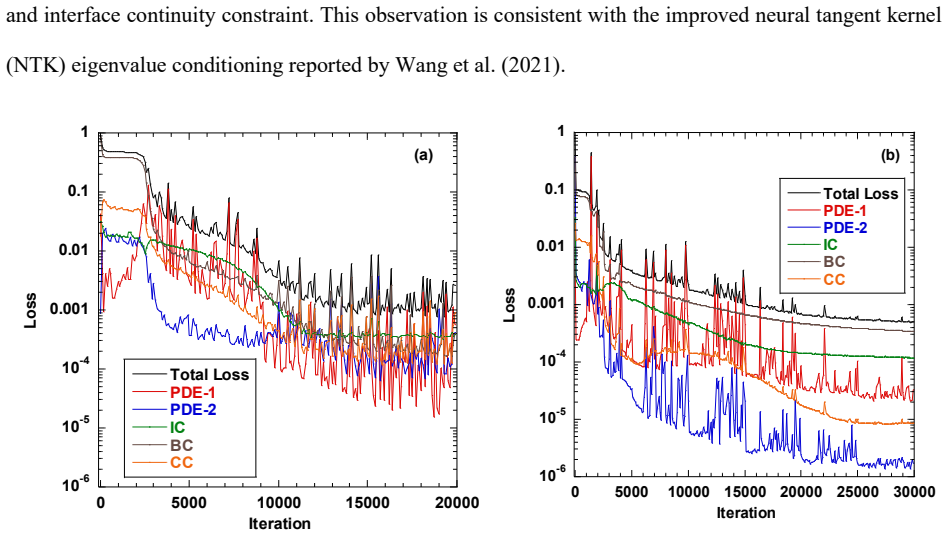
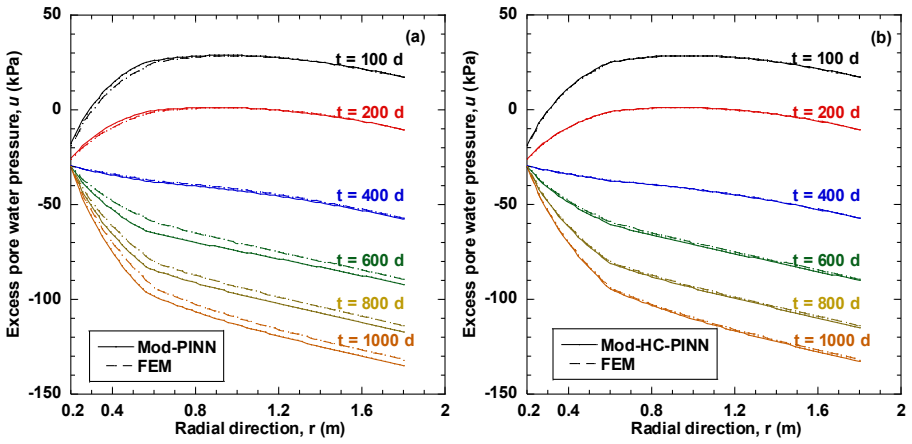
- Embedding boundary conditions reduces the simultaneous learning of multiple competing objectives under time-dependent vacuum and surcharge loads.
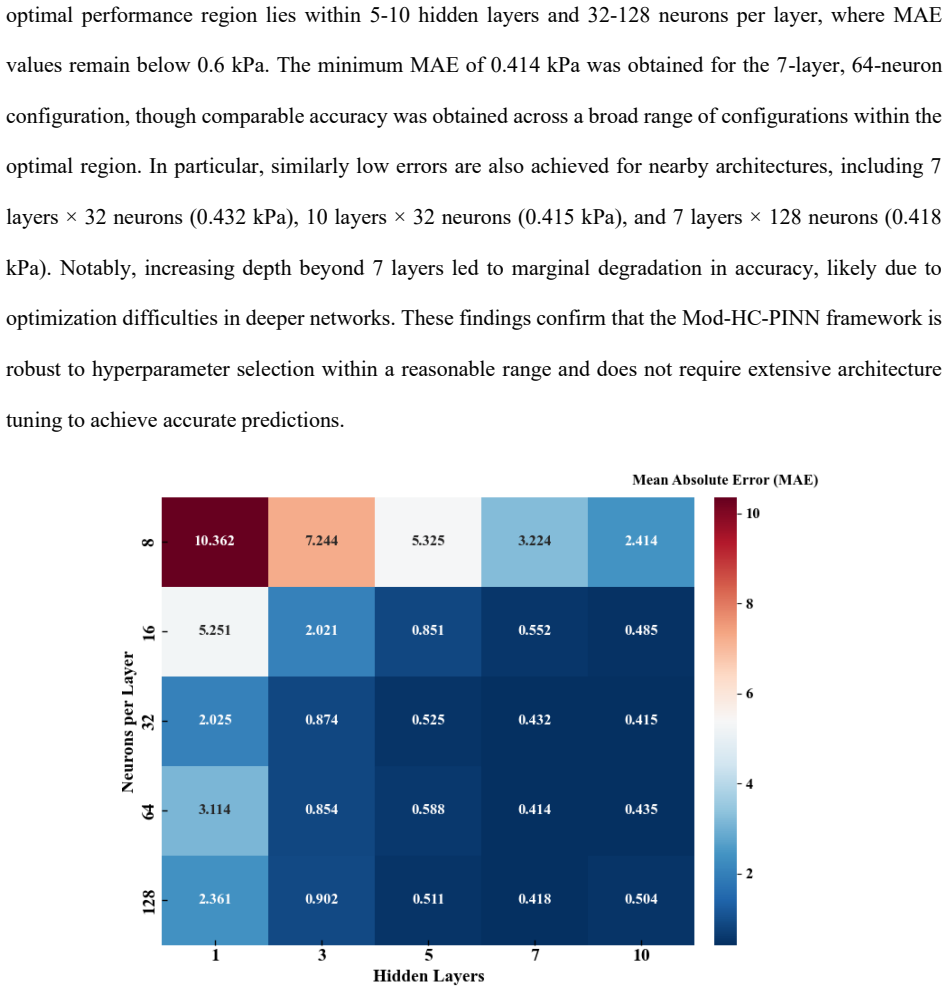
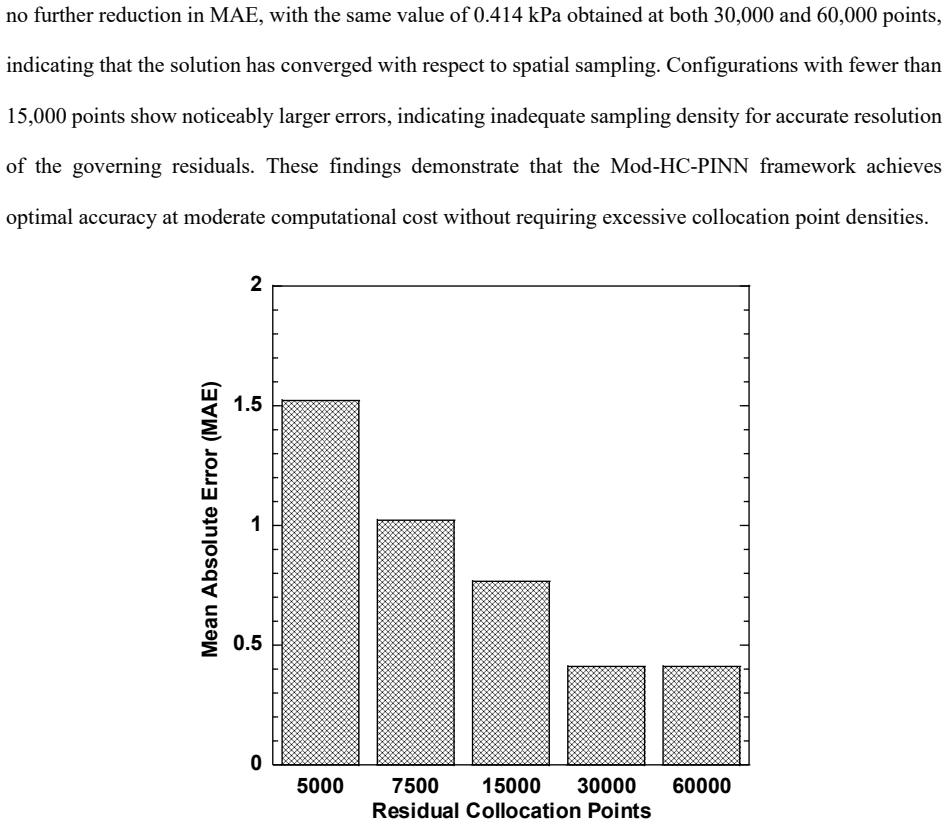
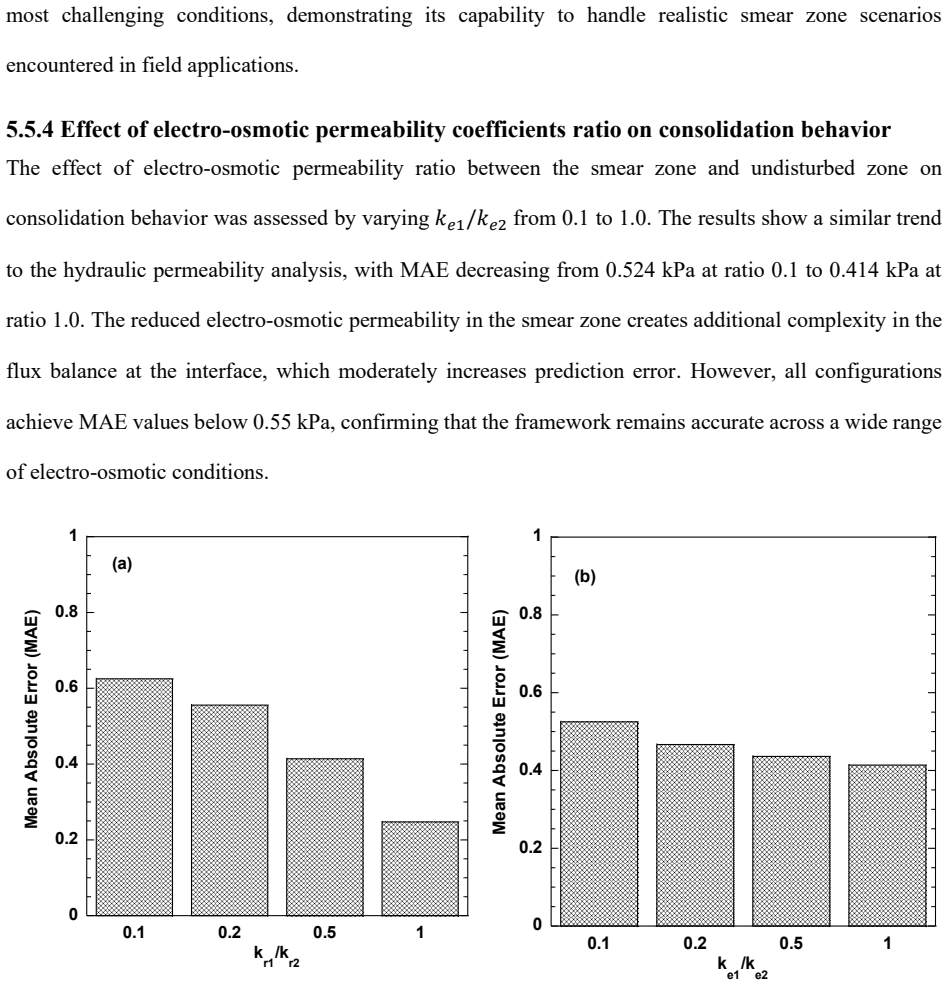
- The framework remains robust when network architecture, collocation density, and permeability contrast vary across practical engineering ranges.
- Mod-HC-PINN predictions match finite-element references for constant, exponential, ramp, and cyclic loading cases with the reported mean absolute errors.
Where Pith is reading between the lines
- The same hard-constraint approach could be adapted to model other coupled transport processes such as contaminant migration under electric fields.
- Coupling the trained network to real-time sensor data might enable online updating of consolidation forecasts without repeated full simulations.
- Testing the framework on three-dimensional geometries or anisotropic permeability fields would clarify how far the multi-domain structure generalizes.
Load-bearing premise
The finite element method reference solutions accurately represent the true physical consolidation behavior including smear effects and combined loadings.
What would settle it
Laboratory measurements of pore-pressure evolution during electro-osmotic consolidation with documented smear zones and cyclic surcharge would show whether the Mod-HC-PINN errors stay below 0.5 kPa.
Figures
read the original abstract
This study develops a dimensionless multi-domain physics-informed neural network (PINN) framework for electro-osmotic radial consolidation considering smear effects and combined vacuum and surcharge loading. Three PINN-based models are investigated: a standard soft-constrained PINN (Std-PINN), a modified gated PINN (Mod-PINN), and a modified gated PINN with hard-constraint boundary encoding (Mod-HC-PINN). The models are evaluated against FEM reference solutions under four loading cases, including constant vacuum, exponential vacuum, exponential vacuum with ramp surcharge, and exponential vacuum with cyclic haversine surcharge. The results indicate that the gated architecture applied in Mod-PINN improves the resolution of steep pressure gradients near the cathode and smear-zone interface under constant vacuum loading. Under time-dependent loading, the soft-constrained Mod-PINN shows reduced accuracy because it must learn multiple competing objectives simultaneously. The Mod-HC-PINN mitigates this issue by embedding the cathode boundary and initial conditions into the output structure, thereby reducing the optimization burden and improving physical consistency. The Mod-HC-PINN achieves MAE values of 0.43, 0.41, and 0.27 kPa for the exponential vacuum, ramp surcharge, and cyclic surcharge cases, respectively. Sensitivity analyses further demonstrate that the proposed framework remains robust across practical ranges of network architecture, collocation density, and permeability contrast.
Editorial analysis
A structured set of objections, weighed in public.
Referee Report
Summary. The paper develops a dimensionless multi-domain PINN framework (Std-PINN, Mod-PINN, Mod-HC-PINN) for electro-osmotic radial consolidation that incorporates smear-zone permeability reduction and combined time-dependent vacuum/surcharge loadings. The central claim is that the Mod-HC-PINN variant, which hard-encodes the cathode boundary and initial conditions, yields the lowest errors against FEM reference solutions, with reported MAE values of 0.43 kPa (exponential vacuum), 0.41 kPa (ramp surcharge), and 0.27 kPa (cyclic haversine surcharge), while sensitivity studies confirm robustness to network size, collocation density, and permeability contrast.
Significance. If the FEM reference solutions are shown to be accurate, the work would demonstrate a practical advantage of hard-constraint encoding for multi-objective time-dependent consolidation problems that exhibit steep gradients at the smear-zone interface. The explicit comparison of soft vs. hard constraint formulations and the sensitivity analyses constitute reproducible elements that strengthen the contribution to PINN applications in geotechnical modeling.
major comments (2)
- [Abstract / Results] Abstract and results section: The headline MAE values (0.43/0.41/0.27 kPa) are defined exclusively relative to FEM solutions; no analytical benchmark for any reduced case (constant vacuum, no surcharge, uniform permeability) or experimental comparison is supplied to anchor the absolute accuracy of either the FEM or the PINN, which is load-bearing for the claim that Mod-HC-PINN solves the physical problem.
- [Methodology] Methodology and training description: No information is provided on loss-term weighting coefficients, optimizer hyperparameters, or convergence criteria for the multi-objective optimization under time-dependent loadings; this omission prevents verification that the reported performance gains of Mod-HC-PINN arise from the hard-constraint architecture rather than from favorable hyperparameter choices.
minor comments (1)
- [Notation / §2] Notation for the dimensionless groups and the permeability reduction function inside the smear zone should be tabulated for clarity.
Simulated Author's Rebuttal
We thank the referee for the constructive comments and recommendation for major revision. We address each major comment point by point below, with honest indications of where revisions will be incorporated.
read point-by-point responses
-
Referee: [Abstract / Results] Abstract and results section: The headline MAE values (0.43/0.41/0.27 kPa) are defined exclusively relative to FEM solutions; no analytical benchmark for any reduced case (constant vacuum, no surcharge, uniform permeability) or experimental comparison is supplied to anchor the absolute accuracy of either the FEM or the PINN, which is load-bearing for the claim that Mod-HC-PINN solves the physical problem.
Authors: We agree that absolute accuracy anchoring strengthens the claims. For the complete problem with time-dependent loadings and smear effects, no analytical solutions are available in the literature. The FEM formulation follows established geotechnical models (extensions of radial consolidation theory with electro-osmosis). In revision we will add a validation subsection comparing the FEM to the analytical solution for the reduced case of constant vacuum with uniform permeability (no smear), confirming agreement to within typical tolerances reported in prior work. Experimental comparison is outside the scope of this numerical study, as no laboratory data were generated; the relative gains of Mod-HC-PINN versus the other variants are nevertheless demonstrated consistently against the same reference. revision: partial
-
Referee: [Methodology] Methodology and training description: No information is provided on loss-term weighting coefficients, optimizer hyperparameters, or convergence criteria for the multi-objective optimization under time-dependent loadings; this omission prevents verification that the reported performance gains of Mod-HC-PINN arise from the hard-constraint architecture rather than from favorable hyperparameter choices.
Authors: We accept this point and will correct the omission. The revised manuscript will add a dedicated subsection specifying the loss-term weights (PDE residual, boundary, and initial-condition terms), the optimizer (Adam with learning-rate schedule), additional hyperparameters (epochs, collocation batching), and convergence criteria (loss threshold or plateau detection). This documentation will allow readers to confirm that the Mod-HC-PINN improvements stem from the hard-constraint design. revision: yes
Circularity Check
No circularity: PINN outputs validated against independent FEM reference solutions
full rationale
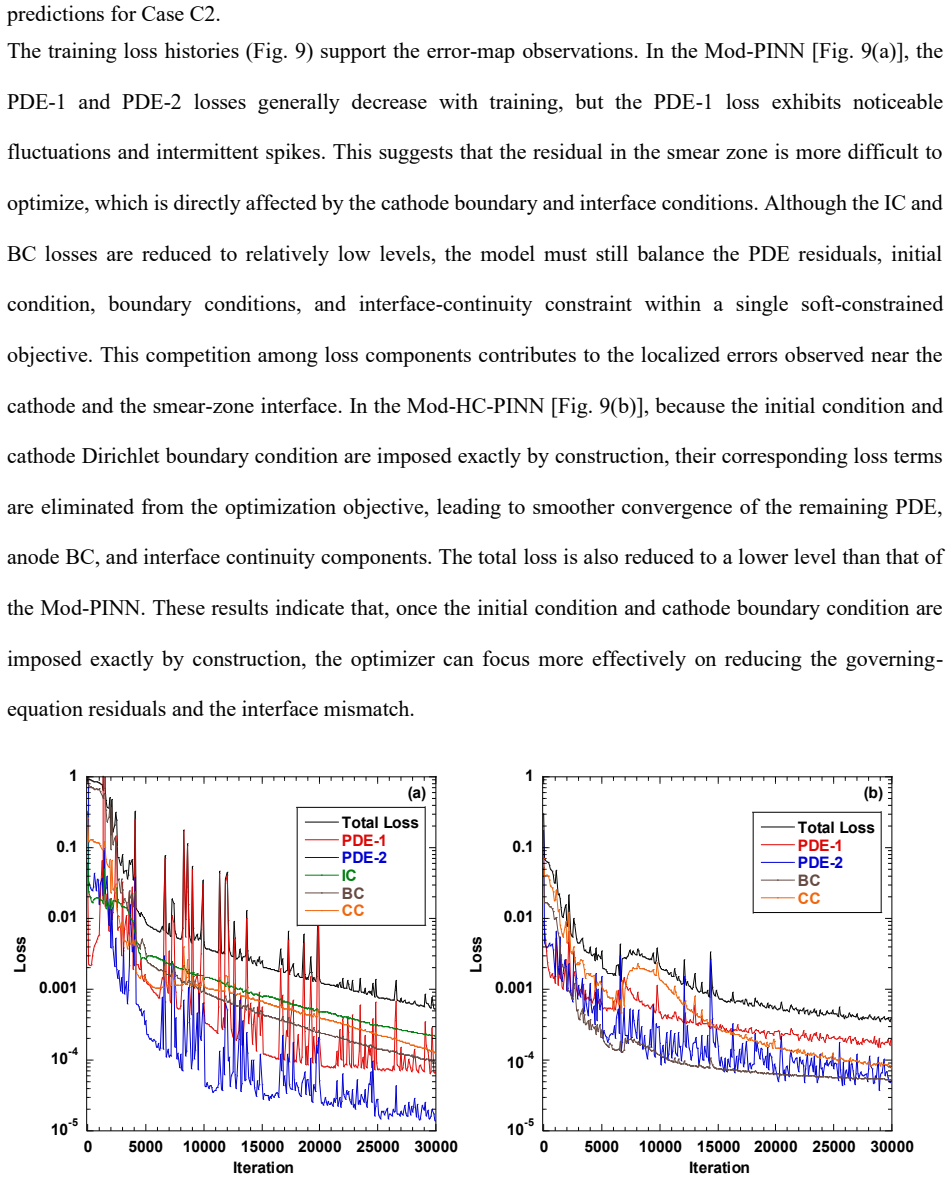
The paper trains three PINN variants to minimize PDE residuals for radial consolidation (including smear-zone permeability reduction and time-dependent loadings) and reports MAE against separately computed FEM solutions. No derivation step reduces a claimed prediction to a fitted parameter or self-citation by construction; the FEM benchmark is an external numerical method whose implementation details are independent of the PINN training. This matches the default case of a self-contained numerical method paper with external validation.
Axiom & Free-Parameter Ledger
axioms (1)
- domain assumption The governing partial differential equations for electro-osmotic radial consolidation with smear effects are known and can be directly embedded in the neural network loss.
Reference graph
Works this paper leans on
-
[1]
Nature Reviews Physics, 3(6), pp.422-440
Physics -informed machine learning. Nature Reviews Physics, 3(6), pp.422-440. Kinga, D. and Adam, J.B., 2015, May. A method for stochastic optimization. In International conference on learning representations (ICLR) (Vol. 5, No. 6). Kjellman, W.,
2015
-
[2]
arXiv preprint arXiv:2602.07031
Lagged backward-compatible physics-informed neural networks for unsaturated soil consolidation analysis. arXiv preprint arXiv:2602.07031. Liu, Y., Zheng, J.J., Zhao, X., Cao, W. and Huang, Z.,
-
[3]
In Dynamics of Earth's Fluid System (pp
An introduction to the finite element method. In Dynamics of Earth's Fluid System (pp. 199- 226). CRC Press. Rittirong, A. and Shang, J.Q., 2008, July. Numerical analysis for electro -osmotic consolidation in two - dimensional electric field. In ISOPE International Ocean and Polar Engineering Conference (pp. ISOPE- I). ISOPE. Su, J.Q. and Wang, Z.,
2008
-
[4]
An Expert’s Guide to Training Physics-informed Neural Networks,
An expert's guide to training physics-informed neural networks. arXiv preprint arXiv:2308.08468. Wang, S., Li, B., Chen, Y. and Perdikaris, P.,
-
[5]
Acta Geotechnica, 20(11), 5941-5969
PINN -based approach to the nonlinear large -strain consolidation under time-dependent drainage boundary. Acta Geotechnica, 20(11), 5941-5969. Zhang, P., Yin, Z.Y. and Sheil, B., 2024 a. A physics -informed data -driven approach for consolidation analysis. Géotechnique, 74(7), 620-631. Zhang, J., Zong, M., Wu, W., Zhang, Y. and Mei, G., 2024 b. Analytical...
2024
discussion (0)
Sign in with ORCID, Apple, or X to comment. Anyone can read and Pith papers without signing in.