A Methodological Framework for Explicit Control of the Speed-Accuracy Trade-off in Brain-Computer Interfaces
Pith reviewed 2026-06-29 15:26 UTC · model grok-4.3
The pith
A tunable alpha parameter in a Gain-Conservation framework gives explicit control over the speed-accuracy trade-off in BCIs without changing the classifier.
A machine-rendered reading of the paper's core claim, the machinery that carries it, and where it could break.
Core claim
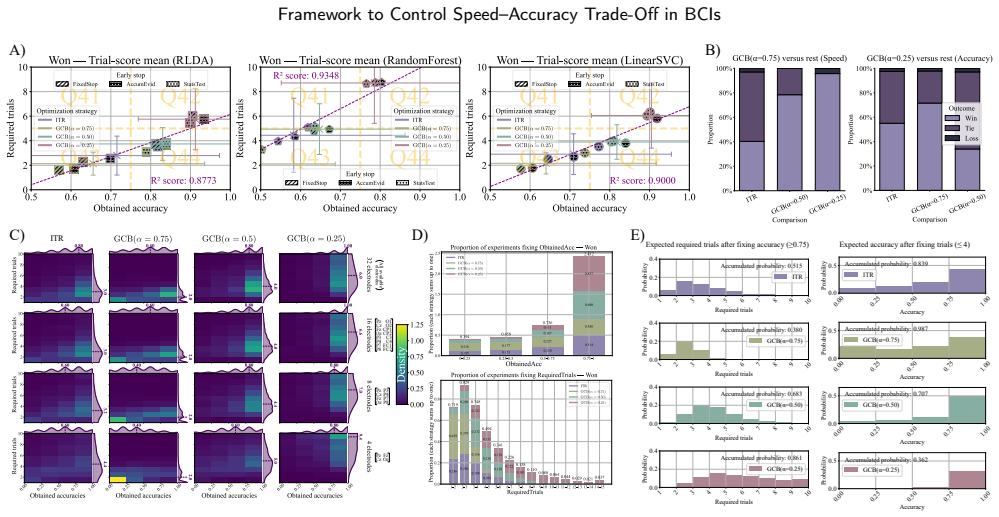
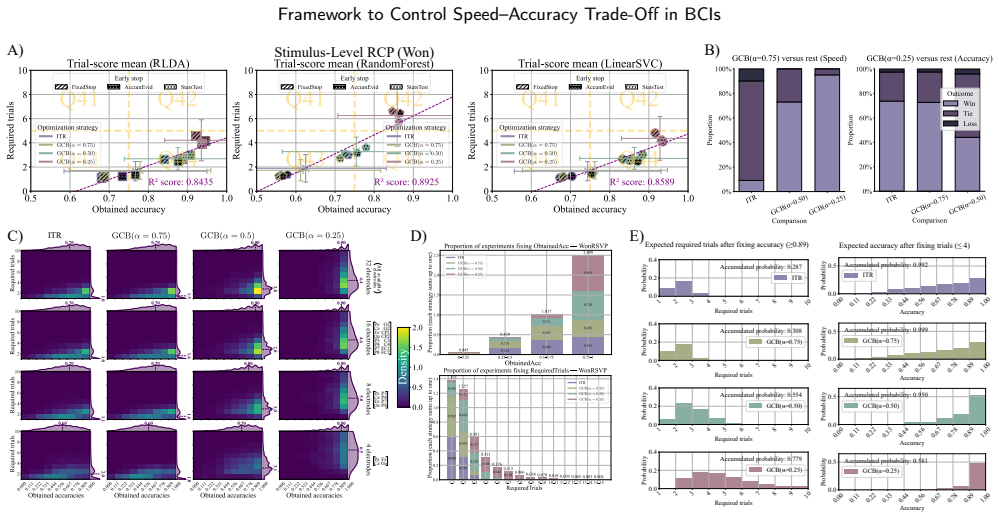
The central claim is that the Gain-Cons Balance, formed by combining Gain and Conservation and regulated by alpha, functions as a controllable design variable for the speed-accuracy trade-off. This balance adjusts BCI operation to application needs while remaining independent of the underlying classifier, paradigm, and early-stopping strategy, as demonstrated through validation on public P300 recordings with multiple classifiers and strategies.
What carries the argument
The Gain-Cons Balance, a tunable linear combination of relative speed improvement (Gain) and relative accuracy preservation (Conservation) controlled by the scalar parameter alpha.
If this is right
- Tuning alpha enables application-specific BCI optimization without retraining classifiers.
- Subject-level performance can be predicted from the framework measurements.
- The Information Transfer Rate's bias toward speed is explained by the separate Gain and Conservation components.
- BCI evaluation becomes more transparent across different setups.
- Distinct operating points in speed, accuracy, and bitrate are achievable by alpha adjustment.
Where Pith is reading between the lines
- The framework could support real-time alpha adaptation during BCI use to match changing task demands.
- It might extend to other BCI modalities like motor imagery or steady-state visual evoked potentials.
- Standardized reporting of alpha values could improve comparability across BCI studies.
- If the measures prove robust, they could replace or augment ITR in BCI benchmarks.
Load-bearing premise
The Gain and Conservation measures, and their alpha-controlled combination, remain independent of the classifier, paradigm, and early-stopping strategy while separating speed from accuracy without new biases.
What would settle it
Re-running the same alpha values on a new classifier or paradigm that produces speed-accuracy points inconsistent with the predicted Gain-Cons curve would falsify the independence claim.
Figures
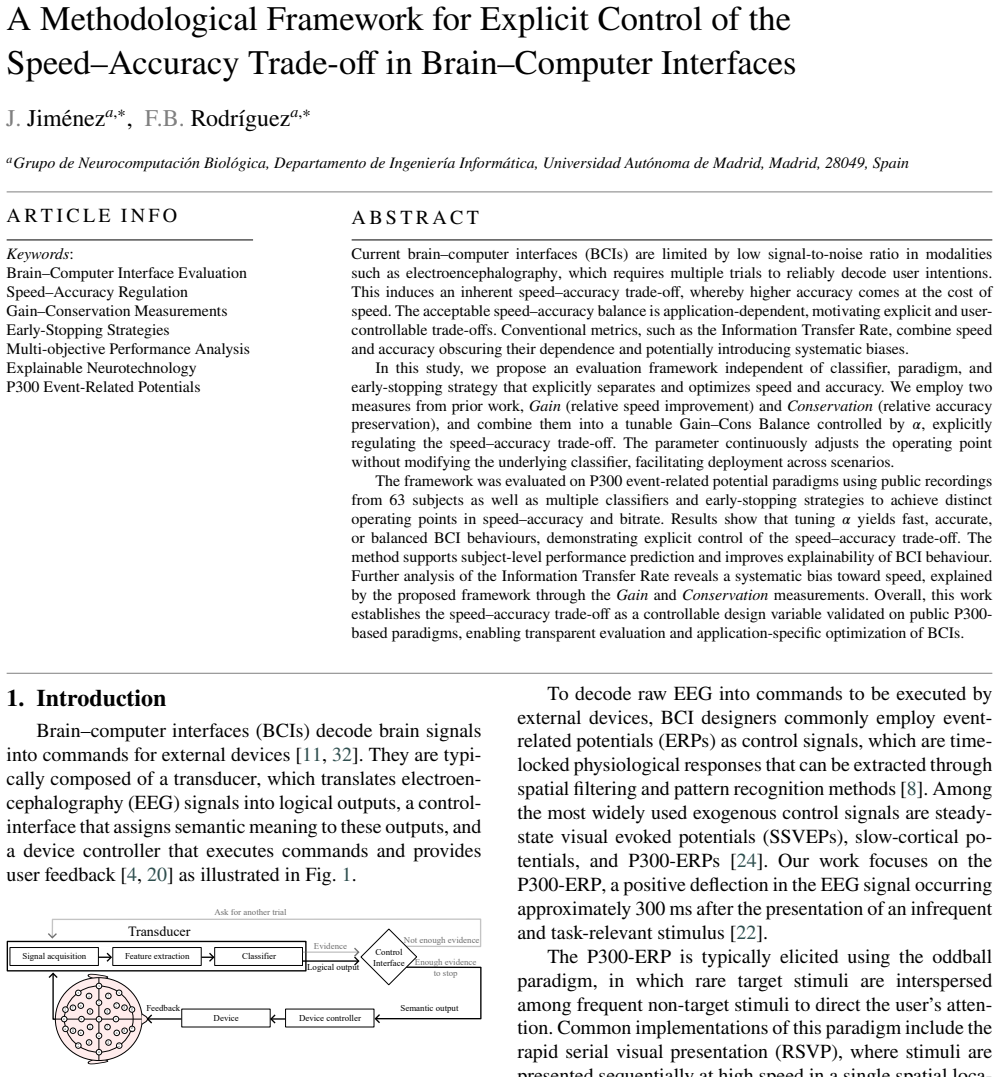
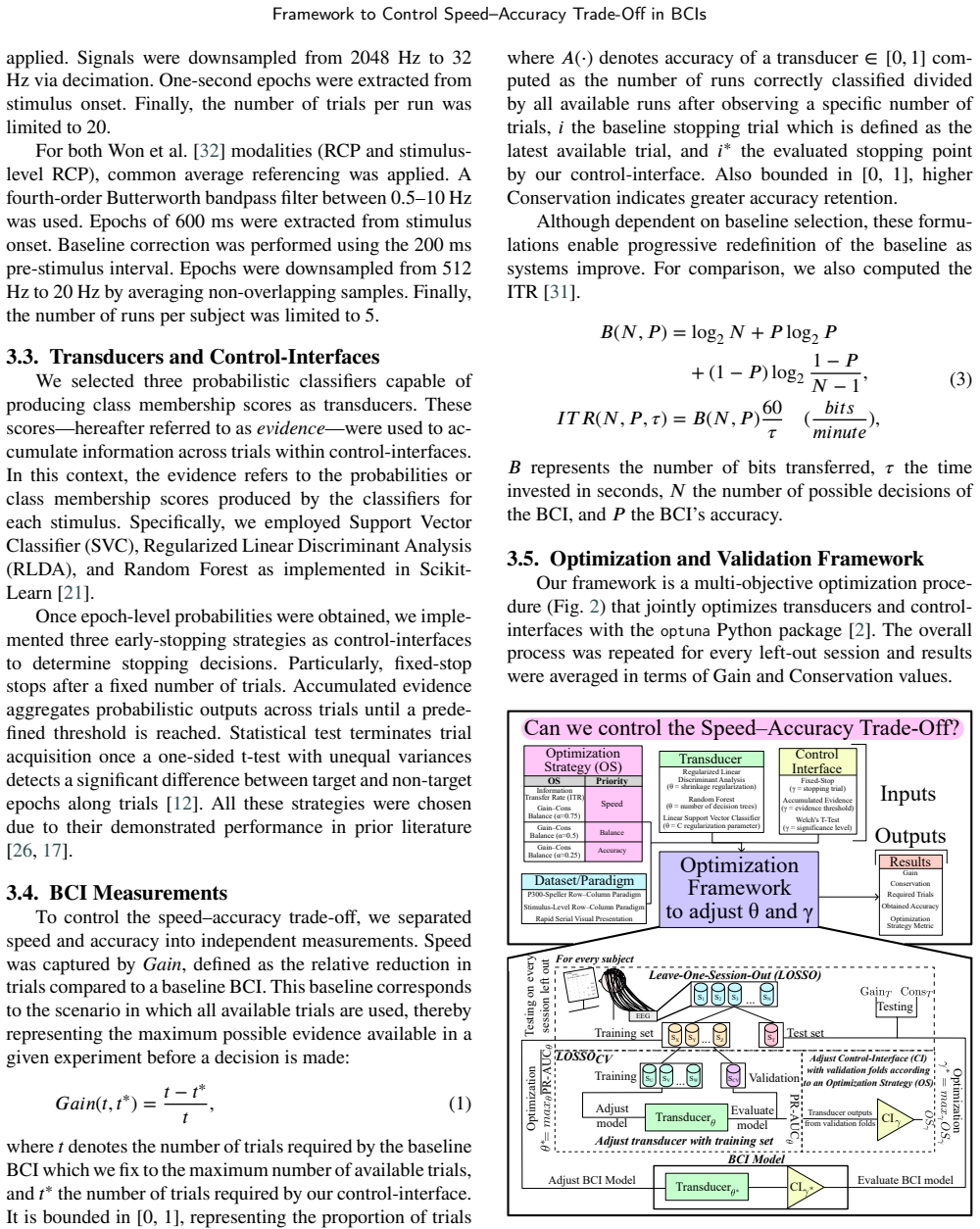
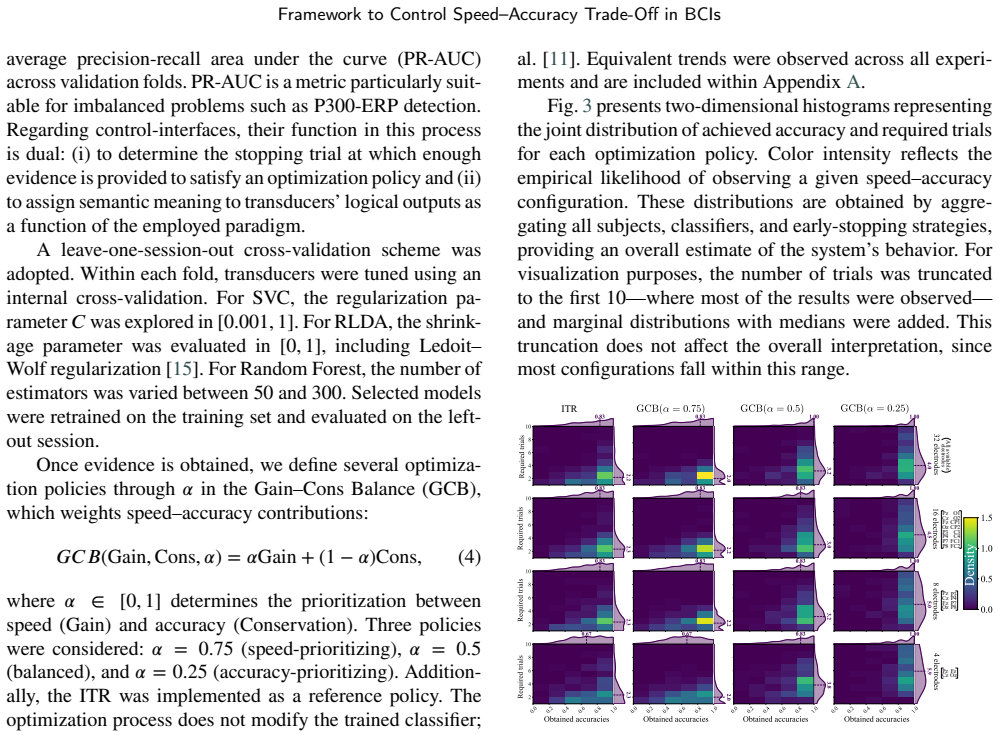
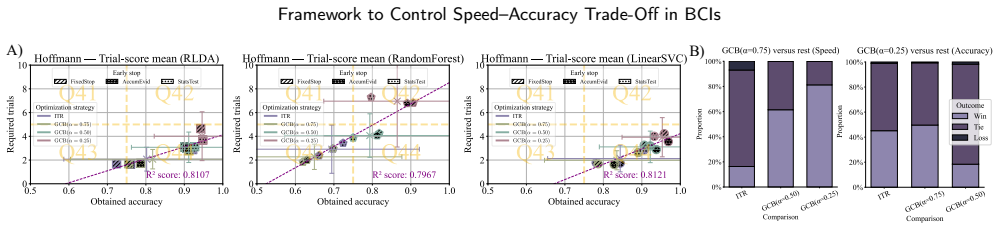
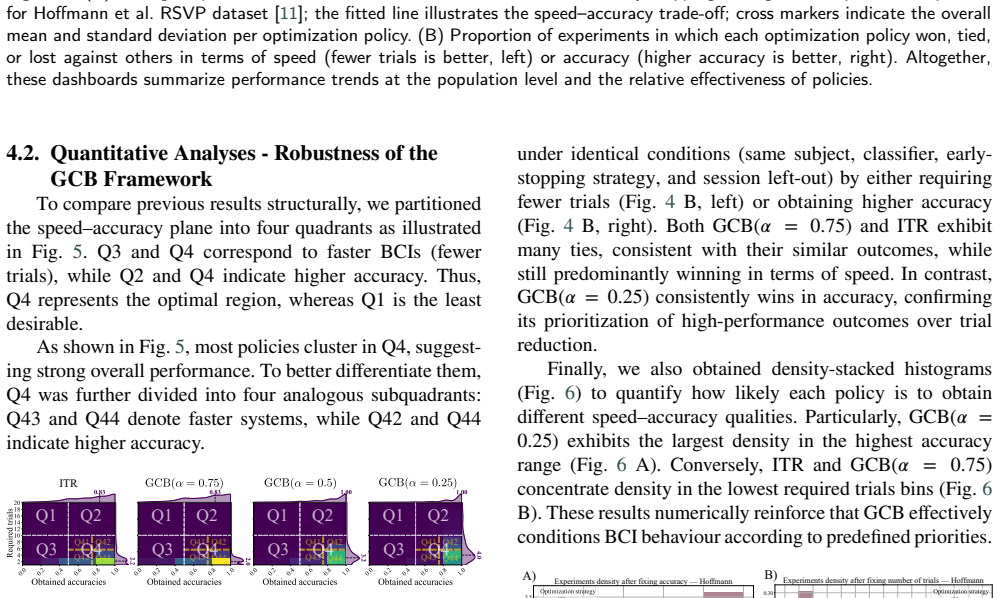
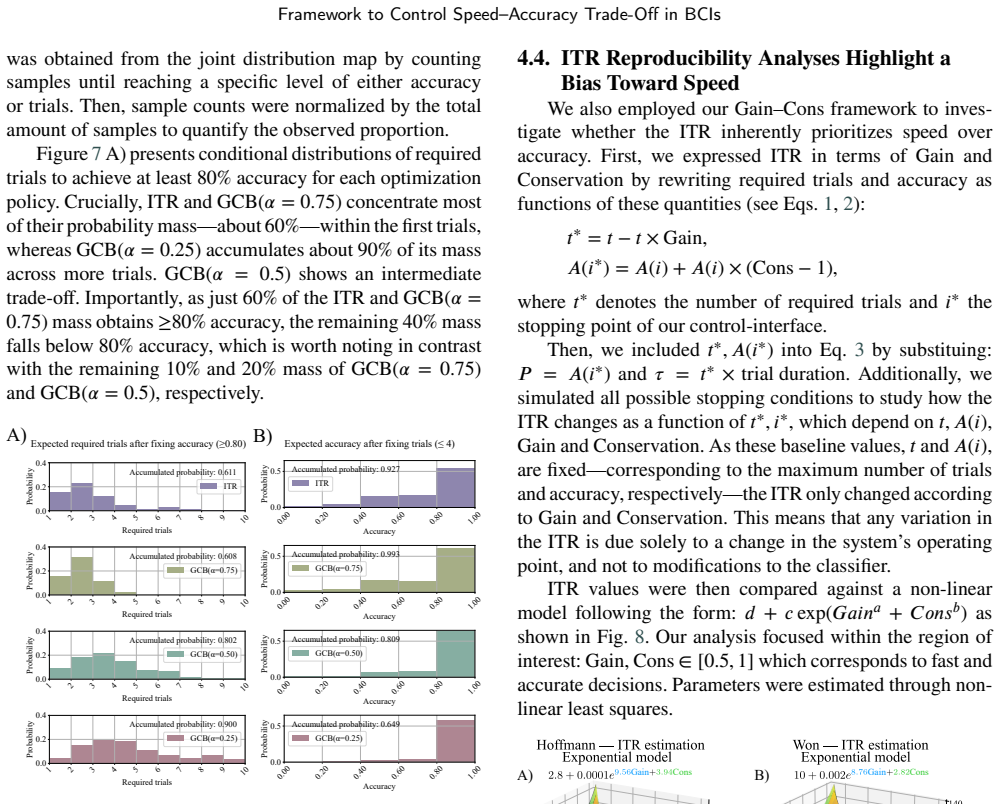
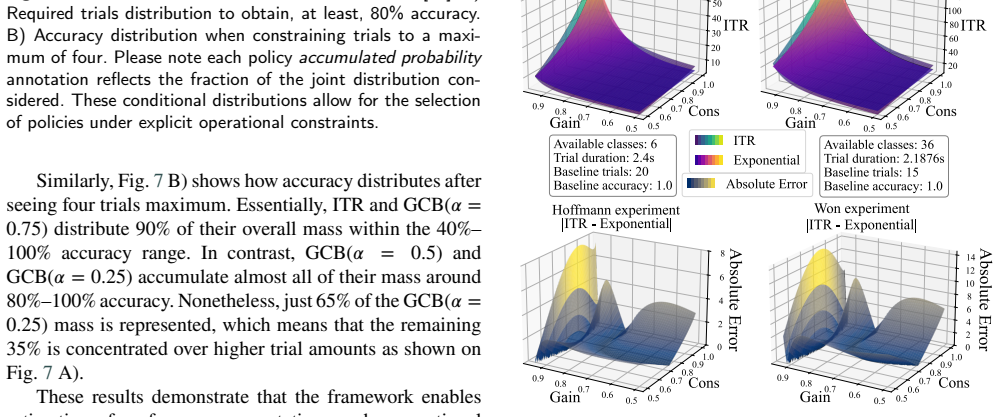
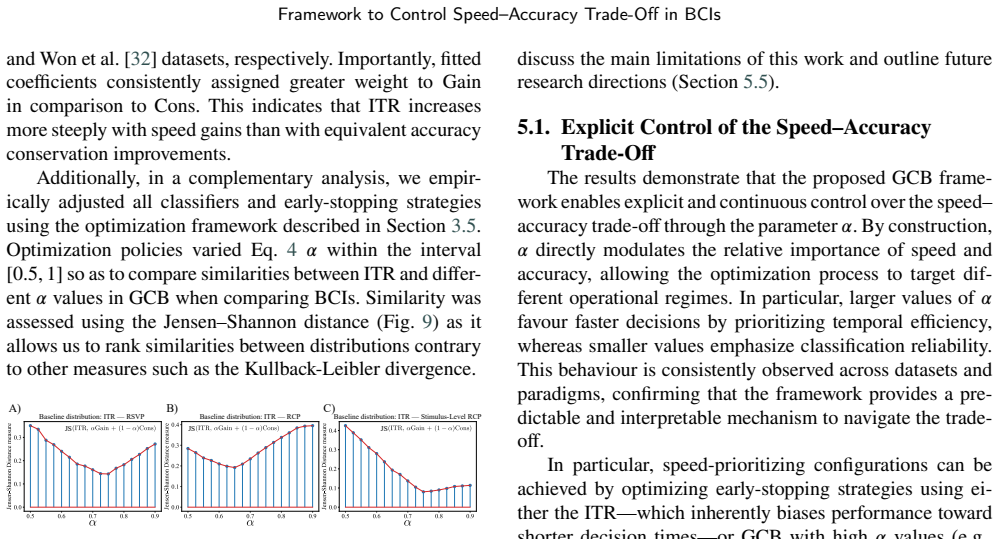
read the original abstract
Brain-computer interfaces (BCIs) are limited by low signal-to-noise ratio in modalities such as electroencephalography, which requires multiple trials to reliably decode user intentions. This induces a speed-accuracy trade-off, whereby higher accuracy comes at the cost of speed. The speed-accuracy balance is application-dependent, motivating controllable trade-offs. Conventional metrics, such as the Information Transfer Rate, combine speed and accuracy obscuring their dependence and potentially introducing biases. In this study, we propose an evaluation framework independent of classifier, paradigm, and early-stopping strategy that separates speed and accuracy. We employ two measures, Gain (relative speed improvement) and Conservation (relative accuracy preservation), and combine them into a tunable Gain-Cons Balance controlled by {\alpha}, regulating the speed-accuracy trade-off. The parameter adjusts the operating point without modifying the classifier, facilitating deployment across scenarios. The framework was evaluated on P300 event-related potential paradigms using public recordings from 63 subjects as well as multiple classifiers and early-stopping strategies to achieve distinct operating points in speed-accuracy and bitrate. Results show that tuning {\alpha} yields fast, accurate, or balanced BCI behaviours, demonstrating explicit control of the speed-accuracy trade-off. The method supports subject-level performance prediction and improves explainability of BCI behaviour. Further analysis of the Information Transfer Rate reveals a systematic bias toward speed, explained by the proposed framework through the Gain and Conservation measurements. Overall, this work establishes the speed-accuracy trade-off as a controllable design variable validated on public P300-based paradigms, enabling transparent evaluation and application-specific optimization of BCIs.
Editorial analysis
A structured set of objections, weighed in public.
Referee Report
Summary. The paper proposes a methodological framework for explicit control of the speed-accuracy trade-off in BCIs. It introduces Gain (relative speed improvement) and Conservation (relative accuracy preservation) measures, combined into a tunable Gain-Cons Balance via parameter α. The framework is claimed to be independent of classifier, paradigm, and early-stopping strategy. It is evaluated on P300 ERP data from 63 subjects using multiple classifiers and stopping strategies, showing that α tuning achieves distinct operating points, supports subject-level prediction, and explains ITR biases toward speed.
Significance. If the measures are robustly independent of paradigm and cleanly separate speed from accuracy without new biases, the framework would enable application-specific BCI optimization without classifier retraining and improve explainability over conventional metrics like ITR. The use of public recordings and multiple classifiers strengthens reproducibility.
major comments (1)
- [Abstract] Abstract: The manuscript asserts independence from paradigm, yet validation is confined to P300 ERP across all 63 subjects and all reported classifiers/stopping rules. This is load-bearing for the central claim, as Gain (relative speed improvement) and Conservation (relative accuracy preservation) may embed P300-specific trial-structure assumptions that do not generalize to asynchronous paradigms such as motor imagery or SSVEP.
Simulated Author's Rebuttal
We thank the referee for the detailed and constructive review. The major comment raises a valid point about the scope of empirical validation relative to the independence claim. We address it directly below and will revise the manuscript accordingly.
read point-by-point responses
-
Referee: [Abstract] Abstract: The manuscript asserts independence from paradigm, yet validation is confined to P300 ERP across all 63 subjects and all reported classifiers/stopping rules. This is load-bearing for the central claim, as Gain (relative speed improvement) and Conservation (relative accuracy preservation) may embed P300-specific trial-structure assumptions that do not generalize to asynchronous paradigms such as motor imagery or SSVEP.
Authors: We agree that the empirical validation is limited to P300 ERP data and that this is a substantive limitation for the paradigm-independence claim. The Gain and Conservation measures are defined generally (as relative speed improvement and accuracy preservation against a no-early-stopping baseline) without explicit dependence on synchronous trial structures; however, we cannot rule out that their numerical behavior may interact with paradigm-specific timing or decision boundaries. To address this, we will revise the manuscript to (1) qualify the independence claim as conceptual and methodological rather than fully empirically demonstrated across paradigms, (2) add a new subsection discussing potential limitations and required adaptations for asynchronous paradigms (motor imagery, SSVEP), and (3) outline a concrete plan for future multi-paradigm validation using public datasets. These changes will be reflected in the abstract, introduction, and discussion. revision: yes
Circularity Check
No circularity detected in derivation chain
full rationale
The provided manuscript text defines Gain as relative speed improvement and Conservation as relative accuracy preservation, then combines them via a tunable alpha-weighted balance to control the speed-accuracy trade-off. No equations, self-referential definitions, fitted inputs renamed as predictions, or load-bearing self-citations appear in the abstract or surrounding text that would reduce these measures or the alpha control to the paper's own inputs by construction. The framework is presented as independent of classifier, paradigm, and stopping strategy, with evaluation on public P300 data; the central claims rest on this separation without reducing to tautology or prior self-citation chains. The derivation is therefore self-contained against external benchmarks.
Axiom & Free-Parameter Ledger
free parameters (1)
- alpha
Reference graph
Works this paper leans on
-
[1]
A Bayesian dynamic stop- ping method for evoked response brain-computer interfacing
Ahmadi, S., Desain, P., Thielen, J., 2024. A Bayesian dynamic stop- ping method for evoked response brain-computer interfacing. Fron- tiers in Human Neuroscience 18. doi:10.3389/fnhum.2024.1437965
-
[2]
Akiba, T., Sano, S., Yanase, T., Ohta, T., Koyama, M., 2019. Op- tuna: A Next-generation Hyperparameter Optimization Framework, in: Proceedings of the 25th ACM SIGKDD International Conference onKnowledgeDiscovery&DataMining,AssociationforComputing Machinery, New York, NY, USA. pp. 2623–2631. doi:10.1145/ 3292500.3330701
-
[3]
Information transfer rate in BCIs: Towards tightly integrated symbiosis
Arslan, S.S., Sinha, P., 2024. Information transfer rate in BCIs: Towards tightly integrated symbiosis. Biomedical Signal Processing and Control 87, 105466. doi:10.1016/j.bspc.2023.105466
-
[4]
Performances Evaluation and Optimization of Brain ComputerInterfaceSystemsinaCopySpellingTask
Bianchi,L.,Quitadamo,L.R.,Garreffa,G.,Cardarilli,G.C.,Marciani, M.G., 2007. Performances Evaluation and Optimization of Brain ComputerInterfaceSystemsinaCopySpellingTask. IEEETransac- tionsonNeuralSystemsandRehabilitationEngineering15,207–216. doi:10.1109/TNSRE.2007.897024
-
[5]
Channel capacity in brain–computer interfaces
Bulhões da Silva Costa, T., Fernanda Suarez Uribe, L., Negreiros de Carvalho, S., Coutinho Soriano, D., Castellano, G., Suyama, R., Attux, R., Panazio, C., 2020. Channel capacity in brain–computer interfaces. Journal of Neural Engineering 17, 016060. doi:10.1088/ 1741-2552/ab6cb7. J. Jiménez et al.:Preprint submitted to ElsevierPage 12 of 13 Framework to ...
2020
-
[6]
A Coefficient of Agreement for Nominal Scales
Cohen, J., 1960. A Coefficient of Agreement for Nominal Scales. EducationalandPsychologicalMeasurement20,37–46. doi:10.1177/ 001316446002000104
1960
-
[7]
IEEE Transactions on Neural Systems and Rehabilitation Engineering 18, 20–28
DalSeno,B.,Matteucci,M.,Mainardi,L.T.,2010.TheUtilityMetric: A Novel Method to Assess the Overall Performance of Discrete Brain–Computer Interfaces. IEEE Transactions on Neural Systems and Rehabilitation Engineering 18, 20–28. doi:10.1109/TNSRE.2009. 2032642
-
[8]
Edelman, B.J., Zhang, S., Schalk, G., Brunner, P., Müller-Putz, G., Guan, C., He, B., 2025. Non-Invasive Brain-Computer Interfaces: StateoftheArtandTrends.IEEEReviewsinBiomedicalEngineering 18, 26–49. doi:10.1109/RBME.2024.3449790
-
[9]
Improve P300-speller performance by online tuning stimulus onset asynchrony (SOA)
Gao, P., Huang, Y., He, F., Qi, H., 2021. Improve P300-speller performance by online tuning stimulus onset asynchrony (SOA). Journal of Neural Engineering 18. doi:10.1088/1741-2552/ac2f04
-
[10]
Enhancing SSVEP-BCI Performance Under Fatigue State Using Dynamic Stop- ping Strategy
Han, Y., Ke, Y., Wang, R., Wang, T., Ming, D., 2024. Enhancing SSVEP-BCI Performance Under Fatigue State Using Dynamic Stop- ping Strategy. IEEE Transactions on Neural Systems and Rehabilita- tion Engineering 32, 1407–1415. doi:10.1109/TNSRE.2024.3380635
-
[11]
A Dynamic Recursive Unified Internet Design (DRUID),
Hoffmann, U., Vesin, J.M., Ebrahimi, T., Diserens, K., 2008. An efficient P300-based brain–computer interface for disabled subjects. Journal of Neuroscience Methods 167, 115–125. doi:10.1016/j. jneumeth.2007.03.005
work page doi:10.1016/j 2008
-
[12]
Höhne, J., Schreuder, M., Blankertz, B., Tangermann, M., 2010. Two-dimensional auditory p300 speller with predictive text system, in: 2010 Annual International Conference of the IEEE Engineering in Medicine and Biology, pp. 4185–4188. doi:10.1109/IEMBS.2010. 5627379
-
[13]
Jiménez, J., Rodríguez, F.B., In press. A Novel Approach to Char- acterizing and Analyzing the Speed-Accuracy Trade-off in Online P300-Based Brain-Computer Interfaces, in: Brain Informatics 2025, LectureNotesinComputerScience. doi:10.1007/978-981-95-9578-5_ 12
-
[14]
Kalaganis, F.P., Chatzilari, E.P., Laskaris, N.A., Nikolopoulos, S.A., Kompatsiaris, I.A., 2024. Error-aware BCIs. Signal Processing to Drive Human-Computer Interaction: EEG and eye-controlled inter- faces , 231–259doi:10.1049/PBCE129E_ch11
-
[15]
A well-conditioned estimator for large- dimensional covariance matrices
Ledoit, O., Wolf, M., 2004. A well-conditioned estimator for large- dimensional covariance matrices. Journal of Multivariate Analysis 88, 365–411. doi:10.1016/S0047-259X(03)00096-4
-
[16]
A review of rapid serial visual presentation- based brain–computer interfaces
Lees, S., Dayan, N., Cecotti, H., McCullagh, P., Maguire, L., Lotte, F., Coyle, D., 2018. A review of rapid serial visual presentation- based brain–computer interfaces. Journal of Neural Engineering 15, 021001. doi:10.1088/1741-2552/aa9817
-
[17]
A review of classification algorithms for EEG-based brain–computer interfaces: A 10 year update
Lotte, F., Bougrain, L., Cichocki, A., Clerc, M., Congedo, M., Rako- tomamonjy, A., Yger, F., 2018. A review of classification algorithms for EEG-based brain–computer interfaces: A 10 year update. Journal of Neural Engineering 15, 031005. doi:10.1088/1741-2552/aab2f2
-
[18]
Chapter 8
Luck, S.J., 2014. Chapter 8. Baseline Correction, Averaging, and Time–Frequency Analysis, in: An Introduction to the Event-Related Potential Technique. 2 ed.. MIT Press, Cambridge, MA, USA, pp. 258–260
2014
-
[19]
BCI-Utility Metric for Asynchronous P300 Brain-Computer Interface Systems
Ma, G., Kang, J., Thompson, D.E., Huggins, J.E., 2023. BCI-Utility Metric for Asynchronous P300 Brain-Computer Interface Systems. IEEETransactionsonNeuralSystemsandRehabilitationEngineering 31, 3968–3977. doi:10.1109/TNSRE.2023.3322125
-
[20]
A general framework for brain-computer interfacedesign
Mason, S., Birch, G., 2003. A general framework for brain-computer interfacedesign. IEEETransactionsonNeuralSystemsandRehabil- itation Engineering 11, 70–85. doi:10.1109/TNSRE.2003.810426
-
[21]
Scikit-learn: Machine learning in Python
Pedregosa, F., Varoquaux, G., Gramfort, A., Michel, V., Thirion, B., Grisel, O., Blondel, M., Prettenhofer, P., Weiss, R., Dubourg, V., Vanderplas, J., Passos, A., Cournapeau, D., Brucher, M., Perrot, M., Duchesnay, E., 2011. Scikit-learn: Machine learning in Python. Journal of Machine Learning Research 12, 2825–2830
2011
-
[22]
Clinical Neurophysiology 118, 2128–2148
Polich,J.,2007.UpdatingP300:AnintegrativetheoryofP3aandP3b. Clinical Neurophysiology 118, 2128–2148. doi:10.1016/j.clinph. 2007.04.019
-
[23]
Quitadamo,L.R.,Abbafati,M.,Cardarilli,G.C.,Mattia,D.,Cincotti, F., Babiloni, F., Marciani, M.G., Bianchi, L., 2012. Evaluation of the performances of different P300 based brain–computer interfaces by means of the efficiency metric. Journal of Neuroscience Methods 203, 361–368. doi:10.1016/j.jneumeth.2011.10.010
-
[24]
Brain computer interface: Control signals review
Ramadan, R.A., Vasilakos, A.V., 2017. Brain computer interface: Control signals review. Neurocomputing 223, 26–44. doi:10.1016/ j.neucom.2016.10.024
2017
-
[25]
(Eds.), 2020
Ramsey, N.F., Millán, J. (Eds.), 2020. Brain-Computer Interfaces. volume 168 ofHandbook of Clinical Neurology. 1 ed., Elsevier, San Diego
2020
-
[26]
Optimizing event-related potential based brain-computer interfaces: A systematic evaluation of dynamic stop- ping methods
Schreuder, M., Höhne, J., Blankertz, B., Haufe, S., Dickhaus, T., Tangermann, M., 2013. Optimizing event-related potential based brain-computer interfaces: A systematic evaluation of dynamic stop- ping methods. Journal of Neural Engineering 10, 036025. doi:10. 1088/1741-2560/10/3/036025
2013
-
[27]
Shi, N., Miao, Y., Huang, C., Li, X., Song, Y., Chen, X., Wang, Y., Gao,X.,2024.Estimatingandapproachingthemaximuminformation rateofnoninvasivevisualbrain-computerinterface. NeuroImage289, 120548. doi:10.1016/j.neuroimage.2024.120548
-
[28]
Soetedjo,J.,Arnold,C.,Pouratian,N.,Speier,W.,Keluo-Udeke,O.S.,
-
[29]
Maintaining High Accuracy General P300 Speller Using the Language Modeling and Dynamic Stopping, in: 2020 IEEE 20th In- ternationalConferenceonBioinformaticsandBioengineering(BIBE 2020), IEEE, New York. pp. 365–368. doi:10.1109/BIBE50027.2020. 00066
-
[30]
Wang, J., Cui, Y., Zhang, H., Wu, H., Yang, C., 2024a. An Asyn- chronous Training-Free SSVEP-BCI Detection Algorithm for Non- Equal Prior Probability Scenarios. IEEE Transactions on Neural SystemsandRehabilitationEngineering32,4120–4130. doi:10.1109/ TNSRE.2024.3496727
-
[31]
Average TimeConsumptionperCharacter:APracticalPerformanceMetricfor Generic Synchronous BCI Spellers
Wang, Z., Hu, H., Zhou, T., Xu, T., Zhao, X., 2024b. Average TimeConsumptionperCharacter:APracticalPerformanceMetricfor Generic Synchronous BCI Spellers. IEEE Transactions on Biomedi- cal Engineering 71, 2684–2698. doi:10.1109/TBME.2024.3387469
-
[32]
Brain–computerinterfaces for communication and control
Wolpaw, J.R., Birbaumer, N., McFarland, D.J., Pfurtscheller, G., Vaughan, T.M.,2002. Brain–computerinterfaces for communication and control. Clinical Neurophysiology 113, 767–791. doi:10.1016/ S1388-2457(02)00057-3
2002
-
[33]
EEGDatasetforRSVP and P300 Speller Brain-Computer Interfaces
Won,K.,Kwon,M.,Ahn,M.,Jun,S.C.,2022. EEGDatasetforRSVP and P300 Speller Brain-Computer Interfaces. Scientific Data 9, 388. doi:10.1038/s41597-022-01509-w
-
[34]
Electroencephalogram based brain- computerinterface:Applications,challenges,andopportunities.Mul- timedia Tools and Applications 82, 47003–47047
Yadav, H., Maini, S., 2023. Electroencephalogram based brain- computerinterface:Applications,challenges,andopportunities.Mul- timedia Tools and Applications 82, 47003–47047. doi:10.1007/ s11042-023-15653-x
2023
-
[35]
Yuan, P., Gao, X., Allison, B., Wang, Y., Bin, G., Gao, S., 2013. A study of the existing problems of estimating the information transfer rate in online brain-computer interfaces. Journal of Neural Engineer- ing 10, 026014. doi:10.1088/1741-2560/10/2/026014. J. Jiménez et al.:Preprint submitted to ElsevierPage 13 of 13
discussion (0)
Sign in with ORCID, Apple, or X to comment. Anyone can read and Pith papers without signing in.