Astronomical Advantages of a Boost Mission to Facilitate HST Science into the 2030s: Imaging the Circumgalactic Medium of Galaxies
Pith reviewed 2026-06-28 21:13 UTC · model grok-4.3
The pith
An orbital boost for the Hubble Space Telescope would enable the first statistical maps of warm-hot gas around galaxies through ultraviolet emission-line imaging.
A machine-rendered reading of the paper's core claim, the machinery that carries it, and where it could break.
Core claim
If the Hubble Space Telescope receives an orbital boost, it can provide the first statistical constraints on the spatial distribution of warm-hot circumgalactic medium and important avenues for science case development as well as target and pointing selection for HWO's upcoming spectroscopic facilities by mapping emission lines with ionization potentials between 13 and 200 electron-volts.
What carries the argument
HST's high-resolution ultraviolet imaging of diffuse emission lines from highly ionized metals and neutral hydrogen in the circumgalactic medium.
If this is right
- First statistical constraints on the spatial distribution of warm-hot circumgalactic medium become available.
- Deep high-resolution mapping of feedback and galaxy-environment exchange becomes possible with no other current facility.
- Science cases and target selection for HWO spectroscopic observations can be developed and tested in advance.
- Basic morphologies of the dominant mass component around galaxies can be measured directly.
- Physics of energetic exchange between galaxies and their surrounding gas can be constrained through spatial mapping.
Where Pith is reading between the lines
- A successful boost would create a continuous observational bridge between current ultraviolet capabilities and those planned for HWO.
- Failure to boost HST would leave a multi-year gap in high-resolution ultraviolet imaging of galaxy halos.
- Statistical CGM maps could reveal whether the gas distributions follow simple geometric patterns or require complex feedback models.
- The same dataset would supply empirical priors that future spectroscopic missions can use to optimize exposure times and field selections.
Load-bearing premise
HST's ultraviolet capabilities for high-resolution emission-line imaging of the circumgalactic medium will remain unmatched until HWO launches and an orbital boost is technically and financially possible.
What would settle it
Detection that another existing or planned telescope can perform comparable deep, high-resolution ultraviolet emission-line imaging of the circumgalactic medium before HWO, or a demonstration that an orbital boost for HST cannot be executed.
Figures
read the original abstract
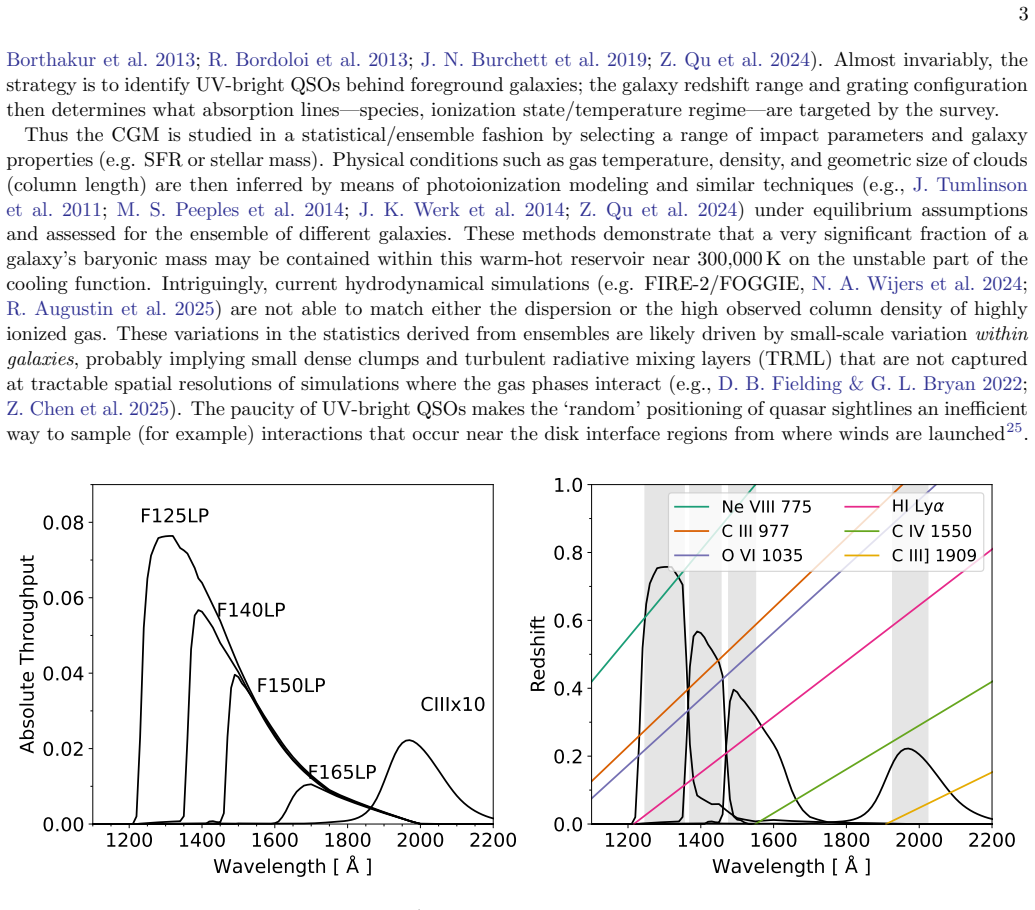
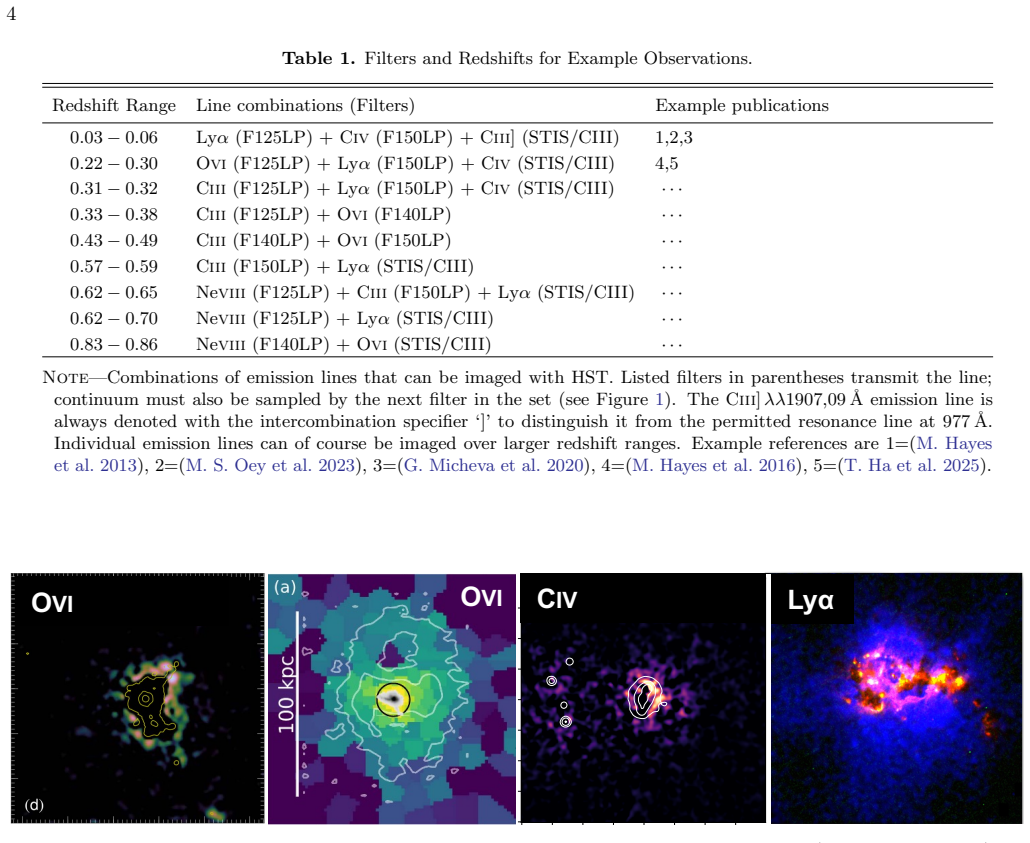
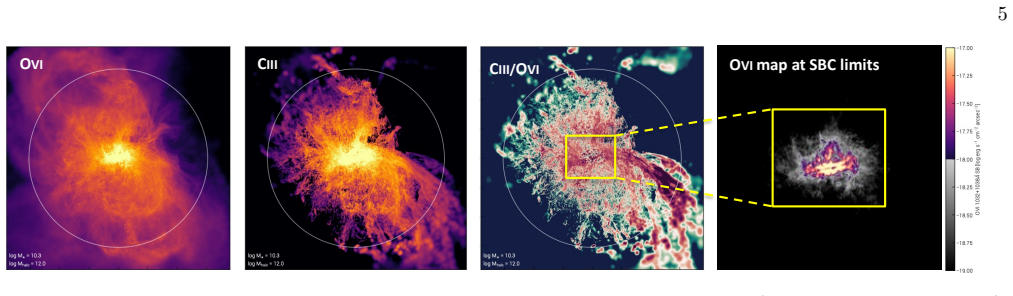
We present the case for imaging ultraviolet line emission from highly ionized metals and HI Lya in the circumgalactic medium of galaxies, should the Hubble Space Telescope receive an orbital boost. Hubble can uniquely probe emission lines with ionization potentials between 13 and 200 electron-volts (Lya, CIV, OVI, NeVIII, etc). Spatial mapping of the diffuse material traced by these transitions is critical to constraining the physics of feedback and the energetic exchange between galaxies and their circumgalactic environments, as well as basic morphologies of the dominant mass component. Deep high-resolution mapping of these features will not be possible with any other observatory, existing or planned, until HWO is launched, which leaves HST as a critical observatory to test key science drivers for HWO. If HST receives an orbital boost, it can (a) provide the first statistical constraints on the spatial distribution of warm-hot CGM and (b) provide important avenues for science case development, as well as target/pointing selection, for HWO's upcoming spectroscopic facilities.
Editorial analysis
A structured set of objections, weighed in public.
Referee Report
Summary. The manuscript presents a science case for an orbital boost to the Hubble Space Telescope (HST) to extend its lifetime into the 2030s. It argues that HST's UV capabilities allow unique high-resolution imaging of emission lines (Lyα, CIV, OVI, NeVIII, etc.) from the circumgalactic medium (CGM) of galaxies, which would deliver the first statistical constraints on the spatial distribution of warm-hot CGM gas and help develop science cases and target selection for the future Habitable Worlds Observatory (HWO).
Significance. If the premises hold, the work identifies a timely opportunity to bridge current UV instrumentation with next-generation facilities by extending HST for CGM emission-line mapping. This could advance understanding of galaxy feedback and circumgalactic physics while providing concrete input for HWO planning. The proposal is grounded in established HST strengths and explicitly frames the boost as enabling pathfinder observations.
major comments (2)
- Abstract: The central claim that 'Deep high-resolution mapping of these features will not be possible with any other observatory, existing or planned, until HWO is launched' is load-bearing for the uniqueness argument and the assertion of 'first statistical constraints,' yet the manuscript provides no quantitative comparison of sensitivity, resolution, or wavelength coverage against JWST, ground-based facilities, or other planned UV missions to support this statement.
- Main text (science case section): No estimates of required exposure times, surface-brightness limits, or sample sizes are given to demonstrate that a boosted HST could actually deliver statistical constraints on CGM spatial distributions; this quantitative gap directly affects the feasibility of the proposed 'first statistical constraints.'
minor comments (1)
- The manuscript would benefit from a short table or paragraph explicitly listing the ionization potentials and rest wavelengths of the key lines (Lyα, CIV, OVI, NeVIII) to improve clarity for readers outside the immediate subfield.
Simulated Author's Rebuttal
We thank the referee for their constructive review, which identifies key areas where the manuscript can be strengthened with additional quantitative support. We address each major comment below and have made revisions to incorporate the requested comparisons and estimates.
read point-by-point responses
-
Referee: Abstract: The central claim that 'Deep high-resolution mapping of these features will not be possible with any other observatory, existing or planned, until HWO is launched' is load-bearing for the uniqueness argument and the assertion of 'first statistical constraints,' yet the manuscript provides no quantitative comparison of sensitivity, resolution, or wavelength coverage against JWST, ground-based facilities, or other planned UV missions to support this statement.
Authors: We agree that the uniqueness claim benefits from explicit quantitative support. In the revised manuscript we have added a new subsection (Section 3.3) containing a side-by-side comparison table of HST (post-boost) versus JWST/NIRSpec, MUSE, KCWI, and the planned UVEX mission. The table reports effective area, spectral resolution, spatial resolution, and wavelength coverage for the key transitions (Lyα, C IV, O VI, Ne VIII). We have also revised the abstract sentence to read: 'Deep high-resolution mapping of these features at the required surface-brightness levels will not be possible with any other observatory, existing or planned, until HWO is launched.' These additions directly address the load-bearing nature of the claim. revision: yes
-
Referee: Main text (science case section): No estimates of required exposure times, surface-brightness limits, or sample sizes are given to demonstrate that a boosted HST could actually deliver statistical constraints on CGM spatial distributions; this quantitative gap directly affects the feasibility of the proposed 'first statistical constraints.'
Authors: We acknowledge that the original submission lacked the requested quantitative feasibility estimates. The revised version now includes order-of-magnitude exposure-time calculations (Section 4.2) derived from archival HST COS and STIS observations of CGM emission, scaled to the improved background levels expected after an orbital boost. We report achievable 5σ surface-brightness limits of ~10^{-18} erg s^{-1} cm^{-2} arcsec^{-2} in 10–20 ks exposures for the strongest lines and estimate that a sample of ~80 galaxies at z < 0.3 would yield the first statistical constraints on CGM spatial distributions. These additions are presented as preliminary calculations that can be refined with detailed exposure-time calculators once a boost mission is funded. revision: yes
Circularity Check
No significant circularity
full rationale
The paper is a forward-looking science case proposal advocating for an HST orbital boost to enable CGM emission-line imaging. It contains no equations, derivations, fitted parameters, or quantitative predictions that could reduce to inputs by construction. The central claims rest on stated premises about instrument uniqueness and mission timelines drawn from external knowledge of HST and HWO capabilities, with no self-citation chains, ansatzes, or renamings of known results serving as load-bearing steps. This is the expected outcome for a non-derivational advocacy document.
Axiom & Free-Parameter Ledger
Reference graph
Works this paper leans on
-
[1]
NAS. 2021, Pathways to discovery in astronomy and astrophysics for the 2020s (The National Academies Press), doi: 10.17226/26141
-
[2]
Augustin, R., Tumlinson, J., Peeples, M. S., et al. 2025, ApJ, 993, 52, doi: 10.3847/1538-4357/ae0462
-
[3]
N., Bergeron, J., Boksenberg, A., et al
Bahcall, J. N., Bergeron, J., Boksenberg, A., et al. 1996, ApJ, 457, 19, doi: 10.1086/176709
-
[4]
Birnboim, Y., & Dekel, A. 2003, MNRAS, 345, 349, doi: 10.1046/j.1365-8711.2003.06955.x
-
[5]
Bordoloi, R., Lilly, S. J., Hardmeier, E., et al. 2013, ArXiv e-prints. https://arxiv.org/abs/1307.6553
arXiv 2013
-
[6]
2013, ApJ, 768, 18, doi: 10.1088/0004-637X/768/1/18
Schiminovich, D. 2013, ApJ, 768, 18, doi: 10.1088/0004-637X/768/1/18
-
[7]
Burchett, J. N., Tripp, T. M., Prochaska, J. X., et al. 2019, ApJL, 877, L20, doi: 10.3847/2041-8213/ab1f7f
-
[8]
Chen, Z., Fielding, D. B., & Bryan, G. L. 2023, ApJ, 950, 91, doi: 10.3847/1538-4357/acc73f
-
[9]
Chen, Z., Peng, Z., Rubin, K. H. R., et al. 2025, arXiv e-prints, arXiv:2510.02443, doi: 10.48550/arXiv.2510.02443
work page internal anchor Pith review Pith/arXiv arXiv doi:10.48550/arxiv.2510.02443 2025
-
[10]
Wyithe, J. S. B. 2018, MNRAS, 478, 255, doi: 10.1093/mnras/sty871
-
[11]
Crain, R. A., & van de Voort, F. 2023, ARA&A, 61, 473, doi: 10.1146/annurev-astro-041923-043618
-
[12]
2009, Nature, 457, 451, doi: 10.1038/nature07648 Faucher-Gigu` ere, C.-A., & Oh, S
Dekel, A., Birnboim, Y., Engel, G., et al. 2009, Nature, 457, 451, doi: 10.1038/nature07648 Faucher-Gigu` ere, C.-A., & Oh, S. P. 2023, ARA&A, 61, 131, doi: 10.1146/annurev-astro-052920-125203
work page internal anchor Pith review doi:10.1038/nature07648 2009
-
[13]
Fielding, D. B., & Bryan, G. L. 2022, ApJ, 924, 82, doi: 10.3847/1538-4357/ac2f41
-
[14]
Ha, T., Rupke, D. S. N., Caraker, S., et al. 2025, ApJ, 986, 87, doi: 10.3847/1538-4357/add0b5
-
[15]
2016, ApJ, 828, 49, doi: 10.3847/0004-637X/828/1/49
Hayes, M., Melinder, J., ¨Ostlin, G., et al. 2016, ApJ, 828, 49, doi: 10.3847/0004-637X/828/1/49
-
[16]
Hayes, M., ¨Ostlin, G., Mas-Hesse, J. M., & Kunth, D. 2009, AJ, 138, 911, doi: 10.1088/0004-6256/138/3/911 7
-
[17]
2013, ApJL, 765, L27, doi: 10.1088/2041-8205/765/2/L27
Hayes, M., ¨Ostlin, G., Schaerer, D., et al. 2013, ApJL, 765, L27, doi: 10.1088/2041-8205/765/2/L27
-
[18]
Howk, J. C., Ribaudo, J. S., Lehner, N., Prochaska, J. X., & Chen, H.-W. 2009, MNRAS, 396, 1875, doi: 10.1111/j.1365-2966.2009.14805.x Le Reste, A., Scarlata, C., Hayes, M. J., et al. 2025, ApJS, 280, 27, doi: 10.3847/1538-4365/adf227
-
[19]
K., Walter, F., Martini, P., et al
Leroy, A. K., Walter, F., Martini, P., et al. 2015, ApJ, 814, 83, doi: 10.1088/0004-637X/814/2/83
-
[20]
2004, MNRAS, 354, 1165, doi: 10.1111/j.1365-2966.2004.08275.x
Maller, A. H., & Bullock, J. S. 2004, MNRAS, 355, 694, doi: 10.1111/j.1365-2966.2004.08349.x
-
[21]
McCourt, M., Sharma, P., Quataert, E., & Parrish, I. J. 2012, MNRAS, 419, 3319, doi: 10.1111/j.1365-2966.2011.19972.x
-
[22]
2023, ApJS, 266, 15, doi: 10.3847/1538-4365/acc2b8
Melinder, J., ¨Ostlin, G., Hayes, M., et al. 2023, ApJS, 266, 15, doi: 10.3847/1538-4365/acc2b8
-
[23]
2020, ApJ, 903, 123, doi: 10.3847/1538-4357/abbdff
Micheva, G., ¨Ostlin, G., Melinder, J., et al. 2020, ApJ, 903, 123, doi: 10.3847/1538-4357/abbdff
-
[24]
Mutchler, M., Bond, H. E., Christian, C. A., et al. 2007, PASP, 119, 1, doi: 10.1086/511160
-
[25]
Oey, M. S., Sawant, A. N., Danehkar, A., et al. 2023, ApJL, 958, L10, doi: 10.3847/2041-8213/ad07dd ¨Ostlin, G., Hayes, M., Kunth, D., et al. 2009, AJ, 138, 923, doi: 10.1088/0004-6256/138/3/923
-
[26]
Peeples, M. S., Werk, J. K., Tumlinson, J., et al. 2014, ApJ, 786, 54, doi: 10.1088/0004-637X/786/1/54
-
[27]
Pointon, S. K., Kacprzak, G. G., Nielsen, N. M., et al. 2019, ApJ, 883, 78, doi: 10.3847/1538-4357/ab3b0e
-
[28]
Prochaska, J. X., Chen, H.-W., Howk, J. C., Weiner, B. J., & Mulchaey, J. 2004, ApJ, 617, 718, doi: 10.1086/425558
-
[29]
Prochaska, J. X., Werk, J. K., Worseck, G., et al. 2017, ApJ, 837, 169, doi: 10.3847/1538-4357/aa6007
-
[30]
Qu, Z., Chen, H.-W., Johnson, S. D., et al. 2024, ApJ, 968, 8, doi: 10.3847/1538-4357/ad410b
-
[31]
2024, MNRAS, 528, 3320, doi: 10.1093/mnras/stae237
Ramesh, R., & Nelson, D. 2024, MNRAS, 528, 3320, doi: 10.1093/mnras/stae237
-
[32]
Rudie, G. C., Steidel, C. C., Pettini, M., et al. 2019, ApJ, 885, 61, doi: 10.3847/1538-4357/ab4255
-
[33]
Runnholm, A., Hayes, M. J., Lin, Y.-H., et al. 2023, MNRAS, 522, 4275, doi: 10.1093/mnras/stad1264
-
[34]
2025, FiCUS: FItting the stellar Continuum of Uv Spectra,, Astrophysics Source Code Library, record ascl:2508.019 http://ascl.net/2508.019
Saldana-Lopez, A., Schaerer, D., Chisholm, J., et al. 2025, FiCUS: FItting the stellar Continuum of Uv Spectra,, Astrophysics Source Code Library, record ascl:2508.019 http://ascl.net/2508.019
2025
-
[35]
Savage, B. D., Tripp, T. M., & Lu, L. 1998, AJ, 115, 436, doi: 10.1086/300222
-
[36]
Strickland, D. K., & Heckman, T. M. 2009, ApJ, 697, 2030, doi: 10.1088/0004-637X/697/2/2030
work page internal anchor Pith review doi:10.1088/0004-637x/697/2/2030 2009
-
[37]
Tripp, T. M., Lu, L., & Savage, B. D. 1998, ApJ, 508, 200, doi: 10.1086/306397
-
[38]
Tumlinson, J., Peeples, M. S., & Werk, J. K. 2017, ARA&A, 55, 389, doi: 10.1146/annurev-astro-091916-055240
work page internal anchor Pith review doi:10.1146/annurev-astro-091916-055240 2017
-
[39]
Tumlinson, J., Werk, J. K., Thom, C., et al. 2011, ApJ, 733, 111, doi: 10.1088/0004-637X/733/2/111
-
[40]
Tumlinson, J., Thom, C., Werk, J. K., et al. 2013, ApJ, 777, 59, doi: 10.1088/0004-637X/777/1/59
-
[41]
J., Chung, H., Hergenrother, C
Vargas, C. J., Chung, H., Hergenrother, C. W., et al. 2025, Journal of Astronomical Telescopes, Instruments, and Systems, 11, 042216, doi: 10.1117/1.JATIS.11.4.042216
-
[42]
Voit, G. M., Bryan, G. L., O’Shea, B. W., & Donahue, M. 2015, ApJL, 808, L30, doi: 10.1088/2041-8205/808/1/L30
-
[43]
Werk, J. K., Prochaska, J. X., Tumlinson, J., et al. 2014, ApJ, 792, 8, doi: 10.1088/0004-637X/792/1/8
-
[44]
Werk, J. K., Prochaska, J. X., Cantalupo, S., et al. 2016, ApJ, 833, 54, doi: 10.3847/1538-4357/833/1/54
-
[45]
A., Faucher-Gigu` ere, C.-A., Stern, J., Byrne, L., & Sultan, I
Wijers, N. A., Faucher-Gigu` ere, C.-A., Stern, J., Byrne, L., & Sultan, I. 2024, ApJ, 973, 99, doi: 10.3847/1538-4357/ad63a0
-
[46]
Wotta, C. B., Lehner, N., Howk, J. C., et al. 2019, ApJ, 872, 81, doi: 10.3847/1538-4357/aafb74
-
[47]
Zahedy, F. S., Chen, H.-W., Cooper, T. M., et al. 2021, MNRAS, 506, 877, doi: 10.1093/mnras/stab1661
discussion (0)
Sign in with ORCID, Apple, or X to comment. Anyone can read and Pith papers without signing in.