AI-Guided Design and Optimization of Graphite-Based Anodes via Iterative Experimental Feedback
Pith reviewed 2026-06-28 23:05 UTC · model grok-4.3
The pith
An iterative AI workflow transforms noisy industrial data into optimized graphite anode formulations achieving full fabrication reliability.
A machine-rendered reading of the paper's core claim, the machinery that carries it, and where it could break.
Core claim
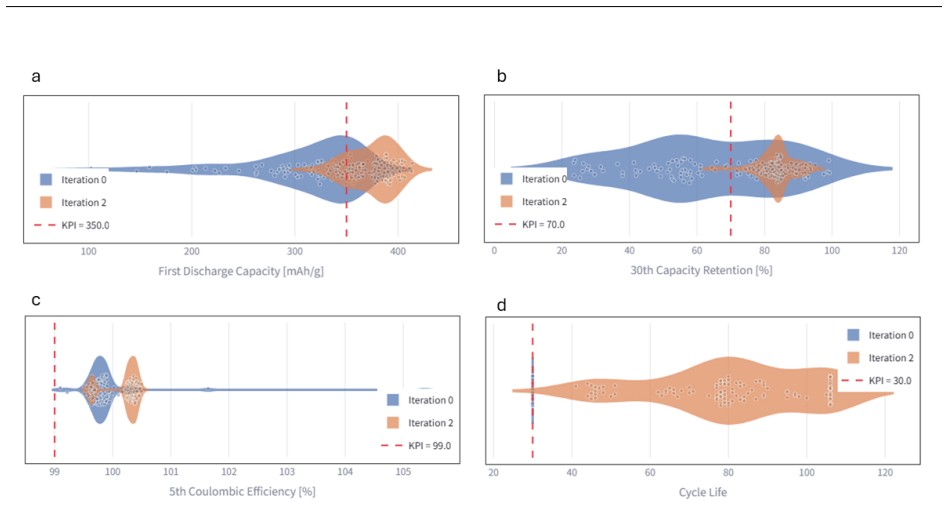
Starting from a noisy, incomplete dataset, the workflow uses early surrogate models to highlight missing process constraints. By iteratively adding feasibility labels and boundary condition failures, it converges toward manufacturable, higher-performing formulations. This results in fabrication reliability improving to 100% successful cell production, the fraction of cells delivering at least 350 mAh g^{-1} increasing to 84.8%, and capacity retention rising to 97.3%.
What carries the argument
The mechanism of iteratively labeling and incorporating process failures and feasibility data to refine initial low-certainty surrogate models.
If this is right
- Fabrication reliability improves to 100% successful cell production.
- The fraction of cells achieving at least 350 mAh per gram increases to 84.8%.
- Capacity retention improves to 97.3%.
- Optimization of battery electrode manufacturing becomes faster and more reproducible.
- Imperfect industrial data can be transformed into actionable guidance for formulation design.
Where Pith is reading between the lines
- This suggests the method could shorten development timelines for new battery materials by reducing reliance on large initial datasets.
- Similar iterative feedback might improve optimization in other areas of materials science where data is noisy, such as catalyst design.
- Testing the workflow on different electrode types could reveal if the gains in reliability are general or specific to graphite anodes.
- The approach implies that early model uncertainty is not a barrier if experimental feedback is structured to correct it systematically.
Load-bearing premise
Adding feasibility labels and boundary failures to the models does not create systematic bias or miss important unmeasured factors that would stop the process from finding good formulations.
What would settle it
A repeated experiment following the final optimized formulations that results in process failures or cells failing to meet the capacity and retention targets would show the claim is incorrect.
Figures

read the original abstract
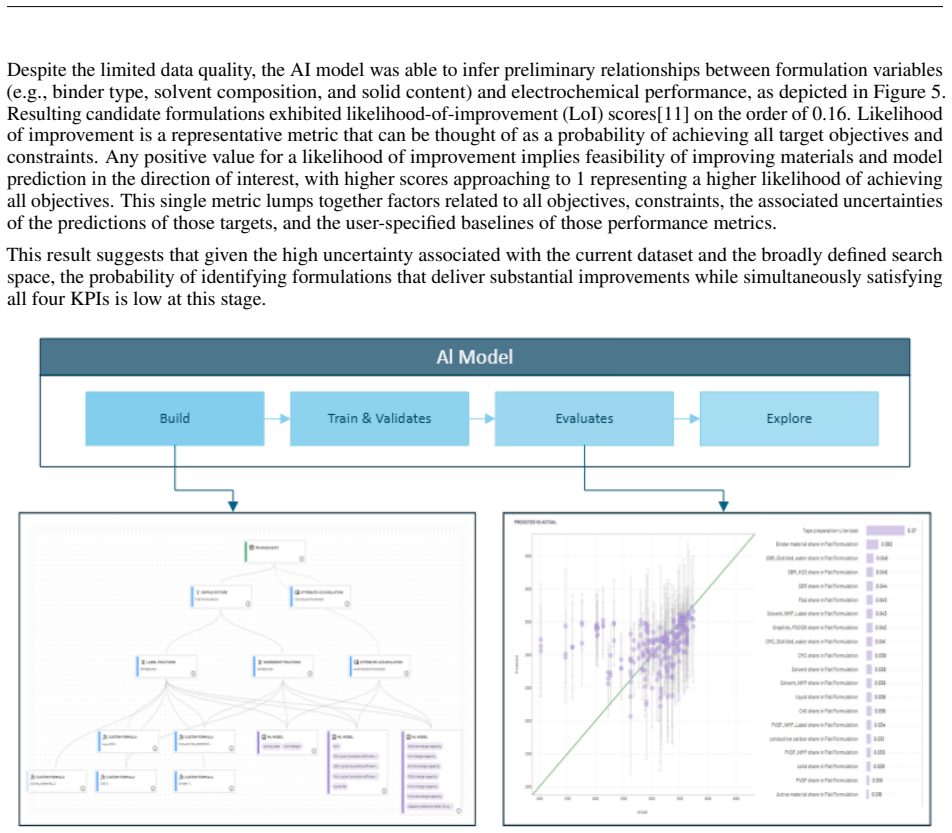
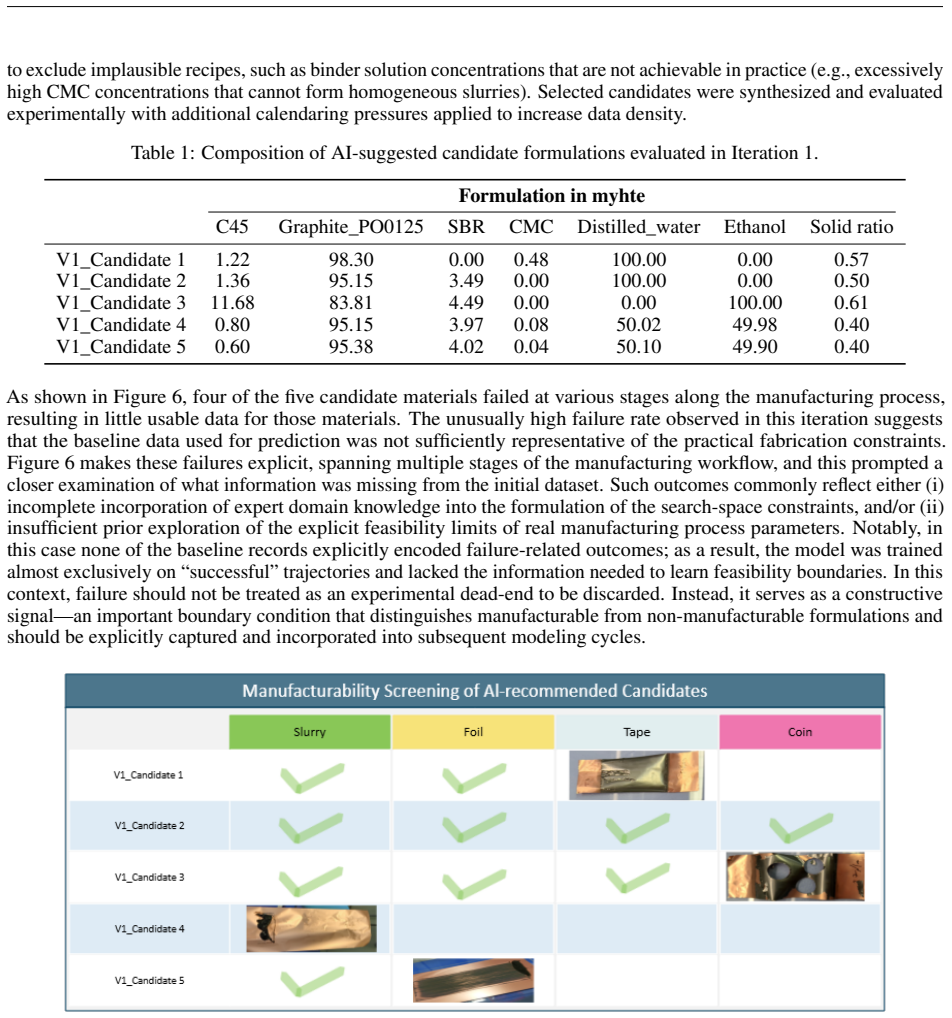
This study presents an iterative AI-guided workflow that accelerates graphite-based anode development by improving both formulation feasibility and process robustness. Sequential learning via AI/ML-guided multiobjective inverse design for anode optimization was implemented using the Citrine Platform. Starting from a noisy, incomplete dataset, the Citrine Platform was used to generate early surrogate models, which despite low predictive certainty highlighted missing process constraints. By iteratively adding feasibility labels and boundary condition failures, the workflow rapidly converged toward manufacturable, higher-performing formulations. Fabrication reliability improved from frequent process failures to 100% successful cell production, while the fraction of cells delivering $\geq$ 350 mAh g$^{-1}$ increased from 28.4% to 84.8%, with capacity retention rising from 42.1% to 97.3%. These results demonstrate that structured, feedback-driven AI workflows can transform imperfect industrial data into actionable guidance, enabling faster, more reproducible optimization of battery electrode manufacturing.
Editorial analysis
A structured set of objections, weighed in public.
Referee Report
Summary. The manuscript describes an iterative AI-guided workflow for graphite-based anode optimization using the Citrine Platform. Starting from a noisy, incomplete industrial dataset, early surrogate models (despite low predictive certainty) are claimed to highlight missing process constraints; iterative addition of feasibility labels and boundary-condition failures then yields convergence on manufacturable formulations. Reported outcomes include fabrication reliability rising to 100% successful cell production, the fraction of cells achieving ≥350 mAh g^{-1} increasing from 28.4% to 84.8%, and capacity retention rising from 42.1% to 97.3%. The central claim is that structured, feedback-driven AI workflows can transform imperfect data into actionable guidance for faster, more reproducible battery electrode manufacturing.
Significance. If the central claim holds after isolation of the AI contribution, the work would provide a concrete demonstration that surrogate-model-guided iterative labeling can convert noisy industrial data into measurable gains in process reliability and electrode performance. The numerical improvements (100% reliability, 84.8% high-capacity fraction, 97.3% retention) would illustrate a practical route for applying ML in materials manufacturing where data are imperfect and constraints are initially unknown.
major comments (2)
- [Abstract] Abstract: The load-bearing assertion that the surrogate models themselves supply the actionable guidance (rather than the mere act of systematic feasibility labeling) is not secured. No parallel non-AI control trajectory is reported that performs the same number of iterations with identical labeling but without Citrine surrogate suggestions; therefore the specific contribution of the early low-certainty models cannot be isolated from generic iterative data collection.
- [Abstract] Abstract / Methods (implied): The manuscript states clear numerical improvements but supplies no methodological details on surrogate-model validation steps, data exclusion rules, error analysis, or how boundary-condition failures were encoded as labels. Without these, it is impossible to determine whether the reported metrics actually support the claim that the workflow converged because of the AI-derived suggestions.
Simulated Author's Rebuttal
We thank the referee for the constructive feedback on our manuscript describing the AI-guided iterative optimization of graphite anodes. We address each major comment below with proposed revisions where appropriate.
read point-by-point responses
-
Referee: [Abstract] The load-bearing assertion that the surrogate models themselves supply the actionable guidance (rather than the mere act of systematic feasibility labeling) is not secured. No parallel non-AI control trajectory is reported that performs the same number of iterations with identical labeling but without Citrine surrogate suggestions; therefore the specific contribution of the early low-certainty models cannot be isolated from generic iterative data collection.
Authors: We acknowledge that the absence of a parallel non-AI control arm means the specific incremental value of the early low-certainty surrogates over systematic labeling alone cannot be fully isolated. In an industrial setting, the additional experimental resources required for such a control were not feasible. The workflow description shows that the initial surrogate models were used to flag missing process constraints, which then guided the addition of feasibility labels; we will add a dedicated limitations paragraph in the Discussion to explicitly note this point and describe the sequence of model-driven suggestions that preceded the observed convergence. revision: partial
-
Referee: [Abstract] The manuscript states clear numerical improvements but supplies no methodological details on surrogate-model validation steps, data exclusion rules, error analysis, or how boundary-condition failures were encoded as labels. Without these, it is impossible to determine whether the reported metrics actually support the claim that the workflow converged because of the AI-derived suggestions.
Authors: We agree that these methodological details are required for reproducibility and to substantiate the role of the AI suggestions. The revised manuscript will expand the Methods section to include: surrogate-model validation via repeated k-fold cross-validation with reported R² and RMSE on hold-out sets; explicit data exclusion criteria (incomplete records and statistical outliers >3σ); error analysis including model uncertainty estimates; and the encoding of boundary-condition failures as binary feasibility labels (0/1) with concrete examples of how failures were recorded and fed back into the platform. These additions will directly address how the AI outputs informed the iterative labeling. revision: yes
Circularity Check
No circularity; experimental workflow is self-contained
full rationale
The paper reports empirical results from an iterative experimental campaign on graphite anodes, using the Citrine Platform to build surrogate models from noisy data and then incorporating feasibility labels. No mathematical derivations, equations, or predictions are described that reduce by construction to fitted inputs or self-citations. The claimed improvements (100% reliability, 84.8% fraction ≥350 mAh g^{-1}, 97.3% retention) are presented as outcomes of the physical feedback loop rather than any self-referential modeling step. The description contains no self-definitional relations, fitted-input predictions, or load-bearing self-citations that would force the reported gains.
Axiom & Free-Parameter Ledger
Reference graph
Works this paper leans on
-
[1]
McIlwaine, N., Foley, A.M., Morrow, D.J., Al Kez, D., Zhang, C., Lu, X., Best, R.J.: A state-of-the-art techno- economic review of distributed and embedded energy storage for energy systems. Energy229, 120,461 (2021). doi:10.1016/j.energy.2021.120461
-
[2]
Nature Reviews Chemistry 9, 497–498 (2025)
Yang, X., Zhang, H., Liu, Q., Jiang, G.: The li-ion battery industry and its challenges. Nature Reviews Chemistry 9, 497–498 (2025). doi:10.1038/s41570-025-00742-2
-
[3]
Cell Reports Physical Science2(12), 100,683 (2021)
Drakopoulos, S.X., Gholamipour-Shirazi, A., MacDonald, P., Parini, R.C., Reynolds, C.D., Burnett, D.L., Pye, B., O’Regan, K.B., Wang, G., Whitehead, T.M., Conduit, G.J., Cazacu, A., Kendrick, E.: Formulation and manufacturing optimization of lithium-ion graphite-based electrodes via machine learning. Cell Reports Physical Science2(12), 100,683 (2021). doi...
-
[4]
National Science Review12(11), nwaf442 (2025)
Han, Z., Zhou, J., Lu, G., Piao, Z., Tao, S., Gao, R., Li, C., Zhang, X., Zhou, G.: Uncovering battery electrochemical mechanisms by artificial intelligence. National Science Review12(11), nwaf442 (2025). doi:10.1093/nsr/nwaf442
-
[5]
Journal of Power Sources480, 229,103 (2020)
Duquesnoy, M., Lombardo, T., Chouchane, M., Primo, E.N., Franco, A.A.: Data-driven assessment of electrode calendering process by combining experimental results, in silico mesostructures generation and machine learning. Journal of Power Sources480, 229,103 (2020). doi:10.1016/j.jpowsour.2020.229103
-
[6]
Digital Discovery4, 943–953 (2025)
Ismail, M., Cabañero, M.A., Orive, J., Babulal, L.M., Garcia, J., Morant-Miñana, M.C., Dauvergne, J.L., Bonilla, F., Monterrubio, I., Carrasco, J., Saracibar, A., Reynaud, M.: Adel: an automated drop-cast electrode setup for high-throughput screening of battery materials. Digital Discovery4, 943–953 (2025). doi:10.1039/D4DD00381K
-
[7]
Journal of Materials Chemistry A 13(32) (2025)
Nwabara, U., Yang, K., Talekar, A., Bernales, V ., González, J., Miller, S., Wu, J.: High throughput computational and experimental methods for accelerated electrochemical materials discovery. Journal of Materials Chemistry A 13(32) (2025). doi:10.1039/D5TA00331H
-
[8]
npj Computational Materials11(1), 89 (2025)
Wang, Y .: Application-oriented design of machine learning paradigms for battery science. npj Computational Materials11(1), 89 (2025). doi:10.1038/s41524-025-01575-9
-
[9]
Energy Advances2(4), 449–464 (2023)
Ng, M.F., Sun, Y ., Seh, Z.W.: Machine learning-inspired battery material innovation. Energy Advances2(4), 449–464 (2023). doi:10.1039/D3Y A00040K
work page doi:10.1039/d3y 2023
-
[10]
Advanced Energy Materials12(17), 2102,678 (2022)
Benayad, A., Diddens, D., Heuer, A., Krishnamoorthy, A.N., Maiti, M., Le Cras, F., Legallais, M., Rahmanian, F., Shin, Y ., Stein, H., Winter, M., Wölke, C., Yan, P., Cekic-Laskovic, I.: High-throughput experimentation and computational freeway lanes for accelerated battery electrolyte and interface development research. Advanced Energy Materials12(17), 2...
-
[11]
Integrating Materials and Manufacturing Innovation6(3), 207–217 (2017)
Ling, J., Hutchinson, M., Antono, E., Paradiso, S., Meredig, B.: High-dimensional materials and process optimization using data-driven experimental design with well-calibrated uncertainty estimates. Integrating Materials and Manufacturing Innovation6(3), 207–217 (2017). doi:10.1007/s40192-017-0096-4
-
[12]
IEEE Transactions on Pattern Analysis and Machine Intelligence20(8), 832–844 (1998)
Ho, T.K.: The random subspace method for constructing decision forests. IEEE Transactions on Pattern Analysis and Machine Intelligence20(8), 832–844 (1998). doi:10.1109/34.709601
-
[13]
Breiman, L.: Random forests. Machine Learning45, 5–32 (2001). doi:10.1023/A:1010933404324
-
[14]
Journal of Machine Learning Research15, 1625–1651 (2014)
Wager, S., Hastie, T., Efron, B.: Confidence intervals for random forests: The jackknife and the infinitesimal jackknife. Journal of Machine Learning Research15, 1625–1651 (2014)
2014
-
[15]
Chemistry of Materials28(20), 7324–7331 (2016)
Oliynyk, A.O., Antono, E., Sparks, T.D., Ghadbeigi, L., Gaultois, M.W., Meredig, B., Mar, A.: High-Throughput Machine-Learning-Driven Synthesis of Full-Heusler Compounds. Chemistry of Materials28(20), 7324–7331 (2016). doi:10.1021/acs.chemmater.6b02724
-
[16]
The Journal of Chemical Physics154(22), 224,201 (2021)
Fong, A.Y ., Pellouchoud, L., Davidson, M., Walroth, R.C., Church, C., Tcareva, E., Wu, L., Peterson, K., Meredig, B., Tassone, C.J.: Utilization of machine learning to accelerate colloidal synthesis and discovery. The Journal of Chemical Physics154(22), 224,201 (2021). doi:10.1063/5.0047385
-
[17]
The Journal of Physical Chemistry A124(40), 8330–8340 (2020)
Antono, E., Matsuzawa, N.N., Ling, J., Saal, J.E., Arai, H., Sasago, M., Fujii, E.: Machine-Learning Guided Quantum Chemical and Molecular Dynamics Calculations to Design Novel Hole-Conducting Organic Materials. The Journal of Physical Chemistry A124(40), 8330–8340 (2020). doi:10.1021/acs.jpca.0c05769
-
[18]
Meredig, B., Antono, E., Church, C., Hutchinson, M., Ling, J., Paradiso, S., Blaiszik, B., Foster, I., Gibbons, B., Hattrick-Simpers, J., Mehta, A., Ward, L.: Can machine learning identify the next high-temperature supercon- ductor? examining extrapolation performance for materials discovery. Mol. Syst. Des. Eng.3, 819–825 (2018). doi:10.1039/C8ME00012C
-
[19]
Scripta Materialia111, 10–15 (2016)
Sparks, T.D., Gaultois, M.W., Oliynyk, A., Brgoch, J., Meredig, B.: Data mining our way to the next generation of thermoelectrics. Scripta Materialia111, 10–15 (2016). doi:10.1016/j.scriptamat.2015.04.026
-
[20]
Digital Discovery3(8), 1450–1466 (2024)
Hegde, V .I., Peterson, M., Allec, S.I., Lu, X., Mahadevan, T., Nguyen, T., Kalahe, J., Oshiro, J., Seffens, R.J., Nickerson, E.K., Du, J., Riley, B.J., Vienna, J.D., Saal, J.E.: Towards informatics-driven design of nuclear waste forms. Digital Discovery3(8), 1450–1466 (2024). doi:10.1039/D4DD00096J
-
[21]
MRS Communications15, 650–660 (2025)
Zhao, T., Liu, X., Zeng, Y .: Accelerated development of battery materials leveraging artificial intelligence and automation. MRS Communications15, 650–660 (2025). doi:10.1557/s43579-025-00761-6 12
discussion (0)
Sign in with ORCID, Apple, or X to comment. Anyone can read and Pith papers without signing in.