Aharonov-Casher Chern bands for ultracold dark state atoms
Pith reviewed 2026-06-28 19:32 UTC · model grok-4.3
The pith
A combination of two imperfections in atom-light coupling produces a flat lowest band with perfect Chern topology.
A machine-rendered reading of the paper's core claim, the machinery that carries it, and where it could break.
Core claim
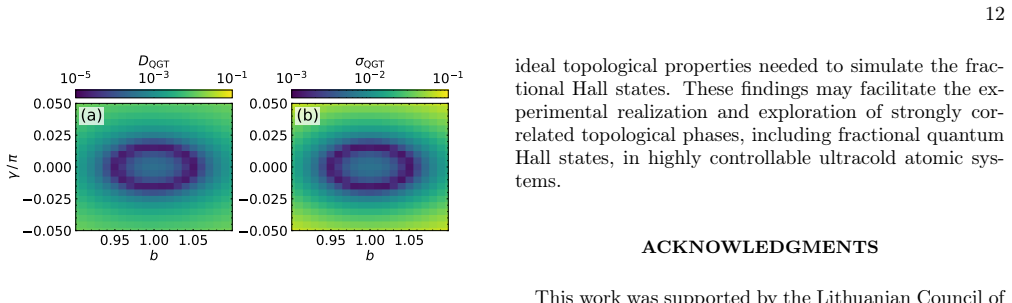
A proper combination of departure from fine tuning of the Rabi frequencies and finite atom-light coupling strength can lead to a completely flat lowest band characterized by the perfect topology needed for simulating the fractional Hall states.
What carries the argument
The Aharonov-Casher condition, which relates the geometric scalar potential and the synthetic magnetic field for atoms following the dark state.
If this is right
- The lowest band becomes fully degenerate like a Landau level despite spatial inhomogeneity in the synthetic field.
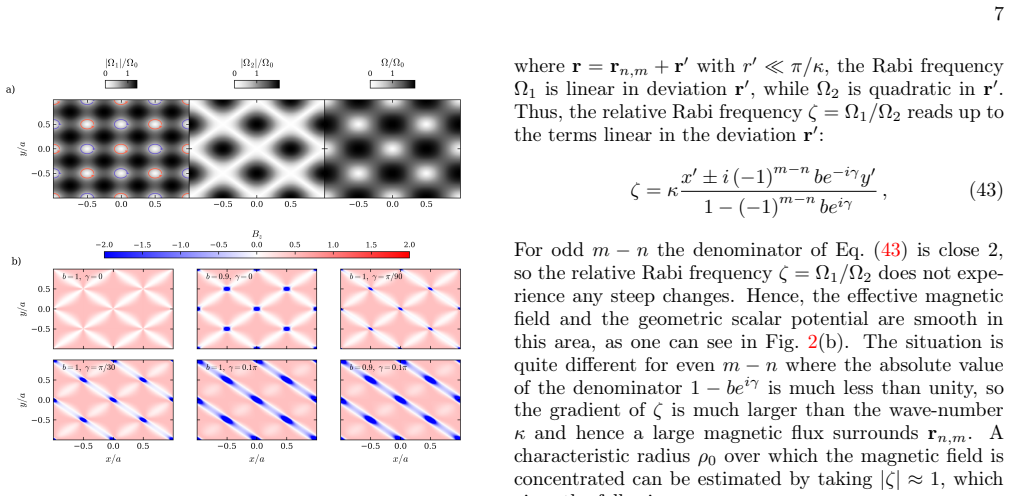
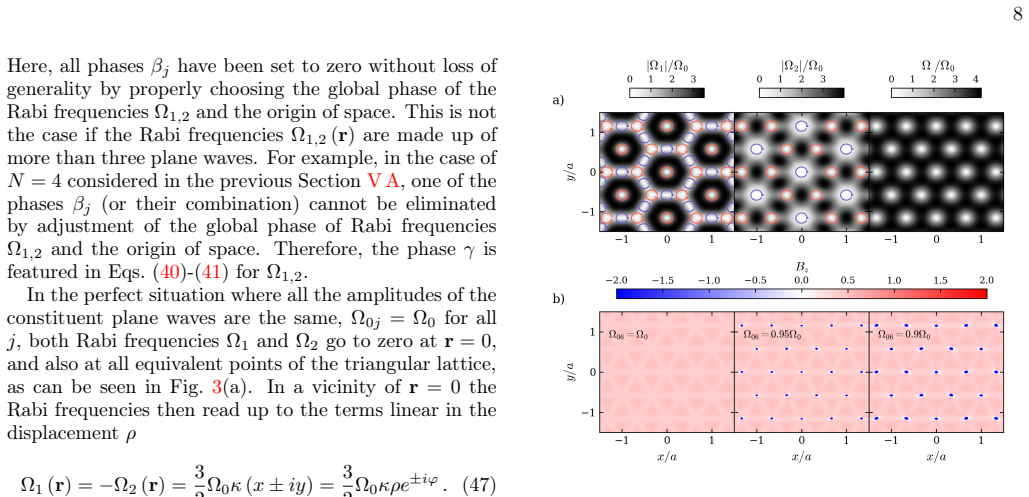
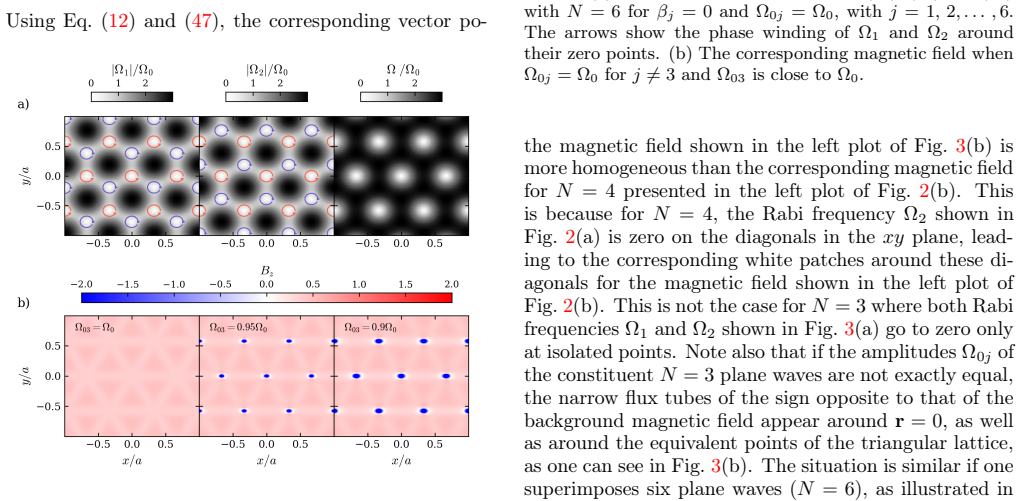
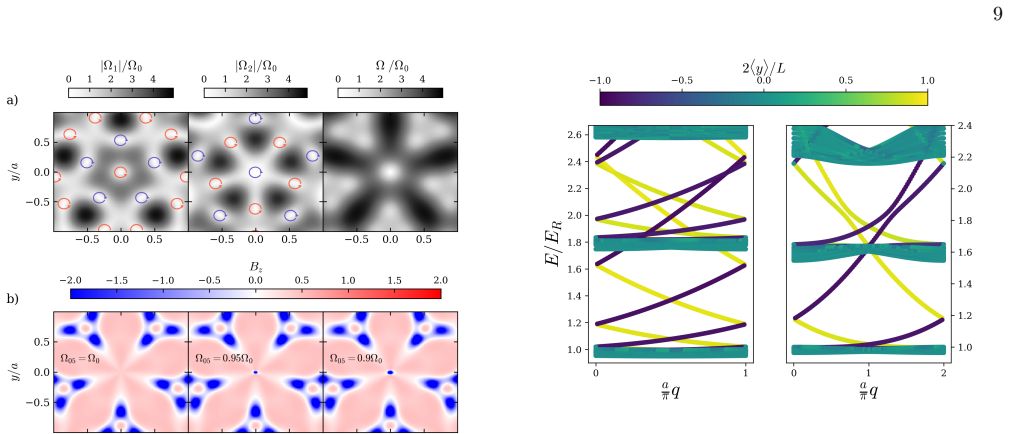
- Superpositions of N=3, 4 or 6 plane waves for the Rabi frequencies produce a smooth background field of definite sign plus arrays of flux singularities.
- Departure from fine tuning converts the singularities into narrow patches of opposite-sign field.
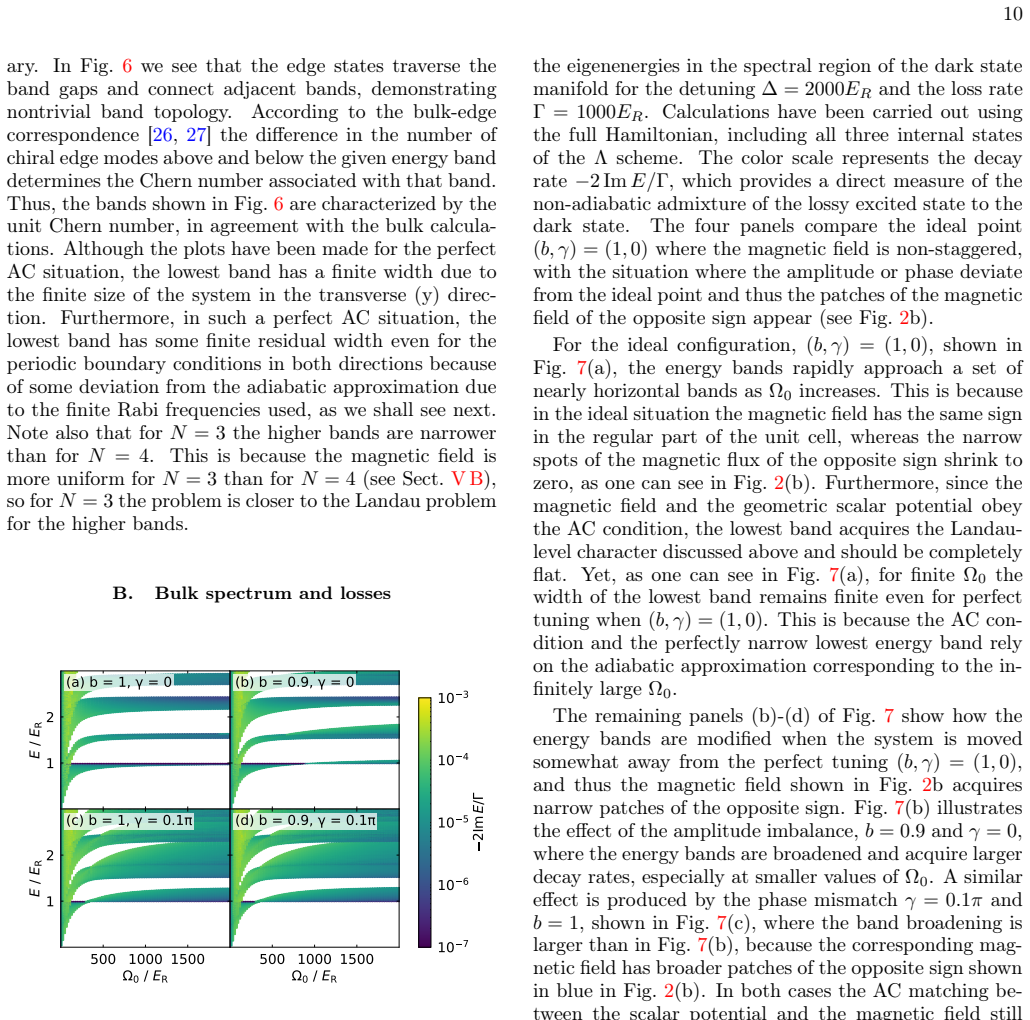
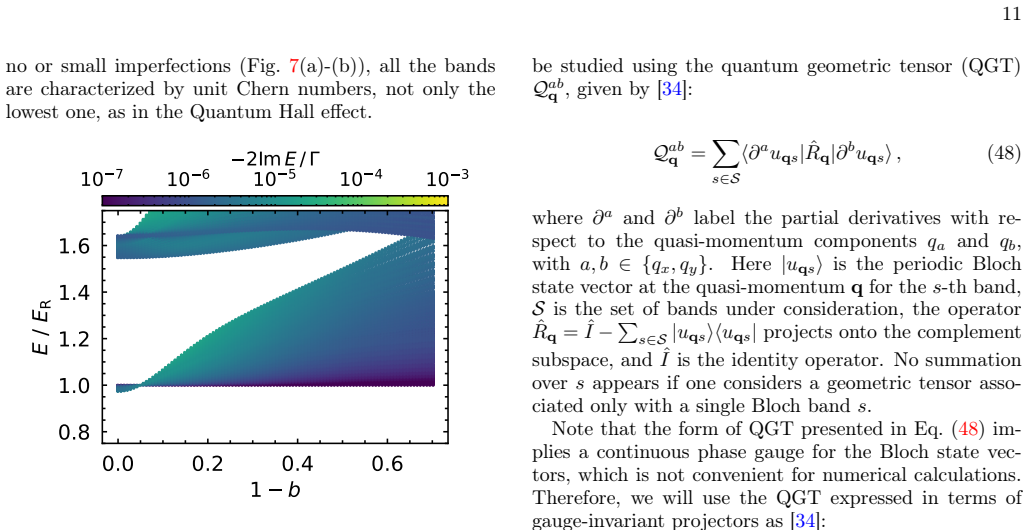
- Finite coupling strength broadens the band, yet the two imperfections together can cancel the broadening.
Where Pith is reading between the lines
- The mechanism suggests a route to fractional Hall states in optical systems where perfect fine tuning or infinite coupling cannot be reached.
- Similar compensation between detuning errors and finite interaction strength may apply to other synthetic gauge-field platforms.
- Direct tests could track how band flatness and Hall conductivity vary with small changes in Rabi-frequency amplitudes and overall coupling strength.
Load-bearing premise
The atoms adiabatically follow the dark state throughout the Lambda-type atom-light coupling scheme.
What would settle it
An experiment that measures a completely flat lowest band with the expected Chern number when both finite coupling strength and controlled departure from fine-tuned plane-wave Rabi frequencies are present.
Figures
read the original abstract
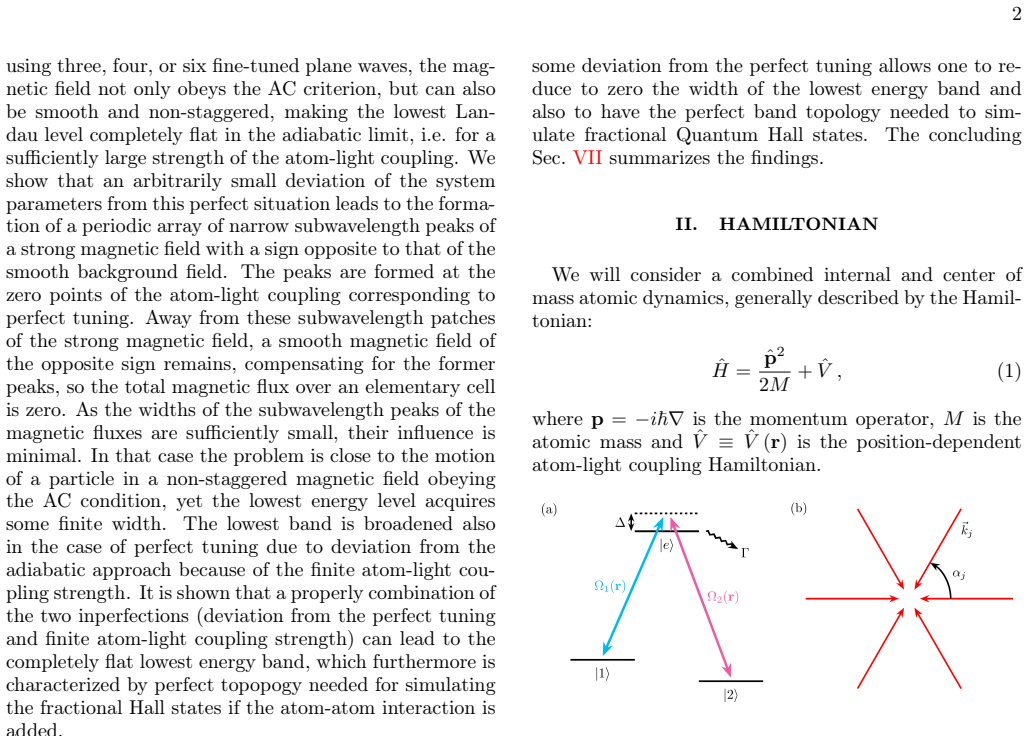
We consider the Aharonov-Casher (AC) condition for ultracold atoms adiabatically following the dark-state in a $\Lambda$-type atom-light coupling scheme. The AC condition establishes a relation between the geometric scalar potential and the synthetic magnetic field, resulting in a fully degenerate lowest Landau-level-like band even if the magnetic field is inhomogeneous but has a proper sign. We derive a general requirement for the atom-light coupling under which the AC condition applies. The requirement holds if the Rabi frequencies of the $\Lambda$ scheme are the superposition of plane waves with the appropriate amplitudes and phases. In particular, the Rabi frequencies made of $N=3,\,4,\,6$ fine tuned plane waves yield a smooth background magnetic field of definite sign, as well as an array of non-measurable Aharonov-Bohm flux singularities. Departing from the fine tuning, the latter singularities broaden into narrow subwavelength patches of the opposite magnetic field, which broaden the lowest energy band. The lowest band is broadened also for the fine tuned situation due to deviation from the adiabatic approach because of the finite atom-light coupling strength. It is shown that a proper combination of the two imperfections (departure from fine tuning and finite atom-light coupling strength) can lead to a completely flat lowest band, which furthermore is characterized by the perfect topology needed for simulating the fractional Hall states.
Editorial analysis
A structured set of objections, weighed in public.
Referee Report
Summary. The manuscript considers the Aharonov-Casher (AC) condition for ultracold atoms in a λ-type atom-light coupling scheme under the adiabatic dark-state approximation. It derives a general requirement that the Rabi frequencies must be superpositions of plane waves with specific amplitudes and phases; for N=3,4,6 components this produces a smooth background synthetic magnetic field of definite sign plus Aharonov-Bohm singularities. Departures from exact fine-tuning broaden the singularities into opposite-sign patches that widen the lowest band, while finite coupling strength also broadens the band via non-adiabatic effects. The central claim is that a suitable combination of these two imperfections can simultaneously produce a completely flat lowest band that retains the perfect (integer) topology required for fractional Hall-state simulation.
Significance. If the central claim is confirmed, the work supplies a concrete route to flat Chern bands in atomic dark-state systems without requiring perfect fine-tuning, directly addressing a practical obstacle in quantum simulation of fractional quantum Hall physics. The derivation of the plane-wave superposition requirement for the AC condition and the explicit balancing of the two imperfections constitute the main technical contributions.
major comments (2)
- [Abstract] Abstract (opening sentence and final claim): the assertion that the combination of imperfections yields both exact flatness and 'perfect topology' rests on the adiabatic dark-state manifold. The skeptic correctly notes that finite coupling introduces virtual bright-state population whose corrections to the geometric vector potential are not guaranteed to preserve the integrated Berry curvature once the plane-wave amplitudes are also detuned; an explicit calculation of the Chern number (or Berry curvature integral) that includes these non-adiabatic terms is required to substantiate the topology claim.
- [Derivation of the AC condition] Derivation of the AC condition and plane-wave requirement: the manuscript presents the AC condition as establishing a relation between the geometric scalar potential and the synthetic magnetic field that produces LLL-like degeneracy. It is unclear whether this relation remains exact once the Rabi frequencies deviate from the N=3/4/6 superposition while the coupling strength is simultaneously finite; a quantitative error estimate or perturbative expansion around the adiabatic limit would be needed to confirm that the flattening mechanism does not simultaneously shift the Chern number.
minor comments (2)
- [Abstract] The abstract states that the singularities 'broaden into narrow subwavelength patches' but does not quantify the scale of these patches relative to the wavelength or the magnetic length; a figure or scaling argument would clarify the regime of validity.
- Notation for the Rabi-frequency amplitudes and phases is introduced without an explicit table or equation listing the precise values for the N=3,4,6 cases; adding such a summary would improve readability.
Simulated Author's Rebuttal
We thank the referee for the careful reading and constructive criticism. The comments highlight important points regarding the robustness of the topological invariant and the validity of the AC condition beyond the strict adiabatic limit. We address each major comment below and will revise the manuscript accordingly.
read point-by-point responses
-
Referee: [Abstract] Abstract (opening sentence and final claim): the assertion that the combination of imperfections yields both exact flatness and 'perfect topology' rests on the adiabatic dark-state manifold. The skeptic correctly notes that finite coupling introduces virtual bright-state population whose corrections to the geometric vector potential are not guaranteed to preserve the integrated Berry curvature once the plane-wave amplitudes are also detuned; an explicit calculation of the Chern number (or Berry curvature integral) that includes these non-adiabatic terms is required to substantiate the topology claim.
Authors: We agree that an explicit verification of the Chern number including non-adiabatic corrections is necessary to fully substantiate the topology claim. In the revised manuscript we will add a section presenting numerical diagonalization of the full three-level Hamiltonian for representative values of the combined imperfections (detuned plane-wave amplitudes and finite Rabi strength). These calculations confirm that the lowest band remains isolated with Chern number 1, provided the gap to higher bands stays open. The analytic argument that the integrated Berry curvature is preserved to leading order in the inverse coupling strength will also be included. revision: yes
-
Referee: [Derivation of the AC condition] Derivation of the AC condition and plane-wave requirement: the manuscript presents the AC condition as establishing a relation between the geometric scalar potential and the synthetic magnetic field that produces LLL-like degeneracy. It is unclear whether this relation remains exact once the Rabi frequencies deviate from the N=3/4/6 superposition while the coupling strength is simultaneously finite; a quantitative error estimate or perturbative expansion around the adiabatic limit would be needed to confirm that the flattening mechanism does not simultaneously shift the Chern number.
Authors: The AC condition and the associated plane-wave requirement are derived exactly within the adiabatic dark-state manifold. When both imperfections are present we rely on numerical band-structure calculations to demonstrate flattening. In the revision we will add a perturbative expansion in 1/Ω (where Ω is the characteristic Rabi frequency) that quantifies the leading-order correction to the effective vector potential. This expansion shows that the deviation from the ideal AC relation scales as O(1/Ω²) and does not alter the integrated Berry curvature at the order relevant for the reported flattening, thereby preserving the integer Chern number. revision: yes
Circularity Check
No significant circularity; derivation remains self-contained
full rationale
The provided abstract and reader summary show the AC condition derived from the dark-state manifold under the adiabatic assumption, with the plane-wave superposition requirement stated as the condition under which the AC relation holds. The balancing of two imperfections (detuning from fine-tuned plane waves and finite coupling) to achieve flatness is presented as a numerical or analytic result rather than a parameter fit renamed as a prediction. No equations reduce the claimed flat band plus quantized Chern number to the input assumptions by construction, and no self-citation chain is invoked as the sole justification for the topology. The adiabatic following is an explicit modeling assumption, not a hidden tautology. This yields a standard non-circular finding.
Axiom & Free-Parameter Ledger
free parameters (1)
- amplitudes and phases of the plane-wave components
axioms (1)
- domain assumption Atoms adiabatically follow the dark state in the Lambda scheme
Reference graph
Works this paper leans on
-
[1]
Z. F. Ezawa, Quantum hall effects, inQuantum Hall Ef- fects, 0 (WORLD SCIENTIFIC, 2011)
2011
-
[2]
Aharonov and A
Y. Aharonov and A. Casher, Ground state of a spin- ½charged particle in a two-dimensional magnetic field, Phys. Rev. A19, 2461 (1979)
1979
-
[3]
J. Shi, N. Morales-Durán, E. Khalaf, and A. H. MacDon- ald, Adiabatic approximation and aharonov-casher bands in twisted homobilayer transition metal dichalcogenides, Phys. Rev. B110, 035130 (2024)
2024
- [4]
-
[5]
C. A. Mead, The geometric phase in molecular systems, Rev. Mod. Phys.64, 51 (1992)
1992
-
[6]
Dalibard, F
J. Dalibard, F. Gerbier, G. Juzeli¯ unas, and P. Öh- berg, Colloquium: Artificial gauge potentials for neutral atoms, Rev. Mod. Phys.83, 1523 (2011)
2011
-
[7]
Goldman, G
N. Goldman, G. Juzeli¯ unas, P. Öhberg, and I. B. Spiel- man, Light-induced gauge fields for ultracold atoms, Rep. Prog. Phys.77, 126401 (2014)
2014
-
[8]
Nascimbene and J
S. Nascimbene and J. Dalibard, Emergence of a landau level structure in dark optical lattices, Phys. Rev. Lett. 135, 153402 (2025)
2025
-
[9]
Burba and G
D. Burba and G. Juzeli¯ unas, Two-dimensional subwave- length topological dark state lattices, Physical Review Research7, 043090 (2025)
2025
-
[10]
Dum and M
R. Dum and M. Olshanii, Gauge structures in atom-laser interaction: Bloch oscillations in a dark lattice, Phys. Rev. Lett.76, 1788 (1996)
1996
-
[11]
Juzeli¯ unas and P
G. Juzeli¯ unas and P. Öhberg, Slow light in degenerate fermi gases, Phys. Rev. Lett.93, 033602 (2004)
2004
-
[12]
G.Juzeli¯ unas, J.Ruseckas,andP.Öhberg,Effectivemag- netic fields induced by eit in ultra-cold atomic gases, Journal of Physics B: Atomic, Molecular and Optical Physics38, 4171 (2005)
2005
-
[13]
Juzeli¯ unas, P
G. Juzeli¯ unas, P. Öhberg, J. Ruseckas, and A. Klein, Ef- fectivemagneticfieldsindegenerateatomicgasesinduced by light beams with orbital angular momenta, Phys. Rev. A71, 053614 (2005)
2005
-
[14]
Ruseckas, G
J. Ruseckas, G. Juzeli¯ unas, P. Öhberg, and M. Fleis- chhauer, Non-abelian gauge potentials for ultracold atoms with degenerate dark states, Phys. Rev. Lett.95, 010404 (2005)
2005
-
[15]
Gvozdiovas, I
E. Gvozdiovas, I. B. Spielman, and G. Juzeli¯ unas, Interference-induced anisotropy in a two-dimensional dark-state optical lattice, Phys. Rev. A107, 033328 (2023)
2023
-
[16]
Łącki, M
M. Łącki, M. A. Baranov, H. Pichler, and P. Zoller, Nanoscale ”dark state” optical potentials for cold atoms, Phys. Rev. Lett.117, 233001 (2016)
2016
-
[17]
Jendrzejewski, S
F. Jendrzejewski, S. Eckel, T. G. Tiecke, G. Juzeli¯ unas, G. K. Campbell, L. Jiang, and A. V. Gorshkov, Subwavelength-width optical tunnel junctions for ultra- cold atoms, Phys. Rev. A94, 063422 (2016)
2016
-
[18]
Y. Wang, S. Subhankar, P. Bienias, M. Łącki, T.-C. Tsui, M. A. Baranov, A. V. Gorshkov, P. Zoller, J. V. Porto, and S. L. Rolston, Dark state optical lattice with a subwavelength spatial structure, Phys. Rev. Lett.120, 083601 (2018)
2018
-
[19]
Ge and M
W. Ge and M. S. Zubairy, Dark-state optical poten- tial barriers with nanoscale spacing, Phys. Rev. A101, 023403 (2020)
2020
-
[20]
Kubala, J
P. Kubala, J. Zakrzewski, and M. Łącki, Optical lattice for a tripodlike atomic level structure, Phys. Rev. A104, 053312 (2021)
2021
-
[21]
Gvozdiovas, P
E. Gvozdiovas, P. Račkauskas, and G. Juzeli¯ unas, Opti- cal lattice with spin-dependent sub-wavelength barriers, SciPost Phys.11, 100 (2021)
2021
-
[22]
M. O. Scully and M. S. Zubairy,Quantum optics(Cam- bridge University Press, 1997)
1997
-
[23]
In the condensed matter literature the geometric scalar potentialϕis sometimes labeled by the letterD[3]
-
[24]
Juzeli¯ unas and I
G. Juzeli¯ unas and I. B. Spielman, Flux lattices reformu- lated, New. J. Phys.14, 123022 (2012)
2012
-
[25]
N. R. Cooper, Optical flux lattices for ultracold atomic gases, Phys. Rev. Lett.106, 175301 (2011)
2011
-
[26]
Hatsugai, Chern number and edge states in the integer quantum hall effect, Physical Review Letters71, 3697 (1993)
Y. Hatsugai, Chern number and edge states in the integer quantum hall effect, Physical Review Letters71, 3697 (1993)
1993
-
[27]
Xiao, M.-C
D. Xiao, M.-C. Chang, and Q. Niu, Berry phase effects on electronic properties, Rev. Mod. Phys.82, 1959 (2010)
1959
-
[28]
N. R. Cooper and J. Dalibard, Reaching fractional quan- tum hall states with optical flux lattices, Phys. Rev. Lett. 110, 185301 (2013)
2013
-
[29]
Léonard, S
J. Léonard, S. Kim, J. Kwan, P. Segura, F. Grusdt, C. Repellin, N. Goldman, and M. Greiner, Realization of a fractional quantum hall state with ultracold atoms, Nature619, 495 (2023)
2023
-
[30]
P. Lunt, P. Hill, J. Reiter, P. M. Preiss, M. Gałka, and S. Jochim, Realization of a laughlin state of two rapidly rotating fermions, Physical Review Letters133, 253401 (2024)
2024
-
[31]
Wang, J.Cano, A
J. Wang, J.Cano, A. J. Millis, Z. Liu,and B. Yang, Exact landau level description of geometry and interaction in a flatband, Phys. Rev. Lett.127, 246403 (2021)
2021
-
[32]
Estienne, N
B. Estienne, N. Regnault, and V. Crépel, Ideal chern bands as landau levels in curved space, Phys. Rev. Res. 5, L032048 (2023)
2023
-
[33]
P. J. Ledwith, A. Vishwanath, and D. E. Parker, Vor- texability: A unifying criterion for ideal fractional chern insulators, Phys. Rev. B108, 205144 (2023)
2023
-
[34]
Mitscherling, A
J. Mitscherling, A. Avdoshkin, and J. E. Moore, Gauge- invariant projector calculus for quantum state geometry and applications to observables in crystals (2025)
2025
discussion (0)
Sign in with ORCID, Apple, or X to comment. Anyone can read and Pith papers without signing in.