Electron vs. hole doping in infinite-layer nickelates: electronic structure, magnetism and correlations
Pith reviewed 2026-06-28 20:36 UTC · model grok-4.3
The pith
Infinite-layer nickelates exhibit a doping asymmetry: hole doping suppresses antiferromagnetism while electron doping preserves it, because rare-earth 5d states affect the Ni d_x2-y2 band differently in each case.
A machine-rendered reading of the paper's core claim, the machinery that carries it, and where it could break.
Core claim
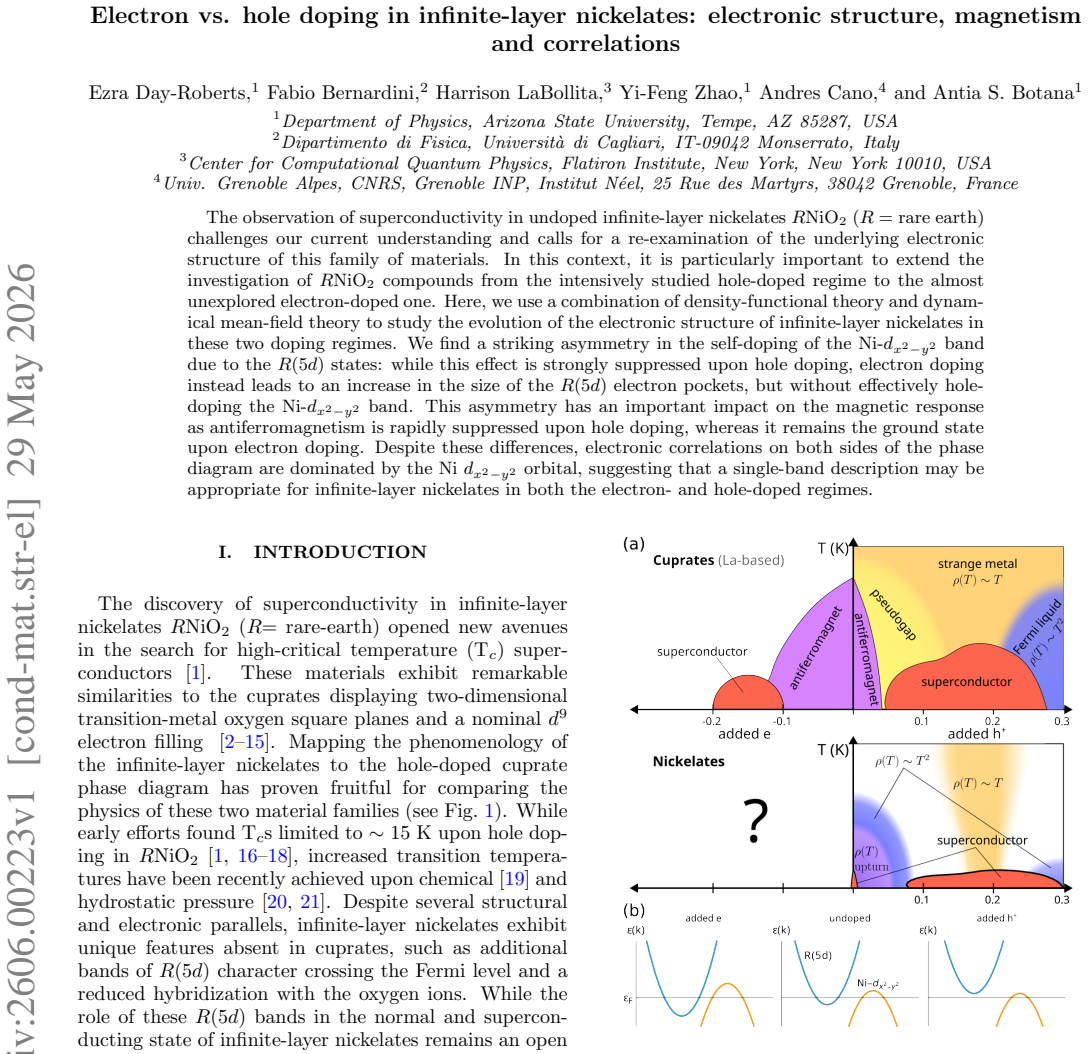
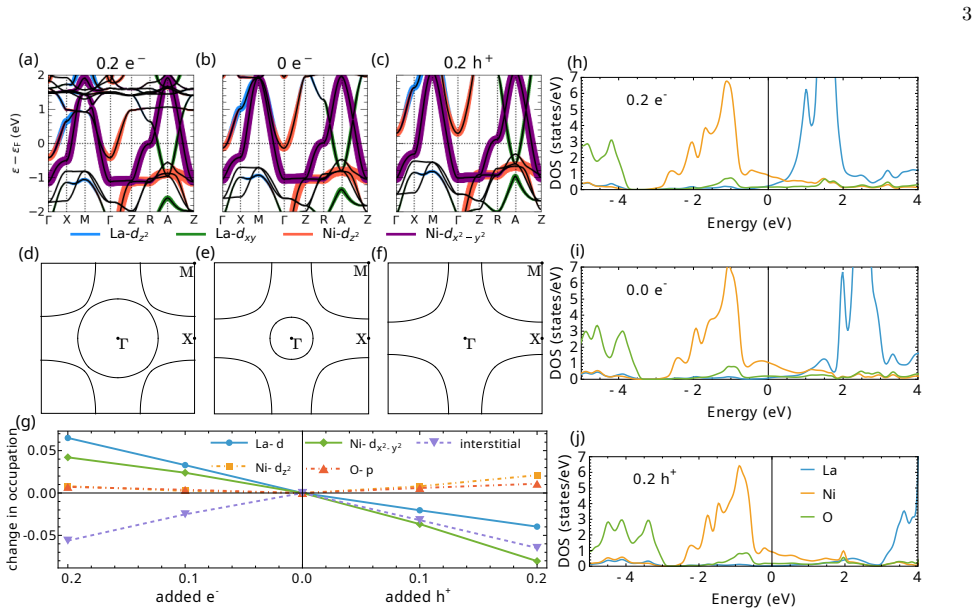
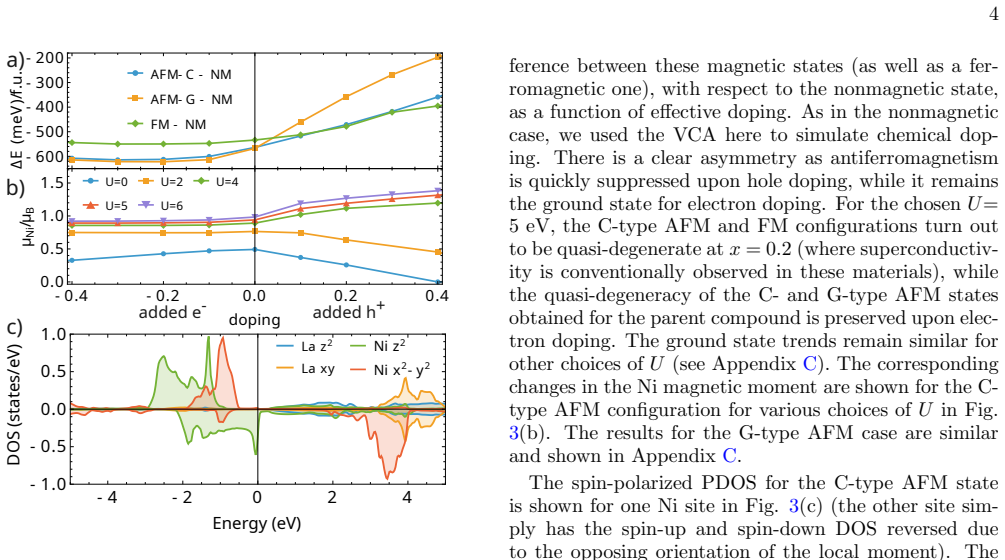
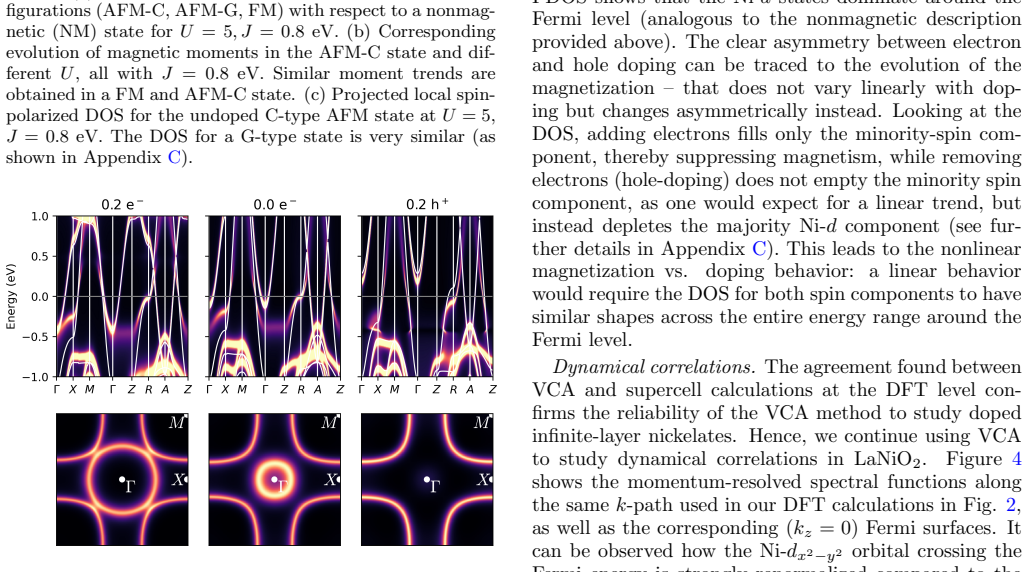
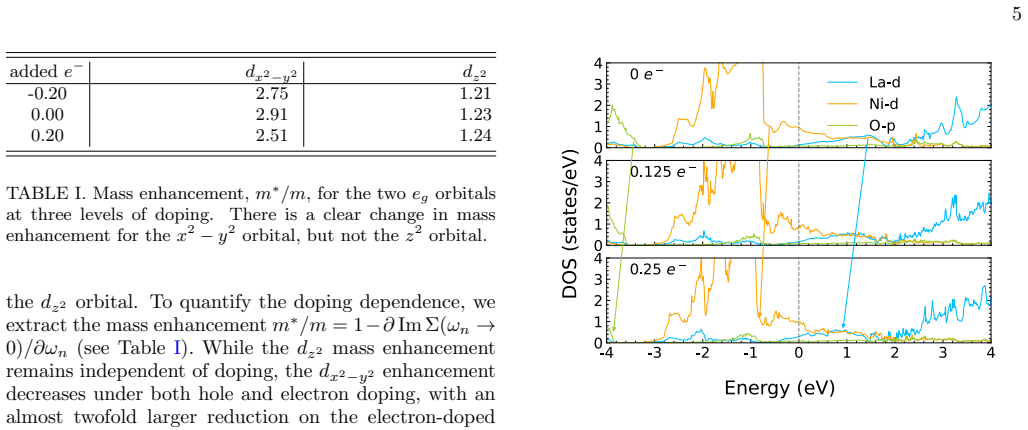
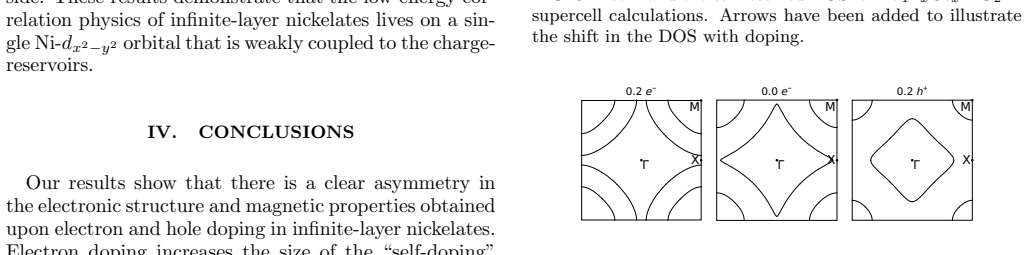
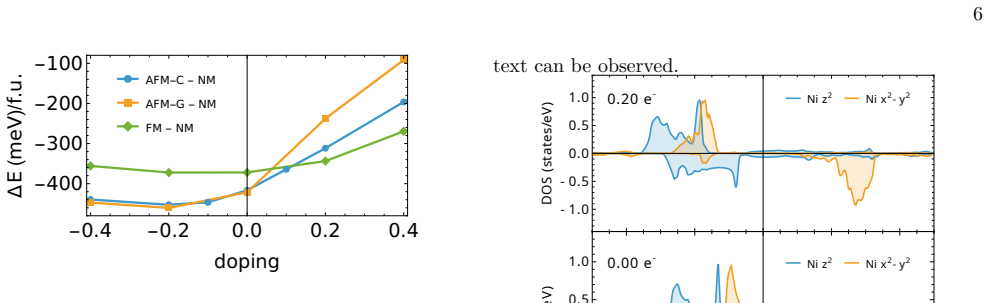
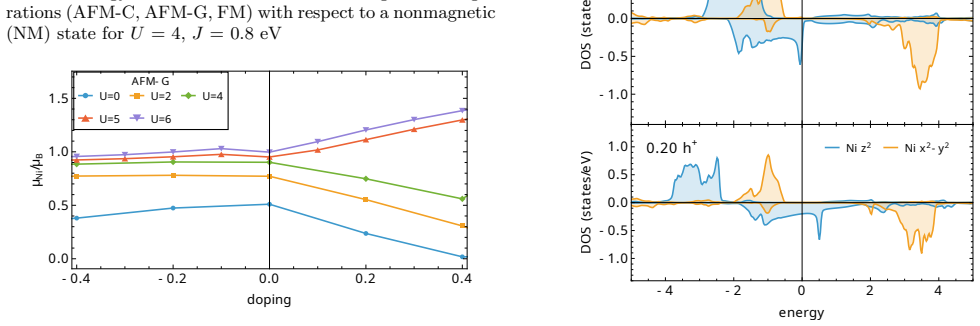
The central claim is a striking asymmetry in the self-doping of the Ni-d_x2-y2 band due to the R(5d) states: while this effect is strongly suppressed upon hole doping, electron doping instead leads to an increase in the size of the R(5d) electron pockets, but without effectively hole-doping the Ni-d_x2-y2 band. This asymmetry has an important impact on the magnetic response as antiferromagnetism is rapidly suppressed upon hole doping, whereas it remains the ground state upon electron doping. Despite these differences, electronic correlations on both sides of the phase diagram are dominated by the Ni d_x2-y2 orbital, suggesting that a single-band description may be appropriate for infinite-la
What carries the argument
The asymmetry in self-doping of the Ni-d_x2-y2 band by R(5d) states, which controls the magnetic ground state while leaving orbital dominance unchanged.
If this is right
- Antiferromagnetism is rapidly suppressed upon hole doping but remains the ground state upon electron doping.
- Electronic correlations are dominated by the Ni d_x2-y2 orbital on both sides of the phase diagram.
- A single-band description may be appropriate for infinite-layer nickelates in both the electron- and hole-doped regimes.
Where Pith is reading between the lines
- The shared dominance of the Ni d_x2-y2 orbital suggests that theoretical models developed for hole-doped superconductivity could be directly tested in the electron-doped regime.
- If structural relaxations were included in the calculations, they might modify the size of the reported asymmetry between the two doping directions.
Load-bearing premise
The DFT+DMFT calculations with the chosen interaction parameters and treatment of rare-earth 5d states accurately capture the doping evolution and magnetic ground states without significant errors from the single-site DMFT approximation or neglected structural relaxations.
What would settle it
ARPES data showing whether R(5d) electron pocket size grows with electron doping while Ni-d_x2-y2 filling stays unchanged, or neutron scattering confirming that long-range antiferromagnetic order survives only on the electron-doped side of the phase diagram.
Figures
read the original abstract
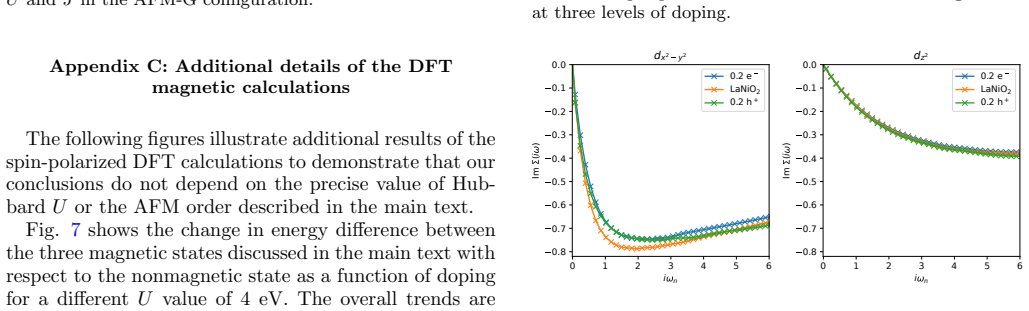
The observation of superconductivity in undoped infinite-layer nickelates $R$NiO$_2$ ($R$ = rare earth) challenges our current understanding and calls for a re-examination of the underlying electronic structure of this family of materials. In this context, it is particularly important to extend the investigation of $R$NiO$_2$ compounds from the intensively studied hole-doped regime to the almost unexplored electron-doped one. Here, we use a combination of density-functional theory and dynamical mean-field theory to study the evolution of the electronic structure of infinite-layer nickelates in these two doping regimes. We find a striking asymmetry in the self-doping of the Ni-$d_{x^2-y^2}$ band due to the $R(5d)$ states: while this effect is strongly suppressed upon hole doping, electron doping instead leads to an increase in the size of the $R(5d)$ electron pockets, but without effectively hole-doping the Ni-$d_{x^2-y^2}$ band. This asymmetry has an important impact on the magnetic response as antiferromagnetism is rapidly suppressed upon hole doping, whereas it remains the ground state upon electron doping. Despite these differences, electronic correlations on both sides of the phase diagram are dominated by the Ni $d_{x^2-y^2}$ orbital, suggesting that a single-band description may be appropriate for infinite-layer nickelates in both the electron- and hole-doped regimes.
Editorial analysis
A structured set of objections, weighed in public.
Referee Report
Summary. The paper uses DFT+DMFT to compare electron and hole doping in infinite-layer nickelates RNiO2. It reports an asymmetry in R(5d) self-doping of the Ni d_x2-y2 band (suppressed on hole doping, enhanced on electron doping without effective hole-doping of Ni), which leads to rapid AFM suppression on the hole side but persistent AFM on the electron side; correlations remain dominated by Ni d_x2-y2 on both sides, supporting a single-band picture.
Significance. If the reported doping asymmetry in self-doping and magnetism is robust, the work clarifies why magnetic and potentially superconducting properties differ across the phase diagram in nickelates, distinct from cuprates, and strengthens the case for orbital-selective single-band models in both doping regimes.
major comments (2)
- [Methods and magnetic results sections] The central magnetic asymmetry (AFM rapidly suppressed on hole doping but stable on electron doping) rests on single-site DMFT at fixed structure. Single-site DMFT is known to omit spatial spin fluctuations that can destabilize long-range AFM; without explicit checks (e.g., comparison to cluster DMFT or estimated fluctuation corrections) it is unclear whether the reported persistence of AFM on the electron side survives this approximation.
- [Computational details and results on electronic structure] The size and position of R(5d) pockets (and thus the self-doping asymmetry) are sensitive to the chosen Ni U and J values as well as any doping-induced lattice relaxation that shifts the 5d bands. The manuscript does not report systematic variation of U/J or structural relaxation tests that would confirm the asymmetry direction is stable under these choices.
minor comments (2)
- [Abstract] The abstract states the conclusions without quoting the specific U, J, or double-counting scheme employed; these should be stated explicitly in the abstract or first paragraph of the methods for reproducibility.
- [Figure captions and magnetism discussion] Figure captions and text should clarify whether the reported magnetic energies include or exclude the R(5d) contribution explicitly, to allow readers to separate the self-doping effect from other factors.
Simulated Author's Rebuttal
We thank the referee for the careful reading of our manuscript and the constructive comments. We address each major point below and will revise the manuscript accordingly where needed to strengthen the presentation.
read point-by-point responses
-
Referee: [Methods and magnetic results sections] The central magnetic asymmetry (AFM rapidly suppressed on hole doping but stable on electron doping) rests on single-site DMFT at fixed structure. Single-site DMFT is known to omit spatial spin fluctuations that can destabilize long-range AFM; without explicit checks (e.g., comparison to cluster DMFT or estimated fluctuation corrections) it is unclear whether the reported persistence of AFM on the electron side survives this approximation.
Authors: We agree that single-site DMFT omits spatial spin fluctuations, which can reduce the stability of long-range AFM order compared to cluster methods. Our reported asymmetry originates from the doping-dependent evolution of the R(5d) self-doping and the resulting filling of the Ni d_x2-y2 band, which is captured already at the single-site level. We will add an explicit discussion of this approximation's limitations in the methods section, including references to fluctuation corrections in related nickelate and cuprate studies, and note that the qualitative trend (rapid suppression on hole doping vs. persistence on electron doping) is tied to the electronic-structure asymmetry rather than the absolute T_N values. revision: partial
-
Referee: [Computational details and results on electronic structure] The size and position of R(5d) pockets (and thus the self-doping asymmetry) are sensitive to the chosen Ni U and J values as well as any doping-induced lattice relaxation that shifts the 5d bands. The manuscript does not report systematic variation of U/J or structural relaxation tests that would confirm the asymmetry direction is stable under these choices.
Authors: We used U = 6 eV and J = 0.9 eV, values standard in the nickelate literature, with fixed experimental lattice parameters. Limited internal tests with ±1 eV variations in U preserved the direction of the self-doping asymmetry. We will include a supplementary figure or note showing the robustness of the R(5d) pocket evolution under modest U/J changes and will discuss the expected effect of doping-induced relaxation (which primarily affects the 5d bands but does not reverse the reported asymmetry in our fixed-structure scans). revision: yes
Circularity Check
No circularity: results are direct numerical outputs of DFT+DMFT
full rationale
The paper's claims derive from applying standard DFT+DMFT to the infinite-layer nickelate Hamiltonian under electron and hole doping. The reported asymmetry in R(5d) self-doping, its effect on the Ni d_x2-y2 band, and the resulting magnetic ground states are computed outputs, not algebraic reductions or fitted quantities renamed as predictions. No self-definitional loops, no load-bearing self-citations that collapse the central results to unverified premises, and no ansatz smuggled via citation appear in the derivation chain. The work is self-contained as a computational study whose validity rests on the method's approximations rather than on any internal equivalence to its inputs.
Axiom & Free-Parameter Ledger
free parameters (1)
- Hubbard U and Hund's J for Ni d orbitals
axioms (1)
- domain assumption Single-site DMFT approximation is sufficient to capture the doping-dependent magnetic and electronic properties
Reference graph
Works this paper leans on
-
[1]
D. Li, K. Lee, B. Y. Wang, M. Osada, S. Crossley, H. R. Lee, Y. Cui, Y. Hikita, and H. Y. Hwang, Nature572, 624 (2019)
2019
-
[2]
A. S. Botana and M. R. Norman, Phys. Rev. X10, 011024 (2020)
2020
-
[3]
J. Karp, A. S. Botana, M. R. Norman, H. Park, M. Zingl, and A. Millis, Phys. Rev. X10, 021061 (2020)
2020
-
[4]
Olevano, F
V. Olevano, F. Bernardini, X. Blase, and A. Cano, Phys. Rev. B101, 161102 (2020)
2020
-
[5]
Lechermann, Phys
F. Lechermann, Phys. Rev. B101, 081110(R) (2020)
2020
-
[6]
Lechermann, Phys
F. Lechermann, Phys. Rev. X10, 041002 (2020)
2020
-
[7]
Lechermann, Phys
F. Lechermann, Phys. Rev. B105, 155109 (2022)
2022
-
[8]
LaBollita and A
H. LaBollita and A. S. Botana, Phys. Rev. B104, 035148 (2021)
2021
-
[9]
Bernardini, A
F. Bernardini, A. Demourgues, and A. Cano, Phys. Rev. Mater.5, L061801 (2021)
2021
-
[10]
Wissel, F
K. Wissel, F. Bernardini, H. Oh, S. Vasala, R. Schoch, B. Blaschkowski, P. Glatzel, M. Bauer, O. Clemens, and A. Cano, Chem. Mater.34, 7201 (2022)
2022
-
[11]
P. Worm, L. Si, M. Kitatani, R. Arita, J. M. Tomczak, and K. Held, Phys. Rev. Mater.6, L091801 (2022)
2022
-
[12]
Kitatani, L
M. Kitatani, L. Si, O. Janson, R. Arita, Z. Zhong, and K. Held, npj Quantum Mater.5, 59 (2020)
2020
-
[13]
Been, W.-S
E. Been, W.-S. Lee, H. Y. Hwang, Y. Cui, J. Zaanen, T. Devereaux, B. Moritz, and C. Jia, Phys. Rev. X11, 011050 (2021)
2021
-
[14]
Leonov, S
I. Leonov, S. L. Skornyakov, and S. Y. Savrasov, Phys. Rev. B101, 241108 (2020)
2020
-
[15]
B. Kang, C. Melnick, P. Semon, S. Ryee, M. J. Han, G. Kotliar, and S. Choi, npj Quantum Mater.8, 35 (2023)
2023
-
[16]
Osada, B
M. Osada, B. Y. Wang, B. H. Goodge, K. Lee, H. Yoon, K. Sakuma, D. Li, M. Miura, L. F. Kourkoutis, and H. Y. Hwang, Nano Lett.20, 5735 (2020)
2020
-
[17]
Osada, B
M. Osada, B. Y. Wang, B. H. Goodge, S. P. Harvey, K. Lee, D. Li, L. F. Kourkoutis, and H. Y. Hwang, Adv. Mater.33, 2104083 (2021)
2021
-
[18]
S. Zeng, C. Li, L. E. Chow, Y. Cao, Z. Zhang, C. S. Tang, X. Yin, Z. S. Lim, J. Hu, P. Yang, and A. Ariando, Sci. Adv.8, eabl9927 (2022)
2022
-
[19]
S. L. E. Chow, Z. Luo, and A. Ariando, Nature642, 58 (2025)
2025
-
[20]
High-temperature superconductivity in Nd$_{0.85}$Sr$_{0.15}$NiO$_2$ membranes under pressure
K. Lee, et al., and H. Y. Hwang, arXiv preprint arXiv:2604.09525 (2026), arXiv:2604.09525 [cond- mat.supr-con]
work page internal anchor Pith review Pith/arXiv arXiv 2026
-
[21]
N. N. Wang, M. W. Yang, Z. Yang, K. Y. Chen, H. Zhang, Q. H. Zhang, Z. H. Zhu, Y. Uwatoko, L. Gu, X. L. Dong, J. P. Sun, K. J. Jin, and J.-G. Cheng, Nat. Commun.13, 4367 (2022)
2022
-
[22]
Jiang, L
P. Jiang, L. Si, Z. Liao, and Z. Zhong, Phys. Rev. B100, 201106 (2019)
2019
-
[23]
Nomura, M
Y. Nomura, M. Hirayama, T. Tadano, Y. Yoshimoto, K. Nakamura, and R. Arita, Phys. Rev. B100, 205138 (2019)
2019
-
[24]
Z. Liu, Z. Ren, W. Zhu, Z. Wang, and J. Yang, npj Quantum Mater.5, 31 (2020)
2020
-
[25]
X. Wu, D. Di Sante, T. Schwemmer, W. Hanke, H. Y. Hwang, S. Raghu, and R. Thomale, Phys. Rev. B101, 060504 (2020)
2020
-
[26]
Choi, K.-W
M.-Y. Choi, K.-W. Lee, and W. E. Pickett, Phys. Rev. B101, 020503 (2020)
2020
-
[27]
S. Ryee, H. Yoon, T. J. Kim, M. Y. Jeong, and M. J. Han, Phys. Rev. B.101(2020)
2020
-
[28]
Hu and C
L.-H. Hu and C. Wu, Phys. Rev. Res.1, 032046 (2019)
2019
-
[29]
Sakakibara, H
H. Sakakibara, H. Usui, K. Suzuki, T. Kotani, H. Aoki, and K. Kuroki, Phys. Rev. Lett.125, 077003 (2020)
2020
-
[30]
Werner and S
P. Werner and S. Hoshino, Phys. Rev. B101, 041104 (2020)
2020
-
[31]
Zhang, L
H. Zhang, L. Jin, S. Wang, B. Xi, X. Shi, F. Ye, and J.-W. Mei, Phys. Rev. Res.2, 013214 (2020)
2020
-
[32]
Zhang and A
Y.-H. Zhang and A. Vishwanath, Phys. Rev. Res.2, 023112 (2020)
2020
-
[33]
LaBollita, A
H. LaBollita, A. Hampel, J. Karp, A. S. Botana, and A. J. Millis, Phys. Rev. B107, 205155 (2023)
2023
-
[34]
N. P. Armitage, P. Fournier, and R. L. Greene, Rev. Mod. Phys.82, 2421 (2010)
2010
-
[35]
Y.-T. Hsu, K. Lee, S. Badoux, C. Duffy, A. Cuoghi, B. Y. Wang, A. Kool, I. Ha¨ ık-Dunn, H. Y. Hwang, and N. E. Hussey, Nat. Commun.15, 9863 (2024)
2024
-
[36]
B. Y. Wang, K. Lee, and B. H. Goodge, Annu. Rev. Condens. Matter Phys.15, 305 (2024)
2024
-
[37]
Sahib, A
H. Sahib, A. Raji, F. Rosa, G. Merzoni, G. Ghiringhelli, M. Salluzzo, A. Gloter, N. Viart, and D. Preziosi, Adv. Mater.37, 2416187 (2025)
2025
-
[38]
C. T. Parzyck, Y. Wu, L. Bhatt, M. Kang, Z. Arthur, T. M. Pedersen, R. Sutarto, S. Fan, J. Pelliciari, V. Bisogni, G. Herranz, A. B. Georgescu, D. G. Hawthorn, L. F. Kourkoutis, D. A. Muller, D. G. Schlom, and K. M. Shen, Phys. Rev. X15, 021048 (2025)
2025
-
[39]
Q. Song, S. Doyle, G. A. Pan, I. El Baggari, D. Fer- enc Segedin, D. C´ ordova Carrizales, J. Nordlander, C. Tzschaschel, J. R. Ehrets, Z. Hasan, H. El-Sherif, J. Krishna, C. Hanson, H. LaBollita, A. Bostwick, C. Jozwiak, E. Rotenberg, S.-Y. Xu, A. Lanzara, A. T. N’Diaye, C. A. Heikes, Y. Liu, H. Paik, C. M. Brooks, B. Pamuk, J. T. Heron, P. Shafer, W. D....
2023
-
[40]
Alonso, M
J. Alonso, M. Martinez-Lope, and M. Hidalgo, J. Solid State Chem.116, 146 (1995)
1995
-
[41]
Kresse and J
G. Kresse and J. Furthm¨ uller, Phys. Rev. B54, 11169 (1996)
1996
-
[42]
Kresse and D
G. Kresse and D. Joubert, Phys. Rev. B59, 1758 (1999)
1999
-
[43]
J. P. Perdew, K. Burke, and M. Ernzerhof, Phys. Rev. Lett.77, 3865 (1996)
1996
-
[44]
Blaha, K
P. Blaha, K. Schwarz, F. Tran, R. Laskowski, G. K. H. Madsen, and L. D. Marks, J. Chem. Phys.152, 074101 (2020)
2020
-
[45]
A. I. Liechtenstein, V. I. Anisimov, and J. Zaanen, Phys. Rev. B52, R5467(R) (1995)
1995
-
[46]
TRIQS: A Toolbox for Research on Interacting Quantum Systems
O. Parcollet, M. Ferrero, T. Ayral, H. Hafermann, I. Krivenko, L. Messio, and P. Seth, Comput. Phys. Commun.196, 398 (2015), 1504.01952
work page internal anchor Pith review Pith/arXiv arXiv 2015
-
[47]
P. Seth, I. Krivenko, M. Ferrero, and O. Parcollet, Com- put. Phys. Commun.200, 274 (2016)
2016
-
[48]
Aichhorn, L
M. Aichhorn, L. Pourovskii, P. Seth, V. Vildosola, M. Zingl, O. E. Peil, X. Deng, J. Mravlje, G. J. Kraberger, C. Martins, M. Ferrero, and O. Parcollet, Comput. Phys. Commun.204, 200 (2016)
2016
-
[49]
E. A. Nowadnick, J. P. Ruf, H. Park, P. D. C. King, D. G. Schlom, K. M. Shen, and A. J. Millis, Phys. Rev. B92, 245109 (2015). 8
2015
-
[50]
Z. Chen, M. Osada, D. Li, E. M. Been, S.-D. Chen, M. Hashimoto, D. Lu, S.-K. Mo, K. Lee, B. Y. Wang, F. Rodolakis, J. L. McChesney, C. Jia, B. Moritz, T. P. Devereaux, H. Y. Hwang, and Z.-X. Shen, Matter5, 1806 (2022)
2022
-
[51]
Held, Adv
K. Held, Adv. Phys.56, 829 (2007)
2007
-
[52]
Boehnke, H
L. Boehnke, H. Hafermann, M. Ferrero, F. Lechermann, and O. Parcollet, Phys. Rev. B84, 075145 (2011)
2011
-
[53]
Q. N. Meier, J. B. de Vaulx, F. Bernardini, A. S. Botana, X. Blase, V. Olevano, and A. Cano, Phys. Rev. B109, 184505 (2024)
2024
-
[54]
Di Cataldo, P
S. Di Cataldo, P. Worm, J. M. Tomczak, L. Si, and K. Held, Nat. Commun.15, 3952 (2024)
2024
-
[55]
H. Lu, M. Rossi, A. Nag, M. Osada, D. F. Li, K. Lee, B. Y. Wang, M. Garcia-Fernandez, S. Agrestini, Z. X. Shen, E. M. Been, B. Moritz, T. P. Devereaux, J. Zaanen, H. Y. Hwang, K.-J. Zhou, and W. S. Lee, Science373, 213 (2021)
2021
-
[56]
Kapeghian and A
J. Kapeghian and A. S. Botana, Phys. Rev. B102, 205130 (2020)
2020
-
[57]
Krishna, H
J. Krishna, H. LaBollita, A. O. Fumega, V. Pardo, and A. S. Botana, Phys. Rev. B102, 224506 (2020)
2020
discussion (0)
Sign in with ORCID, Apple, or X to comment. Anyone can read and Pith papers without signing in.