REVIEW 3 major objections 2 minor 79 references
X-ray flashes, X-ray-rich events, and normal gamma-ray bursts share common progenitors, with differences arising from jet baryon loading, energy, structure, and orientation.
Reviewed by Pith at T0; open to challenge. T0 means a machine referee read the full paper against a public rubric. the ladder, T0–T4 →
BeppoSAX GRB sample shows XRFs, XRRs and normal GRBs share similar spectral indexes and afterglow fractions but differ in peak energy, supporting shared origins with variations in jet loading and orientation.
T0 review reviewed 2026-06-28 challenge →
load-bearing objection BeppoSAX sample of 96 events shows uniform X-ray afterglow rates across classes but the common-progenitor claim rests on a classification that uses the same spectral parameters driving the reported similarities. the 3 major comments →
Comparative properties of X-Ray Flashes and Gamma-Ray Bursts from BeppoSAX observations of Fast X-ray Transients
The pith
A machine-rendered reading of the paper's core claim, the machinery that carries it, and where it could break.
The reading
Core claim
The analysis of 96 events shows that XRFs, XRRs, and GRBs have broadly similar spectral indexes and afterglow properties, with peak energy as the main distinguishing factor. Nine events exhibit soft X-ray precursors. The similarities suggest common progenitors, with differences attributable to varying baryon loading, energy, jet structure, and observer orientation. A comparison with Einstein Probe indicates it will reach fainter events first hinted at by GRB980425.
What carries the argument
Division of events into XRF, XRR, and GRB classes by peak energy thresholds and fluence ratios, followed by direct comparison of Band function parameters and afterglow detection fractions across classes.
Load-bearing premise
The criteria used to divide the 96 events into XRF, XRR, and GRB classes do not introduce selection biases that artificially create the observed similarities in durations and afterglow properties.
What would settle it
A larger sample in which XRFs show systematically lower X-ray afterglow detection rates or different duration distributions from normal GRBs would contradict the claim of shared properties.
If this is right
- The three classes form a continuum differentiated primarily by jet parameters rather than distinct populations.
- Orientation and baryon loading account for the full observed range in peak energies and luminosities.
- X-ray afterglow detection fractions near 90 percent apply uniformly across the spectral classes.
- More sensitive instruments will detect additional faint members of the same population.
Where Pith is reading between the lines
- If viewing angle effects dominate the observed differences, the intrinsic rate of these events exceeds the detected sample size.
- Progenitor models must accommodate a single mechanism producing events across a wide range of peak energies.
- Larger samples could test whether peak energy correlates directly with afterglow brightness as expected from jet structure variations.
Editorial analysis
A structured set of objections, weighed in public.
Referee Report
Summary. The manuscript analyzes a homogeneous sample of 96 GRBs detected by BeppoSAX WFC and GRBM. It classifies 36 as XRFs, 40 as XRRs and 20 as normal GRBs, reports that Band-function spectral indices are broadly similar across classes while E_peak ranges from 8.5 keV (XRFs) to 83 keV (GRBs), notes soft X-ray precursors in 9 of 67 dual-detected events, and finds ~90% X-ray afterglow detection rate (with 35% optical and 33% radio) that is statistically indistinguishable across the three classes. The central claim is that these similarities indicate common progenitors, with observed differences attributable to variations in baryon loading, energy, jet structure and observer orientation; a brief comparison with Einstein Probe is included.
Significance. If the classification criteria prove free of selection bias, the work supplies direct observational support for a unified jet-driven progenitor model spanning XRFs through classical GRBs. The reported uniformity in afterglow detection fractions and the hint of a fainter population accessible to Einstein Probe are potentially valuable constraints on jet physics and luminosity functions.
major comments (3)
- [Abstract / classification section] Abstract and classification description: the division into 36 XRF / 40 XRR / 20 GRB events is stated to rest on peak-energy thresholds and fluence ratios, yet the explicit numerical boundaries (e.g., the E_peak value separating XRF from XRR) and the precise fluence-ratio definition are not supplied. Because E_peak is simultaneously the classification variable and the quantity reported to drive the spectral shape (8.5–83 keV range), it is impossible to verify that the claimed similarities in spectral indices, durations and afterglow fractions are independent of the classification scheme.
- [Abstract] Abstract: the statement that “about 90% of the events … exhibit an X-ray afterglow, with a similar fraction for the three classes” is given without uncertainties, sample-size breakdowns per class, or any control for detection-threshold differences between soft and hard events. This directly bears on the weakest assumption identified in the stress-test note; without these quantifications the uniformity cannot be assessed as evidence against selection bias.
- [Abstract] Abstract: no error bars, confidence intervals or fitting-method details accompany the reported E_peak range, spectral-index distributions or precursor time offsets (14–105 s). These omissions prevent evaluation of whether the reported similarities are statistically robust or merely consistent with the classification boundaries.
minor comments (2)
- [Abstract] Abstract contains two typographical errors: “XRF keV” and the duplicated “the the corresponding fractions”.
- [Methods / results] The manuscript should supply a table or explicit list of the 96 events with their measured E_peak, fluence ratios and class assignments so that the classification can be reproduced.
Simulated Author's Rebuttal
We thank the referee for the thorough review and valuable feedback on our manuscript. We address each of the major comments below and will revise the manuscript accordingly to improve clarity and provide the requested statistical details.
read point-by-point responses
-
Referee: [Abstract / classification section] Abstract and classification description: the division into 36 XRF / 40 XRR / 20 GRB events is stated to rest on peak-energy thresholds and fluence ratios, yet the explicit numerical boundaries (e.g., the E_peak value separating XRF from XRR) and the precise fluence-ratio definition are not supplied. Because E_peak is simultaneously the classification variable and the quantity reported to drive the spectral shape (8.5–83 keV range), it is impossible to verify that the claimed similarities in spectral indices, durations and afterglow fractions are independent of the classification scheme.
Authors: We agree that the explicit classification criteria should be provided to allow independent verification. The classification follows the standard definitions in the GRB literature. We will include the precise numerical boundaries (E_peak thresholds and fluence ratio definitions) in the revised manuscript. The spectral indices are fitted independently in the Band function, and we will add distributions to demonstrate the similarities are not due to the classification scheme. revision: yes
-
Referee: [Abstract] Abstract: the statement that “about 90% of the events … exhibit an X-ray afterglow, with a similar fraction for the three classes” is given without uncertainties, sample-size breakdowns per class, or any control for detection-threshold differences between soft and hard events. This directly bears on the weakest assumption identified in the stress-test note; without these quantifications the uniformity cannot be assessed as evidence against selection bias.
Authors: We agree and will provide per-class sample sizes, fractions with uncertainties, and address potential detection threshold biases in the revised manuscript. revision: yes
-
Referee: [Abstract] Abstract: no error bars, confidence intervals or fitting-method details accompany the reported E_peak range, spectral-index distributions or precursor time offsets (14–105 s). These omissions prevent evaluation of whether the reported similarities are statistically robust or merely consistent with the classification boundaries.
Authors: We will add error bars, confidence intervals, and fitting method details to the reported quantities in the revised manuscript. revision: yes
Circularity Check
No circularity: observational classifications and property comparisons remain independent of inputs
full rationale
The paper defines XRF/XRR/GRB classes via explicit peak-energy thresholds and fluence ratios, then reports that spectral indices (distinct from Epeak), durations, and afterglow detection fractions (~90% across classes) are similar. These measured quantities are not redefined in terms of the classification criteria, nor are any fitted parameters or self-citations used to force the reported similarities. The inference of common progenitors is an interpretive step resting on the observed data rather than a definitional reduction. No equations, ansatzes, or load-bearing self-citations appear that would make the central claim equivalent to its inputs by construction.
Axiom & Free-Parameter Ledger
free parameters (1)
- Peak-energy boundaries separating XRF/XRR/GRB classes
axioms (1)
- domain assumption The BeppoSAX Wide Field Cameras plus GRBM sample of 96 events is homogeneous and complete
Cite this review
Pith. "Pith review of Comparative properties of X-Ray Flashes and Gamma-Ray Bursts from BeppoSAX observations of Fast X-ray Transients." pith.science (2026). https://pith.science/paper/MNDYVY4C
@misc{pith2026260600225,
  author       = {Pith},
  title        = {Pith review of: Comparative properties of X-Ray Flashes and Gamma-Ray Bursts from BeppoSAX observations of Fast X-ray Transients},
  year         = {2026},
  howpublished = {\url{https://pith.science/paper/MNDYVY4C}},
  note         = {Machine review of arXiv:2606.00225}
}
read the original abstract
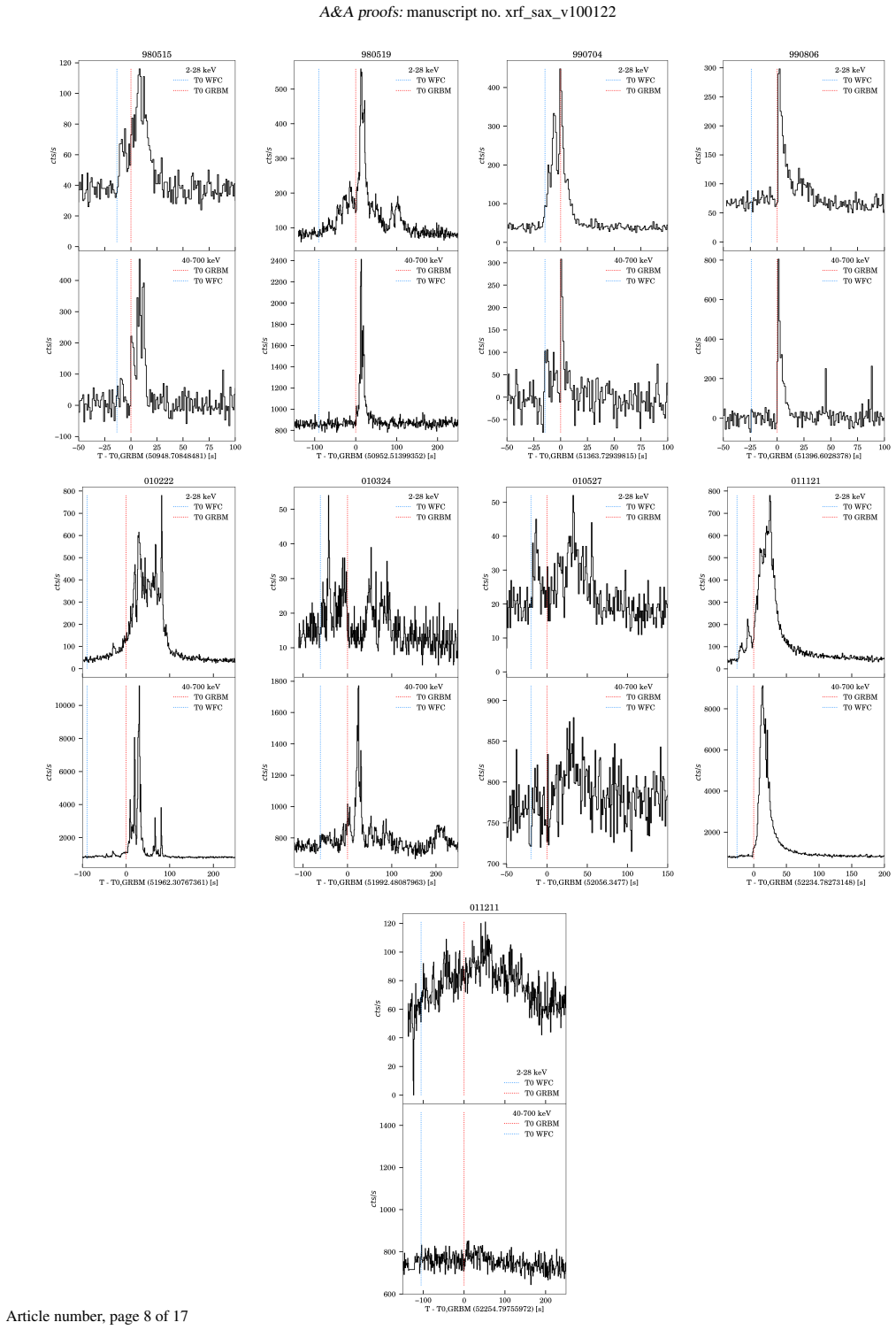
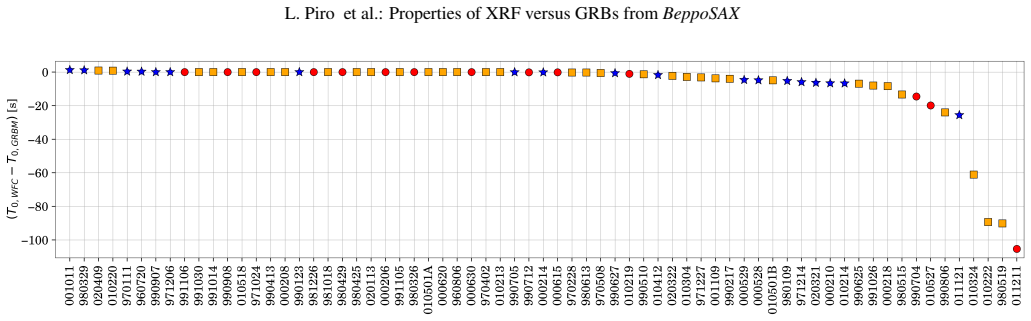
We present the homogeneous and complete sample of 96 bona-fide Gamma Ray Bursts (GRBs) detected by the Wide Field Cameras and Gamma Ray Burst Monitor of BeppoSAX. We derive the spectral and temporal properties of the prompt emission, and assess the properties of the soft population of GRB, namely X-ray flashes (XRFs) in comparison with normal GRBs. We find that 36 events are XRFs, 40 X-ray rich events (XRR), and 20 normal GRBs. We analyze the distribution of the spectral parameters of the Band function, finding that the spectral indexes of the three classes are broadly similar. On the contrary the peak energy is the parameter driving the spectra shape, from 8.5 keV for XRF keV to 83 keV for GRBs. For the 67 events that are detected in both instruments we find that 9 events exhibit a soft X-ray precursor taking place from 14 to 105 s before the onset of the gamma-ray burst. About 90\% of the events that were identified in real time exhibit an X-ray afterglow, with a similar fraction for the three classes. In the optical and radio the the corresponding fractions are 35% and 33%. All the similarities in the spectrum, duration and afterglow properties suggest common progenitors for the three classes, where the differences are likely a combination of the effect of different baryon loading, energy, structure and orientation of the jet with respect to the observer. A comparison with Einstein Probe shows that the latter, thanks to its sensitivity, reaches out to a population of fainter and more numerous events, whose presence was firstly hinted at by the unique very low luminosity BeppoSAX GRB980425.
Figures




Reference graph
Works this paper leans on
-
[1]
2006, MNRAS, 372, 233
Amati, L. 2006, MNRAS, 372, 233
2006
-
[2]
2002, A&A, 390, 81–89
Amati, L., Frontera, F., Tavani, M., et al. 2002, A&A, 390, 81–89
2002
-
[3]
Amati, L., Frontera, F., in ’t Zand, J. J. M., et al. 2004, A&A, 426, 415
2004
-
[4]
A., Priedhorsky, W
Arefiev, V . A., Priedhorsky, W. C., & Borozdin, K. N. 2003, ApJ, 586, 1238
2003
-
[5]
2007, Publications of the Astronomi- cal Society of Japan, 59, 695
Arimoto, M., Kawai, N., Suzuki, M., et al. 2007, Publications of the Astronomi- cal Society of Japan, 59, 695
2007
-
[6]
2025, ApJS, 281, 20
Aryan, A., Chen, T.-W., Yang, S., et al. 2025, ApJS, 281, 20
2025
-
[7]
Band, D. L. 1997, ApJ, 486, 928
1997
-
[8]
P., et al
Barraud, C., Olive, J.-F., Lestrade, J. P., et al. 2003, A&A, 400, 1021
2003
-
[9]
2018, ApJ, 866, 97
Bi, X., Mao, J., Liu, C., & Bai, J.-M. 2018, ApJ, 866, 97
2018
-
[10]
S., Fox, D., van Dokkum, P
Bloom, J. S., Fox, D., van Dokkum, P. G., et al. 2003, ApJ, 599, 957
2003
-
[11]
C., Perola, G
Boella, G., Butler, R. C., Perola, G. C., et al. 1997, A&AS, 122, 299
1997
-
[12]
2012, ApJ, 749, 110
Bromberg, O., Nakar, E., Piran, T., & Sari, R. 2012, ApJ, 749, 110
2012
-
[13]
N., Kennea, J
Burrows, D. N., Kennea, J. A., Ghisellini, G., et al. 2011, Nature, 476, 421
2011
-
[14]
J., et al
Campana, S., Mangano, V ., Blustin, A. J., et al. 2006, Nature, 442, 1008–1010
2006
-
[15]
2021, ApJ, 915, 46
Chen, J.-C., Urata, Y ., & Huang, K. 2021, ApJ, 915, 46
2021
-
[16]
B., Lamb, D
Crew, G. B., Lamb, D. Q., Ricker, G. R., et al. 2003, ApJ, 599, 387
2003
-
[17]
2004, A&A, 422, 381 D’Alessio, V ., Piro, L., & Rossi, E
Dado, S., Dar, A., & De Rújula, A. 2004, A&A, 422, 381 D’Alessio, V ., Piro, L., & Rossi, E. M. 2006, A&A, 460, 653 D’Avanzo, P., Salvaterra, R., Sbarufatti, B., et al. 2012, MNRAS, 425, 506 de Pasquale, M., Piro, L., Gendre, B., et al. 2006, A&A, 455, 813
2004
-
[18]
D., Chiang, J., & Böttcher, M
Dermer, C. D., Chiang, J., & Böttcher, M. 1999, ApJ, 513, 656
1999
-
[19]
& Levinson, A
Eichler, D. & Levinson, A. 2004, ApJ, 614, L13
2004
-
[20]
Eyles-Ferris, R. A. J., Jonker, P. G., Levan, A. J., et al. 2025, ApJL, 988, L14
2025
-
[21]
E., in’t Zand, J
Fenimore, E. E., in’t Zand, J. J. M., Norris, J. P., Bonnell, J. T., & Nemiroff, R. J. 1995, ApJ, 448, L101
1995
-
[22]
1997, in EUV , X-Ray, and Gamma- Ray Instrumentation for Astronomy VIII, ed
Feroci, M., Frontera, F., Costa, E., et al. 1997, in EUV , X-Ray, and Gamma- Ray Instrumentation for Astronomy VIII, ed. O. H. W. Siegmund & M. A
1997
-
[23]
A., Amati, L., et al
Frontera, F., Antonelli, L. A., Amati, L., et al. 2000, ApJ, 540, 697
2000
-
[24]
2009, ApJS, 180, 192
Frontera, F., Guidorzi, C., Montanari, E., et al. 2009, ApJS, 180, 192
2009
-
[25]
& Piro, L
Galli, A. & Piro, L. 2006, A&A, 455, 413
2006
-
[26]
2007, A&A, 465, L13–L16
Gendre, B., Galli, A., & Piro, L. 2007, A&A, 465, L13–L16
2007
-
[27]
2016, ApJ, 833, 116
Geng, J.-J., Zhang, B., & Kuiper, R. 2016, ApJ, 833, 116
2016
-
[28]
B., & Arcavi, I
Gezari, S., Cenko, S. B., & Arcavi, I. 2017, ApJ, 851, L47
2017
-
[29]
2025, A&A, 703, A92
Gianfagna, G., Piro, L., Bruni, G., et al. 2025, A&A, 703, A92
2025
-
[30]
V ., Hamilton, T
Gotthelf, E. V ., Hamilton, T. T., & Helfand, D. J. 1996, ApJ, 466, 779
1996
-
[31]
2009, A&A, 499, 439
Guidorzi, C., Clemens, C., Kobayashi, S., et al. 2009, A&A, 499, 439
2009
-
[32]
2011, A&A, 526, A49
Guidorzi, C., Lacapra, M., Frontera, F., et al. 2011, A&A, 526, A49
2011
-
[33]
M., & Woods, P
Heise, J., in ’t Zand, J., Kippen, R. M., & Woods, P. M. 2003, AIP Conf.Proc., 662, 229
2003
-
[34]
F., Wu, X
Huang, Y . F., Wu, X. F., Dai, Z. G., Ma, H. T., & Lu, T. 2004, ApJ, 605, 300 in ’t Zand, J. J. M., Guidorzi, C., Heise, J., et al. 2025, BeppoSAX-WFC catalog of fast X-ray transients in ’t Zand, J. J. M., Heise, J., van Paradijs, J., & Fenimore, E. E. 1999, ApJ, 516, L57
2004
-
[35]
A., Brinkman, A
Jager, R., Mels, W. A., Brinkman, A. C., et al. 1997, A&AS, 125, 557
1997
-
[36]
Jiang, S.-Q., Xu, D., van Hoof, A. P. C., et al. 2025, ApJL, 988, L34
2025
-
[37]
S., & Terada, Y
Katsukura, D., Sakamoto, T., Tashiro, M. S., & Terada, Y . 2020, ApJ, 889, 110
2020
-
[38]
M., Woods, P
Kippen, R. M., Woods, P. M., Heise, J., et al. 2003, AIP Conf. Proc., 662, 244 Lamb & Graziani. 2003, AAS, 202, 450
2003
-
[39]
Q., Donaghy, T
Lamb, D. Q., Donaghy, T. Q., & Graziani, C. 2005, ApJ, 620, 355
2005
-
[40]
G., Evans, W
Laros, J. G., Evans, W. D., Fenimore, E. E., et al. 1984, ApJ, 286, 681
1984
-
[41]
2005, MNRAS, 357, 722
Lazzati, D. 2005, MNRAS, 357, 722
2005
-
[42]
Li, W.-X., Zhu, Z.-P., Zou, X.-Z., et al. 2025, arXiv e-prints, arXiv:2504.17034
-
[43]
2025, Nature Astronomy, 9, 564 López-Cámara, D., Lazzati, D., & Morsony, B
Liu, Y ., Sun, H., Xu, D., et al. 2025, Nature Astronomy, 9, 564 López-Cámara, D., Lazzati, D., & Morsony, B. J. 2016, ApJ, 826, 180
2025
-
[44]
& Balbus, S
Mummery, A. & Balbus, S. A. 2020, MNRAS, 492, 5655
2020
-
[45]
Murakami, T., Inoue, H., Nishimura, J., van Paradijs, J., & Fenimore, E. E. 1991, Nature, 350, 592
1991
-
[46]
Murakami, T., Ogasaka, Y ., Yoshida, A., & Fenimore, E. E. 1992, in Ameri- can Institute of Physics Conference Series, V ol. 265, American Institute of Physics Conference Series, ed. W. S. Paciesas & G. J. Fishman (AIP), 28
1992
-
[47]
& Sari, R
Nakar, E. & Sari, R. 2012, ApJ, 747, 88
2012
-
[48]
P., O’Brien, P
Patel, M., Gompertz, B. P., O’Brien, P. T., et al. 2023, MNRAS, 523, 4923
2023
-
[49]
2005, ApJ, 623, 314
Piro, L., De Pasquale, M., Soffitta, P., et al. 2005, ApJ, 623, 314
2005
-
[50]
1998, A&A, 329, 906
Piro, L., Heise, J., Jager, R., et al. 1998, A&A, 329, 906
1998
-
[51]
2005, ApJ, 625, L91
Ramirez-Ruiz, E., Granot, J., Kouveliotou, C., et al. 2005, ApJ, 625, L91
2005
-
[52]
& Lloyd-Ronning, N
Ramirez-Ruiz, E. & Lloyd-Ronning, N. M. 2002, New A, 7, 197
2002
-
[53]
C., Levan, A
Rastinejad, J. C., Levan, A. J., Jonker, P. G., et al. 2025, ApJL, 988, L13
2025
-
[54]
& Dwarkadas, V
Ross, M. & Dwarkadas, V . V . 2017, AJ, 153, 246
2017
-
[55]
v., Piro, L., & Troja, E
Ryan, G., Eerten, H. v., Piro, L., & Troja, E. 2020, ApJ, 896, 166
2020
-
[56]
D., et al
Sakamoto, T., Barbier, L., Barthelmy, S. D., et al. 2006, ApJ, 636, L73
2006
-
[57]
2008, ApJ, 679, 570
Sakamoto, T., Hullinger, D., Sato, G., et al. 2008, ApJ, 679, 570
2008
-
[58]
Q., Kawai, N., et al
Sakamoto, T., Lamb, D. Q., Kawai, N., et al. 2005, ApJ, 629, 311
2005
-
[59]
Y ., Sunyaev, R
Sazonov, S. Y ., Sunyaev, R. A., Terekhov, O. V ., et al. 1998, A&AS, 129, 1
1998
-
[60]
O., Osborne, J
Schady, P., Mason, K. O., Osborne, J. P., et al. 2006, ApJ, 643, 276
2006
-
[61]
M., Berger, E., Page, K
Soderberg, A. M., Berger, E., Page, K. L., et al. 2008, Nature, 453, 469
2008
-
[62]
M., Kulkarni, S
Soderberg, A. M., Kulkarni, S. R., Nakar, E., et al. 2006, Nature, 442, 1014
2006
-
[63]
P., Hamidani, H., Schroeder, G., et al
Srinivasaragavan, G. P., Hamidani, H., Schroeder, G., et al. 2025, ApJL, 988, L60
2025
-
[64]
Srinivasaragavan, G. P., Li, D., Hall, X. J., et al. 2025, arXiv e-prints, arXiv:2512.10239
work page internal anchor Pith review Pith/arXiv arXiv 2025
-
[65]
Starling, R. L. C., Wiersema, K., Levan, A. J., et al. 2011, MNRAS, 411, 2792
2011
-
[66]
2007, A&A, 461, 485
Stratta, G., Basa, S., Butler, N., et al. 2007, A&A, 461, 485
2007
-
[67]
E., Fenimore, E
Strohmayer, T. E., Fenimore, E. E., Murakami, T., & Yoshida, A. 1998, ApJ, 500, 873
1998
-
[68]
2005, ApJ, 635, 481
Toma, K., Yamazaki, R., & Nakamura, T. 2005, ApJ, 635, 481
2005
-
[69]
2015, ApJ, 806, 222
Urata, Y ., Huang, K., Yamazaki, R., & Sakamoto, T. 2015, ApJ, 806, 222
2015
-
[70]
& Mészáros, P
Wang, X.-Y . & Mészáros, P. 2007, ApJ, 670, 1247
2007
-
[71]
J., et al
Wu, S., Pérez-García, I., Castro-Tirado, A. J., et al. 2025, Galaxies, 13
2025
-
[72]
2002, ApJ, 571, L31
Yamazaki, R., Ioka, K., & Nakamura, T. 2002, ApJ, 571, L31
2002
-
[73]
2003, ApJ, 593, 941
Yamazaki, R., Ioka, K., & Nakamura, T. 2003, ApJ, 593, 941
2003
-
[74]
2004, ApJ, 606, L33
Yamazaki, R., Ioka, K., & Nakamura, T. 2004, ApJ, 606, L33
2004
-
[75]
1989, PASJ, 41, 509
Yoshida, A., Murakami, T., Itoh, M., et al. 1989, PASJ, 41, 509
1989
-
[76]
2025, Science China Physics, Mechanics and Astronomy, 68
Yuan, W., Dai, L., Feng, H., et al. 2025, Science China Physics, Mechanics and Astronomy, 68
2025
-
[77]
M., & Mészáros, P
Zhang, B., Dai, X., Lloyd-Ronning, N. M., & Mészáros, P. 2004, ApJ, 601, L119
2004
-
[78]
2012, ApJ, 756, 190
Zhang, B.-B., Fan, Y .-Z., Shen, R.-F., et al. 2012, ApJ, 756, 190
2012
-
[79]
2025, ApJL, 987, L38 Article number, page 12 of 17 L
Zhang, Y .-Q., Xue, W.-C., Zhang, J.-P., et al. 2025, ApJL, 987, L38 Article number, page 12 of 17 L. Piro et al.: Properties of XRF versus GRBs fromBeppoSAX Appendix A: Data tables Table A.1: Counting rates and durations. In the first column the GRB name is reported, while from the second to the fifth columns T50 andT 90 values are reported for WFC and G...
2025
This paper was first reviewed by grok-4.3 on June 28, 2026.
discussion (0)
Sign in with ORCID, Apple, or X to comment. Anyone can read and Pith papers without signing in.