Bath-induced deviations from Gibbs statistics for strongly interacting oscillators
Pith reviewed 2026-06-28 22:04 UTC · model grok-4.3
The pith
Unequal bath damping drives non-Gibbs steady states in strongly coupled oscillators via bath-induced coherences.
A machine-rendered reading of the paper's core claim, the machinery that carries it, and where it could break.
Core claim
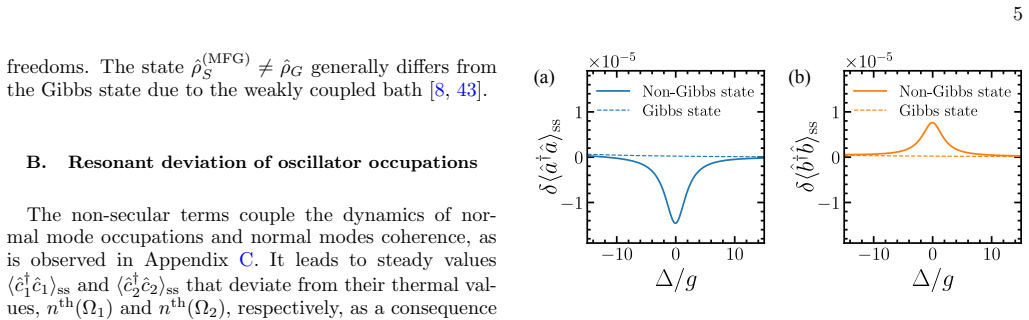
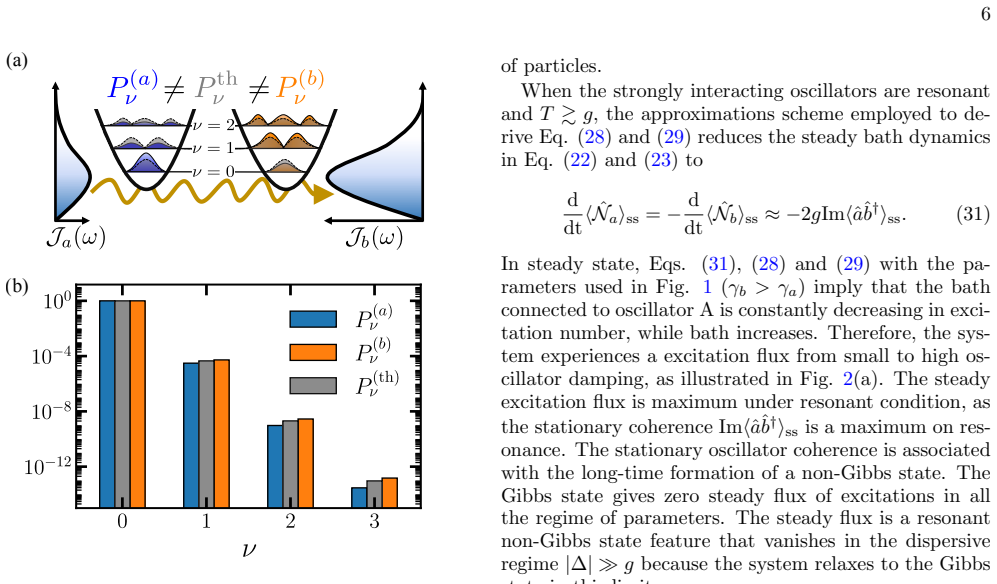
For two strongly interacting quantum oscillators with independent baths at equal temperature, provided that the oscillators are unequally damped by their baths, we show that steady state occupation numbers can significantly deviate from a Boltzmann distribution due to an excitation flux driven by bath-induced coherences between nearly-degenerate oscillator levels.
What carries the argument
bath-induced coherences between nearly-degenerate oscillator levels that drive an excitation flux
If this is right
- Occupation numbers deviate from a Boltzmann distribution whenever the damping rates differ.
- The steady state is not a Gibbs state under unequal bath couplings.
- Gibbs statistics are recovered when the two oscillators experience equal damping from their baths.
- The deviation arises only when the spectrum contains nearly degenerate levels that allow bath-induced coherences.
Where Pith is reading between the lines
- The same coherence-driven flux could appear in larger networks of oscillators or multi-level systems whenever bath couplings are asymmetric.
- Non-secular contributions may alter steady-state currents or correlations even when populations look nearly thermal.
- The effect provides a concrete way to test the limits of the secular approximation in experiments that can control relative damping rates.
Load-bearing premise
The Redfield quantum master equation remains valid for strongly interacting oscillators that are only weakly coupled to their baths.
What would settle it
Measure the long-time occupation numbers of two coupled oscillators with deliberately unequal bath damping rates at the same temperature and test whether they match the Boltzmann distribution set by their energy spacings.
Figures
read the original abstract
The Redfield quantum master equation is widely used to study the dynamics of interacting sub-systems that are weakly coupled to baths. Redfield dynamics under secular approximation preserves positivity of the reduced density operator and thermalizes the system into a Gibbs state at equilibrium. Long-time effects arising from non-secular terms are often neglected, but depending on the system spectrum and relative bath couplings, non-secular contributions are shown here to drive the system into a non-Gibbs state. For two strongly interacting quantum oscillators with independent baths at equal temperature, we analyze the microscopic origin of the deviations from Gibbs statistics. Provided that the oscillators are unequally damped by their baths, we show that steady state occupation numbers can significantly deviate from a Boltzmann distribution due to an excitation flux driven by bath-induced coherences between nearly-degenerate oscillator levels. Conditions for the recovery of thermal Gibbs statistics are discussed and experimental signatures suggested.
Editorial analysis
A structured set of objections, weighed in public.
Referee Report
Summary. The paper claims that the non-secular Redfield master equation for two strongly interacting oscillators coupled to independent baths at equal temperature yields steady-state populations that deviate from Boltzmann statistics when the oscillators experience unequal damping rates. The deviation is attributed to an excitation flux generated by bath-induced coherences between nearly degenerate levels; conditions for recovery of Gibbs statistics are discussed.
Significance. If the reported steady states are positive semidefinite and the non-secular treatment is justified, the result would show that non-secular terms can prevent thermalization to a common-temperature Gibbs state, with direct relevance to quantum thermodynamics and open-system dynamics in strongly coupled regimes.
major comments (2)
- [Numerical results / steady-state analysis] The manuscript does not verify that the long-time density operator obtained from the non-secular Redfield equation remains positive semidefinite. Because non-secular Redfield dynamics are known to violate complete positivity in some parameter regimes, the claimed deviation from Gibbs statistics could be an artifact; explicit checks (eigenvalue spectra of the steady-state ρ) are required in the numerical-results section.
- [Model and master-equation derivation] The central claim that unequal damping produces a non-zero excitation flux via coherences is load-bearing. The paper must demonstrate that this flux survives when the secular approximation is restored or when a positivity-preserving variant (e.g., Lindblad form) is used; otherwise the deviation is tied to the known limitations of the non-secular Redfield equation rather than to the physics of the model.
minor comments (1)
- [Introduction] Clarify the precise regime of validity (weak system-bath coupling versus strong inter-oscillator coupling) in the introduction; the abstract states both but the text should quantify the separation of timescales.
Simulated Author's Rebuttal
We thank the referee for the careful reading and constructive comments on our manuscript. We address each major comment below.
read point-by-point responses
-
Referee: [Numerical results / steady-state analysis] The manuscript does not verify that the long-time density operator obtained from the non-secular Redfield equation remains positive semidefinite. Because non-secular Redfield dynamics are known to violate complete positivity in some parameter regimes, the claimed deviation from Gibbs statistics could be an artifact; explicit checks (eigenvalue spectra of the steady-state ρ) are required in the numerical-results section.
Authors: We agree that verifying positive semidefiniteness is necessary to ensure the reported deviations are not artifacts. In the revised manuscript we will add explicit eigenvalue spectra of the long-time density operator in the numerical-results section for the parameter regimes shown, confirming that ρ remains positive semidefinite where non-Gibbs statistics appear. revision: yes
-
Referee: [Model and master-equation derivation] The central claim that unequal damping produces a non-zero excitation flux via coherences is load-bearing. The paper must demonstrate that this flux survives when the secular approximation is restored or when a positivity-preserving variant (e.g., Lindblad form) is used; otherwise the deviation is tied to the known limitations of the non-secular Redfield equation rather than to the physics of the model.
Authors: The excitation flux originates specifically from the non-secular terms that generate bath-induced coherences between nearly degenerate levels under unequal damping. Restoring the secular approximation eliminates these coherences and recovers Gibbs statistics by construction; we will add an explicit comparison demonstrating this recovery. Lindblad forms typically correspond to the secular limit for this system and likewise suppress the flux. The non-secular Redfield treatment is justified under the weak system-bath coupling and strong intra-system interaction regime of the model, and the result illustrates the physical consequences of retaining those terms. We will expand the discussion to clarify the validity conditions and known limitations of the approach. revision: partial
Circularity Check
No significant circularity; derivation self-contained
full rationale
The paper applies the standard Redfield quantum master equation (with and without secular approximation) to a microscopic model of two strongly interacting oscillators coupled to independent baths. The claimed non-Gibbs steady state is obtained by solving the resulting linear system for the long-time limit of the density operator, with the deviation traced to non-secular coherences when bath couplings differ. No parameter is fitted to data and then relabeled a prediction, no result is defined in terms of itself, and no load-bearing step reduces to a self-citation or ansatz smuggled from prior work by the same authors. The derivation therefore remains independent of its target conclusion.
Axiom & Free-Parameter Ledger
axioms (1)
- domain assumption Redfield master equation applies when system-bath coupling is weak
Reference graph
Works this paper leans on
-
[1]
Dynamics in the normal mode basis To explicitly derive ˆra and ˆrb in Eq. (A4), we write the system Hamiltonian in diagonal form by considering the Bogoliubov transformation [49] ˆa= X i={1,2} Ua,iˆci +V a,iˆc† i ,(A6) ˆb= X i={1,2} Ub,iˆci +V b,iˆc† i ,(A7) where coefficientsU α,i andV α,i are conveniently chosen such that ˆHS in Eq. (1) is reduced to th...
-
[2]
(A20) in the interaction picture, the evolution of ˆρS(t) = ˆUt ˆρS ˆU † t contains time-independent (secular) and time- dependent (non-secular) terms
Partial secular approximation When we write the Redfield master equation in Eq. (A20) in the interaction picture, the evolution of ˆρS(t) = ˆUt ˆρS ˆU † t contains time-independent (secular) and time- dependent (non-secular) terms. The non-secular terms oscillate with frequenciesω 0 ={2Ω 1,2Ω 2,Ω 1 −Ω 2,Ω 1 + Ω2}. In order to prevent negative system proba...
-
[3]
Dynamics of mean number of excitations in the baths Here we derive expressions for the bath dynamics us- ing the Redfield approach developed in Appendix A for strongly interacting oscillators. The dynamics of the mean number of excitations in the baths connected to the oscillator A (α=a) and B (α=b) is given by [15] d dt ⟨ ˆNα⟩= − Z ∞ 0 dτTr n ˆNα h ˆHSB ...
-
[4]
In this regime, normal mode frequencies in Eq
Approximated steady occupations of resonant oscillators Based on the exact expressions for the normal mode occupations and coherence in Appendix C, here we de- rive approximated expressions for the steady occupa- tion of oscillators A and B under the resonant condition ∆ = 0 and strong coupling. In this regime, normal mode frequencies in Eq. (7) and (8) a...
-
[5]
P. R. Eastham, P. Kirton, H. M. Cammack, B. W. Lovett, and J. Keeling, Phys. Rev. A94, 012110 (2016)
2016
-
[6]
J. F. Sousa, C. H. S. Vieira, J. F. G. Santos, and I. G. da Paz, Phys. Rev. A106, 032401 (2022)
2022
-
[7]
Purkayastha, G
A. Purkayastha, G. Guarnieri, M. T. Mitchison, R. Filip, and J. Goold, npj Quantum Information6, 27 (2020)
2020
-
[8]
D. P. Pires, I. A. Silva, E. R. deAzevedo, D. O. Soares- Pinto, and J. G. Filgueiras, Phys. Rev. A98, 032101 (2018)
2018
-
[9]
J. Joo, W. J. Munro, and T. P. Spiller, Phys. Rev. Lett. 107, 083601 (2011)
2011
-
[10]
Albash and D
T. Albash and D. A. Lidar, Phys. Rev. A91, 062320 (2015)
2015
-
[11]
Albash, S
T. Albash, S. Boixo, D. A. Lidar, and P. Zanardi, New Journal of Physics14, 123016 (2012)
2012
-
[12]
A. S. Trushechkin, M. Merkli, J. D. Cresser, and J. An- ders, AVS Quantum Science4, 012301 (2022)
2022
-
[13]
Davidovi´ c, Quantum4, 326 (2020)
D. Davidovi´ c, Quantum4, 326 (2020)
2020
-
[14]
W. Ahn, J. F. Triana, F. Recabal, F. Herrera, and B. S. Simpkins, Science380, 1165 (2023)
2023
-
[15]
Roy and S
C. Roy and S. Hughes, Phys. Rev. X1, 021009 (2011)
2011
-
[16]
Lind- blad equations for strongly coupled populations and co- herences in photosynthetic complexes,
B. Palmieri, D. Abramavicius, and S. Mukamel, “Lind- blad equations for strongly coupled populations and co- herences in photosynthetic complexes,” (2009)
2009
-
[17]
Herrera and J
F. Herrera and J. Owrutsky, The Journal of Chemical Physics152, 100902 (2020)
2020
-
[18]
Scali, J
S. Scali, J. Anders, and L. A. Correa, Quantum5, 451 (2021)
2021
-
[19]
Recabal and F
F. Recabal and F. Herrera, The Journal of Chemical Physics164, 114113 (2026)
2026
-
[20]
Orgiu, J
E. Orgiu, J. George, J. A. Hutchison, E. Devaux, J. F. Dayen, B. Doudin, F. Stellacci, C. Genet, J. Schachen- mayer, C. Genes, G. Pupillo, P. Samor` ı, and T. W. Ebbe- sen, Nature Materials14, 1123 (2015)
2015
-
[21]
Joshi, P
C. Joshi, P. ¨Ohberg, J. D. Cresser, and E. Andersson, Phys. Rev. A90, 063815 (2014)
2014
-
[22]
Cattaneo, G
M. Cattaneo, G. L. Giorgi, S. Maniscalco, and R. Zam- brini, New Journal of Physics21, 113045 (2019)
2019
-
[23]
Levy and R
A. Levy and R. Kosloff, Europhysics Letters107, 20004 (2014)
2014
-
[24]
J. D. Cresser, Journal of Modern Optics39, 2187 (1992)
1992
-
[25]
Hartmann and W
R. Hartmann and W. T. Strunz, Phys. Rev. A101, 012103 (2020)
2020
-
[26]
Beaudoin, J
F. Beaudoin, J. M. Gambetta, and A. Blais, Phys. Rev. A84, 043832 (2011)
2011
-
[27]
Baust, E
A. Baust, E. Hoffmann, M. Haeberlein, M. J. Schwarz, P. Eder, J. Goetz, F. Wulschner, E. Xie, L. Zhong, F. Quijandr´ ıa, D. Zueco, J.-J. G. Ripoll, L. Garc´ ıa- ´Alvarez, G. Romero, E. Solano, K. G. Fedorov, E. P. Menzel, F. Deppe, A. Marx, and R. Gross, Phys. Rev. B93, 214501 (2016)
2016
-
[29]
Wallraff, D
A. Wallraff, D. I. Schuster, A. Blais, L. Frunzio, R. S. Huang, J. Majer, S. Kumar, S. M. Girvin, and R. J. Schoelkopf, Nature431, 162 (2004)
2004
-
[30]
Mergenthaler, J
M. Mergenthaler, J. Liu, J. J. Le Roy, N. Ares, A. L. Thompson, L. Bogani, F. Luis, S. J. Blundell, T. Lan- caster, A. Ardavan, G. A. D. Briggs, P. J. Leek, and 13 E. A. Laird, Phys. Rev. Lett.119, 147701 (2017)
2017
-
[31]
Polariton-polariton coherent coupling in a molecular spin-superconductor chip,
C. del R´ ıo, M. Rub´ ın-Osanz, D. Rodriguez, S. Roca- Jerat, M. C. Pallar´ es, J. A. de Sousa, P. Pakulski, J. L. G. Palacios, D. Granados, D. Pinkowicz, N. Criv- illers, A. Lostao, D. Zueco, A. Gomez, and F. Luis, “Polariton-polariton coherent coupling in a molecular spin-superconductor chip,” (2026), arXiv:2602.18103 [quant-ph]
arXiv 2026
-
[32]
Takahashi, E
H. Takahashi, E. Kassa, C. Christoforou, and M. Keller, Phys. Rev. Lett.124, 013602 (2020)
2020
-
[33]
J. F. Triana, M. Arias, J. Nishida, E. A. Muller, R. Wilcken, S. C. Johnson, A. Delgado, M. B. Raschke, and F. Herrera, The Journal of Chemical Physics156, 124110 (2022)
2022
-
[34]
Chikkaraddy, B
R. Chikkaraddy, B. de Nijs, F. Benz, S. J. Barrow, O. A. Scherman, E. Rosta, A. Demetriadou, P. Fox, O. Hess, and J. J. Baumberg, Nature535, 127 (2016)
2016
-
[35]
Dann and R
R. Dann and R. Kosloff, Phys. Rev. Res.3, 023006 (2021)
2021
-
[36]
J. D. Cresser and C. Facer, “Coarse-graining in the derivation of markovian master equations and its significance in quantum thermodynamics,” (2017), arXiv:1710.09939 [quant-ph]
Pith/arXiv arXiv 2017
-
[37]
T. V. Tscherbul and P. Brumer, The Journal of Chemical Physics142, 104107 (2015)
2015
-
[38]
Mori and S
T. Mori and S. Miyashita, Journal of the Physical Society of Japan77, 124005 (2008)
2008
-
[39]
E. Geva, E. Rosenman, and D. Tannor, The Journal of Chemical Physics113, 1380 (2000)
2000
-
[40]
de Vega, M
I. de Vega, M. C. Ba˜ nuls, and A. P´ erez, New Journal of Physics12, 123010 (2010)
2010
-
[41]
Farina and V
D. Farina and V. Giovannetti, Phys. Rev. A100, 012107 (2019)
2019
-
[42]
Jeske, D
J. Jeske, D. J. Ing, M. B. Plenio, S. F. Huelga, and J. H. Cole, The Journal of Chemical Physics142, 064104 (2015)
2015
-
[43]
Schaller and T
G. Schaller and T. Brandes, Phys. Rev. A78, 022106 (2008)
2008
-
[44]
Mozgunov and D
E. Mozgunov and D. Lidar, Quantum4, 227 (2020)
2020
-
[45]
Becker, A
T. Becker, A. Schnell, and J. Thingna, Phys. Rev. Lett. 129, 200403 (2022)
2022
-
[46]
P. P. Potts, A. A. S. Kalaee, and A. Wacker, New Journal of Physics23, 123013 (2021)
2021
-
[47]
J. D. Cresser and J. Anders, Phys. Rev. Lett.127, 250601 (2021)
2021
-
[48]
Brenes, B
M. Brenes, B. Min, N. Anto-Sztrikacs, N. Bar-Gill, and D. Segal, The Journal of Chemical Physics160, 244106 (2024)
2024
-
[49]
Wang, G.-Q
S.-P. Wang, G.-Q. Zhang, Y. Wang, Z. Chen, T. Li, J. S. Tsai, S.-Y. Zhu, and J. Q. You, Phys. Rev. Appl.13, 054063 (2020)
2020
-
[50]
Yu and R
Z. Yu and R. R. Frontiera, ACS Nano17, 4306 (2023)
2023
-
[51]
J. P. Long and B. S. Simpkins, ACS Photonics2, 130 (2015)
2015
-
[52]
J. D. Erwin, M. Smotzer, and J. V. Coe, The Journal of Physical Chemistry B123, 1302 (2019)
2019
-
[53]
Xiao, arXiv preprint arXiv:0908.0787 (2009)
M.-w. Xiao, arXiv preprint arXiv:0908.0787 (2009)
Pith/arXiv arXiv 2009
discussion (0)
Sign in with ORCID, Apple, or X to comment. Anyone can read and Pith papers without signing in.